Enduring Folklore of Afghanistan
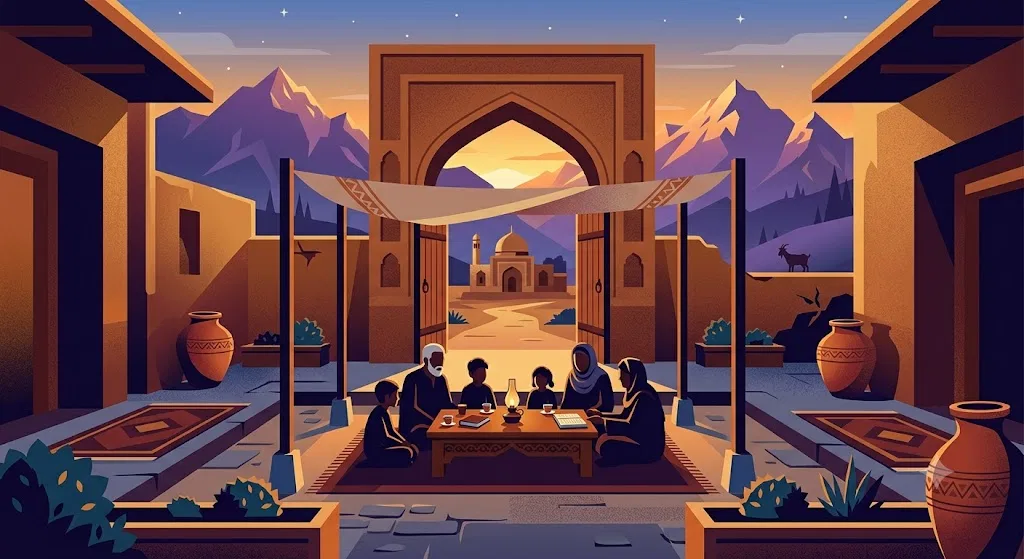
Afghanistan’s folklore is not a single neat mythology with one pantheon and one authorised storybook. It is a living mixture of village storytelling, Persianate epic, Islamic belief, regional languages, shrine traditions, seasonal customs, children’s tales, heroic poetry, jokes, proverbs, animal fables and modern retellings.
Page outline Jump by section
Introduction
The best-attested Afghan folklore is therefore not the internet’s “Giant of Kandahar” material, but older and better-documented traditions: Herati oral tales recorded by folklorists and linguists, stories of clever animals and dangerous supernatural beings, regional legends connected with places such as Bamiyan and Balkh, spring customs around Nowruz, and the continuing place of storytelling in children’s books, podcasts and diaspora culture. Afghanistan’s folklore matters because it preserves cultural memory in a country where war, displacement and censorship have repeatedly threatened everyday cultural life.
What makes Afghan folklore distinctive?
Afghan folklore sits at a crossroads. Afghanistan has long connected Central Asia, Iran, South Asia and the wider Islamic world, and its traditional stories show that layered geography. A tale told in western Afghanistan may share patterns with Persian-language storytelling; a northern custom may overlap with Central Asian practice; a children’s fable may have versions across the Middle East and South Asia; and a sacred place may be understood through Islamic devotion, older local memory and modern politics at the same time.
That does not make Afghan folklore “borrowed” or vague. It means the Afghan tradition is deeply local in performance even when its story-patterns are widely travelled. Folklorist Margaret Mills’s work is especially important here: her study of Afghan oral fiction focuses on storytelling as performance, not just as plot. A recorded evening of storytelling in rural Afghanistan in 1975 became the basis for a detailed interpretation of how stories work socially, rhetorically and politically in their own setting.[JSTOR]jstor.orgRhetorics and Politics in Afghan Traditional StorytellingRhetorics and Politics in Afghan Traditional Storytelling
One useful rule for readers is to separate story-pattern from local life. A wolf-and-goat tale may resemble European or Central Asian animal stories, but the Afghan version matters because of who tells it, where it is told, what language or dialect carries it, what social lesson is emphasised, and how listeners recognise its humour, danger or moral pressure. Recent public projects still present Afghan tales as stories “heard and told by the elders at night” and passed from generation to generation, which captures the central role of memory and family performance even when the tales now appear as podcasts or children’s books.[Goethe-Institut]goethe.deInstitut Afghan FolktalesInstitut Afghan Folktales
Oral storytelling is the heart of the tradition
The strongest scholarly evidence for Afghan folklore comes from recorded oral narrative rather than from a fixed ancient “myth book”. Afghanistan’s twentieth-century oral culture existed alongside elaborate religious and literary traditions, so the boundary between folk tale, learned poetry, moral anecdote and epic recitation has often been porous. Encyclopaedia Iranica describes Afghan folklore as part of a setting where oral culture long mingled with established written traditions, both religious and secular.[Iranica Online]iranicaonline.orgOpen source on iranicaonline.org.
Herat is one of the clearest examples. Youli Ioannesyan’s Afghan Folktales from Herat presented eleven oral texts recorded from three men in Herat villages in the 1980s, preserving local speech and narrative form rather than smoothing everything into literary prose. Margaret Mills’s review notes that Ioannesyan transcribed the tales verbatim, including irregularities of grammar and syntax, which makes the collection valuable not only for folklore but also for the study of Afghan Persian dialects and oral style.[ResearchGate]researchgate.netOpen source on researchgate.net.
That detail matters because Afghan storytelling is not simply “content”. A tale may include repetitions, sudden turns, formulaic openings, comic exaggeration, shifts in register and phrases that make sense in the performance moment. A printed summary can tell readers what happened, but it often loses the social skill of the teller: when to pause, when to frighten, when to tease, when to moralise and when to leave a contradiction unresolved.
Modern projects have kept this oral emphasis visible. The Goethe-Institut’s Simurgh Centre series introduces Afghan folktales as “Once Upon a Time” stories and includes examples such as the goat-and-wolf tale Buzak Chini, a story about forty girls, and a tale explaining a popular saying.[Goethe-Institut]goethe.deInstitut Afghan FolktalesInstitut Afghan Folktales These are not museum pieces in the narrow sense. They are examples of how Afghan folklore moves from household narration into audio, education and public cultural preservation.
The best-known tale types: cleverness, danger and repair
Many Afghan folktales are not about gods creating the world; they are about survival, wit, family pressure and moral intelligence. Animals talk, poor people outwit powerful ones, women and girls may show courage or cunning, and supernatural forces appear less as abstract theology than as dangers or helpers inside a recognisable social world.
One widely circulated example is the goat-and-wolf story often known in English as “The Chinese Goat” or “Buzak Chini”. In public retellings, a goat must use wit against a threatening wolf, making the tale easy for children to follow while still carrying the older folktale tension between vulnerability and clever resistance. The Simurgh Centre presents it as the opening tale in an Afghan folktale podcast series, framing it as part of a living oral inheritance.[Goethe-Institut]goethe.deInstitut Afghan FolktalesInstitut Afghan Folktales
Afghan children’s publishing has also turned traditional tales into modern educational material. Hoopoe Books and related literacy projects have issued Dari, Pashto and bilingual editions of traditional stories, with teacher guides, audio versions and radio material. Afghan Culture Unveiled describes these books as based on a rich oral tradition, with themes such as problem-solving, negotiation rather than confrontation, self-esteem and overcoming difficulties.[Afghan Culture Unveiled]afghancultureunveiled.comOpen source on afghancultureunveiled.com.
This is a useful reminder that folklore is not only “spooky old belief”. In Afghanistan, as elsewhere, folk narrative can be a way of teaching children how to think under pressure. A monster or wolf is rarely just a monster or wolf. It is a test of judgement, courage, speech, obedience, luck or social intelligence.
Spirits, fairies and demons in Afghan belief
Afghan supernatural folklore is shaped strongly by Islamic and Persianate worlds of belief. Jinn are part of a wider Islamic cosmology rather than uniquely Afghan beings, but they appear naturally in Afghan stories, warnings and everyday explanations of uncanny events. In Islamic tradition more broadly, jinn are usually understood as invisible beings who may shapeshift, harm, help, possess, deceive or simply live parallel lives beyond ordinary human sight.[Wikipedia]WikipediaOpen source on wikipedia.org.
Another important figure is the demon or giant-like being of Persianate epic and folk imagination. In the Shahnameh, the great Persian epic completed by Ferdowsi in the early eleventh century, the world of heroes includes monstrous adversaries, magical birds, enchanted kings and demon-haunted territories. The Fitzwilliam Museum’s Shahnameh project describes the epic as moving through myth, legend and history, with a porous boundary between those categories.[Shahnameh]shahnameh.fitzmuseum.cam.ac.ukOpen source on cam.ac.uk.
Afghanistan belongs to this epic geography in especially vivid ways. The hero Rostam is associated with Zabulistan, a historical region linked with today’s southern Afghanistan, and his mother is a princess of Kabul in the epic tradition.[Wikipedia]WikipediaOpen source on wikipedia.org. That gives Afghan readers a direct stake in stories sometimes loosely labelled “Persian mythology”. They are not foreign tales imported after the fact; they are part of a wider Persianate and Iranian cultural world in which places now inside Afghanistan are central to heroic imagination.
The most famous demonic opponent in this epic world is the White Demon, the monstrous chief of the demons of Mazandaran whom Rostam defeats in his final labour.[Wikipedia]WikipediaDiv-e SepidDiv-e Sepid For a folklore page on Afghanistan, the key point is not to claim that every Afghan village told the same Rostam episode in the same way. It is that epic beings, heroic names and demon imagery helped shape the imaginative vocabulary available to Afghan storytellers, poets and listeners.
Sacred places and haunted landscapes
Afghan folklore is often tied to landscape: mountains, caves, ruins, shrines, valleys and old cities. A place may be historically important, religiously revered and legend-haunted all at once. This is why Afghan folklore cannot be separated neatly from pilgrimage and local sacred geography.
Shrines are especially important. Anthropologist Sana Haroon Homayun’s recent work on Afghan shrines notes that visiting shrines is a significant social and religious practice in Afghanistan, and that local shrines may consist of a small dome over a simple grave. Her research also examines a circulating Afghan legend in which foreigners are believed to create shrines in order to conceal buried antiquities, showing how modern politics, heritage anxiety and supernatural suspicion can fuse into new folklore.[Cultural Anthropology]journal.culanth.orgOpen source on culanth.org.
Bamiyan is another powerful example of landscape layered with memory. It is internationally known for the Buddhist heritage of the Bamiyan Valley, but local legendary geography also includes ruined citadels and names that invite story. UNESCO’s work at Shahr-e Gholghola presents the site as part of Bamiyan’s World Heritage landscape and focuses on local community empowerment and preservation.[UNESCO]unesco.orgOpen source on unesco.org. The site is often glossed in English as the “City of Screams” or “City of Woe”, linked in historical retellings to the Mongol destruction of Bamiyan in 1221.[Wikipedia]WikipediaOpen source on wikipedia.org.
Such places show how Afghan folklore frequently grows around ruins. The stones are real; the exact tale may shift. A ruined citadel can become a lesson about tyranny, betrayal, divine punishment, foreign invasion or the fragility of cities. The folklore does not replace history, but it gives history an emotional shape.
Nowruz, spring and public tradition
Afghanistan’s folklore is not only night stories and supernatural beings. Seasonal custom is part of the same wider field of intangible culture. Nowruz, the spring new year celebration, is one of the most important examples. UNESCO describes Nowruz as an ancestral festivity marking the first day of spring and the renewal of nature, involving rituals, ceremonies, family meals, new clothes, visits and gifts for children. It has been celebrated for more than 3,000 years across regions including Central Asia and the Middle East, and UNESCO records Afghanistan among the countries behind its inscription on the Representative List of the Intangible Cultural Heritage of Humanity.[UNESCO]unesco.orgInternational Day of Nowruz | UNESCOInternational Day of Nowruz | UNESCO
In Afghanistan, Nowruz is especially associated in many public accounts with northern celebrations, spring flowers, family visiting and gatherings around Mazar-i-Sharif. The exact forms of celebration vary by region, community and political period, but the festival’s deeper meaning is consistent: renewal, social repair, kinship and the return of life after winter.
This is where “folklore” overlaps with public culture. A spring festival may not look like a monster story, but it carries traditional symbolism, ritual action, inherited seasonal timing and community memory. It also shows how Afghan cultural life belongs to broader regional worlds without losing its local forms.
Heroic games and living performance
Buzkashi, Afghanistan’s famous equestrian game, is not folklore in the narrow sense of a tale, but it belongs beside folklore because it is a traditional public performance loaded with memory, masculinity, prestige and regional identity. Riders compete to carry a goat carcass, now often replaced by a weighted fake carcass, and score before large crowds. Associated Press reporting from a 2025 Kabul tournament described riders from Afghan provinces competing in an annual final, with thousands of men and boys watching and northern Sar-e-Pul defeating Badakhshan.[AP News]apnews.comOpen source on apnews.com.
The game also shows how tradition changes under political pressure. AP reported that buzkashi was banned during the Taliban’s first rule in the late 1990s, later returned, and has been allowed to continue since the Taliban’s return to power in 2021, with officials attending matches. The same report notes that women and girls were not allowed to attend as spectators under current restrictions.[AP News]apnews.comOpen source on apnews.com.
For readers of folklore, the value of buzkashi is not just the spectacle. It is an example of how Afghan traditional culture is performed in public: dangerous skill, local pride, patronage, crowd memory and changing rules all become part of the cultural story.

Modern retellings, diaspora memory and internet confusion
Afghan folklore today survives through families, books, scholarship, podcasts, classroom material, online video, diaspora memory and social media. That makes it easier to share, but also easier to distort.
The strongest modern retellings usually acknowledge their relationship to older oral material. Children’s books inspired by Afghan and regional teaching stories, such as those associated with Idries Shah and Hoopoe Books, often adapt tales into accessible formats for literacy and social-emotional learning.[The National]thenationalnews.comThe National How folk tales are giving children in conflict-ridden regionsThe National How folk tales are giving children in conflict-ridden regions The Simurgh Centre podcast format similarly presents Afghan tales as remembered, told and re-heard stories rather than as fixed sacred scripture.[Goethe-Institut]goethe.deInstitut Afghan FolktalesInstitut Afghan Folktales
By contrast, some internet-era “Afghan monster” claims are weakly rooted. The so-called “Giant of Kandahar” is a good example of a modern military-paranormal legend that circulates online more strongly than it appears in credible Afghan folklore sources. Even online Afghan discussion often pushes back against treating it as authentic local tradition, noting that it is associated more with non-Afghan internet storytelling than with established Afghan lore.[Reddit]reddit.comWhat are some Mythological Monsters in unique to AfghanistanWhat are some Mythological Monsters in unique to Afghanistan
That does not mean modern legends are irrelevant. They are folklore too, in the sense that they circulate as contemporary legend. But they should not be confused with older Afghan oral tradition, shrine belief, epic inheritance or seasonal custom. A responsible folklore page should make that distinction clear: old oral tradition, literary epic, religious belief, tourist legend, children’s adaptation and internet creepypasta are related cultural forms, but they are not the same kind of evidence.
How to read Afghan folklore well
The safest way to approach Afghan folklore is to ask three questions. First, where is the story attested? A tale recorded from Herati storytellers in the 1970s or 1980s has a different evidential weight from an anonymous online monster post. Second, what kind of tradition is it? A shrine legend, a children’s animal fable, a Persianate epic episode and a seasonal ritual all work differently. Third, who is retelling it now, and why? A classroom book, a diaspora podcast and a tourist article may all preserve something real while reshaping it for a new audience.
Afghanistan’s folklore is therefore best understood as a cultural web rather than a catalogue of creatures. Its most memorable figures include wolves, goats, fairies, jinn, demons, heroic riders, legendary kings, saints, ruined cities and clever children. Its most important settings include homes, villages, shrines, mountains, spring festivals, citadels and storytelling circles. Its deepest theme is continuity under pressure: stories are remembered, corrected, repaired and retold even when the world around them changes.
Amazon book picks
Further Reading
Books and field guides related to What Makes Afghan Folklore So Enduring?. Use these as the next step if you want deeper reading beyond the article.

Thousand and One Nights
Shares the wider storytelling world that influenced many Afghan tale traditions.
Dr. Bruno Bettelheim Reads "the Struggle for Meaning" and "Ha...
First published 1985.
eBay marketplace picks
Marketplace Samples
Live-tested eBay searches with available results related to this page.

Endnotes
1.
Source: jstor.org
Title: Rhetorics and Politics in Afghan Traditional Storytelling
Link:https://www.jstor.org/stable/j.ctv51300k
2.
Source: goethe.de
Title: Institut Afghan Folktales
Link:https://www.goethe.de/prj/sce/en/aud/aft.html
3.
Source: researchgate.net
Link:https://www.researchgate.net/publication/265816338_Afghan_Folktales_from_Herat_Persian_Texts_in_Transcription_and_Translation_by_Youli_Ioannesyan_review
4.
Source: Wikipedia
Link:https://en.wikipedia.org/wiki/Jinn
5.
Source: Wikipedia
Link:https://en.wikipedia.org/wiki/Rostam
6.
Source: Wikipedia
Title: Div-e Sepid
Link:https://en.wikipedia.org/wiki/Div-e_Sepid
7.
Source: unesco.org
Link:https://www.unesco.org/en/fieldoffice/kabul/expertise/culture/shahr-e-gholghola
8.
Source: Wikipedia
Link:https://en.wikipedia.org/wiki/Shahr-e-Gholghola
9.
Source: unesco.org
Title: International Day of Nowruz | UNESCO
Link:https://www.unesco.org/en/days/nowruz
10.
Source: reddit.com
Title: What are some Mythological Monsters in unique to Afghanistan
Link:https://www.reddit.com/r/Afghan/comments/1kugtj5/what_are_some_mythological_monsters_in_unique_to/
11.
Source: Wikipedia
Title: Culture of Afghanistan
Link:https://en.wikipedia.org/wiki/Culture_of_Afghanistan
12.
Source: Wikipedia
Title: Div (mythology)
Link:https://en.wikipedia.org/wiki/Div_%28mythology%29
13.
Source: Wikipedia
Title: Khastakhumar and Bibinagar
Link:https://en.wikipedia.org/wiki/Khastakhumar_and_Bibinagar
14.
Source: Wikipedia
Title: Oral tradition
Link:https://en.wikipedia.org/wiki/Oral_tradition
15.
Source: Wikipedia
Link:https://en.wikipedia.org/wiki/Buzkashi
16.
Source: Wikipedia
Link:https://en.wikipedia.org/wiki/Nowruz
17.
Source: Wikipedia
Link:https://en.wikipedia.org/wiki/Shahnameh
18.
Source: ich.unesco.org
Link:https://ich.unesco.org/en/RL/nawrouz-novruz-nowrouz-nowrouz-nawrouz-nauryz-nooruz-nowruz-navruz-nevruz-nowruz-navruz-02097
19.
Source: unesco.org
Title: document 4378
Link:https://www.unesco.org/archives/multimedia/document-4378
20.
Source: ich.unesco.org
Title: afghanistan AF
Link:https://ich.unesco.org/en/state/afghanistan-AF
21.
Source: ich.unesco.org
Link:https://ich.unesco.org/en/video/75240
22.
Source: ich.unesco.org
Title: photo pop up 00973
Link:https://ich.unesco.org/en/photo-pop-up-00973?photoID=10208
23.
Source: reddit.com
Link:https://www.reddit.com/r/Afghan/comments/s2pdgi/what_are_some_childrens_stories_in/
24.
Source: reddit.com
Link:https://www.reddit.com/r/Pashtun/comments/13ddjed/quickly_dump_pashtun_andor_afghan_myths_or/
25.
Source: reddit.com
Link:https://www.reddit.com/r/afghanistan/comments/1aunc3k/are_there_myths_legends_tales_folklore_about/
26.
Source: reddit.com
Link:https://www.reddit.com/r/AskHistorians/comments/qr3i6y/is_there_historical_basis_behind_the_mythical/
27.
Source: jstor.org
Link:https://www.jstor.org/stable/2059704
28.
Source: researchgate.net
Link:https://www.researchgate.net/publication/378647522Demons[spirits
29.
Source: iranicaonline.org
Link:https://www.iranicaonline.org/articles/folklore-ii/
30.
Source: afghancultureunveiled.com
Link:https://www.afghancultureunveiled.com/humaira-ghilzai/2017/4/7/tbkn4l30grkkfw5psv8zcgvebl2npm
31.
Source: shahnameh.fitzmuseum.cam.ac.uk
Link:https://shahnameh.fitzmuseum.cam.ac.uk/structure-and-themes
32.
Source: journal.culanth.org
Link:https://journal.culanth.org/index.php/ca/article/download/5857/1052/27459
33.
Source: apnews.com
Link:https://apnews.com/article/600be62d7d38e53d2765f7b83dc9c3fc
34.
Source: thenationalnews.com
Title: The National How folk tales are giving children in conflict-ridden regions
Link:https://www.thenationalnews.com/arts/how-folk-tales-are-giving-children-in-conflict-ridden-regions-fresh-windows-on-the-world-1.198940
35.
Source: blogs.loc.gov
Link:https://blogs.loc.gov/folklife/category/legends/
36.
Source: scribd.com
Link:https://www.scribd.com/document/747716831/Shahnameh
37.
Source: iranicaonline.org
Link:https://www.iranicaonline.org/articles/iran-iv-myths-and-legends/
38.
Source: journal.culanth.org
Link:https://journal.culanth.org/index.php/ca/article/view/5857/1051
39.
Source: linkedin.com
Title: unesco new delhi happynowruz nowruz2025 unesco activity 7308750515159384064 Lpc7
Link:https://www.linkedin.com/posts/unesco-new-delhi_happynowruz-nowruz2025-unesco-activity-7308750515159384064-Lpc7
40.
Source: unescobmw.org
Title: nawruz a celebration of renewal and unity
Link:https://unescobmw.org/2026/02/26/nawruz-a-celebration-of-renewal-and-unity/
41.
Source: cryptidz.fandom.com
Title: Giant of Kandahar
Link:https://cryptidz.fandom.com/wiki/Giant_of_Kandahar
42.
Source: mythus.fandom.com
Link:https://mythus.fandom.com/wiki/Jinn
43.
Source: windsweptwords.com
Link:https://windsweptwords.com/tag/jinn/
Additional References
44.
Source: youtube.com
Title: Heartbreaking Afghan Tale of Love and Sacrifice: A Folklore
Link:https://www.youtube.com/watch?v=R2LvJQCVFdo
Source snippet
Afghan folklore legends stories storytelling Heartbreaking Afghan Tale of Love and Sacrifice: A Folklore | Short Story English subtitle B...
45.
Source: youtube.com
Title: Exploring Afghanistan’s Supernatural Legacy
Link:https://www.youtube.com/watch?v=Vqq4qiroPYg
Source snippet
The Lantern of Bamyan & The Whispering Cypress of Panjshir Afghan Folklore Sleep Stories...
46.
Source: youtube.com
Link:https://www.youtube.com/watch?v=9txV6yr_mOQ
Source snippet
Adam Khan and Durkhani Story - an Afghan love story...
47.
Source: dokumen.pub
Link:https://dokumen.pub/download/afghan-folktales-from-herat-persian-texts-in-transcription-and-translation-student-edition-9781604976526-2009038074.html
48.
Source: cambriapress.com
Link:https://www.cambriapress.com/AfghanFolktales/
49.
Source: facebook.com
Link:https://www.facebook.com/61579608549581/posts/afghanistan-a-popular-theme-in-afghan-folklore-and-mythology-are-divs-monstrous-/122141006456986951/
50.
Source: instagram.com
Link:https://www.instagram.com/p/DTn6pL7iARW/?hl=en
51.
Source: instagram.com
Link:https://www.instagram.com/p/DN2wHIqWlfg/?hl=en
52.
Source: facebook.com
Link:https://www.facebook.com/groups/1702950456599867/posts/4435923383302547/
53.
Source: beyondtheborderstours.com
Link:https://beyondtheborderstours.com/buzkashi-in-afghanistan-understanding-the-countrys-most-intense-sport/
Topic Tree
Follow this branch
Related pages 192
- Albanian Folklore
- Algerian Folklore
- Australian Folklore
- Azerbaijan Folklore
- Belarus Folklore
- +187 more in sidebar