Why Peru's Legends Still Walk the Landscape
Peru’s folklore is not a single national story but a living mix of Andean, Amazonian, coastal, Catholic, Indigenous and modern urban traditions.
Page outline Jump by section
Why Peruvian folklore feels so tied to place
A useful way to understand Peruvian folklore is to start with the landscape. In many Andean traditions, mountains, lakes, caves, passes, mines and irrigation systems are not neutral scenery. They are social presences: protectors, witnesses, owners of resources, or dangerous places where the ordinary rules of village life become fragile. This helps explain why Peruvian legends so often begin with someone walking alone at night, crossing a highland path, entering a mine, ignoring a ritual obligation, or getting lost in the forest.
The Andes give Peru some of its most durable sacred geography. The early colonial Huarochirí traditions, written around 1608 in Quechua by anonymous Andean authors or narrators, describe religious life in the highlands east of Lima and preserve stories of local sacred beings, water, fertility and community order. Scholars often treat this manuscript as one of the most important sources for ancient and early colonial Andean religion because it records Indigenous mythic material in an Andean language rather than only through Spanish colonial description.[dedenbachsalazar.de]dedenbachsalazar.deThe Texts from HuarochiríThe texts were written around 1608 by anonymous authors/narrators entirely in the Quechua language and describe…
That does not mean Peruvian folklore is frozen in the Inca past. Much of it changed under Spanish colonisation, Catholic evangelisation, hacienda labour systems, mining, migration, political violence, schooling, tourism and mass media. The result is a layered tradition: a mountain pilgrimage may honour Christ while still moving through older sacred terrain; a monster may look like a colonial stranger in one version and a state official or technician in another; a festival may be Catholic in date but Andean in music, dance, costume and social meaning.[unesco.org]ich.unesco.orgPilgrimage to the sanctuary of the Lord of Qoyllurit'iThe pilgrimage includes processions of crosses up and down the snow-cappe…
The Huarochirí traditions: Peru’s rare window into early Andean myth
For readers looking for the deepest written roots of Peruvian myth, the Huarochirí traditions matter because they sit close to the meeting point between oral tradition and colonial writing. The text was compiled in the early seventeenth century in the highlands near Lima and contains 31 chapters and two supplements about sacred beings, ritual obligations, ancestors, floods, animals, fertility and local community histories. It is not a simple “Inca mythology book”; it is regional, complex and shaped by the colonial situation in which it was written.[dedenbachsalazar.de]dedenbachsalazar.deThe Texts from HuarochiríThe texts were written around 1608 by anonymous authors/narrators entirely in the Quechua language and describe…
One of its striking features is how strongly myth is tied to local places and practical life. The stories are not only about distant gods. They explain why particular beings are honoured, why water matters, why communities owe ritual duties, and how social memory is attached to mountains and irrigation. Cambridge scholarship describes the manuscript as recounting the mythical origins of sacred beings and heroes regarded as ancestors of communities in Huarochirí, based on oral traditions and written soon after in Quechua.[Cambridge University Press & Assessment]cambridge.orgUniversity Press & Assessment Chapter 9Cambridge University Press & AssessmentChapter 9 - The Flood Story in the Huarochirí Manuscript …25 Nov 2022 — Based on accounts obtain…
The manuscript also shows why “Peruvian mythology” can be misleading if treated as one tidy pantheon. Peru’s traditions are regional and multilingual. A tale from Huarochirí, a Cusco pilgrimage, a Puno festival and an Amazonian forest warning may all belong to Peru, but they arise from different landscapes, languages and historical experiences. Modern scholarship on Peruvian oral traditions also stresses that Andean and Amazonian cultural contributions have often been marginalised by Spanish-speaking, coastal-centred national culture, which makes preservation and respectful interpretation especially important. Sistema de Información Científica - USIL[cris.usil.edu.pe]cris.usil.edu.peSistema de Información CientíficaSistema de Información Científica

Sacred mountains, pilgrimages and the blending of traditions
The best-known Andean sacred beings in popular explanation are often described as mountain protectors. In local belief, a powerful mountain may guard a community, livestock, water and weather, and people may make offerings or take part in festivals that acknowledge this relationship. These beliefs vary by region and community, so they should not be flattened into a single national formula. Still, the wider pattern is clear: highland folklore often treats the mountain world as active, morally charged and closely tied to survival.
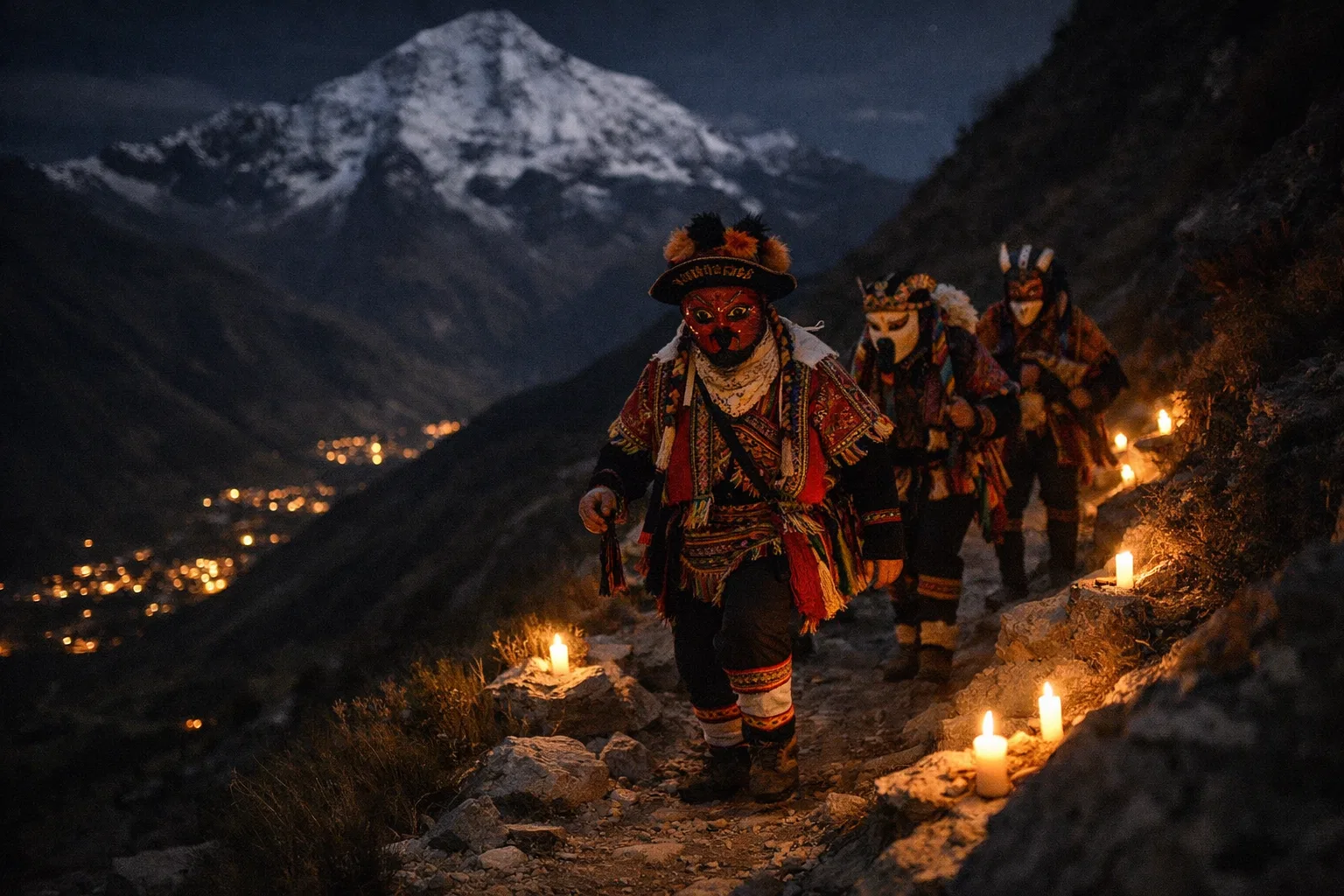
The pilgrimage to the sanctuary of the Lord of Qoyllurit’i is one of the clearest examples of how Peruvian folk religion can combine Catholic devotion with older Andean sacred geography. UNESCO describes the pilgrimage as including processions of crosses up and down a snow-capped mountain and a long procession involving groups from Paucartambo and Quispicanchi. The sanctuary lies in the Sinakara valley near Ausangate, a mountain that is deeply important in southern Andean religious geography.[ICH UNESCO]ich.unesco.orgPilgrimage to the sanctuary of the Lord of Qoyllurit'iThe pilgrimage includes processions of crosses up and down the snow-cappe…
For a folklore reader, Qoyllurit’i matters because it is not just a picturesque festival. It shows how landscape, devotion, music, dance, regional identity and sacred obligation work together. People move through dangerous high-altitude terrain, carry crosses, dance, pray and renew social bonds. The tradition is also an example of how Indigenous and Catholic forms can coexist without becoming identical: the official Christian object of devotion does not erase the older sense that mountains, snow, water and paths are spiritually significant.[ICH UNESCO]ich.unesco.orgPilgrimage to the sanctuary of the Lord of Qoyllurit'iThe pilgrimage includes processions of crosses up and down the snow-cappe…
Monsters that speak about fear, power and outsiders
Peru’s legendary creatures are often more than spooky entertainment. They tell readers what communities have feared: exploitation, broken kinship rules, dangerous travel, the lure of the forest, mine labour, disease, hunger, strangers and abuse of power.
The most famous Andean example is the fat-stealing figure commonly described as a white or foreign-looking killer who attacks isolated travellers and extracts human fat. Harvard’s ReVista notes that stories of this figure circulated in South America during the Conquest, when he was often imagined as a white man, usually bearded and light-eyed, armed with a knife. The legend has shifted over time: later versions could cast the figure as a monk, landowner, soldier, doctor, technician or other outsider associated with power.[ReVista]revista.drclas.harvard.eduRe Vista Peruvian PishtacosRe Vista Peruvian Pishtacos
This is why the figure is so important in Peruvian folklore. It turns social fear into a body-horror story. The stolen fat has been said to serve different purposes in different eras: greasing bells, making medicine, lubricating machines, helping military or economic projects, or enriching outsiders. A medical-anthropological article even argues that some elements of the legend connect to early modern European uses of human tissues in medicine, complicating the idea that the story is purely pre-Hispanic Andean in origin.[PubMed]pubmed.ncbi.nlm.nih.govOpen source on nih.gov.
Other highland beings express different anxieties. Mine spirits and underground owners appear in stories from mining regions, where wealth, danger and death are concentrated below the earth. Tales of cursed or transformed beings can enforce moral rules about kinship and sexuality. These stories should not be read as literal evidence of monsters, but as traditional narratives that make danger legible and memorable.
The Amazonian forest as trickster, judge and maze
Peru’s Amazonian folklore has a different texture from highland mountain tradition. The forest is often portrayed as alive with deceptive presences: beings that imitate human voices, take familiar forms, whistle in the dark, guard animals, punish disrespect, or lure travellers away from safe paths. These stories reflect the lived reality of rainforest travel, where sound, distance, darkness and orientation can become matters of survival.
One well-known Amazonian figure is the forest trickster often said to disguise himself as a familiar person and lead victims deep into the jungle. Tourism and cultural explainers commonly describe him as a small, uncanny forest being identifiable by mismatched or abnormal feet, a detail that marks the false human form. The Peruvian state tourism platform presents him as one of the best-known legendary characters of the Peruvian Amazon, while other accounts emphasise his role as a guardian of the forest who punishes careless or disrespectful behaviour.[peru.travel]peru.travel5 mythical characters and popular legends of peru5 mythical characters and popular legends of peru
Another major jungle figure is the whistling night spirit often associated with fear, punishment or the souls of those who died in the forest. Peru’s official tourism site describes this being as one of the best-known myths of the Peruvian jungle, with versions that make it a tormented soul, a punisher, or a figure that can take on the appearance of someone known to the victim.[Perú Info]peru.infoPerú Info Myths and legends from the Peruvian junglesPerú Info Myths and legends from the Peruvian jungles
The Amazon also has giant serpent traditions, especially water and forest serpents imagined as mothers or owners of powerful natural zones. These stories are often connected to rivers, lagoons, rain and large snakes such as anacondas or boas. The details vary widely, and internet retellings can exaggerate them into cryptid-style spectacle, so the safest reading is as Amazonian mythic ecology: river and forest danger expressed through enormous living forms.[travelatin.com]viajes.travelatin.comShop Travelatin Myths and legends of the Peruvian jungleShop Travelatin Myths and legends of the Peruvian jungle
Dance, masks and festivals as living folklore
Peruvian folklore is not only told in stories. It is danced, worn, sung, processed through streets and performed in public squares. This is especially important because many traditions that outsiders might call “myths” are embedded in festivals with real organisers, specialists, costumes, instruments, ritual roles and local rules.
The Scissors Dance, recognised by UNESCO in 2010, is performed by people from Quechua villages and communities in Peru’s south-central Andes and also in urban settings. Dancers perform demanding steps while holding metal rods that give the dance its English name. The Smithsonian’s National Museum of the American Indian describes the high Andean mountains of south-central Peru as the dance’s traditional setting and notes that its origins are uncertain, with development in areas including Huancavelica, Ayacucho, Apurímac and Arequipa.[ICH UNESCO]ich.unesco.orgOpen source on unesco.org.
For folklore readers, the Scissors Dance is fascinating because it sits between art, ordeal and ritual. It is often explained as a semi-religious performance in which the dancer tests bodily limits and mediates between human communities and Andean powers. Modern performances may appear on national stages or in migrant communities abroad, but the dance’s force comes from its older associations with highland ritual, endurance, music and sacred landscape.[Perú Info]peru.infoPerú Info The Scissors Dance: Intangible Cultural Heritage of HumanityPerú Info The Scissors Dance: Intangible Cultural Heritage of Humanity
The Huaconada of Mito, also recognised by UNESCO in 2010, is a ritual dance performed in the village of Mito in Peru’s central Andes. Masked men perform as authoritative figures during the first days of January, with masks that inspire respect, fear, sadness or mockery depending on type and style. The dance turns the village square into a ritual theatre of order, discipline and social memory.[ICH UNESCO]ich.unesco.orgOpen source on unesco.org.
Puno’s Festivity of the Virgin of Candelaria, recognised by UNESCO in 2014, shows another side of living folklore: mass devotion, dance, music, costume and regional identity on a huge scale. Peru’s official tourism site describes it as blending Andean tradition with Catholic faith and cementing Puno’s reputation as a capital of Peruvian folklore. UNESCO describes the festival as including religious, festive and cultural activities each February in Puno.[ICH UNESCO]ich.unesco.orgOpen source on unesco.org.
Catholic saints, Indigenous memory and folk religion
Many Peruvian traditions make most sense when read as folk religion rather than as either “purely Catholic” or “purely Indigenous”. Colonial evangelisation did not simply replace older traditions. In many places, Catholic saints, crosses, virgins, processions and feast days became part of local religious systems that still carried Andean ideas about reciprocity, landscape, fertility, protection and danger.
This blending is visible in major public traditions. Qoyllurit’i combines devotion to Christ with a pilgrimage through sacred mountain terrain. Candelaria in Puno honours the Virgin while drawing on Quechua, Aymara and mestizo music, dance and festival organisation. The Scissors Dance can appear at Catholic feast times while retaining older associations with Andean sacred powers and ritual specialists.[unesco.org]ich.unesco.orgPilgrimage to the sanctuary of the Lord of Qoyllurit'iThe pilgrimage includes processions of crosses up and down the snow-cappe…
The important point is not that every tradition hides a single ancient meaning underneath a Catholic surface. Traditions change because communities change. Some practices have colonial roots, some preserve older elements, some were reshaped by national folklore festivals, and some have been consciously revived or formalised through heritage policy. Peru’s Ministry of Culture and related cultural bodies treat intangible heritage as living practice transmitted and recreated by communities, including oral traditions, dances, music, rituals, craftsmanship and other forms of cultural knowledge.[Inca Garcilaso Cultural Center]ccincagarcilaso.gob.peOpen source on gob.pe.
Oral tradition, literature and modern media
Peruvian folklore has also travelled through books, theatre, paintings, tourism, radio, television, schools and online videos. This matters because a legend may have one life in village storytelling and another in national literature or global horror media.
The fat-stealing Andean figure is a good example. In oral tradition, he can express local fears of exploitation and predatory outsiders. In literature, he becomes a way to explore violence, misunderstanding and the uneasy relationship between the Andes and the Peruvian state. Harvard’s ReVista points to the figure’s long historical circulation, while later studies connect him to structural inequality, colonial memory and modern political fears.[ReVista]revista.drclas.harvard.eduRe Vista Peruvian PishtacosRe Vista Peruvian Pishtacos
The same process affects Amazonian figures. The forest trickster, whistling spirit and giant serpent appear in local stories, tourist blogs, children’s books, social media posts and cryptid-style lists. Some versions preserve moral and ecological lessons: do not walk alone, respect the forest, listen to elders, do not mock what you do not understand. Others become simplified monsters for entertainment. A careful reader should ask: who is telling this version, for whom, and with what relationship to the community that keeps the tradition?[peru.info]peru.infoPerú Info Myths and legends from the Peruvian junglesPerú Info Myths and legends from the Peruvian jungles
How old are Peru’s legends?
Some Peruvian traditions are very old in theme but not always easy to date in their present form. The Huarochirí traditions give unusually strong evidence for early colonial Andean myth and ritual because they were written down around 1608 from oral accounts in Quechua. They preserve material shaped by both pre-colonial memory and colonial disruption, so they should not be read as a transparent recording of untouched pre-Hispanic religion.[dedenbachsalazar.de]dedenbachsalazar.deThe Texts from HuarochiríThe texts were written around 1608 by anonymous authors/narrators entirely in the Quechua language and describe…
Other legends are better understood as colonial or post-colonial developments. The fat-stealing stranger, for instance, is strongly tied to the encounter between Indigenous communities and outsiders with coercive power. Its form changes across centuries, which is exactly why it remains useful: it can absorb new fears about doctors, soldiers, engineers, terrorists, foreigners, machinery, debt or state violence.[harvard.edu]revista.drclas.harvard.eduRe Vista Peruvian PishtacosRe Vista Peruvian Pishtacos
Living festivals have mixed timelines. A present-day UNESCO-listed festival may include older ritual patterns, Catholic colonial elements, nineteenth- and twentieth-century performance forms, modern heritage management and contemporary tourism. Calling such traditions “ancient” without qualification can be misleading. It is more accurate to say that they are living inheritances: old materials, later transformations and current community practice held together in performance.[ICH UNESCO]ich.unesco.orgOpen source on unesco.org.
What visitors and readers often misunderstand
The first mistake is treating Peru’s folklore as a single Inca mythology. The Inca past is crucial, but Peru also includes many Indigenous peoples, regional highland traditions, Amazonian worlds, Afro-Peruvian and coastal practices, Catholic devotional cultures and modern urban legends. Even within the Andes, a Cusco pilgrimage and a central highland masked dance may work very differently.
The second mistake is treating folklore as either fake history or literal belief. Folklore is better understood as tradition: stories, practices and performances that communities use to remember, warn, explain, entertain, mourn, discipline, celebrate and negotiate identity. A jungle spirit story may encode practical warnings about getting lost. A mountain ritual may speak to water, herding and social obligation. A monster may dramatise colonial extraction or distrust of authorities.[machupicchuterra.com]machupicchuterra.comMachupicchu Terra The most popular legends and myths in PeruMachupicchu Terra The most popular legends and myths in Peru
The third mistake is trusting every modern retelling equally. Some online accounts recycle simplified lists, add invented details, or turn regional beings into generic “cryptids”. Stronger evidence usually comes from community practice, early documents, museum or heritage records, academic work, and careful cultural reporting. Peru’s folklore is vivid enough without needing exaggeration.

Peru’s folklore today
Today, Peruvian folklore lives in several overlapping worlds. It is protected and promoted through heritage institutions, performed in festivals, taught through family stories, sold through tourism, reworked in literature, and shared online by people who may be far from the communities where the stories began. UNESCO-listed traditions have given international visibility to practices such as Qoyllurit’i, the Scissors Dance, the Huaconada and Candelaria, but recognition also brings questions about staging, tourism pressure, authenticity and who controls the meaning of a tradition.[ICH UNESCO]ich.unesco.orgPilgrimage to the sanctuary of the Lord of Qoyllurit'iThe pilgrimage includes processions of crosses up and down the snow-cappe…
The strongest way to read Peru’s folklore is to keep its layers visible. A sacred mountain is also a real mountain. A masked dancer is also a community role. A frightening monster is also a memory of power. A jungle trickster is also a warning about place, respect and survival. Peru’s legends endure because they are not detached from life; they remain tied to paths, rivers, mines, festivals, families, songs, costumes, fear and belonging.
Amazon book picks
Further Reading
Books and field guides related to Why Peru's Legends Still Walk the Landscape. Use these as the next step if you want deeper reading beyond the article.
The Huarochirí Manuscript
Core text for understanding Peruvian myth and sacred landscapes.
eBay marketplace picks
Marketplace Samples
Live-tested eBay searches with available results related to this page.


Endnotes
1.
Source: dedenbachsalazar.de
Link:https://dedenbachsalazar.de/?page_id=71
Source snippet
The Texts from HuarochiríThe texts were written around 1608 by anonymous authors/narrators entirely in the Quechua language and describe...
2.
Source: cambridge.org
Title: University Press & Assessment Chapter 9
Link:https://www.cambridge.org/core/books/latin-american-literature-in-transition-pre14921800/flood-story-in-the-[huarochiri
Source snippet
Cambridge University Press & AssessmentChapter 9 - The Flood Story in the Huarochirí Manuscript...25 Nov 2022 — Based on accounts obtain...
3.
Source: ich.unesco.org
Link:https://ich.unesco.org/en/RL/pilgrimage-to-the-sanctuary-of-the-lord-of-qoyllurit-i-00567
Source snippet
Pilgrimage to the sanctuary of the Lord of Qoyllurit'iThe pilgrimage includes processions of crosses up and down the snow-cappe...
4.
Source: ich.unesco.org
Link:https://ich.unesco.org/en/RL/scissors-dance-00391
5.
Source: ich.unesco.org
Link:https://ich.unesco.org/en/RL/huaconada-ritual-dance-of-mito-00390
6.
Source: ich.unesco.org
Link:https://ich.unesco.org/en/RL/festivity-of-virgen-de-la-candelaria-of-puno-00956
7.
Source: peru.info
Title: virgen de la candelaria in puno everything you need to know
Link:https://peru.info/en-us/tourism/blogperu/3/17/virgen-de-la-candelaria-in-puno-everything-you-need-to-know
8.
Source: revista.drclas.harvard.edu
Title: Re Vista Peruvian Pishtacos
Link:https://revista.drclas.harvard.edu/peruvian-pishtacos/
9.
Source: Wikipedia
Title: Huarochirí Manuscript
Link:https://en.wikipedia.org/wiki/Huarochir%C3%AD_Manuscript
10.
Source: cris.usil.edu.pe
Title: Sistema de Información Científica
Link:https://cris.usil.edu.pe/en/publications/myth-and-identity-a-compilation-of-oral-traditions-in-a-universit/
11.
Source: peru.travel
Title: 5 mythical characters and popular legends of peru
Link:https://www.peru.travel/stories/5-mythical-characters-and-popular-legends-of-peru
12.
Source: peru.info
Title: Perú Info Myths and legends from the Peruvian jungles
Link:https://peru.info/en-us/talent/blogperu/6/24/myths-and-legends-from-the-peruvian-jungles
13.
Source: viajes.travelatin.com
Title: Shop Travelatin Myths and legends of the Peruvian jungle
Link:https://viajes.travelatin.com/en/blog-en/myths-and-legends-of-the-peruvian-jungle/
14.
Source: Wikipedia
Link:https://en.wikipedia.org/wiki/Yacumama
15.
Source: peru.info
Title: Perú Info The Scissors Dance: Intangible Cultural Heritage of Humanity
Link:https://peru.info/en-us/talent/blogperu/6/24/the-scissors-dance–cultural-heritage-of-humanity
16.
Source: Wikipedia
Link:https://en.wikipedia.org/wiki/Huaconada
17.
Source: ich.unesco.org
Title: sarawja aimara music and dance of moquegua 02071
Link:https://ich.unesco.org/en/RL/sarawja-aimara-music-and-dance-of-moquegua-02071
18.
Source: ich.unesco.org
Title: peru PE
Link:https://ich.unesco.org/en-state/peru-PE?info=periodic-reporting
19.
Source: ich.unesco.org
Link:https://ich.unesco.org/en/decisions/9.COM/10.34
20.
Source: ich.unesco.org
Title: 07459 EN
Link:https://ich.unesco.org/doc/src/07459-EN.pdf
21.
Source: ich.unesco.org
Link:https://ich.unesco.org/en/decisions/20.COM/7.B.35
22.
Source: ich.unesco.org
Link:https://ich.unesco.org/en/lists
23.
Source: ich.unesco.org
Link:https://ich.unesco.org/doc/src/Signed%20periodic%20report%20-%20Periodic%20report-50250.pdf
24.
Source: ich.unesco.org
Title: 26643 EN.doc
Link:https://ich.unesco.org/doc/src/26643-EN.doc
25.
Source: ich.unesco.org
Title: ITH 15 10.CO M 10.b EN.doc
Link:https://ich.unesco.org/doc/src/ITH-15-10.COM-10.b_EN.doc
26.
Source: ich.unesco.org
Title: ITH 14 9.CO M Decisions EN.doc
Link:https://ich.unesco.org/doc/src/ITH-14-9.COM-Decisions-EN.doc
27.
Source: ich.unesco.org
Title: peru PE
Link:https://ich.unesco.org/es/estado/peru-PE?info=actividades-con-el-patronage
28.
Source: ich.unesco.org
Link:https://ich.unesco.org/en/decisions/5.COM/6.35
29.
Source: ich.unesco.org
Title: huaconada ritual dance of mito 00390
Link:https://ich.unesco.org/en/RL/huaconada-ritual-dance-of-mito-00390?RL=00390&id=04124&include=film_inc.php
30.
Source: ich.unesco.org
Title: askiya the art of wit 00971
Link:https://ich.unesco.org/en/RL/askiya-the-art-of-wit-00971?call=film&id=21602&include=film_inc.php&width=700
31.
Source: ich.unesco.org
Title: photo pop up 00973
Link:https://ich.unesco.org/en/photo-pop-up-00973?photoID=02308
32.
Source: ich.unesco.org
Link:https://ich.unesco.org/es/documents/62301
33.
Source: Wikipedia
Link:https://en.wikipedia.org/wiki/[Pishtaco
34.
Source: Wikipedia
Link:https://en.wikipedia.org/wiki/Quyllurit%27i
35.
Source: Wikipedia
Link:https://en.wikipedia.org/wiki/Chullachaki
36.
Source: doaks.org
Title: letters from the ancients of water huarochiri peru
Link:https://www.doaks.org/events/pre-columbian-studies/public-lectures/letters-from-the-ancients-of-water-huarochiri-peru
37.
Source: estudioslatinoamericanos.pl
Link:https://estudioslatinoamericanos.pl/index.php/estudios/article/view/326
38.
Source: lookatsouthamerica.com
Title: John Haigh13. The Huarochiri Manuscript
Link:https://lookatsouthamerica.com/18b-the-huarochiri-manuscript-2/
39.
Source: dmc-peru.com
Title: Festivals Peru Qoyllur Rit’I
Link:https://dmc-peru.com/festivals-peru
40.
Source: pubmed.ncbi.nlm.nih.gov
Link:https://pubmed.ncbi.nlm.nih.gov/21072458/
41.
Source: ccincagarcilaso.gob.pe
Link:https://www.ccincagarcilaso.gob.pe/creacion-y-patrimonio/peru-patrimonio-del-mundo/patrimonio-cultural-inmaterial-de-la-humanidad/
42.
Source: machupicchuterra.com
Title: Machupicchu Terra The most popular legends and myths in Peru
Link:https://www.machupicchuterra.com/guide/popular-legends-myths-peru/
43.
Source: repositorio.cultura.gob.pe
Link:https://repositorio.cultura.gob.pe/item/5dc4ed52-7be3-47fa-9a48-52fb4e7085ee
44.
Source: repositorio.cultura.gob.pe
Title: cultura.gob.pe Fecha
Link:https://repositorio.cultura.gob.pe/community/684ec68a-f024-43bf-b7eb-99cfe92354e0/browse/dateissued
45.
Source: repositorio.cultura.gob.pe
Link:https://repositorio.cultura.gob.pe/collection/0a445e80-bddc-4761-bfd1-22049972bcd4
46.
Source: repositorio.cultura.gob.pe
Link:https://repositorio.cultura.gob.pe/backend/api/core/bitstreams/58eadbdb-72f9-470b-8be8-28733b9f6cd3/content
47.
Source: youtube.com
Link:https://www.youtube.com/watch?v=xNd0Qr1_5e0
48.
Source: gob.pe
Link:https://www.gob.pe/cultura
49.
Source: alicia.concytec.gob.pe
Title: concytec.gob.pe Descripción: El Patrimonio Oral e Inmaterial del Perú
Link:https://alicia.concytec.gob.pe/vufind/Record/MCUL_427d49843b83b8e96131f6c757460995
50.
Source: ccincagarcilaso.gob.pe
Title: la fiesta de la virgen de la candelaria en puno 2
Link:https://www.ccincagarcilaso.gob.pe/en/peru-world-heritage-site/la-fiesta-de-la-virgen-de-la-candelaria-en-puno-2/
51.
Source: ccincagarcilaso.gob.pe
Title: Huaconada, ritual dance of Mito
Link:https://www.ccincagarcilaso.gob.pe/en/peru-world-heritage-site/la-huaconada-danza-ritual-de-mito/
52.
Source: pmc.ncbi.nlm.nih.gov
Link:https://pmc.ncbi.nlm.nih.gov/articles/PMC12534179/
Additional References
53.
Source: traveltoperu.eu
Link:https://traveltoperu.eu/folklore-of-peru/
54.
Source: scribd.com
Link:https://www.scribd.com/document/524828982/The-chullachaqui-is-a-rainforest-dwarf-or-demon
55.
Source: dosmanosperu.com
Link:https://www.dosmanosperu.com/blog/cusco-celebrating-festivals-in-peru-in-may-june-and-july/
56.
Source: facebook.com
Link:https://www.facebook.com/DDCAncash/posts/sab%C3%ADas-que-el-per%C3%BA-tiene-12-expresiones-de-patrimonio-cultural-inmaterial-recono/1219995873500250/
57.
Source: scribd.com
Link:https://www.scribd.com/document/438275143/Frank-Salomon-Huarochiri-Manuscript
58.
Source: nytraditions.org
Link:https://nytraditions.org/digital-heritage/los-chankas-del-peru-scissor-dance
59.
Source: marvelousperu.com
Link:https://www.marvelousperu.com/en/blog-en/the-legend-of-the-pishtacos/
60.
Source: researchgate.net
Link:https://www.researchgate.net/publication/371936244_Myth_and_Identity_A_Compilation_of_Oral_Traditions_in_a_University_Context_from_Peru
61.
Source: americanindian.si.edu
Link:https://americanindian.si.edu/exhibitions/circleofdance/quechua.html
62.
Source: instagram.com
Link:https://www.instagram.com/p/DWGpsrsjNoJ/
Topic Tree
Follow this branch
Related pages 192
- Afghan Folklore
- Albanian Folklore
- Algerian Folklore
- Australian Folklore
- Azerbaijan Folklore
- +187 more in sidebar