Why Ireland's Old Stories Still Feel Alive
Ireland’s folklore is not a single story but a layered tradition: medieval heroic sagas, fairy belief, saints’ legends, seasonal customs, haunted landscapes, family omens, local cures, and modern retellings all sit beside one another.
Page outline Jump by section
Introduction
The result is a folklore culture that feels both ancient and close to everyday life. Some traditions reach back through medieval manuscripts; others are best understood as local oral accounts collected from named communities in the last century. Ireland’s folklore is also continually remade: by tourism, literature, film, Halloween festivals, children’s books, heritage projects and internet culture. The key is not to treat every tale as timeless pagan survival, nor to dismiss it as fantasy, but to ask where each story comes from, who told it, what it explained, and why it still has emotional force.
Why Irish folklore feels so tied to the land
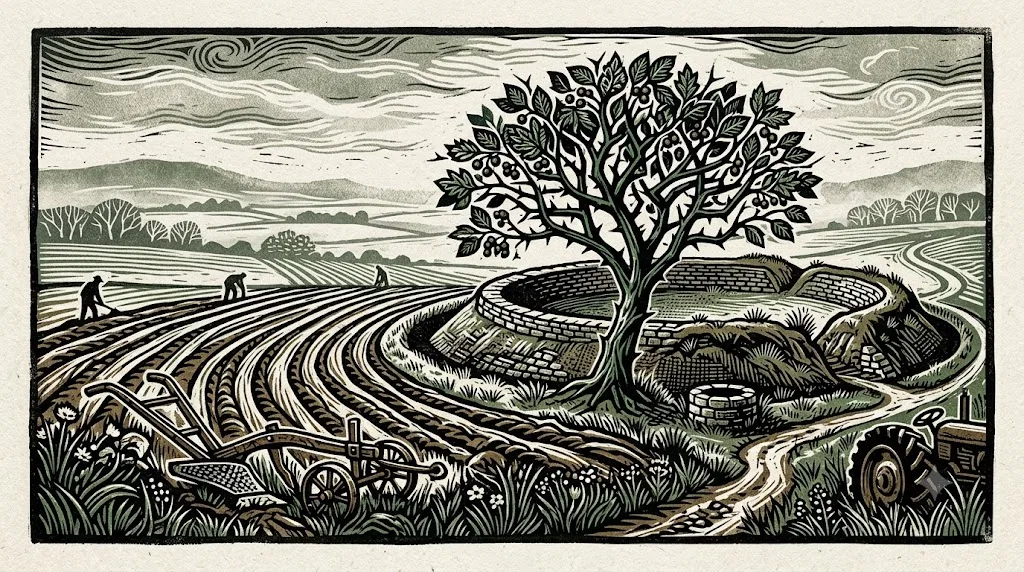
Irish folklore often begins with place. A circular earthwork in a field may be an archaeological ringfort, but in local tradition it may also be a fairy fort; a hawthorn standing alone may be avoided because it is understood as belonging to the fairy people; a well may carry a saint’s blessing; a mountain, lake or cave may be the entrance to an Otherworld. This is one reason Irish folklore is so memorable: it does not float in a vague fantasy world, but attaches itself to features people can point to.
Ringforts are a good example of the overlap between archaeology and belief. Archaeologically, many ringforts were early medieval enclosed farmsteads, often circular or near-circular, made from banks, ditches or stone walls. Folklorically, many became known as “fairy forts”, places that should not be disturbed. The Irish Times has reported estimates of about 32,000 surviving ringforts in Ireland and notes that many are over 1,000 years old, though popular “fairy fort” language can also be attached to other old sites such as passage tombs or ritual places.[The Irish Times]irishtimes.comfrom ringfort to ring road the destruction of ireland s fairy forts 1.4496069from ringfort to ring road the destruction of ireland s fairy forts 1.4496069
That distinction matters. Folklore did not make the monuments, but it helped shape how people behaved around them. Fear of bad luck, illness, crop failure or fairy revenge could discourage digging, cutting trees or levelling banks. In modern heritage language, the belief has sometimes worked like an unofficial conservation instinct, although development, farming and neglect have still damaged many sites. The folklore is therefore not just a set of stories about supernatural beings; it has affected real landscapes and real decisions.
The same pattern appears with hawthorn trees, holy wells, burial mounds and old roads. A place may have an official history, a local legend, a family warning and a tourist version, all at once. Irish folklore is at its strongest when those layers are allowed to remain visible rather than being flattened into a single “ancient Celtic myth”.
The fairy tradition is darker than the souvenir version
The best-known international image of Irish fairy lore is probably cheerful: tiny winged creatures, pots of gold, green hats and St Patrick’s Day decorations. Traditional Irish fairy belief is much stranger and more serious. The fairy folk were often imagined as powerful neighbours: beautiful, dangerous, easily offended, capable of blessing or harming households, livestock, children, crops and luck. Modern readers may think of fairies as cute; many Irish traditions treated them with caution.
The National Folklore Collection preserves thousands of local accounts of fairy places, fairy music, fairy paths, banshees, changelings, cures, charms and protective customs. Its digitised archive, Dúchas, describes the collection as covering “every aspect of the Irish oral tradition”, while the National Folklore Collection itself is recognised by UNESCO and held at University College Dublin.[Dúchas]duchas.ieOpen source on duchas.ie.
A common older explanation linked the fairy people with the defeated supernatural race of medieval Irish mythology, the Tuatha Dé Danann. In later tradition they become associated with the people of the fairy mounds. This is not a neat historical survival from pagan religion into modern folklore; it is a long process of reinterpretation, shaped by Christian scribes, medieval literature, oral storytelling and nineteenth-century collectors. Medieval texts often recast divine or semi-divine beings into a Christian worldview, while later rural belief turned fairy encounters into practical warnings about land, illness, death, childbirth and social boundaries.[Wikipedia]WikipediaTuatha Dé DanannTuatha Dé Danann
Several fairy figures became especially famous:
The banshee is usually understood as a female death omen, heard keening or crying before a death connected with certain families. A Schools’ Collection account from County Tipperary says she is “supposed to be an Irish Fairy or Ghost” and an omen of death, moving about mournfully and combing her hair. The Smithsonian’s Folklife Magazine describes the banshee as a death omen whose stories also reveal family memory and community identity.[Dúchas]duchas.ieOpen source on duchas.ie.
The leprechaun belongs to the tradition of solitary fairies rather than fairy courts. Older literary and antiquarian accounts usually present him as a small male figure linked with shoemaking, trickery and hidden treasure. The modern cereal-box leprechaun is a simplified commercial descendant of a more varied and mischievous folkloric being.[Library Ireland]libraryireland.comOpen source on libraryireland.com.
The púca is a shapeshifting and often unsettling figure, associated in many retellings with wildness, night travel, mischief and seasonal danger. It is especially prominent in popular explanations of Halloween and late-autumn folklore, though its exact form varies by region and storyteller.[National Museum of Ireland]museum.ieOpen source on museum.ie.
Changelings appear in stories where a fairy substitute is believed to have replaced a human child or adult. These tales can be disturbing today because they often touch on illness, disability, postnatal fear, mental distress or social suspicion. They are important evidence of how supernatural explanation could be used to make sense of suffering, but they also show how belief could become dangerous when applied to vulnerable people.
The central lesson is that Irish fairy lore is not one tidy mythology. It is a web of local rules: do not cut that tree, do not disturb that fort, do not boast of fairy gifts, do not follow strange music, do not ignore a warning before a death. The power of the tradition lies in that everyday intimacy.

Mythic Ireland: heroes, gods and medieval manuscripts
Irish mythology is often introduced through four broad narrative groupings: the Mythological Cycle, the Ulster Cycle, the Fenian Cycle and the Historical or Kings Cycle. These categories are useful for readers, but they are modern scholarly conveniences rather than ancient filing cabinets. The stories survive mainly through medieval manuscripts copied by Christian scribes, who preserved, reshaped and interpreted older narrative material.
The Ulster Cycle’s central epic is the Táin Bó Cúailnge, often known in English as The Cattle Raid of Cooley. The University College Cork CELT project provides editions and translations of early Irish texts, including versions of the Táin. The story centres on Queen Medb of Connacht and King Ailill’s attempt to seize the great bull of Cooley, while the young hero Cú Chulainn defends Ulster.[celt.ucc.ie]celt.ucc.ieOpen source on ucc.ie.
Cú Chulainn matters because he is not just a superhero figure. He is heroic, terrifying, doomed, loyal, violent and vulnerable. His stories carry themes that recur across Irish legendary tradition: honour, cattle wealth, fosterage, battle frenzy, prophecy, sovereignty and the cost of fame. They also show that Irish folklore and mythology are not always gentle or whimsical; many of the great tales are tragic.
The Fenian Cycle centres on Fionn mac Cumhaill and his warrior band. These stories have a different tone: hunting, wisdom, poetry, loyalty, landscape and encounters with the Otherworld. Fionn’s legends are spread across Ireland and Scotland, and they travelled widely through oral tradition and later literature. The eighteenth-century Ossian controversy, in which James Macpherson claimed to translate ancient Gaelic epics, drew partly on this shared Gaelic heroic world and became a major Romantic-era literary event, though its authenticity was heavily contested.[arXiv]arxiv.orgarXiv A Networks-Science Investigation into the Epic Poems of OssianarXiv A Networks-Science Investigation into the Epic Poems of Ossian
The Mythological Cycle contains stories of supernatural peoples, invasions, battles and transformations. The Tuatha Dé Danann, Brigid, the Dagda, Lugh, the Morrígan and other figures are often discussed today as “Irish gods”, but medieval texts rarely give modern readers a clean pagan pantheon. They are literary, religious and political figures all at once, filtered through Christian manuscript culture and later nationalist, literary and popular reinterpretation.
One of the most famous transformation tales is the Children of Lir, in which four children are changed into swans for 900 years. Trinity College Dublin’s library exhibition notes that the story is believed to have been written in the fifteenth century and became a major part of later Irish literary and children’s retellings.[Trinity College Dublin]tcd.ieirish mythsirish myths
Saints, wells and the Christian reshaping of older traditions
Irish folklore cannot be separated from Christianity. Saints’ lives, holy wells, feast days, pilgrimage places, blessings, curses, charms and household devotions are central to the country’s traditional belief culture. Rather than replacing older story worlds completely, Christian practice often absorbed, redirected or reinterpreted them.
St Brigid’s Day on 1 February is one of the clearest examples. The National Museum of Ireland describes the day as rich in customs and links it with protection, new life, spring and abundance. It also notes its association with the older seasonal festival of Imbolc and with rural hopes for fertility in land, animals and households.[National Museum of Ireland]museum.ieOpen source on museum.ie.
The familiar St Brigid’s cross, made from rushes or straw, is not merely decorative in tradition. It was placed in homes and farm buildings for protection. Customs around Brigid could include festive meals, visiting, making crosses, invoking blessing on livestock and marking the turn from winter towards spring. The figure of Brigid herself is unusually layered: a Christian saint, a patron of healing and domestic protection, and a name that also belongs to earlier Irish mythological tradition.
Holy wells show the same blending of local landscape and Christian practice. A well might be dedicated to a saint, visited on a pattern day, associated with healing, and governed by rules about prayer, offerings, rounds or respectful behaviour. Such practices belong to folk religion: not official doctrine alone, but lived religion shaped by community memory, landscape and repeated action.
This is why “pagan versus Christian” is often too simple a frame for Ireland. The better question is how stories changed as people changed religion, language, politics and social life. A fairy mound might be feared, a saint might bless a well, a charm might invoke Christian names, and a seasonal custom might preserve older agricultural concerns in Christian form.
Samhain, Halloween and the Irish calendar of fear and renewal
Many readers come to Irish folklore through Halloween, and here Ireland has a strong claim to global influence. The National Museum of Ireland’s Halloween and Samhain material records customs including masks, visiting, entertainment, protective crosses and seasonal objects. Tourism Ireland also promotes Ireland as a home of Halloween, linking modern celebrations to Samhain traditions.[National Museum of Ireland]museum.ieOpen source on museum.ie.
Samhain marked a threshold in the year: the end of the harvest season and the beginning of the darker half. In modern explanations it is often described as a time when boundaries between the living and the dead, or the human world and the Otherworld, were especially thin. That wording can be overused, but it captures a real pattern in Irish seasonal folklore: late autumn is full of divination, disguise, mischief, ghosts, wandering beings, food customs and household protection.
The National Museum of Ireland records that ghostly masks were made to frighten neighbours and that disguised groups visited and entertained. It also highlights protective crosses placed above doors. Other Irish Halloween customs include fortune-telling games, barmbrack with hidden objects, carved turnips or lanterns, and stories of spirits abroad.[National Museum of Ireland]museum.ieOpen source on museum.ie.
The modern festival has also become a heritage and tourism stage. Derry’s Halloween celebrations, the Hill of Ward/Tlachtga narratives, museum exhibitions and public events all present Ireland as a source of Halloween tradition. The important caution is that modern Halloween is not simply ancient Samhain preserved unchanged. It is a layered festival shaped by medieval Christianity, local Irish and Scottish customs, migration to North America, commercial popular culture and recent Irish heritage branding.
That does not make the Irish connection false. It makes it more interesting. Halloween is a good example of how folklore travels: a local seasonal complex becomes a global festival, then returns to Ireland as tourism, performance and cultural pride.
Ghosts, haunted houses and the folklore of memory
Ireland’s ghost stories are not separate from its history. Haunted castles, ruined houses, old roads, famine landscapes, graveyards and former gentry estates often carry stories about violence, dispossession, death, hidden rooms, cruel landlords or family tragedy. The supernatural story becomes a way of keeping emotional pressure around a place.
Popular haunted-site lists often include places such as the Hellfire Club in the Dublin Mountains, Leap Castle in County Offaly and Charleville Castle, but these accounts need careful handling. Some are strongly shaped by tourism and dark entertainment. Tourism Ireland, for example, presents the Hellfire Club as a famously haunted former hunting lodge, while heritage writing notes that the lodge was built in 1725 for William Conolly on Mount Pelier.[Ireland.com]ireland.com9 most haunted places in Ireland9 most haunted places in Ireland
Ghost traditions are still folklore even when the historical details are uncertain. What matters is how the story circulates: who tells it, what place it marks, what fear it expresses, and how it changes for visitors. A castle ghost may begin as a local tale, become a newspaper feature, then a tour script, then a television or internet story. Each stage adds drama and may simplify the past.
The banshee sits between ghost lore and fairy lore. She is not just a haunted-house figure but a family omen. In many accounts her cry is heard before death, especially within old family lines. This makes her more intimate than the typical castle ghost. She belongs to kinship, mourning and the soundscape of death: keening, crying, warning, remembering.
Irish ghost folklore is therefore not only about fear. It is about unresolved memory. The dead remain present because the place, family or community has not stopped telling their story.
The collectors who saved, shaped and sometimes polished the tradition
Modern knowledge of Irish folklore depends heavily on collectors, archives and editors. This is both a strength and a complication. Without collectors, many local traditions would be lost. But collection also changes folklore: oral stories are written down, translated, selected, tidied, romanticised or arranged for readers.
The most important institutional source is the National Folklore Collection at University College Dublin. It includes manuscript, photographic, audio and other archival material and is one of Europe’s largest archives of oral tradition and cultural history. The Schools’ Collection, gathered between 1937 and 1939 under the Irish Folklore Commission, is especially valuable because it recorded local lore from across the country through schoolchildren interviewing older relatives and neighbours.[Dúchas]duchas.ieDúchasNational Folklore CollectionThe National Folklore Collection (NFC) is a UNESCO recognised folklore… folktales can be found in th…
Earlier collectors and literary figures also shaped public ideas of Irish folklore. Thomas Crofton Croker’s Fairy Legends and Traditions of the South of Ireland appeared in the nineteenth century and helped popularise figures such as the cluricaune, banshee, phooka, merrow and dullahan for English-reading audiences.[Internet Archive]archive.orgOpen source on archive.org.
Lady Wilde’s Ancient Legends, Mystic Charms and Superstitions of Ireland and W. B. Yeats’s fairy and folk-tale collections also helped make Irish folklore internationally famous. Yet these works should be read with awareness. They often preserve valuable material, but they also reflect the tastes, politics and literary styles of their time. Nineteenth-century folklore was frequently entangled with nationalism, Romanticism, antiquarianism and the desire to present Ireland as spiritually deep, ancient and distinct.
This is why a good reading of Irish folklore uses several kinds of evidence: medieval manuscripts, oral archives, local history, museum collections, archaeology, older printed folklore and modern scholarship. No single source tells the whole story.
What is old, what is retold, and what is modern invention?
A common mistake is to treat every Irish folklore image as ancient. Another is to assume that anything popular must be fake. Irish folklore usually sits somewhere between those extremes.
Some traditions are old in the sense that they are recorded in medieval literature: Cú Chulainn, Fionn, the Tuatha Dé Danann, the Children of Lir and many Otherworld motifs. But medieval does not mean unchanged from pre-Christian religion. These stories come through scribal culture, Christian interpretation and manuscript transmission.
Some traditions are old in oral practice but recorded much later. Fairy forts, banshee warnings, cures, wake customs, holy wells, seasonal games and local ghost stories may be best attested through nineteenth- and twentieth-century collectors. That does not make them “new”; it means their strongest evidence is oral-traditional rather than ancient manuscript evidence.
Some traditions are literary inventions or literary expansions. Yeats, Lady Wilde, Croker and later writers shaped the tone of Irish folklore for readers far beyond Ireland. Their work can preserve genuine motifs while also making them more poetic, eerie or nationally symbolic.
Some traditions are modern commercial adaptations. The cheerful leprechaun in a green suit, the tourist-shop fairy, the Halloween attraction and the internet ghost list all belong to modern folklore too, but they should not be confused with older local belief. They show how tradition is packaged, sold and remixed.
This distinction helps explain why Irish folklore is so resilient. It has never belonged to one period. It can be a medieval saga, a grandmother’s warning, a museum object, a schoolchild’s notebook, a local road story, a stage performance, a festival parade and a film reference — all while remaining recognisably Irish.

Irish folklore today: heritage, identity and popular culture
Irish folklore today is not merely a survival from the past. It is part of cultural identity, tourism, art, environmental debate, local history and popular entertainment. The digitisation of Dúchas has made local folklore far more accessible, allowing readers to search stories by place, theme and collector. Smithsonian Folklife has described the Schools’ Collection as a project in which schoolchildren became researchers, gathering material from older community members at a moment when the Irish state feared oral lore was disappearing.[Smithsonian Folklife]folklife.si.edu1930s irish folklore duchas projectSmithsonian FolklifeHow the Homework of 1930s Irish Schoolchildren Invites…17 Aug 2021 — In 1937, the Irish Folklore Commission embark…
Contemporary artists also return to fairy lore and seasonal customs. Reports on recent Irish performance work show dancers, musicians and folklorists gathering fairy stories from older people, especially around Leitrim and Bealtaine, and turning them into new performance. That kind of work does not simply repeat old belief; it asks what folklore can do for communities that feel disconnected from place, ancestry or shared ritual.[The Times]thetimes.co.ukThe Times How retirement home residents are recording Ireland's fairy folkloreThe Times How retirement home residents are recording Ireland's fairy folklore
Tourism can both preserve and distort folklore. Halloween festivals, haunted castles and fairy trails introduce visitors to Irish tradition, but they often prefer the spectacular version: bigger scares, clearer monsters, tidier origin stories. A responsible account keeps the drama while admitting uncertainty. The Hellfire Club may be a fine ghost-tour setting, but its folklore is not the same kind of evidence as a recorded local charm or a medieval manuscript.
Popular culture has also globalised Irish motifs. Banshees, leprechauns, Celtic warriors, fairy realms and Halloween imagery appear in films, games, fantasy novels and online folklore. These versions are not “wrong” simply because they are modern. They are part of the afterlife of tradition. The problem arises when modern fantasy is mistaken for old Irish belief, or when a single tourist image replaces the range of local stories.
Why Ireland’s folklore still matters
Ireland’s folklore matters because it preserves ways people made sense of uncertainty: illness, death, weather, harvests, childbirth, grief, luck, land ownership, danger and belonging. A banshee story is about death, but also about family. A fairy fort warning is about supernatural fear, but also about respect for place. A Samhain custom is about spirits, but also about winter, food, disguise and community. A heroic saga is about warriors, but also about honour, loss and the fragile price of fame.
It also matters because Ireland’s folklore is unusually well documented. The National Folklore Collection, medieval manuscript projects, museum collections and local heritage work give modern readers a way to compare grand literary myth with ordinary household tradition. That breadth is rare. It allows Ireland to be seen not just as a land of famous myths, but as a country where folklore has been recorded at the level of townlands, families, schools, farms and individual storytellers.
The most useful way to approach Irish folklore is therefore neither blind belief nor chilly dismissal. It is to read the stories as cultural evidence: evidence of imagination, fear, humour, faith, power, landscape and memory. Ireland’s old tales still travel because they are not only about fairies, ghosts and heroes. They are about how people live with places that seem older, stranger and more storied than themselves.
Amazon book picks
Further Reading
Books and field guides related to Why Ireland's Old Stories Still Feel Alive. Use these as the next step if you want deeper reading beyond the article.
Irish Fairy and Folk Tales
Covers many of the best-known Irish folklore traditions in one volume.
The Mammoth Book of Celtic Myths and Legends
Introduces major Irish and Celtic legends and characters.
eBay marketplace picks
Marketplace Samples
Live-tested eBay searches with available results related to this page.
Endnotes
1.
Source: Wikipedia
Title: Tuatha Dé Danann
Link:https://en.wikipedia.org/wiki/Tuatha_D%C3%A9_Danann
2.
Source: Wikipedia
Link:https://en.wikipedia.org/wiki/Aos_S%C3%AD
3.
Source: museum.ie
Link:https://www.museum.ie/en-IE/News/2023/Ghost-turnips%2C-pucas%2C-fortune-telling-and-evil-abd
4.
Source: ireland.ie
Link:https://www.ireland.ie/en/visit/halloween/6-halloween-traditions-that-come-from-irelands-samhain-festival/
5.
Source: celt.ucc.ie
Link:https://celt.ucc.ie/celt/document/T301012
6.
Source: celt.ucc.ie
Link:https://celt.ucc.ie/published/T301035.html
7.
Source: arxiv.org
Title: arXiv A Networks-Science Investigation into the Epic Poems of Ossian
Link:https://arxiv.org/abs/1610.00142
8.
Source: museum.ie
Link:https://www.museum.ie/en-ie/collections-research/folklife-collections/folklife-collections-list-%281%29/religion-and-calendar-customs/st-brigid-s-day
9.
Source: museum.ie
Title: National Museum of Ireland St Brigid’s Day
Link:https://www.museum.ie/en-IE/News/St-Brigids-Day-a-weaving-tradition-of-Celtic-ritu
10.
Source: museum.ie
Link:https://www.museum.ie/en-ie/collections-research/folklife-collections/folklife-collections-list-%281%29/religion-and-calendar-customs/hallowe-en-samhain
11.
Source: ireland.ie
Link:https://www.ireland.ie/en/visit/halloween/
12.
Source: ireland.com
Title: 9 most haunted places in Ireland
Link:https://www.ireland.com/en-us/magazine/culture/nine-most-haunted/
13.
Source: archive.org
Link:https://archive.org/details/fairylegendstrad00crokrich
14.
Source: archive.org
Link:https://archive.org/details/fairylegendstrad03crok
15.
Source: Wikipedia
Title: Irish folklore
Link:https://en.wikipedia.org/wiki/Irish_folklore
16.
Source: Wikipedia
Link:https://en.wikipedia.org/wiki/Ireland
17.
Source: Wikipedia
Title: Táin Bó Cúailnge
Link:https://en.wikipedia.org/wiki/T%C3%A1in_B%C3%B3_C%C3%BAailnge
18.
Source: Wikipedia
Link:https://en.wikipedia.org/wiki/Ringfort
19.
Source: celt.ucc.ie
Link:https://celt.ucc.ie/published/T301035/header.html
20.
Source: archive.org
Title: bub gb Stk DAAAAQAAJ
Link:https://archive.org/details/bub_gb_StkDAAAAQAAJ
21.
Source: archive.org
Link:https://archive.org/details/fairylegendstrad00crokiala
22.
Source: archive.org
Link:https://archive.org/details/fairylegendsand01crokgoog
23.
Source: archive.org
Link:https://archive.org/details/irishfairylegend0000crok
24.
Source: ia801802.us.archive.org
Link:https://ia801802.us.archive.org/15/items/britishgoblinswe00sikeuoft/britishgoblinswe00sikeuoft.pdf
25.
Source: archive.org
Link:https://archive.org/download/irishfairyfolkta00yeatuoft/irishfairyfolkta00yeatuoft.pdf
26.
Source: ia601309.us.archive.org
Link:https://ia601309.us.archive.org/34/items/castlesofireland00adamiala/castlesofireland00adamiala.pdf
27.
Source: archive.org
Link:https://archive.org/download/keenofsouthofire00crok/keenofsouthofire00crok.pdf
28.
Source: archive.org
Title: bub gb 7EPXAAAAMAAJ
Link:https://archive.org/details/bub_gb_7EPXAAAAMAAJ
29.
Source: archaeology.ie
Link:https://www.archaeology.ie/app/uploads/2025/03/Register-of-Historic-Monuments-09_V1.pdf
30.
Source: museum.ie
Link:https://www.museum.ie/en-IE/News/2023/St-Brigids-Day
31.
Source: dublin.ie
Link:https://dublin.ie/study/stories/ucds-irish-folklore-centre/
32.
Source: youtu.be
Link:https://youtu.be/_WC-zpVw-Xo
Source snippet
Irish fairy forts folklore documentary Top 5 Fairy Forts in Ireland and Why You Should Avoid Them...
33.
Source: duchas.ie
Link:https://www.duchas.ie/en/info/cbe
Source snippet
DúchasNational Folklore CollectionThe National Folklore Collection (NFC) is a UNESCO recognised folklore... folktales can be found in th...
34.
Source: ucd.ie
Title: University College Dublin Schools’ Collection (Dúchas)
Link:https://www.ucd.ie/irishfolklore/en/collections/schoolscollectionduchas/
Source snippet
Dating from 1937-39, this remarkable collection is the outcome of an innovative project supervised by the Irish Folklore...Read more...
35.
Source: folklife.si.edu
Title: 1930s irish folklore duchas project
Link:https://folklife.si.edu/magazine/1930s-irish-folklore-duchas-project
Source snippet
Smithsonian FolklifeHow the Homework of 1930s Irish Schoolchildren Invites...17 Aug 2021 — In 1937, the Irish Folklore Commission embark...
36.
Source: irishtimes.com
Title: from ringfort to ring road the destruction of ireland s fairy forts 1.4496069
Link:https://www.irishtimes.com/culture/heritage/from-ringfort-to-ring-road-the-destruction-of-ireland-s-fairy-forts-1.4496069
37.
Source: irishtimes.com
Title: fairy forts why these sacred places deserve our respect 1.3181259
Link:https://www.irishtimes.com/culture/heritage/fairy-forts-why-these-sacred-places-deserve-our-respect-1.3181259
38.
Source: duchas.ie
Link:https://www.duchas.ie/en
39.
Source: duchas.ie
Link:https://www.duchas.ie/en/cbes/4922258/4864934/5020938
40.
Source: folklife.si.edu
Title: irish banshee
Link:https://folklife.si.edu/magazine/irish-banshee
41.
Source: libraryireland.com
Link:https://www.libraryireland.com/
42.
Source: tcd.ie
Title: irish myths
Link:https://www.tcd.ie/library/exhibitions/wild-waves/irish_myths.php
43.
Source: thetimes.co.uk
Title: The Times How retirement home residents are recording Ireland’s fairy folklore
Link:https://www.thetimes.co.uk/article/ireland-fairy-folklore-dance-edwina-gulkian-hmqh6gcbs
44.
Source: sacredtrails.ie
Link:https://www.sacredtrails.ie/heritage/category/ringforts
45.
Source: mail.libraryireland.com
Link:https://mail.libraryireland.com/
46.
Source: facebook.com
Link:https://www.facebook.com/nationalmuseumofireland/posts/did-you-know-that-many-of-the-halloween-celebrations-we-enjoy-today-owe-their-or/1289584776537067/
47.
Source: emeraldisle.ie
Link:https://emeraldisle.ie/the-banshee
48.
Source: emeraldisle.ie
Link:https://emeraldisle.ie/the-hellfire-club
49.
Source: irishtimes.com
Title: spooked by the fairy forts 1.334451
Link:https://www.irishtimes.com/news/spooked-by-the-fairy-forts-1.334451
50.
Source: irishtimes.com
Title: ring fort may have held bronze age sports arena 1.627196
Link:https://www.irishtimes.com/news/ring-fort-may-have-held-bronze-age-sports-arena-1.627196
51.
Source: irishtimes.com
Title: away with the faeries 1.1725375
Link:https://www.irishtimes.com/culture/heritage/away-with-the-faeries-1.1725375
52.
Source: duchas.ie
Link:https://www.duchas.ie/en/cbes/4922122/4854248/4956935
53.
Source: duchas.ie
Link:https://www.duchas.ie/en/cbes/5044708/5033375/5148480
54.
Source: heritage.clareheritage.org
Link:https://heritage.clareheritage.org/topics/clare-community-archaeology/archaeology/medieval-archaeology/early-medieval/ringforts
55.
Source: irishmyths.com
Link:https://irishmyths.com/2022/07/25/banshee/
56.
Source: irishfolklore.wordpress.com
Link:https://irishfolklore.wordpress.com/tag/fairy/
57.
Source: loreofeire.com
Link:https://loreofeire.com/cycle/fenian
58.
Source: superprof.ie
Title: irish mythology
Link:https://www.superprof.ie/blog/irish-mythology/
59.
Source: amazingireland.weebly.com
Link:https://amazingireland.weebly.com/folklore.html
Additional References
60.
Source: youtube.com
Title: What Are Fairies? (Celtic Mythology Explained)
Link:https://www.youtube.com/watch?v=Eszb1jqJtoQ
Source snippet
Irish folklore National Folklore Collection Discovering the Cryptids, Myths, and Legends of the Celtic World | Celtic Mythology Forgotten...
61.
Source: youtube.com
Title: National Folklore Collection, University College Dublin and Dúchas.ie
Link:https://www.youtube.com/watch?v=qndrou6yuvk
Source snippet
How to Duchas Dive | Using the National Folklore Collection Digitised Archive...
62.
Source: youtube.com
Title: How to Duchas Dive | Using the National Folklore Collection Digitised Archive
Link:https://www.youtube.com/watch?v=HRW-_yr8ZFM
Source snippet
The Enchanting Fairies of Celtic Lore | Monstrum...
63.
Source: researchgate.net
Link:https://www.researchgate.net/publication/343749116_The_Fear_of_Fairy_Forts_Archaeological_Preservation_by_Plague_and_Superstition
64.
Source: researchgate.net
Link:https://www.researchgate.net/publication/399740204_IRISH_MYTHOLOGY_A_STUDY_OF_THE_FOUR_MAIN_CYCLES_USING_THE_EXAMPLE_OF_IRISH_LITERARY_MONUMENTS
65.
Source: facebook.com
Link:https://www.facebook.com/groups/2333089990266317/posts/3821879208054047/
66.
Source: approachtours.com
Link:https://approachtours.com/a-journey-through-irish-folklore/
67.
Source: dubraybooks.ie
Link:https://www.dubraybooks.ie/product/banshees-hags-and-changelings-9780815611998?srsltid=AfmBOooKBacDHa1voygZqxkjtddM-NGDeU8uxTSciFvraUdpF9UupaEN
68.
Source: academia.edu
Link:https://www.academia.edu/64910900/Daoine_Sidhe_Celtic_Superstitions_of_Death_Within_Irish_Fairy_Tales_Featuring_the_Dullahan_and_Banshee
69.
Source: researchgate.net
Link:https://www.researchgate.net/publication/321800781_Fairies_banshees_and_the_church_Cultural_conceptualisations_in_Irish_English
Topic Tree
Follow this branch
Related pages 192
- Afghan Folklore
- Albanian Folklore
- Algerian Folklore
- Australian Folklore
- Azerbaijan Folklore
- +187 more in sidebar