Within Iran Folklore
What Are Iran's Strangeest Folk Beings?
Iranian supernatural beings shift between demons, ogres, dragons, fairies and jinn depending on story, religion and region.
On this page
- Divs and demon language
- Dragons in magic tales
- Jinn, fairies and blurred categories
Page outline Jump by section
Introduction
Iranian supernatural tales are crowded with beings that do not fit neatly into modern categories. A creature described as a demon in one story may look like an ogre in another, while a dragon can behave like a magical monster, a force of chaos, or even a disguised supernatural being. This flexibility is one of the most distinctive features of Iranian folklore. Over centuries, ancient Iranian religion, epic poetry, Islamic belief, local storytelling and popular legend blended together, creating a supernatural landscape where divs, dragons and jinn often overlap rather than remain separate categories.[Iranica Online]iranicaonline.orgIranica Online DĪVIranica OnlineDĪV - Encyclopaedia IranicaDĪV (demon, monster, fiend), expresses not only the idea of “demon,” but also that of “ogre,” “g…
For readers expecting a tidy bestiary, Iranian tradition can be surprising. The same tale may describe a hero fighting a dragon-like monster, a shape-shifting demon, or a jinn with similar powers. What matters is often not the creature’s exact species but its role in the story: testing heroes, threatening communities, guarding hidden places, or representing disorder and danger.[Iranica Online]iranicaonline.orgIranica Online DĪVIranica OnlineDĪV - Encyclopaedia IranicaDĪV (demon, monster, fiend), expresses not only the idea of “demon,” but also that of “ogre,” “g…
Divs and the language of demons
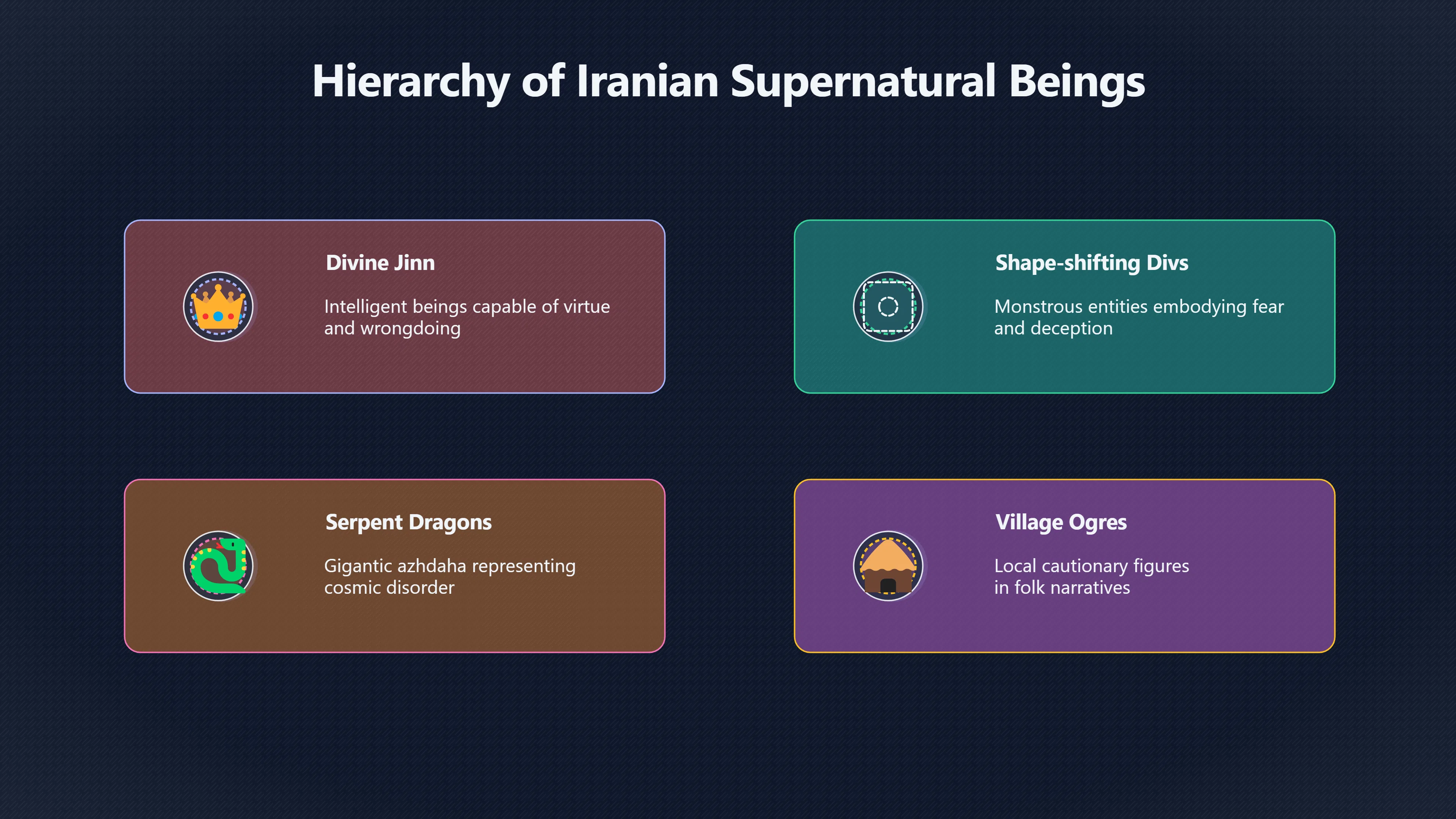
Among Iran’s most famous supernatural beings are the divs. In modern retellings they are often translated simply as “demons”, but traditional usage is far broader. Encyclopaedia Iranica notes that the term can mean demon, monster, ogre, giant or even Satan depending on context. In both literary and folk traditions, divs are frequently confused or blended with other supernatural beings, including jinn and ogres.[Iranica Online]iranicaonline.orgIranica Online DĪVIranica OnlineDĪV - Encyclopaedia IranicaDĪV (demon, monster, fiend), expresses not only the idea of “demon,” but also that of “ogre,” “g…
The roots of the div reach deep into pre-Islamic Iranian religion. Ancient Iranian texts describe hostile supernatural powers associated with deception, disorder and spiritual corruption. Over time these religious figures evolved into the monstrous adversaries of epic and folk narrative.[Wikipedia]WikipediaApril 13, 2026 — A daeva (Avestan: 𐬛𐬀𐬉𐬎𐬎𐬀 daēuua) is a Zoroastrian supernatural entity with disagreeable characteristics. In the Gathas…
In Iranian tales, divs are rarely simple villains. They often possess magical knowledge, extraordinary strength and the ability to transform themselves. Some stories portray them as enormous mountain-dwelling monsters; others present them as cunning shape-shifters who deceive travellers or heroes. Traditional accounts describe divs taking the forms of humans, animals and even dragons.[Circle of Ancient Iranian Studies]cais-soas.comThey can change themselves into other beings such as people, dragons, lions, and more commonly onagers or horses…
This ambiguity explains why divs remain so memorable. They are not merely creatures to be slain. They embody the fear that appearances cannot be trusted. A monster may look human, a stranger may be a div in disguise, and a magical helper may turn out to be dangerous.
One of the best-known literary examples appears in the epic Shahnameh, where heroes confront powerful divs whose strength is matched by their magical abilities. These encounters helped shape later folk tales, in which local storytellers adapted epic demons into village-scale monsters and household cautionary figures.[Wikipedia]WikipediaMay 9, 2026 — The Shahnameh, is a long epic poem written by the Persian poet Ferdowsi between c. 977 and 1010 CE and is the national epic…
Why Iranian dragons are different
Many readers imagine dragons as winged treasure-hoarders from European fantasy. Iranian dragons belong to a different tradition.
The Iranian dragon, often known in scholarship as the azhdaha, is usually a gigantic serpent-like monster. It may live underground, in mountains, beneath the sea or in remote wilderness. Ancient sources connect dragons with destructive forces and cosmic disorder, while later stories place them in heroic adventures and magical quests.[Iranica Online]iranicaonline.orgIranica OnlineAŽDAHĀAŽDAHĀ “dragon,” various kinds of snake-like, mostly gigantic, monsters living in the air, on earth, or in the sea (a…
One of the oldest dragon figures is a monstrous being described in ancient Iranian tradition as having multiple heads, mouths and eyes. This creature occupies a boundary between myth and legend: part cosmic enemy, part monstrous dragon. Later Iranian literature transformed similar figures into opponents for legendary heroes.[Iranica Online]iranicaonline.orgIranica OnlineAŽDAHĀ i. In Old and Middle IranianAz[i]dahāg, spelled ʾcydhʾk, or Dahāg) belongs to the realm of mythologized history or h…
A notable feature of Iranian folklore is that dragons appear most often in wonder tales and magical legends rather than creation myths. Encyclopaedia Iranica’s survey of folktales notes that dragons are especially associated with storytelling motifs such as heroic journeys, enchanted locations, kidnapped maidens and supernatural tests.[Iranica Online]iranicaonline.orgIranica OnlineAŽDAHĀ iii. In Iranian folktalesIn Persian folklore, the dragon (aždahā) appears mostly in tales of magic and in legends. I…
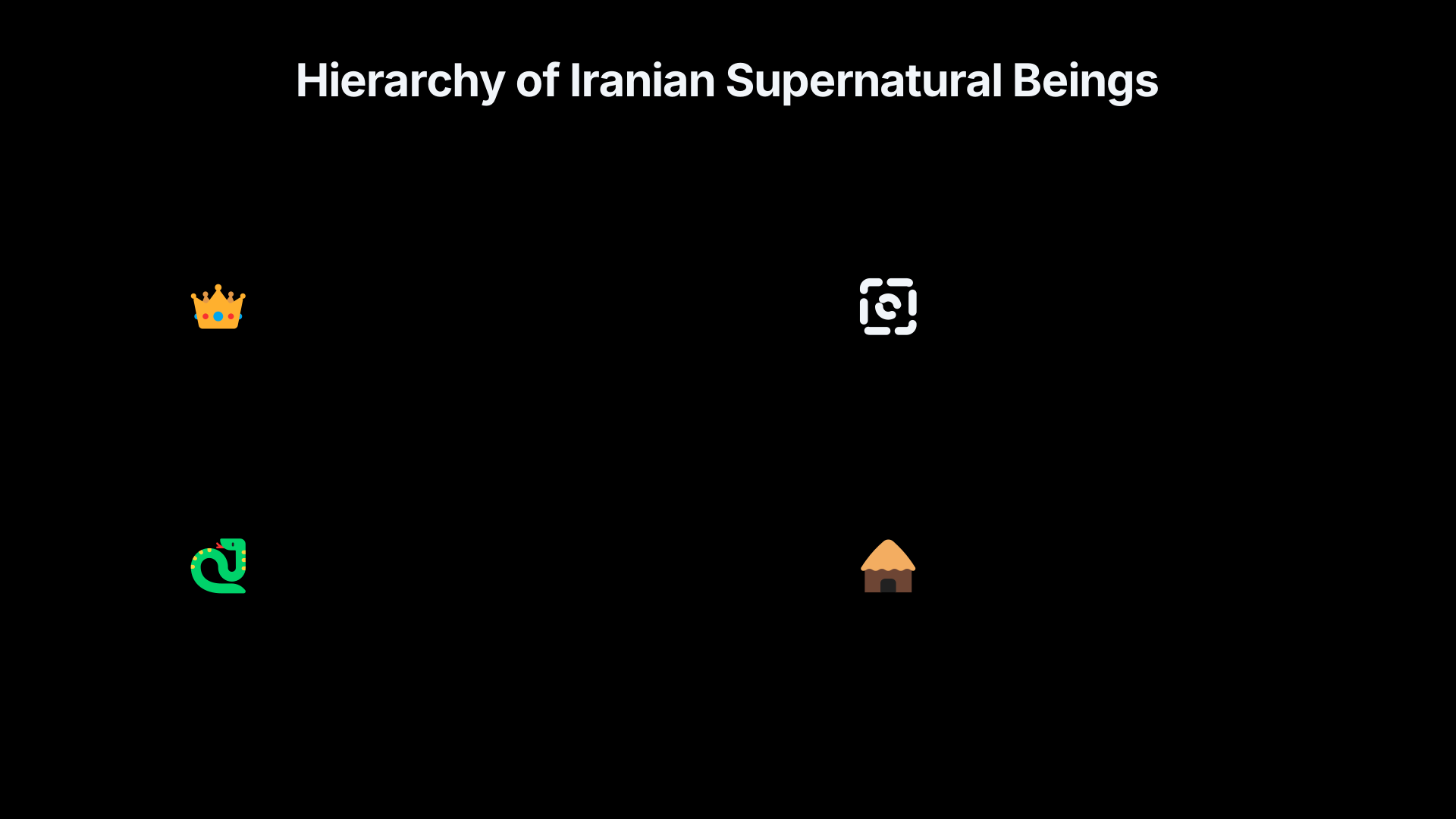
Several recurring patterns appear in dragon stories:
- A hero must defeat a dragon threatening a community.
- A dragon guards water, treasure or access to a magical realm.
- A dragon inhabits a mountain, cave or wilderness beyond ordinary society.
- A dragon’s defeat marks the restoration of order.[Iranica Online]iranicaonline.orgIranica OnlineAŽDAHĀ iii. In Iranian folktalesIn Persian folklore, the dragon (aždahā) appears mostly in tales of magic and in legends. I…
These dragons are less like animals and more like narrative obstacles. They represent chaos at the edge of the known world. The hero’s victory is therefore both a physical and moral achievement.
Jinn, fairies and blurred categories
The arrival and spread of Islam added another major layer to Iranian supernatural tradition: belief in jinn.
Unlike divs, jinn are not necessarily evil. Islamic tradition generally treats them as intelligent beings created separately from humans, capable of belief, disbelief, virtue and wrongdoing. Iranian storytelling adopted these ideas but blended them with older local traditions. As a result, Iranian tales often feature jinn alongside demons, fairies and other supernatural creatures.[Iranica Online]iranicaonline.orgIranica Online GENIEIranica OnlineGENIE - Encyclopaedia IranicaSome of the jinn are described as composite beings that may have a human body, a lion's head…
Descriptions vary dramatically. Some jinn appear as beautiful and powerful beings inhabiting hidden kingdoms. Others are monstrous creatures with hybrid animal and human features. Folklore collected from different Iranian regions preserves a remarkable variety of appearances and behaviours.[Iranica Online]iranicaonline.orgIranica Online GENIEIranica OnlineGENIE - Encyclopaedia IranicaSome of the jinn are described as composite beings that may have a human body, a lion's head…
What makes Iranian supernatural tales especially interesting is that boundaries frequently dissolve. Encyclopaedia Iranica notes that Persian sources sometimes translated Arabic references to jinn using terms that could also refer to divs or fairies. In practice, storytellers often cared less about strict classification than about the creature’s narrative role.[Iranica Online]iranicaonline.orgIranica Online DĪVIranica OnlineDĪV - Encyclopaedia IranicaDĪV (demon, monster, fiend), expresses not only the idea of “demon,” but also that of “ogre,” “g…
A supernatural being might:
- Live in abandoned places or remote wilderness.
- Kidnap or assist humans.
- Test a hero’s courage.
- Possess magical knowledge.
- Guard hidden wealth.
- Transform into another form.[Iranica Online]iranicaonline.orgIranica Online GENIEIranica OnlineGENIE - Encyclopaedia IranicaSome of the jinn are described as composite beings that may have a human body, a lion's head…
Because these functions overlap, folk narratives sometimes move easily between categories. A listener may hear a tale involving a jinn in one village and encounter a very similar story elsewhere involving a div or another supernatural being.
Why categories remain fluid
Modern readers often want to know whether a creature is a demon, dragon, fairy or jinn. Traditional Iranian storytelling is less concerned with those distinctions.
The supernatural vocabulary developed across many centuries and cultural layers. Ancient Iranian religious concepts survived in altered form after the spread of Islam. Epic literature influenced oral storytelling. Regional traditions added local creatures and interpretations. The result was a living folklore in which categories remained flexible rather than fixed.[Iranica Online]iranicaonline.orgIranica Online DĪVIranica OnlineDĪV - Encyclopaedia IranicaDĪV (demon, monster, fiend), expresses not only the idea of “demon,” but also that of “ogre,” “g…
This flexibility explains unusual overlaps. Dragons can possess demonic traits. Divs can transform into dragons. Jinn can resemble monsters or fairies. Ogres, demons and desert spirits may merge into a single storytelling figure depending on region and narrator.[cais-soas.com]cais-soas.comThey can change themselves into other beings such as people, dragons, lions, and more commonly onagers or horses…
Rather than seeing this as confusion, folklorists generally view it as evidence of a vibrant tradition adapting to changing religious and cultural environments. The creatures endure because they are useful storytelling tools, capable of taking on new meanings while preserving older ones.

How these beings survive today
Divs, dragons and jinn remain among the most recognisable figures in Iranian supernatural culture. They appear in children’s books, illustrated editions of epic literature, television adaptations, fantasy art, games and modern retellings of traditional stories. The dragon-slaying heroes of the epics continue to inspire new interpretations, while divs remain visual symbols of monstrous opposition and magical danger.[Wikipedia]WikipediaMay 9, 2026 — The Shahnameh, is a long epic poem written by the Persian poet Ferdowsi between c. 977 and 1010 CE and is the national epic…
Yet their modern appeal comes from more than spectacle. Together, these beings preserve a record of how Iranian storytelling absorbed influences from ancient religion, heroic epic, Islamic belief and local oral tradition. Their shifting identities are not a flaw in the tradition but one of its defining features. In Iranian folklore, monsters are rarely confined to a single category. They live in the spaces between demon, dragon, spirit and wonder, where some of the most enduring stories are found.[Iranica Online]iranicaonline.orgIranica Online DĪVIranica OnlineDĪV - Encyclopaedia IranicaDĪV (demon, monster, fiend), expresses not only the idea of “demon,” but also that of “ogre,” “g…
Amazon book picks
Further Reading
Books and field guides related to What Are Iran's Strangeest Folk Beings?. Use these as the next step if you want deeper reading beyond the article.
The Arabian Nights
Includes jinn traditions relevant to the wider Middle Eastern supernatural world.
eBay marketplace picks
Marketplace Samples
Live-tested eBay searches with available results related to this page.
Endnotes
1.
Source: Wikipedia
Link:https://en.wikipedia.org/wiki/Daeva
Source snippet
April 13, 2026 — A daeva (Avestan: 𐬛𐬀𐬉𐬎𐬎𐬀 daēuua) is a Zoroastrian supernatural entity with disagreeable characteristics. In the Gathas...
Published: April 13, 2026
2.
Source: Wikipedia
Link:https://en.wikipedia.org/wiki/Shahnameh
Source snippet
May 9, 2026 — The Shahnameh, is a long epic poem written by the Persian poet Ferdowsi between c. 977 and 1010 CE and is the national epic...
Published: May 9, 2026
3.
Source: Wikipedia
Link:https://en.wikipedia.org/wiki/Encyclopedia
Source snippet
EncyclopediaAn encyclopedia is a reference work or compendium providing summaries of knowledge, either general or special, in a partic...
4.
Source: Wikipedia
Link:https://en.wikipedia.org/wiki/Azhdaha
Source snippet
AzhdahaThe azhdaha, azhdahak, ezhdeha (Persian: اژدها) or azhdar (اژدر) is a mythical creature in Iranian mythology, roughly equivale...
5.
Source: Wikipedia
Title: Div (mythology)
Link:https://en.wikipedia.org/wiki/Div_%28mythology%29
Source snippet
Div (mythology)This bowl depicts humans, angels, and horned creatures called divs - demons of ancient Iranian origin. Divs embody evil...
6.
Source: Wikipedia
Title: Persian mythology
Link:https://en.wikipedia.org/wiki/Persian_mythology
Source snippet
Persian mythologyShahnameh, The Akvan Div throws Rostam into the sea. Div: monstrous creatures within Middle Eastern lore, with Persia...
7.
Source: iranicaonline.org
Title: Iranica Online DĪV
Link:https://www.iranicaonline.org/articles/div/
Source snippet
Iranica OnlineDĪV - Encyclopaedia IranicaDĪV (demon, monster, fiend), expresses not only the idea of “demon,” but also that of “ogre,” “g...
8.
Source: iranicaonline.org
Link:https://www.iranicaonline.org/articles/azdaha/
Source snippet
Iranica OnlineAŽDAHĀAŽDAHĀ “dragon,” various kinds of snake-like, mostly gigantic, monsters living in the air, on earth, or in the sea (a...
9.
Source: iranicaonline.org
Title: Iranica Online GENIE
Link:https://www.iranicaonline.org/articles/genie/
Source snippet
Iranica OnlineGENIE - Encyclopaedia IranicaSome of the jinn are described as composite beings that may have a human body, a lion's head...
10.
Source: iranicaonline.org
Link:https://www.iranicaonline.org/articles/azdaha/azdaha-iii-in-iranian-folktales/
Source snippet
Iranica OnlineAŽDAHĀ iii. In Iranian folktalesIn Persian folklore, the dragon (aždahā) appears mostly in tales of magic and in legends. I...
11.
Source: cais-soas.com
Link:https://www.cais-soas.com/CAIS/Mythology/div.htm
Source snippet
They can change themselves into other beings such as people, dragons, lions, and more commonly onagers or horses...
12.
Source: iranicaonline.org
Link:https://www.iranicaonline.org/articles/azdaha/azdaha-i-in-old-and-middle-iranian/
Source snippet
Iranica OnlineAŽDAHĀ i. In Old and Middle IranianAz[i]dahāg, spelled ʾcydhʾk, or Dahāg) belongs to the realm of mythologized history or h...
13.
Source: iranicaonline.org
Link:https://www.iranicaonline.org/articles/iran-iv-myths-and-legends/
Source snippet
IRAN iv. MYTHS AND LEGENDSAži Dahāka (Azdaha, q.v.) is described as a dragon “who had three mouths, three heads, six eyes, a thousand ski...
14.
Source: iranicaonline.org
Title: Iranica OnlineḠUL
Link:https://www.iranicaonline.org/articles/gul/
Source snippet
ḠUL - Encyclopaedia Iranica... jinn or a creature classed between fairies... In Persian folklore and classical literature, ḡuls are anth...
15.
Source: the-demonic-paradise.fandom.com
Link:https://the-demonic-paradise.fandom.com/wiki/Div
Source snippet
The Demonic Paradise Wiki - FandomThe Div, or Dev, are a race of monsters who are referenced in Persian and later Islamic mythology. They...
16.
Source: genies.fandom.com
Link:https://genies.fandom.com/wiki/Daeva
Source snippet
DemonologyIn the Younger Avesta, the daevas are noxious creatures that promote chaos and disorder. In later tradition and folklore, the...
Additional References
17.
Source: facebook.com
Link:https://www.facebook.com/ToddAndrewPronovost/posts/azhdaha-azhdahak-ezhdeha-persian-%D8%A7%DA%98%D8%AF%D9%87%D8%A7-or-azhdar-%D8%A7%DA%98%D8%AF%D8%B1-is-a-mythical-creature-in-/1255490833246313/
Source snippet
Azhdaha, Azhdahak, Ezhdeha (PersianAzhdaha, Azhdahak, Ezhdeha (Persian: اژدها) or Azhdar (اژدر) is a mythical creature in Iranian mytholo...
18.
Source: graphsearch.epfl.ch
Link:https://graphsearch.epfl.ch/en/concept/42325773
Source snippet
(mythology)Div or dev (Persian: Dīv: دیو) (with the broader meaning of demons or fiends) are monstrous creatures within Middle Eastern lore...
19.
Source: facebook.com
Title: 1001 mythical creatures of iranian cultures and beyondfrom wolves that haunt mou
Link:https://www.facebook.com/alexrezashams/posts/1001-mythical-creatures-of-iranian-cultures-and-beyondfrom-wolves-that-haunt-mou/10109666178437755/
Source snippet
1001 Mythical Creatures of Iranian Cultures and Beyond...Ten Mythological Creatures in Ancient Folklore The world is full of stories abo...
20.
Source: youtube.com
Link:https://www.youtube.com/watch?v=pCILGFekVFI
Source snippet
Persian / Iranian Dragons and Monsters of MythPersian mythology is filled with terrifying dragons, demons, and monstrous creatures that o...
21.
Source: hunara.org
Link:https://www.hunara.org/article_173300_b715bd6eb2d81ea6f32c1b103256554d.pdf
Source snippet
Dragons, the Avestan saošiiant, and Possible Connections...The origins of the Dragon-slaying myth can be traced back to ancient civiliza...
22.
Source: facebook.com
Link:https://www.facebook.com/groups/persianversion/posts/1480883729275321/
Source snippet
ogy and later immortalized in the* Shahnameh*, Iran's 10th century...
23.
Source: essentialhistoryandmythology.wordpress.com
Title: These malevolent creatures, often equated
Link:https://essentialhistoryandmythology.wordpress.com/2025/04/17/divs/
Source snippet
wordpress.comDivs: Demonic Architects of Chaos in Persian Mythology17 Apr 2025 — Divs of ancient Persia — terrifying, shadowy beings who...
24.
Source: academia.edu
Link:https://www.academia.edu/108453244/Islamic_Lore_and_Supernatural_Creatures_in_the_Persian_ProseBook_of_Alexander_Iskandarn%C4%81ma_
Source snippet
They appear as cannibal monsters or devils (div=...Read more...
25.
Source: scribd.com
Link:https://www.scribd.com/document/882264845/Div-Mythology
Source snippet
ties with human-like forms and supernatural powers.Read more...
26.
Source: instagram.com
Link:https://www.instagram.com/p/DTt4b9SEcUT/?hl=en
Source snippet
an a single, named god or demon. The term is...Read more...
Topic Tree