Where Libya's Stories Haunt the Landscape
Libyan folklore is not a single tidy mythology with one national monster or one official book of tales. It is a layered tradition shaped by coastal cities, oasis settlements, desert routes, Amazigh and Tuareg cultures, Arabic storytelling, Islamic belief, Jewish Libyan memory, ancient Mediterranean myth, and modern literature.
Page outline Jump by section
What makes Libyan folklore distinctive?
The strongest feature of Libyan folklore is its geography. Libya joins the Mediterranean to the Sahara, and its stories often move between sea-facing towns, mountain routes, oases, desert camps and ruined ancient places. A tale collected in Tripoli in the nineteenth century sits in a different world from a Tuareg legend around Ghat, yet both belong to the same national story-map. This is why a reader looking for “Libyan mythology” may find Greek references to ancient Libya, Islamic stories of jinn, Amazigh religious survivals, Sufi saint traditions, desert legends and modern novels all appearing side by side.[archive.org]archive.orgOpen source on archive.org.
Libyan tradition is also unusually dependent on oral forms. Folktales, vernacular poetry, songs, saint stories and family memories have often mattered more than formal mythological texts. A study of modern Libyan writing notes that oral traditions are a major inspiration for Libyan fiction, giving writers a way to imagine land, animals, nomads, vulnerability and memory outside official national narratives. The same study points to the term commonly used for folk tales, meaning roughly fables, fairy tales or superstitious tales, as a key marker of this oral inheritance.[Cambridge Repository]repository.cam.ac.ukArticle CharisArticle Charis
A third distinctive feature is Libya’s plural inheritance. Libyan folklore includes Muslim, Amazigh, Arab, Tuareg and Jewish strands, as well as older Greek and Roman-era stories about “Libya” as a mythic North African space. These are not all the same kind of evidence. A recorded fairy tale, a classical Greek myth, a local haunted-place report and a UNESCO heritage file do not prove the same things. Read together, however, they show how Libya has been imagined through ancestors, spirits, desert beings, saints, animals, women’s songs, sacred places and dangerous journeys.[google.com]books.google.comCultural Social and Political PerceptionCultural Social and Political Perception
Jinn, caves and the haunted desert around Ghat
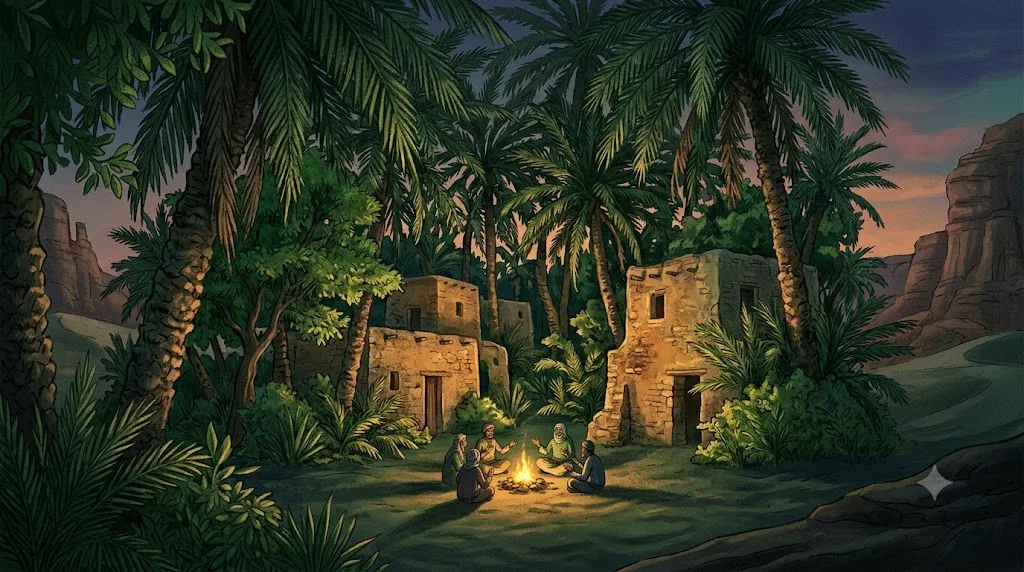
The most vivid supernatural landscape in modern public retellings of Libyan folklore is the far south-west, especially the Ghat region near the Algerian border. One frequently mentioned place is Kaf Ajnoun, often translated in English as the “Cave of the Jinn” or “Fortress of the Jinn”. Descriptions place it near Ghat and the Wadi Tanezuft area, presenting it as a natural rock fortress whose name and reputation are tied to Tuareg and desert stories of unseen beings.[Temehu]temehu.comOpen source on temehu.com.
The stories attached to the cave are typical of jinn folklore across many Muslim societies, but their Libyan setting gives them a strong local flavour. Reports and travel retellings speak of strange voices, eerie night sounds, and an animal apparition sometimes described as a deer that cannot be caught and is believed by some narrators to be a jinn in animal form. These should be read as local traditions and traveller lore, not as verified events. Their importance lies in what they reveal about desert imagination: remote rock formations, darkness, echoes, animal movement and danger become part of a supernatural geography.[Libya Observer]libyaobserver.lyhave you heard jinn cave ghathave you heard jinn cave ghat
Jinn traditions also help explain why the Libyan Sahara is so productive as folklore space. In Islamic and Arabic storytelling more broadly, jinn are hidden beings who may dwell in desolate places, ruins, caves and wilderness. Libyan local stories adapt that wider belief to named sites, making the landscape itself memorable. The result is not simply “a haunted cave”, but a way of mapping caution, awe and local identity onto a difficult environment.[Wikipedia]WikipediaOpen source on wikipedia.org.

Older layers: Amazigh religion and ancient Libyan myth
Libya’s older religious and mythic layers are harder to reconstruct than its better-documented archaeological heritage, but several clues matter. Ancient sources and later scholarship point to ancestor veneration among some Berber or Amazigh groups, including the Awjila region in Cyrenaica. Accounts associated with the classical writer Pomponius Mela describe the Augilae as consulting the spirits of the dead and treating ancestral powers as protective or influential. This is not “modern Libyan folklore” in a simple sense, but it is part of the deep background from which North African ideas about tombs, ancestors and sacred places can be understood.[Libyan Heritage House]libyanheritagehouse.orgOpen source on libyanheritagehouse.org.
Classical Greek writers also imagined Libya as a mythic landscape. Lake Tritonis, placed by ancient authors in “Libya” in the broad classical sense of North Africa, was associated with Triton, Tritonis and a Libyan version of Athena. Herodotus described Libyan women’s ritual practices and suggested links between Libyan customs and Greek representations of Athena, though his account must be read with care because Greek ethnographic writing often filtered African peoples through outsider assumptions.[Theoi Greek Mythology]theoi.comGreek Mythology TRITONISGreek Mythology TRITONIS
Another important older figure is Gurzil, a deity associated with the Laguatan of late antique Tripolitania. The sixth-century Latin poet Corippus describes Gurzil as linked to Ammon and to a cow, and later scholarship debates whether he should be seen as a bull god, a desert god, or a more complex local deity. The key point for folklore readers is that Libya’s supernatural past was not only imported from Greece, Rome or Islam. North African communities had their own local divine and protective figures, some of which appear only briefly and partially in outside texts.[wikipedia.org]WikipediaOpen source on wikipedia.org.
Folktales from Tripoli and eastern Libya
One of the clearest windows into Libyan folktale tradition is Hans Stumme’s nineteenth-century collection of tales and poems from Tripoli, published in 1898. It is a linguistic and folkloric source rather than a modern children’s book, recording material in the Arabic dialect of the city with translation and commentary. Its importance is that it preserves Libyan narrative material from a time before radio, television and the internet reshaped storytelling habits.[Internet Archive]archive.orgOpen source on archive.org.
The best-known tale from this older collected material in English is “Udea and Her Seven Brothers”, later retold in Andrew Lang’s The Grey Fairy Book. The story begins with a family of seven sons and a long-lost sister, then turns into a journey tale involving deception, danger, a castle, a cat, birds and a man-eating figure. Like many folktales, it is not “uniquely Libyan” in every motif; it belongs to a wider family of North African and international story types. What makes it valuable for Libya is its Tripolitanian collection history and its local place in the archive of Arabic oral tales.[wikipedia.org]WikipediaUdea and Her Seven BrothersUdea and Her Seven Brothers
Eastern Libya has also produced important collected fairy-tale material. A modern Libyan anthology gathered tales from the Jabal Akhdar region of Cyrenaica, associated with the folklorist and short-story writer Ahmad Yusuf Agila. Reports on the book describe it as an unusually significant recent Libyan collection of fairy tales, which matters because oral material is often fragile: it can vanish quickly when older tellers die, when dialects lose prestige, or when families stop passing stories down at home.[The Silphium Gatherer | مجمّع سلفيوم]silphiumgatherer.comlibyan fairytaleslibyan fairytales
Animals, trickery and memory in Libyan tales
Animal tales are one of the most memorable strands of Libyan story culture. Modern scholarship on Libyan writing argues that animal tales are not merely childish entertainment; they can carry “deep history”, recalling older relations between people, land, animals, nomads and vulnerability. In modern Libyan childhood narratives, animal stories told by women become a way to recover collective memory and to speak about violence, empire and social fragility indirectly.[Cambridge Repository]repository.cam.ac.ukCambridge Repository Animal Tales as Deep History in Modern Libyan WritingCambridge Repository Animal Tales as Deep History in Modern Libyan Writing
This helps explain why Libyan folklore should not be reduced to monsters and ghosts. Many of its tales work through recognisable folktale engines: the clever weak character, the dangerous stranger, the disguised threat, the testing journey, the household rule that must not be broken, and the animal that knows more than a human child. These patterns connect Libya to wider Arab, Amazigh, Mediterranean and African storytelling worlds, while still being rooted in local dialects, places and social experience.[Wikipedia]WikipediaUdea and Her Seven BrothersUdea and Her Seven Brothers
Vernacular poetry belongs in this picture too. Libyan folk culture has long used dialect poetry as a vehicle for memory, feeling and history. A study of Libyan vernacular poetry describes it as an oral tradition with historical value, passed through generations because its dialect, rhythm and imagery make it memorable. For folklore readers, this matters because not every “legend” is a prose tale; some of Libya’s traditional imagination lives in sung or recited forms.[Folk Culture BH]folkculturebh.orgOpen source on folkculturebh.org.
Saints, shrines and sacred protection
Libyan folk religion has also centred on saints, shrines and Sufi institutions. A country study on Libya describes the veneration of saints as especially widespread in rural areas, with blessing or spiritual power believed to remain associated with saints’ tombs after death. Such traditions were particularly numerous in Cyrenaica, though their strength varied by region and way of life.[Country Studies]countrystudies.usCountry Studies LibyaCountry Studies Libya
The Sufi lodge or shrine complex has been one of the main places where religious learning, local memory and sacred geography meet. The Asmariya complex at Zliten, associated with the sixteenth-century figure Abdessalam al-Asmar, is a major example: recent reporting describes it as a place of Qur’anic instruction, manuscripts, religious study and Sufi heritage. In folklore terms, such sites matter not because they are “myths” in the narrow sense, but because they anchor stories of blessing, saintly authority, protection and communal continuity.[AW]thearabweekly.comlibya sufis strive protect their heritage they come openlibya sufis strive protect their heritage they come open
This heritage is contested today. Since 2011, Sufi shrines and sites in Libya have been damaged or destroyed by hard-line groups who reject shrine veneration as idolatry. Reports from the British Council and specialist coverage of Libyan Sufism describe attacks on shrines, mosques and heritage sites, as well as attempts by Sufi communities to preserve or restore them. This is one of the clearest cases where folklore, religion and heritage politics overlap: a shrine can be a sacred place for one community, a historical monument for another, and a target for ideological destruction for a third.[britishcouncil.org]britishcouncil.orguk old relationship libyauk old relationship libya
Ghadames and the living heritage of the oasis
Ghadames is not primarily famous because of one monster or one legend. Its folklore value lies in the way built space, seasonal gathering, women’s worlds, crafts, music and oasis memory come together. UNESCO describes the Old Town of Ghadames as a remarkable traditional settlement whose architecture, crafts and cultural practices preserve a balanced relationship between environment, social life and desert conditions.[UNESCO World Heritage Centre]whc.unesco.orgOpen source on unesco.org.
Modern heritage events in Ghadames show how tradition becomes public performance. Reports on festivals in the town describe Tuareg traditions, craft displays, singing, dancing, traditional dress, camel and horse events, and families returning to the old town for celebrations. These are not all “ancient survivals” in a pure form; festivals often reshape heritage for tourism, media and national display. Even so, they keep oral and performative culture visible in a country where conflict and migration have put many heritage practices under pressure.[tourslibya.com]tourslibya.comOpen source on tourslibya.com.
Ghadames also shows why folklore cannot be separated from preservation. In 2025, UNESCO removed the Old Town of Ghadames from the List of World Heritage in Danger after conservation work reduced threats to the site. That decision concerns architecture and management, but it also matters for intangible culture: stories, songs, festivals and local memories need places where they can still be performed and recognised.[King's College London]kcl.ac.ukKing's College London King's project helps to remove Libyan World Heritage SiteKing's College London King's project helps to remove Libyan World Heritage Site
Tadrart Acacus: rock art, memory and the limits of myth
The rock-art sites of Tadrart Acacus in south-western Libya are among the country’s most powerful ancient story landscapes. UNESCO describes thousands of paintings and engravings in different styles, dating from around 12,000 BC to AD 100, reflecting changing animals, environments and ways of life in the Sahara. The images include periods when the region was far wetter than today, with animals such as giraffes, elephants and cattle appearing in the broader rock-art record.[UNESCO World Heritage Centre]whc.unesco.orgOpen source on unesco.org.
It would be tempting to call this “mythology in pictures”, but that would go too far. Rock art can show ritual, memory, animal knowledge, identity and environment, but we usually cannot translate it into named myths with characters and plots. Its folklore importance is more subtle: it gives Libya one of the oldest visible archives of human imagination in the Sahara, long before written literary traditions.[UNESCO World Heritage Centre]whc.unesco.orgOpen source on unesco.org.
The Acacus also reveals how fragile legendary landscapes can be. Scholarly and heritage reports have documented vandalism and damage to the rock-art sites, especially in the modern period of weak protection and increased pressure on heritage locations. For readers interested in folklore, this is a reminder that oral and visual traditions are not just charming survivals; they are vulnerable records of how communities understood animals, land, movement and sacred or social life.[ResearchGate]researchgate.netOpen source on researchgate.net.
Jewish Libyan tales and memory after migration
Libya’s folklore also includes the traditions of Libyan Jews, whose communities largely left the country in the twentieth century. Recent scholarship on Libyan Jewish folktales examines how stories expressed social, cultural and political perceptions, including subjects that could be difficult to discuss openly in everyday life. The available book descriptions point to themes such as marriage, gender, social hierarchy, Muslim-Jewish relations, demons, rabbis, rulers and miraculous events.[Google Books]books.google.comCultural Social and Political PerceptionCultural Social and Political Perception
These tales are important because they show that Libyan folklore is not only the heritage of those currently living within Libya’s borders. Migration can turn folklore into portable memory. A tale told in Tripoli, Derna, Zliten or another Libyan setting may later be preserved in Israel, Italy or elsewhere by families and archives. The Israel Folktale Archives, for example, collected stories from immigrants from Libya and other Arab lands, and published selections in English-language scholarship on Jewish folktales from Arab lands.[Jewish Book Council]jewishbookcouncil.orgJewish Book Council Folktales of the Jews, Volume 3: Tales from Arab LandsJewish Book Council Folktales of the Jews, Volume 3: Tales from Arab Lands
This diaspora dimension complicates any simple national folklore page. Some Libyan stories now survive most visibly outside Libya, in family memory, academic archives and diaspora publishing. They remain Libyan in origin and setting, but their modern life belongs to migration, translation and remembrance.[JSTOR]jstor.orgJewish Libya: Memory and Identity in Text and ImageJewish Libya: Memory and Identity in Text and Image
Modern writers and the afterlife of folklore
Libyan folklore has not remained frozen in old collections. Modern Libyan writers have repeatedly drawn on oral tales, animals, desert memory, saints, jinn-like presences and magical or uncanny atmospheres. One study of animal tales in modern Libyan writing argues that oral traditions provide a connection to land before the nation-state and help writers resist simplified official histories.[Cambridge Repository]repository.cam.ac.ukArticle CharisArticle Charis
Ibrahim al-Koni is especially important in this respect. His fiction, rooted in Saharan and Tuareg worlds, often turns animals, desert signs, ascetic journeys and spiritual ambiguity into literary form. English-language discussion of Libyan literature has also emphasised how modern Libyan storytelling developed under pressure from colonialism, censorship, exile and political upheaval, making indirect, symbolic and fantastic modes especially useful.[Words Without Borders]wordswithoutborders.orgOpen source on wordswithoutborders.org.
The modern afterlife of folklore is therefore not simply a matter of retelling old tales for children. In Libya, traditional story materials have helped writers think about power, memory, exile, ecological change, gender, violence and survival. That is one reason the boundary between “folklore” and “literature” is especially porous in the Libyan case.[Cambridge Repository]repository.cam.ac.ukCambridge Repository Animal Tales as Deep History in Modern Libyan WritingCambridge Repository Animal Tales as Deep History in Modern Libyan Writing
How old and well-attested are these traditions?
Libyan folklore has uneven evidence. Some layers are ancient but filtered through outsiders, such as Greek and Roman-era writing about Libyan gods, Lake Tritonis or Amazigh customs. These sources are valuable, but they are not neutral recordings of Libyans speaking for themselves.[Philip Harland]philipharland.comlibyans herodotos fifth century bcelibyans herodotos fifth century bce
Other materials are better understood as collected oral literature. Stumme’s Tripoli collection, later retellings in European fairy-book form, and modern Libyan fairy-tale anthologies give firmer evidence that particular tales circulated in Libyan settings. Even then, collectors shaped what was written down, how dialect was represented, and how stories were translated for outside readers.[archive.org]archive.orgOpen source on archive.org.
The thinnest evidence belongs to haunted-place legends and internet-era retellings. Kaf Ajnoun and the Ghat jinn stories are clearly meaningful in modern Libyan travel and local-story contexts, but many available English accounts are short, touristic or anecdotal. They are best presented as living legend and place-lore, not as ancient myths with stable canonical texts.[Libya Observer]libyaobserver.lyhave you heard jinn cave ghathave you heard jinn cave ghat
What readers often misunderstand
The first misunderstanding is to expect Libya to have one unified “mythology” like a modern fantasy bestiary. Libya’s traditions are regional, multilingual, religiously layered and unevenly documented. A Tripoli fairy tale, a Tuareg jinn legend and a Sufi shrine tradition may all be Libyan, but they come from different social worlds.[archive.org]archive.orgOpen source on archive.org.
The second misunderstanding is to treat every ancient reference to “Libya” as a direct reference to the modern state. In Greek and Roman writing, “Libya” often meant a much broader North African space. Myths of Lake Tritonis, Athena or the personified Libya are relevant to the cultural history of the region, but they should not be forced into a simple modern national box.[Theoi Greek Mythology]theoi.comGreek Mythology TRITONISGreek Mythology TRITONIS
The third misunderstanding is to separate folklore from heritage politics. In Libya, stories and sacred places have been affected by war, displacement, tourism, ideological conflict and preservation work. The survival of a shrine, an old town, a rock-art panel or a folktale collection is not automatic. It depends on communities, archives, scholars, conservators and sometimes fragile political conditions.[unesco.org]whc.unesco.orgWorld Heritage Centre LibyaWorld Heritage Centre Libya
Why Libya’s folklore still matters
Libyan folklore matters because it gives the country a cultural depth that cannot be captured by headlines about war, oil or migration. It shows Libya as a place of storytellers, desert routes, oasis festivals, saintly lineages, women’s oral memory, animal fables, Jewish diaspora tales, ancient rock art and modern literary reinvention.[cam.ac.uk]repository.cam.ac.ukArticle CharisArticle Charis
It also matters because Libya’s traditions are unusually exposed to loss. Oral storytelling can disappear within a generation. Rock art can be vandalised. Shrines can be destroyed. Old towns can empty out. Diaspora memories can fade if they are not recorded. The most honest way to approach Libyan folklore is therefore not to inflate it into a neat mythology, but to recognise its richness, its gaps and its living fragility.[academia.edu]academia.eduOpen source on academia.edu.
Amazon book picks
Further Reading
Books and field guides related to Where Libya's Stories Haunt the Landscape. Use these as the next step if you want deeper reading beyond the article.
The Arabian Nights
Provides context for narrative motifs, jinn traditions and storytelling culture found across North Africa.
The Myth of the Eternal Return
Offers a framework for understanding sacred landscapes, ritual memory and traditional belief.
Arab Folktales
Libyan folklore sits within wider Arabic storytelling traditions represented in this anthology.
Berber Government: The Kabyle Polity in Pre-colonial Algeria
Helps readers understand Amazigh cultural backgrounds that influenced parts of Libyan folklore.
eBay marketplace picks
Marketplace Samples
Live-tested eBay searches with available results related to this page.

Endnotes
1.
Source: whc.unesco.org
Link:https://whc.unesco.org/en/list/287/
2.
Source: whc.unesco.org
Link:https://whc.unesco.org/en/list/362/
3.
Source: archive.org
Link:https://archive.org/details/mrchenundgedich00stumgoog
4.
Source: temehu.com
Link:https://www.temehu.com/Cities_sites/kaf-ajnoun.htm
5.
Source: books.google.com
Title: Cultural Social and Political Perception
Link:https://books.google.com/books/about/Cultural_Social_and_Political_Perception.html?id=5WIfEQAAQBAJ
6.
Source: theoi.com
Title: Greek Mythology TRITONIS
Link:https://www.theoi.com/Nymphe/NympheTritonis.html
7.
Source: ich.unesco.org
Link:https://ich.unesco.org/en/state/libya-LY
8.
Source: Wikipedia
Link:https://en.wikipedia.org/wiki/Jinn
9.
Source: Wikipedia
Link:https://en.wikipedia.org/wiki/Traditional_Berber_religion
10.
Source: Wikipedia
Link:https://en.wikipedia.org/wiki/Gurzil
11.
Source: columbia.edu
Link:https://www.columbia.edu/itc/history/conant/Mattingly.pdf
12.
Source: Wikipedia
Title: Udea and Her Seven Brothers
Link:https://en.wikipedia.org/wiki/Udea_and_Her_Seven_Brothers
13.
Source: silphiumgatherer.com
Title: libyan fairytales
Link:https://silphiumgatherer.com/2016/06/28/libyan-fairytales/
14.
Source: folkculturebh.org
Link:https://www.folkculturebh.org/en/index.php?id=185&issue=38&page=article
15.
Source: Wikipedia
Title: Zawiya (institution)
Link:https://en.wikipedia.org/wiki/Zawiya_%28institution%29
16.
Source: en.minbarlibya.org
Title: the sufi struggle in libya
Link:https://en.minbarlibya.org/2017/12/02/the-sufi-struggle-in-libya/
17.
Source: news.trust.org
Title: 20200316052222 voar7
Link:https://news.trust.org/item/20200316052222-voar7
18.
Source: africanews.com
Title: thousands flock to pearl of the desert in libya for heritage event
Link:https://www.africanews.com/2023/02/04/thousands-flock-to-pearl-of-the-desert-in-libya-for-heritage-event/
19.
Source: acacus.org
Title: Rock art
Link:https://www.acacus.org/research/rock-art
20.
Source: researchgate.net
Link:https://www.researchgate.net/publication/262450097_UNESCO_World_Heritage_Site_vandalised_Report_on_damages_to_Acacus_rock_art_SW_Libya
21.
Source: academia.edu
Link:https://www.academia.edu/881492/UNESCO_World_Heritage_Site_vandalised_Report_on_damages_to_Acacus_rock_art_SW_Libya_
22.
Source: jstor.org
Title: Jewish Libya: Memory and Identity in Text and Image
Link:https://www.jstor.org/stable/j.ctt20p574k
23.
Source: whc.unesco.org
Title: World Heritage Centre Libya
Link:https://whc.unesco.org/en/statesparties/ly
24.
Source: ich.unesco.org
Link:https://ich.unesco.org/en/lists
25.
Source: whc.unesco.org
Link:https://whc.unesco.org/document/180796
26.
Source: unesco.org
Title: document 1145
Link:https://www.unesco.org/archives/multimedia/document-1145
27.
Source: Wikipedia
Link:https://en.wikipedia.org/wiki/Libya
28.
Source: Wikipedia
Title: Tuareg people
Link:https://en.wikipedia.org/wiki/Tuareg_people
29.
Source: Wikipedia
Title: Libyan literature
Link:https://en.wikipedia.org/wiki/Libyan_literature
30.
Source: Wikipedia
Title: List of World Heritage Sites in Libya
Link:https://en.wikipedia.org/wiki/List_of_World_Heritage_Sites_in_Libya
31.
Source: Wikipedia
Title: Lake Tritonis
Link:https://en.wikipedia.org/wiki/Lake_Tritonis
32.
Source: Wikipedia
Title: Libya (daughter of Epaphus)
Link:https://en.wikipedia.org/wiki/Libya_%28daughter_of_Epaphus%29
33.
Source: Wikipedia
Title: Ancient Libya
Link:https://en.wikipedia.org/wiki/Ancient_Libya
34.
Source: Wikipedia
Title: Acacus Mountains
Link:https://en.wikipedia.org/wiki/Acacus_Mountains
35.
Source: Wikipedia
Title: Jewish folklore
Link:https://en.wikipedia.org/wiki/Jewish_folklore
36.
Source: Wikipedia
Link:https://en.wikipedia.org/wiki/Sufism
37.
Source: Wikipedia
Link:https://en.wikipedia.org/wiki/Sanusiyya
38.
Source: theoi.com
Title: TIMEORO I LIBYES
Link:https://www.theoi.com/Nymphe/NymphaiLibyes.html
39.
Source: temehu.com
Link:https://www.temehu.com/tours/paranormal_sites_in_libya.htm
40.
Source: temehu.com
Link:https://www.temehu.com/imazighen/tamazight-mythology.htm
41.
Source: temehu.com
Link:https://www.temehu.com/Cities_sites/meghedet.htm
42.
Source: researchgate.net
Link:https://www.researchgate.net/publication/391004901_EXPLORING_CULTURAL_ANTHROPOLOGY_IN_LIBYA_HERITAGE_IDENTITY_AND_SOCIAL_DYNAMICS
43.
Source: researchgate.net
Link:https://www.researchgate.net/publication/388409115_Renaissance_of_Islam_in_North_Africa_A_Historical_and_Religious_Analysis
44.
Source: researchgate.net
Link:https://www.researchgate.net/publication/249594518_Magical_Realism_in_Libya
45.
Source: researchgate.net
Title: 338994073 The History Of Short Story In Modern Libyan Literature Analytic Study
Link:https://www.researchgate.net/publication/338994073_The_History_Of_Short_Story_In_Modern_Libyan_Literature_Analytic_Study
46.
Source: researchgate.net
Link:https://www.researchgate.net/publication/363594228_Ghadames_Libya_A_traditional_Earthen_Settlement_Resilient_to_Crises_and_Environmental_Challenges
47.
Source: researchgate.net
Link:https://www.researchgate.net/publication/374022066_ATLAS_of_Tadrart_Acacus_rock_art_A_UNESCO_World_Heritage_site_in_southwestern_Libya
48.
Source: books.google.com
Title: ATLAS of Tadrart Acacus rock art A UNESC
Link:https://books.google.com/books/about/ATLAS_of_Tadrart_Acacus_rock_art_A_UNESC.html?id=c0e1EAAAQBAJ
49.
Source: play.google.com
Title: Cultural Social and Political Perceptions in the F
Link:https://play.google.com/store/books/details/Cultural_Social_and_Political_Perceptions_in_the_F?hl=fr&id=5WIfEQAAQBAJ
50.
Source: jstor.org
Title: Jewish Folklore Studies
Link:https://www.jstor.org/stable/1396473
51.
Source: academia.edu
Title: An Ethnographic Discussion of Fairy Tales and Folktales from Southern Oman
Link:https://www.academia.edu/78422166/An_Ethnographic_Discussion_of_Fairy_Tales_and_Folktales_from_Southern_Oman
52.
Source: repository.cam.ac.uk
Title: Article Charis
Link:https://www.repository.cam.ac.uk/bitstream/1810/293038/2/ArticleCharis.pdf
53.
Source: philipharland.com
Title: libyans herodotos fifth century bce
Link:https://www.philipharland.com/Blog/2022/08/libyans-herodotos-fifth-century-bce/
54.
Source: countrystudies.us
Title: Country Studies Libya
Link:https://countrystudies.us/libya/52.htm
55.
Source: thearabweekly.com
Title: libya sufis strive protect their heritage they come open
Link:https://thearabweekly.com/libya-sufis-strive-protect-their-heritage-they-come-open
56.
Source: libyaobserver.ly
Title: have you heard jinn cave ghat
Link:https://libyaobserver.ly/life/have-you-heard-jinn-cave-ghat
57.
Source: libyanheritagehouse.org
Link:https://libyanheritagehouse.org/religion/amazigh-religion-in-libya
58.
Source: philipharland.com
Link:https://www.philipharland.com/Blog/2023/04/libyans-and-maurians-corippus-poetic-survey-of-peoples-in-the-tale-of-john-troglita-after-548-ce/
59.
Source: sacred-texts.com
Link:https://sacred-texts.com/neu/lfb/gy/gyfb17.htm
60.
Source: repository.cam.ac.uk
Title: Cambridge Repository Animal Tales as Deep History in Modern Libyan Writing
Link:https://www.repository.cam.ac.uk/bitstreams/6be787a2-5126-4c26-af9d-9eab8235c4b4/download
61.
Source: britishcouncil.org
Title: uk old relationship libya
Link:https://www.britishcouncil.org/voices-magazine/uk-old-relationship-libya
62.
Source: tourslibya.com
Link:https://tourslibya.com/festivals/ghadames-festival/
63.
Source: thearabweekly.com
Title: crafts festival seeks attract visitors libyas pearl desert
Link:https://thearabweekly.com/crafts-festival-seeks-attract-visitors-libyas-pearl-desert
64.
Source: kcl.ac.uk
Title: King’s College London King’s project helps to remove Libyan World Heritage Site
Link:https://www.kcl.ac.uk/news/libyan-world-heritage-site-removed-from-unescos-list-of-world-heritage-in-danger
65.
Source: jewishbookcouncil.org
Title: Jewish Book Council Folktales of the Jews, Volume 3: Tales from Arab Lands
Link:https://www.jewishbookcouncil.org/book/folktales-of-the-jews-volume-3-tales-from-arab-lands
66.
Source: jps.org
Title: folktales of the jews volume 3
Link:https://jps.org/books/folktales-of-the-jews-volume-3/
67.
Source: wordswithoutborders.org
Link:https://wordswithoutborders.org/read/collection/july-2006/
68.
Source: silphiumgatherer.com
Title: short story collection magic lanterns libyan lit 2006
Link:https://silphiumgatherer.com/2026/06/26/short-story-collection-magic-lanterns-libyan-lit-2006/
69.
Source: silphiumgatherer.com
Title: stumme poem
Link:https://silphiumgatherer.com/2020/06/20/stumme-poem/
70.
Source: mythus.fandom.com
Link:https://mythus.fandom.com/wiki/Gurzil
71.
Source: mythus.fandom.com
Link:https://mythus.fandom.com/wiki/Libya
72.
Source: beastsoflegend.com
Title: North Africa
Link:https://beastsoflegend.com/bestiary/africa/north-africa/
73.
Source: ewalukaszyk.com
Link:https://www.ewalukaszyk.com/libya.html
74.
Source: libyaobserver.ly
Title: libya moves preserve cultural heritage unesco support
Link:https://libyaobserver.ly/culture/libya-moves-preserve-cultural-heritage-unesco-support
75.
Source: en.wikisource.org
Title: The Grey Fairy Book
Link:https://en.wikisource.org/wiki/The_Grey_Fairy_Book
76.
Source: tourslibya.com
Link:https://tourslibya.com/fezzan/acacus-engravings/
77.
Source: um.edu.mt
Link:https://www.um.edu.mt/library/oar/bitstream/123456789/107534/1/Cassar-Pullicino%20J._Some%20parallels%20between%20Maltese%20and%20Arabic%20folklore_Acta%20Ethnographica%20Acad.Sci.Hung.%2034%281-4%29_1988.pdf
78.
Source: ndl.ethernet.edu.et
Link:https://ndl.ethernet.edu.et/bitstream/123456789/88320/1/%5BF._Abiola_Irele%2C_Simon_Gikandi%5D_The_Cambridge_His%28BookFi.org%29%20%281%29.pdf
79.
Source: dash.harvard.edu
Link:https://dash.harvard.edu/bitstreams/9c34ae90-f85d-4326-9b0a-71fff8d0d0c8/download
80.
Source: publish.ojs-indonesia.com
Link:https://publish.ojs-indonesia.com/index.php/SIWAYANG/article/download/2702/1165
Additional References
81.
Source: youtube.com
Title: Libyans Fight ISIS & Nature to Try and Save Ancient Greek Ruins of Cyrenaica
Link:https://www.youtube.com/watch?v=iQxFSFk_AIA
Source snippet
Discover The Tuareg People: The Blue People of the Sahara...
82.
Source: linkedin.com
Link:https://www.linkedin.com/posts/ahmed-abdessame-26448355_stories-revealed-about-this-place-in-far-activity-7119598079149797376-gPg2?trk=public_profile
83.
Source: travel-magical-morocco.com
Link:https://www.travel-magical-morocco.com/amazigh-the-proud-guardians-of-an-ancient-culture/
84.
Source: scribd.com
Link:https://www.scribd.com/document/465779714/Berber-Mythology-Berber-Deities-Guanche-Mythology-Libya-in-Greek-Mythology
85.
Source: ancient-origins.net
Link:https://www.ancient-origins.net/ancient-places-africa/rich-mythology-and-megalithic-culture-ancient-berbers-lords-desert-003216
86.
Source: vitalsource.com
Link:https://www.vitalsource.com/ie/products/cultural-social-and-political-perceptions-in-the-rachel-simon-v9781036409692?srsltid=AfmBOopN7iTE5_YFWdm24W6BPpyYiW1NOZgwsoFgFGWzYMfcitvcfK45
87.
Source: amazon.sg
Link:https://www.amazon.sg/Cultural-Social-Political-Perceptions-Folktales/dp/1036450287?tag=searcht-20
88.
Source: amazon.com.mx
Link:https://www.amazon.com.mx/Cultural-Social-Political-Perceptions-Folktales/dp/1036409686?tag=searcht-20
89.
Source: medium.com
Link:https://medium.com/%40krishanukundu/does-anyone-here-believe-in-the-supernatural-fa74a6210ccd
90.
Source: mythlok.com
Link:https://mythlok.com/world-mythologies/african/north-african-mythology/moroccan-libyan/
Topic Tree
Follow this branch
Related pages 192
- Afghan Folklore
- Albanian Folklore
- Algerian Folklore
- Australian Folklore
- Azerbaijan Folklore
- +187 more in sidebar