Within Nepal Folklore
When Demons Dance to Protect Kathmandu
Lakhe dances show how frightening demon figures can become protectors when honoured through masks, offerings and public performance.
On this page
- Who or what is the Lakhe
- Masks, offerings and ritual preparation
- Indra Jatra and protective street performance
Page outline Jump by section
Introduction
Few figures in Nepalese festival culture capture the imagination as strongly as the Lakhe: a red-faced, fanged demon who charges through crowded streets to the sound of drums. At first glance the character seems frightening, even dangerous. Yet in Newar tradition, especially in the Kathmandu Valley, the Lakhe is not simply a monster. He is a protector. The annual Lakhe dances demonstrate a distinctive idea at the heart of many Newar festivals: powerful and potentially destructive beings are not always rejected or defeated. Instead, they are honoured, controlled through ritual, and brought into civic life as guardians of the community.[Wikipedia]WikipediaOpen source on wikipedia.org.

This transformation of a demon into a protector is one of the most memorable themes in Nepalese folklore. Through masks, offerings, music and public performance, the Lakhe becomes a living reminder that fearsome forces can be redirected toward the welfare of the city rather than its destruction.[Nepal Legacy]nepallegacy.comNepal Legacy Majipa Lakhey Aaju: The Legendary Guardian DemonNepal LegacyMajipa Lakhey Aaju: The Legendary Guardian DemonSeptember 22, 2024 — Despite being viewed by many as a demon that hunts peopl…
Who or What Is the Lakhe?
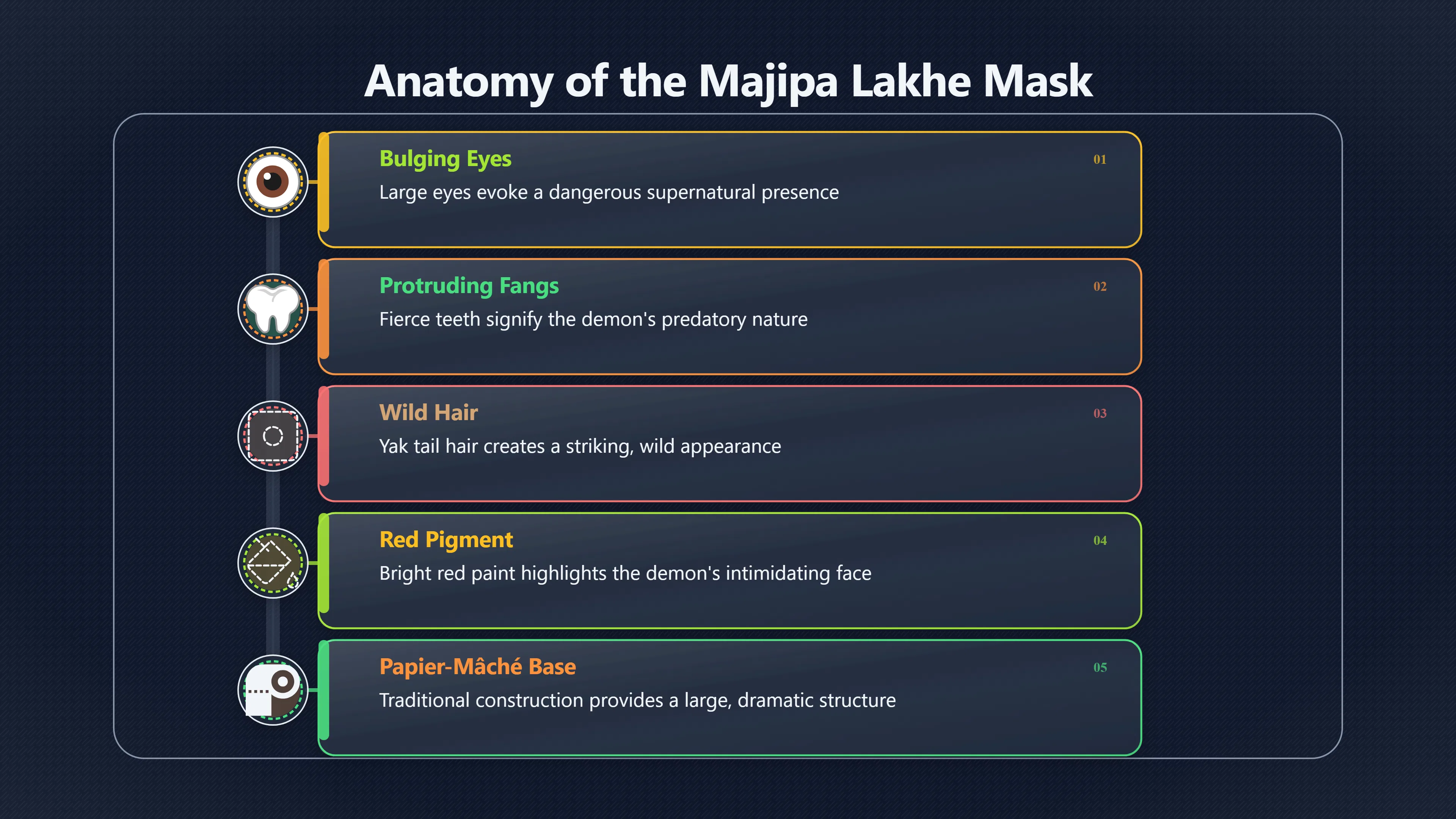
The Lakhe is a legendary demon figure found in Newar folklore and ritual culture throughout the Kathmandu Valley and other Newar settlements. He is traditionally portrayed with bulging eyes, protruding fangs, wild hair and an intimidating expression. The visual design is meant to evoke a dangerous supernatural being rather than a benevolent deity.[Wikipedia]WikipediaOpen source on wikipedia.org.
Yet folklore surrounding the best-known Lakhe, the Majipa Lakhe of Kathmandu, tells a more complicated story. According to popular traditions, this demon entered the city after falling in love with a local woman. When his true nature was discovered, he was brought before the king. Rather than banishing him completely, the ruler allowed him to remain on the condition that he protect the city’s inhabitants—especially its children—and help drive away harmful spirits. The demon accepted the bargain and became a guardian of Kathmandu.[wikipedia.org]WikipediaMajipa LakheyMajipa Lakhey
Different versions of the story exist, as is common in oral tradition. Some connect the Lakhe with the expulsion of other dangerous beings from the city, while others emphasise his role as a protector associated with Bhairava, a fierce form of divine power. What remains consistent is the central idea that a frightening supernatural force has been incorporated into the moral and ritual life of the community.[Wikipedia]WikipediaMajipa LakheyMajipa Lakhey
This is an important feature of Newar festival culture. The Lakhe is not celebrated because he is harmless. He is celebrated because his power is considered useful when properly recognised and ritually contained.[The Wonder Nepal]thewondernepal.comBut unlike fearsome demons of popular lore, the Majipa…Read more…
Masks, Offerings and Ritual Preparation
The Lakhe exists most visibly through performance. The dancer’s costume is designed to transform an ordinary person into a supernatural presence. Traditional masks are large and dramatic, often painted bright red and fitted with fierce teeth, wide eyes and flowing hair. Historical descriptions note the use of papier-mâché construction and hair made from yak tails, creating a striking appearance even from a distance.[Wikipedia]WikipediaOpen source on wikipedia.org.
The costume is not merely theatrical decoration. In Newar understanding, masks used in sacred performance often carry ritual significance. Before appearing in public, the Lakhe must be prepared through established ceremonial practices, and communities treat the figure with respect rather than as a simple entertainer. During festival appearances, residents offer food and ritual items to the Lakhe as he moves through neighbourhoods and market squares.[Wikipedia]WikipediaOpen source on wikipedia.org.
The performance itself combines fear and celebration. Accompanied by traditional drums and cymbals, the dancer moves with explosive energy, spinning, stomping and rushing towards spectators. The crowd knows the figure is a performer, yet the dance deliberately creates a sense that something larger than an individual is present. The Lakhe becomes a temporary embodiment of a supernatural protector moving through the city.[Explore Himalaya]explorehimalaya.comExplore HimalayaLakhe Dance Nepal – The Ultimate Guide to This FestivalThe Lakhe Dance draws inspiration from the legend of the Lakhe, a…
One of the most famous recurring elements is the appearance of a small boy known as Jhyalincha. During performances, he taunts the Lakhe and is chased through the crowd. The playful pursuit introduces humour into an otherwise intimidating spectacle and highlights the festival’s mixture of danger, protection and entertainment.[wikipedia.org]WikipediaOpen source on wikipedia.org.
Indra Jatra and Protective Street Performance
The Lakhe’s most famous appearance occurs during Indra Jatra, one of Kathmandu’s major annual festivals. Known in the Newar tradition as Yenya, the celebration combines religious observances, processions, masked dances and public gatherings that fill the old city streets. The festival is often described as a celebration of both deities and demons, making it a fitting setting for the Lakhe’s appearance.[Wikipedia]WikipediaIndra JatraIndra Jatra
During Indra Jatra, the Majipa Lakhe emerges from his usual hidden status and moves through Kathmandu’s streets accompanied by musicians and attendants. He performs at crossroads, market squares and festival routes, drawing large crowds wherever he appears. Historically and symbolically, his movement through the city is not random. The performance marks the presence of a guardian power actively circulating through urban space.[Wikipedia]WikipediaOpen source on wikipedia.org.
Some accounts note that the Lakhe helps clear routes and maintain the festive atmosphere before major processions. His energetic presence creates excitement, but it also reinforces the idea that supernatural protection accompanies the celebration. The city becomes a stage on which divine, human and demonic forces interact under ritual control.[Wikipedia]WikipediaIndra JatraIndra Jatra
The annual reappearance of the Lakhe is therefore more than a dance performance. It renews an old relationship between the community and a powerful being who, according to tradition, pledged his strength to the city’s welfare.[Wikipedia]WikipediaMajipa LakheyMajipa Lakhey
Why the Lakhe Matters in Newar Folklore
For outsiders, the most surprising aspect of the Lakhe may be that a demon is treated with reverence. In many folklore traditions, monsters are enemies to be destroyed. The Lakhe represents a different approach. His story suggests that dangerous forces can be transformed rather than eliminated. Through ritual obligations, public recognition and repeated performance, a feared being becomes a civic guardian.[The Wonder Nepal]thewondernepal.comBut unlike fearsome demons of popular lore, the Majipa…Read more…
This idea appears repeatedly in Newar religious culture, where fierce figures are often respected for their protective abilities. The Lakhe’s terrifying face is not a contradiction of his role as a protector; it is evidence of the power that makes protection possible. A weak guardian would not be effective against dangerous spirits or misfortune. The Lakhe protects precisely because he remains formidable.[Nepal Legacy]nepallegacy.comNepal Legacy Majipa Lakhey Aaju: The Legendary Guardian DemonNepal LegacyMajipa Lakhey Aaju: The Legendary Guardian DemonSeptember 22, 2024 — Despite being viewed by many as a demon that hunts peopl…
The continued popularity of Lakhe dances also shows how folklore survives through performance. Rather than existing only in stories or manuscripts, the tradition is renewed every year in streets, squares and neighbourhood gatherings. The demon who once belonged to legend becomes visible again through movement, music and community participation.[Wikipedia]WikipediaOpen source on wikipedia.org.
In that sense, the Lakhe is one of the clearest examples of a broader Nepalese folkloric theme: frightening supernatural beings are not always kept outside society. Sometimes they are invited in, given a place, and asked to help protect the people they once threatened.[Wikipedia]WikipediaMajipa LakheyMajipa Lakhey
Amazon book picks
Further Reading
Books and field guides related to When Demons Dance to Protect Kathmandu. Use these as the next step if you want deeper reading beyond the article.
The Snow Leopard
Captures the spiritual and cultural atmosphere that informs many mountain legends.

The Cult of Kumari
Directly examines the living goddess institution, rituals and cultural meaning.
Nepal Mandala
Provides background on Newar festivals, masks, processions and sacred urban traditions.
eBay marketplace picks
Marketplace Samples
Live-tested eBay searches with available results related to this page.
Endnotes
1.
Source: Wikipedia
Link:https://en.wikipedia.org/wiki/Lakhey
2.
Source: Wikipedia
Title: Majipa Lakhey
Link:https://en.wikipedia.org/wiki/Majipa_Lakhey
3.
Source: Wikipedia
Link:https://es.wikipedia.org/wiki/Lakhey
4.
Source: artsandculture.google.com
Link:https://artsandculture.google.com/story/infamous-but-captivating-lakhe-dance-of-[nepal
Source snippet
Kathmandu witnessing the captivating Lakhe performance with little Jhyalincha during...Read more...
5.
Source: Wikipedia
Title: Indra Jatra
Link:https://en.wikipedia.org/wiki/Indra_Jatra
6.
Source: Wikipedia
Title: Newar dance
Link:https://en.wikipedia.org/wiki/Newar_dance
7.
Source: nepallegacy.com
Title: Nepal Legacy Majipa Lakhey Aaju: The Legendary Guardian Demon
Link:https://nepallegacy.com/cultural/majipa-lakhey-mask-dance/
Source snippet
Nepal LegacyMajipa Lakhey Aaju: The Legendary Guardian DemonSeptember 22, 2024 — Despite being viewed by many as a demon that hunts peopl...
Published: September 22, 2024
8.
Source: thewondernepal.com
Link:https://thewondernepal.com/articles/majipa-lakhey-naach-the-dance-of-the-masked-demon-kathmandus-living-heritage-on-the-brink/
Source snippet
But unlike fearsome demons of popular lore, the Majipa...Read more...
9.
Source: dntt.com.np
Title: lakhe dance in kathmandu valley a colorful festival experience
Link:https://www.dntt.com.np/detail/43/lakhe-dance-in-kathmandu-valley-a-colorful-festival-experience
Source snippet
The king allowed him to live in the city on one...Read more...
10.
Source: explorehimalaya.com
Link:https://explorehimalaya.com/lakhe-dance-kathmandu-vibrant-culture/
Source snippet
Explore HimalayaLakhe Dance Nepal – The Ultimate Guide to This FestivalThe Lakhe Dance draws inspiration from the legend of the Lakhe, a...
Additional References
11.
Source: apnews.com
Link:https://apnews.com/article/838cce2a5bf2e8a6745f6d53bd0f6c11
Source snippet
This weeklong festival marks the end of the monsoon and rice farming season and is especially celebrated by the Newar community. The even...
12.
Source: visitbudhanilkantha.com
Link:https://visitbudhanilkantha.com/festivals-events/lakhe-dance
Source snippet
Lakhe DanceThe interplay between and among the Lakhe, Jhyalincha and the crowd resembles microcosms of the world of demon, god and people...
13.
Source: facebook.com
Link:https://www.facebook.com/groups/318122976168561/posts/1471678297479684/
Source snippet
Lakhey demon in Nepali folkloreLakhey is a demon in Nepali folklore, specifically within Newari culture, known for both its fearsome app...
14.
Source: culturalsurvival.org
Link:https://www.culturalsurvival.org/publications/cultural-survival-quarterly/demon-among-deities
Source snippet
Cultural SurvivalA Demon Among Deities9 Jun 2010 — The demon, or Lakhe, dances wearing a huge red, terrifying mask with prominent, bawdy...
15.
Source: facebook.com
Link:https://www.facebook.com/TheNewars.Nepal/posts/majipa-lakhey-also-know-as-peaceful-bhairav-considered-to-be-the-protector-of-th/4376254372499599/
Source snippet
Majipa Lakhey also know as Peaceful Bhairav, considered...A legendary demon who held his realm by chasing away other demons...
16.
Source: instagram.com
Link:https://www.instagram.com/p/DR8haRgDzpm/
Source snippet
to ward off evil spirits and symbolize strength and...Read more...
17.
Source: facebook.com
Link:https://www.facebook.com/groups/culturalheritagesofnepal/posts/2181973145577526/
Source snippet
LAKHEY DANCE This dance is a great cultural tradition of...Where Demons Bring Luck: Join Nepal's Lakhe Celebration Ever seen a demon dance?...
18.
Source: facebook.com
Link:https://www.facebook.com/100057191870858/posts/a-legendary-lakhe-is-one-of-the-cultural-symbols-of-newar-indigenous-community-o/1011059517477101/
Source snippet
The mask is made of [papier- mâché]...Read more...
19.
Source: shankerhotel.com.np
Title: legend of majipa lakhey
Link:https://www.shankerhotel.com.np/blog/legend-of-majipa-lakhey
Source snippet
The Legend of Majipa | Hotel Shanker, Kathmandu, Nepal28 Sept 2019 — In the folklore of the Newar Deities passed on from ages, Lakhey's a...
20.
Source: culturesofnepal.wordpress.com
Title: love story of lakhey
Link:https://culturesofnepal.wordpress.com/2022/09/15/love-story-of-lakhey/
Source snippet
love story of Majipa Lakhey: The demon among the gods15 Sept 2022 — Lakhey is a demon in Newari culture. The fierce carnivore with the f...
Topic Tree