Where Tonga's Myths Still Meet the Land
Tonga’s folklore is not a separate fantasy world tucked away from ordinary life. It is tied to land, ocean, chiefly genealogy, dance, ceremony, sacred places and the way people explain where the islands and their social order came from.
Page outline Jump by section
Introduction
For a modern reader, the key point is this: Tongan folklore is both old and still active. Some pre-Christian divine stories survive as fragmentary or contested traditions after missionary suppression; other elements live publicly through dance, poetry, royal ceremony, heritage tourism and debates about how ancestral spirituality relates to Christianity today.[PMN | Pacific Media Network]pmn.co.nzPMN | Pacific Media Network Tonga’s ancient gods and the 21st centuryPMN | Pacific Media Network Tonga’s ancient gods and the 21st century
What makes Tongan folklore distinctive?
Tongan folklore belongs to the wider Polynesian story-world, so readers will recognise names such as Maui and Tangaloa from neighbouring traditions. What makes Tonga distinctive is the close link between myth, rank and landscape. Stories about gods and ancestors are not just explanations of the natural world; they also support ideas of kinship, chiefly authority, sacred descent and the special status of royal places. UNESCO’s tentative World Heritage description of Tonga’s ancient capitals says the Ha’amonga ‘a Maui and the royal tombs of Lapaha express a traditional political system that can be traced through oral traditions, genealogies and recorded history back to around 950 AD.[UNESCO World Heritage Centre]whc.unesco.orgWorld Heritage Centre The Ancient Capitals of the Kingdom of TongaWorld Heritage Centre The Ancient Capitals of the Kingdom of Tonga
That does not mean every legend can be read as literal history. Tongan tradition, like most oral tradition, mixes genealogy, sacred narrative, social memory, political meaning and poetic explanation. A monument may have a royal history, a mythic name and later interpretations layered on top of it. A goddess figure in a museum may be linked to Hikule’o by modern Tongan knowledge, while early European accounts may be less clear. Good folklore reading means holding these layers together instead of forcing them into a simple “true or false” box.[British Museum]britishmuseum.orgBritish Museumfigure | British MuseumBritish Museumfigure | British Museum
The other distinctive feature is Tonga’s survival as a monarchy. Sacred and royal themes are not only antiquarian. Tongatapu is still promoted as a place where tradition meets modern life, with visitors directed to the Ha’amonga ‘a Maui, the terraced tombs of past Tongan kings, the Royal Palace, markets, churches and cultural performances.[Tonga Tourism]tongatourism.travelTonga Tourism Our Islands | Tongatapu | Tonga TourismTonga Tourism Our Islands | Tongatapu | Tonga Tourism
The creation stories: ocean, land and divine kinship
Several Tongan creation traditions begin not with a familiar land-based garden, but with ocean, ancestral space and emergence. In a 2024 discussion of Tonga’s ancient gods, anthropologist Tēvita Ka’ili describes a Tongan creation account in which the ocean comes first, followed by early ancestors connected with seaweed and sea sediment, then a chain of beings leading to the major divine figures Hikule’o, Tangaloa and Maui.[PMN | Pacific Media Network]pmn.co.nzPMN | Pacific Media Network Tonga’s ancient gods and the 21st centuryPMN | Pacific Media Network Tonga’s ancient gods and the 21st century
These stories do several things at once. They explain the islands; they place people in a kin relationship with land and sea; and they make social order feel cosmic rather than merely political. Ka’ili presents the tradition as teaching that people have a genealogical tie to the ocean and land, and therefore a responsibility towards them. That modern ecological reading is not the same thing as saying every old story was environmentalism in a present-day sense, but it shows why the myths still matter: they provide a language of relationship rather than ownership.[PMN | Pacific Media Network]pmn.co.nzPMN | Pacific Media Network Tonga’s ancient gods and the 21st centuryPMN | Pacific Media Network Tonga’s ancient gods and the 21st century
A well-known strand of the tradition assigns different creative or cosmic roles to major figures. Hikule’o is associated with Pulotu, Tangaloa with the sky and divine descent, and Maui with feats of creation or island-fishing. One modern summary reports a tradition in which Hikule’o throws stones into the sea to create volcanic islands such as Kao, Tofua, Late, Fonualei and Hunga Tonga-Hunga Ha’apai, while Maui pulls up coral islands with his hook.[PMN | Pacific Media Network]pmn.co.nzPMN | Pacific Media Network Tonga’s ancient gods and the 21st centuryPMN | Pacific Media Network Tonga’s ancient gods and the 21st century
The important reader takeaway is that Tongan myth does not present creation as a single neat episode. It is a web of related stories: ocean beginnings, divine siblings, ancestral lands, island origins, chiefly descent and later Christian reinterpretation.

Hikule’o and Pulotu: the powerful, disputed heart of the old religion
Hikule’o is one of the most important and most difficult figures in Tongan folklore. In many modern accounts, Hikule’o is described as a goddess associated with Pulotu, an ancestral homeland or realm of the dead. The British Museum describes a late eighteenth- or early nineteenth-century Tongan whale-ivory female figure that “may represent Hikule’o”, goddess of Pulotu, while also noting uncertainty around the object’s identification.[British Museum]britishmuseum.orgBritish Museumfigure | British MuseumBritish Museumfigure | British Museum
That uncertainty matters. Museum objects, missionary reports and oral tradition do not always line up cleanly. The British Museum’s catalogue says the small carved figure was made by a Tongan carver more than 200 years ago, that such figures were connected with reverence for gods and goddesses before Christian missions, and that many were destroyed or desecrated after missionaries settled in Tonga in the early nineteenth century.[British Museum]britishmuseum.orgBritish Museumfigure | British MuseumBritish Museumfigure | British Museum
Specialist discussion of Tongan goddess figures shows the same complexity. Research on these figures notes that many Tongans consulted in the twentieth century identified such female figures as Hikule’o, but early missionary and voyager accounts did not consistently make that connection. The same study reports early accounts in which Hikule’o is the powerful ruler of Pulotu, associated with death and the Tu’i Tonga line, but with uncertain gender in some sources. Later scholarship has argued that, within Tongan structure, Hikule’o occupies the place of an elder sister and is best understood as female, while some male or serpent-like versions may reflect influence from related Samoan traditions.[SciSpace]scispace.comSci Space Tongan Figures: From Goddesses to Missionary Trophies to MasterpiecesSci Space Tongan Figures: From Goddesses to Missionary Trophies to Masterpieces
This makes Hikule’o a good example of how folklore changes over time. There is an older sacred figure, early outsider records that are partial and sometimes confused, later museum identifications, Tongan scholarly reinterpretation and contemporary cultural revival. Hikule’o is not merely a “monster” or “underworld goddess” in a simple fantasy sense. She sits at the meeting point of death, fertility, chiefly sacredness, gender, harvest and ancestral power.[PMN | Pacific Media Network]pmn.co.nzPMN | Pacific Media Network Tonga’s ancient gods and the 21st centuryPMN | Pacific Media Network Tonga’s ancient gods and the 21st century
Maui, Tangaloa and the making of Tonga’s story-world
Maui and Tangaloa are shared across much of Polynesia, but Tongan stories give them local meaning. Maui is often linked with astonishing acts of transformation: fishing up islands, challenging limits, or performing feats beyond ordinary human ability. Tangaloa is closely tied to sky, divine origin and chiefly lines. In modern discussion of Tongan creation stories, Tangaloa’s descendants are connected with the first line of Tongan kings, the Tu’i Tonga.[PMN | Pacific Media Network]pmn.co.nzPMN | Pacific Media Network Tonga’s ancient gods and the 21st centuryPMN | Pacific Media Network Tonga’s ancient gods and the 21st century
This is where Tongan mythology becomes more than a list of gods. The divine world helps explain rank. The stories give the Tu’i Tonga line sacred ancestry and place human authority inside a cosmic family. That is why stories of gods, chiefly genealogy and royal ceremony are hard to separate in Tonga. Gifford’s Tongan Myths and Tales remains important partly because it records oral traditions in which mythology and traditional history overlap, rather than treating them as unrelated genres.[Internet Archive]archive.orgOpen source on archive.org.
Maui also gives his name to Tonga’s most famous ancient monument, the Ha’amonga ‘a Maui. The name is mythic, but the site itself is archaeological and historical. That combination is typical of Tonga: myth does not float free of place; it is attached to stone, coast, village, tomb and royal memory.[UNESCO World Heritage Centre]whc.unesco.orgWorld Heritage Centre The Ancient Capitals of the Kingdom of TongaWorld Heritage Centre The Ancient Capitals of the Kingdom of Tonga
Sacred landscapes: where stories become places
Tongan folklore is unusually easy to place on a map. Tongatapu in particular gathers together royal, mythic and heritage sites that continue to shape how Tonga is imagined by locals and visitors. Tonga Tourism highlights the Ha’amonga ‘a Maui, the ancient terraced tombs of past Tongan kings, the Royal Palace, caves, blowholes and cultural performances as part of the island’s living heritage landscape.[Tonga Tourism]tongatourism.travelTonga Tourism Our Islands | Tongatapu | Tonga TourismTonga Tourism Our Islands | Tongatapu | Tonga Tourism
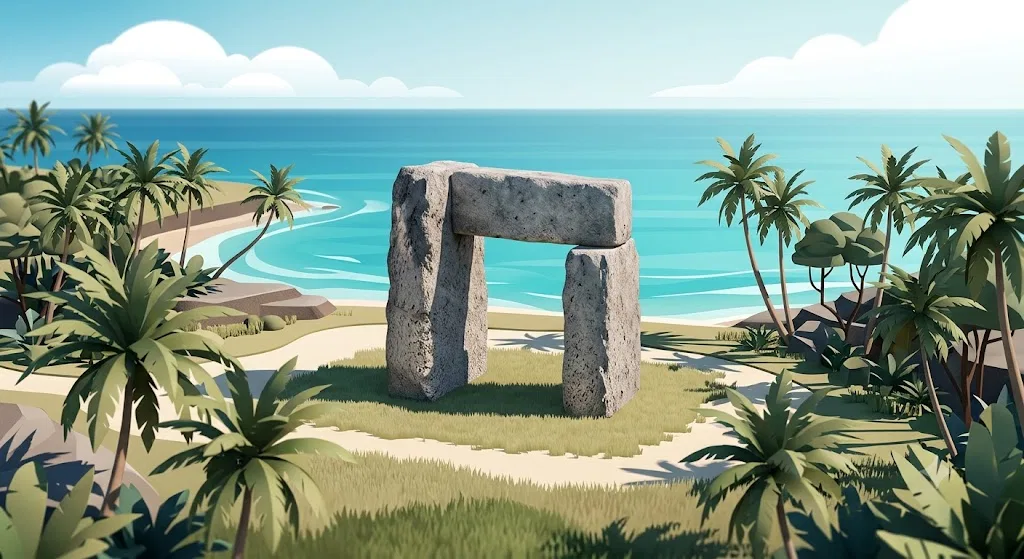
The Ha’amonga ‘a Maui is the most famous example. UNESCO’s tentative World Heritage entry describes it as the prominent feature of a historic park at Heketa, the second capital of ancient Tonga. It is made of three coral-limestone slabs, each estimated at more than 20 tonnes, and stands about six metres high. The same UNESCO description says the site’s name comes from Maui and records a tradition that the monument was erected by the Tu’i Tonga to remind his two sons to remain united after his death.[UNESCO World Heritage Centre]whc.unesco.orgWorld Heritage Centre The Ancient Capitals of the Kingdom of TongaWorld Heritage Centre The Ancient Capitals of the Kingdom of Tonga
Nearby, the Maka Fa’akinanga stone is described in the same entry as a royal seat from which the king could protect himself against assassins. This is not a ghost story, but it has the texture of legend: a single stone becomes a physical memory of royal danger, vigilance and sacred power.[UNESCO World Heritage Centre]whc.unesco.orgWorld Heritage Centre The Ancient Capitals of the Kingdom of TongaWorld Heritage Centre The Ancient Capitals of the Kingdom of Tonga
The astronomical interpretation of Ha’amonga ‘a Maui is more contested. UNESCO’s tentative listing reports a Palace Office tradition, associated with research initiated by King Taufa’ahau Tupou IV in 1967, that notches on the lintel mark the longest day, shortest day and equinox. Yet the same listing also says the source of this belief is unclear and may have been introduced in the early twentieth century.[UNESCO World Heritage Centre]whc.unesco.orgWorld Heritage Centre The Ancient Capitals of the Kingdom of TongaWorld Heritage Centre The Ancient Capitals of the Kingdom of Tonga
That is a useful caution for readers. A site can be ancient without every interpretation of it being equally ancient. Ha’amonga ‘a Maui is securely important as a royal and monumental site; its solar-calendar reading is culturally meaningful, but not uncontested.
Royal tombs and the memory of the Tu’i Tonga
The ancient royal tombs at Lapaha are among Tonga’s most important folklore-adjacent sites because they turn sacred descent into a visible landscape. UNESCO describes Lapaha, in the village of Mu’a, as the centre of chiefly power of the Tu’i Tonga from roughly the thirteenth to the nineteenth century, with about 22 ancient royal tombs spread over an estimated 400 by 500 metres.[UNESCO World Heritage Centre]whc.unesco.orgWorld Heritage Centre The Ancient Capitals of the Kingdom of TongaWorld Heritage Centre The Ancient Capitals of the Kingdom of Tonga
These tombs are not just old graves. The listing describes them as earth platforms with a stepped pyramid effect, supported by stone slabs, and says their construction demonstrated the spiritual and political power of the Tu’i Tonga. It also states that the tombs and rituals surrounding burial of descendants of the Tu’i Tonga remain part of living Tongan culture.[UNESCO World Heritage Centre]whc.unesco.orgWorld Heritage Centre The Ancient Capitals of the Kingdom of TongaWorld Heritage Centre The Ancient Capitals of the Kingdom of Tonga
For folklore readers, the tombs matter because they show how story, genealogy and ritual memory can be carried by architecture. A tale about divine descent becomes a royal title; a royal title becomes a burial place; the burial place becomes a continuing social obligation. The UNESCO entry also notes that there are still conflicting findings about the number, names and sizes of the tombs, which is a reminder that even famous heritage landscapes may contain unresolved historical questions.[UNESCO World Heritage Centre]whc.unesco.orgWorld Heritage Centre The Ancient Capitals of the Kingdom of TongaWorld Heritage Centre The Ancient Capitals of the Kingdom of Tonga
Dance, sung speech and oral tradition that still performs
Not all Tongan folklore survives as a prose tale. Some of it lives in performance. The strongest public example is lakalaka, recognised by UNESCO as “dances and sung speeches of Tonga”. UNESCO describes lakalaka as a blend of choreography, oratory, and vocal and instrumental polyphony, often considered Tonga’s national dance.[UNESCO Intangible Cultural Heritage]ich.unesco.orgOpen source on unesco.org.
This matters because oral tradition is not only about old stories told by a narrator beside a fire. In Tonga, memory is also sung, danced, ranked and publicly displayed. Lakalaka can carry praise, genealogy, place, political feeling and poetic allusion. Its importance lies in the way a community performs knowledge together, with bodies, voices and social order all visible at once.[UNESCO Intangible Cultural Heritage]ich.unesco.orgOpen source on unesco.org.
Tonga Tourism’s present-day visitor material reflects that continuity, directing travellers not only to archaeological sites but also to feasts, traditional dances, craft, church singing and local markets. Some of this is tourism, and should not be mistaken for untouched antiquity. But tourism does not automatically make a tradition fake. It often creates a public-facing version of practices that also have deeper family, village, church or royal contexts.[Tonga Tourism]tongatourism.travelTonga Tourism Our Islands | Tongatapu | Tonga TourismTonga Tourism Our Islands | Tongatapu | Tonga Tourism
Christianity, suppression and survival
Christianity profoundly changed Tongan religious life. Modern discussions of Hikule’o repeatedly return to the destruction or removal of older sacred images. The British Museum notes that figures connected with pre-Christian reverence were often destroyed or desecrated as missionaries settled in Tonga in the early nineteenth century.[British Museum]britishmuseum.orgBritish Museumfigure | British MuseumBritish Museumfigure | British Museum
Ka’ili’s discussion of Tonga’s ancient gods goes further, describing the deliberate destruction of images of older deities and ancestors, and arguing that the loss of images also damaged the stories associated with them. In this account, surviving traditions are often fragments, with some objects removed by missionaries and later donated to museums.[PMN | Pacific Media Network]pmn.co.nzPMN | Pacific Media Network Tonga’s ancient gods and the 21st centuryPMN | Pacific Media Network Tonga’s ancient gods and the 21st century
This history explains why Tongan folklore can feel both rich and incomplete. Some stories were recorded by outsiders after major religious disruption had already begun. Some were preserved in families, chiefly contexts, dance, place-names or ceremony rather than in formal myth books. Some have been reinterpreted by Christian Tongans who may value ancestral stories culturally without reviving pre-Christian worship.[PMN | Pacific Media Network]pmn.co.nzPMN | Pacific Media Network Tonga’s ancient gods and the 21st centuryPMN | Pacific Media Network Tonga’s ancient gods and the 21st century
The result today is not a simple battle between “old gods” and “new religion”. Ka’ili argues that it is possible to hold Christian faith while recognising ancient Tongan deities as part of cultural inheritance. That view will not represent every Tongan believer, but it captures a wider modern pattern: ancestral narratives can remain meaningful as identity, ethics, art and heritage even when their religious status has changed.[PMN | Pacific Media Network]pmn.co.nzPMN | Pacific Media Network Tonga’s ancient gods and the 21st centuryPMN | Pacific Media Network Tonga’s ancient gods and the 21st century
How well-attested are Tonga’s legends?
Tonga’s folklore is better documented than many casual readers might expect, but the evidence is uneven. There are early European and missionary accounts, formal ethnographic collections, museum objects, oral histories, royal genealogies, UNESCO heritage descriptions and modern Tongan scholarship. Gifford’s Tongan Myths and Tales, published in 1924 by the Bernice P. Bishop Museum, is a key source because it gathers oral traditions from informants’ recitations as well as earlier archives and publications.[Internet Archive]archive.orgOpen source on archive.org.
However, readers should be careful with three common mistakes.
First, do not assume a single official version. Creation stories, divine genealogies and island-origin tales vary. Even modern public summaries note that there are several variations of Tonga’s creation story.[PMN | Pacific Media Network]pmn.co.nzPMN | Pacific Media Network Tonga’s ancient gods and the 21st centuryPMN | Pacific Media Network Tonga’s ancient gods and the 21st century
Second, do not treat missionary-era sources as neutral recordings. They are valuable, but they were written during a period when old religious practice was being challenged, suppressed or reframed. Museum catalogues and specialist research both point to the destruction or removal of sacred images during Christianisation.[British Museum]britishmuseum.orgBritish Museumfigure | British MuseumBritish Museumfigure | British Museum
Third, do not assume every modern heritage interpretation is ancient. The solar-calendar reading of Ha’amonga ‘a Maui is meaningful and officially discussed, but UNESCO’s tentative listing says the source of that belief is unclear and may be relatively recent.[UNESCO World Heritage Centre]whc.unesco.orgWorld Heritage Centre The Ancient Capitals of the Kingdom of TongaWorld Heritage Centre The Ancient Capitals of the Kingdom of Tonga
The most reliable approach is layered: read mythic narratives as oral tradition, check them against early collections where possible, recognise the role of living Tongan interpretation, and separate firm evidence from later speculation.
Tonga’s folklore today
Tongan folklore today appears in several public forms: heritage tourism on Tongatapu, museum interpretation of old sacred figures, cultural performance, academic writing, podcasts and Pacific media discussion of ancestral spirituality. The most visible themes remain creation, sacred land, ocean kinship, chiefly genealogy, divine siblings and the continuing place of the royal past in national identity.[Tonga Tourism]tongatourism.travelTonga Tourism Our Islands | Tongatapu | Tonga TourismTonga Tourism Our Islands | Tongatapu | Tonga Tourism
Hikule’o has become especially important in modern reinterpretation. For some, she is a figure of ancestral religion, fertility, death and Pulotu. For others, she is a symbol for Tongan women’s rank, elder-sister authority and ecological responsibility. Ka’ili connects the respect shown by Tangaloa and Maui towards Hikule’o with the continuing high regard for the father’s eldest sister in Tongan kinship systems.[PMN | Pacific Media Network]pmn.co.nzPMN | Pacific Media Network Tonga’s ancient gods and the 21st centuryPMN | Pacific Media Network Tonga’s ancient gods and the 21st century
The heritage sites also remain active. Tongatapu’s monuments are not presented only as ruins; they are woven into a living picture of Tonga that includes royal history, churches, markets, crafts, feasts and performance.[Tonga Tourism]tongatourism.travelTonga Tourism Our Islands | Tongatapu | Tonga TourismTonga Tourism Our Islands | Tongatapu | Tonga Tourism
For curious readers, the most honest summary is that Tongan folklore is neither a vanished pagan system nor a neatly preserved mythological canon. It is a living cultural inheritance shaped by oral tradition, monarchy, Christianity, colonial-era collecting, scholarly recovery, tourism and the continuing need to explain what it means to belong to the islands, the ocean and the ancestors.
Amazon book picks
Further Reading
Books and field guides related to Where Tonga's Myths Still Meet the Land. Use these as the next step if you want deeper reading beyond the article.
Polynesian Mythology
Surveys major Polynesian mythic themes including figures known in Tonga.
Tongan Myths and Tales
Foundational published collection of Tongan oral traditions and myths.
We, the Navigators
Provides background on the oceanic world that shaped Tongan mythology.
eBay marketplace picks
Marketplace Samples
Live-tested eBay searches with available results related to this page.
Endnotes
1.
Source: pmn.co.nz
Title: PMN | Pacific Media Network Tonga’s ancient gods and the 21st century
Link:https://pmn.co.nz/read/language-and-culture/tonga-s-ancient-gods-and-the-21st-century
2.
Source: whc.unesco.org
Title: World Heritage Centre The Ancient Capitals of the Kingdom of Tonga
Link:https://whc.unesco.org/en/tentativelists/5167/
3.
Source: scispace.com
Title: Sci Space Tongan Figures: From Goddesses to Missionary Trophies to Masterpieces
Link:https://scispace.com/pdf/tongan-figures-from-goddesses-to-missionary-trophies-to-1rmpil1k1x.pdf
4.
Source: archive.org
Link:https://archive.org/details/tonganmythstales0000giff
5.
Source: ich.unesco.org
Link:https://ich.unesco.org/en/RL/lakalaka-dances-and-sung-speeches-of-tonga-00072
6.
Source: archive.org
Link:https://archive.org/download/tonganmythstales0000giff/tonganmythstales0000giff.pdf
7.
Source: archive.org
Link:https://archive.org/details/tonganplacenames0000giff
8.
Source: unesco.org
Title: document 3747
Link:https://www.unesco.org/archives/multimedia/document-3747
9.
Source: ich.unesco.org
Link:https://ich.unesco.org/en/video/41755
10.
Source: ich.unesco.org
Title: safeguarding of lakalaka sung speeches with choreographed movements 00016
Link:https://ich.unesco.org/en/projects/safeguarding-of-lakalaka-sung-speeches-with-choreographed-movements-00016
11.
Source: ich.unesco.org
Title: 00345 EN
Link:https://ich.unesco.org/doc/src/00345-EN.pdf?t=1268152637
12.
Source: unesdoc.unesco.org
Link:https://unesdoc.unesco.org/ark%3A/48223/pf0000265728
13.
Source: polynesia.com
Link:https://www.polynesia.com/blog/tongan-legend-ahoeitu
14.
Source: ehrafworldcultures.yale.edu
Title: e HRAF World Cultures Tongan Myths And Tales
Link:https://ehrafworldcultures.yale.edu/cultures/ou09/documents/005
15.
Source: britishmuseum.org
Title: British Museumfigure | British Museum
Link:https://www.britishmuseum.org/collection/object/E_Oc-TAH-133
16.
Source: tongatourism.travel
Title: Tonga Tourism Our Islands | Tongatapu | Tonga Tourism
Link:https://www.tongatourism.travel/our-islands/tongatapu
17.
Source: Wikipedia
Link:https://en.wikipedia.org/wiki/Tongans
18.
Source: Wikipedia
Link:https://en.wikipedia.org/wiki/Tonga
19.
Source: Wikipedia
Link:https://en.wikipedia.org/wiki/Tangaloa
20.
Source: Wikipedia
Link:https://en.wikipedia.org/wiki/Lakalaka
21.
Source: research.cgu.edu
Link:https://research.cgu.edu/wincart/communities/tongan/
22.
Source: natlib.govt.nz
Link:https://natlib.govt.nz/records/23085375
23.
Source: natlib.govt.nz
Link:https://natlib.govt.nz/records/21813075
24.
Source: ndl.ethernet.edu.et
Link:https://ndl.ethernet.edu.et/bitstream/123456789/73280/1/30.pdf.pdf
25.
Source: openresearch-repository.anu.edu.au
Link:https://openresearch-repository.anu.edu.au/bitstreams/9e412e93-7a23-4eb4-b20a-982ffbdadaa9/download
Additional References
26.
Source: academia.edu
Link:https://www.academia.edu/13968412/Social_memory_and_the_langi_royal_tombs_of_Lapaha
27.
Source: thetongan.com
Link:https://thetongan.com/about-tonga/
28.
Source: facebook.com
Link:https://www.facebook.com/ancienttongaattraction/posts/in-realms-of-old-where-ocean-sighslies-tonga-neath-cerulean-skiesfrom-mauis-gras/1059749792843343/
29.
Source: facebook.com
Link:https://www.facebook.com/ivanhenares/posts/archaeological-historic-sites-on-tongatapu-island-tonga-ha%CA%BBamonga-%CA%BBa-maui-ancien/10163063484055937/
30.
Source: facebook.com
Link:https://www.facebook.com/100095216137706/posts/sacred-origins-of-the-tangaloa-from-manua-and-tui-tonga-lineages-from-ahoeitu-on/752438901273308/
31.
Source: intltravelnews.com
Link:https://www.intltravelnews.com/2016/02/haamonga-maui-trilithon-tongatapu-tonga.html
32.
Source: facebook.com
Link:https://www.facebook.com/groups/Tonga.Research.Association/posts/10159623095475777/
33.
Source: jonestravel.com.to
Link:https://jonestravel.com.to/tours/highlights-of-tongatapu/
34.
Source: mythlok.com
Link:https://mythlok.com/hikuleo/
35.
Source: instagram.com
Link:https://www.instagram.com/p/DBkV_EJyPyj/?hl=en-gb
Topic Tree
Follow this branch
Related pages 192
- Afghan Folklore
- Albanian Folklore
- Algerian Folklore
- Australian Folklore
- Azerbaijan Folklore
- +187 more in sidebar