Distinctive Folklore of Slovakia
Slovakia’s folklore is not a single “mythology” with one sacred book or fixed cast of gods. It is a living mixture of oral tales, seasonal customs, mountain music, folk religion, village craft, castle legends, outlaw hero stories and later literary retellings.
Page outline Jump by section
Introduction
The heart of Slovak folklore lies in the tension between old rural life and modern retelling. Some material is genuinely old oral tradition, some was reshaped by collectors such as Pavol Dobšinský, some survives as calendar custom, and some is now tourist storytelling around castles and famous landscapes. That does not make it less valuable; it means readers need to know whether they are looking at a village belief, a literary fairy tale, a national revival symbol, or a modern heritage performance.[google.com]books.google.comBooks Traditional Slovak FolktalesBooks Traditional Slovak Folktales
What makes Slovak folklore distinctive?
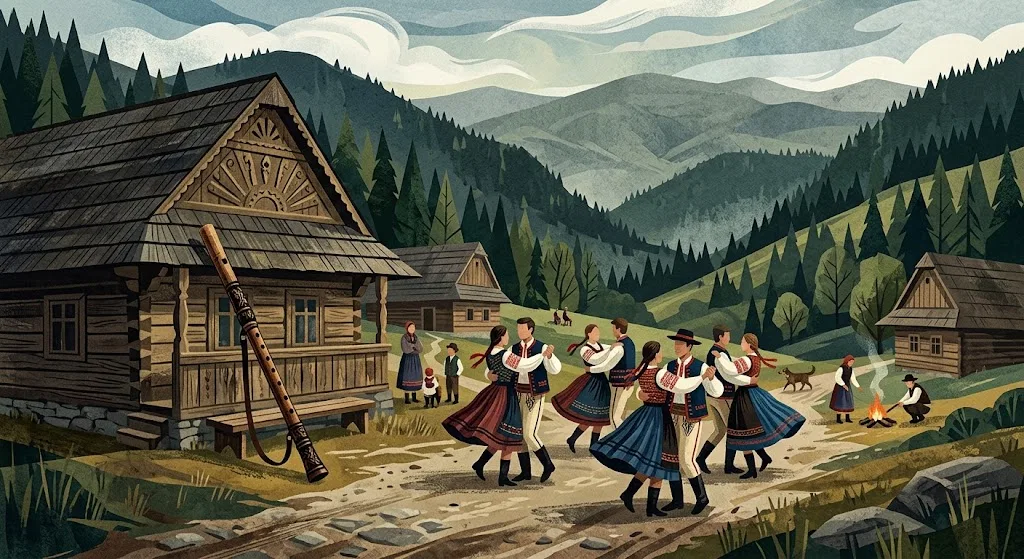
Slovak folklore is strongly tied to place. The country’s mountains, forests, rivers, castles, wooden villages and shepherding landscapes are not just scenery; they are the settings that give many traditions their emotional force. The High and Low Tatras frame major folk festivals, Terchová is inseparable from the Jánošík tradition, central Slovakia is associated with shepherd music and the long fujara flute, and Vlkolínec is internationally recognised as an exceptionally preserved settlement of folk architecture.[festivalvychodna.sk]festivalvychodna.skOpen source on festivalvychodna.sk.
Another defining feature is the layering of pre-Christian, Christian and local rural practice. Slovak tourism and heritage sources explicitly describe annual customs as a blending of older and Christian traditions: Carnival masks, the drowning or burning of Morena before Easter, May poles, All-Hallows’ observances, Christmas rituals and witch-related winter customs all sit within a yearly cycle that made sense to agricultural communities.[Slovakia Travel]slovakia.travelOpen source on slovakia.travel.
This folklore is also unusually visible in public culture. Slovakia has official and institutional structures for safeguarding traditional folk culture, including the Slovak National Museum’s Museum of Ethnography in Martin, the Centre for Folk Art Production, the Centre for Traditional Folk Culture, and UNESCO-listed intangible heritage such as fujara music, Terchová music, bagpipe culture and other practices.[snm.sk]snm.skSlovenské národné múzeum Slovak National Museum in MartinSlovenské národné múzeum Slovak National Museum in Martin
The great Slovak folk hero: Juraj Jánošík
No Slovak legendary figure is more famous than Juraj Jánošík. He was a real historical person, born in 1688 in Terchová and executed in 1713, but his afterlife belongs to folklore. In popular memory, he became a Slovak Robin Hood: the outlaw who robbed the rich, helped the poor and stood against injustice. Slovakia’s official tourism site presents him as both a real personality of Slovak history and a “just defender of the poor”, while the Centre for Traditional Folk Culture treats the Jánošík tradition as a nationwide cultural phenomenon reaching far beyond Terchová.[Slovakia Travel]slovakia.travelthe monument of juraj janosik terchovathe monument of juraj janosik terchova
The important point is that the legend grew larger than the man. The official heritage account says the tradition has moved through Slovak collective memory from heroisation to humorous and ironic versions. It now includes oral tradition, music, dance, folk art, literature, theatre, popular music, crafts, food culture and tourism. That makes Jánošík less a single tale than a cultural engine: a figure through whom Slovaks have imagined justice, courage, rebellion, masculinity, village pride and national identity. Centrum pre tradičnú ľudovú kultúru[ludovakultura.sk]ludovakultura.skthe janosik traditionCentrum pre tradičnú ľudovú kultúruThe Jánošík Tradition3 Dec 2021 — The Jánošík tradition is inherently linked to a particular cultural…
Modern scholarship and public history also complicate the myth. The Slovak Academy of Sciences notes that brigandage was widespread in the turbulent world of early eighteenth-century warfare, and that many counties in the territory of present-day Slovakia had their own outlaw bands. In that context, Jánošík’s later elevation tells us as much about nineteenth- and twentieth-century Slovak memory as it does about 1713.[SAV]sav.skOpen source on sav.sk.
Terchová remains the natural centre of this tradition. The village has a large monument to Jánošík, created in 1988, and the Jánošík Days festival presents folk music, exhibitions, parades, craft and religious elements in a setting that links local pride with national folklore.[Slovakia Travel]slovakia.travelthe monument of juraj janosik terchovathe monument of juraj janosik terchova
Fairy tales, collectors and the making of a national tradition
For many English-language readers, Slovak folk tales first become visible through the work of Pavol Dobšinský, the nineteenth-century collector whose tales were later translated and published as Traditional Slovak Folktales. The English edition brings together fifty tales from Dobšinský’s collections and presents them as an entry point into Slovak folk culture for general readers and students.[Google Books]books.google.comBooks Traditional Slovak FolktalesBooks Traditional Slovak Folktales
Dobšinský matters because folklore collection was never neutral copying. Nineteenth-century collectors worked during an era when language, peasant culture and oral tradition were central to national revival movements across Europe. His collections preserved a huge body of Slovak narrative material, but they also passed through literary selection, editing and Romantic ideas about the “people” as bearers of national character. Recent scholarship on Slovak ethnography notes that interpretations of folk tales, magic and supernatural belief changed across political periods and scholarly fashions, rather than remaining fixed.[ResearchGate]researchgate.net364081386 Slovak Tales and the Collections of Pavol Dobsinsky364081386 Slovak Tales and the Collections of Pavol Dobsinsky
The tales themselves belong to a wider Central European and Slavic storytelling world: enchanted helpers, dragons, impossible tasks, clever youngest children, wicked stepmothers, magical animals, giants, devils and tests of generosity all appear in forms familiar from neighbouring traditions. What makes them Slovak is not always a unique monster or plot, but the local language, landscape, humour, moral emphasis and the way collectors and communities attached them to Slovak identity.[Google Books]books.google.comBooks Traditional Slovak FolktalesBooks Traditional Slovak Folktales
Spirits, witches and supernatural beings
Slovak supernatural tradition includes beings shared with wider Slavic folklore as well as strongly local names and variants. A study of Slovak mythological vocabulary notes both common Slavic roots and regional particularity, including terms connected with witches, wild women, household or nature spirits, mine or underworld beings, and water or fairy-like figures. It also warns that Slovak folk demonology has been less comprehensively represented in broad Slavic studies than some neighbouring traditions, which is one reason careful sourcing matters.[Academia]academia.eduOpen source on academia.edu.
Water spirits are among the most familiar figures in popular retellings. In Slovak and neighbouring Slavic traditions, the water being is usually imagined as an uncanny inhabitant of rivers, ponds and lakes: sometimes comic, sometimes dangerous, often a way of turning real water hazards into memorable narrative. Modern Slovak folklore articles describe such beings as warning figures around natural water, though individual stories can also present helpful or ambiguous versions.[netky.sk]netky.skThe Enchanting World of Slovak Folklore and LegendsThe Enchanting World of Slovak Folklore and Legends
Witches are especially vivid in winter customs. St Lucy’s Day, 13 December, is described by Slovakia’s official tourism site as one of the “witches’ days” before Christmas, when people believed witches could be seen. Folk practice around the day included white-clad processions and protective acts against evil, while modern accounts show how a Christian saint’s day could become, in popular imagination, a night of witchcraft, reversal and danger.[Slovakia Travel]slovakia.travelOpen source on slovakia.travel.
It is important not to treat these beings as a neat fantasy bestiary. Slovak belief culture worked through use and setting: a witch explained misfortune or social suspicion; a water spirit warned children away from dangerous places; a wild woman or fairy-like being marked the boundary between village order and forest otherness; a devil in a tale might test greed, pride or cleverness. The creature mattered because it gave shape to risk, morality and uncertainty in daily life.[Academia]academia.eduOpen source on academia.edu.
Seasonal customs: winter out, spring in, witches kept away
The spring ritual of Morena is one of Slovakia’s clearest examples of old seasonal symbolism surviving in modern custom. Morena is represented by a straw female effigy, dressed in women’s clothing, carried out of the village and destroyed by burning, drowning, or both. Slovakia’s official tourism site explains the core logic plainly: Morena symbolised winter, so people who wanted spring to come had to “kill” her by fire or water.[Slovakia Travel]slovakia.travelOpen source on slovakia.travel.
The custom is often performed by children and folklore groups today, but its older meaning belongs to the agricultural year. It dramatises the end of cold, darkness and danger, and the return of life. Similar rituals exist in neighbouring Slavic countries, which is a useful reminder that Slovak folklore is both national and regional: it has Slovak forms, names and songs, but it also shares deep seasonal patterns with Central and Eastern Europe.[Wikipedia]WikipediaMorana (goddessMorana (goddess
Easter customs are another striking example of living tradition meeting modern debate. On Easter Monday, boys and men in many areas visit girls and women with water, perfume, or symbolic willow whipping, depending on region. Official Slovak tourism presents the practices as customs associated with health, youth and spring renewal, while contemporary journalism records that not everyone experiences or interprets them positively today.[Slovakia Travel]slovakia.travelOpen source on slovakia.travel.
Christmas and Advent customs likewise combine Christian observance with protective folk practice. St Lucy’s Day sits in the pre-Christmas period as a time of witch lore and household protection; other winter customs include masks, processions, fortune-telling and ritual acts intended to protect people, animals and homes through the darkest part of the year. The value of these customs is not that everyone now believes their older explanations literally, but that they preserve a calendar in which the year was emotionally charged and socially performed.[Slovakia Travel]slovakia.travelOpen source on slovakia.travel.
Castles, ghosts and dark legends
Slovakia’s ruined castles are powerful folklore machines. They give stories a visible stage: cliffs, towers, dungeons, borderlands and noble families all invite legend. Čachtice Castle is the most internationally recognisable example because of its association with Elizabeth Báthory, the noblewoman remembered in popular tradition as the “Bloody Countess”. Slovakia’s official tourism site states that she lived there at the turn of the sixteenth and seventeenth centuries and presents the familiar legend that she murdered hundreds of girls and bathed in blood to preserve her youth.[Slovakia Travel]slovakia.travelOpen source on slovakia.travel.
That story should be handled carefully. Báthory was a historical figure, but the blood-bathing image is a legend that grew through accusation, political context, moral horror and later sensational retelling. Local tourism keeps the story alive through castle events, statues, exhibitions and products, showing how a grim aristocratic narrative can become both heritage and spectacle.[Slovakia Travel]slovakia.travelOpen source on slovakia.travel.
Beckov Castle offers a different kind of legendary landscape. It stands on a dramatic rock above the Váh River and is tied to stories of nobles, raids, trade routes and, in tourist presentation, mysterious or gloomy night events. Its appeal is partly architectural and partly narrative: a fortress on a cliff already looks like a story before anyone adds a ghost.[Visit Trenčín]visit.trencin.skVisit Trenčín Beckov CastleVisit Trenčín Beckov Castle
These castle legends matter because they show how folklore survives through places people can visit. A tale attached to a ruin, statue, cave, spring or village has a stronger public life than a tale sitting only in a book. In Slovakia, haunted and legendary places often work as bridges between historical tourism and supernatural imagination.

Music, dance and living heritage
Slovak folklore is not only about stories and spirits. Music, dance, costume and craft are central to how tradition is performed today. The fujara, an exceptionally long three-holed flute traditionally linked with Slovak shepherds, is listed by UNESCO as intangible cultural heritage and is described by UNESCO as an integral part of traditional culture in central Slovakia.[Intangible Cultural Heritage]ich.unesco.orgOpen source on unesco.org.
The music of Terchová is another UNESCO-recognised tradition. UNESCO describes it as collective vocal and instrumental music from north-west Slovakia, performed by small string ensembles, often with polyphonic singing and dance. Its strongest public setting is not a museum shelf but performance: family occasions, festivals and especially Jánošík Days.[Intangible Cultural Heritage]ich.unesco.orgOpen source on unesco.org.
Festivals make folklore visible to modern audiences. The Východná Folklore Festival, founded in 1953, is described by its organisers and Slovak tourism as the oldest and largest nationwide folklore festival with international participation in Slovakia. It turns the village of Východná, near the Tatras, into a temporary centre of Slovak folk culture through music, dance, costume, craft and staged performance.[Folklórny festival Východná]festivalvychodna.skOpen source on festivalvychodna.sk.
There is always a difference between living village practice and staged folklore. A song sung at a wedding, a ritual performed in a village, and a choreographed festival performance are not the same thing. But performance is not necessarily fake. It can preserve skills, give communities pride, teach younger people, and make traditions legible to visitors, even as it changes their setting and meaning.[Slovenské národné múzeum]snm.skSlovenské národné múzeum Slovak National Museum in MartinSlovenské národné múzeum Slovak National Museum in Martin
Where folklore is preserved and studied today
Slovakia has a substantial institutional base for folk culture. The Slovak National Museum in Martin includes the Museum of Ethnography, which focuses on preservation, research, documentation and presentation of folk culture in Slovakia. The Museum of the Slovak Village, also in Martin, presents traditional architecture and ways of life from the second half of the nineteenth century and first half of the twentieth century.[Slovenské národné múzeum]snm.skSlovenské národné múzeum Slovak National Museum in MartinSlovenské národné múzeum Slovak National Museum in Martin
The Centre for Folk Art Production, founded in 1945, safeguards and develops traditional crafts and homemade products through research, education, publishing, exhibitions and work with producers. Its library, built from 1954, holds specialist material on traditional folk art production, crafts, folk art, ethnography, architecture and related fields.[ÚĽUV]uluv.skOpen source on uluv.sk.
Digital preservation also matters. The Council of Europe describes Slovakia’s electronic encyclopaedia of traditional folk culture as a public resource created from work by the Coordination Centre of Traditional Folk Culture and the Institute of Ethnology of the Slovak Academy of Sciences, combining text with graphic, video, audio and film documentation.[Portal]coe.intPortal Electronic encyclopaedia of traditional folk culturePortal Electronic encyclopaedia of traditional folk culture
UNESCO recognition adds another layer. Slovakia’s intangible heritage entries include fujara music, Terchová music, bagpipe culture, puppetry shared with Czechia, multipart singing of Horehronie, blueprint textile printing, wire craft, falconry and Lipizzan horse breeding traditions. Not all of these are “myths” in the narrow sense, but they belong to the wider cultural ecology in which stories, rituals, craft, song and identity reinforce each other.[UNESCO]unesco.skOpen source on unesco.sk.
Old tradition, modern invention and internet folklore
A useful way to read Slovak folklore is to ask: what kind of tradition is this? Some customs, such as Morena or St Lucy’s witch lore, are rooted in older seasonal and protective practice. Some tales come through nineteenth-century collectors and were shaped by literary editing. Some legends, such as Jánošík, combine a historical person with later national mythmaking. Some castle stories are part history, part accusation, part tourism.[slovakia.travel]slovakia.travelOpen source on slovakia.travel.
Modern media adds new complications. Internet lists of “Slovak mythical creatures” often mix well-attested beings with generic Slavic material, fantasy-style invention, duplicated names and unsourced claims. That does not mean all online folklore writing is useless, but it does mean readers should be cautious when a page presents hundreds of creatures without clear collection history, local variants or source trails. Stronger evidence usually comes from museums, heritage institutions, academic work, older collections, and specific local traditions.[Academia]academia.eduOpen source on academia.edu.
The most interesting modern development is not that folklore has “survived unchanged”, because it has not. It is that Slovaks continue to reinterpret it: through festivals, school events, craft courses, museum displays, tourist trails, music scenes, children’s books, films, local branding and family memory. Folklore remains useful because it lets people talk about belonging, landscape, danger, justice, humour and the passing of the seasons in forms older than the modern state but still adaptable to it.[ctm-festival.de]ctm-festival.deCTM FESTIVALRewriting Slovak Folk Traditions in Fraught Political TimesCTM FESTIVALRewriting Slovak Folk Traditions in Fraught Political Times
Why Slovakia’s folklore still matters
Slovak folklore matters because it gives the country a story-map. The mountains are not just mountains; they are shepherd music, outlaw legends and festival settings. Rivers are not just rivers; they are places where winter is drowned and water spirits may lurk in cautionary tales. Castles are not just ruins; they are stages for moral horror, noble violence and ghostly imagination. Villages are not just picturesque; they preserve architecture, craft, costume, song and seasonal customs.[unesco.org]ich.unesco.orgOpen source on unesco.org.
For a first-time reader, the best way into Slovak folklore is through a few strong anchors: Jánošík for national legend, Dobšinský for fairy tales, Morena for seasonal ritual, St Lucy’s Day for witch belief, Čachtice for dark castle legend, the fujara and Terchová music for living performance, and institutions such as the Slovak National Museum and the Centre for Traditional Folk Culture for evidence-based preservation. Together, they show a tradition that is lively, layered and still changing.[ludovakultura.sk]ludovakultura.skthe janosik traditionCentrum pre tradičnú ľudovú kultúruThe Jánošík Tradition3 Dec 2021 — The Jánošík tradition is inherently linked to a particular cultural…
Amazon book picks
Further Reading
Books and field guides related to What Makes Slovak Folklore So Distinctive?. Use these as the next step if you want deeper reading beyond the article.
Slovak Folk Tales
Introduces the major tales, motifs and characters of Slovak tradition.
The Twelve Months and Other Slovak Folk Tales
Showcases classic stories preserved from oral tradition.
eBay marketplace picks
Marketplace Samples
Live-tested eBay searches with available results related to this page.
Endnotes
1.
Source: slovakia.travel
Link:https://slovakia.travel/en/burning-of-morena-two-weeks-before-easter
2.
Source: slovakia.travel
Link:https://slovakia.travel/en/easter-whipping-or-bathing-march-or-april
3.
Source: books.google.com
Title: Books Traditional Slovak Folktales
Link:https://books.google.com/books/about/Traditional_Slovak_Folktales.html?id=3L8g2uoZ-ggC
4.
Source: ich.unesco.org
Link:https://ich.unesco.org/en/RL/music-of-terchova-00877
5.
Source: ich.unesco.org
Link:https://ich.unesco.org/en/RL/fujara-and-its-music-00099
6.
Source: whc.unesco.org
Title: World Heritage Centre Vlkolínec
Link:https://whc.unesco.org/en/list/622/
7.
Source: slovakia.travel
Link:https://slovakia.travel/en/things-to-see-and-do/traditions/traditions
8.
Source: slovakia.travel
Link:https://slovakia.travel/en/lucia-13th-december
9.
Source: ich.unesco.org
Title: Intangible Cultural Heritage Slovakia
Link:https://ich.unesco.org/en/state/slovakia-SK
10.
Source: slovakia.travel
Title: the monument of juraj [janosik]({{ ‘janosik/’ | relative_url }}) terchova
Link:https://slovakia.travel/en/the-monument-of-juraj-janosik-terchova
11.
Source: sav.sk
Link:https://www.sav.sk/news/9184%26lang%3Den
12.
Source: researchgate.net
Title: 295141287 Hungarian Slav Goral Slovak Janosik as mythic folk hero
Link:https://www.researchgate.net/publication/295141287_Hungarian_Slav_Goral_Slovak_Janosik_as_mythic_folk_hero
13.
Source: slovakia.travel
Link:https://slovakia.travel/en/the-janosiks-days-july
14.
Source: researchgate.net
Title: 364081386 Slovak Tales and the Collections of Pavol Dobsinsky
Link:https://www.researchgate.net/publication/364081386_Slovak_Tales_and_the_Collections_of_Pavol_Dobsinsky
15.
Source: academia.edu
Link:https://www.academia.edu/39784546/Slovak_mythological_vocabulary_on_the_Common_Slavic_background_Ethno_linguistic_aspect
16.
Source: netky.sk
Title: The Enchanting World of Slovak Folklore and Legends
Link:https://www.netky.sk/clanok/the-enchanting-world-of-slovak-folklore-and-legends-a-journey-into-central-europes-mystical-heart-video
17.
Source: Wikipedia
Title: Morana (goddess)
Link:https://en.wikipedia.org/wiki/Morana_%28goddess%29
18.
Source: slovakia.travel
Link:https://slovakia.travel/en/the-castle-of-cachtice
19.
Source: slovakia.travel
Link:https://slovakia.travel/en/closing-the-summer-tourist-season-at-cachtice-castle
20.
Source: slovakia.travel
Link:https://slovakia.travel/en/international-award-for-cachtice-castle
21.
Source: slovakia.travel
Link:https://slovakia.travel/en/gloomy-walls-of-beckov-castle
22.
Source: unesco.org
Title: document 3511
Link:https://www.unesco.org/archives/multimedia/document-3511
23.
Source: slovakia.travel
Title: the vychodna folklore festival
Link:https://slovakia.travel/en/the-vychodna-folklore-festival
24.
Source: slovakia.travel
Link:https://slovakia.travel/en/ethnography-museum-snm-martin
25.
Source: unesco.sk
Link:https://www.unesco.sk/en/intangible-cultural-heritage-of-Slovakia
26.
Source: ctm-festival.de
Title: CTM FESTIVALRewriting Slovak Folk Traditions in Fraught Political Times
Link:https://www.ctm-festival.de/magazine/rewriting-slovak-folk-traditions-in-fraught-political-times
27.
Source: Wikipedia
Title: List of World Heritage Sites in Slovakia
Link:https://en.wikipedia.org/wiki/List_of_World_Heritage_Sites_in_Slovakia
28.
Source: Wikipedia
Title: Culture of Slovakia
Link:https://en.wikipedia.org/wiki/Culture_of_Slovakia
29.
Source: Wikipedia
Title: Pavol Dobšinský
Link:https://en.wikipedia.org/wiki/Pavol_Dob%C5%A1insk%C3%BD
30.
Source: Wikipedia
Title: Supernatural beings in Slavic religion
Link:https://en.wikipedia.org/wiki/Supernatural_beings_in_Slavic_religion
31.
Source: Wikipedia
Title: Vila (fairy)
Link:https://en.wikipedia.org/wiki/Vila_%28fairy%29
32.
Source: Wikipedia
Title: Juraj Jánošík
Link:https://en.wikipedia.org/wiki/Juraj_J%C3%A1no%C5%A1%C3%ADk
33.
Source: Wikipedia
Title: Easter whip
Link:https://en.wikipedia.org/wiki/Easter_whip
34.
Source: Wikipedia
Title: Slovak National Museum
Link:https://en.wikipedia.org/wiki/Slovak_National_Museum
35.
Source: researchgate.net
Link:https://www.researchgate.net/publication/350555307_Folk_Tales_Magic_and_Politics_Interpretation_of_Folklore_in_Slovak_Ethnography
36.
Source: researchgate.net
Link:https://www.researchgate.net/profile/Eva-Pocs/publication/37070154_Fairies_and_Witches_at_the_Boundary_of_South-Eastern_and_Central_Europe/links/5ff4e39645851553a022833c/Fairies-and-Witches-at-the-Boundary-of-South-Eastern-and-Central-Europe.pdf
37.
Source: researchgate.net
Link:https://www.researchgate.net/publication/362159733INTANGIBLE_CULTURAL_HERITAGE_AND_DIGITAL_MEDIA_Portugal-Slovakia_Readings_Title_Intangible_Cultural_Heritage_and_Digital_Media_Portugal_-Slovakia_Readings_Publication_coordinators
38.
Source: researchgate.net
Link:https://www.researchgate.net/publication/358062647_Changes_in_Intangible_Cultural_Heritage_in_Slovakia_The_Case_the_Fujara
39.
Source: slovakia.travel
Link:https://slovakia.travel/en/things-to-see-and-do/traditions
40.
Source: slovakia.travel
Link:https://slovakia.travel/en/slovakia-folk
41.
Source: slovakia.travel
Link:https://slovakia.travel/en/magic-of-advent-at-cachtice-castle
42.
Source: slovakia.travel
Link:https://slovakia.travel/en/cachtice-castle-opens-for-the-summer-season
43.
Source: slovakia.travel
Link:https://slovakia.travel/en/saints-cyril-and-methodius-at-the-cachtice-castle
44.
Source: slovakia.travel
Link:https://slovakia.travel/en/bath-of-eternal-youth-or-the-story-of-the-bloodthirsty-countesss-victims
45.
Source: slovakia.travel
Link:https://slovakia.travel/en/slovak-castles-together-in-one-place-visit-the-miniature-park-in-podolie
46.
Source: slovakia.travel
Link:https://slovakia.travel/en/the-castle-of-beckov
47.
Source: slovakia.travel
Link:https://slovakia.travel/en/easter-at-cachtice-castle
48.
Source: slovakia.travel
Link:https://slovakia.travel/en/unesco-intangible-heritage-fujara
49.
Source: slovakia.travel
Link:https://slovakia.travel/en/vlkolinec
50.
Source: unesco.org
Title: Care for traditional folk culture
Link:https://www.unesco.org/creativity/en/policy-monitoring-platform/care-traditional-folk-culture
51.
Source: ich.unesco.org
Link:https://ich.unesco.org/doc/src/27426.pdf
52.
Source: ich.unesco.org
Link:https://ich.unesco.org/doc/src/18996.pdf
53.
Source: ich.unesco.org
Title: folklore festival vychodna 00331
Link:https://ich.unesco.org/en/activities/folklore-festival-vychodna-00331
54.
Source: ich.unesco.org
Title: 01278 EN.doc
Link:https://ich.unesco.org/doc/src/01278-EN.doc
55.
Source: unesco.org
Title: document 4012
Link:https://www.unesco.org/archives/multimedia/document-4012
56.
Source: unesco.org
Title: document 4352
Link:https://www.unesco.org/archives/multimedia/document-4352
57.
Source: ich.unesco.org
Title: 42974 EN.doc
Link:https://ich.unesco.org/doc/src/42974-EN.doc
58.
Source: ich.unesco.org
Link:https://ich.unesco.org/en/video/18149
59.
Source: whc.unesco.org
Link:https://whc.unesco.org/document/153901
60.
Source: ich.unesco.org
Link:https://ich.unesco.org/?call=film&id=18149&include=film_inc.php&width=700
61.
Source: ich.unesco.org
Link:https://ich.unesco.org/en/video/41753
62.
Source: academia.edu
Link:https://www.academia.edu/45657819/Folk_Tales_Magic_and_Politics_Interpretation_of_Folklore_in_Slovak_Ethnography
63.
Source: academia.edu
Link:https://www.academia.edu/27464537/Slovakia_Libraries_Archives_and_Museums
64.
Source: academia.edu
Link:https://www.academia.edu/35926941/Traditional_Folk_Culture_and_Ethnology
65.
Source: academia.edu
Link:https://www.academia.edu/90762941/Changes_in_Intangible_Cultural_Heritage_in_Slovakia_The_Case_the_Fujara
66.
Source: slovakia.com
Link:https://www.slovakia.com/folklore/
67.
Source: slovak.com
Title: s and Christmas traditions
Link:https://www.slovak.com/xmas_traditions/
68.
Source: uesa.sav.sk
Link:https://uesa.sav.sk/en/projects/unesco-intangible-cultural-heritage-elements-instrumentalization-and-cultural-representations-in-the-context-of-tourism-and-regional-development-in-slovakia/
69.
Source: uesa.sav.sk
Link:https://uesa.sav.sk/en/research-collections/
70.
Source: folklore.ee
Link:https://www.folklore.ee/folklore/vol93/cechova.pdf
71.
Source: youtube.com
Title: SLOVAK Folklore!
Link:https://www.youtube.com/watch?v=bogY6AurK80
72.
Source: youtube.com
Link:https://www.youtube.com/watch?v=R1_lBpN4AGw
Source snippet
The Forgotten Brother of Robin Hood: The Tragic Tale of Ján Jánošík...
73.
Source: ludovakultura.sk
Title: the janosik tradition
Link:https://www.ludovakultura.sk/en/list-ich/the-janosik-tradition/
Source snippet
Centrum pre tradičnú ľudovú kultúruThe Jánošík Tradition3 Dec 2021 — The Jánošík tradition is inherently linked to a particular cultural...
74.
Source: festivalvychodna.sk
Link:https://festivalvychodna.sk/2025/en/
75.
Source: ojs.uniba.sk
Link:https://ojs.uniba.sk/eses/article/download/171/175/308
76.
Source: snm.sk
Title: Slovenské národné múzeum Slovak National Museum in Martin
Link:https://www.snm.sk/en/museums/slovak-national-museum-in-martin/slovak-national-museum-in-martin/about-the-museum
77.
Source: uluv.sk
Link:https://uluv.sk/en/
78.
Source: ludovakultura.sk
Link:https://www.ludovakultura.sk/
79.
Source: visit.trencin.sk
Title: Visit Trenčín Beckov Castle
Link:https://visit.trencin.sk/en/beckov-castle/
80.
Source: uluv.sk
Link:https://uluv.sk/en/library/
81.
Source: coe.int
Title: Portal Electronic encyclopaedia of traditional folk culture
Link:https://www.coe.int/en/web/culture-and-heritage/-/electronic-encyclopaedia-of-traditional-folk-culture
82.
Source: facebook.com
Title: UNESC O
Link:https://www.facebook.com/unesco/photos/music-of-terchov%C3%A1slovakiathe-village-of-terchov%C3%A1-in-north-west-slovakia-is-renow/10152047524848390/
83.
Source: festivalvychodna.sk
Link:https://festivalvychodna.sk/2026/en/
84.
Source: uluv80.sk
Title: The Centre for Folk Art Production
Link:https://uluv80.sk/en.html
85.
Source: worldheritagesites.net
Link:https://worldheritagesites.net/vlkolinec/
86.
Source: ludovakultura.sk
Link:https://www.ludovakultura.sk/en/ich-lists-slovakia/representative-list-of-the-intangible-cultural-heritage-of-slovakia/elements-included-in-the-representative-list-of-the-intangible-cultural-heritage-of-slovakia/
87.
Source: snm.sk
Link:https://www.snm.sk/en
88.
Source: snm.sk
Link:https://www.snm.sk/en/museums/slovak-national-museum-in-martin/ethnographic-museum/discover/collections
89.
Source: biblioteca-virtual.fandom.com
Title: Pavol Dobšinský
Link:https://biblioteca-virtual.fandom.com/es/wiki/Pavol_Dob%C5%A1insk%C3%BD
90.
Source: gstc.org
Title: slovakia travel joins gstc
Link:https://www.gstc.org/slovakia-travel-joins-gstc/
91.
Source: eventattack.sk
Link:https://eventattack.sk/en/events/folklorny-festival-vychodna
92.
Source: gender-power.amu.edu.pl
Title: amu.edu.pl Folktales about The Tatras in children’s literatureby J Dzuriaková —
Link:https://gender-power.amu.edu.pl/wp-content/uploads/2020/03/JGP_Vol_12_No_2_D.pdf
93.
Source: unesconadosah.sk
Title: Intangible legacy
Link:https://www.unesconadosah.sk/en/intangible-cultural-legacy
94.
Source: visitsweden.com
Link:https://visitsweden.com/what-to-do/culture-history-and-art/swedish-traditions/christmas/lucia/
95.
Source: visaliv.com
Title: Slovak National Museum
Link:https://visaliv.com/slovakia/slovakia-tourist-places/slovak-national-museum-cultural-institution
96.
Source: portal.ehri-project.eu
Title: eu Slovenský národný archív
Link:https://portal.ehri-project.eu/institutions/sk-003250
97.
Source: ulib.sk
Title: intangible cultural heritage
Link:https://www.ulib.sk/english/unesco-centre/unesco-programmes/intangible-cultural-heritage/
Additional References
98.
Source: youtube.com
Title: The Forgotten Brother of Robin Hood: The Tragic Tale of Ján Jánošík
Link:https://www.youtube.com/watch?v=x6obsIG0pKw
Source snippet
Discovering Slovakian Culture: What You May Not Know About Slovakia...
99.
Source: getyourguide.com
Link:https://www.getyourguide.com/beckov-castle-l150509/
100.
Source: europaadventure.com
Link:https://www.europaadventure.com/en/slovakia/castles-of-trencin-exploring-the-regions-medieval-fortresses/
101.
Source: slovakia-explorer.com
Link:https://slovakia-explorer.com/holiday-tours/cultural-discovery
102.
Source: facebook.com
Link:https://www.facebook.com/groups/696915460452883/posts/1853321481478936/
103.
Source: hrad-beckov.sk
Link:https://www.hrad-beckov.sk/en
104.
Source: kamnavylet.sk
Link:https://www.kamnavylet.sk/en/attraction/ethnographic-museum-in-martin
105.
Source: museu.ms
Link:https://museu.ms/museum/details/5927
106.
Source: placementslovakia.com
Link:https://www.placementslovakia.com/blog/exploring-slovak-culture-through-its-unique-and-festive-traditions
107.
Source: visitliptov.sk
Link:https://www.visitliptov.sk/en/event/folklore-festival-vychodna-2026/
Topic Tree
Follow this branch
Related pages 192
- Afghan Folklore
- Albanian Folklore
- Algerian Folklore
- Australian Folklore
- Azerbaijan Folklore
- +187 more in sidebar