Where Botswana's Stories Live in the Land
Botswana’s folklore is not a single mythology with one neat pantheon. It is a layered story world shaped by Tswana-speaking communities, San and other Kalahari traditions, Kalanga heritage, rainmaking, ancestral belief, animal trickster tales, rock-art landscapes and modern cultural revival.
Page outline Jump by section
What Makes Botswana’s Folklore Distinctive?
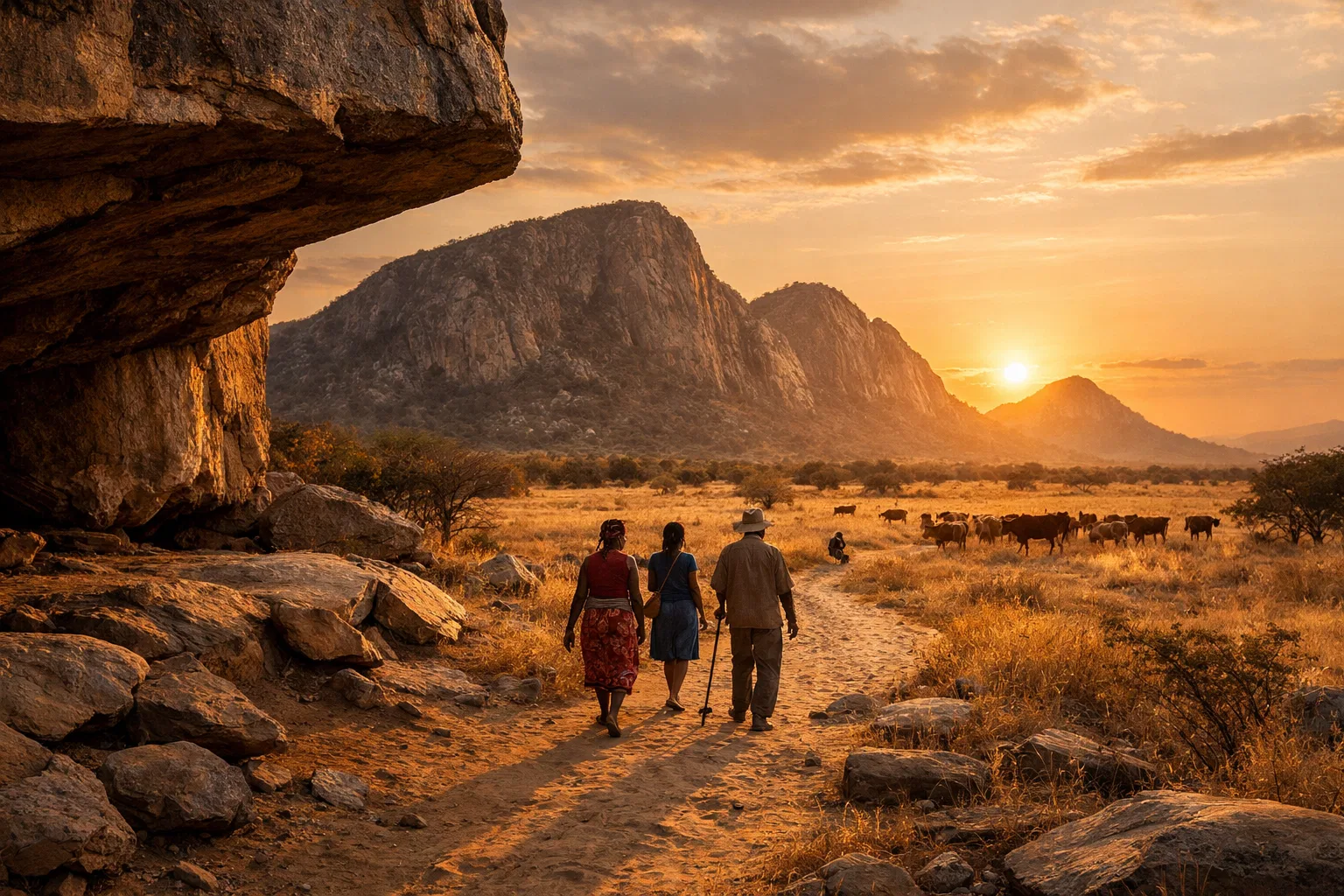
The first thing to understand is that Botswana’s legendary culture is unusually tied to landscape. Folklore is not just told around a fire or preserved in books; it is attached to hills, waterholes, caves, footprints, cattle spaces, rain clouds and rock shelters. A story may explain a place, while a place helps keep the story believable, memorable and socially important.
This is especially clear in creation traditions. Matsieng Footprints, north of Gaborone near Rasesa, is officially promoted as a National Monument with a sandstone slab, deep holes and engravings. Botswana Tourism says local legend identifies Matsieng as the first ancestor of the Batswana, a giant one-legged man who climbed out of a hole followed by his people, domestic animals and wildlife.[Botswana Tourism]botswanatourism.co.bwBotswana Tourism Matsieng Footprints | Botswana Tourism OrganisationBotswana Tourism Matsieng Footprints | Botswana Tourism Organisation The value of the story is not that it should be read as literal geology. Its importance lies in how it turns engraved stone and rainwater holes into a remembered origin point: people, animals and land emerging together.
Botswana’s folklore is also strongly ecological. Hare, lion, hyena, jackal, tortoise, elephant, kudu and ostrich appear in Setswana tales not as random animal mascots but as social characters. A University of Pretoria study of Setswana hare folktales lists stories such as “The lion and the hare”, “The porcupine and the hare”, “The hare and the tortoise”, “The hare and the jackal” and “The hare deceives the elephant”, showing how repeated animal pairings carry lessons about cunning, violence, social order and moral ambiguity.[UPSpace Repository]repository.up.ac.zaUPSpace Repository
Creation Places: Matsieng and Tsodilo
Matsieng is one of Botswana’s clearest examples of a mythic landscape: a physical site where engraved human and animal forms are interpreted through origin tradition. The folklore says Matsieng emerged first, followed by people and animals, leaving marks in still-soft ground that later hardened. The site therefore works on two levels at once: as rock engraving, and as a story about ancestry, movement and belonging. Botswana Tourism’s own presentation of the monument keeps the legendary frame alive for visitors rather than reducing it to archaeology alone.[Botswana Tourism]botswanatourism.co.bwBotswana Tourism Matsieng Footprints | Botswana Tourism OrganisationBotswana Tourism Matsieng Footprints | Botswana Tourism Organisation
Tsodilo Hills, in north-western Botswana, is even more famous internationally. UNESCO calls it the “Louvre of the Desert” because of its dense rock-art concentration: over 4,500 paintings in about 10 square kilometres. UNESCO also stresses that the archaeological record there stretches across at least 100,000 years of human activity and environmental change, while local communities continue to respect the hills as a place frequented by ancestral spirits.[UNESCO World Heritage Centre]whc.unesco.orgWorld Heritage Centre TsodiloWorld Heritage Centre Tsodilo
For the folklore reader, Tsodilo is important because it shows how “ancient art” and “living sacred place” can be different things but still overlap. A visitor may come to see paintings; local San and Hambukushu communities may know the hills through routes, stories, ritual associations and inherited respect. Botswana Tourism notes that both San and Hambukushu live near the hills and that guides from their villages can be arranged, while the site has walking trails, a museum and camping facilities.[Botswana Tourism]botswanatourism.co.bwBotswana Tourism Tsodilo Hills | Botswana Tourism OrganisationBotswana Tourism Tsodilo Hills | Botswana Tourism Organisation
The careful distinction is this: Tsodilo’s rock art is not a single illustrated storybook whose meanings can be read with certainty from every image. Some meanings have been reconstructed through archaeology, ethnography and local knowledge; others remain uncertain. What is well attested is the site’s continuing sacred status, its exceptional concentration of paintings, and its role as one of Botswana’s strongest bridges between deep time and living memory.[UNESCO World Heritage Centre]whc.unesco.orgWorld Heritage Centre TsodiloWorld Heritage Centre Tsodilo

Ancestors, Rain and the Moral Weather
Rain is one of the great organising ideas in Botswana’s traditional belief culture. In a largely dry country shaped by the Kalahari, rain is not just weather; it is blessing, survival, political legitimacy and ritual concern. Isaac Schapera’s classic study Rainmaking Rites of Tswana Tribes, published in 1971, is catalogued specifically under rain-making, religious aspects and Botswana, reflecting how central this subject became in scholarship on Tswana ritual life.[Internet Archive]archive.orgOpen source on archive.org.
Rainmaking was not simply a private magical act. In older Tswana social life, it was bound up with leadership, community welfare and relations with ancestors. The practical problem was drought; the cultural question was why rain had failed and what social or ritual disorder might need addressing. This is why rainmaking belongs on a folklore page as much as on a religion page: it joins story, ritual, authority and environment.
Traditional specialists also matter here. A summary of Tswana religious and expressive culture describes traditional doctors as specialists whose roles historically included healing, rainmaking, compound protection, countering sorcery and women’s reproductive health. It also notes divination through bones and the attribution of much illness or misfortune to sorcery.[EveryCulture]everyculture.comEvery Culture Religion and expressive cultureEvery Culture Religion and expressive culture In everyday terms, this means Botswana’s supernatural traditions have often been less about distant gods and more about diagnosing misfortune: why sickness came, why crops failed, why a household was troubled, or why the dead had not settled peacefully.
Ancestor belief remains an important part of the picture, though modern Botswana is largely Christian. Statistics Botswana’s 2022 census analysis found that, among those who stated a religious affiliation, 86.5% identified as Christian, while 4.6% identified with African Traditional Religions and 7.1% reported no religious affiliation.[Statistics Botswana]statsbots.org.bwStatistics Botswana The same report notes that African Traditional Religions continued to be practised in Botswana and that the share identifying with them rose from 4.1% in 2011 to 4.6% in 2022.[Statistics Botswana]statsbots.org.bwStatistics Botswana
Those figures do not capture every lived mixture of practice. People may identify as Christian while still recognising ancestral customs, consulting traditional healers, attending family rites or treating certain places as spiritually charged. That overlap is not a contradiction in many households; it is part of how inherited belief adapts under Christianity, schooling, urban life and national identity.
Animal Tales: Why Hare Is Clever but Not Always Good
Botswana’s folktales often use animals to think about human behaviour. The hare is especially important in Setswana storytelling. In many African traditions the trickster is funny, sharp and disruptive; in Setswana hare tales, the character can be entertaining but also morally troubling. That makes the stories more interesting than simple children’s fables.
The University of Pretoria study mentioned above collected 19 Setswana hare folktales, including stories in which hare interacts with lion, porcupine, tortoise, kudu, hyena, jackal, elephant and other animals.[UPSpace Repository]repository.up.ac.zaUPSpace Repository The repeated pattern is not “small animal good, large animal bad”. Hare’s intelligence may expose arrogance or brute force, but it may also slide into cruelty, deception and social danger. This helps explain why such tales remain useful: they teach listeners that cleverness is powerful, but not automatically virtuous.
This is a key difference between living folklore and polished moralising retellings. A modern children’s version may end with a tidy lesson about wit. Older or fuller versions can be darker, stranger or more ambivalent. In that sense, Botswana’s animal tales are not merely entertainment; they are compact arguments about power, survival, appetite and consequence.
The animal world also connects Tswana and San materials without making them identical. San traditions across southern Africa place great ritual and imaginative weight on animals, especially the eland. Scholarly work on San mythology points to long traditions of trickster figures, trance, animal transformation and complex mythic storytelling; bibliographic records for San folklore include studies of Kalahari Ju’hoan, Nharo of Botswana and related southern African traditions.[Cambridge University Press & Assessment]cambridge.orgOpen source on cambridge.org. Botswana’s folklore therefore sits within a wider southern African story zone while still having local forms tied to Botswana’s peoples and places.

Spirits, Ghosts and Witchcraft in Everyday Explanation
Botswana’s supernatural traditions are often concerned with social disturbance. Ghosts, sorcery, ancestral displeasure and ritual impurity are ways of explaining why ordinary life has gone wrong. In Tswana belief summaries, elders may become ancestors after death, while people who die with unresolved regrets may become ghosts whose souls haunt the living at night.[EveryCulture]everyculture.comEvery Culture Religion and expressive cultureEvery Culture Religion and expressive culture
This does not mean every Motswana today believes such accounts literally. Botswana is modern, urbanising and religiously diverse. The more useful way to read these traditions is as cultural explanations: ways of talking about grief, illness, fear, guilt, family obligation and social tension. A ghost story may be about the dead, but it is also about the living community’s responsibility to bury, mourn and remember properly.
Witchcraft belief has a similarly complicated role. It can be a frightening accusation, a way of explaining misfortune, or a narrative device in stories about envy and hidden harm. Traditional healers may be approached for protection, diagnosis or cleansing. The same source on Tswana expressive culture distinguishes healers from malevolent sorcerers and notes that misfortune may be attributed to harmful powers.[EveryCulture]everyculture.comEvery Culture Religion and expressive cultureEvery Culture Religion and expressive culture For a public folklore page, the safest and most accurate approach is to present these as beliefs and social narratives, not as proof of supernatural action.
San and Kalahari Traditions
No account of Botswana folklore is complete without San traditions, but they need careful handling. “San” covers diverse communities and languages, not a single timeless people with one mythology. Much older scholarship used outsider labels and sometimes treated San culture as frozen in the past. Better modern reading sees San storytelling as varied, historical and still connected to living communities.
For Botswana, the Kalahari is central. Published scholarship cited in studies of southern African San myth includes works on Kalahari Ju’hoan folklore, Nharo oral traditions of Botswana, tricksters, trance, rain, sorcerers and rock-art interpretation.[Cambridge University Press & Assessment]cambridge.orgOpen source on cambridge.org. These traditions often blur the boundaries between animal, human, spirit and landscape. A being may be trickster, creator, transformer and comic troublemaker at once. That instability is part of the point.
The connection with rock art is especially important. At Tsodilo, the paintings are not merely decorative relics. They belong to a wider world in which image-making, animal power, ritual experience and place-based memory can overlap. Scholars continue to debate exact meanings, and not every image should be forced into a single explanation. Still, the combination of archaeology, local sacred geography and San-associated interpretive traditions makes Botswana one of the key countries for understanding southern African rock-art folklore.[UNESCO World Heritage Centre]whc.unesco.orgWorld Heritage Centre TsodiloWorld Heritage Centre Tsodilo
Kalanga Heritage and Revived Cultural Memory
Botswana’s folklore is not only Tswana and San. Kalanga heritage is particularly visible in the north-east, including around Domboshaba. The ruins are associated with stone-walled settlement history and have become a focus for cultural pride, performance and identity.
A report on the Domboshaba Festival describes it as a way for the Bakalanga, one of Botswana’s minority groups, to build cultural awareness, pride and belonging. It also frames cultural festivals as a way for traditions to revive rather than disappear.[Sunday Standard]sundaystandard.infoOpen source on sundaystandard.info. That matters for folklore because modern festivals are not just “performances of the past”. They are places where songs, dances, foodways, oral memory, dress, ruins and regional identity are brought together for a contemporary audience.
This is one of the clearest examples of how folklore changes over time. A precolonial ruin may become a heritage site; a local memory may become a festival; a minority language tradition may become a public statement of belonging within the nation. The result is not fake tradition simply because it is organised through modern events. It is tradition being re-staged under modern conditions.
Folklore in Books, Archives and Modern Retellings
Botswana’s oral traditions have entered print through scholarship, school materials, museums, literary retellings and popular story collections. This is useful, but it changes the material. A tale told at night in a village setting is not the same experience as a short translated story in a textbook or a tourist brochure. Performance, audience response, song, gesture and local knowledge can be lost when a story is flattened into prose.
Botswana has a serious research base for this work. Botswana Notes and Records, founded in 1968 by The Botswana Society, publishes scholarship on Botswana’s history, languages, folklore, archaeology, traditional culture and related subjects.[Pluto Journals]plutojournals.comPluto Journals Botswana Notes and RecordsPluto Journals Botswana Notes and Records The broader bibliography of Botswana culture includes work by Megan Biesele on Kalahari San music and folklore, Isaac Schapera on rainmaking, and literary figures such as Bessie Head and Unity Dow, whose writing helped bring Botswana village life, belief and social conflict into wider literary circulation.[South African History Online]sahistory.org.zaSouth African History Online
Modern retellings are valuable when they help readers encounter stories, but they should not be confused with untouched ancient originals. Folklore is always shaped by the person telling it, the language used, the audience, the politics of collection and the purpose of publication. A good Botswana folklore page should therefore ask: is this an old oral tradition, a scholarly transcription, a school retelling, a tourist explanation, a literary adaptation, or an internet-era version?
How Botswana’s Folklore Is Understood Today
Today, Botswana’s folklore lives in several places at once. It lives in families, in rural memory, in churches and healing practices, in cultural festivals, in national monuments, in schoolbooks, in academic archives, in tourism and in online retellings. Some traditions are actively practised; others are remembered, performed, debated or reinterpreted.
The strongest examples are those where story, place and community still meet. Matsieng remains powerful because the engraved footprints are visible. Tsodilo remains powerful because the hills, paintings and sacred associations are still there. Domboshaba remains powerful because heritage activity links ruins to Kalanga identity. Hare tales remain powerful because they still make readers laugh, wince and argue about whether cleverness excuses harm.
The main misconception is that folklore is simply “old superstition”. In Botswana, it is better understood as cultural memory in story form. It explains origins, encodes environmental knowledge, dramatises moral danger, gives shape to grief and misfortune, and turns landscapes into places of meaning. Some traditions are ancient, some are historically documented, some are modern revivals, and some are simplified for visitors. The most honest reading keeps those categories distinct while recognising that all of them help show how Botswana imagines its past and negotiates its present.
Amazon book picks
Further Reading
Books and field guides related to Where Botswana's Stories Live in the Land. Use these as the next step if you want deeper reading beyond the article.
The Palm-Wine Drinkard
Demonstrates African oral tradition, spirits and mythic landscapes.
African Myths of Origin
Covers origin stories and folklore traditions relevant to southern Africa.
African Religions and Philosophy
Explains ancestors, spirituality and worldview themes central to Botswana traditions.
eBay marketplace picks
Marketplace Samples
Live-tested eBay searches with available results related to this page.


Endnotes
1.
Source: whc.unesco.org
Title: World Heritage Centre Tsodilo
Link:https://whc.unesco.org/en/list/1021/
2.
Source: repository.up.ac.za
Title: UPSpace Repository
Link:https://repository.up.ac.za/bitstreams/96620cdb-9d19-434e-a07a-5941a77ca6d1/download
3.
Source: archive.org
Link:https://archive.org/details/rainmakingriteso0000scha
4.
Source: everyculture.com
Title: Every Culture Religion and expressive culture
Link:https://www.everyculture.com/Africa-Middle-East/Tswana-Religion-and-Expressive-Culture.html
5.
Source: statsbots.org.bw
Title: Statistics Botswana
Link:https://www.statsbots.org.bw/sites/default/files/census_documents/Botswana%20Population%20%26%20Housing%20Census%202022%20Analytical%20Report%20Volume%201-Demographic%20and%20Social%20Characteristics%2CRegistration%2C%20Youth%20and%20Elderly%2CEducation.pdf
6.
Source: cambridge.org
Link:https://www.cambridge.org/core/journals/africa/article/three-nineteenthcentury-southern-african-san-myths-a-study-in-meaning/FD4275F183EBE3F2A842E5D18F2322BA
7.
Source: sahistory.org.za
Title: South African History Online
Link:https://sahistory.org.za/sites/default/files/archive-files/james_denbow_phenyo_c._thebe_culture_and_custombook4you.pdf
8.
Source: folktales.africa
Title: the girl and the lion spirit
Link:https://folktales.africa/the-girl-and-the-lion-spirit/
9.
Source: folktales.africa
Link:https://folktales.africa/jackal-and-hare-an-angolan-folktale-that-teaches-lessons-on-greed-pride-and-deceit/
10.
Source: botswanatourism.co.bw
Title: Botswana Tourism Matsieng Footprints | Botswana Tourism Organisation
Link:https://www.botswanatourism.co.bw/explore/matsieng-footprints
11.
Source: botswanatourism.co.bw
Title: Botswana Tourism Tsodilo Hills | Botswana Tourism Organisation
Link:https://www.botswanatourism.co.bw/explore/tsodilo-hills
12.
Source: sundaystandard.info
Link:https://www.sundaystandard.info/domboshaba-festival-the-heart-of-the-bakalanga-people/
13.
Source: plutojournals.com
Title: Pluto Journals Botswana Notes and Records
Link:https://www.plutojournals.com/botswana-notes-records/
14.
Source: facebook.com
Link:https://www.facebook.com/100064551407916/posts/according-to-the-2011-population-housing-census73-of-people-living-in-botswana-a/1734579033353938/
15.
Source: thebotswanasociety.net
Link:https://www.thebotswanasociety.net/matsieng
16.
Source: statsbots.org.bw
Title: 2022 Population and Housing Census Preliminary Results
Link:https://www.statsbots.org.bw/sites/default/files/2022%20Population%20and%20Housing%20Census%20Preliminary%20Results.pdf
17.
Source: statsbots.org.bw
Title: Population Housing Census 2022 Key Demographic and Socio Economic Indicators
Link:https://www.statsbots.org.bw/sites/default/files/publications/Population%20%20Housing%20Census%202022-%20Key%20Demographic%20and%20Socio-Economic%20Indicators.pdf
18.
Source: Wikipedia
Link:https://en.wikipedia.org/wiki/Botswana
19.
Source: Wikipedia
Link:https://en.wikipedia.org/wiki/Tsodilo
20.
Source: Wikipedia
Title: Matsieng Footprints
Link:https://en.wikipedia.org/wiki/Matsieng_Footprints
21.
Source: Wikipedia
Link:https://en.wikipedia.org/wiki/Domboshaba
22.
Source: repository.up.ac.za
Link:https://repository.up.ac.za/server/api/core/bitstreams/265c0684-42f7-4476-add0-37f15101de5d/content
23.
Source: sheppard.me.uk
Link:https://www.sheppard.me.uk/botswana/medicine/doctors.html
24.
Source: openlibrary.org
Title: Isaac Schapera
Link:https://openlibrary.org/authors/OL118262A/Isaac_Schapera
25.
Source: atlasobscura.com
Title: matsieng footprints
Link:https://www.atlasobscura.com/places/matsieng-footprints
26.
Source: sundaystandard.info
Title: batswana still strongly believe in dingaka tsa setswana 2
Link:https://www.sundaystandard.info/batswana-still-strongly-believe-in-dingaka-tsa-setswana-2/
27.
Source: hgcosmos.org
Title: Megan Biesele
Link:https://hgcosmos.org/assets/researchers/B/Biesele%2C%20Megan.pdf
28.
Source: botswanatourism.co.bw
Link:https://www.botswanatourism.co.bw/
29.
Source: tripadvisor.com.au
Title: Tsodilo Hills
Link:https://www.tripadvisor.com.au/Attraction_Review-g480161-d311243-Reviews-Tsodilo_Hills-Shakawe_North_West_District.html
30.
Source: africanrockart.britishmuseum.org
Link:https://africanrockart.britishmuseum.org/country/botswana/tsodilo/
31.
Source: evolveback.com
Title: tsodilo hills
Link:https://www.evolveback.com/blogs/tsodilo-hills.html
32.
Source: ebsco.com
Link:https://www.ebsco.com/research-starters/geography-and-cartography/botswana
33.
Source: botswana.co.za
Title: Tsodilo Hills
Link:https://www.botswana.co.za/africa_tsodilo_hills.html
34.
Source: state.gov
Link:https://www.state.gov/countries-areas/botswana
Additional References
35.
Source: youtube.com
Title: Tsodilo Hills, Botswana | Africa’s Cultural Landmarks
Link:https://www.youtube.com/watch?v=H5h0q1PE2Qk
Source snippet
Trip To Matsieng Footprints | Botswana Youtuber...
36.
Source: researchgate.net
Link:https://www.researchgate.net/publication/6326607_El_Negro_el_Nino_witchcraft_and_the_absence_of_rain
37.
Source: researchgate.net
Link:https://www.researchgate.net/publication/237829767_Eland_Hunting_Rituals_among_Northern_and_Southern_San_Groups_Striking_Similarities
38.
Source: researchgate.net
Link:https://www.researchgate.net/publication/380763092_CHILD_OF_GOD_AND_THE_ANCESTORS_TALES_OF_THE_BAKWENA_DYNASTY_IN_BOTSWANA_BEFORE_SECHELE_BY_JEFF_RAMSAY_FORWARD
39.
Source: researchgate.net
Link:https://www.researchgate.net/publication/404642752_Spirits_Ancestors_and_the_Land_Exploring_the_Chthonic_Myths_Of_Mwaghavul_Oral_Narrative
40.
Source: facebook.com
Link:https://www.facebook.com/groups/275114380263865/posts/608999343542032/
41.
Source: amazon.nl
Link:https://www.amazon.nl/African-folktales-Retold-baboon-animals/dp/B08PJK78S3?tag=searcht-20
42.
Source: facebook.com
Link:https://www.facebook.com/groups/28845000311/posts/basarwa-san-speaking-setswana-a-legacy-older-than/10165549868435312/
43.
Source: journals.co.za
Link:https://journals.co.za/doi/10.25159/2663-6697/11506
44.
Source: facebook.com
Link:https://www.facebook.com/groups/28845000311/posts/10165539233260312/
Topic Tree
Follow this branch
Related pages 192
- Afghan Folklore
- Albanian Folklore
- Algerian Folklore
- Australian Folklore
- Azerbaijan Folklore
- +187 more in sidebar