Within Chile Folklore
Why Serpents Shape Chile's Earth
The struggle of Caicai and Trentren turns floods, earthquakes and mountains into a powerful Mapuche story of balance.
On this page
- Caicai, Trentren and the flood story
- Earthquakes, coastlines and sacred terrain
- Retelling Mapuche cosmology with care
Page outline Jump by section
Introduction
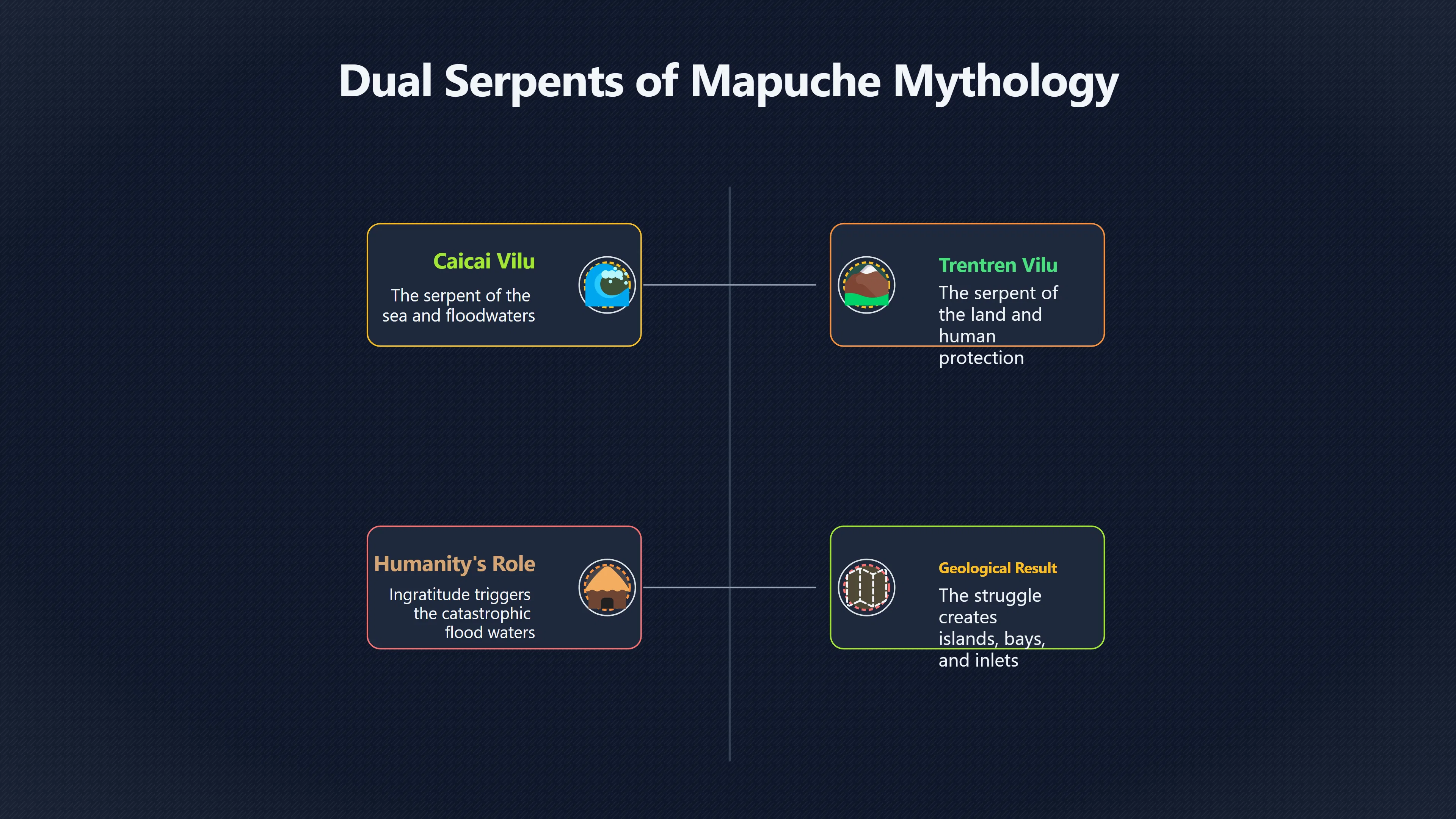
Few myths seem so perfectly matched to the country that tells them as the Mapuche story of Caicai and Trentren. In this tradition, two immense serpents struggle against one another: Caicai, associated with the sea and floodwaters, and Trentren, linked to the land and the protection of human life. Their conflict explains why mountains rise, coastlines change, earthquakes shake the ground and the ocean can suddenly become dangerous. Far more than a simple creation story, the myth offers a way of understanding life in one of the world’s most geologically active regions. For generations of Mapuche communities in southern Chile, the tale connected human behaviour, spiritual power and the forces that shape the landscape itself.[chileprecolombino.cl]chileprecolombino.clCaicai lives in the sea, Trentren on the land. Mapuche legend relates that when Caicai awoke…Read more…
The story remains one of the most widely recognised elements of Mapuche mythology and one of the clearest examples of how Chilean folklore turns geography into narrative. Rather than separating nature from culture, the myth treats mountains, oceans, earthquakes and floods as part of a living relationship between people and the world around them.[researchgate.net]researchgate.netResearchGate(PDF) Influence of Geological Processes in the…One particularly illustrative myth refers to the combat between two huge sn…
Why Two Serpents Shape Chile’s Earth
According to Mapuche tradition, Caicai dwells in the waters while Trentren belongs to the land. The most familiar version of the myth tells how Caicai became angered by humanity’s ingratitude and unleashed a catastrophic flood. Waters rose across the land, threatening people and animals alike. In response, Trentren raised hills and mountains, giving refuge to those fleeing the deluge. The struggle continued until neither force achieved complete victory. The sea retreated, but not entirely, leaving a transformed world of islands, mountains, bays and inlets.[chileprecolombino.cl]chileprecolombino.clCaicai lives in the sea, Trentren on the land. Mapuche legend relates that when Caicai awoke…Read more…
The story survives in many local variations, reflecting the fact that Mapuche traditions developed across a large territory and were transmitted orally. Details differ from place to place, but the central tension remains remarkably consistent: water seeks to overwhelm the land, while the land rises in resistance.[Wikipedia]WikipediaLegend of Trentren Vilu and Caicai ViluLegend of Trentren Vilu and Caicai Vilu
For listeners, the myth is not simply about a disaster in the distant past. It describes an ongoing relationship between opposing but interconnected powers. The world exists because neither serpent completely defeats the other. Order depends on balance rather than permanent victory.[pubs.geoscienceworld.org]pubs.geoscienceworld.org1 Oct 2021 — This myth, like the one previously quoted, invokes the eternal dispute between the two snakes, Kaikai, the serpent of water…
Earthquakes, Coastlines and Sacred Terrain
One reason the story remains so compelling is its close connection to the physical reality of Chile. The country sits above an active subduction zone where earthquakes, tsunamis, volcanic eruptions and coastal uplift have shaped human experience for millennia. Scholars studying Mapuche cosmology have noted that the myth mirrors many of these processes. Caicai’s advancing waters resemble tsunamis and flooding, while Trentren’s rising land recalls uplifted coasts and mountains.[researchgate.net]researchgate.netResearchGate(PDF) Influence of Geological Processes in the…One particularly illustrative myth refers to the combat between two huge sn…
Researchers have argued that the narrative preserves cultural memories of dramatic geological events. Rather than functioning as a scientific explanation in the modern sense, the story provides a meaningful framework through which communities could understand recurring natural hazards. Earthquakes and tidal waves become part of a familiar cosmic drama rather than isolated catastrophes.[ResearchGate]researchgate.netResearchGate(PDF) Influence of Geological Processes in the…One particularly illustrative myth refers to the combat between two huge sn…
The connection between myth and landscape is visible in place names as well. Studies have identified numerous hills and mountains in Chile and Argentina associated with Trentren or Caicai traditions, suggesting that the story became attached to specific features of the land over long periods of time. Sacred hills often appear in local versions as places of refuge during the great flood.[Wikipedia]WikipediaLegend of Trentren Vilu and Caicai ViluLegend of Trentren Vilu and Caicai Vilu
This relationship between narrative and terrain is one reason the myth feels unusually rooted in place. It does not merely occur in a landscape; it actively explains why that landscape looks the way it does.[chileantesdechile.cl]chileantesdechile.clCai Cai and Tren TrenThe Mapuche people relate that the Earth was created from a conflict between two enormous reptiles—Cai Cai, ruler of…
More Than a Flood Myth
Readers often compare the story to flood narratives from other parts of the world. While the motif of a world-threatening flood is certainly present, reducing the tale to a local version of a universal flood myth misses what makes it distinctive.
The central concern is not simply survival after a catastrophe. Instead, the myth explores relationships:
- Between land and sea.[chileantesdechile.cl]chileantesdechile.clCai Cai and Tren TrenThe Mapuche people relate that the Earth was created from a conflict between two enormous reptiles—Cai Cai, ruler of…
- Between human beings and the natural world.
- Between gratitude and disrespect.
- Between stability and disruption.
- Between destruction and renewal.[museo.precolombino.cl]museo.precolombino.clCaicai y TrentrenCaicai y Trentren son dos serpientes que aparecen en los relatos mapuches. Caicai vive en el mar y Trentren reside en la…
In many retellings, human behaviour plays a role in provoking imbalance. The flood is not random. It emerges from a breakdown in proper relationships with the powers that sustain life. This moral dimension helps explain why the story remains culturally significant even when listeners no longer interpret it literally.[museo.precolombino.cl]museo.precolombino.clCaicai y TrentrenCaicai y Trentren son dos serpientes que aparecen en los relatos mapuches. Caicai vive en el mar y Trentren reside en la…
The serpents themselves are also more complex than simple monsters. Neither is wholly good nor wholly evil. Caicai threatens life through overwhelming waters, yet the sea is also a source of abundance. Trentren protects humanity, but some versions portray the land serpent as capable of destructive volcanic and seismic force when angered. The world depends on both powers existing in tension.[Wikipedia]WikipediaLegend of Trentren Vilu and Caicai ViluLegend of Trentren Vilu and Caicai Vilu
Retelling Mapuche Cosmology with Care
Modern discussions sometimes present the myth as if it were merely an ancient geological observation encoded in story. While geological interpretations can be illuminating, many Mapuche scholars and cultural institutions emphasise that the narrative belongs within a broader worldview that links spiritual forces, ancestors, landscapes and human responsibilities.[ResearchGate]researchgate.netResearchGate(PDF) Influence of Geological Processes in the…One particularly illustrative myth refers to the combat between two huge sn…
Seen only as a record of prehistoric earthquakes, the story loses much of its cultural meaning. Its importance lies not just in what it may remember about environmental events, but in how it expresses a relationship with the world. Land, water and mountains are not passive scenery. They participate in a moral and spiritual order that humans must respect.[pubs.geoscienceworld.org]pubs.geoscienceworld.org1 Oct 2021 — This myth, like the one previously quoted, invokes the eternal dispute between the two snakes, Kaikai, the serpent of water…
This perspective helps explain why the myth continues to appear in museums, educational programmes, literature and contemporary artistic works. The story offers a powerful language for discussing environmental vulnerability, cultural identity and the experience of living in a landscape that can never be entirely controlled.[chileprecolombino.cl]chileprecolombino.clCaicai lives in the sea, Trentren on the land. Mapuche legend relates that when Caicai awoke…Read more…
Why the Story Endures
Chile remains a country where earthquakes, tsunamis and volcanic activity are part of lived experience. Against that backdrop, the conflict between Caicai and Trentren still feels relevant. The myth does not promise that disasters will end. Instead, it suggests that disruption is woven into the fabric of the world and that survival depends on recognising the balance between powerful forces.[researchgate.net]researchgate.netResearchGate(PDF) Influence of Geological Processes in the…One particularly illustrative myth refers to the combat between two huge sn…
For many readers, that is what makes the serpent myth memorable. It transforms geological instability into a story of relationship, responsibility and resilience. Mountains become more than rock, the sea becomes more than water, and Chile’s restless landscape becomes part of a living cultural imagination shaped over generations.[chileprecolombino.cl]chileprecolombino.clCaicai lives in the sea, Trentren on the land. Mapuche legend relates that when Caicai awoke…Read more…
Amazon book picks
Further Reading
Books and field guides related to Why Serpents Shape Chile's Earth. Use these as the next step if you want deeper reading beyond the article.
eBay marketplace picks
Marketplace Samples
Live-tested eBay searches with available results related to this page.




Endnotes
1.
Source: chileantesdechile.cl
Link:https://www.chileantesdechile.cl/en/vitrinas/zona-sur/a-cai-cai-y-tren-tren/
Source snippet
Cai Cai and Tren TrenThe Mapuche people relate that the Earth was created from a conflict between two enormous reptiles—Cai Cai, ruler of...
2.
Source: Wikipedia
Title: Legend of Trentren Vilu and Caicai Vilu
Link:https://en.wikipedia.org/wiki/Legend_of_Trentren_Vilu_and_Caicai_Vilu
3.
Source: researchgate.net
Link:https://www.researchgate.net/publication/355762068_Influence_of_Geological_Processes_in_the_Cosmovision_of_the_Mapuche_Native_People_in_South_Central_Chile
Source snippet
ResearchGate(PDF) Influence of Geological Processes in the...One particularly illustrative myth refers to the combat between two huge sn...
4.
Source: pubs.geoscienceworld.org
Link:https://pubs.geoscienceworld.org/hess/earth-sciences-history/article/40/2/581/614856/INFLUENCE-OF-GEOLOGICAL-PROCESSES-IN-THE
Source snippet
1 Oct 2021 — This myth, like the one previously quoted, invokes the eternal dispute between the two snakes, Kaikai, the serpent of water...
5.
Source: museo.precolombino.cl
Link:https://museo.precolombino.cl/caicai-y-trentren/
Source snippet
Caicai y TrentrenCaicai y Trentren son dos serpientes que aparecen en los relatos mapuches. Caicai vive en el mar y Trentren reside en la...
6.
Source: museo.precolombino.cl
Title: Tren Tren y Kay Kay
Link:https://museo.precolombino.cl/tren-tren-y-kay-kay/
Source snippet
SantiagoEn este mito mapuche las poderosas serpientes TREN-TREN y KAI-KAI, hijas de los pillanes, protegen a la tierra poniendo en eviden...
7.
Source: museo.precolombino.cl
Link:https://museo.precolombino.cl/catalogo-en-linea/
Source snippet
Catálogo de ColeccionesEl catálogo en línea de la colección del Museo Chileno de Arte Precolombino contiene más de 10.000 piezas que se c...
8.
Source: Wikipedia
Link:https://en.wikipedia.org/wiki/Mapuche
Source snippet
Mapuchea group of indigenous inhabitants of south-central Chile and southwestern Argentina, including parts of Patagonia.Read more...
9.
Source: Wikipedia
Title: Museo Chileno de Arte Precolombino
Link:https://en.wikipedia.org/wiki/Museo_Chileno_de_Arte_Precolombino
Source snippet
Museo Chileno de Arte PrecolombinoThe Chilean Museum of Pre-Columbian Art is an art museum dedicated to the study and display of pre-C...
10.
Source: researchgate.net
Title: 266315701 Chile antes de Chile Chile before Chile
Link:https://www.researchgate.net/publication/266315701_Chile_antes_de_Chile_Chile_before_Chile
Source snippet
(PDF) Chile antes de Chile / Chile before ChileMar 16, 2026 — This is the exhibit guide of a new permanent exhibition centered on the nat...
11.
Source: mapuche.nl
Link:https://www.mapuche.nl/english/mapuche.html
Source snippet
people) of the Chilean population.Read more...
12.
Source: chile.travel
Title: Discover the ruca, ancestral weaving, and Lafquenche cuisine in southern
Link:https://chile.travel/en/blog/ancestral-travel-5-experiences-with-the-mapuche-people-2-2/
Source snippet
Ancestral Travel: 5 Experiences with the Mapuche peopleAug 27, 2021 — Experience 5 authentic Mapuche cultural encounters in Araucanía...
13.
Source: youtube.com
Title: Legend of Tren Tren and Cai Cai: Mapuche Oral Storytelling
Link:https://www.youtube.com/watch?v=ygaiJMXwxY4
Source snippet
Mapuche Mythology - Indigenous Culture in South America...
14.
Source: youtube.com
Title: Mapuche Mythology
Link:https://www.youtube.com/watch?v=qZlR4lgacZQ
Source snippet
The Mapuche Creation Myth...
15.
Source: chileprecolombino.cl
Link:https://chileprecolombino.cl/en/arte/piezas-selectas/caicai-y-trentren/
Source snippet
Caicai lives in the sea, Trentren on the land. Mapuche legend relates that when Caicai awoke...Read more...
16.
Source: lammuseum.wfu.edu
Link:https://lammuseum.wfu.edu/exhibits/virtual/ties-that-bind-wedding-customs-from-around-the-world/mapuche/
Source snippet
Timothy S. Y. Lam Museum of AnthropologyThe Mapuche are the indigenous people of south-central Chile and southwest Argentina and the most...
17.
Source: chileprecolombino.cl
Link:https://chileprecolombino.cl/en/search/Tr%C3%AAn%20D%C6%B0%E1%BB%9Bithu%E1%BA%ADt%20to%C3%A1n%EF%BC%88splay01.win%EF%BC%89/
Source snippet
Caicai lives in... Creative Commons © 2012 Chile antes de Chile - Museo Chileno de Arte Precolombino...
Additional References
18.
Source: tripadvisor.cl
Link:https://www.tripadvisor.cl/Attractions-g294305-Activities-c49-Santiago_Santiago_Metropolitan_Region.html
Source snippet
10 MEJORES museos de SantiagoVer formas de disfrutar (11) · 3. Museo Chileno de Arte Precolombino. 4,6. (4.980). Museos de historia. Bole...
19.
Source: reddit.com
Link:https://www.reddit.com/r/AlternativeHistory/comments/10sz3r5/an_unknown_to_most_diluvian_myth/
Source snippet
An unknown to most diluvian myth: r/AlternativeHistoryTren tren rising the hills and Cai Cai rising the waters. Eventually both serpents...
20.
Source: minorityrights.org
Link:https://minorityrights.org/communities/mapuche-2/
Source snippet
Mapuche in ChileMapuche are the largest indigenous groups in Chile, comprising about 84 per cent of the total indigenous population or ab...
21.
Source: mnba.gob.cl
Link:https://www.mnba.gob.cl/
Source snippet
Museo Nacional de Bellas Artes: InicioEl Museo Nacional de Bellas Artes es una institución pública, perteneciente al Servicio Nacional de...
22.
Source: mnhn.gob.cl
Link:https://www.mnhn.gob.cl/
23.
Source: educationperfect.com
Link:https://www.educationperfect.com/media/content/English%20%26%20Literature/resources/Reading%20Library/Narrative-Y8-Trentren%20Vilu%20and%20Caicai%20Vilu%20%2828-09-2017%29.pdf
Source snippet
Trentren Vilu and Caicai ViluLong ago, there were two enormous snakes, Trentren Vilu and Caicai Vilu.... The battle between the two gian...
24.
Source: museoschile.gob.cl
Link:https://www.museoschile.gob.cl/
25.
Source: aljazeera.com
Link:https://www.aljazeera.com/video/the-big-picture/2023/6/4/the-mapuche-and-the-myth-of-chile
26.
Source: berkleycenter.georgetown.edu
Title: los mapuche a native culture struggling for survival in chile
Link:https://berkleycenter.georgetown.edu/posts/los-mapuche-a-native-culture-struggling-for-survival-in-chile
Source snippet
Mapuche: A Native Culture Struggling for Survival in ChileMay 13, 2013 — The Mapuche, although officially autonomous as their own nation...
Published: May 13, 2013
27.
Source: mapy.com
Link:https://mapy.com/en/?id=137644540&source=osm
Source snippet
titude, but Trentren Vilu saved the people and animals, shaping the geography of...
Topic Tree