Where Ritual, Ancestors and Landscape Still Speak
Eswatini’s folklore is best understood as a living web of oral storytelling, ancestor-centred belief, royal ceremony, sacred landscape, dance, praise, and cautionary tales rather than as a fixed “mythology” in the bookish sense.
Page outline Jump by section
Introduction
For readers looking for monsters, ghosts and old tales, the most useful starting point is this: Eswatini has fewer globally famous “creatures” than some neighbouring folklore traditions, but it has a rich belief world in which animals, ancestors, diviners, rain, kingship, caves, mountains and stories of transformation carry supernatural weight. The evidence is strongest for oral literature, ancestral religion, national ceremonies, and San rock-art landscapes; it is thinner for named internet-style monsters, which should not be mistaken for old Swazi tradition unless they can be traced to local sources.
What makes Eswatini folklore distinctive?
Eswatini’s folklore grows out of a small but culturally concentrated kingdom in southern Africa, historically called Swaziland. The Swazi people’s oral traditions are closely linked to royal history, clan memory and praise poetry. Accessible cultural summaries note that elder storytellers recount histories of forebears stretching back several centuries, while scholarly work on Swazi oral literature treats folktales, songs, praises, riddles and proverbs as important carriers of social memory and values.[everyculture.com]everyculture.comEvery Culture SwazisEvery Culture Swazis
The central difference from a written mythology is that Swazi tradition has often been performed rather than merely recited. A story told by a grandmother, a praise-song naming an early king, a healer’s diagnosis, a dance at a royal residence, or a guide’s explanation at a rock-art shelter all belong to different settings. They are not interchangeable. Some are public and adaptable; others are tied to ritual authority and are not meant to be fully exposed to outsiders.
Several themes appear again and again:
- Ancestors matter more in everyday life than distant creation myths. Swazi religion recognises a remote first power, but practical spiritual life is strongly connected to ancestors, family ritual, healing and protection.[Encyclopedia.com]encyclopedia.comSwazi Religion | Encyclopedia.comSwazi Religion | Encyclopedia.com
- Royal ceremony is folklore in action. The Incwala is not simply a harvest festival; official tourism material describes it as a rite of cleansing, renewal and kingship, with secret components that may not be recorded.[The Kingdom of Eswatini]thekingdomofeswatini.comThe Kingdom of Eswatini Incwala Festival | The Kingdom of Eswatini (SwazilandThe Kingdom of Eswatini Incwala Festival | The Kingdom of Eswatini (Swaziland
- Landscape carries meaning. Rock shelters, mountains, rivers, cattle byres and royal residences are not just scenic backdrops; they are places where memory, authority and spiritual interpretation gather.
- Animals and transformation are important story vehicles. Swazi folktales include animal tales, trickster patterns, magical reversals and moral testing, while San rock art in Eswatini includes striking human-animal and spirit-like forms interpreted through shamanic traditions.[pressbooks.pub]pressbooks.pubA Reader's Guide to African Folktales at the Internet ArchiveA Reader's Guide to African Folktales at the Internet Archive
Ancestors, rain and the unseen order
A good way to approach Swazi supernatural belief is to set aside the modern split between “religion” and “folklore”. In the older worldview described by scholars of Swazi religion, sacred and everyday life overlap. Powers are understood as active in people, water, earth and social relations; the natural and supernatural are not sharply separated. A distant first power is acknowledged, but the more immediate spiritual relationship is with ancestors, whose influence is felt in health, misfortune, dreams, ritual and family continuity.[Encyclopedia.com]encyclopedia.comSwazi Religion | Encyclopedia.comSwazi Religion | Encyclopedia.com
This ancestor-centred world gives Eswatini’s folklore much of its seriousness. A story about disrespect, greed, broken kinship or careless speech is not merely a moral lesson in the abstract. It may reflect a wider belief that disorder among the living can draw misfortune, illness or ancestral displeasure. Diviners and healers occupy a key role here because they interpret hidden causes: sickness may be read not only as a physical condition, but as a sign of social or spiritual imbalance. General accounts of Swazi expressive culture note that both male and female diviners communicate with spirits, and that ancestral spirits may influence welfare, especially health.[EveryCulture]everyculture.comEvery Culture SwaziEvery Culture Swazi
Rain is one of the strongest bridges between folklore, ritual and political authority. The king and queen mother are described in scholarly accounts as figures associated with ritual knowledge “to work the rain”, with rain understood as fertility and the “water of life”.[Encyclopedia.com]encyclopedia.comSwazi Religion | Encyclopedia.comSwazi Religion | Encyclopedia.com This is not just picturesque symbolism. In an agricultural and pastoral society, rain is survival, cattle wealth, crop fertility and national well-being. Traditions about rain therefore sit at the border of ecology, sacred kingship and public welfare.
This also explains why Eswatini folklore is often less about a single named god battling monsters and more about balance: balance between living and dead, king and queen mother, cattle and land, secrecy and public ceremony, young and old, rain and drought, respect and danger.
Incwala: the great public ritual with a hidden centre
The Incwala is the best-known example of Eswatini’s ritual folklore as a living national performance. It is often translated as a first-fruits festival, but that translation is too narrow. Eswatini’s official tourism site calls it the country’s most important cultural event and stresses that the tasting of the new season’s produce is only one part of a long rite centred on cleansing, renewal and kingship.[The Kingdom of Eswatini]thekingdomofeswatini.comThe Kingdom of Eswatini Incwala Festival | The Kingdom of Eswatini (SwazilandThe Kingdom of Eswatini Incwala Festival | The Kingdom of Eswatini (Swaziland
For a folklore reader, the most important point is that Incwala is not a staged “show” in the usual tourist sense. Public parts may be witnessed, but the ceremony has inner workings that remain private. The same official source states that the songs, dances and ritual inside the royal cattle enclosure are secret and may not be recorded or written down. Dates are released close to the time because they are determined through ancestral astrology, and photography requires special permission.[The Kingdom of Eswatini]thekingdomofeswatini.comThe Kingdom of Eswatini Incwala Festival | The Kingdom of Eswatini (SwazilandThe Kingdom of Eswatini Incwala Festival | The Kingdom of Eswatini (Swaziland
This guardedness is part of the tradition’s meaning. Incwala’s power lies partly in the fact that it is not reduced to spectacle. It gathers regiments, royal figures, sacred plants, cattle symbolism, dance, song and national renewal into a single ritual sequence. The public climax includes thousands of people at the royal parade grounds, but the full ceremonial logic belongs to Swazi ritual authority rather than to outside description.[The Kingdom of Eswatini]thekingdomofeswatini.comThe Kingdom of Eswatini Incwala Festival | The Kingdom of Eswatini (SwazilandThe Kingdom of Eswatini Incwala Festival | The Kingdom of Eswatini (Swaziland
That creates a useful rule for modern readers: Incwala can be discussed, photographed in limited permitted contexts, and experienced respectfully, but it should not be treated as an open archive from which every secret can be extracted. In folklore terms, it is a living rite with boundaries, not a dead myth waiting to be decoded.
The Reed Dance and the folklore of youth, reeds and royal service
The Reed Dance is more open to spectators than Incwala and is now one of Eswatini’s most visible cultural events. The Eswatini National Trust Commission describes it as an eight-day ceremony in which girls cut reeds, present them to the Queen Mother and dance, usually in late August or early September. The stated aims include preserving chastity, providing tribute labour for the Queen Mother and creating solidarity through shared work.[Eswatini National Trust Commission]entc.org.szEswatini National Trust Commission Umhlanga Reed Dance CeremonyEswatini National Trust Commission Umhlanga Reed Dance Ceremony
The ceremony is not a folktale in the narrow sense, but it belongs to folklore because it transmits values through repeated action: gathering, marching, reed-cutting, singing, costume, hierarchy, public performance and return. The ENTC account describes girls arriving from about 350 chiefdoms, being grouped by age, cutting reeds, carrying them back to the royal capital, delivering them near the Queen Mother’s residence and dancing in groups.[Eswatini National Trust Commission]entc.org.szEswatini National Trust Commission Umhlanga Reed Dance CeremonyEswatini National Trust Commission Umhlanga Reed Dance Ceremony
Its historical layering is important. The same ENTC account says the Reed Dance developed out of an older custom in which girls were placed in female age-regiments; pregnancy outside marriage could bring a cattle fine, and the period ended with labour service, dancing and feasting.[Eswatini National Trust Commission]entc.org.szEswatini National Trust Commission Umhlanga Reed Dance CeremonyEswatini National Trust Commission Umhlanga Reed Dance Ceremony This makes the modern ceremony both traditional and adaptive. It is old in its themes of age, service, chastity, public female solidarity and royal connection, but its current national form has been shaped by changing social history.
For readers interested in folklore, the reeds themselves are worth noticing. They are not simply props. They connect young women’s labour to the Queen Mother’s residence, domestic protection, renewal, discipline and public belonging. Like cattle in Incwala, reeds make a social idea visible.
Fireside stories, animal tales and moral intelligence
Swazi oral storytelling is sometimes described through the image of children gathering around an elder in the evening. That image can become romantic if overused, but it captures something real: folktales were traditionally social events, not isolated texts. They taught listeners how to think about cleverness, danger, kinship, greed, marriage, animals, strangers and the consequences of foolish behaviour.
Published and republished Swazi tales include stories such as “The Rooster’s Kraal” and “The Three Little Eggs”, preserved in older African folktale collections and now available through public-domain or educational editions. These tales sit within a wider southern African storytelling world where animals may speak, kings may be humbled, and small or unlikely figures may defeat stronger opponents through wit or magical reversal.[Pressbooks]pressbooks.pubA Reader's Guide to African Folktales at the Internet ArchiveA Reader's Guide to African Folktales at the Internet Archive
Academic work on Swazi oral literature stresses that such material is not merely decorative. Enongene Mirabeau Sone’s study of Swazi oral literature and environmental thought argues that oral literature encodes indigenous environmental knowledge and can help strengthen customary knowledge in biodiversity conservation.[Unisa Press Journals]unisapressjournals.co.zaSWAZI ORAL LITERATURE, ECO-CULTURE AND ENVIRONMENTAL APOCALYPSE | Southern African Journal for Folklore Studies… That is a useful corrective to the idea that folktales are only childish entertainment. A tale about animals, food, water, forest behaviour or taboo may also preserve ways of noticing the land.
Another study on the “fireside stories” of Swaziland uses the tale of Lomalanga and Nomvula to discuss social, religious and educational meanings, while also arguing that modernity has affected the place of such stories in everyday life.[Journals]journals.co.zaAJA18183816 10AJA18183816 10 The pattern is familiar across many oral cultures: school, wage labour, urbanisation, broadcast media and global entertainment do not erase storytelling overnight, but they change when, where and why people tell stories.
Witches, healers and the danger of hidden harm
Belief in witchcraft and counter-witchcraft is one of the more sensitive parts of Eswatini’s supernatural culture. It should be discussed carefully, because accusations of witchcraft can have real social consequences. Older ethnographic material on Swazi society distinguishes respected diviners and medicine specialists from feared evildoers associated with witchcraft or sorcery. One accessible digitised account describes witches and sorcerers as illegal opposites of medicine men and diviners, with harm imagined as both psychological and physical.[dokumen.pub]dokumen.pubOpen source on dokumen.pub.
In folklore terms, witchcraft beliefs often answer a painful question: why did misfortune strike this person, this family, this herd, this crop? A diviner may be consulted to interpret sickness or death, while protective medicines or rituals may be used to restore safety. This does not mean every misfortune is always read as witchcraft, nor that all healers are feared. On the contrary, traditional healing can be a respected social role, while witchcraft is associated with antisocial harm.
The important distinction is between belief as a cultural fact and supernatural claims as literal fact. A responsible account can say that people have believed in witches, sorcerers, protective medicines, spirit communication and ancestral causes of illness; it should not present any individual as truly guilty of witchcraft without evidence. This distinction matters especially in modern reporting, where sensational claims about “witches” can flatten a complex healing and divination tradition into lurid entertainment.

Sacred landscapes: rock shelters, mountains and the spirit world
Eswatini’s landscape gives folklore a physical setting. The most striking evidence comes from rock-art sites associated with the San hunter-gatherer peoples who lived in the region before later Swazi settlement. Nsangwini Rock Art, on the northern side of the Nkomati Valley between Maguga Dam and Piggs Peak, is described by Eswatini tourism as preserving some of the country’s finest San paintings. The paintings may be up to 4,000 years old and include animals, spear-bearing human figures and unusual spirit-like figures with insect heads.[The Kingdom of Eswatini]thekingdomofeswatini.comThe Kingdom of Eswatini Nsangwini Rock Art | The Kingdom of Eswatini (SwazilandThe Kingdom of Eswatini Nsangwini Rock Art | The Kingdom of Eswatini (Swaziland
The same source notes that archaeologists interpret many of the paintings as symbolically charged and connected with shamanic trance.[The Kingdom of Eswatini]thekingdomofeswatini.comThe Kingdom of Eswatini Nsangwini Rock Art | The Kingdom of Eswatini (SwazilandThe Kingdom of Eswatini Nsangwini Rock Art | The Kingdom of Eswatini (Swaziland That interpretation fits broader scholarship on San rock art in southern Africa, where human-animal figures are often discussed in relation to trance, spirit travel, healing, death, animal power and mythic beings. A major study of therianthropes in San rock art argues that such figures can express the interrelationship between shamans, spirits of the dead and mythical early beings rather than fitting only one simple category.[OpenUCT]open.uct.ac.zaOpen source on uct.ac.za.
This is not “Swazi folklore” in the same sense as royal praise or Incwala, because San rock art belongs to an earlier and partly different cultural world. But it is still part of Eswatini’s legendary landscape. It shows that the land now called Eswatini has been interpreted through spiritual images, animal power and visionary experience for thousands of years.
Sibebe Rock, near Mbabane, is another landscape with strong cultural presence. Tourism sources describe it as an immense three-billion-year-old volcanic slab, one of southern Africa’s most impressive geological features and often promoted as among the world’s largest granite domes.[The Kingdom of Eswatini]thekingdomofeswatini.comOpen source on thekingdomofeswatini.com. Travel writing also reports that Sibebe is treated as sacred by Swazi people because of its place in myths and legends, though specific legends are often mentioned more vaguely than the geological and hiking details.[The Business Standard]tbsnews.netThe Business Standard Beyond stereotypes: A magical year spent in the KingdomThe Business Standard Beyond stereotypes: A magical year spent in the Kingdom That is a useful example of thin-evidence handling: Sibebe clearly functions as a memorable cultural landmark, but many online claims about its legends are too general to treat as settled oral tradition without local corroboration.
Mantenga and the public performance of tradition
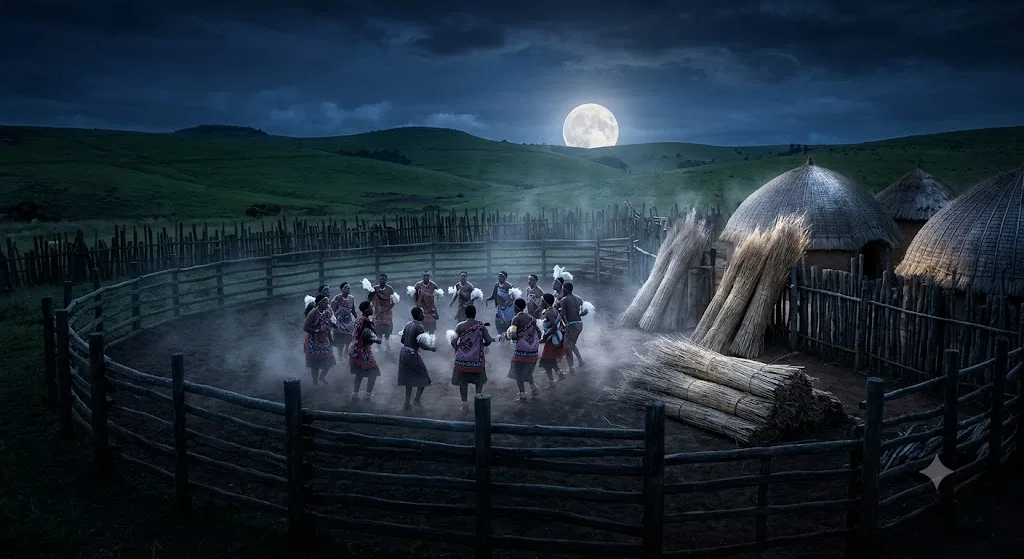
Mantenga Cultural Village is one of the easiest places for visitors to encounter Eswatini’s performed heritage. The Eswatini National Trust Commission describes Mantenga Nature Reserve as home to a cultural village representing a classical Swazi lifestyle of the 1850s, with huts, a cattle byre, reed fences and other homestead structures. It also has a permanent performance troupe, daily dance performances and visitor activities such as grinding maize and plaiting grass.[Eswatini National Trust Commission]entc.org.szEswatini National Trust Commission Mantenga Nature ReserveEswatini National Trust Commission Mantenga Nature Reserve
This kind of living museum raises an important folklore question: is staged heritage still authentic? The honest answer is that it is authentic in one sense and selective in another. It is not the same as stumbling into a private family ritual or hearing an elder tell a tale at home. It is curated, timed, visitor-facing and partly educational. Yet it also preserves forms of architecture, dance, costume, music and explanation that might otherwise be hard for outsiders to understand.
Mantenga is therefore best seen as interpretation rather than replacement. It can introduce the layout of a homestead, the importance of the cattle byre, the look of reed fences, the sound of group performance and the embodied discipline of dance. It should not be treated as the full depth of Swazi spiritual life, especially because some royal and ancestral rites are private by design.
How old are these traditions?
The answer depends on which tradition is being discussed. San rock art in Eswatini may be thousands of years old, while the specific Swazi royal and oral traditions belong to later histories of Swazi settlement, kingdom formation and ongoing cultural practice. Nsangwini’s paintings are described as possibly up to 4,000 years old, but Incwala, Reed Dance, praise poetry and Swazi homestead customs belong to a different historical layer.[The Kingdom of Eswatini]thekingdomofeswatini.comThe Kingdom of Eswatini Nsangwini Rock Art | The Kingdom of Eswatini (SwazilandThe Kingdom of Eswatini Nsangwini Rock Art | The Kingdom of Eswatini (Swaziland
Incwala is described by official tourism material as a ceremony that has lasted for hundreds of years.[The Kingdom of Eswatini]thekingdomofeswatini.comThe Kingdom of Eswatini Incwala Festival | The Kingdom of Eswatini (SwazilandThe Kingdom of Eswatini Incwala Festival | The Kingdom of Eswatini (Swaziland The Reed Dance has older roots in female age-regiment customs, but the modern ceremony’s form developed out of those earlier practices.[Eswatini National Trust Commission]entc.org.szEswatini National Trust Commission Umhlanga Reed Dance CeremonyEswatini National Trust Commission Umhlanga Reed Dance Ceremony Oral tales are harder to date precisely because they change in performance. A story may preserve an old motif while using newer social details, or a printed version may freeze only one variant of a tale that once circulated in many forms.
That variability should not be treated as a weakness. Oral tradition survives by adapting. A tale that changes wording, setting or emphasis as it passes between tellers may remain culturally continuous even when no single “original version” can be recovered.
What changed in modern Eswatini?
The biggest change is not that folklore vanished, but that its settings multiplied. A story once told in a homestead may now appear in school materials, academic articles, tourism performances, radio discussion, heritage policy, social media clips or festival promotion. UNESCO’s intangible cultural heritage work in Eswatini includes support for community-based inventorying, including a project to develop an inventory for the Shiselweni region.[UNESCO ICH]ich.unesco.orgOpen source on unesco.org. The Eswatini National Trust Commission also presents itself as a body concerned with conserving natural resources and preserving cultural treasures.[Eswatini National Trust Commission]entc.org.szOpen source on entc.org.sz.
This shift has benefits and risks. Documentation can help protect endangered knowledge, support local pride and make heritage visible to younger generations. Tourism can create income and encourage preservation of performance skills. But public packaging can also simplify, romanticise or overexpose traditions, especially when outsiders want dramatic “secrets” or marketable “mysteries”.
Modern Eswatini also lives with Christianity alongside traditional belief. Accessible accounts of Swazi religion note that Christianity as practised by Swazis has been influenced by beliefs in ancestral spirits, while traditional religion has also been influenced by Christianity.[EveryCulture]everyculture.comEvery Culture SwaziEvery Culture Swazi This blending is important. Many people may move between church, family ritual, respect for ancestors and cultural ceremony without seeing those categories as mutually exclusive in the way an outsider might expect.
Old tradition, tourist retelling and internet folklore
Eswatini folklore is sometimes flattened online into generic “African mythology” with lists of gods, monsters or dramatic claims. That should be treated with caution. The strongest sources for Eswatini point less to a neat pantheon and more to ancestors, royal ritual, oral literature, healing, environmental knowledge and sacred performance. Claims about named gods or creatures should be checked against local scholarship, recorded oral literature or institutional heritage sources before being repeated as old Swazi tradition.
A useful credibility test is to ask:
- Is the tradition attached to a real setting? Incwala, the Reed Dance, Mantenga, Nsangwini and Sibebe are connected to specific places or practices.
- Is it supported by local or specialist sources? ENTC, Eswatini tourism, academic folklore studies and archaeology are stronger than anonymous myth lists.
- Does the source distinguish public performance from secret ritual? Responsible sources admit when parts of Incwala are private.
- Is it too tidy? Oral traditions often have variants, layered meanings and uncertainty. A perfectly packaged “monster profile” may be modern invention or regional borrowing.
- Does it respect belief without pretending to prove the supernatural? The best writing presents spirits, witches and ancestors as beliefs, traditions and narratives, not as verified paranormal facts.
Why Eswatini’s folklore still matters
Eswatini’s folklore matters because it is one of the places where national identity, family memory, ritual authority and landscape still meet in visible public life. The Incwala shows kingship as ritual renewal rather than merely political office. The Reed Dance shows youth, gender, reeds, work and royal service turned into ceremonial movement. Oral tales preserve moral intelligence and ecological observation. Ancestor belief explains why health, kinship and misfortune can be interpreted through unseen relationships. Rock-art sites remind visitors that the region’s spiritual imagination long predates the modern state.
The most interesting thing about Eswatini is not that it hides a catalogue of famous monsters. It is that folklore remains woven into institutions, places and performances that people can still recognise: the royal residence, the cattle enclosure, the reed-bed, the healer’s consultation, the grandmother’s story, the painted rock shelter and the living museum. Its legendary culture is therefore both old and present-tense: not a museum label alone, and not a fantasy detached from life, but a continuing way of giving memory, power and place a meaningful shape.
Amazon book picks
Further Reading
Books and field guides related to Where Ritual, Ancestors and Landscape Still Speak. Use these as the next step if you want deeper reading beyond the article.
African Myths of Origin
Provides strong context for southern African oral traditions, ancestors and sacred landscapes.
Myths and Legends of Southern Africa
Covers legendary traditions closely related to Eswatini's cultural setting.
African Religions and Philosophy
Explains ancestor belief, ritual practice and sacred worldviews.
The Penguin Book of African Folktales
Introduces storytelling traditions across Africa including themes found in Eswatini.
eBay marketplace picks
Marketplace Samples
Example marketplace items related to this page. Use the search link to explore similar finds on eBay.
Endnotes
1.
Source: encyclopedia.com
Title: Swazi Religion | Encyclopedia.com
Link:https://www.encyclopedia.com/environment/encyclopedias-almanacs-transcripts-and-maps/swazi-religion
2.
Source: everyculture.com
Title: Every Culture Swazis
Link:https://www.everyculture.com/wc/Rwanda-to-Syria/Swazis.html
3.
Source: academia.edu
Link:https://www.academia.edu/961478/Swazi_Oral_Literature_Studies_Yesterday_and_Today_The_Way_Forward
4.
Source: unisapressjournals.co.za
Title: Unisa Press Journals
Link:https://unisapressjournals.co.za/index.php/SAJFS/article/view/1264
Source snippet
SWAZI ORAL LITERATURE, ECO-CULTURE AND ENVIRONMENTAL APOCALYPSE | Southern African Journal for Folklore Studies...
5.
Source: everyculture.com
Title: Every Culture Swazi
Link:https://www.everyculture.com/Africa-Middle-East/Swazi-Religion-and-Expressive-Culture.html
6.
Source: pressbooks.pub
Title: A Reader’s Guide to African Folktales at the Internet Archive
Link:https://pressbooks.pub/africanguide/chapter/17-the-roosters-kraal/
7.
Source: dokumen.pub
Link:https://dokumen.pub/the-swazi-a-south-african-kingdom.html
8.
Source: ich.unesco.org
Link:https://ich.unesco.org/en/state/eswatini-SZ
9.
Source: ich.unesco.org
Link:https://ich.unesco.org/es/estado/eswatini-SZ
10.
Source: archive.org
Link:https://archive.org/download/80204dff-c8a9-4155-a539-7ee980102875/80204dff-c8a9-4155-a539-7ee980102875_djvu.txt
11.
Source: archive.org
Link:https://archive.org/stream/AnarchismRadicalFeminism7_20180113/Women%20in%20South%20African%20History%20-%20Administrator_djvu.txt
12.
Source: ich.unesco.org
Link:https://ich.unesco.org/doc/src/Signed%20periodic%20report%20-%20Periodic%20report-62443.pdf
13.
Source: whc.unesco.org
Link:https://whc.unesco.org/fr/etatsparties/sz
14.
Source: unesco.org
Title: swaziland national trust commission act 1972 sntc act 1972
Link:https://www.unesco.org/creativity/en/policy-monitoring-platform/swaziland-national-trust-commission-act-1972-sntc-act-1972
15.
Source: unesco.org
Link:https://www.unesco.org/creativity/en/policy-monitoring-platform/swaziland-national-arts-and-culture-policy
16.
Source: academia.edu
Title: Lesotho and the Struggle for Azania 1780 1994
Link:https://www.academia.edu/10976948/Lesotho_and_the_Struggle_for_Azania
17.
Source: academia.edu
Link:https://www.academia.edu/65458555/The_societal_voice_in_Swazi_childrens_oral_poetry
18.
Source: thekingdomofeswatini.com
Title: The Kingdom of Eswatini Incwala Festival | The Kingdom of Eswatini (Swaziland)
Link:https://www.thekingdomofeswatini.com/eswatini-experiences/events/incwala-festival/
19.
Source: entc.org.sz
Title: Eswatini National Trust Commission Umhlanga Reed Dance Ceremony
Link:https://entc.org.sz/umhlanga-the-reed-dance/
20.
Source: thekingdomofeswatini.com
Title: The Kingdom of Eswatini Nsangwini Rock Art | The Kingdom of Eswatini (Swaziland)
Link:https://www.thekingdomofeswatini.com/north-west-eswatini/nsangwini-rock-art/
21.
Source: open.uct.ac.za
Link:https://open.uct.ac.za/server/api/core/bitstreams/3f7c28ff-96de-4905-b777-7d06cc5d510d/content
22.
Source: journals.co.za
Title: AJA18183816 10
Link:https://journals.co.za/doi/pdf/10.10520/AJA18183816_10
23.
Source: thekingdomofeswatini.com
Link:https://www.thekingdomofeswatini.com/central-eswatini/sibebe-rock/
24.
Source: tbsnews.net
Title: The Business Standard Beyond stereotypes: A magical year spent in the Kingdom
Link:https://www.tbsnews.net/features/explorer/beyond-stereotypes-magical-year-spent-kingdom-eswatini-1062001
25.
Source: entc.org.sz
Title: Eswatini National Trust Commission Mantenga Nature Reserve
Link:https://entc.org.sz/mantenga-nature-reserve/
26.
Source: entc.org.sz
Link:https://entc.org.sz/culture/
27.
Source: thekingdomofeswatini.com
Title: eswatini national trust commission vision for the future with rebrand
Link:https://www.thekingdomofeswatini.com/news-blogs/eswatini-national-trust-commission-vision-for-the-future-with-rebrand/
28.
Source: swaziland.freeservers.com
Link:https://www.swaziland.freeservers.com/tour/folklore.html
29.
Source: entc.org.sz
Link:https://entc.org.sz/
30.
Source: facebook.com
Link:https://www.facebook.com/EswatiniNationalTrustCommission/posts/launching-a-new-chapter-for-culture-sustainable-tourism-in-eswatiniunesco-in-par/1339059294937450/
31.
Source: facebook.com
Link:https://www.facebook.com/merchantofknowledge/posts/eswatini-religion-and-ethnicity-fact-religion/1478440004300822/
32.
Source: facebook.com
Link:https://www.facebook.com/EswatiniNationalTrustCommission/posts/today-the-eswatini-national-museum-under-the-eswatini-national-trust-commission-/1413581760818536/
33.
Source: facebook.com
Link:https://www.facebook.com/EswatiniNationalTrustCommission/posts/the-eswatini-national-museum-under-the-eswatini-national-trust-commission-entc-w/1410938761082836/
34.
Source: Wikipedia
Link:https://en.wikipedia.org/wiki/Sibebe
35.
Source: Wikipedia
Title: Eswatini National Trust Commission
Link:https://en.wikipedia.org/wiki/Eswatini_National_Trust_Commission
36.
Source: beastsoflegend.com
Link:https://beastsoflegend.com/bestiary/africa/southern/
37.
Source: thekingdomofeswatini.com
Link:https://www.thekingdomofeswatini.com/central-eswatini/mantenga-reserve-village-falls/
38.
Source: thekingdomofeswatini.com
Title: umhlanga reed dance
Link:https://www.thekingdomofeswatini.com/eswatini-experiences/events/umhlanga-reed-dance/
39.
Source: thekingdomofeswatini.com
Link:https://www.thekingdomofeswatini.com/events-calendar/
40.
Source: instagram.com
Link:https://www.instagram.com/eswatininationaltrustcommi_/?hl=en
41.
Source: tripadvisor.com
Title: Sibebe Rock
Link:https://www.tripadvisor.com/Attraction_Review-g293837-d11709661-Reviews-Sibebe_Rock-Mbabane_Hhohho_District.html
42.
Source: scholar.sun.ac.za
Link:https://scholar.sun.ac.za/server/api/core/bitstreams/ad3f8236-4fdc-43fc-aa16-b163a8f17e41/content
43.
Source: gov.sz
Title: UNESC O
Link:https://www.gov.sz/index.php/departments-sp-799263136/unesco
44.
Source: journals.co.za
Title: EJC 6a0bfb289
Link:https://journals.co.za/doi/pdf/10.10520/EJC-6a0bfb289
45.
Source: africanrockart.britishmuseum.org
Title: rock art in southern africa
Link:https://africanrockart.britishmuseum.org/regional_introduction/rock-art-in-southern-africa/
Additional References
46.
Source: youtube.com
Title: [RECAP] MAIN DAY at Incwala celebrations with His Majesty King Mswati III
Link:https://www.youtube.com/watch?v=ZuDESWFCpMI
Source snippet
Africas Most Popular Cultural Ceremony In Swaziland/INCWALA...
47.
Source: youtube.com
Title: The Forbidden Love of the Zulu Warrior and the Swazi Princess
Link:https://www.youtube.com/watch?v=So-tfHTvIoE
Source snippet
[RECAP] MAIN DAY at Incwala celebrations with His Majesty King Mswati III...
48.
Source: youtube.com
Title: Inside Africans | The Eswatini Traditions That Surprised Me
Link:https://www.youtube.com/watch?v=_WX4jeB0A1A
Source snippet
The Forbidden Love of the Zulu Warrior and the Swazi Princess...
49.
Source: youtube.com
Title: Africas Most Popular Cultural Ceremony In Swaziland/INCWALA
Link:https://www.youtube.com/watch?v=zpPTowwyVq8
Source snippet
Buhle Betfu SO4E14 || Mantenga Cultural Village...
50.
Source: facebook.com
Link:https://www.facebook.com/unescoROSA/posts/eswatini-popularly-known-as-the-tiny-kingdom-with-a-big-heart-carries-every-geog/1043240671171471/
51.
Source: scribd.com
Link:https://www.scribd.com/document/551251812/Tuxdoc-com-a-Dictionary-of-African-Mythology
52.
Source: facebook.com
Link:https://www.facebook.com/groups/archeologyandcivilizations/posts/3046429318783905/
53.
Source: facebook.com
Link:https://www.facebook.com/groups/827611048652074/posts/1323317395748101/
54.
Source: facebook.com
Link:https://www.facebook.com/eswatinipositivenews/posts/as-emaswati-make-their-way-to-incwala-this-brief-video-reflects-how-our-rich-cul/1196950635987624/
55.
Source: africatouroperators.org
Link:https://www.africatouroperators.org/swaziland/cultural-tours-in-eswatini/
Topic Tree
Follow this branch
Related pages 192
- Afghan Folklore
- Albanian Folklore
- Algerian Folklore
- Australian Folklore
- Azerbaijan Folklore
- +187 more in sidebar