Where Bangladesh's Story World Comes Alive
Bangladesh’s folklore is not a single mythology with one fixed canon. It is a living mix of rural oral tales, river and forest legends, ghost stories, folk songs, religious storytelling, seasonal processions, women’s ritual songs, ballads, riddles, charms, painted narratives and modern retellings.
Page outline Jump by section
Introduction
For a curious reader, the heart of Bangladeshi folklore lies in that meeting point between story and daily life. A ghost may express anxiety about marriage, a snake goddess may explain danger in the rainy season, a forest guardian may shape how honey collectors enter the Sundarbans, and a New Year procession may turn old protective imagery into modern public art. The traditions are old, but not frozen. They have moved from village performance to printed collections, national heritage policy, school art, television, music, digital archives and popular culture.
Why Bangladesh’s folklore feels so tied to land and water
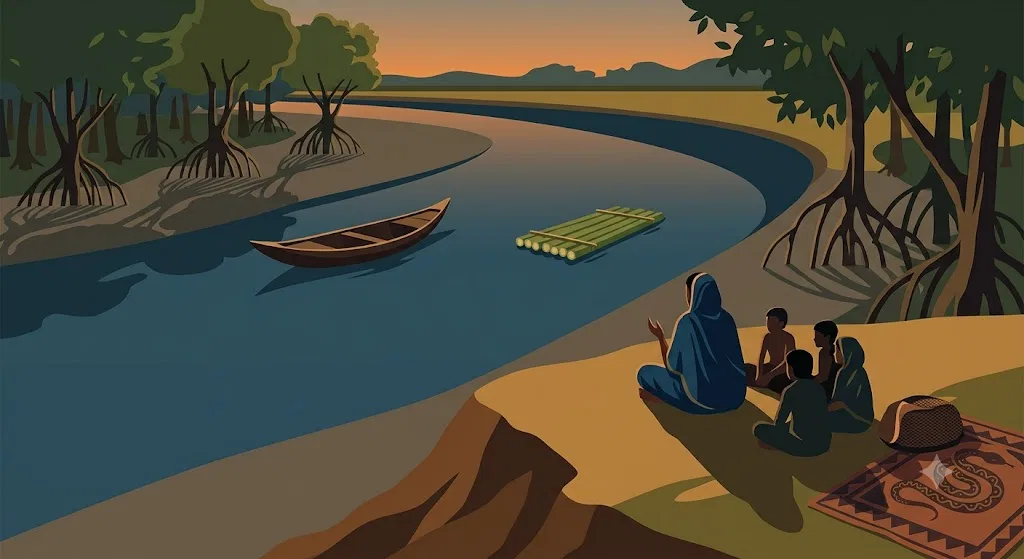
Bangladesh is a delta country, and its story-world often behaves like a delta: shifting, fertile, dangerous and full of crossings. Rivers, chars, marshes, monsoon fields, mangrove forests and village courtyards are not just scenery. They are the places where tales are told, sung, feared and tested. This helps explain why so many Bangladeshi traditions are about movement: a bride floating on a raft, a boatman singing on open water, a forest worker crossing into tiger country, a wandering singer carrying spiritual songs from village to village.
The oral nature of this culture also matters. Banglapedia defines folk tales as stories composed orally among rural communities and passed from one generation to the next through telling and retelling; because of that process, the same tale often exists in different versions.[Banglapedia]en.banglapedia.orgFolk TalesFolk Tales - Banglapedia… That is why a “Bangladeshi folktale” is often less like a single copyrighted plot and more like a family of related performances. A grandmother’s version, a printed schoolbook version, a village singer’s version and a modern television version may all belong to the same tradition while differing in detail.
This also means that Bangladesh’s folklore cannot be reduced to one religion or one ethnic group. Bengali Muslim, Bengali Hindu, Buddhist, Christian and Indigenous communities have contributed to local story culture. Banglapedia notes that the folk music of Bangladesh has been shaped by interaction with communities including Santal, Garo, Hajong, Chakma, Manipuri, Tripuri and Marma groups, while some songs are regional, some are shared across Bangladesh and West Bengal, and some cross religious boundaries.[Banglapedia]en.banglapedia.orgFolk MusicFolk Music - Banglapedia… The result is a folklore landscape where a tale may be Bengali in language, Islamic in imagery, Hindu in narrative inheritance, local in ritual use and regional in performance history.
The great oral tale-world: fairies, animals, heroes and tricksters
Bangladeshi folk tales include several broad story types that readers will recognise from world folklore, but their local texture is distinctive. Banglapedia lists fairy-tale-like stories, longer adventure tales linked to historical or legendary places, animal fables, humorous “fool” stories and heroic tales in which a fearless figure completes impossible tasks.[Banglapedia]en.banglapedia.orgFolk TalesFolk Tales - Banglapedia… These categories are useful, but they should not be treated as rigid boxes. A single tale may include a prince, a talking animal, a saintly helper, a magical test, a comic servant and a moral about generosity.
The fairy-tale tradition is especially important. Banglapedia notes that such tales may be called fairy tales in English, though not all of them actually feature fairies; many are stories of a prince’s adventure, a princess, divine help, magical powers or the reward given to a humble and hard-working girl.[Banglapedia]en.banglapedia.orgFolk TalesFolk Tales - Banglapedia… This is a helpful warning against reading Bengali “fairy tale” too literally. The enchanted world is broader than winged fairies. It includes sorcerers, demons, ascetics, supernatural tests, impossible journeys and sudden reversals of fortune.
Animal stories are another major strand. They often make animals speak and behave like humans, turning village experience into compact moral drama. Birds, jackals, tigers, snakes, cows and other familiar creatures become figures through which people talk about cleverness, greed, foolishness, loyalty or survival. These stories are not merely children’s entertainment. Like riddles and proverbs, they compress social knowledge into memorable form.
A striking feature of many Bangladeshi tales is their closeness to household and village life. The enchanted palace may appear, but so do food, marriage, stepmothers, labour, rivers, poverty and reputation. The supernatural often enters through ordinary vulnerability: a young woman treated unfairly, a poor child sent into danger, a traveller lost in wild country, a family under a curse, or a household that ignores a ritual obligation.

Ballads that made village emotion into literature
If folk tales are the prose heart of Bangladesh’s oral tradition, the ballads are among its most powerful poetic forms. Banglapedia describes the narrative ballad form as oral poetry that tells a single event or dramatic story, often through dialogue, and notes that its characters may include princes, princesses, merchants, fairies, demons, sorcerers, ascetics, pirs and fakirs.[Banglapedia]en.banglapedia.orgFolk LiteratureFolk Literature - Banglapedia… These ballads carry the charge of performance: they were not simply read silently, but sung, recited, remembered and adapted.
The most famous collection is the Mymensingh ballad tradition. Banglapedia’s entry on the Maimansingha Gitika names ten ballads in one major collection, including stories such as “Mahua”, “Chandravati”, “Kamala”, “Kajolrekha” and “Dewan Madina”; it also notes that some writers’ names are preserved in ritual introductions while others remain unknown.[Banglapedia]en.banglapedia.orgMaimansingha GitikaMaimansingha Gitika - Banglapedia… The entry stresses that the ballads are mostly about mortal life rather than formal religion, and that nine of the ten centre on worldly love, some ending happily and others tragically.[Banglapedia]en.banglapedia.orgMaimansingha GitikaMaimansingha Gitika - Banglapedia…
What makes these ballads memorable is not just romance, but the moral force given to female characters. Banglapedia observes that the heroines are often brighter and more active than the heroes, struggling and sacrificing more in the name of love.[Banglapedia]en.banglapedia.orgMaimansingha GitikaMaimansingha Gitika - Banglapedia… That matters because it complicates a simple view of “traditional” folklore as only conservative or passive. These songs could preserve social norms, but they could also imagine women as brave, eloquent, enduring and morally central.
The wider East Bengal ballad tradition is also geographically important. Banglapedia says the Purbabanga-Gitika ballads were collected from Mymensingh, Netrakona, Chittagong, Noakhali, Faridpur, Sylhet and Tripura, with more than 50 ballads included in the collection.[Banglapedia]en.banglapedia.orgOpen source on banglapedia.org. Many were composed around the fifteenth and sixteenth centuries, with some from the seventeenth and eighteenth centuries, and later performed in villages by groups of singers.[Banglapedia]en.banglapedia.orgOpen source on banglapedia.org. This gives Bangladesh’s folklore a strong archive of regional memory: love stories, fairy tales, merchant tales, landlord rivalries, domestic sorrow and local history carried in song.
Behula, Manasa and the snake that enters the wedding chamber
One of the best-known mythic story cycles in Bengal, including Bangladesh, centres on Manasa, the snake goddess, and the ordeal of Behula. Banglapedia describes Manasa as one of Bengal’s most popular goddesses and the central figure of Manasa Mangalkavya, a medieval Bengali verse tradition.[Banglapedia]en.banglapedia.orgOpen source on banglapedia.org. Her worship is especially linked to the rainy months, when snakes are more active and devotees seek protection from snakebite, as well as blessings for wealth and children.[Banglapedia]en.banglapedia.orgOpen source on banglapedia.org.
The famous story turns on a conflict between divine recognition and human refusal. Chand Saodagar, a powerful merchant, refuses to worship Manasa. His son Lakhindar is married to Behula, but Manasa sends a snake into the supposedly impregnable iron bridal chamber. Banglapedia’s account says the snake becomes as fine as a strand of hair, enters through a minute hole and bites Lakhindar on the wedding night.[Banglapedia]en.banglapedia.orgOpen source on banglapedia.org. Behula then places her husband’s body on a banana raft and journeys towards the abode of the gods, refusing to accept his death until she wins his life back.[Banglapedia]en.banglapedia.orgOpen source on banglapedia.org.
The story works on several levels. As myth, it explains the power of a local goddess whose cult demanded recognition. As seasonal folklore, it gives narrative form to the very real fear of snakes in the wet season. As emotional drama, it makes Behula the active hero: loyal, persistent and willing to cross cosmic boundaries. As social memory, it shows how local deities and older beliefs could be folded into literary and ritual traditions.
The Manasa cycle also moved beyond words into visual and ritual art. Banglapedia notes that traditional paintings for Manasa worship may depict Manasa, Behula, Lakhindar, Chand Sadagar, snake charmers, fishermen and coiled snakes, and that the ritual frame may be set afloat on water after the worship.[Banglapedia]en.banglapedia.orgFolk Art and CraftsFolk Art and Crafts This is folklore as a full sensory system: story, image, ritual object, seasonal danger and riverine landscape all reinforcing one another.
Bonbibi and the moral forest of the Sundarbans
The Sundarbans give Bangladesh one of its most distinctive sacred landscapes. Here folklore is inseparable from ecology. Bonbibi, the forest guardian revered around the mangrove forest, is called on by people who enter a dangerous environment for honey, fish, wood and other livelihoods. The Environment & Society Portal describes the Bonbibi Johuranama as a narrative chanted in forest-fringe villages before honey collectors and fish workers enter the forest, and says these workers traditionally carry the sacred blessing of Bonbibi as their protection.[Environment & Society Portal]environmentandsociety.orgOpen source on environmentandsociety.org.
The central conflict is between Bonbibi and Dakshin Ray, often associated with tiger danger. The same source explains that the Johuranama describes Bonbibi and her brother Shah-Janguli, their struggle over the Sundarbans, and the story of Dukhe, a poor child saved from Dakshin Ray by Bonbibi.[Environment & Society Portal]environmentandsociety.orgOpen source on environmentandsociety.org. UNESCO’s article on the Sundarbans similarly presents Bonbibi as a protective deity in local legend, guarding people from Dakshin Rai, the man-eating tiger figure.[UNESCO]unesco.orgOpen source on unesco.org.
The point is not simply that people “believe in a forest goddess”. Bonbibi tradition encodes rules for living with a perilous landscape. The Environment & Society Portal notes that this “religion of the forest” is tied to local ecological knowledge, customary rights and restraint: forest workers may observe norms about when to enter, avoiding night entry, not smoking or defecating in the forest, entering without weapons, avoiding fishing in breeding seasons and not extracting honey or wood from small flowering trees.[Environment & Society Portal]environmentandsociety.orgOpen source on environmentandsociety.org. In other words, the legend helps turn danger into discipline.
This is why Bonbibi has become so important in discussions of folklore, ecology and climate-vulnerable communities. She is a supernatural protector in story, but also a cultural figure through whom people negotiate risk, livelihood and moral limits. For readers outside Bangladesh, Bonbibi is a useful reminder that folklore is not always escapism. In the Sundarbans, it can be a practical language for entering tiger country.
Ghosts, jinn and the social life of fear
Bangladeshi ghost lore belongs to the wider Bengali supernatural imagination, but it has its own local settings: ponds, trees, graveyards, riverbanks, abandoned houses, village roads, hospitals, crossroads and the edges of settlement. Some figures are shared across Bengal, such as female ghosts associated with marriage, death before fulfilment, jealousy, longing or revenge. These stories can be frightening, but they also reveal social anxieties around gender, widowhood, sexuality, domestic control and the vulnerability of women.
Modern journalism and popular culture often name figures such as the petni and shakchunni when introducing Bengali ghost lore. The Daily Star, for example, describes the shakchunni as a ghostly figure of a married woman who dies prematurely, identified by signs of marriage and associated with longing for domestic stability.[The Daily Star]thedailystar.netbits halloween bangladeshs ghostly lore 4023076bits halloween bangladeshs ghostly lore 4023076 Such accounts should be handled carefully: they are useful evidence of contemporary popular understanding, not proof of one fixed ancient doctrine. Ghosts vary widely by region, teller and audience.
Jinn belief is also important in Bangladesh, especially among Muslim communities, but it is not identical to “ghost” belief. A study of 320 attendees at a large university hospital in Dhaka found that 72% believed in the existence of jinn and 61% in jinn possession, while smaller proportions believed in black magic and the evil eye.[ResearchGate]researchgate.netResearch Gate Beliefs about Jinn, black magic and evil eye in BangladeshResearch Gate Beliefs about Jinn, black magic and evil eye in Bangladesh A 2024 medical anthropology and psychiatry study on Bangladesh examined how communities distinguish jinn possession from serious mental disorders, showing that these beliefs still affect how distress and unusual behaviour are interpreted.[PubMed Central]pmc.ncbi.nlm.nih.govOpen source on nih.gov.
For folklore readers, the key is to distinguish belief, narrative and diagnosis. A village story about a spirit, a religious explanation involving jinn, a family’s interpretation of illness and a clinician’s psychiatric assessment may overlap without being the same kind of claim. Bangladesh’s supernatural culture remains socially active because it offers explanations for fear, misfortune, grief and uncertainty. But a careful account presents these as traditions and interpretations, not as confirmed supernatural facts.
Saints, pirs, fakirs and the Islamic story-world
Bangladesh’s folklore is deeply shaped by Islamic devotional culture, especially through stories of pirs, fakirs, saints, miracle workers and heroic figures. These traditions are not separate from Bengali oral culture; they are part of it. Banglapedia’s entry on folk literature notes that oral narrative poetry may include characters such as pirs and fakirs alongside princes, merchants, demons, sorcerers and fairy princesses.[Banglapedia]en.banglapedia.orgFolk LiteratureFolk Literature - Banglapedia…
One important literary bridge is puthi literature. Banglapedia describes puthi literature as an eighteenth- and nineteenth-century genre written in a mixed vocabulary drawn from Bangla, Arabic, Urdu, Persian and Hindi, associated especially with Muslim composers and readers.[Banglapedia]en.banglapedia.orgPuthi LiteraturePuthi Literature It adds that Fakir Garibullah helped initiate the genre with an epic on warfare combining Arabian history and legend.[Banglapedia]en.banglapedia.orgPuthi LiteraturePuthi Literature These texts show how Islamic narrative material, Persianate romance, Arabic heroic legend and Bengali performance habits could merge.
Banglapedia’s discussion of Persian literary influence notes that many dobhasi narratives mixed love-story, fantasy, romance and heroic adventure, and that versions of Arabian Nights material circulated in this style.[Banglapedia]en.banglapedia.orgOpen source on banglapedia.org. This matters because Bangladeshi folklore is sometimes misrepresented as only rural “pre-Islamic” survival or only religious teaching. In reality, Islamic and Persianate materials became part of the Bengali popular imagination through performance, manuscript, recitation and adaptation.
The result is a layered story-world. A village listener might hear of a saint’s miracle, a pious warrior, a magical journey, a moral romance, a jinn, a fakir, a forest guardian or a local deity in overlapping cultural registers. Folklore here is less a museum of pure origins than a history of translation, borrowing and local use.
Songs that carry folklore in the voice
Bangladesh’s folk songs are among the country’s most visible forms of living tradition. Banglapedia lists nearly 50 types of folk song in Bangladesh, including Baul, Bhatiyali, Bhawaiya, Murshidi, Marfati, Gambhira, Kirtan, Jhumur, Sari, Jari and others.[Banglapedia]en.banglapedia.orgFolk CultureFolk Culture - Banglapedia… These songs are not all “myths” in a narrow sense, but they carry many of the same materials: saints, longing, river journeys, spiritual riddles, moral conflict, seasonal labour, village humour and the mysteries of the body and soul.
Baul songs are especially important internationally. UNESCO describes Baul poetry, music, song and dance as devoted to the relationship between humankind and God and to spiritual liberation, with the human body treated as the place where the divine resides; UNESCO also notes that Baul devotional songs can be traced back to the fifteenth century in Bengali literature.[Intangible Cultural Heritage]ich.unesco.orgOpen source on unesco.org. The Baul figure is often imagined as a wandering singer outside strict social convention, carrying songs that are both mystical and earthy.
River songs also matter because Bangladesh is a riverine country. Banglapedia identifies Bhatiyali as widespread across Bangladesh and connected with regions of water and boat travel.[Banglapedia]en.banglapedia.orgFolk MusicFolk Music - Banglapedia… These songs may not always tell supernatural stories directly, but they create the emotional landscape in which folklore lives: distance, longing, fate, water, work, separation and the call of the unseen.
Folk song also crosses boundaries. Banglapedia notes that some folk songs belong distinctly to Hindu or Muslim communities, while others cross religious lines; some belong to men, others to women, and some are sung by both.[Banglapedia]en.banglapedia.orgFolk MusicFolk Music - Banglapedia… That variety is crucial. Bangladesh’s folklore is not a neat shelf of tales but a performance ecology in which gender, region, religion, occupation and language shape who sings what, where and why.
New Year monsters, masks and modern public folklore
Not all Bangladeshi folklore is ancient. Some traditions are modern but draw power from older visual and ritual ideas. The best example is Mangal Shobhajatra, the colourful public procession held on Pahela Baishakh, the Bengali New Year. UNESCO’s multimedia archive describes it as a public festival on 14 April organised by students and teachers of Dhaka University’s Faculty of Fine Art. It began in 1989, when students under military rule wanted to bring the community hope for a better future.[UNESCO]unesco.orgMangal Shobhajatra on Pahela Baishakh | Intangible HeritageMangal Shobhajatra on Pahela Baishakh | Intangible Heritage
The procession uses large floats, masks and symbolic figures representing strength, peace and the driving away of evil so that progress can come.[UNESCO]unesco.orgMangal Shobhajatra on Pahela Baishakh | Intangible HeritageMangal Shobhajatra on Pahela Baishakh | Intangible Heritage For folklore readers, this is fascinating because it shows how protective and auspicious imagery can be reworked in a modern civic setting. The figures are not simply “mythological creatures” in the old village sense, but they behave like public ritual symbols: they make evil visible so it can be rejected, and they turn the street into a shared moral stage.
This also challenges the idea that folklore only survives in remote villages. Mangal Shobhajatra is urban, university-linked, political in origin and now nationally recognised. Yet its use of masks, animals, demons, colour, procession and public blessing connects it to older South Asian patterns of seasonal renewal and symbolic protection. It is modern folklore in the open air.
Indigenous and regional traditions beyond the Bengali mainstream
A country-level page on Bangladesh must not make Bengali-language traditions stand in for every community. Bangladesh includes Indigenous and minority-language cultures with their own legends, songs, ritual practices and oral histories. Banglapedia notes that almost all tribal languages in Bangladesh have rich folk literatures, including poems, songs, fairy tales and legends of past nomadic life.[Banglapedia]en.banglapedia.orgTribal LanguagesTribal Languages It also notes narrative plays in Magh, Chakma, Khasia and Garo languages, with some Garo folk tales resembling tales in the Mymensingh ballad tradition.[Banglapedia]en.banglapedia.orgTribal LanguagesTribal Languages
This evidence points to two truths at once. First, Bangladesh’s folklore is more diverse than a Bengali-only summary can capture. Second, traditions have long interacted. Similar plots, rhythms, riddles and lullabies can move between neighbouring communities without erasing their differences. Folklore spreads by marriage, migration, markets, labour, worship, performance and shared landscape.
Recent language documentation also shows why this matters now. A 2026 research paper on Bangladesh’s minority languages states that the country is home to about 40 minority languages across four language families, many predominantly oral and computationally under-resourced, with 14 classified as endangered.[arXiv]arxiv.orgarXiv Oral to Web: Digitizing 'Zero Resource'Languages of BangladesharXiv Oral to Web: Digitizing 'Zero Resource'Languages of Bangladesh While that paper is about language data rather than folklore alone, it highlights a central heritage problem: when oral languages weaken, songs, legends, ritual speech and local place-memory become harder to transmit.
A good Bangladesh folklore map should therefore include the Chittagong Hill Tracts, the north-eastern and northern borderlands, Santal and Garo communities, Hajong traditions, Marma and Chakma narrative forms, and other regional worlds alongside Bengali Muslim and Bengali Hindu materials. The archive is uneven, but the living diversity is part of the story.
How old is Bangladeshi folklore, and how well is it attested?
The honest answer is: some traditions are very old in theme, some are medieval in written form, some were collected from oral performance in the colonial and early modern periods, and some are modern reinventions. The age of a story should not be guessed from how “ancient” it feels. Magical motifs can be old, but the version people know may come from a nineteenth-century printed collection, a twentieth-century schoolbook or a recent television adaptation.
The Manasa tradition, for example, is tied to medieval Bengali verse literature, while its underlying snake fears and local goddess worship are older and broader. Banglapedia describes Manasa Mangalkavya as a medieval Bengali poetic work and notes the seasonal worship of Manasa during months when snakes are more active.[Banglapedia]en.banglapedia.orgOpen source on banglapedia.org. The East Bengal ballads have a different evidence trail: Banglapedia says many Purbabanga-Gitika ballads were composed in the fifteenth and sixteenth centuries, some later, collected from village communities and published in the twentieth century.[Banglapedia]en.banglapedia.orgOpen source on banglapedia.org.
Bonbibi has another kind of record. The Environment & Society Portal notes that Abdur Rahim’s late nineteenth-century Bonbibi Johuranama adapted material from the seventeenth-century Ray-mangal, while the ritual and oral tradition remained active in forest-fringe communities.[Environment & Society Portal]environmentandsociety.orgOpen source on environmentandsociety.org. Mangal Shobhajatra, by contrast, is explicitly modern: UNESCO dates its beginning to 1989.[UNESCO]unesco.orgMangal Shobhajatra on Pahela Baishakh | Intangible HeritageMangal Shobhajatra on Pahela Baishakh | Intangible Heritage
This variety is a strength, not a problem. Folklore is not valuable only when it is ancient. A modern procession can become genuine heritage if it is collectively transmitted and culturally meaningful. An old ballad can change each time it is sung. A ghost story can be both traditional and newly reshaped by film, Facebook posts, podcasts or Halloween-themed journalism. The useful question is not “Is it original?” but “What kind of tradition is this, how is it attested, and who uses it now?”
Folklore in books, archives and digital culture
Bangladesh’s folklore moved from oral performance into print through collectors, editors, scholars and cultural institutions. Banglapedia records that Chandra Kumar De began publishing some East Bengal folk ballads from 1913, that Dinesh Chandra Sen helped collect ballads from villagers, and that Calcutta University published Purbabanga-Gitika in 1926; later English translations appeared as Eastern Bengal Ballads.[Banglapedia]en.banglapedia.orgOpen source on banglapedia.org. This collecting history preserved many works, but it also changed them. Once a sung village performance becomes a printed text, it gains stability but loses some of its original setting, music, improvisation and audience response.
Modern scholarship and technology are changing the archive again. A 2022 computational study of Bengali folklore argued for using natural language processing to study and analyse Bengali folklore, reflecting a newer effort to make folklore searchable and usable in digital systems.[arXiv]arxiv.orgOpen source on arxiv.org. More recent work on Bengali cultural knowledge datasets has found that large language models struggle with culturally specific knowledge, including folk traditions, unless given context.[arXiv]arxiv.orgOpen source on arxiv.org. That finding may sound technical, but its cultural lesson is simple: folklore does not survive well as isolated trivia. It needs context, region, language, performance and social meaning.
There is also a popular digital afterlife. Ghost lore circulates through online articles, podcasts, videos and social posts. Folk-rock songs retell old legends. Bonbibi appears in climate and environmental writing. Baul songs are performed on global stages. Mangal Shobhajatra circulates through images of masks and giant figures. These new forms can keep traditions visible, but they can also flatten them into aesthetic symbols or spooky content. The best modern retellings make clear whether they are adapting an old oral tale, citing a collected text, creating fiction inspired by folklore or presenting a living ritual practice.
What Bangladesh’s folklore means today
Bangladesh’s folklore matters because it preserves ways of thinking that formal history often misses. It records how rural people imagined justice, danger, love, honour, hunger, illness, devotion and survival. It gives voice to women in ballads, to forest workers in Bonbibi ritual, to boatmen in river songs, to village humour in fool tales, to seasonal fear in snake worship, and to public hope in New Year procession.
It also offers a more complex picture of Bangladeshi identity than a simple religious or national label. In this folklore, Islamic saints and jinn, Hindu goddesses and snake myths, Buddhist and Indigenous oral traditions, Persian romances, river songs, colonial-era collections and modern civic art all share cultural space. Some traditions are devotional, some comic, some frightening, some ecological, some literary and some political.
For readers exploring monsters and supernatural beings, Bangladesh offers ghosts, jinn, demons, tiger-spirits, snake powers and forest guardians. For readers interested in oral literature, it offers ballads, fairy tales, animal fables, riddles, puthi narratives and women’s songs. For readers interested in place, it offers the Sundarbans, river journeys, village courtyards, shrines, ponds, seasonal festivals and the urban streets of Dhaka at New Year.
The most important takeaway is that Bangladeshi folklore is not a dead catalogue of quaint beliefs. It is a changing cultural toolkit. People have used it to remember, warn, mourn, entertain, protest, worship, teach and survive. Its beings may be supernatural, but its concerns are deeply human.
Amazon book picks
Further Reading
Books and field guides related to Where Bangladesh's Story World Comes Alive. Use these as the next step if you want deeper reading beyond the article.
Thakurmar Jhuli ঠাকুরমার ঝুলি
One of the foundational collections of Bengali folklore and storytelling.
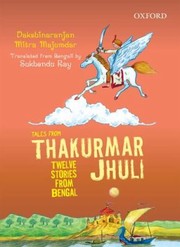
Tales From Thakurmar Jhuli Twelve Stories From Bengal
First published 2012. Subjects: Tales, india, Fairy tales, Translations into English.
Myths and Legends of India
Helps readers place Bengali folk traditions within wider South Asian narrative culture.
eBay marketplace picks
Marketplace Samples
Live-tested eBay searches with available results related to this page.


Endnotes
1.
Source: en.banglapedia.org
Title: Folk Culture
Link:https://en.banglapedia.org/index.php/Folk_Culture
Source snippet
Folk Culture - Banglapedia...
2.
Source: en.banglapedia.org
Title: Folk Tales
Link:https://en.banglapedia.org/index.php/Folk_Tales
Source snippet
Folk Tales - Banglapedia...
3.
Source: en.banglapedia.org
Title: Folk Music
Link:https://en.banglapedia.org/index.php/Folk_Music
Source snippet
Folk Music - Banglapedia...
4.
Source: en.banglapedia.org
Title: Folk Literature
Link:https://en.banglapedia.org/index.php/Folk_Literature
Source snippet
Folk Literature - Banglapedia...
5.
Source: en.banglapedia.org
Title: Maimansingha Gitika
Link:https://en.banglapedia.org/index.php/Maimansingha_Gitika
Source snippet
Maimansingha Gitika - Banglapedia...
6.
Source: en.banglapedia.org
Link:https://en.banglapedia.org/index.php/Purbabanga-Gitika
7.
Source: en.banglapedia.org
Link:https://en.banglapedia.org/index.php/Manasa
8.
Source: en.banglapedia.org
Link:https://en.banglapedia.org/index.php/Behula
9.
Source: en.banglapedia.org
Title: Folk Art and Crafts
Link:https://en.banglapedia.org/index.php/Folk_Art_and_Crafts
10.
Source: unesco.org
Link:https://www.unesco.org/en/articles/sundarbans
11.
Source: researchgate.net
Title: Research Gate Beliefs about Jinn, black magic and evil eye in Bangladesh
Link:https://www.researchgate.net/publication/241732493_Beliefs_about_Jinn_black_magic_and_evil_eye_in_Bangladesh_The_effects_of_gender_and_level_of_education
12.
Source: en.banglapedia.org
Title: Puthi Literature
Link:https://en.banglapedia.org/index.php/Puthi_Literature
13.
Source: en.banglapedia.org
Link:https://en.banglapedia.org/index.php/Persian
14.
Source: ich.unesco.org
Link:https://ich.unesco.org/en/RL/baul-songs-00107
15.
Source: unesco.org
Title: Mangal Shobhajatra on Pahela Baishakh | Intangible Heritage
Link:https://www.unesco.org/archives/multimedia/document-4385
16.
Source: en.banglapedia.org
Title: Tribal Languages
Link:https://en.banglapedia.org/index.php/Tribal_Languages
17.
Source: arxiv.org
Title: arXiv Oral to Web: Digitizing ‘Zero Resource’Languages of Bangladesh
Link:https://arxiv.org/abs/2603.05272
18.
Source: arxiv.org
Link:https://arxiv.org/abs/2203.06607
19.
Source: arxiv.org
Link:https://arxiv.org/abs/2510.20043
20.
Source: facebook.com
Link:https://www.facebook.com/rongtOru/posts/nishir-daak-is-a-bengali-ghost-story-based-on-folklore-it-tells-of-a-mysterious-/27243793328596560/
21.
Source: facebook.com
Title: Folklore creatures of Bengal region
Link:https://www.facebook.com/groups/cartoonpeople/posts/25442358245391137/
22.
Source: en.banglapedia.org
Link:https://en.banglapedia.org/index.php/Festivals
23.
Source: en.banglapedia.org
Link:https://en.banglapedia.org/index.php/Riddle
24.
Source: en.banglapedia.org
Title: Santal Pat
Link:https://en.banglapedia.org/index.php/Santal_Pat
25.
Source: en.banglapedia.org
Title: Children’s Literature
Link:https://en.banglapedia.org/index.php/Children%E2%80%99s_Literature
26.
Source: en.banglapedia.org
Link:https://en.banglapedia.org/index.php/Sundarbans%2C_The
27.
Source: en.banglapedia.org
Title: Kaliganj Upazila (Jhenaidah District)
Link:https://en.banglapedia.org/index.php/Kaliganj_Upazila_%28Jhenaidah_District%29
28.
Source: en.banglapedia.org
Link:https://en.banglapedia.org/index.php/Mangalkavya
29.
Source: en.banglapedia.org
Title: Bangla Literature
Link:https://en.banglapedia.org/index.php/Bangla_Literature
30.
Source: en.banglapedia.org
Title: Pata Painting
Link:https://en.banglapedia.org/index.php/Pata_Painting
31.
Source: en.banglapedia.org
Title: Sakta pitha
Link:https://en.banglapedia.org/index.php/Sakta-pitha
32.
Source: en.banglapedia.org
Title: Syed Hamza
Link:https://en.banglapedia.org/index.php/Syed_Hamza
33.
Source: en.banglapedia.org
Title: Quraishi Magan Thakur
Link:https://en.banglapedia.org/index.php/Quraishi_Magan_Thakur
34.
Source: en.banglapedia.org
Link:https://en.banglapedia.org/index.php/Janganama
35.
Source: en.banglapedia.org
Link:https://en.banglapedia.org/index.php/Paintings
36.
Source: ich.unesco.org
Title: 00010 EN
Link:https://ich.unesco.org/doc/src/00010-EN.pdf
37.
Source: ich.unesco.org
Title: bangladesh BD
Link:https://ich.unesco.org/en/state/bangladesh-BD
38.
Source: ich.unesco.org
Title: 38379 EN
Link:https://ich.unesco.org/doc/src/38379-EN.pdf
39.
Source: ich.unesco.org
Link:https://ich.unesco.org/en/lists
40.
Source: arxiv.org
Link:https://arxiv.org/pdf/2203.06607
41.
Source: researchgate.net
Link:https://www.researchgate.net/publication/377957026_The_New_Knowledge_System_Regarding_the_Idea_of_Community_and_Power-Structures_of_Society_The_Bengali_Narrative_Ballads_of_Maimansingha_Gitika
42.
Source: researchgate.net
Link:https://www.researchgate.net/publication/371269063_Popular_Memory_of_a_Mediaeval_Pilgrim_and_her_Pilgrimage_Legends_of_Behula_and_the_Cult_of_Manasa
43.
Source: researchgate.net
Link:https://www.researchgate.net/publication/381639530_%27Ma_Bonbibi%27_A_Goddess_in_the_Folk_Culture_of_Sundarbans_Region_in_India_Bangladesh
44.
Source: facebook.com
Link:https://www.facebook.com/rongtOru/posts/shakchunni-is-one-of-the-most-famous-female-spirits-in-bengali-folklore-she-is-b/27118676854441542/
45.
Source: facebook.com
Title: banglar bhootthis bhoot is the shakchunni they are the ghosts of married women w
Link:https://www.facebook.com/JatraWorld/posts/banglar-bhootthis-bhoot-is-the-shakchunni-they-are-the-ghosts-of-married-women-w/709349194549898/
46.
Source: facebook.com
Link:https://www.facebook.com/TantrikSpirituality/posts/the-story-of-devi-manasa-behula-and-lakhindar-is-a-profound-tale-of-devotion-pri/122188943294068169/
47.
Source: facebook.com
Link:https://www.facebook.com/unescodhaka/posts/today-we-begin-a-five-day-campaign-highlighting-bangladeshs-elements-listed-by-u/1260750442743243/
48.
Source: facebook.com
Title: bengali folklores ghosts from the haunting shakchunni to the enigmatic brahmadai
Link:https://www.facebook.com/DailyStarNews/posts/bengali-folklores-ghosts-from-the-haunting-shakchunni-to-the-enigmatic-brahmadai/889222060025741/
49.
Source: archive.org
Link:https://archive.org/details/dli.calcutta.11004
50.
Source: environmentandsociety.org
Link:https://www.environmentandsociety.org/arcadia/bonbibi-religion-forest-sundarbans
51.
Source: thedailystar.net
Title: bits halloween bangladeshs ghostly lore 4023076
Link:https://www.thedailystar.net/entertainment/theatre-arts/news/bits-halloween-bangladeshs-ghostly-lore-4023076
52.
Source: pmc.ncbi.nlm.nih.gov
Link:https://pmc.ncbi.nlm.nih.gov/articles/PMC11738708/
53.
Source: Wikipedia
Title: Folk music
Link:https://en.wikipedia.org/wiki/Folk_music
54.
Source: Wikipedia
Title: Maimansingha Gitika
Link:https://en.wikipedia.org/wiki/Maimansingha_Gitika
55.
Source: Wikipedia
Link:https://en.wikipedia.org/wiki/Behula
56.
Source: Wikipedia
Link:https://en.wikipedia.org/wiki/Bonbibi
57.
Source: thedailystar.net
Title: praise mymensinghs bangla folk ballads 3004791
Link:https://www.thedailystar.net/slow-reads/slow-reads-special/news/praise-mymensinghs-bangla-folk-ballads-3004791
58.
Source: thedailystar.net
Title: bangla folktales stories wisdom wit and wonder 77180
Link:https://www.thedailystar.net/slow-reads/slow-reads-special/folk-bangladesh/news/bangla-folktales-stories-wisdom-wit-and-wonder-77180
59.
Source: thedailystar.net
Title: folkloric bangladesh 1390843
Link:https://www.thedailystar.net/slow-reads/slow-reads-special/news/folkloric-bangladesh-1390843
60.
Source: thedailystar.net
Title: goddesses bengal the living myth devi manasa bon bibi and more 3220591
Link:https://www.thedailystar.net/books-literature/news/goddesses-bengal-the-living-myth-devi-manasa-bon-bibi-and-more-3220591
61.
Source: thedailystar.net
Title: bon bibi reimagined feminist tale sundarbans 3931571
Link:https://www.thedailystar.net/books-literature/news/bon-bibi-reimagined-feminist-tale-sundarbans-3931571
62.
Source: greatersundarbans.org
Link:https://greatersundarbans.org/blog/bonbibi
63.
Source: scribd.com
Link:https://www.scribd.com/document/638289515/Untitled
64.
Source: bideshi.co
Link:https://bideshi.co/blogs/puran-patrika/bonbibi
65.
Source: otibeguni.com
Title: Stories | Otibeguni
Link:https://otibeguni.com/stories/
Additional References
66.
Source: youtube.com
Title: Grandma and the Great Gourd: A Bengali Folktale
Link:https://www.youtube.com/watch?v=8kJ8ym_MkMU
Source snippet
Bangladesh folklore legends ghosts myths Top 10 Most Horror Places In Bangladesh 🇧🇩🔥🇧🇩#horrorshorts#horrorplaces#top#top10 Top 10 Edit...
67.
Source: youtube.com
Title: Searching for the Mystery Surrounding the Domra Tree
Link:https://www.youtube.com/watch?v=JSBR9fY6mB8
Source snippet
Unveiling Bengali Folklore: The Enigmatic Byangoma...
68.
Source: zenodo.org
Link:https://zenodo.org/records/10669452/files/1.pdf
69.
Source: academia.edu
Link:https://www.academia.edu/109661236/Haunters_or_Haunted_A_Feminist_Anatomization_of_Female_Ghosts_Shakchunni_Sheekol_Buri_and_Prapti_from_Bengali_Folk_Tales_through_the_Prism_of_Biological_Essentialism
70.
Source: reddit.com
Link:https://www.reddit.com/r/bangladesh/comments/17us78g/bangladeshi_folklores/
71.
Source: academia.edu
Link:https://www.academia.edu/80297266/Beliefs_about_Jinn_black_magic_and_evil_eye_in_Bangladesh_the_effects_of_gender_and_level_of_education
72.
Source: scribd.com
Link:https://www.scribd.com/document/344429239/The-Chronicles-of-Bengali-Folktale
73.
Source: scribd.com
Link:https://www.scribd.com/document/1022751040/Beyond-Belief-2
74.
Source: sahapedia.org
Link:https://www.sahapedia.org/bonbibi-r-palagaan-tradition-history-and-performance
75.
Source: scribd.com
Link:https://www.scribd.com/document/354795934/The-Sundarbans-Folk-and-Folk-Religion-by-doc
Topic Tree
Follow this branch
Related pages 192
- Afghan Folklore
- Albanian Folklore
- Algerian Folklore
- Australian Folklore
- Azerbaijan Folklore
- +187 more in sidebar