Living Folklore of Ukraine
Ukraine’s folklore is not a single book of myths but a living web of village rites, household spirits, forest and water beings, heroic songs, Easter egg symbols, Cossack legends, Carpathian mountain lore, Crimean Tatar ornament, and modern retellings in literature, film and wartime culture.
Page outline Jump by section
Introduction
For a first-time reader, the most useful way into Ukrainian folklore is to see it as three overlapping worlds. There is the enchanted natural world, full of water nymphs, forest maidens, witches, werewolves and house spirits. There is the ritual world, where Christmas, Easter, midsummer, harvest, weddings and funerals carry older meanings beneath Christian forms. And there is the national story-world, where Cossack bards, folk heroes, decorated eggs, embroidered signs and literary reworkings have helped Ukrainians tell themselves who they are.[encyclopediaofukraine.com]encyclopediaofukraine.comOpen source on encyclopediaofukraine.com.
What makes Ukrainian folklore distinctive?
Ukrainian folklore belongs to the wider East Slavic and European folk world, so some figures have relatives in neighbouring traditions. The witch in the forest, the water spirit, the household guardian, the werewolf and the vampire-like revenant are not uniquely Ukrainian types. What makes the Ukrainian tradition distinctive is the local texture: the agricultural calendar, the Cossack historical memory, the Carpathian and Polissia landscapes, the strong song tradition, and the way folk imagery has been repeatedly used to defend Ukrainian cultural identity.[encyclopediaofukraine.com]encyclopediaofukraine.comOpen source on encyclopediaofukraine.com.
That matters because Ukraine’s folklore is often mislabelled as merely “Russian” or generically “Slavic” in older English-language books. Folklorist Natalie Kononenko notes, in the introduction to an English collection of Ukrainian tales, that Ukrainian material was sometimes printed under Russian labels, even when language, place and collection history showed it to be Ukrainian. This confusion is not just a bibliographic nuisance: it affects how readers understand cultural ownership, especially when folklore is tied to language, region and national memory.[PagePlace]api.pageplace.dePage Place The Magic Egg aand Other Tales from UkrainePage Place The Magic Egg aand Other Tales from Ukraine
Ukrainian tales also have a strong practical moral tone. Magic is present, but it often works through endurance, cleverness, hospitality, correct ritual behaviour and respect for forces beyond human control. A household spirit may protect a family or punish disrespect. A water spirit may be beautiful and deadly. A hero may be supernaturally strong, but the story still tests courage, loyalty and wit. That mixture of wonder and everyday caution gives Ukrainian folklore much of its flavour.[Encyclopedia of Ukraine]encyclopediaofukraine.comOpen source on encyclopediaofukraine.com.
Spirits of water, forest and home
The best-known supernatural beings in Ukrainian folk belief are not distant gods but beings close to daily life: rivers, fields, woods, houses, barns and crossroads. Ukrainian folk demonology, as summarised by the Encyclopedia of Ukraine, includes water and forest beings associated with people who died tragically or outside normal Christian rites, especially unbaptised children and young women who died violently. These figures are not simply “monsters”; they express anxiety about death, fertility, danger, beauty and the boundary between the living and the dead.[Encyclopedia of Ukraine]encyclopediaofukraine.comOpen source on encyclopediaofukraine.com.
The rusalka is a good example. In Ukrainian tradition she is often imagined as a beautiful long-haired young woman connected with water, though she can also belong to fields and forests. The Encyclopedia of Ukraine describes her as a water nymph representing the soul of a drowned girl or young woman. That origin story makes her more than a mermaid-like creature: she is a restless dead person, and her danger comes from grief as much as from enchantment.[Encyclopedia of Ukraine]encyclopediaofukraine.comOpen source on encyclopediaofukraine.com.
The mavka, often described as a forest or wood nymph, has become one of the most recognisable Ukrainian folklore figures because of literature and animation. In older demonological material, she belongs to the same shadowy family as the rusalka, linked to untimely death and wild nature. In modern retellings, however, she is often softened into a guardian of the forest, a figure of ecological harmony or a romantic heroine. That shift shows how folklore changes when it moves from village belief to national literature, children’s culture and cinema.[encyclopediaofukraine.com]encyclopediaofukraine.comOpen source on encyclopediaofukraine.com.
Household spirits sit at the opposite end of the landscape. Instead of luring people into rivers or woods, the house spirit belongs to the home and its order. Contemporary explainers of Ukrainian mythology often present the household guardian as a protective but easily offended being: helpful when treated respectfully, troublesome when neglected. This is a familiar Slavic pattern, but in Ukraine it fits a broader folk worldview in which domestic harmony, proper ritual and respect for invisible presences are closely linked.[ukraineworld.org]ukraineworld.orgukrainian mythologyukrainian mythology
Witches, werewolves and vampire-like beings also appear in Ukrainian supernatural tradition. Their importance lies less in fixed “monster rules” than in the social fears they encode: illness, night attacks, envy, boundary-crossing, dangerous knowledge and the suspicion that an ordinary neighbour may have hidden power. In a village setting, such beings helped explain misfortune and gave communities stories for talking about danger without reducing it to ordinary accident.[ukraineworld.org]ukraineworld.orgukrainian mythologyukrainian mythology

The ritual year: when folklore enters ordinary life
Ukrainian folklore is easiest to see not in isolated monster stories but in the calendar. Folk customs and rites were tied to the seasons, agricultural work, family transitions and communal events. The Encyclopedia of Ukraine divides them broadly into family rites, seasonal and productive rites, and communal rites, often involving songs, dances, charms, dramatic play, religious ceremonies and magical acts.[Encyclopedia of Ukraine]encyclopediaofukraine.comEncyclopedia of UkraineFolk customs and ritesThese customs and rites are regulated by the folk calendar and are often accompanied by magi…
This calendar was never purely pagan or purely Christian. Many customs arose from pre-Christian agricultural and ancestral beliefs, then blended with church feasts over centuries. Christmas, New Year, Easter, midsummer and harvest customs all carry layered meanings: Christian celebration, seasonal turning point, social gathering and older symbolic action. That layering is one reason Ukrainian folklore feels so resilient. A song or ritual may look Christian on the surface while preserving older ideas about fertility, protection, water, fire, ancestors or the return of spring.[Encyclopedia of Ukraine]encyclopediaofukraine.comEncyclopedia of UkraineFolk customs and ritesThese customs and rites are regulated by the folk calendar and are often accompanied by magi…
Christmas and New Year traditions are especially song-rich. Carols, New Year songs and visiting customs turn the village into a ritual stage, where households are blessed, prosperity is wished into being, and young people perform identity, courtship and wit. Spring songs and circular dances mark the release from winter into growing life, while harvest rites dramatise the relationship between people, field and grain. These are not decorative survivals; they are ways of making seasonal change socially meaningful.[Encyclopedia of Ukraine]encyclopediaofukraine.comEncyclopedia of UkraineFolk customs and ritesThese customs and rites are regulated by the folk calendar and are often accompanied by magi…
The Kupalo festival is one of the clearest examples of old and Christianised elements living together. It is a midsummer celebration of ancient pagan origin, later associated with the feast of Saint John the Baptist. Ukrainian tradition links the night with fire, water, love, fertility, the beginning of harvest and magical events: ferns blooming, hidden treasure revealed, trees speaking or moving, and witches gathering. Such claims should be understood as folk belief and ritual imagination, not as literal fact. Their cultural power lies in how they make one night of the year feel charged with possibility.[Encyclopedia of Ukraine]encyclopediaofukraine.comOpen source on encyclopediaofukraine.com.
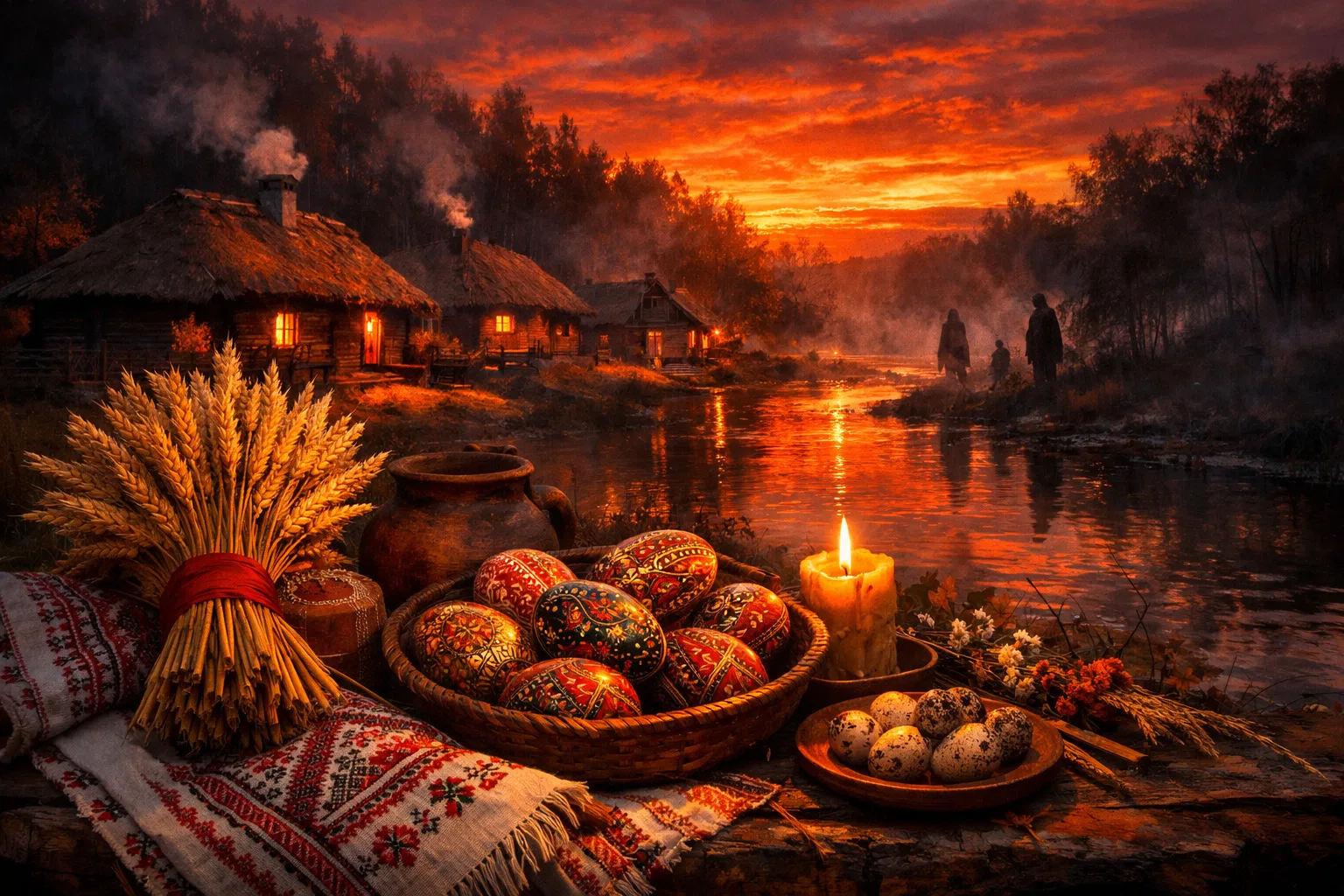
Easter brings one of Ukraine’s most internationally recognised traditions: the decorated egg. UNESCO describes the Ukrainian egg-decorating tradition as centuries old, using wax-resist designs, repeated dyeing and symbolic patterns to carry wishes and messages. Although the custom has pre-Christian roots, it became part of Easter over time, where the egg could speak both of spring renewal and Christian resurrection.[UNESCO ICH]ich.unesco.orgUNESCO ICHPysanka, Ukrainian tradition and art of decorating eggsThe art of decorating eggs is a centuries-old Ukrainian tradition. Tradi…
Pysanky, ornament and symbols that carry stories
Ukrainian decorated eggs are often treated abroad as colourful craft objects, but within Ukrainian culture they are closer to small symbolic texts. The wax-resist method allows a maker to build up patterns in stages; lines, plants, animals, suns, crosses and colours can communicate protection, blessing, fertility, remembrance or hope. UNESCO’s 2024 inscription of the tradition on the Representative List of the Intangible Cultural Heritage of Humanity recognised not just the object, but the knowledge, technique and meaning passed through families and communities.[UNESCO ICH]ich.unesco.orgUNESCO ICHPysanka, Ukrainian tradition and art of decorating eggsThe art of decorating eggs is a centuries-old Ukrainian tradition. Tradi…
The archaeological record is fragile because eggshell rarely survives, yet recent reporting on the Lviv decorated egg shows why these objects matter historically. A decorated duck egg found in Lviv and dated to the early 16th century has been widely reported as one of the oldest known surviving examples of this type. Its survival in an urban archaeological context gives material weight to a tradition otherwise mostly preserved through practice, memory and later collections.[Live Science]livescience.comLive Science Lviv pysanka: World's oldest Easter eggLive Science Lviv pysanka: World's oldest Easter egg
Crimean Tatar ornament is another reminder that Ukrainian folklore and traditional culture are not only ethnic Ukrainian. UNESCO inscribed the Crimean Tatar ornament system known as Ornek in 2021 as Ukrainian intangible cultural heritage. It is a system of symbols used in embroidery, weaving, pottery, engraving, jewellery, wood carving and other arts, with knowledge about meanings transmitted through makers and communities. Its place on a Ukraine folklore page matters because Crimea’s Indigenous Crimean Tatar culture is part of Ukraine’s cultural landscape, not an optional appendix.[UNESCO ICH]ich.unesco.orgOpen source on unesco.org.
These symbolic arts are not “myths” in the sense of plotted tales, but they do mythic work. They turn eggs, cloth, pottery, wood and jewellery into bearers of memory. They also show how folklore can survive without a narrator: a pattern, colour sequence or ritual technique can carry a story about protection, ancestry, belonging and continuity.[UNESCO ICH]ich.unesco.orgUNESCO ICHPysanka, Ukrainian tradition and art of decorating eggsThe art of decorating eggs is a centuries-old Ukrainian tradition. Tradi…
Bards, Cossacks and the heroic memory
Ukraine’s oral tradition is unusually associated with sung history. The kobzar tradition centred on wandering bards, often visually impaired, who performed epic-historical, religious and folk songs while accompanying themselves on stringed instruments. The Encyclopedia of Ukraine traces kobzars back to the world of Kyivan Rus and notes their strong association with Cossack society, where they were respected performers of communal memory.[Encyclopedia of Ukraine]encyclopediaofukraine.comOpen source on encyclopediaofukraine.com.
The epic songs known as dumy are central to that memory. They are performed in a recitative style and often concern war, captivity, moral testing, religious duty and the dignity of the Cossack past. A recent scholarly article in the journal Folklore stresses the importance of performer guilds in maintaining the tradition and notes that these oral musical associations survived until the early 20th century before being damaged or destroyed under Soviet rule.[folklore.ee]folklore.eeUKRAINIA N FOLK DUMY: PROBLEMS OF HISTORICALUKRAINIA N FOLK DUMY: PROBLEMS OF HISTORICAL
UNESCO’s 2024 recognition of a safeguarding programme for the Ukrainian kobza and wheel lyre tradition shows that this is not only a historical subject. The UNESCO description presents it as a nomadic music tradition involving visually impaired musicians who sing and play string instruments, while the safeguarding programme is linked to modern guilds and revival efforts. This recognition matters because it treats living transmission — teaching, performance, instrument-making and community practice — as the heritage, not merely old recordings or museum objects.[UNESCO ICH]ich.unesco.orgOpen source on unesco.org.
Cossack Mamay is the visual counterpart to the bardic tradition. In folk paintings, he is usually shown as a seated Cossack with a stringed instrument, a horse, weapons and often a tree. He is less a single historical person than a symbolic folk figure: calm, free, armed, musical, humorous and self-possessed. The image spread widely from the late 17th century onwards and remains one of the most recognisable figures in Ukrainian folk art.[Wikipedia]WikipediaCossack MamayCossack Mamay
The point is not that every Cossack tale is literal history. Folklore turns history into memory-shaped images. A bard singing of captivity, a painted Cossack with a bandura, or a tale of a giant-slaying hero makes the past emotionally usable. In Ukraine, where political sovereignty and cultural recognition have often been contested, that function has been especially important.[encyclopediaofukraine.com]encyclopediaofukraine.comOpen source on encyclopediaofukraine.com.
Folk tales, heroes and the problem of “whose story?”
Ukrainian folk tales include animal tales, wonder tales, trickster stories, heroic adventures, religious legends and comic stories about fools, devils, landlords, peasants and clever wives. English readers often meet them through 19th- and early 20th-century collections, especially Robert Nisbet Bain’s Cossack Fairy Tales and Folk-Tales, which drew on Ukrainian collections by figures such as Panteleimon Kulish, Ivan Rudchenko and Mykhailo Drahomanov.[The Public Domain Review]publicdomainreview.orgcossack fairy tales 1916cossack fairy tales 1916
The strongest Ukrainian wonder tales often turn on impossible births, serpent-fights, underworld journeys and tests of courage. Kotyhoroshko, the boy of extraordinary strength born from a pea, is one familiar heroic figure in Ukrainian and neighbouring East European tale tradition. His story of rescuing siblings from a serpent has the deep pattern of a dragon-slayer tale, but its local name, humour and domestic opening give it Ukrainian character.[Wikipedia]WikipediaOpen source on wikipedia.org.
Baba Yaga is a useful cautionary example. She appears across East Slavic fairy-tale traditions, including Ukrainian, Russian and Belarusian materials, and should not be claimed as exclusively Ukrainian. In Ukrainian tellings, as elsewhere, she may be terrifying, testing, cannibalistic, wise, or perversely helpful. The better question is not “who owns Baba Yaga?” but how a particular Ukrainian tale uses her: as forest danger, elder knowledge, a gatekeeper to the otherworld, or a test of a heroine’s courage.[Center for European Studies]ces.ufl.eduCenter for European Studies Baba-YagaCenter for European Studies Baba-Yaga
Modern digital work is also changing access to these tales. A 2024 paper on a Ukrainian-to-English folktale corpus notes that translated Ukrainian folklore remains sparse, limiting access for non-Ukrainian readers, and describes efforts to create aligned corpora for translation and study. This is a reminder that what English-speaking readers think of as “the canon” of Ukrainian folktales is partly shaped by what has happened to be translated.[arXiv]arxiv.orgOpen source on arxiv.org.
Carpathian and regional traditions
Ukraine’s folklore is strongly regional. The Carpathians, Polissia, central Ukraine, the steppe, the Black Sea coast and Crimea all have different historical layers, languages, neighbours and landscapes. A country-level page can only sketch this variety, but the key point is that Ukrainian folklore is not a flat national costume laid over the map. It is a patchwork of local practices and story-worlds.[UNESCO World Heritage Centre]whc.unesco.orgOpen source on unesco.org.
The Carpathian region is especially important for outsiders because it has long been imagined as a place of mountain distinctiveness, shepherd culture, wooden churches, music, healing knowledge and supernatural reputation. UNESCO’s World Heritage listing for the wooden churches of the Carpathian region identifies Hutsul, Boyko, Lemko and Halych types across Ukraine and Poland, showing how religious architecture and regional identity are embedded in landscape.[UNESCO World Heritage Centre]whc.unesco.orgOpen source on unesco.org.
Hutsul folklore is often associated with healers, seers and sorcerer-like figures known as molfars. Modern descriptions can easily become sensational, so it is safer to treat the molfar as a figure of Carpathian folk belief and cultural memory rather than as proof of magic. Interest in this figure was strengthened by literary and cinematic works such as Mykhailo Kotsiubynsky’s Shadows of Forgotten Ancestors and Sergei Parajanov’s 1964 film adaptation, which helped turn Hutsul belief and aesthetics into internationally recognisable Ukrainian cultural imagery.[Wikipedia]WikipediaOpen source on wikipedia.org.
Polissia, by contrast, is often associated with forests, wetlands, archaic seasonal rites and strong continuities in song and belief. The figure of the mavka and other forest-water beings fits particularly well into landscapes where water, woodland and settlement are tightly interwoven. Such regional specificity matters because a rusalka in a song, a ritual in a village, or a healing charm in the mountains is not just an abstract “Slavic” motif; it belongs to a place.[Encyclopedia of Ukraine]encyclopediaofukraine.comOpen source on encyclopediaofukraine.com.
Literature, animation and modern reinvention
Ukrainian folklore did not remain only in villages. Writers, composers, artists and filmmakers repeatedly transformed it into national culture. Lesya Ukrainka’s The Forest Song, written in 1911 and first staged in 1918, is the major example for supernatural folklore. The play drew on songs, legends and material associated with Volhynia and turned the forest spirit world into a poetic drama about love, freedom, nature and the cost of human compromise.[Wikipedia]WikipediaThe Forest SongThe Forest Song
This literary transformation is important because many modern readers meet the mavka through Lesya Ukrainka rather than through older belief. The literary mavka is not simply the frightening or dangerous being of folk demonology. She becomes psychologically complex, beautiful, tragic and morally revealing. That is not a corruption of folklore; it is one of the ways folklore lives, by being reimagined for new audiences.[Wikipedia]WikipediaThe Forest SongThe Forest Song
The 2023 animated film Mavka: The Forest Song shows the next stage of reinvention. Based on Lesya Ukrainka’s play and drawing on Ukrainian and Slavic folk mythology, it recasts the story as a family-friendly fantasy about love, nature and the human world’s relationship with an enchanted forest. The film travelled internationally and was widely discussed as a showcase of Ukrainian culture during wartime.[wikipedia.org]WikipediaMavka: The Forest SongMavka: The Forest Song
Modern Ukrainian horror and fantasy have also begun using witches, forest spirits and revenge narratives in direct response to the war. Recent journalism on Ukrainian genre film describes a shift from allegorical folklore fantasy towards darker, cathartic stories in which mythic female power confronts Russian violence. These works should not be mistaken for ancient folklore, but they are part of folklore’s afterlife: old motifs being recruited to express present fear, anger and endurance.[The Guardian]theguardian.comOpen source on theguardian.com.
How old is Ukrainian folklore, and how well attested is it?
The honest answer is mixed. Some Ukrainian customs, symbols and motifs clearly have deep pre-Christian roots, but exact dates are often hard to prove. Folk practices usually survive through performance, not written records, and many were first systematically collected only in the 19th century. Claims that a specific custom is “thousands of years old” should be treated cautiously unless there is archaeological or textual evidence.[Encyclopedia of Ukraine]encyclopediaofukraine.comEncyclopedia of UkraineFolk customs and ritesThese customs and rites are regulated by the folk calendar and are often accompanied by magi…
The strongest evidence comes in layers. Archaeology can occasionally confirm the age of a material practice, as with decorated eggs and ceramic egg-like objects, though survival is rare. Written collections from the 19th century preserve tales, songs and legends, but they also reflect the interests and politics of collectors. Ethnographic recordings, museum collections, photographs and fieldwork provide more recent evidence of practice. UNESCO inscriptions document living traditions and safeguarding efforts, but they do not prove that every modern form is ancient.[livescience.com]livescience.comLive Science Lviv pysanka: World's oldest Easter eggLive Science Lviv pysanka: World's oldest Easter egg
The 19th century was especially important because Ukrainian intellectuals and collectors were preserving oral tradition at a time when language and identity were politically pressured. Collections by Kulish, Rudchenko and Drahomanov became crucial sources for later translators and readers. Yet these collections were never neutral windows onto a timeless peasant past; they were acts of selection, editing and cultural defence.[The Public Domain Review]publicdomainreview.orgcossack fairy tales 1916cossack fairy tales 1916
Soviet rule changed the picture again. Some rites were discouraged, reworked or secularised; some religious and family customs survived privately; some folk forms were staged as safe “national culture” while others were treated with suspicion. The Encyclopedia of Ukraine notes both Soviet attempts to eradicate or reshape folk rites and later revival efforts, especially around family, communal and Christian calendar customs.[Encyclopedia of Ukraine]encyclopediaofukraine.comEncyclopedia of UkraineFolk customs and ritesThese customs and rites are regulated by the folk calendar and are often accompanied by magi…
Why folklore matters in Ukraine today
In Ukraine today, folklore is not just quaint heritage. It is part of public identity, cultural diplomacy and wartime resilience. UNESCO inscriptions for decorated eggs, Crimean Tatar ornament, borscht culture and the kobza and wheel lyre safeguarding programme show how living traditions have become internationally visible markers of Ukrainian culture.[UNESCO ICH]ich.unesco.orgukraine UAukraine UA
The war has sharpened this significance. UNESCO and international reporting have documented damage to Ukrainian cultural sites since Russia’s full-scale invasion, including major religious and cultural locations. When museums, archives, churches, books, icons and historic buildings are threatened, folklore and intangible heritage take on new weight: songs, rituals, stories and craft knowledge can travel with displaced people even when buildings and collections are damaged.[lemonde.fr]lemonde.frPresident Zelensky condemned the strike as a grave cultural crime and reiterated calls for Western air-defense support. The attack is see…
Diaspora communities also play a role. Ukrainian seasonal customs, egg-decorating, folk dance, choirs, language schools, craft workshops and cultural festivals often become ways for families abroad to remain connected to Ukraine. This is not merely nostalgia. In diaspora settings, folklore can become a portable homeland: something taught to children, displayed in public, and used to explain Ukraine to neighbours who may know the country mainly through war news.[Ukrainian Institute London]uil.org.ukOpen source on uil.org.uk.
At the same time, modern popularity brings risks. Internet lists of “Ukrainian monsters” can flatten regional differences, exaggerate ancient origins, or mix Ukrainian, Russian, Belarusian and pan-Slavic material without care. Films and games may make a spirit more heroic or glamorous than older belief allowed. Tourism may package mountain healers or midsummer rites as mystical spectacle. The useful approach is not to reject modern retellings, but to label them honestly: old oral belief, 19th-century collection, literary adaptation, Soviet-era staging, diaspora preservation, tourist performance, or internet-era invention.[encyclopediaofukraine.com]encyclopediaofukraine.comOpen source on encyclopediaofukraine.com.
A reader’s map of the Ukrainian folk world
For readers beginning with Ukrainian folklore, a few anchors make the tradition easier to navigate.
For supernatural beings, start with the rusalka and mavka, then compare household spirits, witches, werewolves and vampire-like beings. The key pattern is boundary-crossing: water and land, forest and village, life and death, home and outside, human and non-human.[Encyclopedia of Ukraine]encyclopediaofukraine.comOpen source on encyclopediaofukraine.com.
For seasonal customs, follow the year: Christmas and New Year songs, spring songs and dances, Easter eggs, Kupalo midsummer rites, harvest ceremonies, weddings and funerals. The key pattern is ritual action: people singing, visiting, blessing, circling, decorating, lighting fires, entering water, and turning private life events into community drama.[Encyclopedia of Ukraine]encyclopediaofukraine.comEncyclopedia of UkraineFolk customs and ritesThese customs and rites are regulated by the folk calendar and are often accompanied by magi…
For heroic tradition, follow the kobzars, dumy and Cossack Mamay. The key pattern is sung and painted memory: the past is not preserved only in chronicles, but in performance, image, instrument and moral example.[encyclopediaofukraine.com]encyclopediaofukraine.comOpen source on encyclopediaofukraine.com.
For regional depth, look to the Carpathians, Polissia, Crimea and the steppe. The key pattern is place. Mountains, forests, wetlands, rivers, frontier zones and sacred buildings shape the beings and stories people imagine.[unesco.org]whc.unesco.orgOpen source on unesco.org.
For modern reinterpretation, compare Lesya Ukrainka’s The Forest Song, the animated Mavka, contemporary horror and the revival of craft and song traditions. The key pattern is transformation: Ukrainian folklore keeps changing because Ukrainians keep using it to think about love, nature, danger, freedom, loss and survival.[Wikipedia]WikipediaThe Forest SongThe Forest Song
Amazon book picks
Further Reading
Books and field guides related to What Makes Ukraine's Folklore So Alive?. Use these as the next step if you want deeper reading beyond the article.
The Gates of Europe
Provides cultural context for understanding folklore's role in identity.
eBay marketplace picks
Marketplace Samples
Live-tested eBay searches with available results related to this page.
Endnotes
1.
Source: ich.unesco.org
Link:https://ich.unesco.org/en/RL/pysanka-ukrainian-tradition-and-art-of-decorating-eggs-02134
Source snippet
UNESCO ICHPysanka, Ukrainian tradition and art of decorating eggsThe art of decorating eggs is a centuries-old Ukrainian tradition. Tradi...
2.
Source: ich.unesco.org
Link:https://ich.unesco.org/en/BSP/safeguarding-programme-of-kobza-and-wheel-lyre-tradition-02136
3.
Source: api.pageplace.de
Title: Page Place The Magic Egg aand Other Tales from Ukraine
Link:https://api.pageplace.de/preview/DT0400.9780313069932_A23451453/preview-9780313069932_A23451453.pdf
4.
Source: ukraineworld.org
Title: ukrainian mythology
Link:https://ukraineworld.org/en/articles/basics/ukrainian-mythology
5.
Source: Wikipedia
Title: Mavka: The Forest Song
Link:https://en.wikipedia.org/wiki/Mavka%3A_The_Forest_Song
6.
Source: ich.unesco.org
Link:https://ich.unesco.org/en/decisions/19.COM/7.B.14
7.
Source: ich.unesco.org
Link:https://ich.unesco.org/en/RL/ornek-a-crimean-tatar-ornament-and-knowledge-about-it-01601
8.
Source: folklore.ee
Title: UKRAINIA N FOLK DUMY: PROBLEMS OF HISTORICAL
Link:https://www.folklore.ee/folklore/vol95/lisniak_cherneta.pdf
9.
Source: ich.unesco.org
Link:https://ich.unesco.org/en/Decisions/19.COM/7.d.2
10.
Source: Wikipedia
Title: Cossack Mamay
Link:https://en.wikipedia.org/wiki/Cossack_Mamay
11.
Source: Wikipedia
Link:https://en.wikipedia.org/wiki/Kotyhoroshko
12.
Source: arxiv.org
Link:https://arxiv.org/abs/2410.10063
13.
Source: whc.unesco.org
Link:https://whc.unesco.org/en/list/1424/
14.
Source: ethnographiques.org
Link:https://www.ethnographiques.org/IMG/pdf/carpathians.pdf
15.
Source: culture.pl
Title: sea of mountains the mysterious hutsul region
Link:https://culture.pl/en/article/sea-of-mountains-the-mysterious-hutsul-region
16.
Source: Wikipedia
Link:https://en.wikipedia.org/wiki/Molfar
17.
Source: Wikipedia
Title: The Forest Song
Link:https://en.wikipedia.org/wiki/The_Forest_Song
18.
Source: ich.unesco.org
Title: ukraine UA
Link:https://ich.unesco.org/en/state/ukraine-UA
19.
Source: reuters.com
Link:https://www.reuters.com/business/media-telecom/ukrainian-family-kyiv-loses-treasured-cultural-items-russian-attack-2026-07-03/
20.
Source: unesco.org
Link:https://www.unesco.org/en/articles/unesco-champions-living-heritage-and-arts-sustainable-development-jeju-forum-2026
21.
Source: unesco.org
Title: unesco youth hackathon 2026
Link:https://www.unesco.org/en/articles/unesco-youth-hackathon-2026
22.
Source: Wikipedia
Link:https://en.wikipedia.org/wiki/Ukraine
23.
Source: Wikipedia
Link:https://en.wikipedia.org/wiki/Encyclopedia
24.
Source: Wikipedia
Link:https://en.wikipedia.org/wiki/Mavka
25.
Source: Wikipedia
Title: List of Intangible Cultural Heritage elements in Ukraine
Link:https://en.wikipedia.org/wiki/List_of_Intangible_Cultural_Heritage_elements_in_Ukraine
26.
Source: Wikipedia
Title: Egg decorating in Slavic culture
Link:https://en.wikipedia.org/wiki/Egg_decorating_in_Slavic_culture
27.
Source: Wikipedia
Title: Duma (epic)
Link:https://en.wikipedia.org/wiki/Duma_%28epic%29
28.
Source: Wikipedia
Title: Kupala Night
Link:https://en.wikipedia.org/wiki/Kupala_Night
29.
Source: Wikipedia
Link:https://en.wikipedia.org/wiki/Rusalka
30.
Source: Wikipedia
Title: Ukrainian language
Link:https://en.wikipedia.org/wiki/Ukrainian_language
31.
Source: Wikipedia
Link:https://en.wikipedia.org/wiki/Ukrainians
32.
Source: ich.unesco.org
Link:https://ich.unesco.org/en/news/culture-of-ukrainian-borscht-cooking-inscribed-on-the-list-of-intangible-cultural-heritage-in-need-of-urgent-safeguarding-13412
33.
Source: unesco.org
Link:https://www.unesco.org/en
34.
Source: ich.unesco.org
Title: culture of ukrainian borscht cooking 01852
Link:https://ich.unesco.org/en/USL/culture-of-ukrainian-borscht-cooking-01852
35.
Source: ich.unesco.org
Link:https://ich.unesco.org/en/video/72549
36.
Source: ich.unesco.org
Title: pysanka ukrainian tradition and art of decorating eggs 02134
Link:https://ich.unesco.org/en/RL/pysanka-ukrainian-tradition-and-art-of-decorating-eggs-02134?call=film&id=72549&include=film_inc.php&width=700
37.
Source: ich.unesco.org
Title: 7b representative list 01370
Link:https://ich.unesco.org/en/7b-representative-list-01370?call=slideshow&id=02134&include=slideshow_inc.php&mode=scroll&width=620
38.
Source: unesco.org
Link:https://www.unesco.org/en/countries/ua/lists-and-nominations
39.
Source: ich.unesco.org
Link:https://ich.unesco.org/en/video/58503
40.
Source: ich.unesco.org
Title: 8b representative list 01191
Link:https://ich.unesco.org/en/8b-representative-list-01191?call=slideshow&id=01601&include=slideshow_inc.php&mode=scroll&width=620
41.
Source: ich.unesco.org
Title: safeguarding programme of kobza and wheel lyre tradition 02136
Link:https://ich.unesco.org/en/BSP/safeguarding-programme-of-kobza-and-wheel-lyre-tradition-02136?call=film&id=72548&include=film_inc.php&width=700
42.
Source: ich.unesco.org
Title: photo pop up 00973
Link:https://ich.unesco.org/en/photo-pop-up-00973?photoID=17685
43.
Source: ich.unesco.org
Title: ukraine UA
Link:https://ich.unesco.org/en-state/ukraine-UA?call=film&id=58503&include=film_inc.php&width=700
45.
Source: ukraineworld.org
Link:https://ukraineworld.org/
46.
Source: encyclopedia.com
Link:https://www.encyclopedia.com/
47.
Source: mavka.ua
Link:https://mavka.ua/en/about
48.
Source: encyclopediaofukraine.com
Link:https://www.encyclopediaofukraine.com/display.asp?linkpath=pages%5CF%5CO%5CFolkcustomsandrites.htm
Source snippet
Encyclopedia of UkraineFolk customs and ritesThese customs and rites are regulated by the folk calendar and are often accompanied by magi...
49.
Source: lemonde.fr
Link:https://www.lemonde.fr/en/international/article/2026/06/16/in-kyiv-a-strike-damages-the-dormition-cathedral-at-the-heart-of-the-historic-kyiv-pechersk-lavra_6754527_4.html
Source snippet
President Zelensky condemned the strike as a grave cultural crime and reiterated calls for Western air-defense support. The attack is see...
50.
Source: encyclopediaofukraine.com
Link:https://www.encyclopediaofukraine.com/display.asp?linkpath=pages%5CD%5CE%5CDemonology.htm
51.
Source: encyclopediaofukraine.com
Link:https://www.encyclopediaofukraine.com/display.asp?linkpath=pages%5CK%5CO%5CKobzars.htm
52.
Source: encyclopediaofukraine.com
Link:https://www.encyclopediaofukraine.com/display.asp?linkpath=pages%5CK%5CU%5CKupalofestival.htm
53.
Source: encyclopediaofukraine.com
Link:https://www.encyclopediaofukraine.com/display.asp?linkpath=pages%5CR%5CU%5CRusalkaIT.htm
54.
Source: animationmagazine.net
Title: ukrainian folklore fantasy mavka the forest song heads home with shout kids
Link:https://www.animationmagazine.net/2023/05/ukrainian-folklore-fantasy-mavka-the-forest-song-heads-home-with-shout-kids/
55.
Source: encyclopediaofukraine.com
Link:https://www.encyclopediaofukraine.com/People.asp
56.
Source: livescience.com
Title: Live Science Lviv pysanka: World’s oldest Easter egg
Link:https://www.livescience.com/archaeology/lviv-pysanka-worlds-oldest-easter-egg
57.
Source: publicdomainreview.org
Title: cossack fairy tales 1916
Link:https://publicdomainreview.org/collection/cossack-fairy-tales-1916/
58.
Source: ces.ufl.edu
Title: Center for European Studies Baba-Yaga
Link:https://ces.ufl.edu/wp-content/uploads/sites/162/Baba-Yaga-informational-material.pdf
59.
Source: theguardian.com
Link:https://www.theguardian.com/film/2025/nov/11/why-ukrainians-are-turning-to-feminist-homegrown-horror-films
60.
Source: uil.org.uk
Link:https://uil.org.uk/
61.
Source: theguardian.com
Link:https://www.theguardian.com/world/live/2026/jul/07/nato-summit-zelenskyy-trump-ukraine-rutte-defence-eu-spending-turkey-france-macron-le-pen-europe-latest-news-updates
62.
Source: encyclopediaofukraine.com
Link:https://www.encyclopediaofukraine.com/display.asp?linkpath=pages%5CM%5CA%5CMavkaIT.htm
63.
Source: dltk-kids.com
Title: Baba Yaga
Link:https://www.dltk-kids.com/world/ukraine/m-story-baba-yaga.htm
64.
Source: theguardian.com
Link:https://www.theguardian.com/world/ukraine
65.
Source: theguardian.com
Link:https://www.theguardian.com/film/2023/jul/24/mavka-the-forest-song-review-fetching-ukrainian-folk-tale-of-sprites-resisting-invaders
66.
Source: waterstones.com
Title: natalie kononenko
Link:https://www.waterstones.com/book/slavic-folklore/natalie-kononenko/9780313336102
67.
Source: crees.ku.edu
Link:https://crees.ku.edu/pysanky
68.
Source: GOV.UK
Link:https://www.gov.uk/foreign-travel-advice/ukraine
69.
Source: chathamhouse.org
Link:https://www.chathamhouse.org/regions/russia-and-eurasia/ukraine
70.
Source: worldbank.org
Link:https://www.worldbank.org/ext/en/country/ukraine
71.
Source: psnews.com.au
Title: Mavka: The Forest Song
Link:https://psnews.com.au/mavka-the-forest-song/103302/
72.
Source: mdpi.com
Link:https://www.mdpi.com/journal/encyclopedia
73.
Source: reutersconnect.com
Title: Licensable picture: Ukrainian Deputy PM, OECD Secretary-General Meet In Kyiv
Link:https://www.reutersconnect.com/item/ukrainian-deputy-pm-oecd-secretary-general-meet-in-kyiv/dGFnOnJldXRlcnMuY29tLDIwMjY6bmV3c21sX01UMVpVTUEwMDA5S0tNMVc
74.
Source: lngglab.com
Title: ukrainian mythology
Link:https://lngglab.com/blog/ukrainian-mythology
Additional References
75.
Source: youtube.com
Title: Ancient Mysteries, Mysticism and Legends of Ukrainian Primeval Forests
Link:https://www.youtube.com/watch?v=IU0MY6nAWMQ
Source snippet
Most TERRIFYING Creatures From Ukrainian Folklore You Never Knew About...
76.
Source: youtube.com
Title: Most TERRIFYING Creatures From Ukrainian Folklore You Never Knew About!
Link:https://www.youtube.com/watch?v=9b-EWLOjr64
Source snippet
Ukrainian Mythology and Demonology: Demons, Mavkas, Witches and More...
77.
Source: amazon.co.uk
Link:https://www.amazon.co.uk/Mavka-Song-Forest-Lesya-Ukrainka-ebook/dp/B0GSCG6LNP?tag=searcht-20
78.
Source: facebook.com
Link:https://www.facebook.com/MFAUkraineENG/posts/on-this-international-day-of-the-intangible-cultural-heritage-ukraine-proudly-ce/122146518410832075/
79.
Source: diasporiana.org.ua
Link:https://diasporiana.org.ua/wp-content/uploads/books/13946/file.pdf
80.
Source: chichestercinema.org
Link:https://chichestercinema.org/film/mavka-the-forest-song/
81.
Source: alamy.com
Link:https://www.alamy.com/stock-photo/cossack-mamay.html
82.
Source: merriam-webster.com
Link:https://www.merriam-webster.com/dictionary/encyclopaedia
83.
Source: pravda.com.ua
Link:https://www.pravda.com.ua/eng/news/2026/06/23/8040731/
84.
Source: facebook.com
Link:https://www.facebook.com/groups/728067234874282/posts/976843256663344/
Topic Tree
Follow this branch
Related pages 192
- Afghan Folklore
- Albanian Folklore
- Algerian Folklore
- Australian Folklore
- Azerbaijan Folklore
- +187 more in sidebar