Within Slovak Folklore
Who Haunts Slovakia's Waters and Winter Nights?
Slovak supernatural lore includes witches, water beings and local spirit names shaped by Slavic roots and village belief.
On this page
- Water beings in rivers, ponds and lakes
- Witches, Lucia and protective magic
- Local spirit names and Slavic connections
Page outline Jump by section
Introduction
Slovak supernatural belief is filled with figures that lived at the edge of everyday life: witches who could spoil milk, curse livestock or be identified during the dark days before Christmas; water spirits lurking in rivers, ponds and millstreams; and a wider population of wandering lights, forest women and night beings inherited from older Slavic traditions. These stories were not simply entertainment. In rural communities they helped explain misfortune, illness, dangerous landscapes and the uncertain boundary between the human world and the unseen. Many of the beliefs recorded in Slovakia during the nineteenth and twentieth centuries show strong connections to wider Slavic folklore, yet they also preserve distinctive local names and customs. Today they survive in folk festivals, literature, tourism, museum collections and popular retellings, offering a window into how earlier generations understood risk, luck and the supernatural.[academia.edu]academia.eduSlovak mythological vocabulary on the Common Slavic…January 1, 2019 — Slovak mythological vocabulary reveals significant Commo…
Water Beings in Rivers, Ponds and Lakes
Among the most important supernatural figures in Slovak folklore is the water spirit commonly known as the waterman or water goblin. In Slovak tradition this being appears under several names, including vodník and regional variants such as “waterman”. He belongs to a wider family of Slavic water spirits found across Central and Eastern Europe, but Slovak stories often place him in specific ponds, rivers and lakes familiar to local communities.[Wikipedia]WikipediaOpen source on wikipedia.org.
The water spirit was usually imagined as a dangerous inhabitant of deep water. Folk narratives warned that he could lure people toward rivers or millponds and drag them beneath the surface. Such tales worked as practical warnings in a country where streams, ponds and water mills were essential parts of village life but also genuine hazards, especially for children. Accounts from Slovak folklore describe water spirits collecting the souls of drowned victims and storing them in pots or vessels hidden beneath the water. Similar motifs appear throughout West Slavic traditions, showing how local stories participated in a larger regional folklore network.[wikipedia.org]WikipediaOpen source on wikipedia.org.
Yet the water spirit was not always portrayed as purely evil. Some stories depict him as a powerful but unpredictable neighbour of humanity. Like many supernatural beings in European folklore, he could punish disrespect but occasionally reward proper behaviour. This ambiguity reflects a broader folk attitude toward nature itself: rivers and lakes were sources of life, food and transport, but they could also kill without warning.[Netky]netky.skThe Enchanting World of Slovak Folklore and LegendsOften depicted as a green-skinned man with algae-covered hair, the Vodník is beli…
Water spirits also reveal how Slovak belief blended local geography with supernatural imagination. Folklore collections record tales tied to particular lakes, villages and regions, turning ordinary landscapes into places of mystery. A pond or river bend could acquire a reputation that survived for generations because a water spirit was said to dwell there.[Wikipedia]WikipediaOpen source on wikipedia.org.
Female Water Spirits and Slavic Connections
Alongside male water beings, Slovak tradition shares in a wider Slavic belief in female supernatural figures associated with water. These spirits are often linked to the souls of young women or the dead and appear in folklore across the Slavic world under related names. Slovak demonological vocabulary includes forms connected to these traditions, demonstrating the country’s position at the crossroads of West, East and South Slavic cultural influences.[Academia]academia.eduSlovak mythological vocabulary on the Common Slavic…January 1, 2019 — Slovak mythological vocabulary reveals significant Commo…
Although local stories vary greatly, female water spirits often combine beauty and danger. They may sing, dance or entice young men, but contact with them can end in death or disappearance. Such figures belong to a broader family of supernatural women found throughout Slavic folklore and illustrate how Slovak traditions absorbed and reshaped ideas shared across neighbouring regions.[Wikipedia]WikipediaSlavic water spiritsSlavic water spirits
Why Witches Were Feared
Belief in witches was deeply woven into Slovak village culture. Witches were not usually imagined as fantasy spell-casters living apart from society. Instead, they were thought to be ordinary people whose hidden powers could harm neighbours, livestock or crops. When unexplained illness struck cattle, milk production failed or repeated bad luck afflicted a household, witchcraft could become one possible explanation.[Academia]academia.eduSlovak mythological vocabulary on the Common Slavic…January 1, 2019 — Slovak mythological vocabulary reveals significant Commo…
Slovak folklore preserves several names for witches and magical practitioners, including terms connected to broader Slavic traditions and others characteristic of the Carpathian region. Linguistic studies of Slovak supernatural vocabulary show a mixture of ancient Slavic roots and regional innovations, reflecting centuries of cultural exchange across the mountains and borderlands.[Academia]academia.eduSlovak mythological vocabulary on the Common Slavic…January 1, 2019 — Slovak mythological vocabulary reveals significant Commo…
Many beliefs centred on the idea that witches possessed a hidden second nature. In some traditions they could travel at night, send harmful forces against neighbours or transform themselves spiritually while their bodies remained elsewhere. These ideas linked Slovak witch beliefs to a larger body of Central and Eastern European folklore concerning shape-shifting, wandering souls and nocturnal supernatural attacks.[Academia]academia.eduSlovak mythological vocabulary on the Common Slavic…January 1, 2019 — Slovak mythological vocabulary reveals significant Commo…
Importantly, belief in witches also generated protective practices. People did not merely fear supernatural harm; they developed rituals to guard against it. Charms, prayers, blessed objects and household customs all formed part of a practical system intended to keep danger away. Folklore was therefore as much about protection as about fear.[Radio Prague International]english.radio.czPrague International Slovakia's witches come out to play on StLucy's DayThe cycle of witches' days in Slovak folk tradition is reaching its end with the day of St Lucy. In some European regions, St L…

Lucia, Winter Nights and Protective Magic
No figure better illustrates Slovak witch beliefs than Lucia, whose feast day falls on 13 December. In official Christian tradition, Saint Lucy is a martyr and saint. In Slovak folk belief, however, “Lucia” developed a strikingly different character and became one of the most feared supernatural figures of the winter season. Folk accounts sometimes described her as the greatest of witches, and her feast day formed part of a larger cycle known as the witches’ days before Christmas.[Slovakia Travel]slovakia.travelTravel Lucia (13th December)LucyLucia (13th December)Lucy - in Slovak “Lucia” (13th December), in contradiction with the Christian tradition, was presented in the folk t…
People believed that supernatural forces were especially active during the darkest part of the year. Between Lucia’s Day and Christmas Eve, witches were thought to move through villages, seeking opportunities to cause harm. As a result, communities developed elaborate protective customs. Households used ritual actions, protective signs and blessed objects to defend people, animals and property against magical attack.[Slovakia Travel]slovakia.travelTravel Lucia (13th December)LucyLucia (13th December)Lucy - in Slovak “Lucia” (13th December), in contradiction with the Christian tradition, was presented in the folk t…
One of the most intriguing traditions involved attempts to identify witches hidden within the community. Folklore held that certain actions performed during the days leading to Christmas could reveal who possessed supernatural powers. These customs combined fear, curiosity and social tension, reflecting the way folk belief could turn anxieties about neighbours into supernatural narratives.[Slovakia Travel]slovakia.travelTravel Lucia (13th December)LucyLucia (13th December)Lucy - in Slovak “Lucia” (13th December), in contradiction with the Christian tradition, was presented in the folk t…
The Lucia traditions also show how Slovak folklore blended Christian and pre-Christian elements. A saint’s feast day became attached to older concerns about darkness, winter and magical danger. Rather than replacing earlier beliefs, Christianity and folk tradition often merged into a single seasonal culture.[Slovakia Travel]slovakia.travelTravel Lucia (13th December)LucyLucia (13th December)Lucy - in Slovak “Lucia” (13th December), in contradiction with the Christian tradition, was presented in the folk t…
Local Spirit Names and the Wider Slavic World
One reason Slovak supernatural belief fascinates folklorists is its rich vocabulary. Studies of Slovak demonology have identified dozens of names for supernatural beings, some shared across the Slavic world and others largely unique to Slovak regions. The result is a folklore landscape that is recognisably Slavic yet distinctly local.[Academia]academia.eduSlovak mythological vocabulary on the Common Slavic…January 1, 2019 — Slovak mythological vocabulary reveals significant Commo…
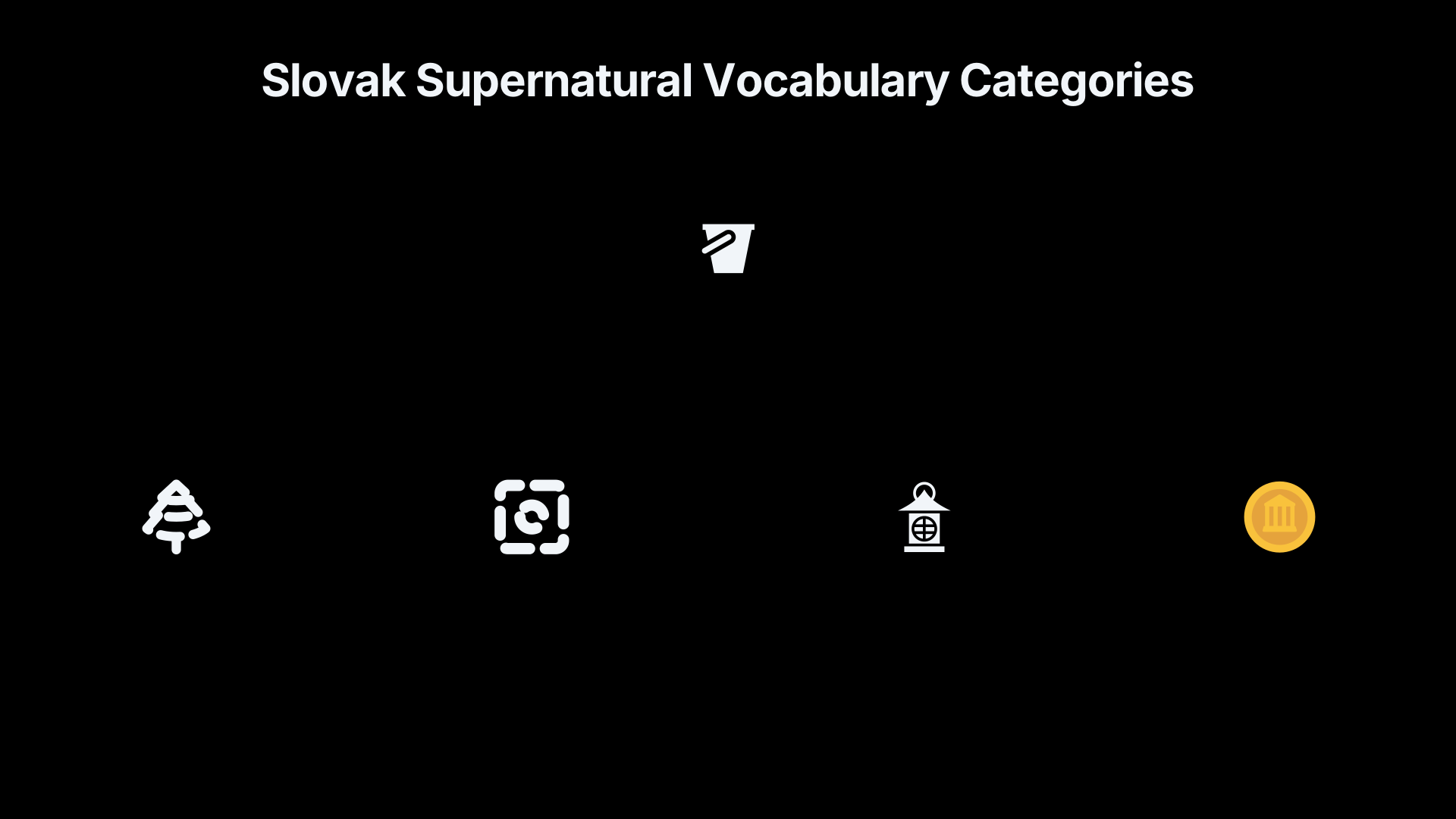
Among the figures recorded in Slovak tradition are:
- Water spirits associated with rivers and ponds.(#endnote-6 “Endnote 6”)[Wikipedia]WikipediaSlavic water spiritsSlavic water spirits
- Wild female beings connected with forests and remote places.
- Night creatures linked to nightmares and suffocation during sleep.
- Wandering lights that mislead travellers.
- Household or wealth-bringing spirits.
- Witches, sorcerers and magical healers.[Academia]academia.eduSlovak mythological vocabulary on the Common Slavic…January 1, 2019 — Slovak mythological vocabulary reveals significant Commo…
The linguistic evidence suggests that Slovakia occupies a meeting point between different branches of the Slavic cultural world. Some supernatural names show close ties to Czech and Polish traditions, others resemble East Slavic or South Slavic forms, while still others appear to be characteristic of the Carpathian region. This mixture reflects centuries of migration, trade and cultural contact across Central Europe.[Academia]academia.eduSlovak mythological vocabulary on the Common Slavic…January 1, 2019 — Slovak mythological vocabulary reveals significant Commo…
Researchers have also noted that folk belief did not disappear when modernity arrived. Contemporary spiritual movements, folk healing practices and modern retellings sometimes reuse traditional narrative patterns even when participants no longer accept older village beliefs literally. The supernatural vocabulary remains part of Slovak cultural memory, adapting to new contexts rather than vanishing entirely.[ResearchGate]researchgate.netFolk Tales, Magic, and Politics: Interpretation of Folklore in…April 1, 2021 — It is argued that practitioners' stories ab…
How These Beliefs Are Understood Today
Most Slovaks no longer treat witches or water spirits as literal dangers, but the stories remain culturally important. They appear in folklore collections, museum exhibitions, local festivals, children’s literature and heritage tourism. The figures of the waterman and the winter witch continue to serve as symbols of a traditional worldview in which nature, religion and the supernatural were deeply intertwined.[Slovakia Travel]slovakia.travelTravel Lucia (13th December)LucyLucia (13th December)Lucy - in Slovak “Lucia” (13th December), in contradiction with the Christian tradition, was presented in the folk t…
For modern readers, these traditions reveal more than old fears. Water spirits reflect the dangers and importance of rivers and lakes in rural life. Witch beliefs illuminate concerns about illness, livestock and social conflict. Lucia customs show how communities coped with the uncertainty of the darkest season of the year. Together they form a vivid part of Slovakia’s supernatural heritage, connecting local villages and landscapes to a much broader Slavic world of spirits, magic and unseen powers.[academia.edu]academia.eduSlovak mythological vocabulary on the Common Slavic…January 1, 2019 — Slovak mythological vocabulary reveals significant Commo…
Amazon book picks
Further Reading
Books and field guides related to Who Haunts Slovakia's Waters and Winter Nights?. Use these as the next step if you want deeper reading beyond the article.
Russian Fairy Tales (Illustrated by Ivan Bilibin)
Provides close parallels to water spirits, witches and Slavic beings.
eBay marketplace picks
Marketplace Samples
Live-tested eBay searches with available results related to this page.
Endnotes
1.
Source: academia.edu
Link:https://www.academia.edu/39784546/Slovak_mythological_vocabulary_on_the_Common_Slavic_background_Ethno_linguistic_aspect
Source snippet
Slovak mythological vocabulary on the Common Slavic...January 1, 2019 — Slovak mythological vocabulary reveals significant Commo...
Published: January 1, 2019
2.
Source: english.radio.cz
Title: Prague International Slovakia’s witches come out to play on St
Link:https://english.radio.cz/slovakias-witches-come-out-play-st-lucys-day-8093750
Source snippet
Lucy's DayThe cycle of witches' days in Slovak folk tradition is reaching its end with the day of St Lucy. In some European regions, St L...
3.
Source: slovakia.travel
Title: Travel Lucia (13th December)Lucy
Link:https://slovakia.travel/en/lucia-13th-december
Source snippet
Lucia (13th December)Lucy - in Slovak “Lucia” (13th December), in contradiction with the Christian tradition, was presented in the folk t...
4.
Source: Wikipedia
Link:https://en.wikipedia.org/wiki/Vodyanoy
5.
Source: netky.sk
Link:https://www.netky.sk/clanok/the-enchanting-world-of-slovak-folklore-and-legends-a-journey-into-central-europes-mystical-heart-video
Source snippet
The Enchanting World of Slovak Folklore and LegendsOften depicted as a green-skinned man with algae-covered hair, the Vodník is beli...
6.
Source: Wikipedia
Title: Slavic water spirits
Link:https://en.wikipedia.org/wiki/Slavic_water_spirits
7.
Source: researchgate.net
Link:https://www.researchgate.net/publication/350555307_Folk_Tales_Magic_and_Politics_Interpretation_of_Folklore_in_Slovak_Ethnography
Source snippet
Folk Tales, Magic, and Politics: Interpretation of Folklore in...April 1, 2021 — It is argued that practitioners' stories ab...
Published: April 1, 2021
Additional References
8.
Source: facebook.com
Link:https://www.facebook.com/groups/281030579692957/posts/1262333371562668/
Source snippet
Slovak witches' days and superstitionsOld pagan beliefs say witches gathered in the mountains on this day. As they are vulnerable to heat...
9.
Source: reddit.com
Link:https://www.reddit.com/r/Slovakia/comments/1ohd7vx/slovakian_myths_and_ancient_songs_around_water/
Source snippet
Slovakian myths and ancient songs? around waterVodnik from Košice once collected soul and body of miller´s daughter, who commited suicide...
10.
Source: brendan-noble.com
Link:https://brendan-noble.com/wodnik-vodyanoy-slavic-spirit-of-the-water/
Source snippet
Wodnik/Vodyanoy – Slavic Spirit of the WaterWodniks are creatures living deep in the sea in their own cities – likely drawing from Polish...
11.
Source: scribd.com
Link:https://www.scribd.com/document/720291869/Supernatural-Beings-from-Slovenian-Myth-and-Folktales
Source snippet
George's Day (April... 19). According to this folk narrative, Muk was a water sprite, the master of the...Read more...
12.
Source: youtube.com
Link:https://www.youtube.com/watch?v=ivSc4T_ZcKs
Source snippet
Vodyanoy – The Odd Water Spirit of Russian FolkloreThe Vodyanoy is a water spirit in Russian mythology. Described as a being with scaly s...
13.
Source: youtube.com
Link:https://www.youtube.com/watch?v=mZOxWA-iols
Source snippet
Witching Days: When Winter's Magic AwokeStep into the mysterious world of Slovakia's strídžie dni — the Witching Days that once marked th...
14.
Source: reddit.com
Link:https://www.reddit.com/r/AskEurope/comments/d50bwv/in_slavic_mythology_vodyanoy_vodyanoi_vodn%C3%ADk/
Source snippet
n is a male water spirit often depicted as a frog man or a little...Read more...
15.
Source: facebook.com
Link:https://www.facebook.com/slavicbros/posts/i-think-lucie-czexan-czech-%C4%8Dert-%C4%8Derti-barborky-perchta-berchten-krampus-vanoce-v/608405894867537/
Source snippet
I think Lucie 🫣#czexan #czech #čert #čerti #barborky...Rusalka, the heroin of Antonín Dvořák´s opera, is another descendent of Vodnik...
16.
Source: wulflund.com
Title: waterman a character from slavic mythology
Link:https://www.wulflund.com/tema/mythology/waterman-a-character-from-slavic-mythology
Source snippet
Waterman, a character from Slavic mythology7 Feb 2025 — A water spirit / demon from ponds and rivers. You will learn that he rides a catf...
17.
Source: instagram.com
Link:https://www.instagram.com/reel/DRvAYq7Da4U/
Source snippet
us forces. This time was called the witch nights. To feel safe...
Topic Tree