Within Spanish Folklore
Who Lives in Spain's Northern Otherworld?
Northern Spanish folklore fills caves, rivers and mountains with powerful women, fairy beings and treasure-guarding dragons.
On this page
- Mari, mountains and moral power
- Lamiak, xanas and anjanas by the water
- Dragons, treasure and enchanted routes
Page outline Jump by section
Introduction
Northern Spain contains some of the richest supernatural traditions in the Iberian Peninsula. Across the Basque mountains, Asturian valleys and Cantabrian waterways, stories place powerful female beings in caves, springs, rivers and hidden underground chambers. These figures are not simply decorative fairies. They explain storms, guard treasure, reward honesty, punish greed and connect dramatic landscapes with moral lessons. In many areas, caves were imagined as entrances to another world, while rivers and springs were treated as places where the human and supernatural realms could meet. The result is a folklore landscape filled with mountain ladies, water spirits and dragon-like beings whose stories remain visible in place names, tourism routes and local identity today.[lurkaia.com]lurkaia.comMari of Anboto: the lady, the goddess and the legendHigh on Mount Anboto, between Biscay and Alava, there is a cave where Mari, th…

Who Is Mari and Why Does She Live in the Mountains?
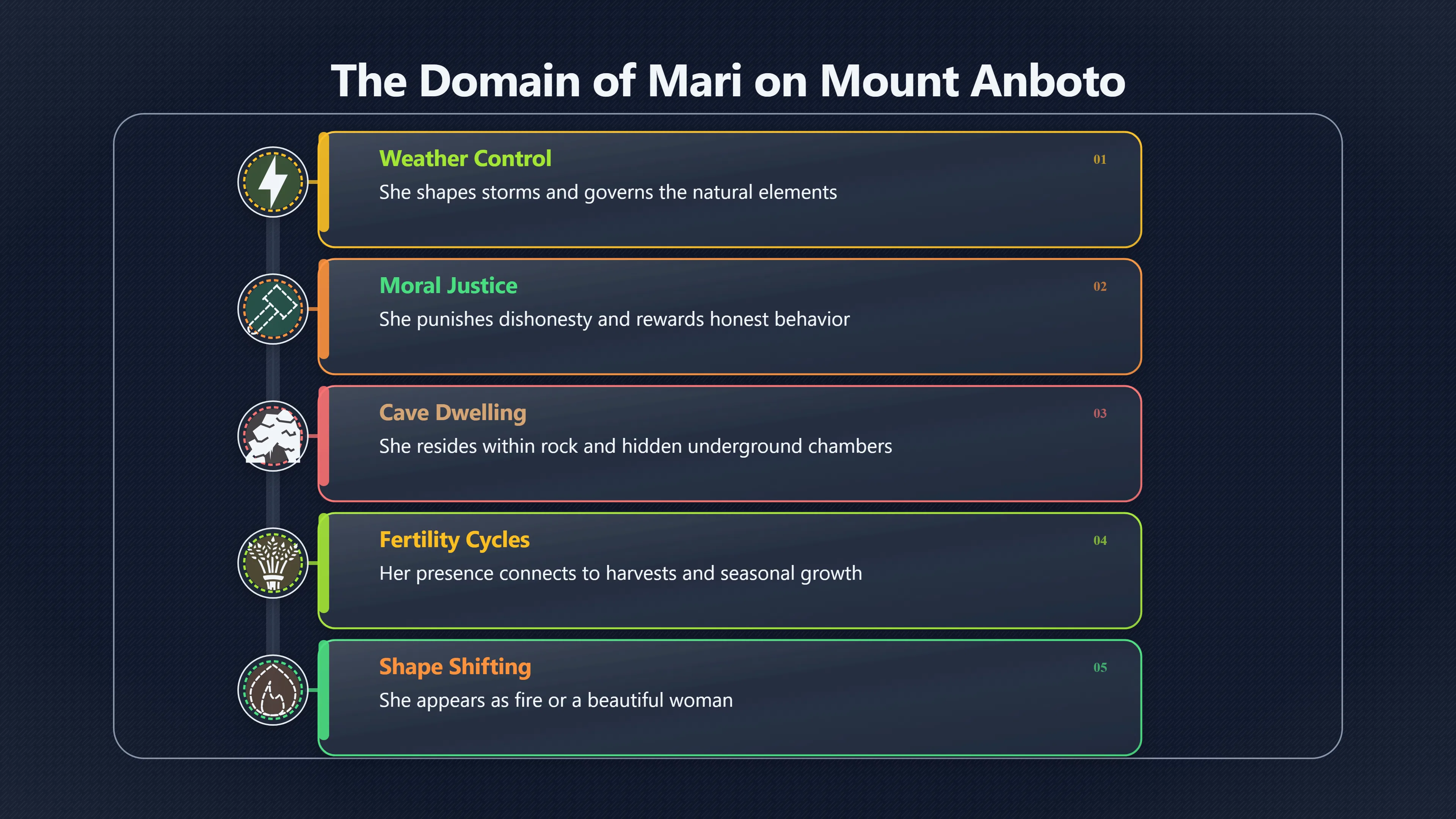
Among all the supernatural women of northern Spain, Mari stands apart. She is the central figure of Basque mythic tradition, associated with mountains, caves, weather and justice. Stories place her in several mountain caves, most famously on Mount Anboto, where she is said to dwell within the rock itself. Folklore collected in the nineteenth and twentieth centuries describes her as a powerful female being who can appear as a beautiful woman, a blaze of fire or a force of nature moving through the sky.[lurkaia.com]lurkaia.comMari of Anboto: the lady, the goddess and the legendHigh on Mount Anboto, between Biscay and Alava, there is a cave where Mari, th…
What makes Mari distinctive is that she is not merely a guardian of a single spring or cave. She is woven into the entire moral landscape. Traditional accounts connect her with storms, fertility, harvests and the punishment of dishonesty. In many stories, lies, arrogance and broken promises attract supernatural consequences. The mountains are therefore not empty wilderness but places where moral order is believed to have a presence.[golocalsansebastian.com]golocalsansebastian.combasque mythologyGo Local San SebastianBasque mythology29 Jul 2024 — Mari is also the lady of the interior of the earth, of its goods and of the water of…
Modern descriptions often call Mari a goddess, but historians and folklorists treat the surviving material carefully. Almost everything known about her comes through centuries of Christianisation, oral transmission and later folklore collection. Rather than revealing a complete ancient religion, the stories show how Basque communities imagined the natural world as alive with intelligence and power.[wikipedia.org]WikipediaBasque mythologyBasque mythology
Caves as Entrances to the Otherworld
Mari’s homes are rarely ordinary houses. They are caves set high in mountains, hidden among cliffs or reached through difficult paths. These cave dwellings reflect a broader northern Spanish belief that underground spaces connect the human world to supernatural forces. In Mari’s legends, caves become places where weather is shaped, destinies are judged and hidden knowledge resides.[lurkaia.com]lurkaia.comMari of Anboto: the lady, the goddess and the legendHigh on Mount Anboto, between Biscay and Alava, there is a cave where Mari, th…
This association between caves and female supernatural power appears repeatedly across the north. Rather than seeing mountains as barriers, folklore often treats them as living centres of authority. The cave becomes both a physical place and a symbolic gateway to an unseen realm.
Lamiak, Xanas and Anjanas by the Water
If Mari rules from the mountains, other female beings belong to water. Northern Spain’s rivers, springs and pools are populated by enchanting women whose stories blend beauty, danger and generosity.
The Basque Lamiak
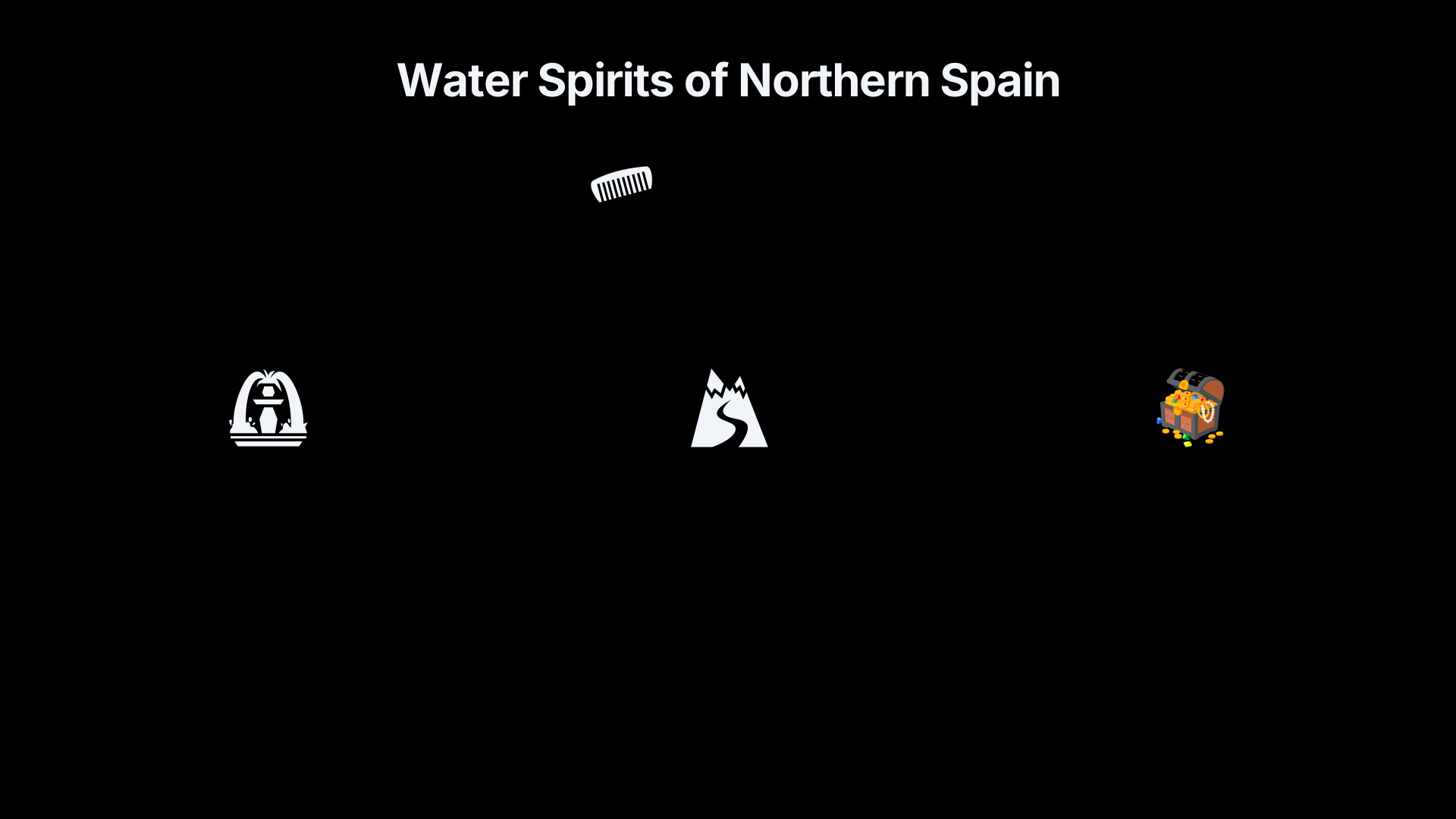
The Basque lamiak are among the best-known water spirits of the region. Folklore describes them as beautiful women who live near springs, rivers, caves and bridges. They are often portrayed combing their hair with golden combs beside the water. Some traditions give them unusual feet, such as duck-like or bird-like feet, a reminder that they are not fully human despite their beauty.[lurkaia.com]lurkaia.comLamiak: who are the lamias of Basque mythologyWho are the Lamiak Discover the Basque water beings linked to springs, rivers, golde…
Unlike many European water spirits, the lamiak are not always hostile. They can reward kindness, assist people and even help construct bridges or roads through supernatural labour. Yet they remain unpredictable. Human beings who approach them carelessly may find themselves enchanted, misled or drawn into dangerous bargains. Their stories often revolve around boundaries: between land and water, civilisation and wilderness, humanity and the supernatural.[Lurkaia]lurkaia.comLamiak: who are the lamias of Basque mythologyWho are the Lamiak Discover the Basque water beings linked to springs, rivers, golde…
The lamiak also illustrate how northern Spanish folklore connects the landscape to storytelling. Particular springs, caves and bridges are frequently linked to individual legends, turning ordinary geographical features into remembered supernatural locations.[Lurkaia]lurkaia.comLamiak: who are the lamias of Basque mythologyWho are the Lamiak Discover the Basque water beings linked to springs, rivers, golde…
The Xanas of Asturias
Further west, Asturias preserves one of northern Spain’s most beloved fairy traditions: the xanas. These beings are typically imagined as extraordinarily beautiful women living near fountains, waterfalls, rivers, springs and caves. Their songs, treasures and magical powers make them central figures in Asturian folklore.[wikipedia.org]WikipediaOpen source on wikipedia.org.
Many xana stories involve hidden wealth. A traveller may encounter a xana near a spring and be offered a challenge, a riddle or an opportunity to break an enchantment. Success can bring treasure or blessing; failure may lead to disappointment or danger. The motif links water with mystery and possibility, suggesting that valuable things lie beneath the visible surface of the world.[wikipedia.org]WikipediaOpen source on wikipedia.org.
Another recurring feature is their connection to midsummer traditions. In some legends, xanas appear around the feast of Saint John, a time when Christian celebrations overlap with older seasonal beliefs about magical nights, hidden treasure and encounters with supernatural beings.[intoAsturias]intoasturias.comruta de las xanas searching for asturian water nymphsThey appear in the night around the time of San Juan's festival, celebrating the birth of John…Read more…
The Anjanas of Cantabria
In neighbouring Cantabria, similar traditions survive in stories of anjanas. Although local details vary, they share many characteristics with the Asturian xanas: beauty, magical abilities, links to nature and a tendency to aid deserving people while opposing cruelty or greed. The overlap shows how folklore travelled across northern Spain’s mountain corridors while developing distinctive local identities.[Wikipedia]WikipediaOpen source on wikipedia.org.
Dragons, Treasure and Enchanted Routes
Water spirits and cave ladies rarely exist alone. Their stories intersect with dragons, serpents and treasure guardians that populate northern Spain’s folklore.
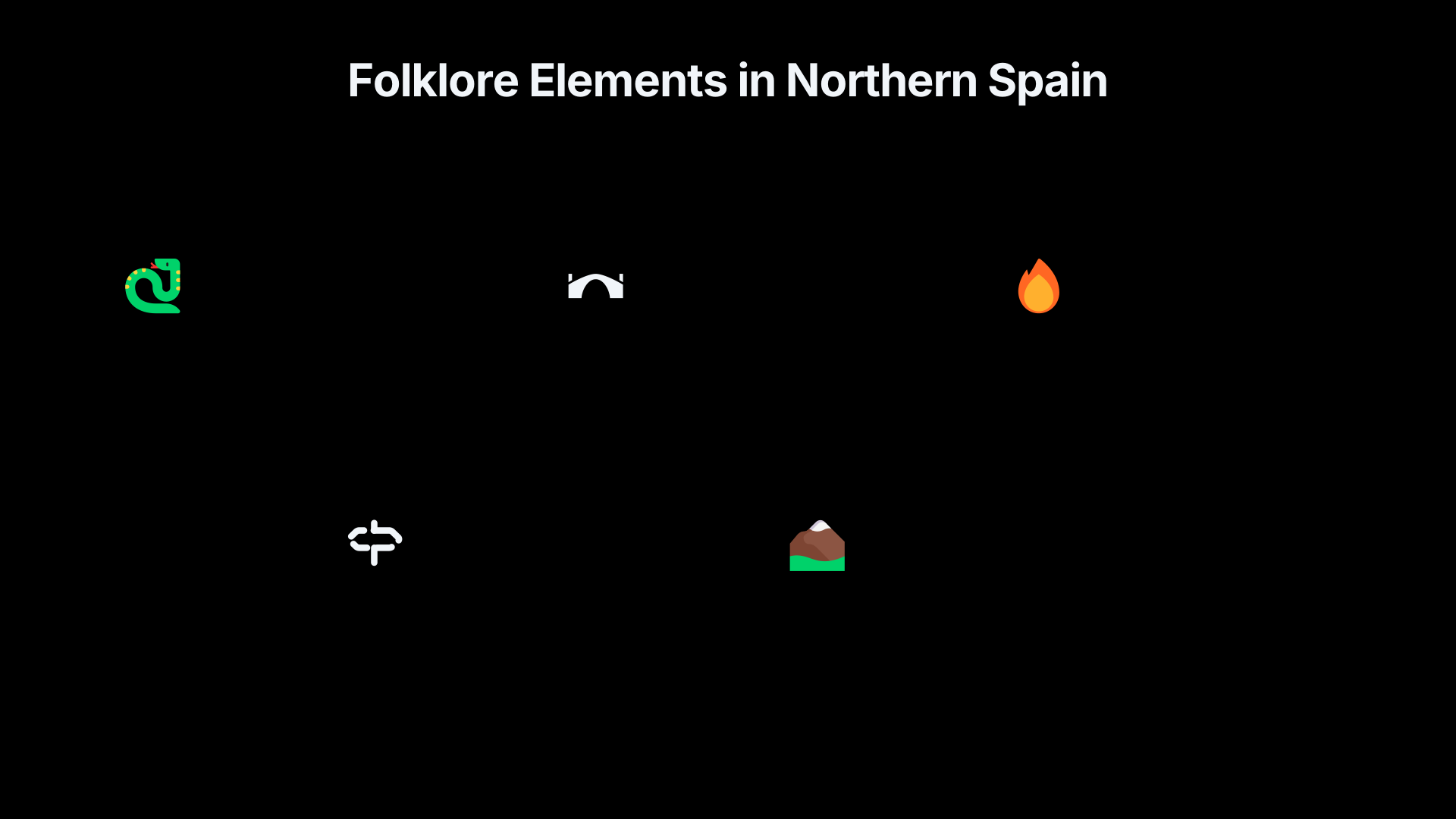
In Basque traditions, Mari is frequently associated with Sugaar, a powerful serpent or dragon-like being. Folklore links their meetings with storms, fertility and dramatic weather. Rather than a simple monster, the serpent becomes part of a wider supernatural system connecting caves, mountains and the forces of nature.[Wikipedia]WikipediaMari (goddessMari (goddess
Treasure is another recurring theme. Hidden gold, enchanted objects and underground riches appear repeatedly in stories of lamiak and xanas. These treasures are rarely easy rewards. They usually require courage, moral worth or successful completion of a supernatural task. The lesson is often that greed leads to failure while patience and honesty bring success.[wikipedia.org]WikipediaOpen source on wikipedia.org.
Many legends are tied to specific routes through mountains and valleys. A bridge attributed to supernatural builders, a cave associated with Mari or a gorge linked to xanas turns travel through the landscape into a journey through story. Modern hiking routes and heritage trails sometimes preserve these associations, allowing folklore to remain connected to the places that inspired it.[intoasturias.com]intoasturias.comruta de las xanas searching for asturian water nymphsThey appear in the night around the time of San Juan's festival, celebrating the birth of John…Read more…
Why These Spirits Still Matter
Northern Spain’s cave goddesses and water spirits survive because they do more than entertain. They provide a way of understanding landscape. Mountains become moral spaces rather than empty geology. Springs become places of wonder rather than mere water sources. Caves become thresholds rather than holes in rock.[lurkaia.com]lurkaia.comMari of Anboto: the lady, the goddess and the legendHigh on Mount Anboto, between Biscay and Alava, there is a cave where Mari, th…
These traditions also reveal how folklore adapts. Mari, the lamiak, xanas and anjanas have been reshaped by Christianity, folklore collectors, tourism and modern popular culture, yet their core themes remain recognisable: powerful female figures linked to nature, hidden realms beneath the earth and water, and the idea that human behaviour matters in a world filled with unseen forces.[wikipedia.org]WikipediaBasque mythologyBasque mythology
For many visitors, northern Spain’s mountains, caves and rivers are striking landscapes. Folklore adds another layer. Behind the cliffs of Anboto, beside an Asturian spring or along a misty Cantabrian stream, traditional stories still suggest that someone may be watching from the other side of the water.[lurkaia.com]lurkaia.comMari of Anboto: the lady, the goddess and the legendHigh on Mount Anboto, between Biscay and Alava, there is a cave where Mari, th…
Amazon book picks
Further Reading
Books and field guides related to Who Lives in Spain's Northern Otherworld?. Use these as the next step if you want deeper reading beyond the article.
The Basque History of the World
Helps readers understand the cultural setting behind Mari and related legends.
Fairy and Folk Tales of the Irish Peasantry
Useful comparison for Atlantic and otherworld traditions similar to northern Iberia.

The Penguin Book of Dragons
Connects to dragon and treasure-guardian traditions of northern Spain.
Index of Spanish Folktales, Classified According to Antti Aar...
Contains motifs involving enchanted women, treasure and supernatural beings.
eBay marketplace picks
Marketplace Samples
Live-tested eBay searches with available results related to this page.
Endnotes
1.
Source: lurkaia.com
Link:https://lurkaia.com/en/leyenda-mari-anboto
Source snippet
Mari of Anboto: the lady, the goddess and the legendHigh on Mount Anboto, between Biscay and Alava, there is a cave where Mari, th...
2.
Source: intoasturias.com
Title: ruta de las xanas searching for asturian water nymphs
Link:https://intoasturias.com/ruta-de-las-xanas-searching-for-asturian-water-nymphs/
Source snippet
They appear in the night around the time of San Juan's festival, celebrating the birth of John...Read more...
3.
Source: Wikipedia
Title: Mari (goddess)
Link:https://en.wikipedia.org/wiki/Mari_%28goddess%29
4.
Source: Wikipedia
Title: Basque mythology
Link:https://en.wikipedia.org/wiki/Basque_mythology
5.
Source: evertype.com
Link:https://www.evertype.com/misc/basque-jies/basque-jies.html
Source snippet
introduction to the Basque goddess, her forms, habits, and attributes, and will demonstrate that, despite even the influence of...
6.
Source: lurkaia.com
Link:https://lurkaia.com/en/lamiak
Source snippet
Lamiak: who are the lamias of Basque mythologyWho are the Lamiak Discover the Basque water beings linked to springs, rivers, golde...
7.
Source: pursiful.com
Title: lamiak and mairuak the fair folk of the basque country
Link:https://pursiful.com/2016/03/07/lamiak-and-mairuak-the-fair-folk-of-the-basque-country/
Source snippet
Darrell J. PursifulLamiak and Mairuak: the Fair Folk of the Basque Country7 Mar 2016 — The lamia (plural lamiak) is a nymph-like being of...
8.
Source: Wikipedia
Title: List of Basque mythological figures
Link:https://en.wikipedia.org/wiki/List_of_Basque_mythological_figures
9.
Source: Wikipedia
Link:https://en.wikipedia.org/wiki/Xana
10.
Source: mythlok.com
Link:https://mythlok.com/xana/
Source snippet
The Water Fairy Who Guarded Hidden Treasures15 Sept 2025 — According to legend, Xanas live near fountains, waterfalls, caves, rivers, and...
11.
Source: Wikipedia
Link:https://es.wikipedia.org/wiki/Xana
12.
Source: durangaldeaturismoa.eus
Link:https://durangaldeaturismoa.eus/en/anbotoko-mari-and-durangaldea/
Source snippet
Anbotoko Mari and DurangaldeaMari inhabits all peaks of the Basque mountains, but the ancient tales claim that her most important dwellin...
13.
Source: golocalsansebastian.com
Title: basque mythology
Link:https://golocalsansebastian.com/basque-mythology/
Source snippet
Go Local San SebastianBasque mythology29 Jul 2024 — Mari is also the lady of the interior of the earth, of its goods and of the water of...
14.
Source: mythus.fandom.com
Title: Myth and Folklore Lamia (Basque mythology)
Link:https://mythus.fandom.com/wiki/Lamia_%28Basque_mythology%29
Source snippet
Lamiak live in the river. They are very beautiful, and stay at the shore combing their long...Read more...
Additional References
15.
Source: enchanted-chronicles.com
Link:https://www.enchanted-chronicles.com/the-xanas-asturias-legend-folklore/
Source snippet
Enchanted Chronicles StudioStep Into the Xana's Enchanted RealmDiscover the legend of the Xanas, mystical water nymphs of Asturias. Guard...
16.
Source: facebook.com
Link:https://www.facebook.com/crystalfighters/posts/with-the-basque-sea-goddess-mari/10157318868009931/
Source snippet
With the Basque sea goddess MariMari is the prominent mythical deity of northern Spain, a mysterious goddess who resides deep in the base...
17.
Source: theearthstoriescollection.org
Link:https://theearthstoriescollection.org/en/xana-galinda/
Source snippet
Xana Galinda – The Earth Stories CollectionThis medieval Asturian legend takes as its protagonist a woman turned into a spirit of nature...
18.
Source: foro3d.com
Title: mari the basque goddess who rules over nature from mount anboto
Link:https://foro3d.com/en/2026/january/mari-the-basque-goddess-who-rules-over-nature-from-mount-anboto.html
Source snippet
, the Basque goddess who rules nature from Mount Anboto6 Jan 2026 — Mari is the principal deity of Basque mythology, personification of t...
19.
Source: instagram.com
Link:https://www.instagram.com/reel/DZBwTv4Ni2M/
Source snippet
igmatic mountain spirit and weather goddess of Basque folklore...
20.
Source: instagram.com
Link:https://www.instagram.com/p/DRctLbkkymW/
Source snippet
the Pyrenees. Every seven years she crosses the dark night...
21.
Source: perennialpyrenees.com
Title: article 22 the cthonic cult of mari
Link:https://perennialpyrenees.com/2018/04/14/article-22-the-cthonic-cult-of-mari/
Source snippet
Article 22 – The Cthonic Cult of Mari14 Apr 2018 — Mari in Basque mythology, who emerges from her network of caverns for various malevole...
22.
Source: youtube.com
Link:https://www.youtube.com/watch?v=WhWbWWu8tgs
Source snippet
ted as a beautiful woman living in caves or pools of water...
23.
Source: youtube.com
Title: The forgotten gods of basque mythology and their bizarre legends
Link:https://www.youtube.com/watch?v=BTsfK34VkAc
Source snippet
ASTURIAN MYTHOLOGY: The Xanas, the Nuberu and the Güestia...
24.
Source: europeanfolktales.com
Link:https://europeanfolktales.com/enchanted-xanas-asturian-folktale/
Source snippet
Enchanted Xanas – Asturian Folktale4 Nov 2025 — A1: Xanas are water-nymphs or fairies from Asturias and León, often depicted as beautiful...
Topic Tree