Within Eritrean Folklore
What Do Eritrean Spirit Beliefs Explain?
Beliefs about the evil eye and zar spirits show how Eritrean folklore explains illness, envy, protection and healing.
On this page
- The feared gaze and social vulnerability
- Protective objects, prayer and amulets
- Zar possession, music and healing
Page outline Jump by section
Introduction
Belief in the evil eye and in spirit possession has long been part of the supernatural landscape of Eritrea. These traditions are not separate from everyday life; they sit at the meeting point of religion, health, family relationships, envy, reputation, and community healing. For many Eritreans, especially in older rural traditions, sudden illness, unexplained misfortune, emotional distress, infertility, or recurring bad luck could be interpreted not only through physical causes but also through unseen spiritual forces. The two most widely discussed ideas are the evil eye—the harmful power of envy expressed through a gaze—and zar spirits, supernatural beings believed to possess or afflict individuals. Although modern education, medicine, and religious reform movements have changed how these beliefs are understood, both traditions remain important for understanding Eritrean folklore and popular culture.[wikipedia.org]WikipediaBuda (folkloreDecember 4, 2025 — Buda (Ge'ez: ቡዳ), in Ethiopian and Eritrean folk religion, is the power of the evil eye and the ability to change int…
What Do Eritrean Spirit Beliefs Explain?
In Eritrean folk belief, the supernatural often serves as an explanation for events that seem difficult to understand through ordinary experience alone. A healthy child who suddenly falls ill, a successful family struck by repeated setbacks, or a person whose behaviour changes dramatically might be interpreted through the language of spirits, envy, or spiritual attack rather than simple chance.[Wikipedia]WikipediaBuda (folkloreDecember 4, 2025 — Buda (Ge'ez: ቡዳ), in Ethiopian and Eritrean folk religion, is the power of the evil eye and the ability to change int…
Rather than forming a separate religion, these beliefs traditionally coexisted with Christianity and Islam. People might attend church or mosque while also accepting the possibility that an envious glance, a wandering spirit, or a neglected supernatural obligation could influence human wellbeing. Anthropological studies from the wider Horn of Africa show that such beliefs often persist alongside formal religious practice rather than replacing it.[Wikipedia]WikipediaOpen source on wikipedia.org.
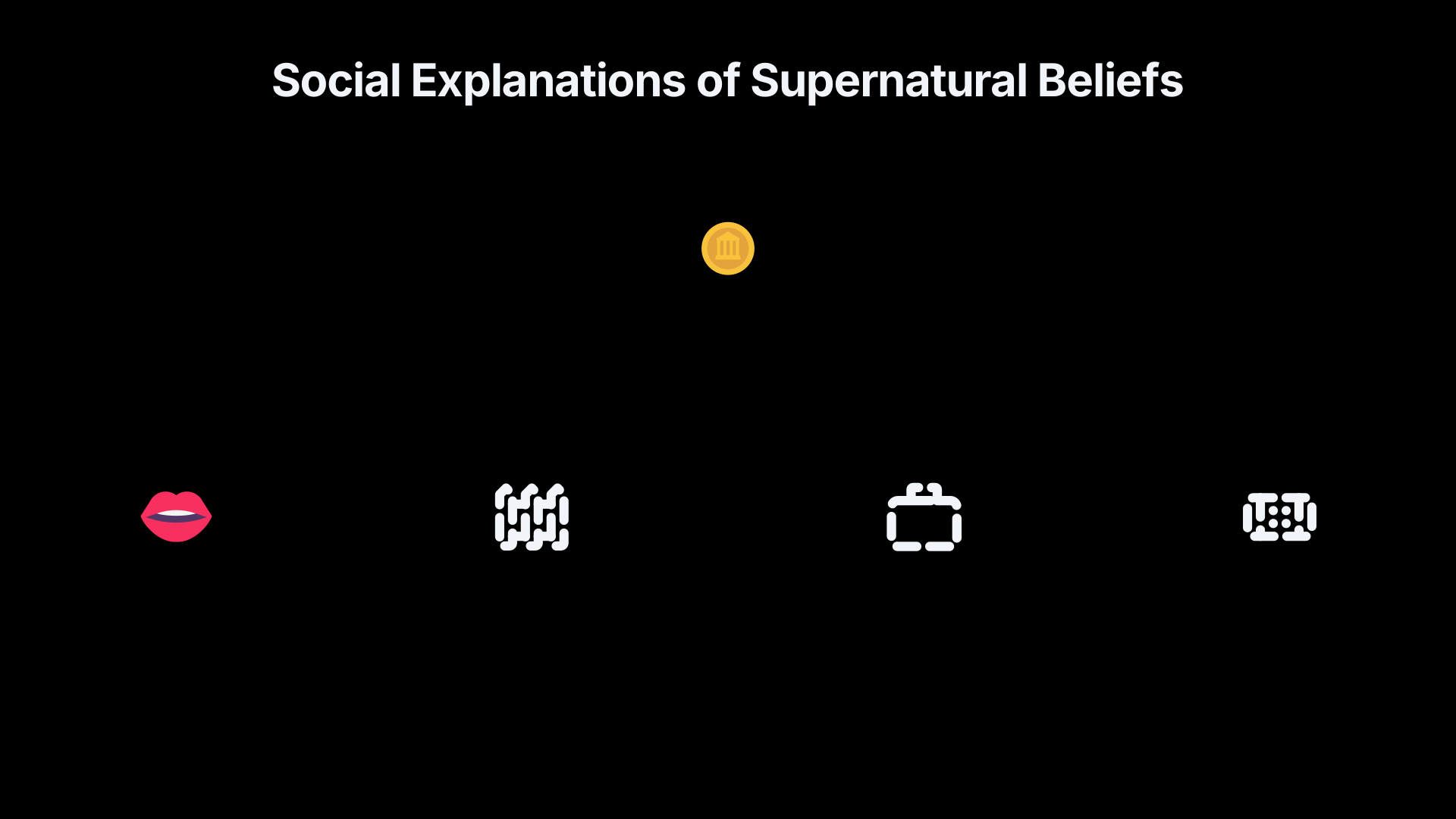
A notable feature of these traditions is that they address social tensions. They provide ways of talking about jealousy, unequal fortune, family conflict, illness, and emotional suffering. Modern scholars frequently interpret them not only as supernatural systems but also as cultural languages through which communities discuss vulnerability and misfortune.[eHRAF World Cultures]ehrafworldcultures.yale.edueHRAF World CulturesThe Evil Eye Belief Among The Amhara Of Ethiopiaby RA Reminick · 1974 · Cited by 113 — Reminick argues that the Amhar…
The Feared Gaze and Social Vulnerability
The evil eye is one of the most widespread supernatural beliefs associated with Eritrea and neighbouring Ethiopia. The basic idea is simple: admiration mixed with envy can cause harm. A person does not necessarily need to cast a deliberate curse. Excessive jealousy, resentment, or even a powerful glance may be believed to bring illness, weakness, accidents, infertility, or other forms of misfortune.[Wikipedia]WikipediaBuda (folkloreDecember 4, 2025 — Buda (Ge'ez: ቡዳ), in Ethiopian and Eritrean folk religion, is the power of the evil eye and the ability to change int…
Traditional stories reveal how deeply this fear could shape behaviour. In one Eritrean folk narrative, a mother hides her beautiful children whenever visitors arrive because she fears that admiration might trigger the evil eye and make them sick. The story illustrates a broader cultural concern that visible success, beauty, or good fortune can attract dangerous envy.[Eritrea Ministry Of Information]shabait.comfrom cultural heritages of eritrea on eritrean traditional fairiesEritrea Ministry Of InformationFrom Cultural Heritages of Eritrea: On Eritrean Traditional…27 Sept 2013 — The reason was that if peopl…
In the wider Eritrean and Ethiopian tradition, the evil eye is sometimes linked to a concept known as buda. Historical accounts describe buda as a feared supernatural power associated with the ability to inflict harm through a glance. In some traditions, people believed that those possessing this power could also transform into hyenas or act through malevolent spirits. Such beliefs often became attached to socially marginal groups, artisans, or outsiders, revealing how folklore can reflect social tensions as much as supernatural fears.[Wikipedia]WikipediaBuda (folkloreDecember 4, 2025 — Buda (Ge'ez: ቡዳ), in Ethiopian and Eritrean folk religion, is the power of the evil eye and the ability to change int…
Modern researchers have noted that evil-eye traditions frequently emerge in societies where envy is a major social concern. The belief offers a way of explaining why visible success can sometimes feel risky and why modesty is valued. Public displays of wealth, beauty, or achievement may attract not only admiration but also suspicion that envy could follow.[eHRAF World Cultures]ehrafworldcultures.yale.edueHRAF World CulturesThe Evil Eye Belief Among The Amhara Of Ethiopiaby RA Reminick · 1974 · Cited by 113 — Reminick argues that the Amhar…
Protective Objects, Prayer and Amulets
Because the evil eye was feared, people developed numerous protective practices. These were rarely viewed as alternatives to religion. Instead, they often drew directly upon religious symbols, prayers, and sacred texts.
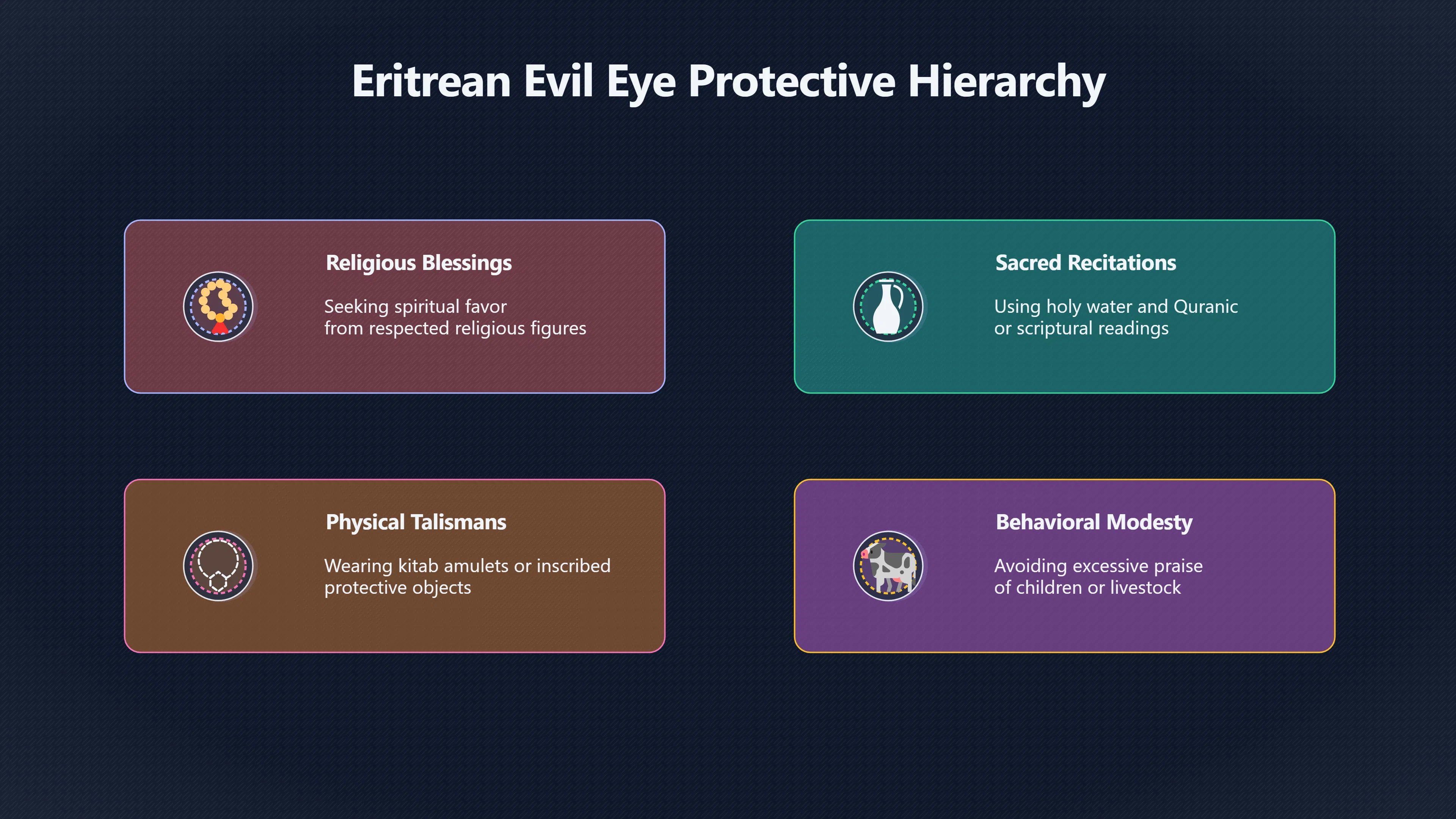
Protective measures could include:
- Carrying amulets or talismans inscribed with sacred words.
- Wearing protective objects around the neck or body.
- Seeking blessings from respected religious figures.
- Using holy water, prayers, or Quranic recitations.
- Avoiding excessive praise of children, livestock, or possessions.[wikipedia.org]WikipediaBuda (folkloreDecember 4, 2025 — Buda (Ge'ez: ቡዳ), in Ethiopian and Eritrean folk religion, is the power of the evil eye and the ability to change int…
Among Christians in Eritrea and Ethiopia, protective talismans known as kitab have historically been worn to ward off harmful spiritual influences. These objects might be prepared by religious specialists who combined literacy, prayer, and traditional healing knowledge.[Wikipedia]WikipediaBuda (folkloreDecember 4, 2025 — Buda (Ge'ez: ቡዳ), in Ethiopian and Eritrean folk religion, is the power of the evil eye and the ability to change int…
Folk customs could also extend into household life. Oral accounts from Eritrea describe protective objects being placed near doorways to discourage harmful spirits from entering the home. While such customs vary widely by region and family, they reflect the broader belief that homes require spiritual as well as physical protection.[SuperstitionsMap]superstitionsmap.comevil eye, holy water, and traditional healing.Read moreEritrean Superstitions (World #80, ≈200 total)29 Mar 2026 — One remembered household custom places a knife near an open d…
The important point is that protection was not merely defensive. It helped people feel that misfortune could be managed. Through prayer, ritual, and symbolic objects, communities created practical responses to fears that otherwise seemed uncontrollable.
Zar Possession, Music and Healing
If the evil eye explained misfortune from outside, zar traditions explained what happened when a spirit entered a person’s life directly.
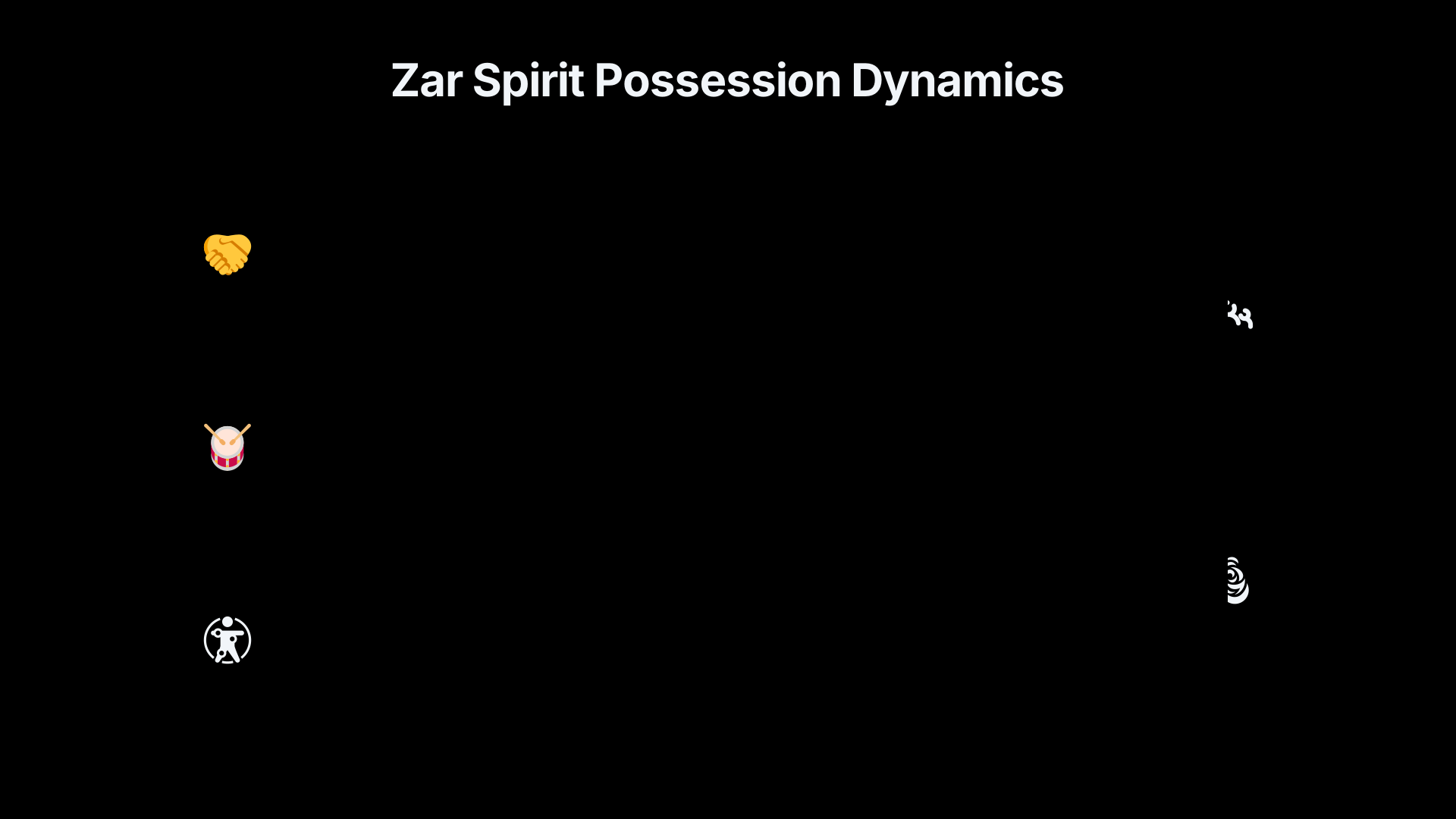
Zar beliefs are found across the Horn of Africa and the Red Sea region, including Eritrea, Ethiopia, Sudan, Djibouti, and parts of the Middle East. In these traditions, a zar is generally understood as a spirit capable of possessing a person and causing physical, emotional, or social distress. Symptoms may include unusual behaviour, unexplained illness, depression, anxiety, exhaustion, or recurring personal problems.[Wikipedia]WikipediaOpen source on wikipedia.org.
Unlike some forms of exorcism, zar traditions do not always aim to expel the spirit completely. In many accounts, the goal is to identify the spirit, understand its demands, and establish a workable relationship with it. Scholars often describe this as a process of accommodation rather than simple removal.[Wikipedia]WikipediaOpen source on wikipedia.org.
Music lies at the heart of many zar ceremonies. Drumming, singing, rhythmic movement, incense, special clothing, and communal participation help create the ritual atmosphere. The afflicted person may dance, enter a trance state, or communicate through the possessing spirit. Through these performances, participants seek diagnosis, relief, and reconciliation.[Wikipedia]WikipediaOpen source on wikipedia.org.
Anthropologists have long noted that women often occupy central roles in zar traditions. In many communities, zar ceremonies provided one of the few socially accepted spaces where women could publicly express emotional distress, negotiate family pressures, or receive communal support. Rather than viewing zar only as a supernatural belief, some researchers interpret it as a cultural healing system that addressed social and psychological burdens.[Wikipedia]WikipediaAfrican divinationAfrican divination
Why Zar and the Evil Eye Often Overlap
In practice, evil-eye beliefs and zar traditions are not always separate categories. Across the Horn of Africa, people have often understood them as related explanations for suffering.
A person believed to have been weakened by envy, sorcery, or the evil eye might also be seen as vulnerable to spirit possession. Conversely, symptoms attributed to a zar spirit could sometimes be linked to an earlier act of jealousy or spiritual attack. The boundaries between these explanations are often fluid rather than rigid.[PMC]pmc.ncbi.nlm.nih.govPMCZār Spirit Possession in Iran and African CountriesNIHby F Mianji · 2015 · Cited by 34 — However, Hofriyati people might also link them to other supernatural causes, like sorcery (am…
This overlap reveals an important feature of Eritrean supernatural traditions: they are less concerned with constructing a neat system than with making sense of difficult experiences. Illness, grief, infertility, family conflict, and emotional distress can have multiple explanations at once, combining spiritual, social, and physical factors.
How These Traditions Are Viewed Today
Contemporary Eritreans hold a wide range of views about the evil eye and zar spirits. Some continue to accept them as real forces. Others interpret them symbolically or as remnants of older traditions. Religious leaders may regard certain practices as incompatible with orthodox Christianity or Islam, while traditional healers may continue to see them as important parts of community wellbeing.[Lausanne Movement]lausanne.orgethiopian case studyLausanne MovementCase Study: Demonization and the Practice of Exorcism in…22 Aug 2000 — A Christian explanation of the anthropological…
Migration has also carried these beliefs beyond Eritrea. Studies of Eritrean and Ethiopian diaspora communities show that ideas about the evil eye and spirit possession can persist even after resettlement in Europe, North America, and the Middle East. The language used to describe them may change, but the underlying concerns—envy, protection, illness, and belonging—often remain familiar.[eCALD]ecald.comEthiopian and Eritrean CultureZar possession is believed to be higher amongst women in the home country and more common amongst men…
From a folklore perspective, the lasting importance of these traditions lies not in proving whether spirits exist but in understanding what the stories and rituals do. They offer a framework for explaining uncertainty, managing social tensions, protecting loved ones, and seeking healing. In Eritrea’s rich landscape of oral tradition, few beliefs reveal more about the relationship between community, vulnerability, and the unseen world than the evil eye and the zar spirits.
Amazon book picks
Further Reading
Books and field guides related to What Do Eritrean Spirit Beliefs Explain?. Use these as the next step if you want deeper reading beyond the article.
The Spirit Catches You and You Fall Down
Rating: 4.0/5 from 7 Google Books ratings
Shows how spiritual explanations of illness operate in daily life.
The Anthropology of Religion, Magic, and Witchcraft
Provides context for possession and protective practices.
African Religions and Philosophy
Directly relevant to spirits, healing and supernatural belief.
eBay marketplace picks
Marketplace Samples
Live-tested eBay searches with available results related to this page.
Endnotes
1.
Source: Wikipedia
Title: Buda (folklore)
Link:https://en.wikipedia.org/wiki/Buda_%28folklore%29
Source snippet
December 4, 2025 — Buda (Ge'ez: ቡዳ), in Ethiopian and Eritrean folk religion, is the power of the evil eye and the ability to change int...
Published: December 4, 2025
2.
Source: ecald.com
Link:https://www.ecald.com/assets/Resources/Assets/C3-P2-S3-Ethiopian-Eritrean-Culture.pdf
Source snippet
Ethiopian and Eritrean CultureZar possession is believed to be higher amongst women in the home country and more common amongst men...
3.
Source: Wikipedia
Link:https://en.wikipedia.org/wiki/Z%C4%81r
4.
Source: Wikipedia
Title: Evil eye
Link:https://en.wikipedia.org/wiki/Evil_eye
Source snippet
Evil eyeThe evil eye is a supernatural belief in a curse brought about by a malevolent glare, usually inspired by envy. Amulets to pro...
5.
Source: Wikipedia
Title: African divination
Link:https://en.wikipedia.org/wiki/African_divination
6.
Source: researchgate.net
Link:https://www.researchgate.net/publication/233321212_The_Evil_Eye_and_Cultural_Beliefs_among_the_Bedouin_Tribes_of_the_Negev_Middle_East_1
Source snippet
The evil eye is perceived by the Bedouin as one of...
7.
Source: researchgate.net
Link:https://www.researchgate.net/publication/396619921_Indigenous_Healing_in_Sudan_Ethnomedical_Practices_Beliefs_and_Policy_Perspectives
Source snippet
evil eye or break magic. spells. Huruz (amulets) are used for protection. healing, and luck. They are crafted from wood. stone, and met...
8.
Source: superstitionsmap.com
Title: evil eye, holy water, and traditional healing.Read more
Link:https://superstitionsmap.com/eritrean-superstitions/
Source snippet
Eritrean Superstitions (World #80, ≈200 total)29 Mar 2026 — One remembered household custom places a knife near an open d...
9.
Source: lausanne.org
Title: ethiopian case study
Link:https://lausanne.org/content/ethiopian-case-study
Source snippet
Lausanne MovementCase Study: Demonization and the Practice of Exorcism in...22 Aug 2000 — A Christian explanation of the anthropological...
10.
Source: superstitionsmap.com
Link:https://superstitionsmap.com/african-superstitions/
Source snippet
folk beliefs tied to envy, affliction, and social tension; certain glances are...Read more...
11.
Source: researchgate.net
Link:https://www.researchgate.net/publication/31230272_Lost_Tribes_and_Coffee_Ceremonies_Zar_Spirit_Possession_and_the_Ethno-Religious_Identity_of_Ethiopian_Jews_in_Israel
Source snippet
Zar Spirit Possession and the Ethno-Religious Identity of...Similarly, Levine (2014) noted that "zar" (bad/evil spirits thought to be ca...
12.
Source: youtube.com
Title: Zar ritual: using music to heal
Link:https://www.youtube.com/watch?v=h81tvI56DFU
13.
Source: ehrafworldcultures.yale.edu
Link:https://ehrafworldcultures.yale.edu/cultures/mp05/documents/021
Source snippet
eHRAF World CulturesThe Evil Eye Belief Among The Amhara Of Ethiopiaby RA Reminick · 1974 · Cited by 113 — Reminick argues that the Amhar...
14.
Source: shabait.com
Title: from cultural heritages of eritrea on eritrean traditional fairies
Link:https://shabait.com/2013/09/27/from-cultural-heritages-of-eritrea-on-eritrean-traditional-fairies/
Source snippet
Eritrea Ministry Of InformationFrom Cultural Heritages of Eritrea: On Eritrean Traditional...27 Sept 2013 — The reason was that if peopl...
15.
Source: shabait.com
Link:https://shabait.com/2016/07/01/belief-in-superstitions-a-direct-product-of-partial-ignorance/
Source snippet
Eritrea Ministry Of InformationBelief in Superstitions: A Direct Product of Partial Ignorance!1 Jul 2016 — “I don't believe in the Evil E...
16.
Source: pmc.ncbi.nlm.nih.gov
Title: PMCZār Spirit Possession in Iran and African Countries
Link:https://pmc.ncbi.nlm.nih.gov/articles/PMC4801492/
Source snippet
NIHby F Mianji · 2015 · Cited by 34 — However, Hofriyati people might also link them to other supernatural causes, like sorcery (am...
Additional References
17.
Source: cp-pc.ca
Link:https://cp-pc.ca/english/eritrea/spirit.html
18.
Source: omicsonline.org
Link:https://www.omicsonline.org/open-access/the-curious-case-of-the-disappearing-zar-cult-1522-4821-1000570-123185.html
Source snippet
The candidate is then isolated sometimes the symptoms may be attributed to separated...Read more...
19.
Source: sforsparkle.com
Title: unraveling the ancient roots of evil eye beliefs
Link:https://sforsparkle.com/blogs/guides/unraveling-the-ancient-roots-of-evil-eye-beliefs?srsltid=AfmBOooCOb8_TqvOwANF38ZOjAtkjqE1q8ZDskR9kpczQP3MuENc3fOH
Source snippet
10 Aug 2024 — The evil eye is a superstition that someone can cause harm, illness, or bad luck to another person simply by looking at the...
20.
Source: youtube.com
Title: Virtual book discussion of ‘Zar’ with its author Hager El Hadidi
Link:https://www.youtube.com/watch?v=XmK-CcDbT5s
Source snippet
Zar ritual: using music to heal provides an overview of the traditional instruments and musical practices utilized in regional Zar healin...
21.
Source: facebook.com
Link:https://www.facebook.com/mazzighen/posts/many-iraqi-jews-believe-in-the-concept-of-evil-eye-resasay-is-an-iraqi-jewish-tr/691649757950268/
Source snippet
s in Mediterranean, Middle Eastern, Latin American, South...Read more...
22.
Source: panaprium.com
Link:https://www.panaprium.com/blogs/i/the-history-of-the-evil-eye-across-cultures?srsltid=AfmBOoqYF1BnTWfQ04vNpct5AsrpbdjhXFiJQS6Q6mKXtiRrmbCVvcu4
Source snippet
The History of the Evil Eye Across Cultures16 Dec 2025 — The evil eye persists because it expresses something profoundly human: envy has...
23.
Source: awate.com
Title: eritrean traditional fairies
Link:https://awate.com/eritrean-traditional-fairies/
Source snippet
18 Jun 2011 — The reason was that if people made eye contact with the beautiful children, the Evil Eye would go into action and cause the...
24.
Source: perfumedskull.com
Link:https://perfumedskull.com/2016/06/02/the-red-wind-of-memory-a-review-of-susan-kenyons-slaves-and-spirits-of-central-sudan-2012/
Source snippet
The Red Wind of Memory: A Review of Susan Kenyon's '...2 Jun 2016 — I often find myself describing ethnographies that are both very, ver...
25.
Source: harep.org
Title: Dr Rereket et al
Link:https://harep.org/Agriculture/trad.pdf
Source snippet
4 Apr 2003 — Her symptoms indicated classic evil Zar possession. The. Zar tend to inhabit women, whom they mount like a horse and fo...
26.
Source: facebook.com
Link:https://www.facebook.com/Uyghursbookshelf/posts/where-the-folk-belief-of-the-evil-eye-iswas-common-%EF%B8%8Fthe-belief-in-the-evil-eye-t/1230073712255405/
Source snippet
When that...Read more...
Topic Tree