Within Syrian Folklore
Why Does Ugarit's Storm God Still Matter?
Ugarit's Baal Cycle gives Syria one of the ancient Levant's deepest mythic records of storm, sea, kingship and death.
On this page
- The Baal Cycle in Plain English
- Storms, Sea and Sacred Power
- What Ancient Myth Can and Cannot Prove
Page outline Jump by section
Introduction
The storm-god myths preserved at ancient Ugarit are among the oldest and most detailed mythological texts ever discovered in what is now Syria. Written on clay tablets during the Late Bronze Age and unearthed at Ras Shamra on the Syrian coast, they preserve the famous Baal Cycle: a dramatic sequence of stories about a storm god who battles the sea, gains kingship, confronts death itself, and returns to power. These texts matter not because they represent a living Syrian folk belief today, but because they provide an exceptionally deep record of how people in ancient Syria imagined weather, fertility, political authority and the fragile balance between life and destruction.[The Metropolitan Museum of Art]metmuseum.orgThe Metropolitan Museum of Art UgaritThe Metropolitan Museum of ArtUgaritOctober 1, 2004 — 1 Oct 2004 — Ugarit was a flourishing city, its streets lined with two-story houses…
For readers interested in Syrian folklore and mythic traditions, Ugarit offers something rare: direct written evidence of stories that once circulated more than three thousand years ago. The Baal Cycle is not merely an archaeological curiosity. It remains one of the key sources for understanding the mythic imagination of the ancient Levant and the symbolic importance of storms in a region where rain could mean survival.[Wikipedia]WikipediaBaal CycleBaal Cycle
Why Does Ugarit’s Storm God Still Matter?
Ancient Ugarit stood on the Mediterranean coast near modern Latakia. Excavations beginning in the twentieth century revealed thousands of tablets written in the Ugaritic language, including some of the most important mythological texts from the ancient Near East. Among them, the Baal Cycle occupies a central place.[metmuseum.org]metmuseum.orgThe Metropolitan Museum of Art UgaritThe Metropolitan Museum of ArtUgaritOctober 1, 2004 — 1 Oct 2004 — Ugarit was a flourishing city, its streets lined with two-story houses…
The hero of these stories is Baal, a storm god associated with thunder, rain and agricultural fertility. In a landscape where successful harvests depended heavily on seasonal rainfall, a storm deity was far more than a weather spirit. Baal represented the forces that made crops grow, filled rivers and ensured prosperity. His victories and defeats symbolised the cycles of nature that shaped everyday life.[Wikipedia]WikipediaBaal CycleBaal Cycle
What makes the Ugaritic material especially important is its detail. Many ancient cultures left references to gods and rituals, but the Baal Cycle preserves extended narratives with characters, conflicts and dramatic tension. Readers can follow a complete mythic story rather than reconstructing one from scattered fragments.[Wikipedia]WikipediaBaal CycleBaal Cycle
The Baal Cycle in Plain English
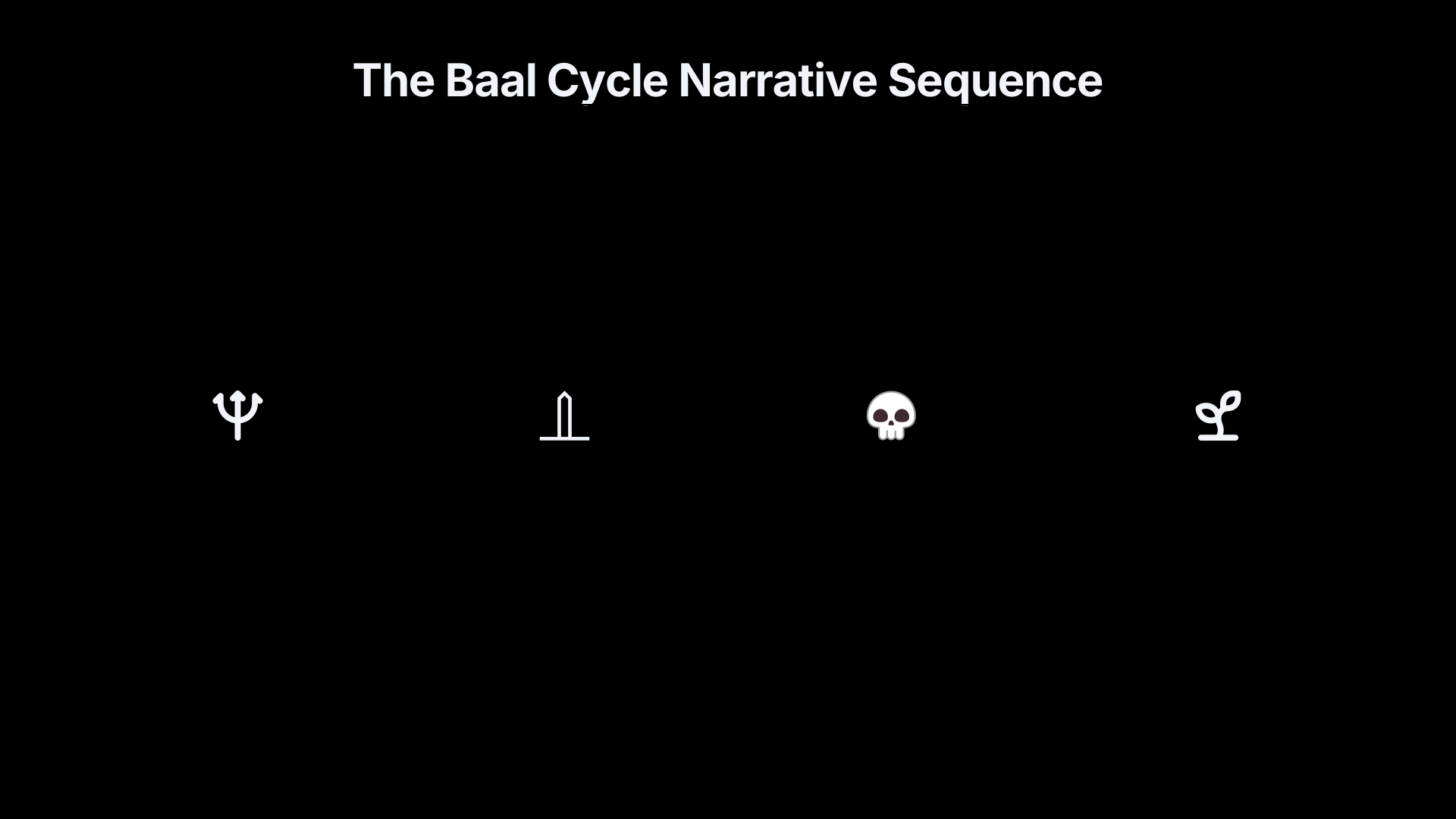
At its simplest, the Baal Cycle tells three connected stories.(#endnote-2 “Endnote 2”)[Wikipedia]WikipediaBaal CycleBaal Cycle
First comes the conflict with the sea. Baal faces a powerful sea deity often identified as Yam. The struggle is not merely a fight between two gods. It represents the confrontation between order and a dangerous, untamed force associated with the sea and chaos. After receiving magical weapons, Baal defeats Yam and establishes his authority.[wikipedia.org]WikipediaBaal CycleBaal Cycle
The second major episode concerns kingship. Having won victory, Baal seeks a proper palace. This may sound like a minor detail to modern readers, but in ancient Near Eastern mythology a palace was a visible sign of legitimate rule. The construction of Baal’s palace confirms his status among the gods and symbolises the establishment of cosmic order.[brill.com]brill.comIntroduction in: Mighty Baal2 Jul 2020 — The cycle describes Baal's victories over the gods Yamm and Mot—Sea and Death—and his const…
The final and most striking section centres on death. Baal encounters Mot, the deity associated with death and the underworld. Unlike the battle with Yam, this conflict cannot be solved through straightforward military victory. Baal disappears into the realm of death, the natural order falters, and the gods mourn. Eventually he returns, restoring balance to the world. The story echoes the annual pattern of drought and renewal familiar to agricultural societies across the eastern Mediterranean.[Wikipedia]WikipediaBaal CycleBaal Cycle
Taken together, these episodes create a narrative about power, legitimacy, mortality and renewal. They explain why storms matter, why drought is frightening and why life repeatedly emerges after apparent collapse.[EBSCO]ebsco.comThe Baal Myth from Ugarit | Religion and PhilosophyThe Baal Myth from Ugarit, also known as the Baal Cycle, is an ancient narrative…

Storms, Sea and Sacred Power
The Baal myths are easiest to understand when viewed through the environmental realities of ancient Syria.
Rainfall in the eastern Mediterranean is seasonal and often unpredictable. A storm god naturally became a symbol of life-giving power. Baal’s control over thunder and rain linked him directly to fertility, crops and prosperity. His victories were therefore not abstract theological events; they reflected concerns that affected farmers, rulers and communities.[EBSCO]ebsco.comThe Baal Myth from Ugarit | Religion and PhilosophyThe Baal Myth from Ugarit, also known as the Baal Cycle, is an ancient narrative…
The sea carried a different symbolic weight. Ugarit was a maritime trading city, dependent on Mediterranean connections yet also vulnerable to the dangers of the sea. In the myths, the sea appears not as a pleasant backdrop but as a force that challenges order and stability. Baal’s victory over Yam can be read as a mythic expression of humanity’s desire to impose structure on unpredictable natural forces.[metmuseum.org]metmuseum.orgThe Metropolitan Museum of Art UgaritThe Metropolitan Museum of ArtUgaritOctober 1, 2004 — 1 Oct 2004 — Ugarit was a flourishing city, its streets lined with two-story houses…
The geography of northern Syria also appears within the tradition. The storm god was closely associated with a prominent mountain known in antiquity as Mount Zaphon, identified with the mountain now called Jebel Aqra near the Syrian-Turkish border. In ancient imagination, this mountain served as a divine dwelling place and cosmic landmark, linking sacred geography directly to mythic authority.[Wikipedia]WikipediaOpen source on wikipedia.org.
These connections between weather, landscape and sacred power help explain why the Baal Cycle feels rooted in a specific place. Although its themes are universal, its imagery belongs unmistakably to the Syrian coast and the wider Levant.[The Metropolitan Museum of Art]metmuseum.orgThe Metropolitan Museum of Art UgaritThe Metropolitan Museum of ArtUgaritOctober 1, 2004 — 1 Oct 2004 — Ugarit was a flourishing city, its streets lined with two-story houses…
How Old Are These Stories?
The surviving tablets date to the Late Bronze Age, roughly between 1400 and 1200 BCE, though the stories themselves may be older than the written versions. They were discovered at Ras Shamra, the site of ancient Ugarit, after excavations began in the 1920s.[ebsco.com]ebsco.comThe Baal Myth from Ugarit | Religion and PhilosophyThe Baal Myth from Ugarit, also known as the Baal Cycle, is an ancient narrative…
The texts were written in Ugaritic, a Northwest Semitic language recorded in a distinctive alphabetic cuneiform script. Their preservation on clay tablets gives scholars unusually direct access to ancient Levantine mythology. Unlike many mythic traditions that survive only through later retellings, the Baal Cycle survives in texts created close to the culture that produced them.[Wikipedia]WikipediaBaal CycleBaal Cycle
This does not mean every detail can be reconstructed with certainty. Some tablets are damaged, and parts of the narrative remain incomplete. Nevertheless, the surviving material is extensive enough to reveal a coherent mythic system and a sophisticated literary tradition.[CDLI]cdli.ox.ac.ukThe Ugaritic Baal Myth, tablet four10 Sept 2013 — The six tablets that comprise the Ugaritic Baal Myth were discovered mostly during…
What Ancient Myth Can and Cannot Prove
The Baal Cycle is often cited in discussions of ancient religion, kingship and the cultural background of the Levant. It unquestionably proves that people living in Bronze Age Syria told elaborate stories about divine conflict, storms, death and cosmic order. It also demonstrates that Ugarit possessed a highly developed literary culture capable of preserving these traditions in written form.[Wikipedia]WikipediaUgaritic textsUgaritic texts
However, the myths cannot be treated as straightforward historical records. They do not provide eyewitness accounts of political events, nor do they offer direct evidence for what every inhabitant of Ugarit believed. Mythological texts reveal symbolic worlds, religious ideals and cultural concerns rather than objective history.[Talking Scripture]ldsscriptureteachings.orgTalking Scripture The Ugaritic Baal Cycle Volume IIIntroductionTalking Scripture The Ugaritic Baal Cycle Volume IIIntroduction
Another common misunderstanding is the assumption that modern Syrians maintain an unbroken folk tradition centred on Baal. The historical reality is far more complex. Over more than three millennia, the region experienced profound cultural, linguistic and religious changes. The Baal Cycle survives primarily through archaeology and scholarship, not through continuous popular worship. Its importance today lies in its value as a record of Syria’s ancient mythic heritage.[The Metropolitan Museum of Art]metmuseum.orgThe Metropolitan Museum of Art UgaritThe Metropolitan Museum of ArtUgaritOctober 1, 2004 — 1 Oct 2004 — Ugarit was a flourishing city, its streets lined with two-story houses…
From Ancient Tablets to Modern Cultural Memory
Despite the enormous historical distance, the Ugaritic storm-god myths continue to attract attention because they preserve questions that remain familiar: How does order emerge from chaos? Why do periods of abundance give way to hardship? Can life overcome death?
For Syria, the myths of Ugarit represent one of the deepest surviving layers of cultural memory. They connect the modern landscape to a Bronze Age world of sacred mountains, thunder gods and cosmic struggles. Whether encountered in museums, archaeological exhibitions, popular histories or discussions of ancient mythology, the Baal Cycle remains one of the most influential mythic legacies ever recovered from Syrian soil.[metmuseum.org]metmuseum.orgThe Metropolitan Museum of Art UgaritThe Metropolitan Museum of ArtUgaritOctober 1, 2004 — 1 Oct 2004 — Ugarit was a flourishing city, its streets lined with two-story houses…
Amazon book picks
Further Reading
Books and field guides related to Why Does Ugarit's Storm God Still Matter?. Use these as the next step if you want deeper reading beyond the article.
The Early History of God
Explains the religious world in which Baal and related Levantine deities were understood.
Myths from Mesopotamia
Provides comparative ancient Near Eastern myths that illuminate Ugaritic traditions.
The Ugaritic Baal Cycle
The Ugaritic Baal Cycle offers a translation and the first commentary on the Ugaritic Baal Cycle. The longest and most important religiou...
Stories from Ancient Canaan, Second Edition
The texts from ancient Ugarit are among the most important modern discoveries for understanding the Bible. For more than thirty years, St...
eBay marketplace picks
Marketplace Samples
Live-tested eBay searches with available results related to this page.
Endnotes
1.
Source: ebsco.com
Link:https://www.ebsco.com/research-starters/religion-and-philosophy/baal-myth-ugarit
Source snippet
The Baal Myth from Ugarit | Religion and PhilosophyThe Baal Myth from Ugarit, also known as the Baal Cycle, is an ancient narrative...
2.
Source: Wikipedia
Title: Baal Cycle
Link:https://en.wikipedia.org/wiki/Baal_Cycle
3.
Source: cdli.ox.ac.uk
Link:https://cdli.ox.ac.uk/wiki/doku.php?id=the_ugaritic_baal_myth
Source snippet
The Ugaritic Baal Myth, tablet four10 Sept 2013 — The six tablets that comprise the Ugaritic Baal Myth were discovered mostly during...
4.
Source: Wikipedia
Title: Ugaritic texts
Link:https://en.wikipedia.org/wiki/Ugaritic_texts
5.
Source: marquette.edu
Link:https://www.marquette.edu/maqom/baalyamm.pdf
Source snippet
Marquette UniversityMyth of Baal and Yammwarrior-goddess Anath came to light in the French excavations of Ras Shamra-Ugarit in the years...
6.
Source: brill.com
Link:https://brill.com/display/book/edcoll/9789004437678/BP000010.xml?language=en&srsltid=AfmBOoptt1gZgEJh2JQFgMbgILr–X_nf82N95FyYrJ1iCqherJGi1IH
Source snippet
Introduction in: Mighty Baal2 Jul 2020 — The cycle describes Baal's victories over the gods Yamm and Mot—Sea and Death—and his const...
7.
Source: Wikipedia
Title: Mot (god)
Link:https://en.wikipedia.org/wiki/Mot_%28god%29
8.
Source: Wikipedia
Link:https://en.wikipedia.org/wiki/Baal-zephon
9.
Source: metmuseum.org
Title: The Metropolitan Museum of Art Ugarit
Link:https://www.metmuseum.org/essays/ugarit
Source snippet
The Metropolitan Museum of ArtUgaritOctober 1, 2004 — 1 Oct 2004 — Ugarit was a flourishing city, its streets lined with two-story houses...
Published: October 1, 2004
10.
Source: sapiru.wordpress.com
Title: The Sapiru Project Baal Cycle Pt.I — Baal vs
Link:https://sapiru.wordpress.com/2024/02/17/baal-cycle-pt-i-baal-vs-yam/
Source snippet
Yam - The Sapiru Project17 Feb 2024 — The first of a series of stories centering on the storm-god Baal, otherwise known as Hadad, describ...
11.
Source: ldsscriptureteachings.org
Title: Talking Scripture The Ugaritic Baal Cycle Volume IIIntroduction
Link:https://www.ldsscriptureteachings.org/wp-content/uploads/2019/12/The-Ugaritic-Baal-Cycle-Volume-II.pdf
Additional References
12.
Source: academia.edu
Link:https://www.academia.edu/50361658/The_Baal_Cycle_as_a_Myth_of_Cosmic_Unification
Source snippet
(PDF) The Baal Cycle as a Myth of Cosmic UnificationThe Baal Cycle illustrates a progression from cosmic strife to reconciliation, emphas...
13.
Source: facebook.com
Link:https://www.facebook.com/groups/661755930543460/posts/26669029659389398/
Source snippet
Discovery of the Baal cycle in Ugarit, SyriaThe Baal and Mot myth (part of the larger Baal Cycle) was discovered in the ancient city of U...
14.
Source: cfmcorner.com
Link:https://www.cfmcorner.com/culture/ancient/canaan/04-ugarit-and-canaanite-religion/
Source snippet
Ugarit & Canaanite ReligionThe most important mythological text from Ugarit is the Baal Cycle — a series of epic poems found on clay tabl...
15.
Source: scribd.com
Link:https://www.scribd.com/document/386020882/29981934-Ugaritic-Religion-and-the-Baal-Cycle-doc
16.
Source: youtube.com
Title: Who Was Baal? (and why he sounds a lot like Yahweh)
Link:https://www.youtube.com/watch?v=0WVKujAa3AU
Source snippet
The Baal Cycle from Ancient Canaanite Mythology...
17.
Source: youtube.com
Title: What Is The Baal Cycle?
Link:https://www.youtube.com/watch?v=qk4OlJHZVms
Source snippet
Who Was Baal? Canaanite God of Storms to Devil...
18.
Source: youtube.com
Title: Ba’al with “Lightning”
Link:https://www.youtube.com/watch?v=YNoaAQNZjQU
Source snippet
What Is The Baal Cycle? - Archaeology Quest...
19.
Source: youtube.com
Title: The Baal Cycle from Ancient Canaanite Mythology
Link:https://www.youtube.com/watch?v=XqE08Cpb0s0
Source snippet
Ba'al with "Lightning"...
20.
Source: youtube.com
Title: Who Was Baal? Canaanite God of Storms to Devil
Link:https://www.youtube.com/watch?v=srp_D29PWxU
Topic Tree