Where Guinea's Legends Still Speak
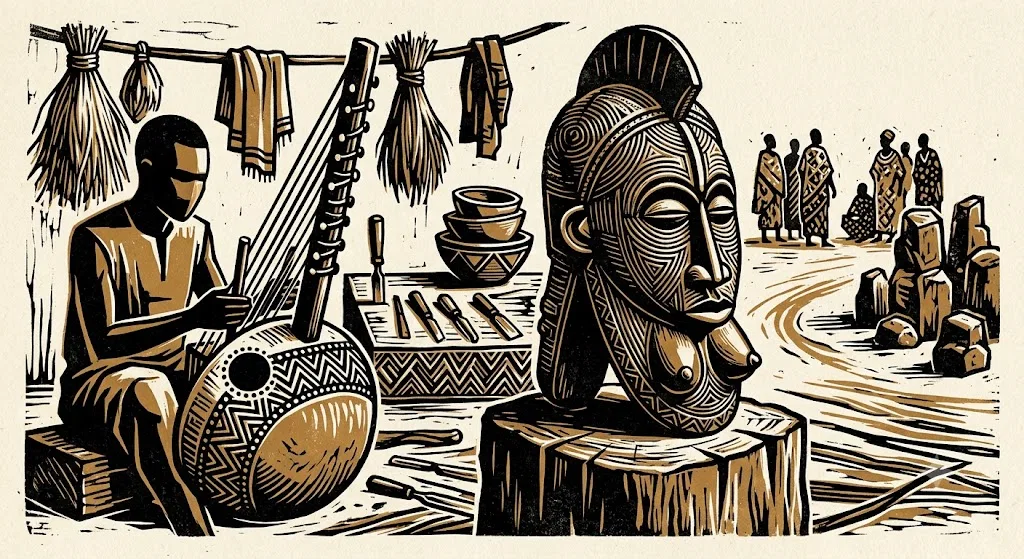
Guinea’s folklore is not a single national mythology with one neat cast of gods and monsters. It is a living patchwork of oral epics, masked performances, ancestral objects, sacred landscapes, initiation memories, Islamic learning, forest-region ritual knowledge and modern stage culture.
Page outline Jump by section
Introduction
The result is unusually rich but also easy to misunderstand. Some museum labels call a figure a “fertility mask”; some tourist accounts call it a spirit; some academic sources stress that the same object may now be danced for entertainment rather than ritual. In Guinea, folklore often survives not as a fixed script but as performance, memory, family authority, village secrecy, public art and carefully negotiated revival.
Why Guinean folklore is so varied
Guinea sits at a crossroads of West African cultural zones. Upper Guinea connects strongly with Mande history and the great heroic traditions of the Mali Empire. The Fouta Djallon highlands are associated with Fulani settlement and Islamic scholarship. The Atlantic coast includes Baga, Nalu and related communities whose masks and sculptural traditions became famous in world museums. The Forest Region links Guinea to Liberia, Sierra Leone and Côte d’Ivoire through Kissi, Loma, Kpelle and related traditions.
That diversity matters because many stories, beings and ceremonies are not “national” in the modern sense. A tale may belong to a family of performers; a mask may be specific to a coastal community; an initiation practice may be shared across today’s borders; a heroic epic may circulate across Guinea, Mali, Senegal, The Gambia and beyond. The modern state of Guinea gives the page its frame, but the traditions themselves often follow rivers, trade routes, languages, kinship lines and ritual networks rather than borders.
Religion also complicates the picture. Guinea is overwhelmingly Muslim, with Christian and smaller indigenous religious communities also present, yet older practices have not simply disappeared. The World Factbook-derived country profile lists Islam as the majority religion and French as the official language, while also noting Pular, Maninka, Susu and many other native languages.[OpenFactBook]openfactbook.orgOpen Fact Book GuineaOpen Fact Book Guinea In practice, folklore may appear in praise poetry, naming ceremonies, divination, agricultural festivals, hunters’ knowledge, children’s tales, proverbs, music, masked dance or the way a community speaks about ancestors and place.
The great oral epic: Sundiata and the Mande memory world
For many readers, the best-known legendary tradition connected with Guinea is the Sundiata epic. It tells of Sundiata Keita, the founder of the thirteenth-century Mali Empire, but it is not just a historical biography. It is a heroic oral epic: a story of exile, destiny, family rivalry, political alliance, supernatural power and the founding of a great order. Its world extends beyond modern Guinea, but Guinea is central to its modern documentation and performance history.
The epic’s original form is oral poetry performed by professional bards often known in English as griots. UC Berkeley’s ORIAS teaching resource describes Sundiata as an oral epic celebrating the founder of the thirteenth-century Mali Empire and notes that written versions exist, but the original form is performance by a trained bard. It also points out that the story is found across the Mandingo language group, including Guinea.[orias.berkeley.edu]orias.berkeley.eduSundiata | ORIASSundiata | ORIAS The Metropolitan Museum of Art gives a clear mainstream explanation of the wider role of griots in the western Sahel: they are storytellers, poets, historians, genealogists and musicians who transmit legendary tales through speech, song and instruments such as the kora and balafon.[The Metropolitan Museum of Art]metmuseum.orgOpen source on metmuseum.org.
Guinea’s link is not only geographical. Djibril Tamsir Niane, the Guinean historian and writer whose published version made the epic widely known to modern readers, recorded a version from the jeli Mamoudou Kouyaté of Djelibakoro, Guinea, in 1958. A published checklist of Sunjata versions also lists several other Guinea-based recordings and performers, including material from Kankan, Kouroussa, Siguiri and Conakry.[verbafricana.org]verbafricana.orgOpen source on verbafricana.org.
The important point for folklore readers is that Sundiata is both history and legend. It preserves memories of political formation in medieval West Africa, but it also works like myth: mothers carry destiny, praise names matter, disability and strength are transformed, and power must be legitimated through ancestry, speech and public memory. There is no single “correct” village version. The tradition lives because performers adapt emphasis, detail and praise to audiences, patrons and historical moments.
Baga and Nalu masquerades: when a “mask” is more than a face
The most internationally recognisable Guinean folklore objects are the great Baga headdresses often called D’mba, Nimba or Yamban. They are commonly described as masks, but they are not face masks in the ordinary sense. They are large wooden shoulder headdresses worn with raffia and cloth, turning the performer into a moving sculptural presence.
The Metropolitan Museum of Art dates one D’mba headdress to the late nineteenth to first half of the twentieth century and describes it as a colossal wooden form, nearly four feet high, known among the Baga peoples of the Guinea coast. Its pendant breasts are interpreted as a sign of motherhood, while its hairstyle recalls Fulbe styles associated with the Fouta Djallon, where Baga ancestors were believed to have lived.[The Metropolitan Museum of Art]metmuseum.orgThe Metropolitan Museum of Art Baga artistThe Metropolitan Museum of Art Baga artist This detail is especially valuable because it shows how one object can hold a migration memory, an aesthetic ideal and a ritual performance all at once.
A common misunderstanding is to call D’mba simply a goddess or spirit. The Met’s own explanation is more careful: D’mba is not a spirit or deity in the Baga sense, but an “idea” or abstraction of the ideal female role, honoured as a universal mother and as a being of spiritual power. The same source notes that in the past D’mba was performed before rainy seasons and at marriages, funerals and visits by honoured guests, while contemporary performances are rarely seen.[The Metropolitan Museum of Art]metmuseum.orgThe Metropolitan Museum of Art Baga artistThe Metropolitan Museum of Art Baga artist The Baltimore Museum of Art similarly describes D’mba as neither spirit nor deity, but as a symbol of community identity created to honour women, inspire girls and express the belief that Baga culture was sustained by mothers.[ArtBMA]artbma.orgArt BMAAfrican ArtArt BMAAfrican Art
Other coastal masquerades are more explicitly supernatural. The Brooklyn Museum identifies Banda as a masked supernatural being among Baga and Nalu people along Guinea’s coastal regions. The mask combines animal forms, including crocodile, chameleon and antelope, understood in the museum account as mythical ancestors within Baga spirituality. The same label adds an important modern shift: as Nalu and Baga communities have more recently converted to Islam, such masks may now be danced for entertainment rather than spiritual purposes.[Brooklyn Museum]brooklynmuseum.orgBrooklyn Museum Banda Mask · Brooklyn MuseumBrooklyn Museum Banda Mask · Brooklyn Museum
That contrast makes Guinea’s mask traditions especially interesting. They are not just “old beliefs preserved in wood”. They are social negotiations: between secrecy and display, Islam and older ritual systems, village authority and museum collection, local meaning and global art markets.
Ancestors in stone: Kissi pomtan and the mystery of older figures
In Guinea’s forest and border regions, folklore is often tied to the dead, to the land and to objects found rather than newly made. One of the most striking examples is the tradition of stone figures known among the Kissi as pomtan. These figures are part of a broader Upper Guinea Coast phenomenon, extending into Sierra Leone and Liberia, where carved stone figures were found in fields, streams or old sites and later reinterpreted by the communities who discovered them.
The Metropolitan Museum of Art explains that among the Kissi, such figures were identified through divination as specific ancestors and kept in family shrines as intermediaries between the living and the dead. Some examples with metal additions may have been used in oath-taking ceremonies, where the object served as a witness to binding agreements. The Met also stresses a key scholarly caution: the names now used for these figures reflect the cultural lens of the people who found and reinterpreted them, not necessarily the names or intentions of their original makers.[The Metropolitan Museum of Art]metmuseum.orgThe Metropolitan Museum of Art Nomoli and Pomdo Stone Figures of Upper GuineaThe Metropolitan Museum of Art Nomoli and Pomdo Stone Figures of Upper Guinea
That makes the pomtan tradition a good example of folklore as reinterpretation. The story is not simply “the Kissi made ancestor stones”. It is more intriguing: older stone figures, possibly made by earlier peoples or under earlier ritual systems, entered later Kissi family and ritual life as ancestors, witnesses and mediators. Their power came partly from uncertainty. They belonged to the land before the present family, yet they could become part of family memory.
For readers used to written mythologies, this may feel unusual. But in many oral cultures, an object’s authority does not depend on a written origin story. It may depend on where it was found, who recognised it, what a diviner said, what family kept it, and what happened when people swore or sacrificed before it.
Forest knowledge, initiation and the hidden side of tradition
Some of Guinea’s most important folklore cannot be fully described in public sources because it belongs to initiation societies, secret knowledge or restricted community memory. This is particularly true for parts of the coastal and forest regions. Masks, forest spirits, ancestral authority and initiation may appear in museum labels, but the deeper ritual grammar was often kept from outsiders and sometimes from uninitiated members of the community itself.
The difficulty is historical as well as ethical. In the decades after independence, Guinea’s first president, Sékou Touré, promoted a modernising and often anti-“mystification” cultural policy. Anthropologist Ramon Sarró, writing on Baga heritage after socialism, describes Baga territory as having been more thoroughly “demystified” than other parts of Guinea. In his fieldwork, dances and masquerades were often promised but rarely performed, and Baga interviewees sometimes explained that people preferred schooling to bush initiation, which they associated with a past from which modern citizens should free themselves.[Lisbon Tech Institute]ics.ulisboa.ptLisbon Tech Institute
Sarró also notes a generational rupture: Baga initiations had ceased in the late 1950s, while Kissi and Loma communities were sometimes able to continue initiations across borders in Liberia or Sierra Leone. This left a divide between elders initiated before independence and younger people who were not.[Lisbon Tech Institute]ics.ulisboa.ptLisbon Tech Institute For folklore, that matters enormously. A tradition can survive in museum collections, photographs and memory while becoming difficult to perform locally because the chain of initiation has been interrupted.
This is why claims about “ancient Guinean secret societies” need care. Some traditions are old and well attested; others were damaged, hidden, reworked or revived; still others survive more as staged heritage, family memory or diaspora art than as continuous village ritual.
Sacred landscapes and places of power
Guinea’s folklore is also attached to landscape: mountains, rivers, forests, old settlement zones and coastal rice lands. Mount Nimba, on Guinea’s south-eastern borderlands with Côte d’Ivoire and Liberia, is best known internationally as a UNESCO World Heritage natural site rather than a folklore site. UNESCO describes it as a rare West African mountain chain rising to 1,752 metres, with montane forest, exceptional biodiversity and species such as the Mount Nimba viviparous toad, the Mount Nimba otter shrew and tool-using chimpanzees.[UNESCO World Heritage Centre]whc.unesco.orgWorld Heritage Centre Mount Nimba Strict Nature ReserveWorld Heritage Centre Mount Nimba Strict Nature Reserve
Although UNESCO’s listing is ecological, its importance helps explain why mountains and forests in Guinea can carry more than scenic value. In regional belief systems, forests are often places of initiation, danger, medicine, ancestral encounter and spirit presence. This is not a licence to invent specific legends for Mount Nimba where sources do not support them. Rather, it shows how a landscape that outsiders classify as biodiversity can also sit within local worlds of taboo, memory and respect.
The same applies to the Fouta Djallon. For folkloric interpretation, it matters not only as highland geography but as a source of migration memory. The D’mba headdress’s Fulbe-style coiffure, interpreted by the Met as a reminder of Baga origins in the Fouta Djallon, is a concrete example of landscape remembered through art.[The Metropolitan Museum of Art]metmuseum.orgThe Metropolitan Museum of Art Baga artistThe Metropolitan Museum of Art Baga artist
From village tradition to national stage
Modern Guinea did not merely inherit folklore; it actively staged and reshaped it. Les Ballets Africains, now presented on its official site as the National Dance Company of the Republic of Guinea and sanctioned by the Ministry of Culture, Tourism and Arts, is central to this story.[LesBalletsAfricains]lesballetsafricains.orgLes Ballets Africains Home | Les Ballets AfricainsLes Ballets Africains Home | Les Ballets Africains
The company’s history shows how local performance became national culture and international spectacle. Scholar Joshua Cohen describes Les Ballets Africains as the first globally touring African performance company, debuting in the United States as a private Paris-based troupe in 1959 and touring again in 1960 as the National Ballet of newly independent Guinea.[Sage Journals]journals.sagepub.comSage Journals Stages in TransitionSage Journals Stages in Transition This shift matters because stage performance changes folklore. A dance once tied to a particular village, initiation or seasonal occasion may be rearranged for theatre, diplomacy, national pride and foreign audiences.
Guinea’s state also invested heavily in music after independence. A University of Melbourne account of the Guinean music archive explains that Sékou Touré tried to build national unity through culture, disbanding private music groups, banning Western music on radio, creating state-sponsored orchestras and encouraging musicians to modernise traditional styles. It also notes that more than 9,000 songs from Guinea’s endangered sound archive were later preserved and made publicly available through the British Library’s Endangered Archives Programme.[Pursuit]pursuit.unimelb.edu.auOpen source on edu.au.
This creates one of the central tensions in Guinean folklore today. The stage helped preserve and publicise traditions, but it also selected, polished and nationalised them. What audiences see in a theatre may be rooted in village performance, yet it is not the same thing as a local ritual with its full social setting, restrictions and spiritual meaning.
What is old, what is revived, and what is modern invention?
Guinean folklore is best read with three questions in mind: who is telling the story, where is it being performed, and what kind of evidence supports it?
Some traditions are strongly attested in oral epic, archival recordings and scholarship. The Sundiata epic, for example, has many documented performances and versions, including Guinea-based recordings and Niane’s influential 1958 recording from Mamoudou Kouyaté.[verbafricana.org]verbafricana.orgOpen source on verbafricana.org. Other traditions are well represented in museum collections, such as D’mba and Banda, but their living ritual contexts may have changed substantially.[The Metropolitan Museum of Art]metmuseum.orgThe Metropolitan Museum of Art Baga artistThe Metropolitan Museum of Art Baga artist Still others are known through family practice, initiation memory or local explanation, which may be difficult for outsiders to verify without reducing the tradition to a museum label.
There is also a difference between “supernatural belief” and “symbolic performance”. D’mba is the clearest example: it is often popularly framed as a fertility mother or spirit, but stronger museum scholarship describes it as an idealised maternal presence with spiritual power rather than a deity or spirit in the narrow sense.[The Metropolitan Museum of Art]metmuseum.orgThe Metropolitan Museum of Art Baga artistThe Metropolitan Museum of Art Baga artist Banda, by contrast, is explicitly described by the Brooklyn Museum as a masked supernatural being.[Brooklyn Museum]brooklynmuseum.orgBrooklyn Museum Banda Mask · Brooklyn MuseumBrooklyn Museum Banda Mask · Brooklyn Museum
Modern internet folklore can blur these distinctions. Short posts may flatten Guinea into generic “African mythology”, attach unsourced monster stories to famous masks, or treat every ritual object as a god. A better reading keeps the local names, communities and contexts attached: Baga and Nalu coastal masquerade, Kissi ancestral stones, Mande oral epic, Loma and forest-region initiation, national ballet adaptation.
Why Guinea matters in West African folklore
Guinea matters because it shows folklore in motion. Its traditions are not only old tales preserved from the past; they are performed, interrupted, revived, collected, staged, archived and debated. A Guinean epic can move from a jeli’s performance to a school text. A coastal headdress can move from rainy-season ceremony to a museum gallery. A stone figure can move from an unknown earlier setting into a Kissi family shrine. A village dance can become national theatre. A government archive can decay, then be digitised and heard again.
That movement does not make the traditions less authentic. It makes them historically alive. Folklore in Guinea is a way of remembering origins, honouring mothers, negotiating Islam and older ritual systems, speaking with ancestors, training specialists, performing identity and turning local culture into national art. Its most important figures are not always “monsters” or “gods” in the familiar fantasy sense. They are mothers, ancestors, praise-singers, hunters, initiates, masks, stones, mountains and performers — the human and more-than-human presences through which communities explain where they came from and how they continue.

eBay marketplace picks
Marketplace Samples
Live-tested eBay searches with available results related to this page.

Endnotes
1.
Source: openfactbook.org
Title: Open Fact Book Guinea
Link:https://openfactbook.org/countries/guinea/
2.
Source: orias.berkeley.edu
Title: Sundiata | ORIAS
Link:https://orias.berkeley.edu/resources-teachers/monomyth-heros-journey-project/sundiata
3.
Source: verbafricana.org
Link:https://verbafricana.org/malinke-fr/griots/Bulman.pdf
4.
Source: artbma.org
Title: Art BMAAfrican Art
Link:https://artbma.org/digital-guide/african-art/?stop=14
5.
Source: ics.ulisboa.pt
Title: Lisbon Tech Institute
Link:https://www.ics.ulisboa.pt/file/4694/download?token=VjmhNLri
6.
Source: whc.unesco.org
Title: World Heritage Centre Mount Nimba Strict Nature Reserve
Link:https://whc.unesco.org/en/list/155/
7.
Source: lesballetsafricains.org
Title: Les Ballets Africains Home | Les Ballets Africains
Link:https://www.lesballetsafricains.org/
8.
Source: pursuit.unimelb.edu.au
Link:https://pursuit.unimelb.edu.au/articles/saving-the-endangered-sounds-of-west-africa
9.
Source: ich.unesco.org
Title: oral heritage of gelede 00002
Link:https://ich.unesco.org/en/RL/oral-heritage-of-gelede-00002
10.
Source: ich.unesco.org
Link:https://ich.unesco.org/en/lists
11.
Source: ich.unesco.org
Title: 00010 EN
Link:https://ich.unesco.org/doc/src/00010-EN.pdf
12.
Source: ich.unesco.org
Title: oral traditions and expressions 00053
Link:https://ich.unesco.org/en/oral-traditions-and-expressions-00053
13.
Source: ich.unesco.org
Title: 00264 EN
Link:https://ich.unesco.org/doc/src/00264-EN.pdf
14.
Source: ich.unesco.org
Title: 01857 EN
Link:https://ich.unesco.org/doc/src/01857-EN.pdf
15.
Source: ich.unesco.org
Link:https://ich.unesco.org/en/USL/mapoyo-oral-tradition-and-its-symbolic-reference-points-within-their-ancestral-territory-00983
16.
Source: ich.unesco.org
Title: ITH 15 10.CO M 6.a EN.docx
Link:https://ich.unesco.org/doc/src/ITH-15-10.COM-6.a_EN.docx?t=1446461031
17.
Source: ich.unesco.org
Title: sanke mon collective fishing rite of the sanke 00289
Link:https://ich.unesco.org/en/USL/sanke-mon-collective-fishing-rite-of-the-sanke-00289
18.
Source: ich.unesco.org
Title: coming forth of the masks and puppets in markala 01004
Link:https://ich.unesco.org/en/RL/coming-forth-of-the-masks-and-puppets-in-markala-01004
19.
Source: ich.unesco.org
Link:https://ich.unesco.org/
20.
Source: ich.unesco.org
Link:https://ich.unesco.org/en/news/thirty-three-elements-inscribed-on-the-representative-list-of-the-intangible-cultural-heritage-of-humanity-00270
21.
Source: ich.unesco.org
Title: LHE 25 20.CO M 4 EN.docx
Link:https://ich.unesco.org/doc/src/LHE-25-20.COM-4_EN.docx
22.
Source: ich.unesco.org
Link:https://ich.unesco.org/es/00875
23.
Source: 2009-2017.state.gov
Link:https://2009-2017.state.gov/outofdate/bgn/guinea/128579.htm
24.
Source: folklore.earth
Link:https://www.folklore.earth/culture/maninka/
25.
Source: archive.org
Link:https://archive.org/details/sundiataepicofol0000nian
26.
Source: metmuseum.org
Link:https://www.metmuseum.org/perspectives/sahel-sunjata-stories-songs
27.
Source: metmuseum.org
Title: The Metropolitan Museum of Art Baga artist
Link:https://www.metmuseum.org/art/collection/search/312189
28.
Source: brooklynmuseum.org
Title: Brooklyn Museum Banda Mask · Brooklyn Museum
Link:https://www.brooklynmuseum.org/objects/2984
29.
Source: metmuseum.org
Title: The Metropolitan Museum of Art Nomoli and Pomdo Stone Figures of Upper Guinea
Link:https://www.metmuseum.org/essays/nomoli-pomdo-stone-figures
30.
Source: journals.sagepub.com
Title: Sage Journals Stages in Transition
Link:https://journals.sagepub.com/doi/10.1177/0021934711426628
31.
Source: facebook.com
Link:https://www.facebook.com/groups/1195271791129874/posts/1321617725161946/
32.
Source: ebsco.com
Link:https://www.ebsco.com/research-starters/biography/sundiata
33.
Source: sk.sagepub.com
Link:https://sk.sagepub.com/ency/edvol/africanreligion/chpt/baga
34.
Source: sk.sagepub.com
Title: africa west guinea
Link:https://sk.sagepub.com/ency/edvol/the-sage-international-encyclopedia-of-music-and-culture/chpt/africa-west-guinea
35.
Source: ics.ulisboa.pt
Link:https://www.ics.ulisboa.pt/file/4693/download?token=UVKbSHOc
36.
Source: geofactbook.com
Link:https://geofactbook.com/countries/guinea
37.
Source: Wikipedia
Title: Sundiata Keita
Link:https://en.wikipedia.org/wiki/Sundiata_Keita
38.
Source: Wikipedia
Link:https://en.wikipedia.org/wiki/Guinea
39.
Source: Wikipedia
Title: Les Ballets Africains
Link:https://en.wikipedia.org/wiki/Les_Ballets_Africains
40.
Source: zyama.com
Link:https://www.zyama.com/Collection/pics%20A-C.htm
41.
Source: beingafrican.org
Link:https://beingafrican.org/guinea/
42.
Source: michaelpluznick.com
Title: les ballets africains
Link:https://michaelpluznick.com/les-ballets-africains/
43.
Source: books.google.com
Link:https://books.google.com/books/about/Sundiata.html?id=6fMuAQAAIAAJ
44.
Source: gardearts.org
Title: les ballets africains st
Link:https://gardearts.org/events/les-ballets-africains-st/
45.
Source: imj.org.il
Link:https://www.imj.org.il/en/content/nimba
46.
Source: youtube.com
Title: Sundiata Keita
Link:https://www.youtube.com/watch?v=2Yc2s8ytbRc
47.
Source: agentsoftransition.wordpress.com
Link:https://agentsoftransition.wordpress.com/baga/
48.
Source: forms.hungwetravel.com
Link:https://forms.hungwetravel.com/guinea
49.
Source: un.org
Link:https://www.un.org/ungifts/nimba
50.
Source: archives.yale.edu
Link:https://archives.yale.edu/repositories/12/resources/4877
Additional References
51.
Source: youtube.com
Title: The Ndimba mask: the new cultural symbol sweeping Guinea
Link:https://www.youtube.com/watch?v=pts2AhL18BQ
Source snippet
The Heavy Truth Behind the African Fertility Mask...
52.
Source: youtube.com
Title: The History of Fouta Djallon: Every Year/Month
Link:https://www.youtube.com/watch?v=H_fkZOWi1wk
Source snippet
The Ndimba mask: the new cultural symbol sweeping Guinea...
53.
Source: facebook.com
Link:https://www.facebook.com/Llntv/posts/discover-the-untold-story-of-the-kissi-tribe-the-heart-of-sierra-leone-guinea-an/1297088582418206/
54.
Source: academia.edu
Link:https://www.academia.edu/8603964/Art_of_the_Baga_A_Drama_of_Cultural_Reinvention
55.
Source: academia.edu
Link:https://www.academia.edu/8249447/the_donzo_hunters
56.
Source: researchgate.net
Link:https://www.researchgate.net/publication/387183085_Chapter_4_The_Manden_Charter_Initiatic_oral_sources_at_the_foundation_of_an_endogenous_governance
57.
Source: academia.edu
Link:https://www.academia.edu/104327056/Two_stone_statues_from_the_Upper_Guinea_Coast_in_the_Africa_Collection_of_the_Museum_of_Ethnography_in_Budapest
58.
Source: researchgate.net
Link:https://www.researchgate.net/publication/291217066_Trickster_and_hero_Two_characters_in_the_oral_and_written_traditions_of_the_world
59.
Source: facebook.com
Link:https://www.facebook.com/ohafrikans/posts/a-story-behind-a-maskthe-yacouba-is-a-group-of-people-who-live-in-the-ivory-coas/488862073266457/
60.
Source: scribd.com
Link:https://www.scribd.com/document/415036135/Factor-Completely
Topic Tree
Follow this branch
Related pages 192
- Afghan Folklore
- Albanian Folklore
- Algerian Folklore
- Australian Folklore
- Azerbaijan Folklore
- +187 more in sidebar