Within Cuban Folklore
What Lives in Cuba's Old Waters?
Güijes and the Mother of Waters turn rivers, pools and wells into places of danger, warning and local memory.
On this page
- Güijes in rivers, pools and wells
- The Mother of Waters as serpent and guardian
- What water legends warned people about
Page outline Jump by section
Introduction
Water is one of the most important settings in Cuban folklore. Rivers, ponds, wells, marshes and hidden pools are not simply parts of the landscape; they are places where stories place supernatural beings, unexplained dangers and memories of the past. Two figures dominate these traditions: the güije, a mysterious water-dweller associated with rivers and pools, and the Mother of Waters, a gigantic serpent believed to guard sources of fresh water. Together they form one of the clearest examples of how Cuban folklore turns ordinary rural environments into places of caution, wonder and fear. These legends are not merely monster stories. They helped explain accidents, warned children away from dangerous water, and connected communities to particular rivers, wells and isolated countryside locations.[wikipedia.org]WikipediaOpen source on wikipedia.org.

What Lives in Cuba’s Old Waters?
Many Cuban folk traditions describe fresh water as inhabited rather than empty. Unlike sea legends centred on sailors and storms, these stories belong mainly to the countryside. They emerge from farming communities, river crossings, night journeys and places where children played beyond the sight of adults.
Folklore collectors such as Samuel Feijóo identified the güije and the Mother of Waters among the most important mythic beings in Cuban popular tradition. Their continued presence in oral storytelling suggests that water was viewed as both life-giving and potentially dangerous. A river could provide drinking water and fish, yet it could also flood, conceal deep currents or become deadly after dark. Legends transformed those risks into memorable narratives.[laotraraiz.cu]laotraraiz.cuCagüeiro: Decoding the Myth – The Other RootLa otra raíz19 Aug 2023 — In Cuba, it evidences the aboriginal cultural legacy in myths that are among the most widespread on the island…
The stories also reveal the layered origins of Cuban culture. Researchers frequently note Indigenous, African and later rural Cuban influences within these traditions. Rather than belonging to a single mythology, the water spirits reflect centuries of cultural mixing on the island.[laotraraiz.cu]laotraraiz.cuCagüeiro: Decoding the Myth – The Other RootLa otra raíz19 Aug 2023 — In Cuba, it evidences the aboriginal cultural legacy in myths that are among the most widespread on the island…
Güijes in Rivers, Pools and Wells
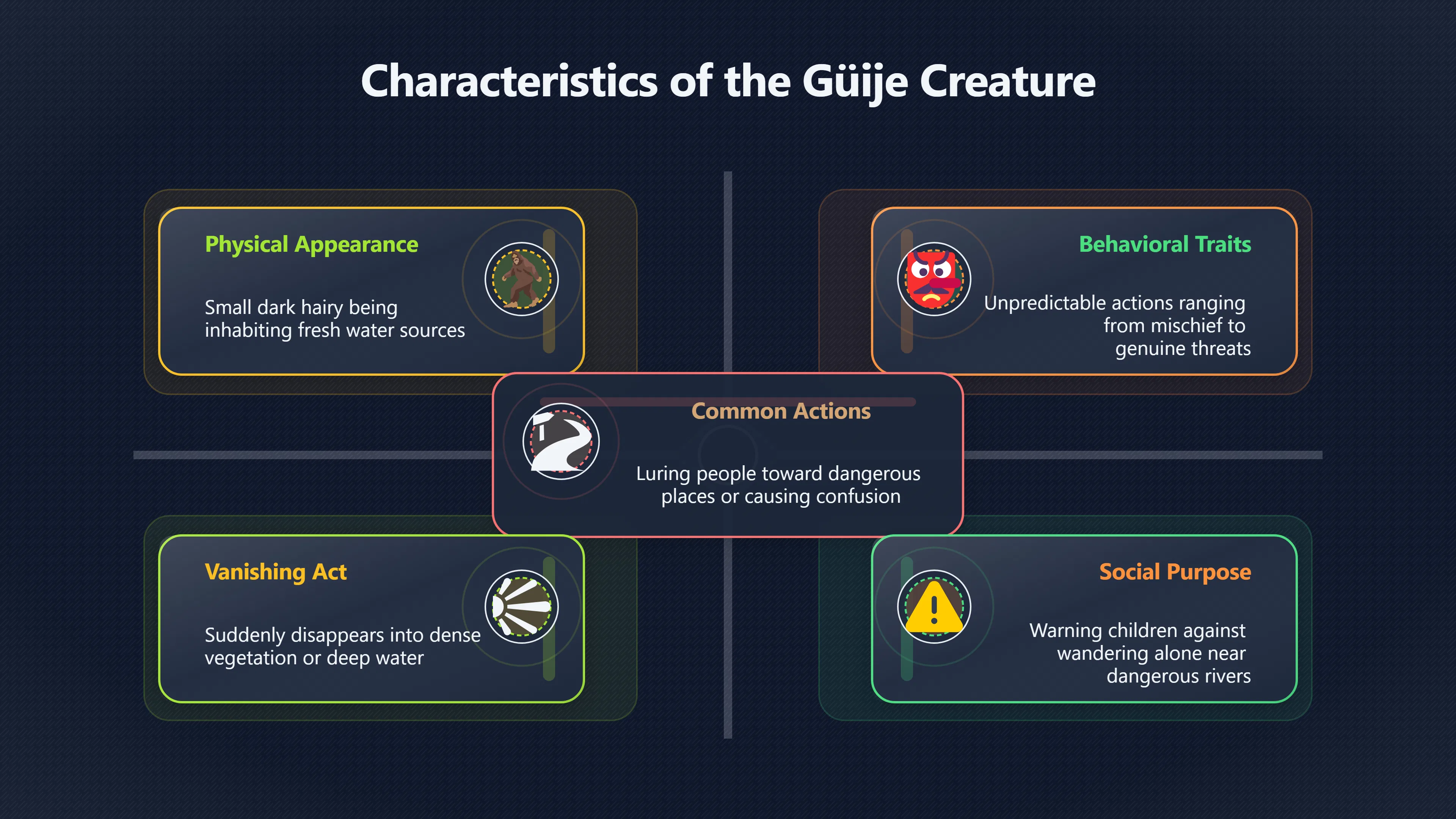
The güije is one of the most recognisable creatures in Cuban folklore. Descriptions vary from region to region, but it is commonly portrayed as a small, dark, hairy being living near fresh water. It appears in rivers, ponds, pools, springs and wells, especially in secluded places surrounded by vegetation.[Wikipedia]WikipediaOpen source on wikipedia.org.
Unlike a straightforward monster, the güije is usually portrayed as unpredictable. Some stories describe it as mischievous, while others make it genuinely threatening. Common themes include:
- Appearing near isolated water after sunset.
- Frightening travellers or children.
- Luring people toward dangerous places.
- Playing tricks that cause confusion or fear.
- Vanishing suddenly into water or vegetation.[Wikipedia]WikipediaOpen source on wikipedia.org.
One reason the figure endured is that it served a practical social purpose. Many versions of the legend were told to children as warnings against wandering alone near rivers or ponds, especially at night. In a rural landscape where drowning was a real risk, a frightening supernatural explanation could be more effective than a simple safety lecture.[The Rocket Star]therocketstar.orgThe Rocket Star El GüijeThe Rocket StarEl Güije - The Rocket StarEl Güije is a popular mythical creature in Cuban folklore. El Güije is a fascinating folklore of…
The Yayabo River Tradition
Some of the best-known local traditions place güijes in the area around the Yayabo River in Sancti Spíritus. Folklore accounts from the region describe the creature inhabiting nearby pools and watercourses, making the river not only a physical landmark but also a supernatural one. The persistence of these stories shows how Cuban folklore often becomes attached to specific places rather than existing only as abstract tales.[Trip Cuba]tripcuba.orgTrip Cuba Bridge of the Yayabo River, Sancti SpíritusTrip CubaBridge of the Yayabo River, Sancti Spíritus - CubaFebruary 5, 2016 — There is a myth about it construction which tells that it w…
In such traditions, a river is remembered through both geography and story. The landscape itself becomes part of local identity because people associate particular bends, pools or crossings with encounters reported by earlier generations.
The Mother of Waters as Serpent and Guardian
If the güije is small and elusive, the Mother of Waters is vast and imposing. Cuban tradition usually imagines this being as an enormous serpent, often described as a giant boa-like creature inhabiting rivers, lagoons and other freshwater locations. Some versions add horn-like projections and scales so strong that ordinary weapons cannot harm it.[Wikipedia]WikipediaMadre de aguasMadre de aguas
The Mother of Waters occupies an unusual place in folklore because it is both feared and respected. According to traditional belief, the waters inhabited by the creature never dry up. The serpent therefore acts as a guardian of freshwater sources even while remaining potentially dangerous. Anyone attempting to kill or capture it is often said to suffer misfortune or death.[Wikipedia]WikipediaMadre de aguasMadre de aguas
This dual role reflects a common pattern in traditional water folklore around the world. Water sustains life, but it also demands respect. In Cuban stories, the Mother of Waters embodies that idea in a single creature: protector, owner and potential punisher.
A Landscape Spirit Rather Than a Monster
Many retellings focus less on attacks and more on the serpent’s connection to place. The creature is often linked to specific rivers, ponds or hidden pools. Local people might claim that an unusually deep body of water, a spring that never dries out, or mysterious marks in the earth are evidence of its presence.[Wikipedia]WikipediaMogotes de JumaguaMogotes de Jumagua
Such stories helped explain natural features that seemed remarkable or difficult to understand. A permanent spring during drought conditions, for example, could become associated with the continued presence of the guardian serpent.
What Water Legends Warned People About
Although these stories are supernatural, their warnings are often practical.
The most obvious concern is drowning. Rivers and ponds can appear calm while hiding strong currents, sudden depth changes or submerged obstacles. A tale about a güije pulling people toward the water turns a physical hazard into a memorable lesson.[The Rocket Star]therocketstar.orgThe Rocket Star El GüijeThe Rocket StarEl Güije - The Rocket StarEl Güije is a popular mythical creature in Cuban folklore. El Güije is a fascinating folklore of…
The stories also caution against:
- Travelling alone at night.
- Entering unfamiliar pools or wells.
- Ignoring local knowledge about dangerous places.
- Disrespecting natural resources.
- Venturing too far from the community.[Wikipedia]WikipediaOpen source on wikipedia.org.
In this sense, rural fear was not simply fear of monsters. It was fear of isolation, darkness, wilderness and water itself. Folklore gave those anxieties a face and a story.
Indigenous Memory and Blended Traditions
Modern researchers often note that Cuban water legends preserve traces of older Indigenous Caribbean ideas about sacred waters. The Taíno ancestral spirit Atabey was associated with fresh water, fertility and life-giving waters throughout the Greater Antilles, including Cuba. While the Mother of Waters is not identical to Atabey, both traditions show the enduring importance of freshwater landscapes within Caribbean belief systems.[Wikipedia]WikipediaAtabey (goddessAtabey (goddess
At the same time, scholars emphasise that Cuban folklore is the product of cultural blending. The güije, in particular, has often been interpreted as a figure transformed through interaction between Indigenous traditions, African influences and later rural storytelling. Rather than belonging to one cultural source alone, the creature reflects centuries of adaptation and reinterpretation.[laotraraiz.cu]laotraraiz.cuCagüeiro: Decoding the Myth – The Other RootLa otra raíz19 Aug 2023 — In Cuba, it evidences the aboriginal cultural legacy in myths that are among the most widespread on the island…
This layered history helps explain why the stories remain distinctive. They are not simply imported legends nor direct survivals from a single past. They are specifically Cuban creations shaped by the island’s cultural history.
Why These Water Spirits Still Matter
The güije and the Mother of Waters continue to appear in Cuban literature, art, children’s stories and discussions of traditional culture. Their survival demonstrates the enduring power of local landscapes in folklore. A river, pond or well becomes more than geography when generations attach stories to it.[Wikipedia]WikipediaOpen source on wikipedia.org.
Today most Cubans do not treat these beings as literal creatures lurking in every stream. Yet the legends remain meaningful because they preserve older relationships with the countryside. They recall a time when rivers were crossed on foot, wells were community resources, and darkness beyond the village boundary felt genuinely uncertain.
The old waters of Cuba therefore remain populated not by proven supernatural beings, but by stories. Those stories continue to connect natural places with memory, caution and imagination, ensuring that the güije and the Mother of Waters remain among the most enduring figures in Cuban folklore.[laotraraiz.cu]laotraraiz.cuCagüeiro: Decoding the Myth – The Other RootLa otra raíz19 Aug 2023 — In Cuba, it evidences the aboriginal cultural legacy in myths that are among the most widespread on the island…
Amazon book picks
Further Reading
Books and field guides related to What Lives in Cuba's Old Waters?. Use these as the next step if you want deeper reading beyond the article.
Lonely Planet Cuba
Provides geographic context for rivers, wetlands and rural folklore.
The Hero with a Thousand Faces
Explains symbolic roles of water and supernatural guardians.
eBay marketplace picks
Marketplace Samples
Live-tested eBay searches with available results related to this page.
Endnotes
1.
Source: Wikipedia
Link:https://en.wikipedia.org/wiki/G%C3%BCijes
2.
Source: laotraraiz.cu
Title: Cagüeiro: Decoding the Myth – The Other Root
Link:https://www.laotraraiz.cu/en/cagueiro-decoding-the-myth/
Source snippet
La otra raíz19 Aug 2023 — In Cuba, it evidences the aboriginal cultural legacy in myths that are among the most widespread on the island...
3.
Source: Wikipedia
Title: Madre de aguas
Link:https://en.wikipedia.org/wiki/Madre_de_aguas
4.
Source: Wikipedia
Title: Atabey (goddess)
Link:https://en.wikipedia.org/wiki/Atabey_%28goddess%29
5.
Source: Wikipedia
Title: Madre de aguas
Link:https://es.wikipedia.org/wiki/Madre_de_aguas
6.
Source: Wikipedia
Title: Mogotes de Jumagua
Link:https://en.wikipedia.org/wiki/Mogotes_de_Jumagua
7.
Source: therocketstar.org
Title: The Rocket Star El Güije
Link:https://therocketstar.org/5705/entertainment/el-guije/
Source snippet
The Rocket StarEl Güije - The Rocket StarEl Güije is a popular mythical creature in Cuban folklore. El Güije is a fascinating folklore of...
8.
Source: tripcuba.org
Title: Trip Cuba Bridge of the Yayabo River, Sancti Spíritus
Link:https://www.tripcuba.org/bridge-yayabo-river-sancti-spiritus
Source snippet
Trip CubaBridge of the Yayabo River, Sancti Spíritus - CubaFebruary 5, 2016 — There is a myth about it construction which tells that it w...
Published: February 5, 2016
Additional References
9.
Source: hangar1publishing.com
Link:https://hangar1publishing.com/blogs/cryptids/cuban-folklore-creatures?srsltid=AfmBOoqP3y5rVqD1hl8NAl0IxbQFUdNg17SLni4D42CoWDZ-SXCRrzxU
Source snippet
Exploring the Enchanting World of Cuban Folklore CreaturesThe Güije: Mischievous Goblin of the Waterways · One popular belief is that Güi...
10.
Source: sneakpeekbooks.com
Link:https://sneakpeekbooks.com/books/the-madre-de-aguas-of-cuba/
Source snippet
The Madre De Aguas of CubaA legendary sea serpent is missing. Can the Unicorn Rescue Society find it and end Cuba's terrible drought? A b...
11.
Source: instagram.com
Link:https://www.instagram.com/p/CzE1lvLNqLZ/
Source snippet
Cuban folklore. Described as a tiny, dark-skinned being with a lot of hair, Güijes are said to inhabit rivers, ponds, and freshwater rese...
12.
Source: hangar1publishing.com
Title: Her size is truly awe-inspiring, with some tales
Link:https://hangar1publishing.com/blogs/cryptids/cuban-folklore-creatures?srsltid=AfmBOorl391mxgJz7dumjIJmIpVUZ4_ztWRL3mox4OpMWBhcG4KBQbX-
Source snippet
Exploring the Enchanting World of Cuban Folklore CreaturesAccording to folklore, the Madre de Aguas takes the form of an enormous snake...
13.
Source: cubaplusmagazine.com
Link:https://www.cubaplusmagazine.com/en/news/gueije-goblin-the-cuban-mountains.html
Source snippet
The Güije, goblin of the Cuban mountains - Covering Cuba...11 Oct 2022 — These mythological beings are cousins of the goblins, gnomes of...
14.
Source: dungeon-crawler-carl.fandom.com
Title: Madre de Aguas
Link:https://dungeon-crawler-carl.fandom.com/wiki/Madre_de_Aguas
Source snippet
de Aguas | Dungeon Crawler Carl Wiki - FandomMadre de Aguas, the Mother of Waters, is a giant boa constrictor that protects the fresh wat...
15.
Source: instagram.com
Title: Cz IH u SLj XX
Link:https://www.instagram.com/p/CzIH-uSLjXX/
Source snippet
The Madre de aguas (Mother of water), also known as...The story was first told in the 1600's and says that the Madre de aguas is a giant...
16.
Source: youtube.com
Title: Madre de Agua (Mother of Water)
Link:https://www.youtube.com/watch?v=bj6LAVvJMvo
Source snippet
YEMOJA EXPLAINED; THE AFRICAN GODDESS 0F WATER, MOTHERHOOD & CREATION...
17.
Source: penguinrandomhousesecondaryeducation.com
Link:https://penguinrandomhousesecondaryeducation.com/book/?isbn=9780735231443
Source snippet
The Madre de Aguas of CubaIn Cuba, it is believed that a mysterious water serpent--the Madre de aguas--is responsible for providing and p...
18.
Source: youtube.com
Title: The Legend of El Güije #legend #cuba
Link:https://www.youtube.com/watch?v=HmSvoeGp7ug
Source snippet
Madre de Agua (Mother of Water) - Coro de Clave...
Topic Tree