Where Cameroon's Spirits Still Shape Place
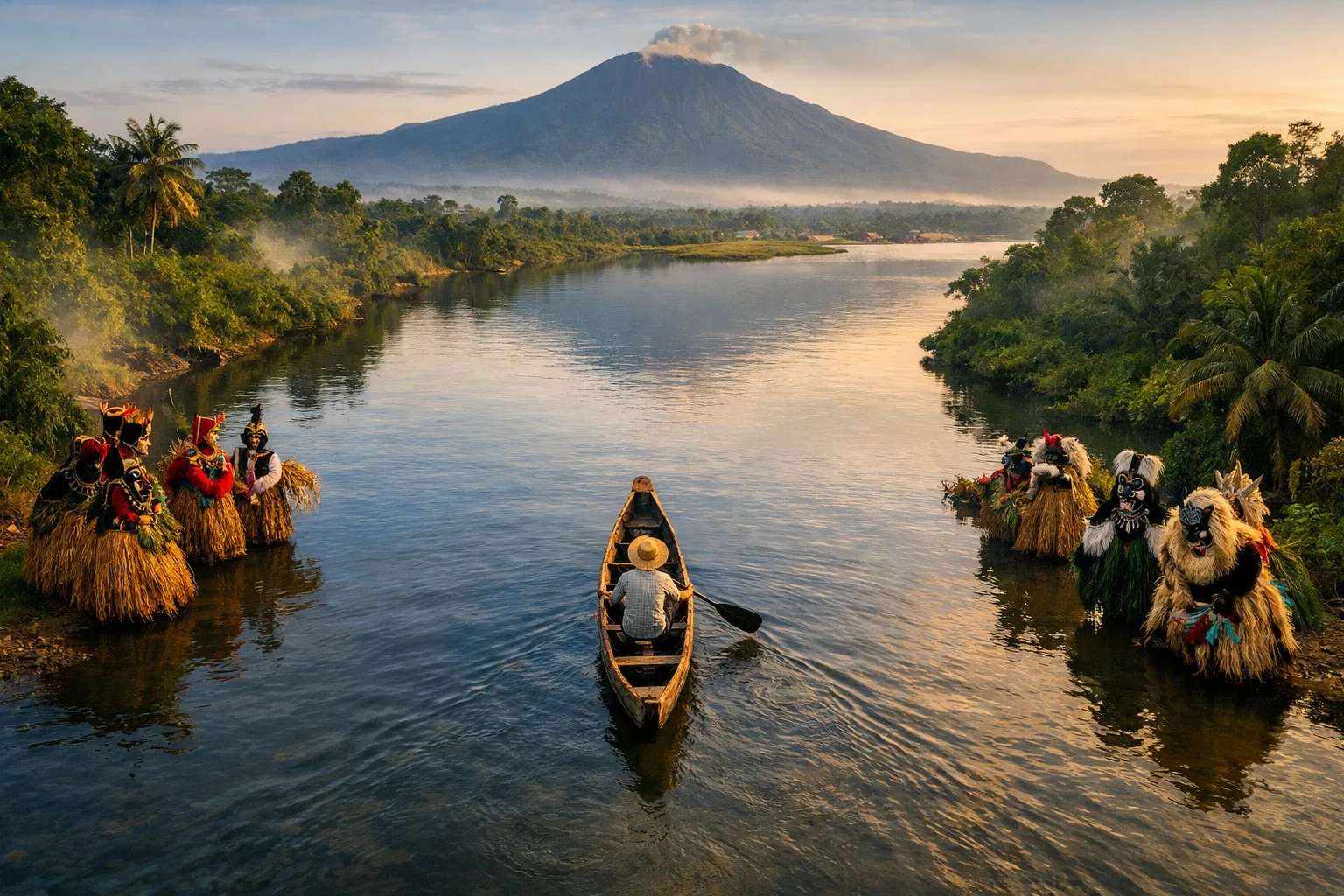
Cameroon’s folklore is best understood as a living mosaic rather than a single national mythology.
Page outline Jump by section
Introduction
That variety matters because Cameroon is often described as a country of striking cultural diversity, and its folklore reflects that reality. Some traditions are old oral narratives collected in books; some are sacred practices tied to rivers, forests, mountains or royal courts; others are modern retellings, tourist explanations or internet summaries. A careful reading has to keep those forms apart: a ritual still practised at Douala is not the same kind of evidence as a children’s folktale anthology, and neither should be treated as proof of supernatural fact. The more useful question is what these traditions say about place, power, morality, danger, ancestry and belonging.
Why Cameroon’s folklore is so varied
Cameroon’s folklore has no single centre because the country itself contains coastal, forest, highland, savannah and urban worlds, each with its own historical routes of trade, migration, language and religion. Folktale collections from Cameroon repeatedly stress that “African folklore” is too broad a label: the stories of Cameroon are locally grounded, and even within Cameroon they differ sharply from one community to another. Emmanuel Matateyou’s anthology, for example, presents Cameroon’s myths, legends and folktales as a way into the “rich, complex and varied customs” of its peoples, while also warning against flattening African oral literature into one undifferentiated category.[AUC Library]library.au.intOpen source on au.int.
For a reader looking for monsters or legendary beings, this means the most memorable figures are often tied to particular regions. The Sawa coast has water spirits and oracles; the Bakweri landscape around Mount Cameroon has the mountain figure Efasa-Moto; the Baka forest world has spirit rituals connected to the living forest; the Grassfields preserve powerful royal masks and societies whose performances gesture towards invisible authority. These are not merely decorative “myths”. They are ways of describing social order, environmental danger, healing, status and the relationship between human beings and the unseen.
Oral storytelling is central to this picture. Studies of Cameroonian folktales describe oral literature as a carrier of culture, history, social values and tradition, passed from one generation to another through tales, myths, poetry, legends and proverbs.[Asian Women]e-asianwomen.orgAsian Women Lessons from Cameroonian FolktalesAsian Women Lessons from Cameroonian Folktales That does not mean every tale is ancient in a simple, unchanged form. Many stories survive because they were retold, translated, edited, printed, taught, performed, adapted for children or reinterpreted in modern cultural spaces. Cameroon’s folklore is therefore both old and actively remade.
The Wouri River and the water oracles of Ngondo
The most internationally visible living folklore tradition in Cameroon today is Ngondo, the Sawa festival and ritual cycle centred on water oracles. UNESCO describes Ngondo as the “worship of water oracles and associated cultural traditions” among the Sawa community of Cameroon. It takes place annually, with activities running from September to December, and culminates on the first Sunday of December on the banks of the Wouri River, where a priest dives from a sacred canoe to recover a message from the water oracles.[UNESCO Intangible Cultural Heritage]ich.unesco.orgOpen source on unesco.org.
For outsiders, the dramatic image is the dive. For the Sawa, the deeper point is communication between the community, its rulers, its ancestors and the water world. UNESCO’s description presents the recovered message as guidance for community life until the next celebration, which shows that this is not simply a colourful festival performance. It is a ritualised public moment where belief, politics, identity, sport, pageantry and cultural memory meet.[UNESCO]unesco.orgdocument 6895document 6895
The beings most often associated with this world are the Sawa water spirits commonly described in English as mermaid-like figures. The singular form is often given as Jengu, with Miengu as the plural, and related forms appear among coastal groups including Duala, Bakweri, Malimba, Bakoko and Oroko communities. Accounts of the tradition describe these spirits as connected with rivers, the sea, healing, good fortune and mediation between human beings and the spirit world.[Wikipedia]WikipediaOpen source on wikipedia.org.
Ngondo is also a useful example of how folklore changes without simply disappearing. It is an annual urban public event in Douala, yet it draws authority from older coastal beliefs. Its 2024 inscription on UNESCO’s Representative List of the Intangible Cultural Heritage of Humanity gave the tradition a new global heritage status, while local reporting in 2025 treated that recognition as a point of public pride for Sawa identity.[UNESCO Intangible Cultural Heritage]ich.unesco.orgOpen source on unesco.org. The result is a tradition that is at once sacred, civic, touristic, political and media-visible.
Jengu and Miengu: Cameroon’s best-known water spirits
The Jengu tradition is one of Cameroon’s clearest examples of a legendary being that still has ritual and cultural weight. In common descriptions, Miengu inhabit rivers, estuaries and the sea; they are associated with beauty, healing, protection, luck and contact with the unseen. They are often compared with mermaids in English-language retellings, but that comparison can be misleading if it reduces them to fantasy creatures. In Sawa tradition they belong to a wider ritual relationship with water, ancestry, healing and communal wellbeing.[Wikipedia]WikipediaOpen source on wikipedia.org.
The Wouri River setting matters. Douala’s coastal history, trade routes and riverine geography help explain why water beings would occupy such a central place in local belief. Ritual specialists, chiefs, offerings, canoe processions and public festivals all turn the river into a sacred landscape rather than a neutral backdrop. The water is not just scenery; it is a threshold where human society seeks counsel from forces beyond ordinary speech.[UNESCO]unesco.orgdocument 6895document 6895
There is also a gendered and initiatory side to related coastal traditions. Sources on Jengu and Bakweri practice describe rites linked to young women’s passage into adulthood, healing and special ritual knowledge.[Wikipedia]WikipediaOpen source on wikipedia.org. This is where popular monster-list summaries often fall short. A Jengu is not simply a “Cameroonian mermaid”; it is part of a network of practices involving water, health, adulthood, secrecy, local authority and the moral obligations of community life.
Modern retellings often translate Miengu into the language of environmental respect, arguing that water spirits express an older understanding of rivers and the sea as living, protected powers. That interpretation can be useful, but it should be handled carefully. It is strongest when grounded in the actual ritual prominence of water in Sawa practice rather than imposed as a modern ecological slogan. UNESCO’s framing of Ngondo as intangible heritage helps support the claim that the tradition remains socially meaningful, but it does not turn every internet-era retelling into equally reliable evidence.[UNESCO Intangible Cultural Heritage]ich.unesco.orgOpen source on unesco.org.
Mount Cameroon and the legend of Efasa-Moto
In the south-west, Mount Cameroon — also known locally as Mount Fako — is one of the country’s most powerful folklore landscapes. The mountain is an active volcano, the highest mountain in West and Central Africa, and a dramatic environment of craters, caves, lava flows, forest, grassland and heavy rainfall.[mtcameroonnationalpark.org]mtcameroonnationalpark.orgOpen source on mtcameroonnationalpark.org. In Bakweri oral tradition, this physical force of the landscape is matched by the figure of Efasa-Moto, often described as a mountain deity or guardian.
The Our Mythical Childhood survey describes Efasa-Moto as a folkloric god of the Bakweri people at the foot of Fako Mountain, connected with control over the mountain and its surrounding territory.[OMC]omc.obta.al.uw.edu.plOpen source on edu.pl. Mount Cameroon National Park’s own ecotourism material presents a fuller tourist-facing version: Efasa-Moto is paired with Liengu la Mwanja, a legendary water figure, with Efasa-Moto choosing the mountain while the water figure remains at sea.[mtcameroonnationalpark.org]mtcameroonnationalpark.orgOpen source on mtcameroonnationalpark.org.
That pairing is revealing. It links two of Cameroon’s most important supernatural landscapes: mountain and water. The mountain is not just a place to climb, and the sea is not just a place to fish. In local legendary geography, they become domains of powerful beings whose separation helps explain the ordering of the world. This is the kind of folklore that makes landscape memorable: the route up a volcano becomes a route through a story.
Efasa-Moto is also a good case for separating oral tradition from modern presentation. Tourism websites, heritage summaries and recent online articles often retell the legend in vivid form, but the most cautious reading is that we are looking at a living cluster of Bakweri oral tradition, local sacred geography and modern cultural branding. The legend is well attested as a recognised Bakweri tradition; the fine details of appearance, powers and narrative episodes can vary depending on teller and context.[mtcameroonnationalpark.org]mtcameroonnationalpark.orgOpen source on mtcameroonnationalpark.org.
Forest spirits and Baka ritual worlds
In south-eastern Cameroon, Baka traditions show a different relationship between folklore and landscape. Here the central imaginative world is the forest. UNESCO describes the Baka as semi-nomadic Indigenous forest-dwellers whose ancestral lands span parts of Cameroon, Gabon and the Republic of Congo, and whose life around the Dja Faunal Reserve is bound to a biodiverse and spiritually significant forest environment.[UNESCO]unesco.orgguardians forest baka and living spirit djaguardians forest baka and living spirit dja
Baka belief is often described through the forest spirit Jengi, also rendered in sources as Ejengi or Djengui. General accounts present Jengi as a mediator between the supreme being and the Baka people, a protective presence associated with the forest, initiation, hunting success, songs and ritual dancing.[Wikipedia]WikipediaBaka people (Cameroon and GabonBaka people (Cameroon and Gabon Academic work on Baka ritual performances adds an important caution: spirit rituals are diverse, and variation exists between local groups, so one neat summary cannot cover all Baka practice.[SciSpace]scispace.comOpen source on scispace.com.
For folklore readers, the most important point is that Baka forest spirits are not simply “creatures” in the modern fantasy sense. They belong to a lived ritual and ecological world. Forest spirits help express moral order, hunting relationships, initiation, danger, protection and memory. Recent commentary on the Baka relationship with the forest emphasises that forest access, conservation policy, logging and protected areas have all affected Baka life, while the forest remains central to identity and ancestral connection.[University College London]ucl.ac.ukOpen source on ucl.ac.uk.
This makes Baka folklore especially vulnerable to distortion. A sensational monster entry can strip the tradition of its setting, while a romantic nature-writing version can flatten it into a vague “forest wisdom” theme. The stronger interpretation keeps the social setting intact: these are traditions of specific communities facing real historical pressures, not anonymous jungle legends.
Tricksters, moral tales and the art of storytelling
Not all Cameroonian folklore is about spirits or sacred places. Much of it is narrative art: animal tales, trickster stories, moral tests, riddles, proverbs and tales of cleverness or foolishness. Loreto Todd’s Tortoise the Trickster and Other Folktales from Cameroon retells traditional tales from Cameroon, and its title points to one of the familiar figures of West and Central African story worlds: the tortoise as a clever, troublesome survivor.[Amazon]amazon.comTortoise the trickster, and other folktales from Cameroon Book overview. Retells 27 traditional tales from the west African country of CaTortoise the trickster, and other folktales from Cameroon Book overview. Retells 27 traditional tales from the west African country of Ca
The tortoise trickster should not be read only as comic entertainment. Trickster tales often explore how weak figures survive among stronger ones, how greed creates trouble, how wit can defeat power, and how social rules can be tested without openly preaching. In this sense, Cameroonian animal tales belong to a wider African and global trickster pattern, but the local teller, language, audience and moral emphasis matter. A tortoise story in Cameroon is not automatically the same as an Anansi story from Akan tradition or a hare tale from elsewhere.
The Beba collection The Sacred Door and Other Stories is a useful example of local storytelling entering print. It presents folktales from the Beba people of Cameroon, including stories shaped by riddles, proverbs, songs, myths and legends. Publisher and review summaries describe the collection as a body of oral narratives dealing with themes such as revenge, greed and deception, and the title story turns on a poor man elevated to kingship under the condition that he must not open a sacred door.[BiblioVault]bibliovault.orgOpen source on bibliovault.org.
That “forbidden door” structure is immediately recognisable to folktale readers around the world, but the Cameroonian setting changes its meaning. It becomes a story about authority, self-control, temptation and the conditions attached to sudden success. Folktales like this often survive because they work at several levels at once: children can follow the plot, adults can hear the warning, and a community can recognise its own values in the pattern of reward, prohibition and consequence.
Witchcraft, wealth and the fear of Nyongo
Cameroon’s folklore also includes darker modern belief traditions around witchcraft, money, death and social suspicion. One of the best-known examples in anthropological literature is Nyongo, a feared witchcraft or occult association most famously discussed in relation to the “Nyongo Terror” described by anthropologist Edwin Ardener in the 1950s in what is now Cameroon’s South West Region.[Wikipedia]WikipediaNyongo societyNyongo society
Nyongo beliefs are not simply old village superstition. They are closely tied to anxiety about wealth, business, inequality and sudden success. Summaries of the tradition describe suspicions that people who become wealthy too quickly may have made a pact with a hidden society, with family deaths or misfortunes interpreted as payment or sacrifice.[Wikipedia]WikipediaNyongo societyNyongo society Anthropologists such as Peter Geschiere have used Cameroonian witchcraft material to discuss the politics of belonging, modernity, migration and the occult in postcolonial Africa.[Wikipedia]WikipediaNyongo societyNyongo society
For a folklore page, Nyongo matters because it shows how supernatural belief can respond to modern pressures. Roads, plantations, schools, business ventures, cash economies and migration do not simply erase occult traditions; they can create new rumours and new fears. A shopkeeper’s prosperity, a fatal accident or a child’s death may become narratively meaningful through the language of witchcraft, especially where trust and inequality are already strained.
This is also an area where ethical care is essential. Witchcraft accusations can cause real harm. The point is not to treat Nyongo as a thrilling secret society, but to understand it as a social narrative through which people have explained danger, resentment, wealth and misfortune. In that sense, it belongs to folklore not because it is harmless fantasy, but because it is a powerful traditional way of making sense of social life.
Masks, royal power and the visible face of the invisible
Cameroon’s Grassfields are famous for masks, beadwork, royal art and ceremonial societies. These objects are sometimes displayed in international museums as “African art”, but their folklore relevance lies in the stories and powers they materialise: kingship, transformation, ancestral authority, rank, secrecy and social control.
Bamileke elephant masks are among the best-known examples. Museum and art-history sources describe them as symbols of royal power, high rank and political authority. Elephants, leopards and other powerful animals are linked with rulership, and expensive beadwork signals wealth and status.[smarthistory.org]smarthistory.orgOpen source on smarthistory.org. Smarthistory’s discussion of a Bamileke elephant mask notes that the elephant and leopard were powerful symbols connected with the Fon, or ruler, and with ideas of transformation and authority.[Smarthistory]smarthistory.orgOpen source on smarthistory.org.
Other Grassfields masks belonged to regulatory or secret societies that had judicial, ritual and commemorative roles. The University of Michigan Museum of Art describes some Cameroon Grassfields masks as part of Kwifoyn, a regulatory society that once had stronger roles in social control and law enforcement, and is now more associated with commemorative celebrations for rulers and elite community members.[umma.umich.edu]umma.umich.eduOpen source on umich.edu. A Menil Collection publication similarly notes that mask and headdress performances are essential in religious, royal and public ceremonies and are linked with initiation and regulatory societies.[The Menil Collection]d27m4mjhi8p0i4.cloudfront.netThe Menil Collection Art of the Cameroon GrassfieldsThe Menil Collection Art of the Cameroon Grassfields
These masks are not “monsters”, but they do sit near the heart of supernatural tradition. A mask can make authority visible; a masquerade can mark the presence of ancestors, social judgement or royal legitimacy. The uncanny power comes from the performance: the wearer is not merely dressed up, but temporarily carries a role that exceeds ordinary personhood.
How old are these traditions, and how well attested are they?
The evidence for Cameroonian folklore is uneven, but not weak. Some traditions are supported by living public practice, institutional recognition and recent documentation. Ngondo is the clearest case: it is practised annually, described by UNESCO, publicly celebrated in Douala and internationally inscribed as intangible cultural heritage in 2024.[UNESCO Intangible Cultural Heritage]ich.unesco.orgOpen source on unesco.org.
Other traditions are well attested through oral history, ethnography, local heritage presentation and cultural memory, but their age is harder to pin down precisely. Efasa-Moto is clearly recognised in Bakweri oral tradition and modern Mount Cameroon heritage interpretation, yet many detailed retellings circulate through tourist, school, blog or local media forms rather than early written records.[mtcameroonnationalpark.org]mtcameroonnationalpark.orgOpen source on mtcameroonnationalpark.org. The right conclusion is not that the legend is “fake”, but that its precise historical layers need to be read with care.
Printed folktale collections provide another kind of evidence. Matateyou’s anthology, Todd’s tortoise tales and Makuchi’s Beba collection show that Cameroonian oral narratives have been collected, translated and presented to wider readers.[google.com]books.google.comOpen source on google.com. But a printed folktale is not a recording of a timeless original. It is a mediated version shaped by selection, translation, editing and the expectations of publishers and readers.
Museum objects are similarly double-edged evidence. A Bamileke mask in a museum can confirm the existence and material form of a ceremonial tradition, but the museum label may not capture the full ritual meaning known locally. Modern scholarship increasingly stresses provenance, colonial collection histories and the shifting meanings of African objects once removed from their communities.[TU Berlin]static.tu.berlinBerlin ATLAS OF ABSENCE CAMEROON'S CULTURALBerlin ATLAS OF ABSENCE CAMEROON'S CULTURAL
Christianity, Islam, cities and modern reinterpretation
Cameroon’s folklore has not remained sealed off from world religions, colonial history or urban life. Christianity and Islam changed religious practice across many regions, while colonial rule, missionary schooling, print culture, museums, tourism and state heritage policy reshaped how traditions were preserved or publicly presented. The survival of older beliefs is therefore rarely a simple matter of “unchanged ancient religion”. More often, older forms coexist, compete or blend with newer religious and civic identities.
Ngondo shows this clearly. It is rooted in water-oracle tradition, yet today it is also a public festival, a marker of Sawa identity, a tourist attraction, a subject of media coverage and a UNESCO-listed heritage practice.[UNESCO Intangible Cultural Heritage]ich.unesco.orgOpen source on unesco.org. Grassfields masks likewise move between royal ceremony, local commemoration, museum display, scholarly interpretation and global art markets.[Smarthistory]smarthistory.orgOpen source on smarthistory.org.
Witchcraft belief also adapts to modern conditions. Nyongo narratives are bound up with wage labour, business, education, migration and sudden wealth, not just with precolonial village life.[Wikipedia]WikipediaNyongo societyNyongo society This is one reason Cameroon is important for the study of African modernity and the occult: the supernatural is not merely a residue of the past, but a language through which people discuss present-day inequality, suspicion and belonging.
Modern internet folklore adds another layer. Short articles often recast Jengu as “Cameroon’s mermaids” or Efasa-Moto as a mountain monster, which can help new readers find the subject but can also flatten complex traditions into creature profiles. The better approach is to treat online summaries as gateways, then return to stronger sources: UNESCO pages, ethnographic work, museum records, local heritage bodies and serious folktale collections.
What readers should remember about Cameroon’s folklore
The first thing to remember is that Cameroon’s folklore is place-based. The Wouri River, Mount Cameroon, the south-eastern forest and the Grassfields courts are not just settings; they are engines of story. Water speaks through oracles, a volcano becomes a sacred mountain, the forest is alive with spirits, and royal masks turn political authority into visible performance.[unesco.org]unesco.orgdocument 6895document 6895
The second is that these traditions are socially practical. Folktales teach caution, cleverness and restraint. Water-spirit rituals seek healing, protection and communal guidance. Witchcraft rumours express fear about wealth and betrayal. Masks and masquerades display rank, continuity and ancestral power. The supernatural is not separate from ordinary life; it is one of the ways ordinary life is explained and judged.
The third is that “Cameroonian folklore” should never be reduced to a single creature list. Jengu, Efasa-Moto, Jengi, tortoise tricksters, Nyongo witches and Bamileke royal masks all belong within the country’s folklore, but they do not belong to the same kind of tradition. Some are sacred beings, some are narrative figures, some are rumours, some are ritual performances, and some are museum-preserved traces of ceremonial systems.
The strongest picture is therefore a layered one: Cameroon’s folklore is a living archive of rivers, forests, mountains, courts, families and public festivals. It is old, but not frozen; local, but increasingly visible to the world; full of spirits and stories, but also full of social memory.
Amazon book picks
Further Reading
Books and field guides related to Where Cameroon's Spirits Still Shape Place. Use these as the next step if you want deeper reading beyond the article.
African Religions and Philosophy
Explains spirits, ancestors and ritual systems relevant to Cameroon.
African Myths of Origin
Introduces oral traditions and cultural narratives from Africa.
The Penguin Book of Myths and Legends of Africa
Provides broad context for Cameroonian traditions.
eBay marketplace picks
Marketplace Samples
Live-tested eBay searches with available results related to this page.
Endnotes
1.
Source: ich.unesco.org
Link:https://ich.unesco.org/en/RL/ngondo-worship-of-water-oracles-and-associated-cultural-traditions-among-the-sawa-02140
2.
Source: unesco.org
Title: document 6895
Link:https://www.unesco.org/archives/multimedia/document-6895
3.
Source: books.google.com
Link:https://books.google.com/books/about/An_Anthology_of_Myths_Legends_and_Folkta.html?id=aNbfAAAAMAAJ
4.
Source: ich.unesco.org
Link:https://ich.unesco.org/en/decisions/19.COM/7.B.28
5.
Source: Wikipedia
Link:https://en.wikipedia.org/wiki/Jengu
6.
Source: mtcameroonnationalpark.org
Link:https://mtcameroonnationalpark.org/
7.
Source: omc.obta.al.uw.edu.pl
Link:https://www.omc.obta.al.uw.edu.pl/myth-survey/item/144
8.
Source: mtcameroonnationalpark.org
Link:https://mtcameroonnationalpark.org/ecotourism/
9.
Source: unesco.org
Title: guardians forest baka and living spirit dja
Link:https://www.unesco.org/en/articles/guardians-forest-baka-and-living-spirit-dja
10.
Source: Wikipedia
Title: Baka people (Cameroon and Gabon)
Link:https://en.wikipedia.org/wiki/Baka_people_%28Cameroon_and_Gabon%29
11.
Source: scispace.com
Link:https://scispace.com/pdf/diversity-of-ritual-spirit-performances-among-the-baka-3cei3h0mim.pdf
12.
Source: amazon.com
Link:https://www.amazon.com/Tortoise-Trickster-Other-Folktales-Cameroon/dp/0710000227?tag=searcht-20
13.
Source: amazon.de
Link:https://www.amazon.de/-/en/Tortoise-Trickster-Other-Folktales-Cameroon/dp/0710000227?tag=searcht-20
14.
Source: bibliovault.org
Link:https://www.bibliovault.org/BV.book.epl?ISBN=9780896802568
15.
Source: Wikipedia
Title: Nyongo society
Link:https://en.wikipedia.org/wiki/Nyongo_society
16.
Source: smarthistory.org
Link:https://smarthistory.org/elephant-mask-kuosi-society-bamileke-peoples-cameroon/
17.
Source: umma.umich.edu
Link:https://umma.umich.edu/objects/mask-1997-1-343/
18.
Source: omc.obta.al.uw.edu.pl
Link:https://www.omc.obta.al.uw.edu.pl/myth-survey/country/11
19.
Source: ich.unesco.org
Title: 7b representative list 01370
Link:https://ich.unesco.org/en/7b-representative-list-01370?call=film&id=72567&include=film.inc.php&width=700
20.
Source: ich.unesco.org
Link:https://ich.unesco.org/en/video/72567
21.
Source: artsandculture.google.com
Link:https://artsandculture.google.com/asset/mask-bamun-or-bamileke-cameroon/-gHl6BZASB-ZJg?hl=en
22.
Source: amazon.com
Link:https://www.amazon.com/Sacred-Door-Other-Stories-Folktales/dp/0896802566?tag=searcht-20
23.
Source: archive.org
Link:https://archive.org/details/treasuryofafrica00cour
24.
Source: Wikipedia
Link:https://en.wikipedia.org/wiki/Anansi
25.
Source: Wikipedia
Title: Selected article
Link:https://en.wikipedia.org/wiki/Portal%3ATraditional_African_religions/Selected_article/24
26.
Source: Wikipedia
Link:https://en.wikipedia.org/wiki/Ngondo
27.
Source: amazon.nl
Link:https://www.amazon.nl/-/en/Professor-Loreto-Todd/dp/0710000227?tag=searcht-20
28.
Source: folktales.africa
Title: the palm wine tapper and the trickster tortoise
Link:https://folktales.africa/the-palm-wine-tapper-and-the-trickster-tortoise/
29.
Source: books.google.ge
Title: ge Cameroon
Link:https://books.google.ge/books?id=CGw3FyAtNDoC&printsec=frontcover
30.
Source: youtube.com
Link:https://www.youtube.com/watch?v=zPWGjqJKQQQ
Source snippet
Cameroon - Ngondo: Canton Bell celebrates Sawa heritage...
31.
Source: youtube.com
Link:https://www.youtube.com/watch?v=Gr0xr7debow
32.
Source: library.au.int
Link:https://library.au.int/fr/anthology-myths-legend-and-falktales-cameroon-storytelling-africa-5
33.
Source: e-asianwomen.org
Title: Asian Women Lessons from Cameroonian Folktales
Link:https://www.e-asianwomen.org/pdf/10.14431/aw.2006.09.22.2.1
34.
Source: ucl.ac.uk
Link:https://www.ucl.ac.uk/news/2025/mar/comment-cameroons-baka-people-say-they-are-part-forest-thats-why-they-look-after-it
35.
Source: brooklynmuseum.org
Link:https://www.brooklynmuseum.org/objects/4852
36.
Source: d27m4mjhi8p0i4.cloudfront.net
Title: The Menil Collection Art of the Cameroon Grassfields
Link:https://d27m4mjhi8p0i4.cloudfront.net/api/file/iAsVa2sjROCh8jBUDUSa?fit=max
37.
Source: static.tu.berlin
Title: Berlin ATLAS OF ABSENCE CAMEROON’S CULTURAL
Link:https://www.static.tu.berlin/fileadmin/www/10002011/Forschungsprojekte/Aktuelle_Forschungsprojekte/Umgekehrte_Sammlungen_KAM/ATLAS_DER_ABWESENHEIT_EN_DeepL.pdf
38.
Source: anthgrp2.wordpress.com
Link:https://anthgrp2.wordpress.com/religion/
39.
Source: the-demonic-paradise.fandom.com
Link:https://the-demonic-paradise.fandom.com/wiki/Jengu
40.
Source: stopblablacam.com
Link:https://www.stopblablacam.com/culture-and-society/0512-13435-unesco-adds-ngondo-sawa-peoples-water-oracle-ritual-to-intangible-cultural-heritage-list
41.
Source: amazon.co.uk
Link:https://www.amazon.co.uk/Anthology-Myths-Legends-Folktales-Cameroon/dp/0773485147?tag=searcht-20
42.
Source: x.com
Link:https://x.com/UNESCO/status/1864309380629373241?lang=en
43.
Source: africa24tv.com
Link:https://africa24tv.com/cameroon-ngondo-canton-bell-celebrates-sawa-heritage/
Additional References
44.
Source: youtube.com
Link:https://www.youtube.com/watch?v=mxLy1apvMCs
Source snippet
Efasa Moto and the Mount Cameroon Race of Hope...
45.
Source: youtube.com
Title: Meet the Baka Pygmies: the voice of the forest | SLICE
Link:https://www.youtube.com/watch?v=4tdFJLw5n-s
Source snippet
DISCOVER RICH CAMEROON AFRICAN CULTURE |NUKWI NE ABUBTE MANKON PART 1 |BAMENDA GRASSFIELDS TRADITION...
46.
Source: goodreads.com
Link:https://www.goodreads.com/en/book/show/4614191-an-anthology-of-myths-legends-and-folktales-from-cameroon
47.
Source: proquest.com
Link:https://www.proquest.com/scholarly-journals/anthology-myths-legends-folktales-cameroon/docview/207629415/se-2
48.
Source: si.edu
Link:https://www.si.edu/object/siris_sil_599286
49.
Source: mellenpress.com
Link:https://mellenpress.com/book/Anthology-of-Myths-Legends-and-Folktales-From-Cameroon-Storytelling-in-Africa/4472/
50.
Source: christies.com
Link:https://www.christies.com/en/lot/lot-6363768
51.
Source: facebook.com
Link:https://www.facebook.com/africanvibes/posts/baka-pygmies-and-the-ejengui-dance-honoring-the-spirit-of-the-forest-among-the-b/1193721219435519/
52.
Source: lastplaces.com
Link:https://lastplaces.com/en/travel-is-knowledge/baka-people-cameroon/
53.
Source: river-films.com
Link:https://www.river-films.com/baka-kombas-forest
Topic Tree
Follow this branch
Related pages 192
- Afghan Folklore
- Albanian Folklore
- Algerian Folklore
- Australian Folklore
- Azerbaijan Folklore
- +187 more in sidebar