Why Bulgarian Folklore Still Feels Alive
Bulgarian folklore is not a single mythology with one neat cast of gods. It is a living mix of village ritual, Orthodox Christianity, older Balkan and Slavic belief, heroic song, fairy lore, seasonal magic, and modern festival culture.
Page outline Jump by section
Introduction
The strongest way to understand Bulgarian folklore is to see it as a calendar and a landscape. Winter brings masks, noise and household blessings. Early spring brings charms, girls’ songs and rites of passage. Summer and saint’s days fold older ideas into Christian festivals. Mountains, caves, monasteries and border regions preserve legends of saints, fairies, dragons and heroic outlaws. The result is a folklore tradition that is both local and national: rooted in particular villages and regions, but repeatedly reworked into a shared Bulgarian cultural identity.[unesco.org]whc.unesco.orgOpen source on unesco.org.
Why Bulgarian folklore feels so distinctive
Bulgarian tradition sits at a crossroads. The country lies in the Balkans, with long contact among Slavic-speaking communities, Thracian antiquity, Byzantine and Ottoman history, Orthodox Christianity, Roma and Turkish-speaking neighbours, and wider South-East European ritual patterns. That is why some Bulgarian customs have close relatives elsewhere in the region, while still having strongly local forms. The spring red-and-white thread custom, for example, is shared in a multi-country UNESCO inscription, but the Bulgarian figure of the weather-changing March grandmother gives it a particularly recognisable national shape.[UNESCO Intangible Cultural Heritage]ich.unesco.orgOpen source on unesco.org.
The tradition also survives in several different forms at once. Some customs are still performed in villages as community ritual. Others are staged in festivals, taught in schools, archived by scholars, sold as souvenirs, or adapted in books and online art. This matters because a masked performer in a village procession, a troupe at an international festival in Pernik, and a fantasy illustration of a woodland fairy are not the same kind of evidence. They all show folklore at work, but they belong to different moments in the life of a tradition.[unesco.org]ich.unesco.orgUNESCO Intangible Cultural HeritageSurova folk feast in Pernik regionThe Surova folk feast in Pernik region takes place each year on 13 a…
A good rule for readers is this: Bulgarian folklore is strongest when it is tied to a specific practice, place, song, archive, or named local belief. Very broad claims about “ancient pagan origins” can be tempting, but they often flatten traditions that changed through Christianity, village life, nationalism, socialism, tourism and the internet. The most reliable picture is layered rather than simple.
Masks, bells and the winter battle against evil
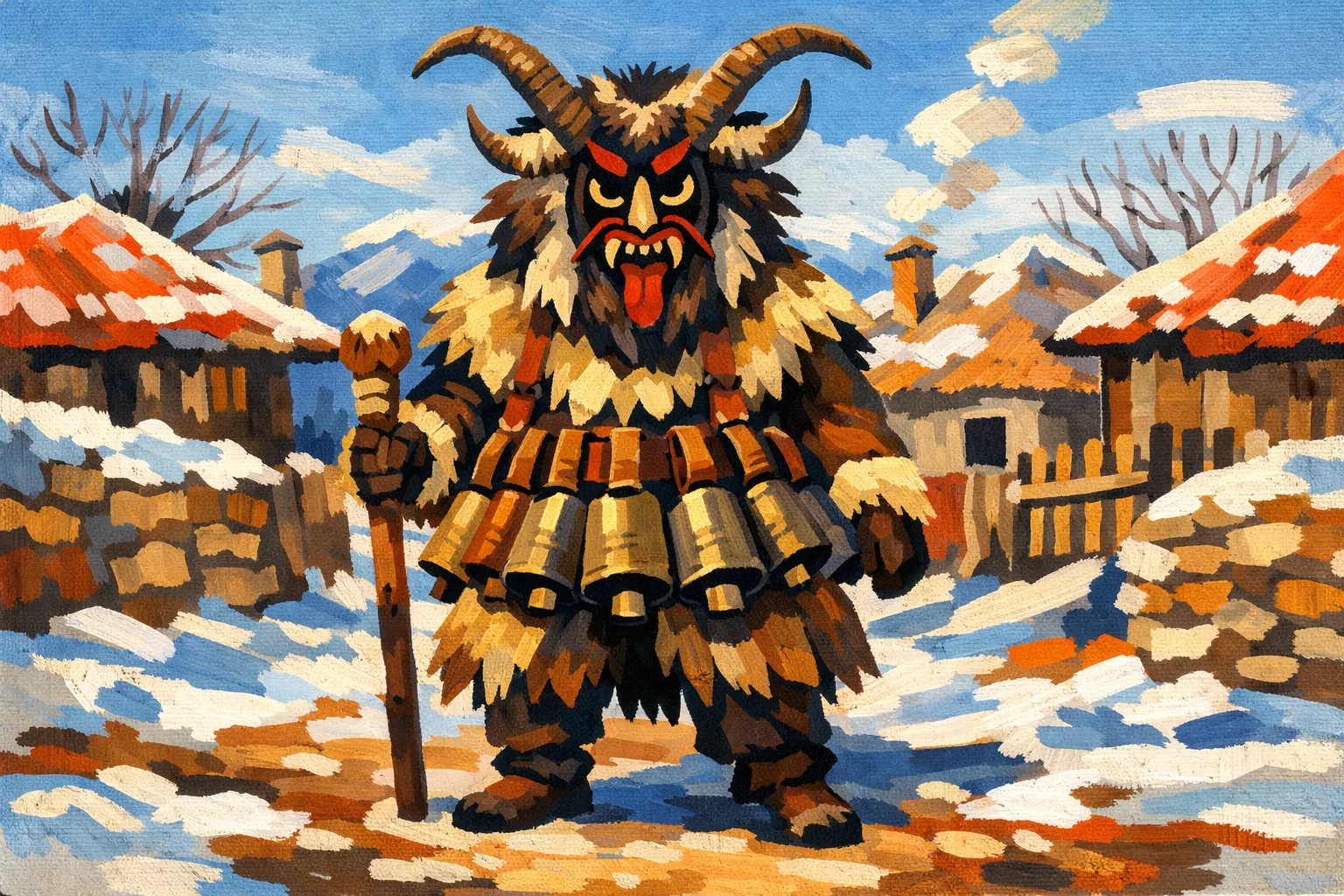
The most internationally recognisable Bulgarian folk image is the masked winter performer: huge bells at the waist, animal skins, towering masks, horns, feathers, carved faces, and an explosive procession through streets or village lanes. In English these traditions are often loosely called “kukeri”, although local names and forms differ. Their purpose is usually explained in plain terms: to frighten away harmful forces and call in health, fertility, prosperity and a good year.
The Surova folk feast in the Pernik region is one of the clearest documented examples. UNESCO describes it as taking place every year on 13 and 14 January, when communities celebrate the New Year according to the old calendar. The masquerade group’s visit to each home is central: the performers do not simply parade for spectacle, but ritually enter the social space of the village and bless it through noise, movement and symbolic disorder.[UNESCO Intangible Cultural Heritage]ich.unesco.orgUNESCO Intangible Cultural HeritageSurova folk feast in Pernik regionThe Surova folk feast in Pernik region takes place each year on 13 a…
Pernik also hosts the International Festival of Masquerade Games, known as Surva, which has become a major public face of Bulgarian masquerade tradition. The festival began in 1966, gained international status in 1985, and is widely promoted as a leading event for traditional masked customs in Bulgaria and the Balkans. This is a useful example of how folklore changes setting: a practice rooted in local winter ritual becomes a staged, competitive, tourist-facing festival while still drawing on village groups and inherited forms.[Visit Bulgaria]visitbulgaria.comOpen source on visitbulgaria.com.
The masks themselves are not just “monster costumes”. They make visible a world where evil can be noisy, contagious and seasonal, and where a community answers it by becoming louder and stranger than the thing it fears. Bells, skins, horns and grotesque faces turn the human body into a protective force. That protective meaning is why the tradition still resonates even for people who do not interpret it as literal magic.
Fire-dancing and the Christian face of older ritual
Another famous Bulgarian tradition is the fire-dancing rite associated with the feast of Saints Constantine and Helena in the village of Bulgari in the Strandzha region. UNESCO describes Nestinarstvo as the climax of an annual ritual cycle on 3 and 4 June, centred on a procession, sacred icons, music and dancing barefoot on glowing embers.[UNESCO Intangible Cultural Heritage]ich.unesco.orgOpen source on unesco.org.
Nestinarstvo is often described in popular writing as “pagan”, but that label can be too blunt. The rite as documented today is not a museum-piece survival of an unchanged pre-Christian religion. It is a Christian village festival with icons, saints and church associations, while also carrying ritual forms that many scholars and observers see as older or at least deeply archaic in atmosphere. Its power lies in precisely that mixture: saints’ images, ecstatic music, heat, danger, communal attention and the belief that certain people can cross a boundary ordinary people cannot.
The village of Bulgari matters here because folklore is not only a story but a social setting. Fire-dancing performed for cameras in a restaurant or tourist show is not equivalent to the ritual embedded in the feast calendar. Both may keep the image alive, but the older meaning depends on place, date, community roles and sacred objects. Nestinarstvo is therefore one of Bulgaria’s clearest examples of a tradition that is spectacular to outsiders but still needs careful explanation rather than exoticising.
Baba Marta and the red-and-white sign of spring
On 1 March, Bulgarians exchange and wear red-and-white thread ornaments for health, luck and the arrival of spring. The custom is tied to the figure of Baba Marta, imagined as a moody grandmother whose changing temper explains March weather. When she is cheerful, spring advances; when she is angry, cold returns.[UNESCO Intangible Cultural Heritage]ich.unesco.orgOpen source on unesco.org.
The charm is usually worn until a sign of spring appears, such as a blossoming tree, a stork or a swallow, after which it may be tied to a branch. UNESCO’s description of the wider 1 March cultural practice highlights the making, offering and wearing of the red-and-white thread and its removal when spring signs appear.[UNESCO Intangible Cultural Heritage]ich.unesco.orgOpen source on unesco.org.
This custom is easy to like because it is cheerful and visible, but its folklore logic is deeper than decoration. Red and white mark transition: winter to spring, vulnerability to protection, old year to renewed life. The charm makes seasonal uncertainty manageable. Instead of passively waiting for warmth, people exchange a sign of care and protection. In modern Bulgaria, it is also a national marker: worn by children, adults, office workers and public figures, sold in markets, made in schools, and shared with foreigners as a quick explanation of Bulgarian identity.
Baba Marta also shows how folklore can remain lively without remaining static. Many modern versions are playful, cute or commercial, but the underlying pattern is old: a personified season, a protective object, and a ritual moment when the body is marked against misfortune.
Girls’ rites, songs and the folklore of growing up
Not all Bulgarian seasonal ritual is about monsters and protection. Some customs organise the life cycle, especially the passage from childhood into marriageable youth. Lazaruvane, performed around Lazarus Saturday before Palm Sunday, is a girls’ spring custom involving visiting homes, singing ritual songs and offering blessings. Ethnographic explanations describe it as a rite of passage: a girl who has taken part is symbolically recognised as ready to enter the social world of courtship and marriage.[BNR News]bnrnews.bgBNR News"LazaruvaneBNR News"Lazaruvane
This is a good reminder that folklore is not just supernatural fiction. It also regulates social life. A village song or procession can answer very practical questions: Who is now considered grown up? Which households are included in the blessing circuit? What virtues are praised? What future is imagined for young people?
Lazaruvane is often compared with boys’ winter carolling traditions, because both involve youth groups moving through the village, singing for households and receiving gifts. The gendered structure can feel distant to modern readers, but it reveals how traditional communities used performance to make social transitions public. The song mattered because the community heard it.
Fairies, dragons and dangerous beauty
Bulgarian supernatural lore is rich in beings who are not simply “good” or “evil”. The woodland fairy figure often called the samodiva is a good example. In songs and stories she is associated with mountains, forests, water, dancing, beauty, healing knowledge and danger. She may help a hero, seduce or punish a man, steal vitality, guard spaces, or appear as a supernatural female presence at the edge of ordinary life.[ResearchGate]researchgate.netResearch Gate(PDF) Samodivi: Thracian Mythology in the Bulgarian EpicsResearch Gate(PDF) Samodivi: Thracian Mythology in the Bulgarian Epics
The samodiva matters because she sits where several ideas meet: wild nature, female power, song, erotic danger, illness and blessing. In literary culture, such figures were reworked by writers of the Bulgarian National Revival and later periods. Hristo Botev, one of Bulgaria’s most important poets, is often discussed as a writer who transformed folkloric images into national literary symbols rather than merely copying village belief.[sesdiva.eu]sesdiva.euHristo BotevHristo Botev
Dragons are equally complex. Bulgarian lore distinguishes between the male dragon figure, often imagined with human and serpentine qualities and sometimes capable of helping people, and more destructive female or monstrous beings such as the lamia or hala. Bulgarian National Radio’s folklore account notes that in St George legends the saint slays a lamia rather than the more humanised male dragon.[Old News]old-news.bnr.bgdragons and lamias in bulgarian folkloredragons and lamias in bulgarian folklore
One particularly memorable strand is the belief in a dragon’s love for a woman. Scholarly discussion of Bulgarian oral narratives shows that this motif has been interpreted in many ways: as illness, erotic danger, supernatural election, initiation, punishment, or a remnant of older mythic patterns. The range of interpretations is important. It warns against reducing every dragon story to a simple “monster tale”. In village narrative, a dragon lover could explain bodily suffering, social suspicion, unusual behaviour, or a woman’s frightening closeness to the unseen world.[Academia]academia.eduPDF) Loved by a Dragon: Topoi and Idiosyncrasies in OralPDF) Loved by a Dragon: Topoi and Idiosyncrasies in Oral
Vampires and the restless dead
Bulgaria has a deep vampire tradition, but it differs sharply from the elegant aristocratic vampire of modern Gothic fiction. In village belief, the vampire is usually a dangerous revenant: a dead person who has not been properly contained, who returns to disturb the household, harm livestock, spread fear or explain misfortune. Bulgarian accounts often connect vampirism with improper burial, abnormal death, sin, social disorder or failure in funeral observance.[BNR News]bnrnews.bgBNR News Vampires in Bulgarian folkloreBNR News Vampires in Bulgarian folklore
The folklore is highly ritualised. Academic work on Bulgarian vampire belief has stressed its connection to funeral rites, sacrifice, scapegoating and religious syncretism, rather than treating it as simple horror entertainment. In that context, the vampire is a social problem as much as a monster: it marks a breakdown in the relationship between the living, the dead and the community’s rules.[Libra ETD]libraetd.lib.virginia.eduOpen source on virginia.edu.
Modern attention often focuses on “vampire burials”, especially the medieval skeleton found at Sozopol with an iron object through the chest. Journalistic coverage from the time reported that the discovery drew public and tourist interest, while museums and archaeologists had to explain the find within a wider pattern of anti-revenant burial practice rather than as proof of supernatural beings.[smithsonianmag.com]smithsonianmag.comSmithsonian Magazine Pirate Vampire Dug Up in BulgariaSmithsonian Magazine Pirate Vampire Dug Up in Bulgaria
This is a useful distinction for readers. Archaeology can show that people performed actions intended to prevent a corpse from returning. It cannot show that vampires existed. The evidence is about belief, fear and ritual behaviour. That makes it no less valuable: it shows how seriously communities once treated the boundary between death and danger.
Heroes, songs and national memory
Bulgarian folklore is also carried in heroic songs. One major figure is Krali Marko, a South Slavic epic hero associated with superhuman strength, battles, a marvellous horse, and stories that cross modern national borders. In Bulgarian tradition, Marko is often linked with fairies, dragons and liberation themes, but the evidence is not a single authorised biography. He is a hero of song cycles and local variants, not a fixed novel character.[JSTOR]jstor.orgTypes of Bulgarian Folk SongsTypes of Bulgarian Folk Songs
The nineteenth century was crucial for collecting and reframing folk material. The Miladinov brothers’ 1861 collection, commonly known in English as Bulgarian Folk Songs, is repeatedly described as a landmark in Bulgarian folklore studies and national cultural history. Such collections preserved songs, riddles, ritual verses and regional material, but they also selected, edited and recontextualised oral tradition for a literate national audience.[Wikipedia]WikipediaBulgarian Folk SongsBulgarian Folk Songs
That double role is important. Folklore collections saved material that might otherwise have vanished, yet they also helped turn local voices into national heritage. The village singer, the collector, the printer, the schoolteacher and the later scholar all shaped what “Bulgarian folklore” came to mean. Modern readers should therefore treat collected songs as precious evidence, but not as transparent recordings of timeless antiquity.
Sacred landscapes: mountains, caves and monasteries
Bulgarian folklore is strongly attached to landscape. Mountains are not just scenery; they are places where saints withdraw, fairies dance, heroes hide, dragons live and communities imagine contact with older powers. The Rila Monastery is the most famous sacred landscape in the country. UNESCO describes it as founded in the 10th century by St John of Rila, whose hermit dwelling and tomb became a holy site before developing into a major monastic complex.[UNESCO World Heritage Centre]whc.unesco.orgOpen source on unesco.org.
Rila’s importance is religious and cultural rather than “folkloric” in a narrow monster-story sense, but it belongs in any serious account of Bulgarian belief culture. The monastery became a centre of spiritual, literary and national self-preservation, especially during Ottoman rule, and its mountain setting reinforces the older pattern of holiness at the edge of ordinary settlement.[rilskimanastir.org]rilskimanastir.orgOpen source on rilskimanastir.org.
The Rhodope Mountains carry another kind of legendary charge. They are associated in travel writing and local storytelling with Orpheus, Thracian sanctuaries, caves and underworld imagery. Sites such as the Devil’s Throat Cave and Tatul are often presented through Orpheus legends, although here readers should be careful: ancient myth, archaeological interpretation, tourist storytelling and local legend can blur together.[explorergenes.com]explorergenes.comExplorer Genes Exploring Fairytales & Legends in the Rhodope MountainsExplorer Genes Exploring Fairytales & Legends in the Rhodope Mountains
That blurring is not necessarily a problem as long as it is named. A cave promoted as a route to the underworld is not evidence that an ancient event happened there. It is evidence that landscape invites myth, and that modern Bulgaria still uses mythic geography to connect visitors with older layers of memory.
Archives, museums and what counts as evidence
Bulgarian folklore is unusually visible because it is not only performed; it is archived, studied and digitised. The Bulgarian Folklore journal, founded in 1975, presents itself as the only Bulgarian academic periodical dedicated to folklore studies and the popularisation of folkloristic research.[bulgarianfolklorejournal.net]bulgarianfolklorejournal.netOpen source on bulgarianfolklorejournal.net.
The Institute of Ethnology and Folklore Studies with Ethnographic Museum at the Bulgarian Academy of Sciences is especially important. Descriptions of its work refer to rich archive funds including written records, photographs, video and sound recordings, and field research materials. Digital library projects have aimed to make Bulgarian folklore objects from institute collections more accessible for research, education and wider public use.[innovacionyciencia.com]innovacionyciencia.comOpen source on innovacionyciencia.com.
This matters because folklore is often treated online as if it were a free-floating list of creatures. In reality, the best evidence is attached to collectors, dates, regions, performance settings, recordings, museum holdings and scholarly interpretation. A creature name repeated on a fantasy website is much weaker evidence than a recorded song, a regional museum explanation, a UNESCO nomination, or a fieldwork-based study.
At the same time, folklore evidence is rarely as tidy as a modern legal document. Oral traditions vary. Beliefs contradict one another. A being may be protective in one region and harmful in another. A custom may be remembered as ancient even when its current public form is recent. Good folklore writing should preserve that variation rather than smoothing it away.

Bulgaria’s folklore today
Bulgarian folklore today lives in at least four overlapping worlds.[Wikipedia]WikipediaCategory:Bulgarian folkloreCategory:Bulgarian folklore
First, it survives as local practice: village feasts, household customs, seasonal songs, family memory and regional identity. Surova in Pernik villages and the Nestinarstvo rite in Bulgari are strong examples because their meaning still depends on community setting and ritual timing.[UNESCO Intangible Cultural Heritage]ich.unesco.orgUNESCO Intangible Cultural HeritageSurova folk feast in Pernik regionThe Surova folk feast in Pernik region takes place each year on 13 a…
Second, it lives as national heritage. UNESCO inscriptions, museum exhibitions, school celebrations and national festivals turn local traditions into symbols of Bulgaria as a whole. Baba Marta is especially powerful here because it is simple, visible and widely shared.[UNESCO Intangible Cultural Heritage]ich.unesco.orgOpen source on unesco.org.
Third, it lives as performance and tourism. Surva in Pernik, fire-dancing demonstrations, Rhodope legend tours and museum displays make folklore accessible to visitors, but they also reshape it for cameras, crowds and schedules. This does not automatically make them fake; it means they should be read as modern heritage performances as well as echoes of older practice.[Visit Bulgaria]visitbulgaria.comOpen source on visitbulgaria.com.
Fourth, it lives in literature, art and digital culture. Samodivi, dragons, lamias, vampires and heroic figures now appear in novels, illustrations, games, online creature lists and popular explainers. These reinterpretations keep the figures alive, but they can also detach them from their songs, rites and regions. The most interesting modern Bulgarian folklore is therefore not a choice between “authentic village past” and “invented internet fantasy”, but the conversation between them.
The best way to read Bulgarian folklore
The most useful approach is to ask three questions of any Bulgarian legend or custom.
Where is it rooted? A Pernik masquerade group, a Strandzha fire-dancing rite, a Rhodope cave legend and a spring charm exchanged in Sofia all belong to Bulgarian folklore, but they do not come from the same social world.
What problem does it solve? Many traditions answer practical emotional questions: how to survive winter, bless a household, mark a girl’s coming of age, explain illness, manage the dead, welcome spring, or make a dangerous landscape meaningful.
How has it changed? A custom may have village roots, Christian framing, nineteenth-century nationalist collection, socialist-era festival organisation, UNESCO recognition and modern tourist promotion all layered together. None of those layers cancels the others. They are the story of how folklore survives.
Bulgarian folklore is memorable because it is vivid, but it matters because it is practical. Its monsters guard moral boundaries. Its fairies mark the danger of wild beauty. Its spring charms turn weather into relationship. Its masks make fear communal and noisy. Its saints and caves tie belief to landscape. Read this way, Bulgaria’s folklore is not a cabinet of curiosities. It is a map of how communities have imagined protection, danger, identity and renewal across centuries.
Amazon book picks
Further Reading
Books and field guides related to Why Bulgarian Folklore Still Feels Alive. Use these as the next step if you want deeper reading beyond the article.
Myths and Symbols in Pagan Europe
Helps readers understand older European folk traditions.
eBay marketplace picks
Marketplace Samples
Live-tested eBay searches with available results related to this page.

Endnotes
1.
Source: ich.unesco.org
Link:https://ich.unesco.org/en/RL/surova-folk-feast-in-pernik-region-00968
Source snippet
UNESCO Intangible Cultural HeritageSurova folk feast in Pernik regionThe Surova folk feast in Pernik region takes place each year on 13 a...
2.
Source: ich.unesco.org
Link:https://ich.unesco.org/en/RL/cultural-practices-associated-to-the-1st-of-march-01287
3.
Source: bulgarianfolklorejournal.net
Link:https://www.bulgarianfolklorejournal.net/Home_en
4.
Source: whc.unesco.org
Link:https://whc.unesco.org/en/list/216/
5.
Source: rilskimanastir.org
Link:https://rilskimanastir.org/en/about/
6.
Source: old-news.bnr.bg
Title: Old News Miladinov Brothers Collection of folk songs
Link:https://old-news.bnr.bg/en/post/100117977/miladinov-brothers-collection-of-folk-songs
7.
Source: Wikipedia
Title: Baba Marta
Link:https://en.wikipedia.org/wiki/Baba_Marta
8.
Source: researchgate.net
Link:https://www.researchgate.net/publication/228850641_Digital_Library_for_Bulgarian_Traditional_Culture_and_Folklore
9.
Source: ich.unesco.org
Link:https://ich.unesco.org/en/10b-representative-list-00779?id=00968&include=slideshow_inc.php
10.
Source: ich.unesco.org
Link:https://ich.unesco.org/en/RL/nestinarstvo-messages-from-the-past-the-panagyr-of-saints-constantine-and-helena-in-the-village-of-bulgari-00191
11.
Source: ich.unesco.org
Link:https://ich.unesco.org/en/decisions/4.COM/13.05
12.
Source: researchgate.net
Title: Research Gate(PDF) Samodivi: Thracian Mythology in the Bulgarian Epics
Link:https://www.researchgate.net/publication/274316253_Samodivi_Thracian_Mythology_in_the_Bulgarian_Epics
13.
Source: Wikipedia
Title: Samodiva (folklore)
Link:https://en.wikipedia.org/wiki/Samodiva_%28folklore%29
14.
Source: sesdiva.eu
Title: Hristo Botev
Link:https://sesdiva.eu/en/virtual-rooms/national-revival-of-slavs/item/36-hristo-botev-en
15.
Source: old-news.bnr.bg
Title: dragons and lamias in bulgarian folklore
Link:https://old-news.bnr.bg/en/post/100200249/dragons-and-lamias-in-bulgarian-folklore
16.
Source: academia.edu
Title: (PDF) Loved by a Dragon: Topoi and Idiosyncrasies in Oral
Link:https://www.academia.edu/67052885/Loved_by_a_Dragon_Topoi_and_Idiosyncrasies_in_Oral_Narratives_from_Bulgaria
17.
Source: academia.edu
Link:https://www.academia.edu/49047620/The_vampires_of_Bulgaria_from_the_historical_sources_to_the_modern_fiction
18.
Source: academia.edu
Link:https://www.academia.edu/1222556/Sacrifice_scapegoat_vampire_the_social_and_religious_origins_of_the_Bulgarian_folkloric_vampire
19.
Source: time.com
Title: high stakes tourism vampire hunters descend on bulgaria
Link:https://time.com/archive/7148224/high-stakes-tourism-vampire-hunters-descend-on-bulgaria/
20.
Source: sozopol.bg
Link:https://sozopol.bg/en/muzei-i-galerii.html
21.
Source: jstor.org
Title: Types of Bulgarian Folk Songs
Link:https://www.jstor.org/stable/4204747
22.
Source: Wikipedia
Title: Prince Marko
Link:https://en.wikipedia.org/wiki/Prince_Marko
23.
Source: Wikipedia
Title: Bulgarian Folk Songs
Link:https://en.wikipedia.org/wiki/Bulgarian_Folk_Songs
24.
Source: Wikipedia
Title: Tatul Sanctuary
Link:https://en.wikipedia.org/wiki/Tatul_Sanctuary
25.
Source: clada-bg.eu
Link:https://clada-bg.eu/the-institute-of-ethnology-and-folklore-studies-with-the-ethnographic-museum/
26.
Source: Wikipedia
Title: Culture of Bulgaria
Link:https://en.wikipedia.org/wiki/Culture_of_Bulgaria
27.
Source: Wikipedia
Title: Category:Bulgarian folklore
Link:https://en.wikipedia.org/wiki/Category%3ABulgarian_folklore
28.
Source: Wikipedia
Title: Surva Festival
Link:https://en.wikipedia.org/wiki/Surva_Festival
29.
Source: Wikipedia
Title: Slavic dragon
Link:https://en.wikipedia.org/wiki/Slavic_dragon
30.
Source: Wikipedia
Link:https://en.wikipedia.org/wiki/Lazarice
31.
Source: Wikipedia
Title: Vampire folklore by region
Link:https://en.wikipedia.org/wiki/Vampire_folklore_by_region
32.
Source: Wikipedia
Title: Hristo Botev
Link:https://en.wikipedia.org/wiki/Hristo_Botev
33.
Source: Wikipedia
Title: File:Bulgarian Folk Songs Miladinov1.jpg
Link:https://it.wikipedia.org/wiki/File%3ABulgarian_Folk_Songs_Miladinov1.jpg
34.
Source: Wikipedia
Title: Rila Monastery
Link:https://en.wikipedia.org/wiki/Rila_Monastery
35.
Source: researchgate.net
Link:https://www.researchgate.net/publication/357203201_Masquerade_Games_in_the_Pernik_Region_of_Bulgaria_Preserving_and_Promoting_Intangible_Cultural_Heritage
36.
Source: researchgate.net
Title: 394977585 Vampires in Folklore and Popular Culture A Comprehensive Review
Link:https://www.researchgate.net/publication/394977585_Vampires_in_Folklore_and_Popular_Culture_A_Comprehensive_Review
37.
Source: ich.unesco.org
Title: 30406 EN.doc
Link:https://ich.unesco.org/doc/src/30406-EN.doc
38.
Source: ich.unesco.org
Title: patronage reporting 00493
Link:https://ich.unesco.org/en/patronage-reporting-00493
39.
Source: ich.unesco.org
Title: 35524 EN.doc
Link:https://ich.unesco.org/doc/src/35524-EN.doc
40.
Source: ich.unesco.org
Title: 35525 EN
Link:https://ich.unesco.org/doc/src/35525-EN.pdf?v=1480933251
41.
Source: ich.unesco.org
Link:https://ich.unesco.org/doc/src/29917.pdf
42.
Source: ich.unesco.org
Title: 7b representative list 01412
Link:https://ich.unesco.org/en/7b-representative-list-01412?call=slideshow&id=02265&include=slideshow_inc.php&mode=scroll&width=620
43.
Source: ich.unesco.org
Title: bulgaria BG
Link:https://ich.unesco.org/es-estado/bulgaria-BG?info=actividades-con-el-patronage
44.
Source: ich.unesco.org
Title: le surova festival populaire dans la region de pernik 00968
Link:https://ich.unesco.org/fr/RL/le-surova-festival-populaire-dans-la-region-de-pernik-00968
45.
Source: ich.unesco.org
Title: la surova fiesta popular de la region de pernik 00968
Link:https://ich.unesco.org/es/RL/la-surova-fiesta-popular-de-la-region-de-pernik-00968
46.
Source: ich.unesco.org
Title: 36231 EN.doc
Link:https://ich.unesco.org/doc/src/36231-EN.doc
47.
Source: archive.org
Link:https://archive.org/details/bulgarianfolktal0000edni
48.
Source: archive.org
Link:https://archive.org/details/bulgarianmytholo0000unse
49.
Source: old-news.bnr.bg
Title: bg In Search of Bulgarian legends
Link:https://old-news.bnr.bg/en/post/101627685/in-search-of-bulgarian-legends
50.
Source: visitbulgaria.com
Link:https://visitbulgaria.com/international-festival-of-masquerade-games-surva-town-of-pernik/
51.
Source: bnrnews.bg
Title: BNR News”Lazaruvane”
Link:https://bnrnews.bg/en/post/131040/lazaruvane-a-rite-symbolising-a-girl-s-coming-of-age
52.
Source: bnrnews.bg
Title: BNR News Vampires in Bulgarian folklore
Link:https://bnrnews.bg/en/post/136210/bulgarian-folklore-abounds-in-protective-rituals-and-measures-against-vampires
53.
Source: libraetd.lib.virginia.edu
Link:https://libraetd.lib.virginia.edu/public_view/n583xv419
54.
Source: smithsonianmag.com
Title: Smithsonian Magazine Pirate Vampire Dug Up in Bulgaria
Link:https://www.smithsonianmag.com/smart-news/pirate-vampire-dug-up-in-bulgaria-131708166/
55.
Source: explorergenes.com
Title: Explorer Genes Exploring Fairytales & Legends in the Rhodope Mountains
Link:https://explorergenes.com/exploring-fairytales-legends-in-the-rhodope-mountains-bulgaria/
56.
Source: innovacionyciencia.com
Link:https://innovacionyciencia.com/noticias/serachingresearchers
57.
Source: blazingbulgaria.wordpress.com
Link:https://blazingbulgaria.wordpress.com/literature/
58.
Source: traditions-bg.com
Link:https://traditions-bg.com/en/easter/lazarovden.php
59.
Source: thehistoryblog.com
Link:https://www.thehistoryblog.com/archives/17515
60.
Source: makedonskadrzava.com
Link:https://www.makedonskadrzava.com/books/bulgarian-folk-songs
61.
Source: youtube.com
Title: Hristo Botev
Link:https://www.youtube.com/watch?v=P52whMbCrnU
62.
Source: youtube.com
Title: The Rhodope
Link:https://www.youtube.com/watch?v=mJspfbn9Fik
63.
Source: pangeathetravelstore.com
Title: Rila Monastery
Link:https://pangeathetravelstore.com/en-US/travel-to/europe/bulgaria/rila-monastery/
64.
Source: bulgariadropview.com
Title: baba marta
Link:https://bulgariadropview.com/en/baba-marta/
65.
Source: bnrnews.bg
Title: surva begins 60 years of festival magic in bulgarias pernik
Link:https://bnrnews.bg/en/post/414525/surva-begins-60-years-of-festival-magic-in-bulgarias-pernik
66.
Source: firstedit.co.uk
Title: baba marta
Link:https://www.firstedit.co.uk/blog/2026/03/baba-marta/
Additional References
67.
Source: youtube.com
Title: Mythical Creatures Of Bulgaria Explained
Link:https://www.youtube.com/watch?v=L4K-37G29eo
Source snippet
Bistritsa Grannies in Bulgaria keeping the ancient singing tradition alive...
68.
Source: visitmybulgaria.com
Link:https://visitmybulgaria.com/amazing-bulgarian-traditions/
69.
Source: plovdivtrips.com
Link:https://www.plovdivtrips.com/belintash-thracian-sanctuary-day-tour-from-plovdiv/
70.
Source: facebook.com
Link:https://www.facebook.com/groups/1443996132521509/posts/4218013828453045/
71.
Source: privateguidebulgaria.com
Link:https://privateguidebulgaria.com/blog/bulgarias-beautiful-martenitsa-tradition/
72.
Source: facebook.com
Link:https://www.facebook.com/expressnewspk/posts/bulgarias-winter-carnival-uses-fire-rituals-to-ward-off-evil-spiritsbulgaria-win/1405149941640995/
73.
Source: learn-bulgarian.net
Link:https://www.learn-bulgarian.net/blog/bulgarian-folklore-samodiva/
74.
Source: facebook.com
Link:https://www.facebook.com/groups/281886105961506/posts/1581128469370590/
75.
Source: instagram.com
Link:https://www.instagram.com/p/DVVjc76DU0h/
76.
Source: pinterest.com
Link:https://www.pinterest.com/ideas/bulgarian-mythology/905188952834/
Topic Tree
Follow this branch
Related pages 192
- Afghan Folklore
- Albanian Folklore
- Algerian Folklore
- Australian Folklore
- Azerbaijan Folklore
- +187 more in sidebar