Living Folklore of Ghana
Ghana’s folklore is not a single mythology with one fixed canon. It is a living patchwork of oral stories, sacred places, festival traditions, proverbs, spirit beliefs, witchcraft fears, children’s tales, theatre, school texts, museum objects and modern cultural revival.
Page outline Jump by section
Introduction
The key to understanding Ghanaian folklore is that many traditions are not “old stories” in the museum sense. They still shape performance, conservation, festivals, family teaching, law, tourism, theatre and debates about cultural ownership. Ghana’s National Commission on Culture describes national literary heritage as rooted in oral systems of knowledge transmission used to preserve history, governance, ethics and identity before formal schooling and print became dominant.[Ghana Culture]ghanaculture.gov.ghOpen source on ghanaculture.gov.gh.
Why Ghanaian folklore begins with oral performance
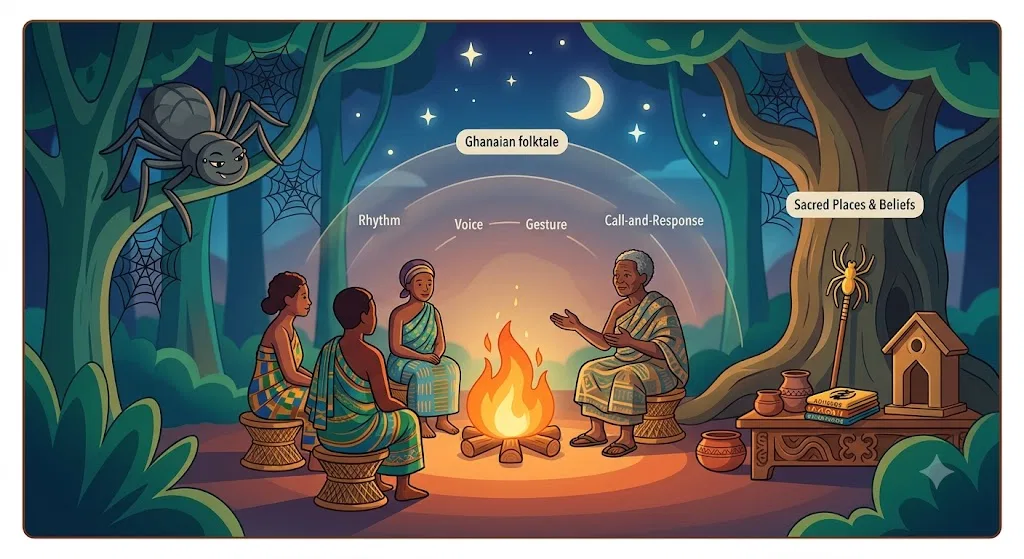
A Ghanaian folktale is often less like a silent written text and more like a social event. The story may be carried by voice, song, rhythm, call-and-response, gesture, proverb and audience reaction. In Akan contexts, scholars of oral tradition have long noted that proverbs are used not only in storytelling but also in everyday conversation, royal praise, conflict resolution, drumming, horn-blowing, dance gestures and visual symbols on objects such as staffs and swords.[Oral Tradition]oraltradition.orgOral Tradition Unraveling the KnotOral Tradition Unraveling the Knot
That matters because a story’s meaning is not confined to its plot. A child hearing a tale learns how cleverness can defeat arrogance, how greed can expose a person, how speech can conceal or reveal truth, and how human behaviour is judged by the community. A listener also learns when a story should be told, who has the right to tell it, how humour softens criticism, and how indirect speech can say what direct accusation might not.
This performance setting also explains why Ghanaian folklore is difficult to reduce to one “official” version. A tale told in one household, village, schoolroom or stage adaptation may differ from another without either being false. Variation is part of the life of oral literature. Printed collections and scholarly studies are valuable, but they are snapshots of traditions that have long circulated through memory, performance and local adaptation.
Anansi: Ghana’s spider trickster and world traveller
Anansi, often rendered in Ghanaian contexts as a spider trickster associated especially with Akan and Asante storytelling, is the figure most readers outside Ghana are likely to recognise. He is clever, greedy, funny, shameless, inventive and sometimes foolish. He may win by cunning rather than strength, but his own schemes can rebound on him. That doubleness is the point: Anansi is not simply a hero or a villain, but a testing device for social intelligence.
The historical evidence for Anansi as a major Ghanaian oral figure is strong. R. S. Rattray’s Akan-Ashanti Folk-Tales, first published in 1930, is a landmark collection of Asante tales with Akan text and English translation, and library records describe it as a collection of Ashanti tales in an Akan dialect with the two languages printed on facing pages.[Internet Archive]archive.orgOpen source on archive.org. A JSTOR-indexed study of Ananse as the Akan trickster also points to the importance of oral traditions among Akan communities and discusses Rattray’s work as part of the documentary record.[JSTOR]jstor.orgAnanse the Akan TricksterAnanse the Akan Trickster
The best-known Anansi pattern is the trickster’s quest to obtain stories, wisdom or status from a higher power. In many retellings, Anansi wins not by force but by solving impossible tasks through language, traps and nerve. UNESCO’s culture material describes Anansi as a symbol of African skill and wisdom in speech whose stories survived oral transmission and travelled especially to the Caribbean through the history of enslavement.[UNESCO]unesco.orgOpen source on unesco.org.
That Atlantic afterlife is important, but a Ghana-focused page should not let diaspora fame swallow the local tradition. In Ghana, Anansi belongs to a wider world of fireside storytelling, proverb, moral instruction, comic social criticism and theatre. A 2019 article on Ananse stories and Ghanaian pedagogy argues that Akan storytelling works as a form of indirect social communication and local knowledge-making, linking past and present in performance.[Academia]academia.eduman, know thyself: the role of ananse stories in ghanaianman, know thyself: the role of ananse stories in ghanaian

From fireside tales to Ghanaian theatre
Modern Ghanaian literature did not simply abandon oral folklore; it reworked it. One of the major figures here is Efua T. Sutherland, whose dramatic work helped turn Anansi-based storytelling into a modern Ghanaian theatrical form often discussed under the label Anansegoro. University of Ghana research describes this theatre form as rooted in the storytelling tradition of the Akan people and linked to Sutherland’s search for an authentic Ghanaian dramatic language.[UGSpace]ugspace.ug.edu.ghUGSpace ANANSE AS A FOLKLORIC CHARACTER IN NEWUGSpace ANANSE AS A FOLKLORIC CHARACTER IN NEW
This shift from oral tale to theatre changes the tradition without severing it. In a family setting, an Anansi story might teach children how greed, laziness or pride are punished. On stage, the same trickster energy can be used to examine marriage, status, money, urban aspiration or political behaviour. A study on Anansi in new Ghanaian drama notes that Ghanaian playwrights have treated Anansi in varied ways, sometimes as villain, sometimes as victor, owner of the story or socially useful commentator.[UGSpace]ugspace.ug.edu.ghUGSpace ANANSE AS A FOLKLORIC CHARACTER IN NEWUGSpace ANANSE AS A FOLKLORIC CHARACTER IN NEW
That range is one reason Anansi remains fresh. He is not locked in childhood. He can move between folk tale, school lesson, popular entertainment, theatre, copyright debate, children’s book and international fantasy. The spider survives because he is a method as much as a character: a way of thinking about power from below.
Spirits, gods and ancestors in Ghanaian belief culture
Folklore in Ghana cannot be separated neatly from traditional religion, because many stories are tied to ideas about invisible forces, ancestors, shrines, rivers, forests and moral order. A useful starting point is that Ghanaian traditional cosmologies commonly recognise a supreme being, but daily religious life has often involved more immediate relationships with deities, ancestors and local powers. A country-study account notes that the supreme being is known by different names among different groups, including Akan and Ewe examples, and is often thought of as remote from ordinary worship.[Country Studies]countrystudies.usCountry Studies Traditional ReligionCountry Studies Traditional Religion
Akan religious thought, for example, is often described as a hierarchy in which the supreme being stands above smaller gods, spirits and ancestors. A study of ancestor veneration in Akan philosophy summarises this hierarchy and notes that spirits may be understood as residing in particular parts of the world.[PhilArchive]philarchive.orgPhil Archive The Belief in and Veneration of Ancestors in AkanPhil Archive The Belief in and Veneration of Ancestors in Akan Another Ghanaian religious-studies source describes Akan religion as the indigenous religion practised before the arrival of Christianity and Islam, with the creator at its centre and shrine custodians mediating relationships with sacred powers.[Noyam Journals]noyam.orgJournals Hamartiology: An Akan PerspectiveJournals Hamartiology: An Akan Perspective
For folklore readers, the point is not to treat these beings as fantasy characters. In many local settings they belong to a lived moral and ritual landscape. A river, tree, grove or stool may matter because it is embedded in origin stories, lineage memory, taboos, healing practices, political authority or seasonal rites. Stories about spirits therefore often do practical work: they explain why a place is protected, why a rule must be obeyed, why a family remembers certain ancestors, or why a ritual specialist has authority.
Forest beings: dwarfs, monsters and the dangers of the bush
Ghanaian supernatural tradition often places power in the forest. The forest is a source of food, medicine, timber and danger; it is also a place where ordinary human rules can weaken. In Akan and Asante-related materials, two figures often discussed by folklorists and popular writers are the dwarf-like forest spirits commonly compared with fairies, and the more frightening Sasabonsam or related forest monster traditions.
The strongest museum evidence for Sasabonsam is material rather than merely textual. The British Museum holds a 1935 Asante wooden figure made in Ghana by Osei Bonsu, described as a Sasabonsam figure with a human face, bat-like wings, horns, a long beard and looped legs, seated in a tree.[British Museum]britishmuseum.orgOpen source on britishmuseum.org. Another British Museum entry notes a related figure described in connection with an animal form of Sasabonsam said to live in the ground.[British Museum]britishmuseum.orgOpen source on britishmuseum.org. These objects show that the creature was not only a fireside image but also a subject of carving and collection in the twentieth century.
Older ethnographic literature also recorded Asante interest in fairies, forest monsters and witches. Rattray’s Religion and Art in Ashanti, published in 1927, included material on “fairies, forest monsters, and witches”, and bibliographic records identify it as a major study of Ashanti religion, manners, customs and art.[Scribd]scribd.comRATTRAY Religion and Art in Ashanti 1927 pdfRATTRAY Religion and Art in Ashanti 1927 pdf Such works have to be read carefully, because colonial-era collectors often filtered local categories through European language. Still, they preserve evidence that forest beings were a recognised part of Asante supernatural imagination.
The “dwarf” traditions are harder to source from public institutional pages than Anansi or Sasabonsam, but they remain important in popular accounts of Ghanaian spirit belief. They are usually described as small hidden beings of the bush, sometimes tricky, sometimes linked with healing knowledge and ritual specialists. The safer interpretation is not to flatten them into European fairies, but to see them as part of a Ghanaian landscape where forests, rocks, medicines, hunters, healers and hidden powers meet.
Witchcraft belief: folklore with real-world consequences
Witchcraft is one of the most sensitive areas in Ghanaian belief culture because it sits between folklore, religion, social fear, accusation and human rights. It should not be treated as spooky entertainment. Harvard Divinity School’s Religion and Public Life project explains that Ghanaian ideas about witchcraft have been shaped by indigenous religious worlds as well as colonialism, Christianity, Islam and other influences, and that belief in witchcraft and witch-finders cuts across class, education, religion, age and region.[rpl.hds.harvard.edu]rpl.hds.harvard.eduOpen source on harvard.edu.
In folklore terms, witchcraft belief often provides a narrative explanation for misfortune: illness, death, crop failure, infertility, bad luck or family conflict. In social terms, it can become a weapon against vulnerable people, especially older women. Amnesty International reported in 2025 that hundreds of women in northern Ghana had been accused of witchcraft and forced into remote camps, with serious consequences for housing, family life, dignity, food, water and healthcare.[Amnesty International]amnesty.orgInternational Ghana: Branded for LifeInternational Ghana: Branded for Life
The camps themselves are sometimes described locally as places of refuge where accused people may be safe from attack. ActionAid’s earlier report noted that some camps were believed locally to be “safe places” where witchcraft could not be carried out, while also emphasising that many women could not return home even when judged innocent because their communities would not accept them.[ActionAid UK]actionaid.org.ukAction Aid UKwomen and witchcraft in GhanaAction Aid UKwomen and witchcraft in Ghana
This is where a folklore page must be especially careful. The cultural history of witchcraft belief is real and important, but accusations against living people are not harmless stories. They can lead to banishment, assault, poverty and stigma. A grounded account should distinguish between mythic figures such as dangerous witches in tales, broader religious ideas about hidden harm, and the modern legal and ethical problem of accusing actual people.
Sacred places and why stories protect landscapes
Ghanaian folklore is often attached to place. Sacred groves, shrines, rivers, hills, lakes and festival routes can carry stories that regulate behaviour. A grove may be protected not because of a written conservation law, but because it is understood as the dwelling of a deity, ancestor or other supernatural being. Research on Ghanaian sacred groves describes them as products of indigenous religious belief and notes that they have historically helped conserve biodiversity because groves are believed to house local gods, ancestral spirits and other supernatural beings.[SSRN]papers.ssrn.comOpen source on ssrn.com.
This is one of the clearest examples of folklore having practical effects. A taboo against cutting trees, hunting in a grove, entering on a particular day, or polluting a water source can preserve habitat. A review of biodiversity in Ghanaian sacred groves estimates that there are thousands of such groves in Ghana, many in the southern half of the country, and describes them as ecological and sociocultural refuges for forest, medicinal plants, ritual life and local biodiversity.[ResearchGate]researchgate.netOpen source on researchgate.net.
The Songor area in south-eastern Ghana offers a concrete example of cultural life tied to landscape. UNESCO’s Man and the Biosphere programme notes that the Asafotufiam festival is a major homecoming involving rites in two sacred groves, and that marine turtles are totems for five clans, reinforcing conservation.[UNESCO]unesco.orgOpen source on unesco.org. This is not folklore as decorative background; it is story, ritual, identity and environmental practice braided together.
Sacred landscapes also change under pressure. Migration, Christianity, Islam, urbanisation, commercial farming, schooling and tourism can all alter how taboos are understood. Some people continue to treat groves and shrines as living sacred places; others reinterpret them as heritage, conservation sites or tourist destinations. The tension between reverence, scepticism, development and preservation is now part of the story.
Festivals as remembered history, ritual and public culture
Ghanaian festivals are often described as colourful public events, but their deeper role is to make history, migration, harvest, military memory, ancestral honour and sacred obligation visible. The National Commission on Culture’s festival listings include Aboakyer, celebrated by the Effutu people of Winneba on the first Saturday in May, among many other traditional festivals across the country.[Ghana Culture]ghanaculture.gov.ghOpen source on ghanaculture.gov.gh.
Aboakyer is a good example of the way folklore and ritual can become a public spectacle without losing local meaning. University of Education, Winneba research describes the festival’s traditional rituals as important to Effutu culture and explains that two warrior groups take part in a hunting expedition, with the first to capture a live bushbuck and present it at a durbar highly regarded for bravery; the animal is then sacrificed, marking the start of the festival cycle.[UEWScholar]ir.uew.edu.ghOpen source on edu.gh.
Homowo, associated with the Ga people of the Greater Accra Region, is another widely known festival. Ghana’s official tourism site describes it as an annual celebration between August and September that commemorates a period of famine endured during migration.[Visit Ghana]visitghana.comOpen source on visitghana.com. Its core narrative is memorable because it turns hunger into communal defiance: a remembered crisis becomes a ritual of survival, food, music, family gathering and public identity.
Festivals matter to folklore because they keep stories embodied. A migration story is walked, danced, cooked, sung or re-enacted. A deity is not merely named; it is honoured through a rite. A moral value such as bravery, unity or gratitude becomes a public act. That is why festival traditions often survive even when individual beliefs shift.
What is old, what is collected, and what is modern invention?
Readers often ask whether a folklore item is “authentic”. For Ghana, the better question is: authentic in what sense? Some traditions are old oral materials with multiple local variants. Some are colonial-era collections, valuable but filtered through translators, administrators and scholars. Some are modern literary adaptations. Some are tourist summaries. Some are internet-era monster profiles that mix Ghanaian tradition with global fantasy language.
Anansi is strongly attested in oral tradition, print collections, scholarship, theatre and diaspora transmission. Sasabonsam has both textual and museum-object evidence, including named Asante carving in the British Museum. Sacred groves and festival traditions are supported by contemporary cultural, environmental and institutional sources. Witchcraft belief is widely documented, but modern claims about specific accused people must be treated as harmful social allegations, not folklore curiosities.
By contrast, some online creature lists present Ghanaian beings as if they were fixed entries in a fantasy bestiary. These can be useful starting points for names, but they often strip stories from performance, language, place and ritual use. A responsible Ghana folklore page should therefore prefer sources that show context: oral performance, museum records, Ghanaian cultural institutions, academic studies, human-rights reporting, and local festival documentation.
Folklore, copyright and cultural ownership in Ghana today
Ghana is unusual because folklore is not only a cultural matter; it is also a legal and policy matter. Scholarship on Ghanaian copyright notes that the 2005 Copyright Act made use of Ghanaian folklore by nationals and non-nationals subject to consent from the National Folklore Office or National Folklore Board and payment of a fee before use.[AUC Library]library.au.intwho owns ananse tangled web folklore and copyright ghanawho owns ananse tangled web folklore and copyright ghana A later academic summary states that Ghana’s 2005 legislation protects folklore against unregulated use even by Ghanaian nationals, meaning a Ghanaian creator may have to register intent and pay an undetermined fee before using cultural heritage commercially.[The UWS Academic Portal]research-portal.uws.ac.ukcopyright and folklore in ghana a question of national treatmentcopyright and folklore in ghana a question of national treatment
The aim is understandable: to prevent outsiders from exploiting Ghanaian cultural expressions without recognition or benefit. But scholars and artists have raised a difficult question: can protecting folklore also make it harder for Ghanaian writers, musicians, playwrights and designers to rework their own traditions? That debate is especially relevant to Anansi, because the spider is both a communal inheritance and a commercial icon.
At the same time, Ghanaian institutions continue to promote oral storytelling as living culture. In 2025, Ghana’s government reintroduced the “By the Fire Side” storytelling series through the National Folklore Board, with reports saying the monthly series would feature stories from Ghana’s diverse regions in local languages.[Ghana News Agency]gna.org.ghgovernment re introduces by the fire side storytelling seriesgovernment re introduces by the fire side storytelling series The revival shows that the state is not only trying to regulate folklore; it is also trying to keep performance alive for new audiences.
How Ghanaian folklore is understood now
Today, Ghanaian folklore sits in several worlds at once. In families and communities, it can still teach children, entertain gatherings and preserve local memory. In schools and books, it becomes literature and moral education. In festivals, it becomes public heritage. In sacred groves, it can support conservation. In theatre, it becomes modern drama. In law, it becomes protected cultural property. Online, it becomes searchable mythology, sometimes enriched and sometimes distorted.
The most useful way to approach Ghanaian folklore is therefore neither as superstition nor as a fixed national storybook. It is a living set of narrative practices: stories people tell, places people honour, beings people imagine, rituals people perform, and arguments people continue to have about identity, ownership, belief and change.
Anansi’s web is a good metaphor, but only if it is not allowed to cover everything. Ghana’s folklore is also in the grove that should not be cut, the festival that remembers hunger, the shrine by the water, the proverb spoken through a royal staff, the stage play that turns a trickster into social criticism, and the painful modern reality of witchcraft accusations. Its power lies in that mixture: playful and serious, ancient and newly adapted, local and global, entertaining and morally charged.
Amazon book picks
Further Reading
Books and field guides related to What Makes Ghanaian Folklore Still Feel Alive?. Use these as the next step if you want deeper reading beyond the article.
African Folktales
Includes storytelling traditions closely related to Ghanaian folklore.
The palm-wine drinkard and his dead palm-wine tapster in the...
First published 1952. Subjects: Fiction, Yoruba (African people), Folklore, Wine and wine making, Nigeria, fiction.
eBay marketplace picks
Marketplace Samples
Live-tested eBay searches with available results related to this page.

Endnotes
1.
Source: archive.org
Link:https://archive.org/details/akanashantifolkt0000ratt
2.
Source: jstor.org
Title: Ananse the Akan Trickster
Link:https://www.jstor.org/stable/1581431
3.
Source: unesco.org
Link:https://www.unesco.org/en/working-towards-african-renaissance-through-culture-and-history
4.
Source: academia.edu
Title: man, know thyself: the role of ananse stories in ghanaian
Link:https://www.academia.edu/41720072/MAN_KNOW_THYSELF_THE_ROLE_OF_ANANSE_STORIES_IN_GHANAIAN_PEDAGOGY
5.
Source: ugspace.ug.edu.gh
Title: UGSpace ANANSE AS A FOLKLORIC CHARACTER IN NEW
Link:https://ugspace.ug.edu.gh/server/api/core/bitstreams/7eb7d24c-c1d2-40d9-a010-faba7b25996b/content
6.
Source: philarchive.org
Title: Phil Archive The Belief in and Veneration of Ancestors in Akan
Link:https://philarchive.org/archive/MORTBI
7.
Source: noyam.org
Title: Journals Hamartiology: An Akan Perspective
Link:https://noyam.org/?download_id=7889&sdm_process_download=1
8.
Source: scribd.com
Title: RATTRAY Religion and Art in Ashanti 1927 pdf
Link:https://www.scribd.com/document/463950346/RATTRAY-Religion-and-Art-in-Ashanti-1927-pdf
9.
Source: rpl.hds.harvard.edu
Link:https://rpl.hds.harvard.edu/religion-context/case-studies/violence-peace/witch-camps-ghana
10.
Source: amnesty.org
Title: International Ghana: Branded for Life
Link:https://www.amnesty.org/en/latest/research/2025/04/ghana-branded-for-life/
11.
Source: papers.ssrn.com
Link:https://papers.ssrn.com/sol3/papers.cfm?abstract_id=1665065
12.
Source: researchgate.net
Link:https://www.researchgate.net/publication/235701263_Review_of_biodiversity_in_sacred_groves_in_Ghana_and_implications_on_conservation
13.
Source: unesco.org
Link:https://www.unesco.org/en/mab/songor
14.
Source: ir.uew.edu.gh
Link:https://ir.uew.edu.gh/bitstream/handle/123456789/2194/Effects%20of%20covid-19%20pandemic%20on%20community%20based%20event%20The%20case%20of%20Aboakyer%20Festival.pdf?isAllowed=y&sequence=1
15.
Source: noyam.org
Title: the role of ananse stories in ghanaian pedagogy
Link:https://noyam.org/?download_id=3353&sdm_process_download=1
16.
Source: noyam.org
Link:https://noyam.org/?download_id=6797&sdm_process_download=1
17.
Source: archive.org
Link:https://archive.org/details/anansifindsfool00vern
18.
Source: archive.org
Title: religionartinash0000ratt p4f9
Link:https://archive.org/details/religionartinash0000ratt_p4f9
19.
Source: researchgate.net
Title: 351515892 From Anansesem to Anansegoro ‘Literarising’ Akan Folktales
Link:https://www.researchgate.net/publication/351515892From_Anansesem_to_Anansegoro%27Literarising%27_Akan_Folktales
20.
Source: researchgate.net
Title: 381140790 Preserving Traditional Ghanaian Folklore through Storytelling
Link:https://www.researchgate.net/publication/381140790_Preserving_Traditional_Ghanaian_Folklore_through_Storytelling
21.
Source: researchgate.net
Link:https://www.researchgate.net/publication/351950506_Witchcraft_in_Ghana_Belief_Practice_and_Consequences
22.
Source: researchgate.net
Link:https://www.researchgate.net/publication/325185415_An_anthropological_study_of_witch_camps_and_human_rights_in_northern_Ghana
23.
Source: researchgate.net
Title: 302588897 The list of 100 objects from British Museum collection
Link:https://www.researchgate.net/publication/302588897_The_list_of_100_objects_from_British_Museum_collection
24.
Source: researchgate.net
Link:https://www.researchgate.net/publication/378444646_The_Akan_Indigenous_Concepts_of_Religion_and_Nyame_the_Supreme_Deity_and_the_Promotion_of_Inter-religious_Relations_in_Ghana
25.
Source: researchgate.net
Link:https://www.researchgate.net/publication/278679209_Birifoh_Belief_System_Perspectives_from_Birifoh-Sila_Yiri_Upper_West_Region_Ghana
26.
Source: researchgate.net
Link:https://www.researchgate.net/publication/335381043_Recent_Discoveries_in_the_Aboakyer_Festival_of_the_Effutus-Ghana
27.
Source: researchgate.net
Link:https://www.researchgate.net/publication/310660198_Who_owns_Ananse_The_tangled_web_of_folklore_and_copyright_in_Ghana
28.
Source: researchgate.net
Title: 264879711 The Nationalization And Commercialization Of Ghanaian Folklore
Link:https://www.researchgate.net/publication/264879711_The_Nationalization_And_Commercialization_Of_Ghanaian_Folklore
29.
Source: researchgate.net
Link:https://www.researchgate.net/publication/371545695_Ghanaian_Languages_An_Essential_Regulatory_Instrument_that_Promote_Culture
30.
Source: ich.unesco.org
Title: benin BJ
Link:https://ich.unesco.org/en/state/benin-BJ
31.
Source: ich.unesco.org
Title: 65029 EN
Link:https://ich.unesco.org/doc/src/65029-EN.pdf
32.
Source: whc.unesco.org
Link:https://whc.unesco.org/en/tentativelists/1392/
33.
Source: whc.unesco.org
Link:https://whc.unesco.org/en/decisions/4841/
34.
Source: ich.unesco.org
Link:https://ich.unesco.org/doc/src/Signed%20periodic%20report%20-%20Periodic%20report-62640.pdf
35.
Source: whc.unesco.org
Link:https://whc.unesco.org/en/activities/496/
36.
Source: whc.unesco.org
Link:https://whc.unesco.org/archive/andes98.pdf
37.
Source: unesdoc.unesco.org
Link:https://unesdoc.unesco.org/ark%3A/48223/pf0000113898
38.
Source: jstor.org
Link:https://www.jstor.org/stable/40654609
39.
Source: jstor.org
Link:https://www.jstor.org/stable/40986316
40.
Source: jstor.org
Link:https://www.jstor.org/stable/26283152
41.
Source: jstor.org
Link:https://www.jstor.org/stable/42884256
42.
Source: jstor.org
Link:https://www.jstor.org/stable/48856289
43.
Source: jstor.org
Link:https://www.jstor.org/stable/pdf/48569376.pdf
44.
Source: jstor.org
Link:https://www.jstor.org/stable/1771741
45.
Source: jstor.org
Link:https://www.jstor.org/stable/30029611
46.
Source: jstor.org
Link:https://www.jstor.org/stable/3818938
47.
Source: academia.edu
Link:https://www.academia.edu/65729354/Tackling_the_Preservation_of_African_Tales_in_the_Technological_Era_Ghanas_Legends
48.
Source: academia.edu
Link:https://www.academia.edu/73339305/Traditional_Festivals_in_the_Political_Economy_The_Case_of_Contemporary_Ghana
49.
Source: academia.edu
Title: Who owns Ananse The tangled web of folklore and copyright in Ghana
Link:https://www.academia.edu/30218092/Who_owns_Ananse_The_tangled_web_of_folklore_and_copyright_in_Ghana
50.
Source: curriculumresources.edu.gh
Link:https://curriculumresources.edu.gh/wp-content/uploads/2024/12/Religious-Studies_Section-6-LV.pdf
51.
Source: curriculumresources.edu.gh
Title: History Section 7 LV
Link:https://curriculumresources.edu.gh/wp-content/uploads/2025/01/History_Section-7-LV.pdf
52.
Source: curriculumresources.edu.gh
Link:https://curriculumresources.edu.gh/wp-content/uploads/2025/05/Government_-Section-TV-2.pdf
53.
Source: ugspace.ug.edu.gh
Link:https://ugspace.ug.edu.gh/bitstreams/4c2112ab-457f-44be-b9bb-749b72fa2079/download
54.
Source: ugspace.ug.edu.gh
Link:https://ugspace.ug.edu.gh/bitstreams/301ce39f-0cea-486f-9bd6-dbc7775f8e62/download
55.
Source: amnesty.org
Title: ghana witchcraft accusations
Link:https://www.amnesty.org/en/latest/news/2025/04/ghana-witchcraft-accusations/
56.
Source: scribd.com
Link:https://www.scribd.com/document/995410973/Akan-Ashanti-Folktales
57.
Source: scribd.com
Title: Anansi wins Stories
Link:https://www.scribd.com/document/734689449/Anansi-wins-Stories
58.
Source: scribd.com
Link:https://www.scribd.com/document/371092574/Akan-Ashanti-Folk-Tales-R-S-Rattray
59.
Source: scribd.com
Link:https://www.scribd.com/document/730557603/2
60.
Source: scribd.com
Link:https://www.scribd.com/document/33657031/Akan-Ghanaian-Traditional-Thought-and-Notions-of-Gods
61.
Source: scribd.com
Link:https://www.scribd.com/document/635122754/AS-Project-Mahdi
62.
Source: scribd.com
Link:https://www.scribd.com/document/932224315/Aboakyere-Festival-1
63.
Source: cwas.uestc.edu.cn
Link:https://cwas.uestc.edu.cn/__local/A/FD/26/653E50871872AD6F47F60B0A0AA_51F25885_1E19B6.pdf
64.
Source: folklore.earth
Link:https://www.folklore.earth/culture/akan/
65.
Source: ir.knust.edu.gh
Link:https://ir.knust.edu.gh/bitstreams/9da42280-fe47-4282-a2e4-6b17441a6d92/download
66.
Source: journals.uew.edu.gh
Link:https://journals.uew.edu.gh/index.php/jaac/article/download/484/281/1222
67.
Source: ir.ucc.edu.gh
Link:https://ir.ucc.edu.gh/xmlui/handle/123456789/10752
68.
Source: youtube.com
Link:https://www.youtube.com/watch?v=pT-NvGBa1zA
Source snippet
Anansi, Nyame & Asase Yaa - Akan Mythology - Adeche Atelier...
69.
Source: census2021.statsghana.gov.gh
Link:https://census2021.statsghana.gov.gh/subreport.php?Ghana-2021-Population-and-Housing-Census-General-Report-Volume-3C=&readreport=NTI3ODI4NDAuNzUz
70.
Source: ghanaculture.gov.gh
Link:https://ghanaculture.gov.gh/ghanas-literary-heritage-and-oral-foundations/
71.
Source: oraltradition.org
Title: Oral Tradition Unraveling the Knot
Link:https://oraltradition.org/unraveling-the-knot/
72.
Source: countrystudies.us
Title: Country Studies Traditional Religion
Link:https://countrystudies.us/ghana/52.htm
73.
Source: britishmuseum.org
Link:https://www.britishmuseum.org/collection/object/E_Af1935
74.
Source: britishmuseum.org
Link:https://www.britishmuseum.org/collection/object/E_Af1947
75.
Source: actionaid.org.uk
Title: Action Aid UKwomen and witchcraft in Ghana
Link:https://www.actionaid.org.uk/sites/default/files/publications/condemned_without_trial_women_and_witchcraft_in_ghana_report_september_2012.pdf
76.
Source: ghanaculture.gov.gh
Link:https://ghanaculture.gov.gh/festivals/
77.
Source: ghanaculture.gov.gh
Link:https://ghanaculture.gov.gh/festivals-list/
78.
Source: visitghana.com
Link:https://visitghana.com/homowo-festival/
79.
Source: library.au.int
Title: who owns ananse tangled web folklore and copyright ghana
Link:https://library.au.int/who-owns-ananse-tangled-web-folklore-and-copyright-ghana
80.
Source: research-portal.uws.ac.uk
Title: copyright and folklore in ghana a question of national treatment
Link:https://research-portal.uws.ac.uk/en/publications/copyright-and-folklore-in-ghana-a-question-of-national-treatment
81.
Source: gna.org.gh
Title: government re introduces by the fire side storytelling series
Link:https://gna.org.gh/2025/08/government-re-introduces-by-the-fire-side-storytelling-series/
82.
Source: Wikipedia
Link:https://en.wikipedia.org/wiki/Anansi
83.
Source: Wikipedia
Link:https://en.wikipedia.org/wiki/Ghana
84.
Source: Wikipedia
Title: Akan religion
Link:https://en.wikipedia.org/wiki/Akan_religion
85.
Source: Wikipedia
Link:https://en.wikipedia.org/wiki/Sasabonsam
86.
Source: natureandsupernaturalnature.wordpress.com
Link:https://natureandsupernaturalnature.wordpress.com/tag/ashanti/
87.
Source: cryptidarchives.fandom.com
Link:https://cryptidarchives.fandom.com/wiki/Sasabonsam
88.
Source: mythopia.io
Title: Ananse Stories
Link:https://mythopia.io/tagged/1/ananse
89.
Source: ghanaculture.gov.gh
Link:https://ghanaculture.gov.gh/
90.
Source: bmarchives.org
Link:https://www.bmarchives.org/items/show/34765?output=pdf
91.
Source: ottawa.mfa.gov.gh
Link:https://ottawa.mfa.gov.gh/population.aspx
92.
Source: scispace.com
Title: Religion and Art in Ashanti
Link:https://scispace.com/papers/religion-and-art-in-ashanti-p2eamabshm?citations_page=23
93.
Source: ageconsearch.umn.edu
Link:https://ageconsearch.umn.edu/record/92787/?ln=en
95.
Source: akwaaba.app
Link:https://akwaaba.app/aboakyer/
96.
Source: find.slv.vic.gov.au
Link:https://find.slv.vic.gov.au/discovery/fulldisplay/alma994692283607636/61SLV_INST%3ASLV
97.
Source: libraryguides.umassmed.edu
Link:https://libraryguides.umassmed.edu/diversity_guide/ghanaian
98.
Source: thecommonwealth.org
Link:https://thecommonwealth.org/our-member-countries/ghana
99.
Source: visitghana.com
Link:https://visitghana.com/
100.
Source: ebsco.com
Link:https://www.ebsco.com/research-starters/literature-and-writing/anansi
101.
Source: ghana.gov.gh
Link:https://www.ghana.gov.gh/
102.
Source: worldbank.org
Link:https://www.worldbank.org/ext/en/country/ghana
Additional References
103.
Source: youtube.com
Title: Live Family Storytelling: Anansi and the Unknown Challenge
Link:https://www.youtube.com/watch?v=zi-fMrPrXW0
Source snippet
Anansi's Biggest Mistake? Trying to Hoard Wisdom from Everyone...
104.
Source: youtube.com
Title: Anansi, Nyame & Asase Yaa
Link:https://www.youtube.com/watch?v=hych6rpQX0c
Source snippet
Live Family Storytelling: Anansi and the Unknown Challenge...
105.
Source: instagram.com
Link:https://www.instagram.com/reel/DGJCxnzO4l6/
106.
Source: facebook.com
Link:https://www.facebook.com/FabafriqMagazine/posts/-aboakyer-festival-ghanas-symbol-of-strength-and-unitydo-you-plan-on-visiting-gh/1376482081172216/
107.
Source: ghanaembassy.at
Link:https://ghanaembassy.at/about-ghana/
108.
Source: facebook.com
Link:https://www.facebook.com/Bangtvzambia/posts/african-mythology-is-he-saying-the-truth-about-luchelenganga/1313235034149790/
109.
Source: mythologis.com
Link:https://mythologis.com/mythologies/africa-middle-east/african
110.
Source: tota.world
Link:https://www.tota.world/article/810/
111.
Source: atscoalition.org
Link:https://www.atscoalition.org/akan-shrine-houses
112.
Source: amazon.co.uk
Link:https://www.amazon.co.uk/Akan-Ashanti-Folk-Tales-R-S-Rattray/dp/1025262913?tag=searcht-20
Topic Tree
Follow this branch
Related pages 192
- Afghan Folklore
- Albanian Folklore
- Algerian Folklore
- Australian Folklore
- Azerbaijan Folklore
- +187 more in sidebar