Why Cape Verdean Folklore Feels So Alive
Cape Verde’s folklore is best understood as island oral culture rather than as a single, tidy “mythology”. Its stories grew from a Creole society formed in the Atlantic, shaped by West African memory, Portuguese colonial rule, Catholic festivals, migration, drought, sea travel, music, and everyday village life.
Page outline Jump by section
Introduction
For curious readers, the key point is this: Cape Verdean folklore is not a museum cabinet of monsters. It is a living, changing web of oral storytelling, music, Catholic-African festival practice, diaspora memory, and modern heritage work. Some traditions are well documented, such as morna and tabanca; others, such as witch stories and ghost tales, are harder to pin down because they often survived as local, family, or island-specific narratives rather than as official national legends.[Instituto do Património Cultural]ipc.cvInstituto do Património Cultural Tabanca – Instituto do Património CulturalInstituto do Património Cultural Tabanca – Instituto do Património Cultural
Why Cape Verdean folklore feels different from “mythology”
Cape Verde was uninhabited before Portuguese settlement began in the fifteenth century, so its folklore does not descend from a pre-colonial island pantheon in the way some countries’ traditions are linked to older sacred landscapes. Instead, the archipelago’s story culture emerged through contact: enslaved and free Africans, Portuguese settlers, sailors, traders, Catholic institutions, later emigrants, and island-born Creole communities all shaped the imaginative world of the islands. That makes Cape Verdean folklore highly hybrid: African-style trickster patterns can sit beside Portuguese names, Catholic saints, Atlantic sea imagery, and local island settings.
This also explains why language matters so much. Cape Verdean Creole became the everyday medium of home, song, humour, memory, and oral performance, while Portuguese remained the official colonial and administrative language. Scholars of Cape Verdean language and identity often describe Creole not merely as a tool of communication but as a way of seeing the world formed through contact, movement, inequality, and adaptation.[OpenEdition Journals]journals.openedition.orgOpen source on openedition.org.
The result is folklore with a practical, social flavour. Many stories are about wit, hunger, danger, obligation, reputation, luck, and survival. The setting may be a road, a mountain, a household, a village feast, a chapel, a field, or the sea. The supernatural is present, but often alongside moral comedy and everyday pressure: who tricks whom, who eats, who escapes, who is exposed, who belongs.
Nho Lobo and the Cape Verdean trickster world
The best-known Cape Verdean folktale figure for English-language readers is Nho Lobo, often translated as “Mr Wolf” or “Uncle Wolf”. He appears in school materials, diaspora collections, and Cape Verdean folktale discussions as a lazy, greedy, boastful, or gullible creature who tries to outwit others but is often outwitted himself. A 1976 teaching guide, Nho Lobo: Folk Tales of the Cape Verdean People, presents two folktales, including “The Biggest Liar”, and asks students to discuss Nho Lobo’s traits, Cape Verdean values, and links with animal and trickster tales elsewhere.[ERIC]eric.ed.gov183469 - Nho Lobo: Folk Tales of the Cape Verdean People. Teacher's Guide., 1976…
Nho Lobo matters because he shows how Cape Verdean folklore often works through humour rather than awe. He is not a sacred wolf-god or a horror monster. He is closer to a trickster-animal figure: useful for teaching children, laughing at foolishness, and exploring social intelligence. In the tale materials preserved for Cape Verdean-American education, Nho Lobo dreams of food, schemes to trick people, and is beaten by cleverer opponents.[ERIC]files.eric.ed.govERICCape Verde and Its PeopleERICCape Verde and Its People
His stories also reveal Cape Verde’s place in wider Atlantic folklore. Trickster animals are common across West African, Caribbean, European, and African-American traditions, but the Cape Verdean versions are not simply copies. They are localised through Creole speech, island settings, hunger, rural social life, and the moral pleasure of seeing arrogance defeated. That is why Nho Lobo is a strong candidate for any internal link on Cape Verdean trickster tales, animal folklore, or diaspora storytelling.
Witches, charms and household fear
Witches appear in Cape Verdean folklore, but the evidence is more fragmentary than internet summaries sometimes suggest. Older collections and later retellings point to witch beliefs, protective charms, and stories of danger around night travel, infants, animals, or vulnerable households. One striking early detail from Parsons’s Cape Verde material concerns crosses cut into woodwork in a Brava family home as charms against witches; the same source tradition also records witch-related tale material and protective practice.[Internet Archive]archive.orgOpen source on archive.org.
These traditions should be handled carefully. “Witch” is an English convenience for a range of Portuguese and Creole terms and ideas, and the same word can blur folk fear, Catholic moral language, inherited Portuguese demonology, African-derived spiritual concepts, and ordinary social suspicion. In other words, Cape Verdean witch lore is not a neat fantasy category. It belongs to lived belief: illness, misfortune, envy, infant vulnerability, and the need to protect the home.
Modern tourism and folklore blogs sometimes list Cape Verdean witches beside werewolves, ghosts, and monsters. Such summaries can be useful for orientation, but they often flatten local variation. The older evidence is more modest and more interesting: witch belief appears in charms, tales, warnings, and family memory rather than in one nationally standardised legend.
Saints, drums and the sacred theatre of tabanca
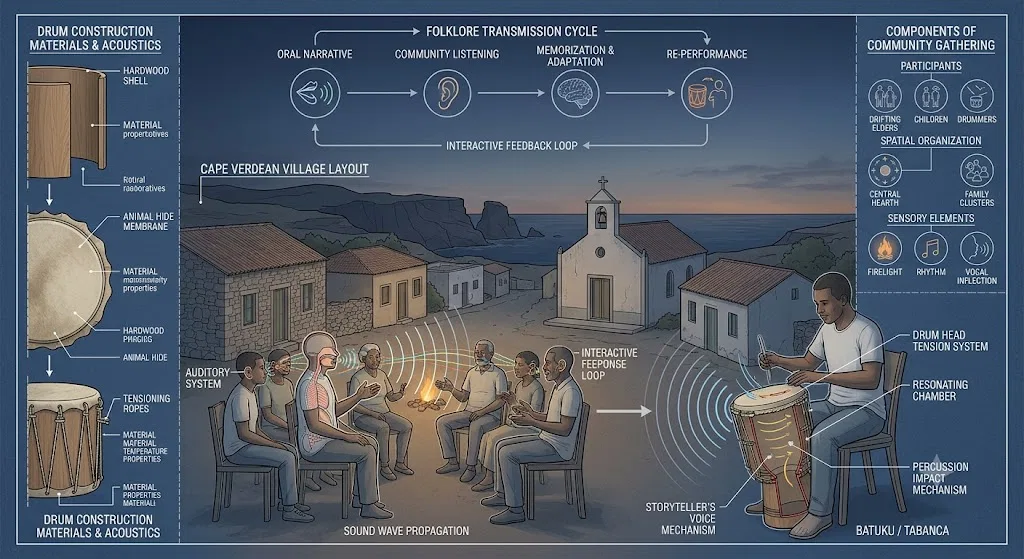
For a reader looking for living folklore rather than old printed tales, tabanca is one of Cape Verde’s richest traditions. It is a ritual-festive practice especially associated with Santiago and Maio, combining Catholic patron-saint devotion, community organisation, music, food, procession, mock authority, symbolic theft, repayment, and public performance. Cape Verde’s Institute of Cultural Heritage describes tabanca festivities as beginning with preparation weeks before the patron saint’s day, including fundraising, decoration, instrument maintenance, communal food, chapel ceremonies, drumming, singing, and dance.[Instituto do Património Cultural]ipc.cvInstituto do Património Cultural Tabanca – Instituto do Património CulturalInstituto do Património Cultural Tabanca – Instituto do Património Cultural
The most memorable element is the dramatic mixture of sacred and playful action. In Praia, the ritual can include a ceremony in the chapel, the sound of drums, the presentation of flags, a communal soup, all-night dancing, and the symbolic stealing of the saint, represented by a small white flag with a red cross and a ritual stick. The “thieves” negotiate with the queen or king figure, food and drink are distributed, and the procession thickens as it moves through the community.[Instituto do Património Cultural]ipc.cvInstituto do Património Cultural Tabanca – Instituto do Património CulturalInstituto do Património Cultural Tabanca – Instituto do Património Cultural
This is folklore in a broad but very real sense: not a fictional story about a saint, but an enacted story-world. People take roles, objects carry symbolic force, sacred and profane space are separated and recombined, and the community retells its values through action. The Institute of Cultural Heritage notes that after an inventory process with communities, Cape Verde classified tabanca as National Intangible Cultural Heritage on 9 August 2019, the same date on which the Cape Verdean language was elevated to national heritage.[Instituto do Património Cultural]ipc.cvInstituto do Património Cultural Tabanca – Instituto do Património CulturalInstituto do Património Cultural Tabanca – Instituto do Património Cultural
Morna, batuku and the sung side of folklore
Cape Verdean folklore cannot be separated from music. Morna, the archipelago’s internationally recognised song tradition, is not “myth” in the narrow sense, but it carries many of the emotional functions that epic, lament, and ballad traditions carry elsewhere. UNESCO describes morna as a Cape Verdean musical and choreographic practice involving voice, music, poetry and dance, performed with instruments such as guitar, violin, ten-string guitar, cavaquinho and ukulele; its lyric themes include love, departure, separation, reunion and the homeland.[UNESCO Intangible Cultural Heritage]ich.unesco.orgIntangible Cultural Heritageich.unesco.orgUNESCO Intangible Cultural Heritageich.unesco.org…
Those themes are central to Cape Verdean cultural imagination. Islands produce departures: sailors leave, families migrate, drought forces movement, and the homeland becomes both physical place and remembered place. Morna turns that experience into public feeling. It is one reason Cape Verdean tradition often sounds less like monster lore and more like a culture of longing, endurance, wit and return.
Batuku, often linked to women’s performance, drumming, dance and call-and-response, is another important bridge between folklore and social life. In the tabanca descriptions preserved by the Institute of Cultural Heritage, batuku appears around the chapel space and festive ground, where women dance into the night to the beat of the percussion.[Instituto do Património Cultural]ipc.cvInstituto do Património Cultural Tabanca – Instituto do Património CulturalInstituto do Património Cultural Tabanca – Instituto do Património Cultural Praia’s UNESCO Creative Cities profile also places tabanka, batuque and funaná among the musical genres promoted after independence, alongside morna and coladeira.[UNESCO]unesco.orgOpen source on unesco.org.
For folklore readers, the takeaway is that Cape Verdean tradition often lives through performance rather than through fixed written myth. A song can preserve a value. A drum pattern can mark a ritual boundary. A dance circle can keep memory alive in a way a written tale cannot.
Haunted places and supernatural landscapes
Cape Verde does have ghostly and haunted-place traditions, but they are less consistently documented in major English-language sources than Nho Lobo, morna or tabanca. Modern island retellings mention apparitions, haunted rocks, salt-flat stories, witches, and werewolf-like figures, but many of these accounts circulate through tourism writing, local storytelling, social media, and contemporary folklore pages rather than through older scholarly collections. That does not make them worthless, but it does change how confidently they should be presented.[Sal Cabo Verde]salcaboverde.comSal Cabo Verde Cape Verdean Folklore: Tales and Legends of the IslandsSal Cabo Verde Cape Verdean Folklore: Tales and Legends of the Islands
A useful way to read these stories is to connect them with landscape. Cape Verde’s folklore terrain includes volcanic Fogo, dry valleys, salt pans, coastal roads, mountain paths, chapels, cemeteries, and ports of departure. In a place where drought, shipwreck, migration and labour have shaped memory, it is unsurprising that ghost stories gather around thresholds: roads, stones, sea edges, abandoned worksites, and places where people passed, suffered, or disappeared.
The strongest claim is not that Cape Verde has one famous national haunted site comparable to a castle legend. It is that local supernatural storytelling maps emotion onto landscape. A rock can become a witness. A salt flat can become a memory of labour. A mountain path can become a place where night travel feels morally and spiritually risky.
The diaspora as a folklore archive
Cape Verdean folklore is unusual because some of its most important early printed records were collected outside Cape Verde. Parsons’s Folk-Lore from the Cape Verde Islands, published in 1923, was based on material gathered among Cape Verdean immigrants and their descendants in the United States. Later commentary describes the collection as extensive and notes that it includes fables, stories, proverbs, sayings and riddles.[Scribd]scribd.comVoices From An Empire: A History of Afro-Portuguese…Folklore from the Cape Verde Islands, which contains fables, stories…
This matters because Cape Verde has long been a diaspora nation. Stories travelled with sailors, labourers, families and students to New England, Portugal, the Netherlands, France, Luxembourg, Senegal, Angola and elsewhere. In diaspora, folklore can become more than entertainment: it helps children recognise family speech, gives migrants a portable homeland, and turns local island memories into ethnic heritage.
The 1976 Nho Lobo teaching guide shows this clearly. It was produced for cultural education, using folktales to teach children about Cape Verde, values, geography, and comparisons with American folklore. That is folklore doing social work: preserving identity in a new setting while adapting the stories for classrooms.[ERIC]eric.ed.gov183469 - Nho Lobo: Folk Tales of the Cape Verdean People. Teacher's Guide., 1976…
What is old, what is documented, and what is modern retelling?
A fair Cape Verde folklore page needs to separate several layers.
Older oral tradition includes animal tales, trickster stories, riddles, proverbs, witch beliefs, charms, and sung or performed community memory. Some of this entered print through Parsons in the early twentieth century and through Cape Verdean writers and folklorists such as Pedro Cardoso, whose Folclore Caboverdeano was published in 1933.[Scribd]scribd.comVoices From An Empire: A History of Afro-Portuguese…Folklore from the Cape Verde Islands, which contains fables, stories…
Community ritual heritage includes tabanca, batuku, morna, funaná and other performed traditions. These are not all “folklore” in the narrow tale-collection sense, but they are central to Cape Verdean intangible culture. UNESCO inscribed morna on the Representative List of the Intangible Cultural Heritage of Humanity in 2019, while Cape Verde’s own heritage body classifies tabanca as national intangible heritage.[UNESCO Intangible Cultural Heritage]ich.unesco.orgIntangible Cultural Heritageich.unesco.orgUNESCO Intangible Cultural Heritageich.unesco.org…
Literary retelling is another layer. Cape Verdean literature has often drawn on oral storytelling, Creole language, music and rural memory. Studies of Cape Verdean language, literature and music note that writers used oral tradition and Creole expression as sources for modern national identity, especially during the twentieth century.[Internet Archive]archive.orgOpen source on archive.org.
Internet-era folklore includes short monster lists, tourist articles and social media claims about witches, werewolves, ghosts and haunted places. These can reflect real motifs, but they often lack the detail needed to tell whether a story is old, local, literary, invented for visitors, or newly standardised online. The safest approach is to use them as prompts for investigation, not as final authority.
Why these traditions still matter today
Cape Verdean folklore matters because it answers a question that history alone cannot: how did island communities imagine survival? The answer appears in many forms. Nho Lobo stories prize verbal cleverness. Witch charms protect the home. Morna makes departure bearable. Tabanca turns faith, food, debt, music and social hierarchy into public drama. Batuku and other performance traditions keep embodied memory alive.
Heritage work has also changed the status of these traditions. UNESCO’s work in Cape Verde has included community-based inventorying of intangible cultural heritage, and the country’s 2019 morna inscription brought international recognition to a practice long treated as a marker of Cape Verdean identity. UNESCO also emphasised that communities should remain central to safeguarding work, a useful reminder that living folklore can be weakened if it is turned only into a state display or tourist product.[UNESCO Intangible Cultural Heritage]ich.unesco.orgOpen source on unesco.org.
For visitors and general readers, the most respectful way to approach Cape Verdean folklore is therefore not to ask, “What monsters does Cape Verde have?” but “What stories, songs, rituals and beliefs helped Cape Verdeans explain danger, longing, cleverness, faith and belonging?” That question leads to a richer country-level picture: an Atlantic folklore of tricksters and saints, witches and charms, drums and departures, local islands and global memory.
Amazon book picks
Further Reading
Books and field guides related to Why Cape Verdean Folklore Feels So Alive. Use these as the next step if you want deeper reading beyond the article.
African Folktales
Provides a strong general gateway into oral traditions, tricksters, spirits, and community storytelling relevant to Cape Verdean folklore.
The Hero with a Thousand Faces
Useful for readers interested in recurring folklore patterns such as tricksters and heroes.
African Folklore
Broad African folklore coverage supports understanding of Cape Verde within wider traditions.
African Myths of Origin
Explores African mythic traditions and cultural narratives that help contextualise island folklore.
eBay marketplace picks
Marketplace Samples
Live-tested eBay searches with available results related to this page.

Endnotes
1.
Source: scribd.com
Link:https://www.scribd.com/document/397364692/Voices-From-an-Empire-a-History-of-Afro-Portuguese-Literature-University-of-Minnesota-Press
Source snippet
Voices From An Empire: A History of Afro-Portuguese...Folklore from the Cape Verde Islands, which contains fables, stories...
2.
Source: ich.unesco.org
Title: Intangible Cultural Heritageich.unesco.org
Link:https://ich.unesco.org/en/RL/morna-musical-practice-of-cabo-verde-01469
Source snippet
UNESCO Intangible Cultural Heritageich.unesco.org...
3.
Source: journals.openedition.org
Link:https://journals.openedition.org/cea/696
4.
Source: files.eric.ed.gov
Title: ERICCape Verde and Its People
Link:https://files.eric.ed.gov/fulltext/ED137152.pdf
5.
Source: archive.org
Link:https://archive.org/download/folklorefromcape01pars/folklorefromcape01pars.pdf
6.
Source: unesco.org
Link:https://www.unesco.org/en/creative-cities/praia
7.
Source: cabo-verde.cv
Title: shadows of cabo verde legends myths of the islands
Link:https://cabo-verde.cv/shadows-of-cabo-verde-legends-myths-of-the-islands/
8.
Source: archive.org
Link:https://archive.org/stream/capeverdelanguag00univ_0/capeverdelanguag00univ_0_djvu.txt
9.
Source: ich.unesco.org
Link:https://ich.unesco.org/en/news/community-members-in-cabo-verde-taking-stock-of-their-intangible-cultural-heritage-00151
10.
Source: ich.unesco.org
Link:https://ich.unesco.org/en/Decisions/14.COM/10.b.8
11.
Source: ich.unesco.org
Link:https://ich.unesco.org/en/inventoryingincaboverde-and-mozambique-a-documentary-00847
12.
Source: unesco.org
Link:https://www.unesco.org/en
13.
Source: unesdoc.unesco.org
Link:https://unesdoc.unesco.org/ark%3A/48223/pf0000080765
14.
Source: unesco.org
Title: document 4942
Link:https://www.unesco.org/archives/multimedia/document-4942
15.
Source: ich.unesco.org
Link:https://ich.unesco.org/doc/src/40562.pdf
16.
Source: ich.unesco.org
Link:https://ich.unesco.org/en/video/50607
17.
Source: ich.unesco.org
Title: cabo verde CV
Link:https://ich.unesco.org/en/state/cabo-verde-CV?cp=CV&info=contacts&topic=en-state
18.
Source: ich.unesco.org
Title: cabo verde CV
Link:https://ich.unesco.org/en/state/cabo-verde-CV
19.
Source: ich.unesco.org
Title: cultural space of the bedu in petra and wadi rum 00122
Link:https://ich.unesco.org/en/RL/cultural-space-of-the-bedu-in-petra-and-wadi-rum-00122?call=film&id=50607&include=film_inc.php&width=700
20.
Source: cabo-verde.cv
Title: the evolution of morna music cape verdes global soul
Link:https://cabo-verde.cv/the-evolution-of-morna-music-cape-verdes-global-soul/
21.
Source: cabo-verde.cv
Title: tabanka the rhythms of resistance on santiago island
Link:https://cabo-verde.cv/tabanka-the-rhythms-of-resistance-on-santiago-island/
22.
Source: cabo-verde.cv
Title: cape verdean culture a fusion of africa and portugal
Link:https://cabo-verde.cv/cape-verdean-culture-a-fusion-of-africa-and-portugal/
23.
Source: scribd.com
Link:https://www.scribd.com/document/441806332/Historical-Dictionary-of-Cape-Verde-pdf
24.
Source: ia601304.us.archive.org
Title: capeverdelanguag00univ 0
Link:https://ia601304.us.archive.org/13/items/capeverdelanguag00univ_0/capeverdelanguag00univ_0.pdf
25.
Source: eric.ed.gov
Link:https://eric.ed.gov/?id=ED183469
Source snippet
183469 - Nho Lobo: Folk Tales of the Cape Verdean People. Teacher's Guide., 1976...
26.
Source: ipc.cv
Title: Instituto do Património Cultural Tabanca – Instituto do Património Cultural
Link:https://ipc.cv/en/patromonio-imaterial/tabanca/
27.
Source: salcaboverde.com
Title: Sal Cabo Verde Cape Verdean Folklore: Tales and Legends of the Islands
Link:https://salcaboverde.com/cape-verdean-folklore-tales-and-legends-of-the-islands/
28.
Source: portalrevistas.ucb.br
Link:https://portalrevistas.ucb.br/index.php/rl/article/download/3856/2975/17894
29.
Source: portalrevistas.ucb.br
Link:https://portalrevistas.ucb.br/index.php/rl/article/download/4716/2993/17939
30.
Source: books.google.com
Title: Nho Lobo
Link:https://books.google.com/books/about/Nho_Lobo.html?id=oeLZAAAAMAAJ
31.
Source: zenodo.org
Link:https://zenodo.org/records/18849368
32.
Source: brainly.com
Link:https://brainly.com/question/16546317
33.
Source: salcaboverde.com
Title: cape verdean batuque the great rhythm of resistance
Link:https://salcaboverde.com/cape-verdean-batuque-the-great-rhythm-of-resistance/
Additional References
34.
Source: youtube.com
Title: From Portugal to Creole: The Untold Story of Cabo Verde’s People & Culture
Link:https://www.youtube.com/watch?v=YPT0v8hcxwo
Source snippet
Cape Verde: The fascinating story of a mixed-race people - Travel Documentary...
35.
Source: youtube.com
Title: Cape Verde: The fascinating story of a mixed-race people
Link:https://www.youtube.com/watch?v=03yyXPzZ0CU
Source snippet
Morning Show: Tabanca of Txada Santo António...
36.
Source: academia.edu
Link:https://www.academia.edu/66964232/Cape_Verdean_Migration_Trajectories_into_Luxembourg_A_Multisited_Sociolinguistic_Investigation
37.
Source: academia.edu
Link:https://www.academia.edu/77811201/The_American_Folklore_Society
38.
Source: researchgate.net
Link:https://www.researchgate.net/publication/355710413_Kola_San_Jon_De_Cova_Da_Moura_An_Instrumental_Case_of_Intangible_Cultural_Heritage_Safeguarding_in_the_African_Diaspora_in_Portugal
39.
Source: facebook.com
Link:https://www.facebook.com/groups/770345239778390/posts/2425584397587791/
40.
Source: reddit.com
Link:https://www.reddit.com/r/FolkloreAndMythology/comments/1oqczp4/ancestry_mythology_folklore/
41.
Source: academia.edu
Link:https://www.academia.edu/4089019/Anexos_Literatura_cabo_verdeana_s%C3%A9culo_XX_e_internet_Literatura_cabo_verdeana_publica%C3%A7%C3%B5es_Teses_ou_disserta%C3%A7%C3%B5es_sobre_literatura_cabo_verdeana
42.
Source: danceus.org
Link:https://www.danceus.org/style/batuque-dance-in-cape-verde/
43.
Source: facebook.com
Link:https://www.facebook.com/penresa/posts/cabo-verdes-cultural-heritage-is-becoming-a-powerful-driver-of-opportunitywe-had/1564407469025188/
Topic Tree
Follow this branch
Related pages 192
- Afghan Folklore
- Albanian Folklore
- Algerian Folklore
- Australian Folklore
- Azerbaijan Folklore
- +187 more in sidebar