Where Bhutan's Legends Meet the Landscape
Bhutan’s folklore is not a separate “storybook” layer sitting beside everyday culture. It is woven through village memory, Buddhist ritual, mountain landscapes, seasonal festivals, children’s tales, and ideas about how humans should live with animals, forests, ancestors, local spirits and sacred places.
Page outline Jump by section
Introduction
That matters because Bhutanese folklore is still alive in public culture. It appears in the famous cliffside story of the Tiger’s Nest, in the “Burning Lake” legend of the treasure-revealer Pema Lingpa, in masked dances at local festivals, and in stories of the Migoi, Bhutan’s version of the yeti. It is also changing: printed collections, school materials, tourism, digital archives and new festivals now reshape traditions that were once mainly passed “from mouth to mouth and from ear to ear”.[google.com]books.google.comBooks Bhutanese Tales of the YetiBooks Bhutanese Tales of the Yeti
What makes Bhutanese folklore distinctive?
Bhutanese folklore is best understood as a landscape tradition. Stories are often tied to a particular valley, rock, lake, mountain, temple, forest or local deity rather than to a single national myth-cycle. Tshering Cigay Dorji, writing in the Journal of Bhutan Studies, notes that every region of Bhutan has oral traditions including folktales, local myths and legends connected to local history, landforms and place-names. That is why a Bhutanese legend often answers more than “what happened?” It may explain why a place is sacred, why a community observes a ritual restriction, why a mountain is treated with respect, or why a moral rule matters.[d1i1jdw69xsqx0.cloudfront.net]d1i1jdw69xsqx0.cloudfront.netPreserving our Folktales, Myths and Legends in the Digital EraJuly 6, 2010 — by T Dorji · 2009 · Cited by 72 — Every region of Bhutan abounds with rich oral traditions which include folktales and loc…
The second distinctive feature is the close relationship between folklore and Buddhism. Bhutan is famous for Vajrayana Buddhist monasteries, religious festivals and sacred biographies, but many local beliefs are older or more local than the formal Buddhist frame in which they are now expressed. Research on local and mountain deities in Bhutan describes a world of territorial gods, spirits and guardians who live in mountains and other sacred places, require regular propitiation, and are often understood as having been brought under Buddhist authority by major religious figures such as Padmasambhava.[Academia]academia.eduOpen source on academia.edu.
The third feature is that folklore is practical. It has been used to educate children, transmit values, entertain farming communities, preserve memories of villages and regions, and teach rules for living with both visible and invisible neighbours. Dorji Penjore’s study of Bhutanese folktales argues that farmers used oral tradition to pass on ideas, values, norms, beliefs, superstition, culture and local knowledge, including knowledge needed for interaction with “man, nature and spirits”.[Cambridge Repository]api.repository.cam.ac.ukOpen source on cam.ac.uk.
Oral tales: moral lessons, satire and village memory
Bhutanese folktales include animal stories, trickster-like tales, tales of wit and stupidity, stories of demons and demonesses, stories of extraordinary strong beings, fairy-tale-like narratives, comic tales and stories with more adult themes. Dorji Penjore’s review of Bhutanese folktale types notes categories including fairy-tale-like stories, stories of superhuman strong men, demons and demonesses, stupidity and wit, funny stories and stories centred on poor people.[d1i1jdw69xsqx0.cloudfront.net]d1i1jdw69xsqx0.cloudfront.netJBSJBS
These tales should not be mistaken for simple children’s entertainment. In many settings they acted as informal education. A child listening by the hearth might learn that greed brings loss, that cleverness can defeat power, that laziness is mocked, that animals are not merely background scenery, or that the poor can speak back to the powerful through humour. Penjore’s work on value transmission describes oral tradition as a repository of culture and values, while his later writing on dissent in Bhutanese folktales argues that tales could satirise social and political order from the viewpoint of “small people”.[d1i1jdw69xsqx0.cloudfront.net]d1i1jdw69xsqx0.cloudfront.netRole of Bhutanese Folktales in Value TransmissionRole of Bhutanese Folktales in Value Transmission
A useful example is the popular story often known in English as “Meme Haylay Haylay and his Turquoise”. Penjore identifies it as one of Bhutan’s best-known folktales and reads it as a story about happiness, foolishness and value judgement: a character’s choices can look absurd, but the tale opens a debate about what counts as wisdom.[Cambridge Repository]api.repository.cam.ac.ukOpen source on cam.ac.uk.
Modern readers often meet this oral world through printed collections. Kunzang Choden’s Folktales of Bhutan is described by its publisher as a collection of thirty-eight folktales and legends and as an early attempt by a Bhutanese writer to record Bhutanese oral tradition in English. The same author’s children’s retellings, such as Aunty Mouse and Room in Your Heart, show how oral tales have moved into illustrated books, classrooms and international reading lists.[google.com]books.google.comBooks Folktales of BhutanBooks Folktales of Bhutan
The Migoi: Bhutan’s yeti is more than a monster
For many outside readers, Bhutan’s most recognisable folk creature is the Migoi, often translated as the Bhutanese yeti. It is tempting to treat the Migoi as a cryptid or tourist curiosity, but Bhutanese yeti stories are better read as highland folklore: tales about remoteness, danger, respect, animal-human boundaries and the power of places beyond settled village life.
Kunzang Choden’s Bhutanese Tales of the Yeti collects stories from four regions of Bhutan and describes the yeti, or Migoi, as part of the cultural backdrop of Himalayan life rather than merely a puzzle for scientific proof. The book’s framing is important: it treats the creature as a subject of oral tradition and cultural meaning, not as a laboratory claim.[Google Books]books.google.comBooks Bhutanese Tales of the YetiBooks Bhutanese Tales of the Yeti
The most famous modern folklore-and-landscape connection is Sakteng Wildlife Sanctuary in eastern Bhutan. UNESCO’s tentative listing describes Sakteng as a remote sanctuary in Trashigang, covering about 740.60 square kilometres and connected to Bhutan’s wider biological conservation network. The area is home to semi-nomadic highlanders whose livelihoods are strongly tied to livestock and grazing land.[UNESCO World Heritage Centre]whc.unesco.orgOpen source on unesco.org.
Popular accounts often say Sakteng was created to protect the habitat of the Migoi. That claim should be handled carefully: the sanctuary is a real protected landscape with ecological and cultural importance, while the Migoi belongs to belief and oral tradition rather than confirmed zoology. The interesting point is not whether a yeti “exists” in a sensational sense, but that a legendary being can shape how people imagine a landscape. In 2026, the “Great Yeti Quest” festival in Sakteng showed this living reinterpretation clearly: a recent public celebration used the Migoi legend to bring together folklore, local culture and community identity.[dailybhutan.com]dailybhutan.comremote sakteng comes alive with bhutan s great yeti quest festivalremote sakteng comes alive with bhutan s great yeti quest festival
Sacred places where legend becomes geography
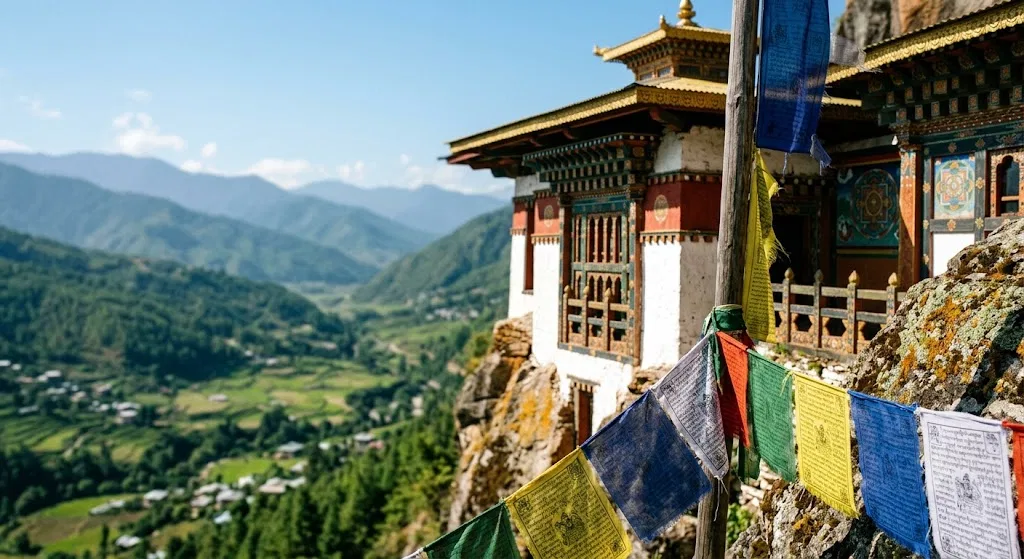
Bhutanese folklore is especially vivid when attached to a place a visitor can actually see. Sacred geography turns story into a route, a cliff, a lake, a cave or a festival ground. Two of the clearest examples are Paro Taktsang, the Tiger’s Nest, and Mebar Tsho, the Burning Lake.
Paro Taktsang is one of Bhutan’s best-known sacred sites, a monastery complex clinging to a cliff above the Paro valley. The Paro district administration explains the tradition that Guru Rinpoche came to Taktsang in the 8th century in a wrathful form to subdue harmful spirits there. Other accounts of the legend tell how he arrived on a tigress and meditated in the cave, which is why the place is known internationally as the Tiger’s Nest.[Paro Dzongkhag Administration]paro.gov.btOpen source on paro.gov.bt.
This is a good example of how Bhutanese legend works on several levels at once. For pilgrims, Taktsang is a sacred Buddhist site associated with Padmasambhava. For folklore readers, it is a story of flight, transformation, cave meditation and the subduing of local powers. For modern tourism, it is also Bhutan’s most recognisable image. The danger is that the postcard view can flatten the story into scenery; the deeper tradition links the cliff to ritual power, spiritual conquest and Bhutan’s Buddhist identity.[Paro Dzongkhag Administration]paro.gov.btOpen source on paro.gov.bt.
Mebar Tsho in Bumthang offers a different kind of sacred-place legend. The Bumthang district administration gives the core story: Pema Lingpa, a great treasure-revealer, had a vision of a temple beneath the water, dived in holding a lit lamp, and emerged with sacred treasures while the lamp remained alight. The site is therefore known as the Burning Lake.[Bumthang Dzongkhag Administration]bumthang.gov.btOpen source on bumthang.gov.bt.
Here again, the folklore is not just a strange miracle tale. It supports the authority of Pema Lingpa, links the landscape to hidden religious treasure, and gives a dramatic form to the idea that sacred knowledge can be concealed in the natural world until the right person reveals it. The story also helps explain why a river pool in the Tang valley is treated as a pilgrimage place rather than merely a scenic stop.[Bumthang Dzongkhag Administration]bumthang.gov.btOpen source on bumthang.gov.bt.
Mountain and land deities: invisible owners of visible places
One of the richest but least tourist-friendly parts of Bhutanese folklore is the world of local and mountain deities. These beings are not always “gods” in the neat sense familiar from classical mythologies. Their categories can overlap: a place may be associated with territorial deities, mountain powers, guardian spirits, treasure guardians or other local beings whose names and roles vary by region. Françoise Pommaret’s influential work on Bhutanese local and mountain deities stresses precisely this difficulty of classification, noting that such beings play an important role in Bhutanese life, live in sacred places, often mountains, and must be propitiated at regular intervals.[Academia]academia.eduOpen source on academia.edu.
A useful way for general readers to understand this is to think of the landscape as inhabited. Mountains, groves, lakes and other places may be treated not as empty resources but as the abodes of powerful non-human presences. Elizabeth Allison’s research on sacred natural sites in Bhutan describes how Vajrayana Buddhism and local deities intertwine, producing a cosmology in which only some sentient beings are visible. Deity abodes can restrict human use of certain areas and may even affect construction, resource use and land-management decisions.[MDPI]mdpi.comOpen source on mdpi.com.
This does not mean that every Bhutanese person believes the same thing in the same way. It means that local cosmology has real cultural force. In some communities, rituals to propitiate territorial deities have helped organise seasonal use of land. Research on a community mountain-closure ritual in eastern Bhutan documents a practice in which ritual action helped “seal” territory and prohibit entry to higher mountain reaches for a period.[ResearchGate]researchgate.netResearch Gate(PDF) Propitiating the Tsen, sealing the mountainResearch Gate(PDF) Propitiating the Tsen, sealing the mountain
For folklore readers, this is one of Bhutan’s most important lessons: supernatural tradition is not only about stories told after dark. It can shape paths, boundaries, taboos, farming, grazing, forest use and how people explain misfortune or prosperity.
Masked dances: folklore performed in public
Bhutan’s festivals are among the most visible places where myth, legend and ritual meet. The great festival form known to many visitors as the tshechu honours Guru Rinpoche and includes masked dances, music, monastic ritual, lay participation, social gathering and public blessing. These dances are not simply theatrical folklore, but they do dramatise stories and beings that folklore readers will recognise: demons, protectors, animals, wrathful deities, death figures, saints and spirit-subduing narratives.
The strongest documented example is the Mask Dance of the Drums from Drametse. UNESCO describes it as a sacred dance performed by the Drametse community during a festival in honour of Padmasambhava. It was proclaimed a Masterpiece in 2005 and inscribed on UNESCO’s Representative List of the Intangible Cultural Heritage of Humanity in 2008.[Intangible Cultural Heritage]ich.unesco.orgOpen source on unesco.org.
The dance’s details show why masked performance matters for folklore. UNESCO and related descriptions note that it is organised by the local monastery, performed in an eastern Bhutanese village, and involves masked dancers and musicians in a sacred setting. Rather than merely “representing culture”, it carries a story-world into the body: dancers become animal-headed, peaceful, wrathful or visionary figures, and the community gathers around a shared religious imagination.[Intangible Cultural Heritage]ich.unesco.orgOpen source on unesco.org.
Other Bhutanese festival dances include stag dances, black-hat dances, dances of terrifying deities, judgement-of-the-dead scenes and narrative performances involving hunters, animals and saints. Some are deeply Buddhist in meaning; others preserve older motifs through Buddhist ritual form. The result is a public folklore in motion: not private belief alone, but a shared event where costume, drumbeat, mask, story and blessing all matter.[tshechu.com]tshechu.comOpen source on tshechu.com.

How old are these traditions?
The honest answer is: different layers are different ages, and not all are equally well documented. Some Bhutanese sacred legends connect themselves to the 7th and 8th centuries, especially through the spread of Buddhism and the figure of Guru Rinpoche. Paro Taktsang’s legend, for example, is attached to Guru Rinpoche’s 8th-century presence, while the monastery complex itself is associated with later building history.[Paro Dzongkhag Administration]paro.gov.btOpen source on paro.gov.bt.
Other traditions have a clearer late-medieval anchor. The Burning Lake legend centres on Pema Lingpa, the 15th-century treasure-revealer associated with Bumthang. The Drametse drum dance is linked to eastern Bhutanese monastic tradition and has been recognised by UNESCO as a living heritage form with centuries of history.[Bumthang Dzongkhag Administration]bumthang.gov.btOpen source on bumthang.gov.bt.
Folktales are harder to date. Oral stories often preserve old motifs while changing names, places, morals and details as they pass from narrator to narrator. Penjore’s study of Bhutanese folktale origins explicitly notes that Bhutan’s store of oral tradition is depleting under rapid social transformation and that systematic study is still limited compared with the richness of the material.[Academia]academia.eduOpen source on academia.edu.
This means readers should be cautious with claims such as “this tale is thousands of years old”. A better question is: what is the evidence for this version? Is it a local oral account, a monastic biography, a printed retelling, a tourist summary, a school adaptation, or a modern festival reinterpretation? Bhutanese folklore is old in broad cultural roots, but individual tellings often have modern forms.
Preservation, archives and modern retelling
Bhutan’s folklore is now moving through a major transition. Older village storytelling contexts have been affected by schooling, urbanisation, television, mobile phones, tourism and migration from rural areas. Tshering Cigay Dorji warned in 2009 that oral traditions could be wiped out as villages moved directly from oral society into digital communication and commercial entertainment.[d1i1jdw69xsqx0.cloudfront.net]d1i1jdw69xsqx0.cloudfront.netPreserving our Folktales, Myths and Legends in the Digital EraJuly 6, 2010 — by T Dorji · 2009 · Cited by 72 — Every region of Bhutan abounds with rich oral traditions which include folktales and loc…
At the same time, digital tools have created new ways to preserve material that was once ephemeral. The Bhutan Cultural Library, hosted through the University of Virginia’s Mandala project, presents texts on genres of Bhutanese oral tradition and links them to places and subjects. A related account of the Oral Cultures of Bhutan project describes an audio-visual archive created between 2015 and 2019 through collaboration between the University of Virginia and the Shejun Agency for Bhutan’s Cultural Documentation and Research.[bhutan.virginia.edu]bhutan.virginia.eduOpen source on virginia.edu.
Bhutan’s official heritage institutions also matter. The National Library and Archives of Bhutan describes itself as a major repository of Bhutan’s literary heritage, especially Vajrayana Buddhist texts and archival documents, and says it aspires to strengthen, promote and preserve Bhutan’s intangible cultural heritage.[doc.gov.bt]doc.gov.btOpen source on doc.gov.bt.
Modern preservation changes the tradition. A folktale written down in English becomes more stable but less flexible. A masked dance filmed for an international audience gains visibility but may lose some local ritual context. A yeti festival can strengthen pride while also turning belief into a public cultural attraction. None of this makes the tradition “fake”; it means Bhutanese folklore is living through the same tension faced by many oral cultures: how to survive modernity without becoming a museum display.
Old tradition, tourist legend and internet folklore
Bhutan’s image as a hidden Himalayan kingdom can make its folklore vulnerable to romantic exaggeration. The safest way to read Bhutanese legends is to distinguish four forms:
Old oral tradition includes folktales, local legends, songs, riddles and village narratives transmitted through families and communities. These often vary by place and narrator, and their value lies partly in that variation.[d1i1jdw69xsqx0.cloudfront.net]d1i1jdw69xsqx0.cloudfront.netPreserving our Folktales, Myths and Legends in the Digital EraJuly 6, 2010 — by T Dorji · 2009 · Cited by 72 — Every region of Bhutan abounds with rich oral traditions which include folktales and loc…
Religious legend includes stories attached to Guru Rinpoche, Pema Lingpa, sacred caves, hidden treasures, monasteries and local protectors. These are often embedded in pilgrimage, ritual calendars and sacred biographies rather than in casual storytelling alone.[Paro Dzongkhag Administration]paro.gov.btOpen source on paro.gov.bt.
Tourist retelling simplifies complex traditions into memorable images: the flying tiger, the burning lamp, the yeti sanctuary, the masked dancer. These retellings are not necessarily wrong, but they usually compress local detail and religious meaning for quick understanding.[Paro Taktsang]parotaktsang.orgOpen source on parotaktsang.org.
Internet-era folklore spreads Bhutanese motifs through blogs, social media, festival marketing and short-form video. This can revive interest, but it can also blur evidence. A viral claim about the Migoi or a dramatic caption about spirits should be checked against stronger sources such as Bhutanese scholarship, official cultural bodies, UNESCO pages, archival projects or careful local documentation.[bhutan.virginia.edu]bhutan.virginia.eduOpen source on virginia.edu.
The point is not to drain the wonder out of Bhutanese folklore. It is to keep the wonder attached to the right kind of truth: cultural truth, ritual truth, local memory, moral imagination and sacred geography, rather than unsupported paranormal certainty.
Why Bhutanese folklore still matters
Bhutanese folklore matters because it offers one of the clearest ways to understand how Bhutan connects culture, religion and landscape. The same country that promotes cultural preservation as part of Gross National Happiness also contains village tales about clever commoners, sacred places where saints subdued harmful forces, mountain deities who claim territory, and a yeti figure that still animates highland identity and tourism. Cultural preservation is formally part of Bhutan’s development philosophy: the Gross National Happiness framework is commonly described through pillars that include cultural preservation and environmental conservation.[Ministry of Foreign Affairs]mfa.gov.btgross national happinessgross national happiness
For readers interested in legends and supernatural traditions, Bhutan is especially rewarding because its folklore has not been reduced to a single pantheon or monster list. Its stories live in relationships: between humans and mountains, monks and local spirits, children and elders, villagers and animals, pilgrims and sacred sites, performers and masks, printed books and oral memory.
That is also why the strongest Bhutanese folklore pages should avoid two extremes. One extreme is to treat every legend as literal supernatural fact. The other is to reduce every tale to quaint superstition. Bhutanese folklore is more interesting than either. It is a living cultural language for speaking about moral life, memory, danger, sacred power, humour, ecology and belonging in a Himalayan country where stories still cling to cliffs, lakes, forests and festival courtyards.
Amazon book picks
Further Reading
Books and field guides related to Where Bhutan's Legends Meet the Landscape. Use these as the next step if you want deeper reading beyond the article.
Treasures of the Thunder Dragon
Explores landscapes, traditions and cultural settings behind many legends.
Folktales of Bhutan
Direct introduction to Bhutan's oral traditions, legends and storytelling culture.
eBay marketplace picks
Marketplace Samples
Live-tested eBay searches with available results related to this page.


Endnotes
1.
Source: d1i1jdw69xsqx0.cloudfront.net
Title: Preserving our Folktales, Myths and Legends in the Digital Era
Link:https://d1i1jdw69xsqx0.cloudfront.net/digitalhimalaya/collections/journals/jbs/pdf/JBS_20_08.pdf
Source snippet
July 6, 2010 — by T Dorji · 2009 · Cited by 72 — Every region of Bhutan abounds with rich oral traditions which include folktales and loc...
Published: July 6, 2010
2.
Source: books.google.com
Title: Books Bhutanese Tales of the Yeti
Link:https://books.google.com/books/about/Bhutanese_Tales_of_the_Yeti.html?id=J_xPDwAAQBAJ
3.
Source: bhutan.virginia.edu
Link:https://bhutan.virginia.edu/
4.
Source: dailybhutan.com
Title: remote sakteng comes alive with bhutan s great yeti quest festival
Link:https://www.dailybhutan.com/article/remote-sakteng-comes-alive-with-bhutan-s-great-yeti-quest-festival
5.
Source: academia.edu
Link:https://www.academia.edu/8593573/On_local_and_mountain_deities_in_Bhutan
6.
Source: d1i1jdw69xsqx0.cloudfront.net
Title: JBS 21 02
Link:https://d1i1jdw69xsqx0.cloudfront.net/digitalhimalaya/collections/journals/jbs/pdf/JBS_21_02.pdf
7.
Source: d1i1jdw69xsqx0.cloudfront.net
Title: Role of Bhutanese Folktales in Value Transmission
Link:https://d1i1jdw69xsqx0.cloudfront.net/digitalhimalaya/collections/journals/jbs/pdf/JBS_12_03.pdf
8.
Source: books.google.com
Title: Books Folktales of Bhutan
Link:https://books.google.com/books/about/Folktales_of_Bhutan.html?id=21HgswEACAAJ
9.
Source: archive.org
Link:https://archive.org/details/auntymousetradit0000kunz
10.
Source: archive.org
Link:https://archive.org/details/roominyourheartf0000kunz
11.
Source: whc.unesco.org
Link:https://whc.unesco.org/en/tentativelists/5701/
12.
Source: paro.gov.bt
Link:https://paro.gov.bt/religious-site/taktshang-tiger-nest-monastery/
13.
Source: bumthang.gov.bt
Link:https://bumthang.gov.bt/tourism/mebar-tso/
14.
Source: mdpi.com
Link:https://www.mdpi.com/2077-1444/10/4/268
15.
Source: researchgate.net
Title: Research Gate(PDF) Propitiating the Tsen, sealing the mountain
Link:https://www.researchgate.net/publication/317835664_Propitiating_the_Tsen_sealing_the_mountain_Community_mountain-closure_ritual_practice_in_Eastern_Bhutan
16.
Source: ich.unesco.org
Link:https://ich.unesco.org/en/RL/mask-dance-of-the-drums-from-drametse-00161
17.
Source: ich.unesco.org
Title: Intangible Cultural Heritage Bhutan
Link:https://ich.unesco.org/en/state/bhutan-BT
18.
Source: unesco.org
Title: document 614
Link:https://www.unesco.org/archives/multimedia/document-614
19.
Source: tshechu.com
Link:https://www.tshechu.com/about/the-10-most-popular-masked-dances-at-bhutanese-festivals/
20.
Source: academia.edu
Link:https://www.academia.edu/3290764/Dangphu_Dingphu_The_Origin_of_the_Bhutanese_Folktales
21.
Source: doc.gov.bt
Link:https://doc.gov.bt/divisions/library-and-archives-division/
22.
Source: mfa.gov.bt
Title: gross national happiness
Link:https://www.mfa.gov.bt/rbedelhi/bhutan-at-glance/gross-national-happiness/
23.
Source: ich.unesco.org
Title: bhutan BT
Link:https://ich.unesco.org/en/state/bhutan-BT?cp=BT&info=periodic-reporting&topic=fr-etat
24.
Source: unesco.org
Link:https://www.unesco.org/reports/science/2021/sites/default/files/medias/fichiers/2022/03/South_Asia_Box-21-2.pdf
25.
Source: researchgate.net
Link:https://www.researchgate.net/publication/332433837_Deity_Citadels_Sacred_Sites_of_Bio-Cultural_Resistance_and_Resilience_in_Bhutan
26.
Source: researchgate.net
Link:https://www.researchgate.net/publication/262100615_Preserving_Our_Folktales_Myths_and_Legends_in_the_Digital_Era
27.
Source: researchgate.net
Link:https://www.researchgate.net/publication/353579310_Bhutanese_Folktale_Interpretation_from_historical_persepctive
28.
Source: researchgate.net
Title: 281126394 Yul and yul lha The Territory and its Deity in Bhutan
Link:https://www.researchgate.net/publication/281126394_Yul_and_yul_lha_The_Territory_and_its_Deity_in_Bhutan
29.
Source: researchgate.net
Link:https://www.researchgate.net/publication/376652258_Interview_with_Karma_Phuntsho
30.
Source: researchgate.net
Link:https://www.researchgate.net/profile/Gengop-Karchung/publication/326342418_Chapter_3_Traditional_Customs_Rituals_Ceremonies_and_Festive_Events/links/5ccc0023299bf11c2a3d3d2b/Chapter-3-Traditional-Customs-Rituals-Ceremonies-and-Festive-Events.pdf
31.
Source: texts.mandala.library.virginia.edu
Title: book pubreader
Link:https://texts.mandala.library.virginia.edu/book_pubreader/40701
32.
Source: bhutan.virginia.edu
Link:https://bhutan.virginia.edu/subjects/7320/audio-video-node/19581/nojs
33.
Source: texts.mandala.library.virginia.edu
Title: bhutan cultural library
Link:https://texts.mandala.library.virginia.edu/collection/bhutan-cultural-library
34.
Source: mandala.library.virginia.edu
Link:https://mandala.library.virginia.edu/subjects/8260/text-node/39156/nojs
35.
Source: tshechu.com
Link:https://www.tshechu.com/
36.
Source: library.gov.bt
Link:https://www.library.gov.bt/
37.
Source: library.gov.bt
Link:https://www.library.gov.bt/ich-mapping/
38.
Source: archive.org
Link:https://archive.org/details/bhutanhimalayanm0000pomm
39.
Source: museums.gov.bt
Link:https://www.museums.gov.bt/our-museums/educational-and-resources
40.
Source: academia.edu
Link:https://www.academia.edu/Documents/in/Bhutanese_folklore/MostCited
41.
Source: academia.edu
Link:https://www.academia.edu/9159067/_Religion_Inscribed_in_the_Landscape_Sacred_Sites_Local_Deities_and_Natural_Resource_Use_in_the_Himalayas_in_Stanley_D_Brun_ed_The_Changing_World_Religion_Map_Sacred_Places_Identities_Practices_and_Politics_New_York_Springer_Publishing_2015
42.
Source: mfa.gov.bt
Link:https://www.mfa.gov.bt/cultural-group-from-bhutan-participates-in-the-international-percussions-festival/
43.
Source: books.google.com
Title: The History of Bhutan
Link:https://books.google.com/books/about/The_History_of_Bhutan.html?id=aUDAAAAAQBAJ
44.
Source: d1i1jdw69xsqx0.cloudfront.net
Title: Françoise Pommaret
Link:https://d1i1jdw69xsqx0.cloudfront.net/digitalhimalaya/collections/journals/ret/pdf/ret_34_06.pdf
45.
Source: youtube.com
Title: Boots for the Migoi | Bhutanese Tales of the Yeti
Link:https://www.youtube.com/watch?v=gVpO3Kqoy6M
Source snippet
The Mask Dance of the Drums from Drametse...
46.
Source: youtube.com
Title: The Mask Dance of the Drums from Drametse
Link:https://www.youtube.com/watch?v=k4qFI51_JRw
Source snippet
The Dance That Cancels Bad Karma...
47.
Source: api.repository.cam.ac.uk
Link:https://api.repository.cam.ac.uk/server/api/core/bitstreams/ed8832a0-be95-4644-a918-94d06429660a/content
48.
Source: parotaktsang.org
Link:https://www.parotaktsang.org/
49.
Source: atlasobscura.com
Title: the burning lake
Link:https://www.atlasobscura.com/places/the-burning-lake
50.
Source: bhutan.com.au
Link:https://bhutan.com.au/festivals/
51.
Source: Wikipedia
Title: Paro Taktsang
Link:https://en.wikipedia.org/wiki/Paro_Taktsang
52.
Source: Wikipedia
Title: Sakteng Wildlife Sanctuary
Link:https://en.wikipedia.org/wiki/Sakteng_Wildlife_Sanctuary
53.
Source: donein90seconds.substack.com
Title: bhutanese tales of the yeti
Link:https://donein90seconds.substack.com/p/bhutanese-tales-of-the-yeti
54.
Source: elifthereader.com
Title: Bhutanese Tales of the Yeti
Link:https://elifthereader.com/books/bhutanese-tales-of-the-yeti-kunzang-choden/
55.
Source: bhutanand.co
Link:https://bhutanand.co/festivals
56.
Source: scribd.com
Link:https://www.scribd.com/document/682797982/Bhutan-ICH
57.
Source: himalaya2000.com
Title: Sakteng Wildlife Sanctuary
Link:https://www.himalaya2000.com/bhutan/wildlife-sanctuaries/sakteng.html
58.
Source: tripadvisor.com
Title: Burning Lake
Link:https://www.tripadvisor.com/Attraction_Review-g469426-d3140537-Reviews-Burning_Lake-Bumthang_Bumthang_District.html
59.
Source: jstor.org
Link:https://www.jstor.org/stable/48714783
60.
Source: penguintravel.com
Title: Paro Taktsang The Enchanting Cliffside Monasteryof Bhutan
Link:https://www.penguintravel.com/New/540/0/ParoTaktsang-TheEnchantingCliffsideMonasteryofBhutan.html
61.
Source: journaloftibetanliterature.org
Link:https://journaloftibetanliterature.org/index.php/jtl/article/view/74/203
62.
Source: bhutaninbound.com
Link:https://www.bhutaninbound.com/bumthang-and-trongsa/Mebar-Tsho
63.
Source: buddhistpilgrimagetours.com
Link:https://www.buddhistpilgrimagetours.com/paro-taktsang-tour
64.
Source: regenerativeplace.earth
Title: BHUTA N
Link:https://www.regenerativeplace.earth/bhutan
Additional References
65.
Source: brill.com
Link:https://brill.com/display/book/9789047420231/9789047420231_webready_content_text.pdf?srsltid=AfmBOopxbE-ugwLWUJLAek_jjrvBDv-sBdSLwDJ-SJTQRmx-9QZxPWyT
66.
Source: facebook.com
Link:https://www.facebook.com/bhutanbroadcastingservice/posts/%F0%9D%97%9A%F0%9D%97%BF%F0%9D%97%B2%F0%9D%97%AE%F0%9D%98%81-%F0%9D%97%AC%F0%9D%97%B2%F0%9D%98%81%F0%9D%97%B6-%F0%9D%97%A4%F0%9D%98%82%F0%9D%97%B2%F0%9D%98%80%F0%9D%98%81-%F0%9D%97%99%F0%9D%97%B2%F0%9D%98%80%F0%9D%98%81%F0%9D%97%B6%F0%9D%98%83%F0%9D%97%AE%F0%9D%97%B9-%F0%9D%97%BF%F0%9D%97%B2%F0%9D%98%83%F0%9D%97%B6%F0%9D%98%83%F0%9D%97%B2%F0%9D%98%80-%F0%9D%97%A6%F0%9D%97%AE%F0%9D%97%B8%F0%9D%98%81%F0%9D%97%B2%F0%9D%97%BB%F0%9D%97%B4%F0%9D%98%80-%F0%9D%97%BF%F0%9D%97%AE%F0%9D%97%BF%F0%9D%97%B2-%F0%9D%97%B5%F0%9D%97%BC%F0%9D%98%82%F0%9D%98%80%F0%9D%97%B2-%F0%9D%97%B0%F0%9D%97%BC%F0%9D%97%BB%F0%9D%98%80%F0%9D%97%B2%F0%9D%97%B0%F0%9D%97%BF%F0%9D%97%AE%F0%9D%98%81%F0%9D%97%B6%F0%9D%97%BC%F0%9D%97%BB-%F0%9D%98%81%F0%9D%97%BF%F0%9D%97%AE%F0%9D%97%B1%F0%9D%97%B6%F0%9D%98%81%F0%9D%97%B6%F0%9D%97%BC%F0%9D%97%BBalth/1660285029102818/
67.
Source: radhibhutantours.com
Link:https://www.radhibhutantours.com/bhutan-festivals/
68.
Source: bhutanwiki.org
Link:https://www.bhutanwiki.org/articles/oral-cultures-of-bhutan
69.
Source: instagram.com
Link:https://www.instagram.com/reel/DYM-xm4vrpr/?hl=en
70.
Source: instagram.com
Link:https://www.instagram.com/p/DW8ZNZfCugg/
71.
Source: amazon.nl
Link:https://www.amazon.nl/-/en/Kunzang-Choden-ebook/dp/B00HBIV756?tag=searcht-20
72.
Source: amazon.nl
Link:https://www.amazon.nl/Bhutanese-Tales-Yeti-Kunzang-Choden/dp/9748496872?tag=searcht-20
73.
Source: instagram.com
Link:https://www.instagram.com/p/DNi2NmQS5Tc/
74.
Source: readaroundtheworldchallenge.com
Link:https://readaroundtheworldchallenge.com/books-by/author/Kunzang%20Choden
Topic Tree
Follow this branch
Related pages 192
- Afghan Folklore
- Albanian Folklore
- Algerian Folklore
- Australian Folklore
- Azerbaijan Folklore
- +187 more in sidebar