Where Mali's Stories Still Speak
Mali’s folklore is best understood as a living culture of spoken memory, sacred landscape, music, masks, ritual performance and local moral teaching rather than as a single fixed “mythology book”.
Page outline Jump by section
Why Mali’s folklore begins with the spoken word
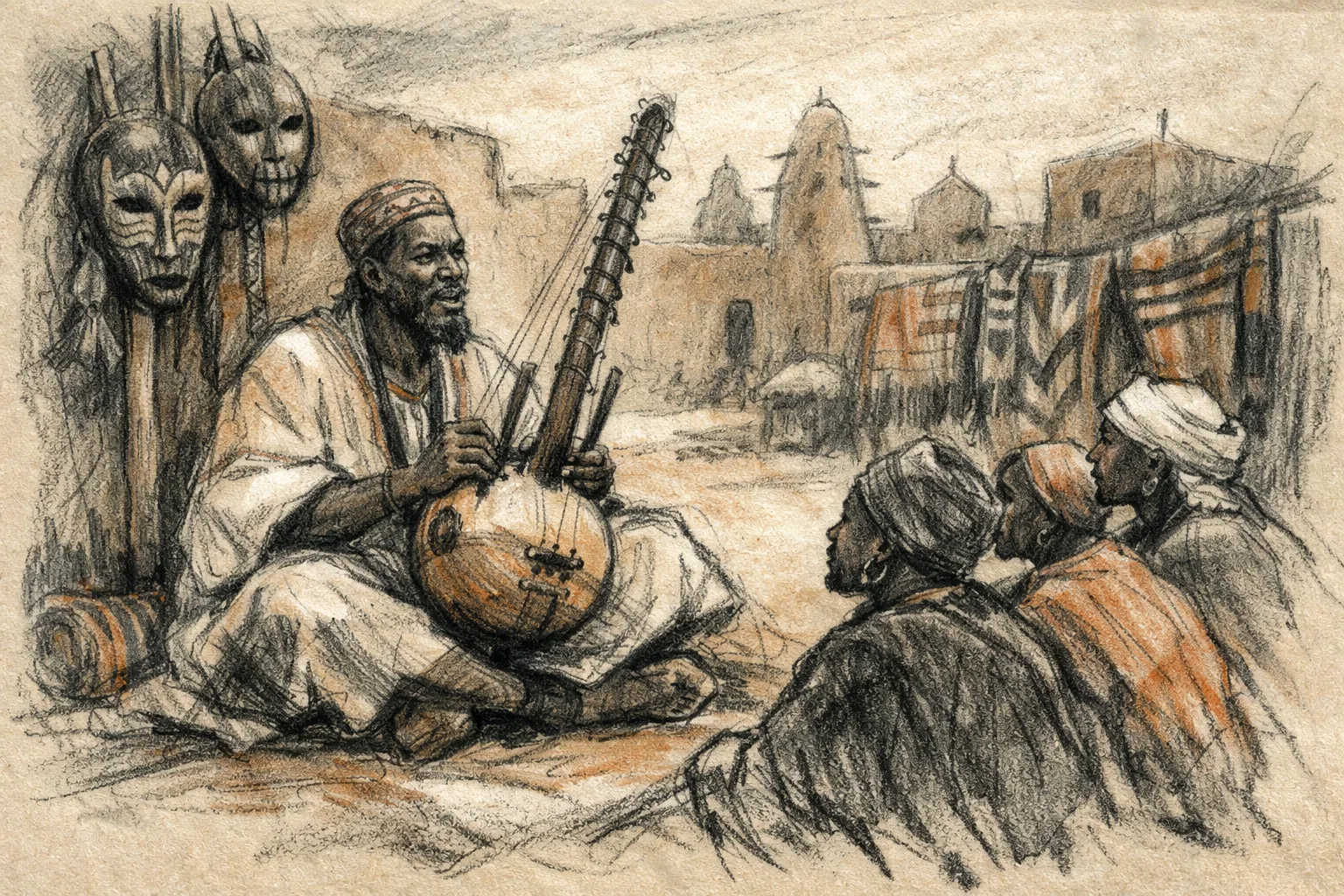
For many readers, the most important difference between Malian folklore and a written myth collection is that performance is part of the meaning. In the western Sahel, legendary tales have often been transmitted through spoken word, music and praise poetry by griots, also known in some Mande contexts as jeliw. The Metropolitan Museum of Art describes griots as narrators of oral traditions who inherit a respected social role and pass on stories through performance rather than simply reciting from a text.[The Metropolitan Museum of Art]metmuseum.orgThe Metropolitan Museum of ArtHow Griots Tell Legendary Epics Through Stories and Songs in West Africa - The Metropolitan Museum of Art…
That matters because a Malian legend may not have one “correct” version. A story can change depending on the performer, patron, village, language, ritual setting and audience. The story is not only entertainment. It may carry genealogy, political memory, praise, moral instruction, social criticism or ritual knowledge. Recent scholarship on Manden oral genres stresses that among Bamana, Maninka and Dyula communities, oral tradition remains a living part of social life, including epics, tales and legends, and that the institution of professional storytellers is still active.[SciELO]scielo.org.zaSci ELOFolklore genre designation among the Manden peoplesSci ELOFolklore genre designation among the Manden peoples
The result is a folklore landscape in which history and wonder often sit side by side. A king may be remembered through heroic exaggeration. A hunter may be both a skilled person and someone associated with hidden knowledge of the bush. A mask may be admired as art in a museum, but in its home setting it may also belong to ceremonies around death, ancestors or social teaching. This does not make the traditions “less true” as culture; it means their truth is often social, ritual and poetic rather than the same kind of truth expected from a chronicle.
Sundiata: the national epic that is more than a hero story
The most famous legendary cycle associated with Mali is the story of Sundiata Keita, the thirteenth-century founder figure of the Mali Empire. In broad outline, the epic tells of a child marked by weakness or difficulty who grows into a heroic leader, defeats a powerful rival and becomes the founder of a great polity. For modern readers, it is often the closest Malian equivalent to a national epic: a story of origin, kingship, destiny and collective identity.
The Sundiata tradition is powerful partly because it is not just a court tale preserved in writing. It has been carried by generations of oral specialists, especially Mande griots, and it links named families, places and political memory to a larger moral universe. The Met’s account of Sahelian storytelling places the Sundiata cycle within a wider West African tradition in which spoken performance, instruments, praise and memory work together.[The Metropolitan Museum of Art]metmuseum.orgThe Metropolitan Museum of ArtHow Griots Tell Legendary Epics Through Stories and Songs in West Africa - The Metropolitan Museum of Art… UNESCO’s page on the Manden Charter also connects the early thirteenth-century founding memory of the Mandingo Empire with an assembly at Kurukan Fuga in the upper Niger region, between present-day Guinea and Mali.[Intangible Cultural Heritage]ich.unesco.orgIntangible Cultural Heritageich.unesco.orgIntangible Cultural Heritageich.unesco.org
One reason the epic still interests readers is that it refuses a neat split between “history” and “myth”. Sundiata was tied to the real political memory of the Mali Empire, yet his story is transmitted through a poetic form that includes prophecy, heroic testing, praise, rivalry, magical power and symbolic episodes. The epic should therefore be read neither as pure fantasy nor as a modern biography. It is a performed memory of power: a way of asking what makes a ruler legitimate, what families owe to one another, and how a people explain the beginning of a political world.
The Sundiata material also has internal-link value for related Malian folklore pages: the griot tradition, the Manden Charter, hunter-heroes, magical kingship, the Sosso rival tradition, praise poetry and modern literary retellings all branch naturally from it. The key is not to reduce the epic to a simplified “African Lion King” comparison, but to treat it as a living Mande story-world with its own performers, lineages and political meanings.
Griots, memory and the power of words
A griot is often described as a storyteller, but that word is too small on its own. In Mali and the wider Mande world, griots may be historians, musicians, praise singers, genealogists, advisers, mediators and public voices of memory. Their work can include recalling births, marriages, deaths, lineages, battles, patron families and old obligations. In performance, music and speech give the past emotional force.
The importance of griots helps explain why Malian folklore can be both old and flexible. A griot does not merely preserve a story like an object in a box. The story is activated in a social situation: at a ceremony, before a patron, in a public performance, on a recording, or in a modern concert hall. This is why the same epic or praise tradition may appear in village settings, national cultural festivals, academic collections and global music circuits.
Manden oral tradition also includes ideas about the power of speech itself. Scholarship on Manden genre terms notes that professional verbal artists are associated not only with narrative skill but with culturally specific ideas about verbal force and the social effect of words.[SciELO]scielo.org.zaSci ELOFolklore genre designation among the Manden peoplesSci ELOFolklore genre designation among the Manden peoples For a general reader, the important point is simple: in many Malian traditions, words do things. They praise, bind, shame, bless, remember, legitimise and sometimes unsettle.
This also affects how supernatural material is handled. A tale about a spirit, dangerous animal, sorcerer or sacred object may be less interested in proving that the being “exists” than in teaching how to behave in a world where unseen power, social obligation and moral danger are taken seriously. Malian folklore often lives in that charged space between public memory and hidden knowledge.
Dogon masks and the sacred landscape of Bandiagara
The Dogon traditions of central Mali are among the most internationally famous parts of the country’s folklore, partly because of masks, cliff villages, ancestor rites and cosmological stories. The Bandiagara escarpment is not just a dramatic landscape; UNESCO describes it as a place of cliffs and plateaux with houses, granaries, altars, sanctuaries and communal meeting places, where age-old traditions including masks, feasts, rituals and ceremonies involving ancestor worship continue.[UNESCO World Heritage Centre]whc.unesco.orgWorld Heritage Centre Cliff of Bandiagara (Land of the DogonsWorld Heritage Centre Cliff of Bandiagara (Land of the Dogons
Dogon masks are often misunderstood when seen only as carved objects. In their local ritual setting, masks may be connected with death, the ancestors and the movement between human and spiritual worlds. Museum and educational sources commonly describe Dogon mask performance as part of funerary and memorial rites, especially those concerned with the proper passage of the dead and the continuing relationship between living communities and ancestral presence. The Smithsonian’s National Museum of African Art also notes that tall plank masks made by the Dogon can visually suggest a bridge between earth and sky in traditions where first beings and founding ancestors connect different realms.[National Museum of African Art]africa.si.eduOpen source on si.edu.
This is where Mali’s folklore becomes especially place-based. The cliff, village, shrine, granary, meeting shelter and mask are not separate cultural fragments. They form a local world in which architecture, landscape, ritual and story reinforce one another. To ask “what is the Dogon myth?” is less useful than asking how Dogon communities have used stories, objects, dances and places to think about death, ancestry, order, farming, origin and the unseen.
The modern fame of Dogon culture has also created problems of interpretation. Masks collected for museums, performances staged for tourists, and internet summaries of “Dogon mythology” can detach the material from its ritual and local context. That does not make all modern retellings false, but it does mean readers should be wary of flattened accounts that turn a complex living culture into a list of exotic symbols.
The Dogon “Sirius mystery” and why caution matters
No topic in Malian folklore has been more distorted online than the claim that the Dogon possessed ancient secret knowledge of the Sirius star system. The popular version says that Dogon tradition preserved detailed astronomical knowledge that should have been impossible without modern telescopes, and some modern writers have linked this claim to ancient-astronaut speculation. It is a striking story, but it is also a good example of why folklore needs careful sourcing.
The claim depends heavily on twentieth-century ethnographic interpretation, especially the work of Marcel Griaule and Germaine Dieterlen. Later field evaluation by Walter van Beek challenged whether Griaule’s published picture of Dogon religion was recognisable to Dogon people and to later researchers, answering that question largely in the negative.[Pure]pure.uvt.nlPure A Field Evaluation of the Work of Marcel GriaulePure A Field Evaluation of the Work of Marcel Griaule Other scholars have defended aspects of Griaule’s work or argued that esoteric knowledge can be restricted and easily lost, so the debate is not a simple case of one line “debunking” everything. But the strongest cautious conclusion is that the internet’s confident version of the Sirius story is not a reliable guide to Dogon religion.
For folklore readers, the lesson is not that Dogon cosmology is uninteresting. Quite the opposite. Dogon traditions around origin, ancestors, masks, death and cosmic order are rich without needing alien embellishment. The problem is that a modern mystery narrative can drown out the actual cultural setting. When a tradition is treated mainly as a puzzle for outsiders, the people who perform, inherit and reinterpret it can disappear from view.
Bamana puppet masquerades and animals that teach society
Another vivid strand of Malian folklore is the puppet and masquerade theatre associated with Bamana and neighbouring communities, especially in the Ségou region. These performances are often known for large animal figures, music, dance, comedy and social commentary. They are not simply children’s puppets or decorative parade pieces. They are public theatre with deep roots in moral teaching, village life and ideas about the bush.
Research on Sogo bò masquerades describes a repertoire full of bush animals, spirits, male and female characters and conceptual figures that comment on human relationships. One study summarised in ResearchGate notes that bush animal figures such as elephants, hippos, buffaloes, hyenas, lions, antelopes and birds can form a major part of the performance world, with the bush understood as a domain linked to hunting, male action and heroic values.[ResearchGate]researchgate.netResearch Gate Visual and Verbal Arts in the Sogo bo Masquerades of MaliResearch Gate Visual and Verbal Arts in the Sogo bo Masquerades of Mali The World Encyclopedia of Puppetry Arts also notes that some formerly sacred representations in Bambara masquerade have been adapted into popular theatre, including figures connected with animals and creation symbolism.[World Encyclopedia of Puppetry Arts]wepa.unima.orgOpen source on unima.org.
The folklore value of these performances lies in how they make social ideas visible. A buffalo may stand for strength and tradition. A hyena may suggest greed or disorder. Domestic scenes may expose jealousy, foolishness or conflict. The animal world becomes a mirror of human society, but one lively enough to entertain. In that sense, Malian puppet masquerade is a bridge between myth, theatre, satire and community education.
These traditions also show how folklore changes without simply disappearing. A figure that once belonged mainly to ritual may later appear in a festival, museum, national arts programme or tourist performance. The meaning changes with the setting, but older layers can remain visible in the animal forms, dance patterns, songs and stories.

Hunters, the bush and dangerous knowledge
Malian folklore gives special weight to hunters because the bush is more than a physical environment. It is a place of animals, medicines, danger, secrecy, courage and unseen power. Hunters’ associations across Mande-speaking regions are often linked with specialist knowledge, protective objects, praise songs and moral codes. In stories, the hunter may be a provider and hero, but also someone who moves close to forces that ordinary villagers avoid.
This is one reason hunter figures appear so naturally in epics and masquerades. The heroic founder, the dangerous rival, the master of animals and the person who knows hidden paths all belong to the same imaginative field. In some Mande material, hunters are not merely practical specialists; they are people whose knowledge of the bush gives them social and symbolic authority.
For the general reader, this helps explain why animals in Malian folklore are rarely “just animals”. The buffalo, antelope, hyena, lion, vulture or crocodile may carry a moral or ritual charge. It may represent strength, disorder, transformation, cunning, fertility, danger or ancestral connection. The bush is a theatre of testing, where human skill meets non-human power.
This also gives Malian folklore a different texture from fairy traditions built around small household spirits or enchanted forests. Here, the supernatural often emerges from relationships among hunters, animals, ancestors, medicines, masks, water, speech and social duty. The unseen is not separate from daily life; it presses into farming, fishing, funerals, marriage, conflict and public reputation.
Water spirits and the Sanké mon fishing rite
One of Mali’s clearest examples of living ritual folklore is the Sanké mon, the collective fishing rite of the Sanké pond at San in southern Mali. UNESCO describes the rite as beginning with sacrifices and offerings made by village residents to the water spirits of the pond before the collective fishing takes place.[Intangible Cultural Heritage]ich.unesco.orgIntangible Cultural Heritageich.unesco.orgIntangible Cultural Heritageich.unesco.org AP’s 2024 reporting similarly described thousands of fishermen entering the pond during the June rite, after animal sacrifices and offerings to the water spirits, and noted that the tradition has been practised for several hundred years.[AP News]apnews.comOpen source on apnews.com.
This is exactly the kind of tradition that shows why folklore is not only “old stories”. The Sanké mon is a seasonal, communal and ecological event. It marks local identity, the start of the rainy season and the relationship between people and a specific body of water. The water spirits are not abstract mythic beings in a distant tale; they belong to a pond, a town, a calendar and a public gathering.
The rite also shows how climate stress can threaten folklore. AP reported that heatwaves and drying conditions have put the pond and the festival under pressure.[AP News]apnews.comOpen source on apnews.com. When the physical place is damaged, the tradition is not merely symbolically affected. The ritual depends on water, fish, bodies, gathering, timing and local belief. Environmental change can therefore become cultural loss.
For readers interested in monsters or spirits, Sanké mon is valuable because it keeps the supernatural grounded. The water spirits are not presented as a horror story. They belong to reciprocity: offerings, respect, seasonal renewal and communal survival.
Timbuktu: saints, manuscripts and sacred memory
Mali’s folklore is not only pre-Islamic or village-based. Islamic sacred history is central to the country’s cultural imagination, especially in Timbuktu. UNESCO describes Timbuktu as an intellectual and spiritual capital in the fifteenth and sixteenth centuries, with Sankore and other madrasas, and with the great mosques of Djingareyber, Sankore and Sidi Yahia recalling its golden age.[UNESCO World Heritage Centre]whc.unesco.orgWorld Heritage Centre TimbuktuWorld Heritage Centre Timbuktu
For folklore readers, Timbuktu matters because it shows a different kind of sacred tradition: saintly memory, manuscripts, shrines, protective places and stories of learning. The city’s mausoleums and religious sites have been locally meaningful not just as architecture but as part of the community’s spiritual identity. A Getty publication discussing the destruction of Timbuktu heritage notes UNESCO’s view that the mausoleums were deeply important to the people of Timbuktu and were perceived as having a protective psychological role.[Getty]getty.eduCultural Heritage at Risk in Mali | Cultural Heritage and Mass AtrocitiesCultural Heritage at Risk in Mali | Cultural Heritage and Mass Atrocities
The manuscript tradition adds another layer. Mali is often introduced through oral tradition, but Timbuktu complicates any lazy claim that the region’s past was only oral. AP reported in 2025 that manuscripts dating back to the thirteenth century cover subjects including theology, law, astronomy, medicine, mathematics, history and geography, and testify to the cultural heritage of the Mali and Songhai empires.[AP News]apnews.comOpen source on apnews.com. During the 2012 occupation of Timbuktu, militants destroyed thousands of manuscripts and heritage structures, while Malian custodians saved more than 27,000 documents by moving them out of the city; in 2025, the first batches began returning from Bamako to Timbuktu.[AP News]apnews.comOpen source on apnews.com.
This belongs in a folklore page because sacred memory is not limited to tales of spirits and masks. A city can be storied. A manuscript can carry inherited authority. A saint’s tomb can be understood as part of a community’s protection. Timbuktu sits at the meeting point of scholarship, Islam, legend, local devotion and modern heritage politics.
What has changed: museums, tourism, conflict and the internet
Malian folklore has never been frozen, but the pressures on it have changed sharply in the modern era. Museum collecting turned masks, headdresses, puppets and carved figures into global art objects. Tourism turned Dogon dances and cliff villages into symbols of national culture. National heritage programmes presented particular ethnic traditions as Malian identity. Conflict and armed extremism made shrines, manuscripts and cultural custodians targets. The internet then added a new layer of simplified, viral retellings.
Some changes have helped preserve visibility. International museum collections and UNESCO listings can draw attention to traditions that might otherwise be ignored by outsiders. UNESCO’s Bandiagara listing, for example, makes clear that the Dogon landscape includes living social traditions, ritual architecture and ancestor ceremonies rather than merely scenic cliffs.[UNESCO World Heritage Centre]whc.unesco.orgWorld Heritage Centre Cliff of Bandiagara (Land of the DogonsWorld Heritage Centre Cliff of Bandiagara (Land of the Dogons UNESCO recognition of Sanké mon likewise records the ritual importance of offerings to water spirits and collective fishing.[Intangible Cultural Heritage]ich.unesco.orgIntangible Cultural Heritageich.unesco.orgIntangible Cultural Heritageich.unesco.org
Other changes can distort. A mask removed from its ritual setting may be admired for form while losing its connection to funerary practice or ancestor relations. A complex Dogon cosmology may be reduced to an alien theory. A griot’s performance may be treated as a “source” while ignoring the patronage, music and social setting that make it meaningful. A festival may be filmed as spectacle while its ecological crisis remains underreported.
The best modern reading of Malian folklore is therefore double: enjoy the vivid stories and performances, but also ask what has happened to them as they moved into books, archives, museums, festivals, courtrooms, news reports and social media.
How to read Malian folklore without flattening it
A useful rule for Mali is to start with place and performance. Ask whether the tradition belongs to a courtly epic, a griot lineage, a village masquerade, a funeral rite, a hunters’ association, a water ritual, an Islamic shrine, a manuscript culture or a modern national festival. The category changes what the story is doing.
Several distinctions help:
- Old oral tradition versus fixed text: The Sundiata epic is best understood as a performed tradition with variants, not as a single novel-like script.
- Ritual object versus museum object: A Dogon mask or Bamana puppet may be beautiful in a gallery, but its older meanings often depend on dance, music, secrecy, season, gender, age and ceremony.
- Local belief versus internet mystery: The Dogon Sirius claims are famous online, but they are not the safest entry point into Dogon religion.
- Sacred place versus tourist landmark: Bandiagara, San and Timbuktu are not merely destinations. They are storied places where ritual, ancestry, learning or protection matter.
- Continuity versus change: A tradition can be old and still modern, especially when performers adapt it to radio, recordings, festivals, schools, heritage campaigns or diaspora audiences.
Mali’s folklore is memorable because it is so varied: heroic founders, master speakers, ancestor masks, animal puppets, water spirits, hunters, saints, manuscripts and sacred cliffs all belong to the same country-level cultural field. Its deepest theme may be that memory must be performed, protected and renewed. In Mali, stories live through voices, bodies, places and ceremonies, and they remain vulnerable whenever those living conditions are threatened.
Amazon book picks
Further Reading
Books and field guides related to Where Mali's Stories Still Speak. Use these as the next step if you want deeper reading beyond the article.
Sundiata: An Epic of Old Mali
The most famous narrative associated with Mali's folklore.
African Myths of Origin
Provides broader folklore context including West African traditions.
eBay marketplace picks
Marketplace Samples
Live-tested eBay searches with available results related to this page.

Endnotes
1.
Source: ich.unesco.org
Title: Intangible Cultural Heritageich.unesco.org
Link:https://ich.unesco.org/en/RL/manden-charter-proclaimed-in-kurukan-fuga-00290
2.
Source: whc.unesco.org
Title: World Heritage Centre Cliff of Bandiagara (Land of the Dogons)
Link:https://whc.unesco.org/en/list/516/
3.
Source: researchgate.net
Title: Research Gate Visual and Verbal Arts in the Sogo bo Masquerades of Mali
Link:https://www.researchgate.net/publication/236777442_Wild_Animals_and_Heroic_Men_Visual_and_Verbal_Arts_in_the_Sogo_bo_Masquerades_of_Mali
4.
Source: ich.unesco.org
Title: Intangible Cultural Heritageich.unesco.org
Link:https://ich.unesco.org/en/USL/sanke-mon-collective-fishing-rite-of-the-sanke-00289
5.
Source: whc.unesco.org
Title: World Heritage Centre Timbuktu
Link:https://whc.unesco.org/en/list/119/
6.
Source: getty.edu
Title: Cultural Heritage at Risk in Mali | Cultural Heritage and Mass Atrocities
Link:https://www.getty.edu/publications/cultural-heritage-mass-atrocities/part-2/14-assomo/
7.
Source: ich.unesco.org
Title: 28118 EN.doc
Link:https://ich.unesco.org/doc/src/28118-EN.doc
8.
Source: unesdoc.unesco.org
Link:https://unesdoc.unesco.org/ark%3A/48223/pf0000044668
9.
Source: ich.unesco.org
Title: mali ML
Link:https://ich.unesco.org/en/state/mali-ML
10.
Source: ich.unesco.org
Title: proclamation of masterpieces 00103
Link:https://ich.unesco.org/en/proclamation-of-masterpieces-00103
11.
Source: ich.unesco.org
Title: oral traditions and expressions 00053
Link:https://ich.unesco.org/en/oral-traditions-and-expressions-00053
12.
Source: ich.unesco.org
Title: mali launches an inventory of intangible cultural heritage 00084
Link:https://ich.unesco.org/en/news/mali-launches-an-inventory-of-intangible-cultural-heritage-00084
13.
Source: whc.unesco.org
Link:https://whc.unesco.org/en/news/1219
14.
Source: ich.unesco.org
Title: mali ML
Link:https://ich.unesco.org/en/state/mali-ML?call=film&id=01932&include=film_inc.php&width=700
15.
Source: ich.unesco.org
Title: mali ML
Link:https://ich.unesco.org/en/state/mali-ML?cp=ML&info=projects&topic=fr-etat
16.
Source: whc.unesco.org
Title: story timbuktu
Link:https://whc.unesco.org/en/story-timbuktu/
17.
Source: researchgate.net
Title: 347758271 Women Music and the Mystique of Hunters in Mali
Link:https://www.researchgate.net/publication/347758271_Women_Music_and_the_Mystique_of_Hunters_in_Mali
18.
Source: researchgate.net
Link:https://www.researchgate.net/publication/298728256_Inside_the_Dogon_Masks_The_Selection_of_Woods_for_Ritual_Objects
19.
Source: researchgate.net
Title: 289906231 Haunting Griaule Experiences from the Restudy of the Dogon
Link:https://www.researchgate.net/publication/289906231_Haunting_Griaule_Experiences_from_the_Restudy_of_the_Dogon
20.
Source: encyclopedia.com
Link:https://www.encyclopedia.com/humanities/encyclopedias-almanacs-transcripts-and-maps/bamana
21.
Source: metmuseum.org
Link:https://www.metmuseum.org/perspectives/sahel-sunjata-stories-songs
Source snippet
The Metropolitan Museum of ArtHow Griots Tell Legendary Epics Through Stories and Songs in West Africa - The Metropolitan Museum of Art...
22.
Source: scielo.org.za
Title: Sci ELOFolklore genre designation among the Manden peoples
Link:https://www.scielo.org.za/scielo.php?pid=S0041-476X2023000300002&script=sci_arttext
23.
Source: africa.si.edu
Link:https://africa.si.edu/exhibitions/african-cosmos-stellar-arts
24.
Source: pure.uvt.nl
Title: Pure A Field Evaluation of the Work of Marcel Griaule
Link:https://pure.uvt.nl/ws/portalfiles/portal/1002365/dogonrestudied.pdf
25.
Source: wepa.unima.org
Link:https://wepa.unima.org/en/lassa-mali/
26.
Source: apnews.com
Link:https://apnews.com/article/mali-fishing-sanke-climate-change-heat-f75bf0e177263b817b8ac7bfa2931fc6
27.
Source: apnews.com
Link:https://apnews.com/article/785663f5854718cca7abdcc95ddeba66
28.
Source: resources.metmuseum.org
Title: Art of the Dogon Selections from the Lester Wunderman Collection
Link:https://resources.metmuseum.org/resources/metpublications/pdf/Art_of_the_Dogon_Selections_from_the_Lester_Wunderman_Collection.pdf
29.
Source: metmuseum.org
Link:https://www.metmuseum.org/-/media/files/learn/for-educators/publications-for-educators/the-art-of-africa.pdf
30.
Source: si.edu
Link:https://www.si.edu/object/archives/sova-hsfa
31.
Source: Wikipedia
Title: Dogon religion
Link:https://en.wikipedia.org/wiki/Dogon_religion
32.
Source: Wikipedia
Title: Sundiata Keita
Link:https://en.wikipedia.org/wiki/Sundiata_Keita
33.
Source: Wikipedia
Link:https://en.wikipedia.org/wiki/Griot
34.
Source: ebsco.com
Link:https://www.ebsco.com/research-starters/biography/sundiata
35.
Source: ehrafworldcultures.yale.edu
Link:https://ehrafworldcultures.yale.edu/cultures/fa16/documents/031
36.
Source: human.libretexts.org
Title: The Manden Charter
Link:https://human.libretexts.org/Courses/The_Westminster_Schools/The_Manden_Charter
37.
Source: orias.berkeley.edu
Link:https://orias.berkeley.edu/resources-teachers/monomyth-heros-journey-project/sundiata
38.
Source: davorrostuhar.com
Title: The Dogon
Link:https://davorrostuhar.com/en/stories/the-dogon-west-african-people-of-unique-customs-and-mythology/
Additional References
39.
Source: youtube.com
Title: The Nommo Mystery: Why the Dogon Knew About Distant Stars
Link:https://www.youtube.com/watch?v=cSHwjhKNNk4
Source snippet
Bamana Puppet Masquerade Video Project, Kirango, Mali, 1992...
40.
Source: youtube.com
Link:https://www.youtube.com/watch?v=QM30BHq3_-w
Source snippet
Timbuktu: Inside the Richest City in History...
41.
Source: youtube.com
Title: Timbuktu: Inside the Richest City in History
Link:https://www.youtube.com/watch?v=MLYEHK2g22U
Source snippet
The Empire of Mali - The Twang of a Bow - Extra History - Part 1...
42.
Source: facebook.com
Link:https://www.facebook.com/africanvibes/posts/100-dogon-culture-energy-rhythm-pride-in-the-heart-of-bandiagara-in-the-dramatic/1247754164032224/
43.
Source: academia.edu
Link:https://www.academia.edu/3871219/2004_%C6%9Dama_nyama_as_cause_of_evil_and_illness_Analysis_of_a_mana_concept_in_the_Bamana_context
44.
Source: facebook.com
Link:https://www.facebook.com/groups/275114380263865/posts/537117884063512/
45.
Source: facebook.com
Link:https://www.facebook.com/groups/275114380263865/posts/777285640046734/
46.
Source: hamillgallery.com
Link:https://www.hamillgallery.com/BAMANA/BamanaPuppets/BamanaPuppets.html
47.
Source: scribd.com
Link:https://www.scribd.com/document/942580437/Beek-DogonRestudiedField-1991
48.
Source: academia.edu
Link:https://www.academia.edu/1950142/Dogon_Restudied_A_Field_Evaluation_of_the_Work_of_Marcel_Griaule_and_Comments_and_Replies_
Topic Tree
Follow this branch
Related pages 192
- Afghan Folklore
- Albanian Folklore
- Algerian Folklore
- Australian Folklore
- Azerbaijan Folklore
- +187 more in sidebar