Where Yemen's Legends Still Haunt the Landscape
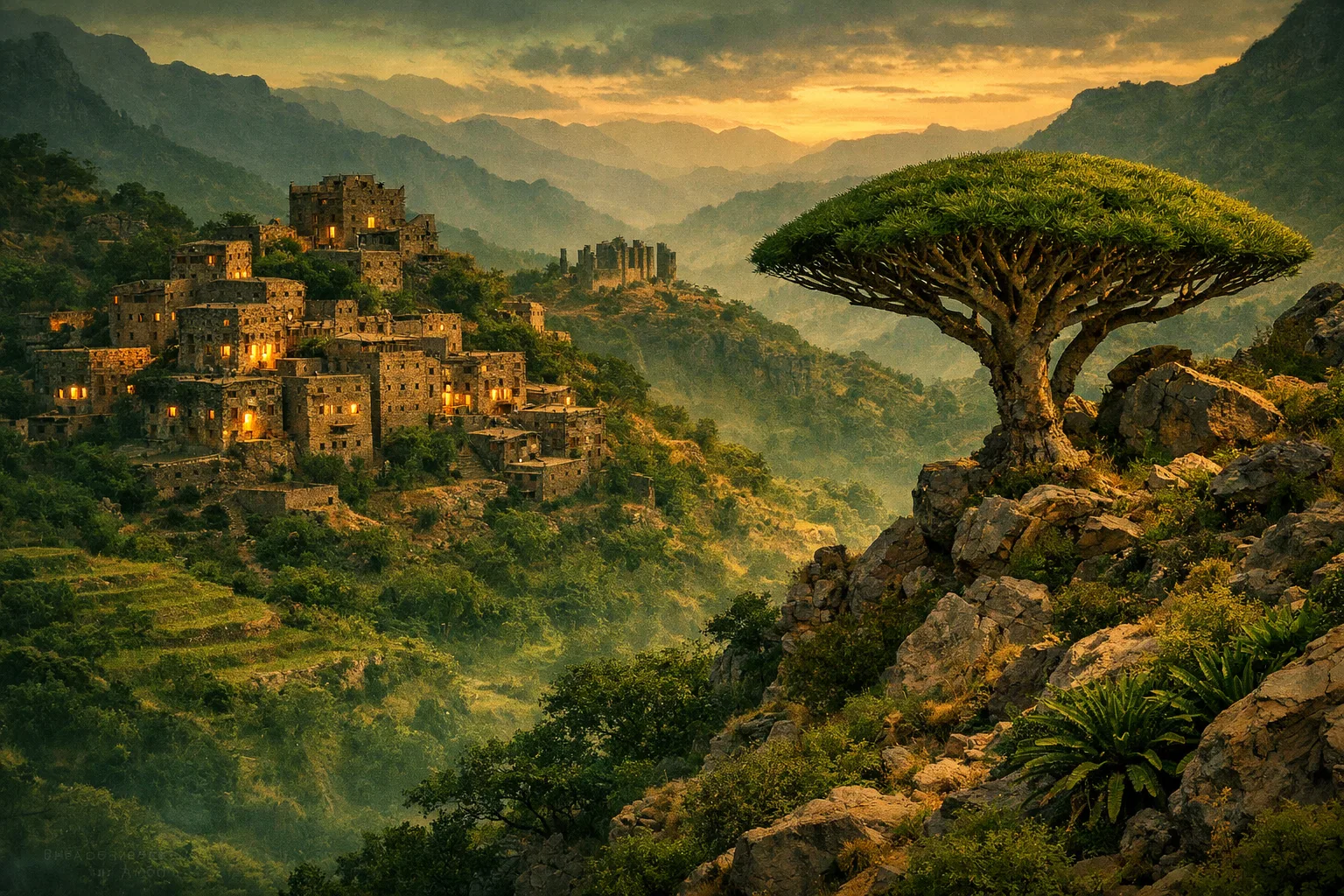
Yemen’s folklore is not a single shelf of old monster stories. It is a living mix of oral tales, sung poetry, saintly places, ancient ruins, island legends, protective amulets, jinn beliefs and local explanations for striking landscapes.
Page outline Jump by section
What makes Yemeni folklore distinctive?
Yemeni folklore stands out because it joins three kinds of cultural memory that are often separated elsewhere: ancient South Arabian heritage, Islamic supernatural belief, and highly local oral performance. Yemen’s archaeological landscape gives legendary memory unusually visible anchors. The ancient Kingdom of Saba, centred on Marib, is not just a biblical or Qur’anic echo: UNESCO describes the Marib sites as evidence of a kingdom with major architectural, technological and trading achievements from the first millennium BCE to the coming of Islam around 630 CE. That historical weight helps explain why stories of Sheba, incense, old temples and vanished prosperity remain so powerful in the national imagination.[UNESCO]unesco.orgLandmarks of Ancient Kingdom of Saba, Marib (Yemen) added to UNESCO’sLandmarks of Ancient Kingdom of Saba, Marib (Yemen) added to UNESCO’s…
At the same time, Yemen’s folklore is deeply social. It lives in sung poetry, wedding gatherings, afternoon storytelling, children’s tales, protective charms, proverbs and local explanations for unusual places. UNESCO’s listing of the Song of Sana’a describes a tradition of sung poetry practised across Yemen, while the Hadrami Dan gathering is recognised as a Hadhramaut form combining spontaneous poetry, music and dance. These are not “myths” in the narrow sense, but they are central to how oral culture carries memory, wit, moral judgement and regional identity.[ICH UNESCO]ich.unesco.orgSong of Sana'aThe Song of Sana'a, also known as al-Ghina al-San'ani, designates a group of songs that belongs to a rich musical…[ICH UNESCO]ich.unesco.orgICH UNESCOich.unesco.orgICH UNESCOich.unesco.org
The result is a folklore culture where a tale may be moral, comic, religious, political, supernatural and place-based at once. A story about a jinn may also be a warning about trespass. A tale about a clever islander may also remember foreign intrusion. A song may preserve older poetic imagery long after its original setting has changed.
Jinn, magic and everyday supernatural life
For many readers, the most recognisable supernatural beings in Yemeni tradition are jinn: invisible or shape-shifting beings known across Islamic and Arabian folklore. In Yemen, jinn beliefs are not merely imported from general Islamic teaching; they have been recorded in specific local forms, especially in Hadhramaut. Mikhail Rodionov’s study of jinn in Hadhramawt society uses oral and written sources to examine human-jinn relations as part of everyday ideas about conflict, alliance and social life, rather than treating them only as exotic “magic”.[JSTOR]jstor.orgOpen source on jstor.org.
That distinction matters. In many Yemeni settings, jinn stories are not told as entertainment alone. They can explain illness, misfortune, haunted houses, dangerous ruins, lonely wadis, caves, wells, abandoned settlements or sudden changes in behaviour. The point of the story is often practical: do not disturb a place, do not mock what you do not understand, protect children, respect thresholds, avoid arrogance, or seek help from a recognised healer or religious specialist.
Yemen also has a documented medieval tradition of writing about marvels, magic and the supernatural. G. Rex Smith’s study of Ibn al-Mujawir’s thirteenth-century guide to Yemen and Arabia highlights the author’s interest in jinn, magic, humour and the bizarre within a work that is also a route-based geographical account. This is important because it shows that supernatural storytelling in Yemen was not only village oral tradition; it also entered learned travel writing and historical topography.[Scribd]scribd.comJinn and Magic in Medieval Yemen | PDF | Jinn | YemenJinn and Magic in Medieval Yemen | PDF | Jinn | Yemen
Modern readers should be careful, however, not to flatten all Yemeni jinn traditions into horror. Some accounts are frightening, but others are comic, moral, legalistic or neighbourly. The jinn may be imagined as dangerous outsiders, hidden co-residents, rivals, tricksters or beings with their own society. That range is part of what makes the tradition culturally rich.
Sheba, Marib and the legendary past beneath the ruins
No figure looms larger in Yemen’s legendary image than the Queen of Sheba. Her story belongs to several religious and literary worlds, but Yemen gives it a landscape: Marib, ancient Saba, monumental temples and the memory of incense-route wealth. The Awam Temple, also known as Mahram Bilqis, is especially important because it sits at the meeting point of archaeology and legend. The Smithsonian’s National Museum of Asian Art describes the Awam Temple as the largest temple of its kind on the Arabian Peninsula and notes the legend that Marib was the capital of the Sabaean kingdom ruled by the biblical Queen of Sheba.[National Museum of Asian Art]asia-archive.si.eduNational Museum of Asian Art Excavations: Awam TempleNational Museum of Asian Art Excavations: Awam Temple
This does not mean every Sheba legend can be treated as literal history. The Queen of Sheba is a figure of scripture, folklore, medieval literature, visual art and national memory. What Yemen contributes is not a simple proof of the story, but a powerful setting in which legendary memory and ancient material culture reinforce each other. UNESCO’s inscription of the Marib landmarks in 2023 underlines the historic importance of the Sabaean kingdom and its role in incense-route exchange across Arabia, the Mediterranean and East Africa.[UNESCO]unesco.orgLandmarks of Ancient Kingdom of Saba, Marib (Yemen) added to UNESCO’sLandmarks of Ancient Kingdom of Saba, Marib (Yemen) added to UNESCO’s…
For folklore, Marib matters because ruins invite stories. A temple half-buried in sand, a broken dam, inscriptions in an ancient script and the memory of a powerful queen all create the conditions for legend-making. Local names and tourist retellings may attach Sheba to particular stones or sanctuaries, while archaeologists separate what can be evidenced from what belongs to later tradition. The most honest reading holds both together: Marib is historically real and culturally legendary, but not every colourful claim about it is equally well attested.
Socotra: dragons, tricksters and an island imagination
Socotra, Yemen’s island archipelago in the Arabian Sea, has some of the country’s most vivid folklore because its landscape looks almost invented. UNESCO describes Socotra as globally important for biodiversity, with 37 per cent of its plant species, 90 per cent of its reptile species and 95 per cent of its land snail species found nowhere else. That unusual ecology has helped outsiders call it the “Galápagos of the Indian Ocean”, but for folklore it has also made the island a natural home for stories about strange trees, caves, jinn, old magic and first encounters.[UNESCO World Heritage Centre]whc.unesco.orgWorld Heritage Centre Socotra ArchipelagoWorld Heritage Centre Socotra Archipelago
The dragon’s blood tree is the clearest example. Its umbrella-shaped crown and red resin invite mythic explanation. Modern reporting on Socotra notes that the trees are known for blood-red sap and are now threatened by stronger cyclones, goats and the effects of Yemen’s prolonged turmoil. Scientists explain the tree ecologically, but folklore explains it imaginatively: red resin becomes blood, and a rare tree becomes the trace of a legendary event.[AP News]apnews.comOpen source on apnews.com.
Socotra’s oral culture also includes trickster storytelling. A 2024 report from the International Women’s Media Foundation records a well-known Socotran tale of Rehabhen, a trickster who outwits European visitors by frightening them into believing he has killed and cooked one of their women. The story is comic and violent in the way many trickster tales are, but it also has a social edge: it turns foreign intrusion into a local victory of cunning over force.[IWMF]iwmf.orgThe Island of Myth and LongingThe Island of Myth and Longing
Socotra also shows how folklore changes under pressure. The same report moves from tales of tricksters and jinn to the modern politics of development, conservation and outside influence. In that sense, Socotran folklore is not a museum piece. Old stories about island cleverness, invisibility, magic and protection are being retold while the island faces tourism, climate stress and regional competition.[IWMF]iwmf.orgThe Island of Myth and LongingThe Island of Myth and Longing
Jewish-Yemeni amulets and shared protective traditions
Yemen’s folklore cannot be understood only through Muslim Arab tradition. For centuries, Yemen also had a major Jewish community with its own religious, poetic, craft and protective practices. One of the best documented areas is the making and use of amulets. Tom Fogel’s study of Yemeni Jewish amulets describes nineteenth-century accounts as important historical and ethnographic sources for Jewish-Yemeni occult practices, and stresses the blurred boundaries created by Judeo-Arabic language, Arabic or pseudo-Arabic magical scripts, and shared social expectations around protection.[Wayne State Digital Commons]digitalcommons.wayne.eduState Digital CommonsFolklore and Folkloristics of Jewish-Yemeni amulets…" by Tom Fogel…
These amulets were not simply decorative objects. They belonged to a world in which writing, sacred names, protective formulae, silverwork and bodily safety were connected. A child, mother, bride or sick person might be protected through words enclosed, worn or hidden. Carmella Abdar’s work on Yemeni Jewish women’s jewellery notes that the common practice was to conceal magical texts written on parchment or paper inside cylindrical containers forming part of jewellery, while visible engraved magical texts were unusual and raised questions about tradition, gender, body and text.[jstudies.huji.ac.il]jstudies.huji.ac.ilOpen source on huji.ac.il.
What makes this especially interesting for a country-level folklore page is the interreligious setting. Fogel argues that Jewish amulet traditions in Yemen were shaped by blurred religious boundaries and had an important social role for a Jewish minority, even as they could become controversial in outside descriptions.[Wayne State Digital Commons]digitalcommons.wayne.eduState Digital CommonsFolklore and Folkloristics of Jewish-Yemeni amulets…" by Tom Fogel… This is folklore as lived protection: not a monster story, but a practical response to fear, illness, childbirth danger and unseen harm.
Folktales, moral stories and the problem of “authenticity”
English-language readers often meet Yemeni folktales through collections such as Carolyn Han’s From the Land of Sheba: Yemeni Folk Tales, published in 2005 and listed by the Internet Archive under Yemen, folklore, fairy tales and legends.[Internet Archive]archive.orgOpen source on archive.org. Such collections are useful gateways, especially for readers with no Arabic, but they also raise a common folklore problem: a tale printed as “Yemeni” may be local, regional, adapted, moralised, literary, or part of a wider Arabic and Islamic storytelling pool.
That is not a flaw unique to Yemen. Folktales travel. Stories move with trade, marriage, pilgrimage, migration and books. Yemen’s location at the southern tip of Arabia, with Red Sea and Indian Ocean connections, makes tale movement especially likely. A jinn disguised as an animal, a poor clever man, a foolish rich man, a magic cave, a sharp-tongued wife, a lucky tailor or a trickster shepherd may appear in forms that feel Yemeni because of setting and style, even if the plot has cousins elsewhere.
The British-Yemeni Society’s review of Han’s collection is a useful caution: it argues that the stories presented are not necessarily intrinsically Yemeni or strictly folk tales, but often edifying anecdotes of a kind found across the region.[britishyemenisociety.org.uk]britishyemenisociety.org.ukfrom the land of sheba yemeni folk talesfrom the land of sheba yemeni folk tales That caveat is valuable. It does not make the stories worthless; it helps readers ask better questions. Was this tale collected orally? From whom? In what language or dialect? Was it retold for children? Was it shaped for Western publication? Does it reflect Yemen specifically, or a wider Arabic storytelling tradition with Yemeni flavour?
A strong folklore page should therefore treat printed tales as evidence, not as transparent windows. They show what people chose to preserve, translate and market as Yemeni tradition, but the living oral tradition is broader, messier and more local than any single book.
Poetry, song and oral memory
Yemen’s folklore is unusually tied to poetry. Sung and improvised verse carry love, satire, praise, social memory and regional identity. The Song of Sana’a, recognised by UNESCO, is a tradition of poetic song practised throughout Yemen, while Hadrami Dan is a community gathering in Hadhramaut that combines spontaneous poetry, music and dance.[ICH UNESCO]ich.unesco.orgSong of Sana'aThe Song of Sana'a, also known as al-Ghina al-San'ani, designates a group of songs that belongs to a rich musical…[ICH UNESCO]ich.unesco.orgICH UNESCOich.unesco.orgICH UNESCOich.unesco.org
This matters because folklore is not only about supernatural beings. In Yemen, a proverb, sung line or improvised exchange can do the cultural work that a legend does elsewhere. It can preserve a moral judgement, mock a social type, praise endurance, remember migration, or mark a wedding, harvest, evening gathering or public celebration. Oral performance also gives folklore flexibility: a singer or poet can use inherited forms to comment on present events.
Recent heritage discussion stresses how vulnerable these traditions are. The Sana’a Center has written about the war’s impact on Yemen’s intangible cultural heritage, noting that dance, song and music are embedded across Yemen’s regions and that Sana’ani music and Hadrami Dan have been inscribed on UNESCO’s heritage lists.[Sana’a Center for Strategic Studies]sanaacenter.orgOpen source on sanaacenter.org. Conflict affects folklore not only by damaging buildings, but by scattering communities, interrupting apprenticeship, reducing public gatherings and making archives harder to protect.
Sacred and haunted landscapes
Yemeni folklore is intensely geographical. Mountains, caves, ruins, wells, old cities, shrines, trees and islands often act as story containers. A place may be sacred because of a saint, dangerous because of jinn, memorable because of a queen, or strange because its plants and animals look unlike anywhere else.
Marib’s ancient remains show one version of this process: archaeology becomes legendary landscape. Socotra shows another: biodiversity becomes mythic scenery. Old urban centres such as Sana’a, Shibam and Zabid are better known for architecture and scholarship than for ghost stories in English-language sources, but they also belong to Yemen’s imaginative geography because their built environments preserve older ways of living, gathering, singing and telling.
The key is not to overclaim. A haunted-place article can easily drift into unsourced paranormal tourism. Yemen’s stronger evidence points instead to a more grounded pattern: unusual places attract stories, and stories help people decide how to behave in those places. Caves may invite tales of hidden beings; ruins may be linked to vanished peoples; trees with red resin may be explained through blood; temples may be attached to Sheba; and remote islands may be protected in memory by sorcery, trickery or divine favour.
Old tradition, modern retelling and internet-era Yemen
Yemeni folklore today reaches readers through several filters. Some material comes from oral tradition recorded by ethnographers. Some comes from medieval Arabic geographical and travel writing. Some is preserved through Jewish-Yemeni manuscripts, amulets and immigrant memory. Some appears in UNESCO heritage language. Some is retold by travel writers, journalists, children’s-book authors or tourism promoters. And some circulates online with little sourcing.
That variety is not a problem if readers know how to read it. A medieval account of jinn in a route guide is not the same kind of evidence as a modern Socotra travel article. A UNESCO entry for a musical tradition is not the same as a family ghost story. A tourist legend about the dragon’s blood tree may preserve a genuine local explanation, but it may also be polished for visitors. A printed folktale collection may contain real oral material while still adapting plots for a new audience.
The safest approach is to sort Yemeni folklore into broad evidence types:
- Well-attested heritage practices: sung poetry traditions such as the Song of Sana’a and Hadrami Dan, supported by UNESCO listings and living performers.
- Historically anchored legends: Sheba and Marib traditions, where archaeology and legendary memory overlap but must not be confused.
- Ethnographic supernatural belief: jinn traditions in Hadhramaut and elsewhere, documented by researchers but still locally varied.
- Material protective folklore: Jewish-Yemeni amulets and jewellery traditions, where objects, text and belief survive in collections and scholarship.
- Place-based island folklore: Socotra’s dragon’s blood tree legends, trickster tales and jinn rumours, now entangled with conservation and tourism.
- Popular retellings: children’s books, travel writing and online stories that may be useful introductions but need careful checking.
Why Yemeni folklore matters now
Yemeni folklore matters because it preserves a picture of Yemen that war headlines often erase. It shows a country of poets, traders, islanders, silversmiths, storytellers, singers, saints, ruins and regional identities. It also shows how culture survives under pressure. A song can outlast a damaged hall. A family tale can travel with refugees. An amulet in a museum can reveal everyday fears that formal history ignores. A Socotran tree legend can make biodiversity emotionally memorable.
The danger is romanticising loss. Yemen’s folklore is not valuable only because it is threatened, and Yemen should not be reduced to ruins, conflict or vanishing traditions. The more interesting truth is that Yemeni folklore has always changed: through trade, religion, migration, translation, performance and political upheaval. What is at stake now is whether communities, archives, performers and local knowledge-holders have the conditions to keep changing it on their own terms.
For a curious reader, the heart of Yemeni folklore is this layeredness. Yemen’s legendary world includes the Queen of Sheba and the jinn of Hadhramaut, the sung poetry of Sana’a and Hadhramaut, Jewish-Yemeni amulets, Socotra’s dragon’s blood trees and tricksters, and the moral tales told in homes and gatherings. Some of it is ancient; some is medieval; some is modern; some is difficult to date. Together, it forms one of the richest folklore landscapes in Arabia.
Amazon book picks
Further Reading
Books and field guides related to Where Yemen's Legends Still Haunt the Landscape. Use these as the next step if you want deeper reading beyond the article.
Legends of the Fire Spirits
Directly addresses supernatural beliefs found throughout Yemen.
eBay marketplace picks
Marketplace Samples
Live-tested eBay searches with available results related to this page.

Endnotes
1.
Source: unesco.org
Title: Landmarks of Ancient Kingdom of Saba, Marib (Yemen) added to UNESCO’s
Link:https://www.unesco.org/en/articles/landmarks-ancient-kingdom-saba-marib-yemen-added-unescos-world-heritage-list
Source snippet
Landmarks of Ancient Kingdom of Saba, Marib (Yemen) added to UNESCO’s...
2.
Source: ich.unesco.org
Link:https://ich.unesco.org/en/RL/song-of-sana-a-00077
Source snippet
Song of Sana'aThe Song of Sana'a, also known as al-Ghina al-San'ani, designates a group of songs that belongs to a rich musical...
3.
Source: ich.unesco.org
Title: ICH UNESCOich.unesco.org
Link:https://ich.unesco.org/en/RL/hadrami-dan-gathering-02232
4.
Source: jstor.org
Link:https://www.jstor.org/stable/41223954
5.
Source: scribd.com
Title: Jinn and Magic in Medieval Yemen | PDF | Jinn | Yemen
Link:https://www.scribd.com/document/495939539/25802765
6.
Source: whc.unesco.org
Title: World Heritage Centre Socotra Archipelago
Link:https://whc.unesco.org/en/list/1263/
7.
Source: iwmf.org
Title: The Island of Myth and Longing
Link:https://www.iwmf.org/reporting/the-island-of-myth-and-longing/
8.
Source: digitalcommons.wayne.edu
Title: State Digital Commons
Link:https://digitalcommons.wayne.edu/jewishfolklore/vol1/iss1/3/
Source snippet
"Folklore and Folkloristics of Jewish-Yemeni amulets..." by Tom Fogel...
9.
Source: jstudies.huji.ac.il
Link:https://jstudies.huji.ac.il/sites/default/files/jstudies/files/folklore_-32-abstracts-e_4-_abgar.pdf
10.
Source: archive.org
Link:https://archive.org/details/fromlandofsheba00caro
11.
Source: britishyemenisociety.org.uk
Title: from the land of sheba yemeni folk tales
Link:https://britishyemenisociety.org.uk/from-the-land-of-sheba-yemeni-folk-tales/
12.
Source: jstor.org
Link:https://www.jstor.org/stable/25802775
13.
Source: jstor.org
Link:https://www.jstor.org/stable/194805
14.
Source: ich.unesco.org
Link:https://ich.unesco.org/en/lists
15.
Source: ich.unesco.org
Title: oral traditions and expressions 00053
Link:https://ich.unesco.org/en/oral-traditions-and-expressions-00053
16.
Source: ich.unesco.org
Link:https://ich.unesco.org/doc/project_doc/00194.doc
17.
Source: unesdoc.unesco.org
Link:https://unesdoc.unesco.org/ark%3A/48223/pf0000189128
18.
Source: ich.unesco.org
Link:https://ich.unesco.org/en/decisions/9.COM/9.B.1?call=film&id=41777&include=film_inc.php&width=700
19.
Source: ich.unesco.org
Title: safeguarding of nkhonde tumbuka and chewa proverbs and folktales 00431
Link:https://ich.unesco.org/en/project-education/safeguarding-of-nkhonde-tumbuka-and-chewa-proverbs-and-folktales-00431
20.
Source: ich.unesco.org
Link:https://ich.unesco.org/
21.
Source: ich.unesco.org
Link:https://ich.unesco.org/en/video/41778
22.
Source: ich.unesco.org
Title: LHE 25 20.CO M 7.b EN.docx
Link:https://ich.unesco.org/doc/src/LHE-25-20.COM-7.b_EN.docx
23.
Source: ich.unesco.org
Title: examples of regional living heritage 00379
Link:https://ich.unesco.org/en/examples-of-regional-living-heritage-00379
24.
Source: unesdoc.unesco.org
Link:https://unesdoc.unesco.org/ark%3A/48223/pf0000147344
25.
Source: ich.unesco.org
Title: yemen YE
Link:https://ich.unesco.org/en/state/yemen-YE
26.
Source: ich.unesco.org
Title: ITH 16 11.CO M 1.BU R 2 EN.doc
Link:https://ich.unesco.org/doc/src/ITH-16-11.COM_1.BUR-2-EN.doc
27.
Source: whc.unesco.org
Link:https://whc.unesco.org/en/list/1700/
28.
Source: whc.unesco.org
Link:https://whc.unesco.org/en/documents/136995
29.
Source: whc.unesco.org
Link:https://whc.unesco.org/en/list/1700/gallery/
30.
Source: digitalcommons.wayne.edu
Link:https://digitalcommons.wayne.edu/cgi/viewcontent.cgi?article=1005&context=jewishfolklore
31.
Source: archive.org
Link:https://archive.org/stream/guideafricafolktales/guideafricafolktales_djvu.txt
32.
Source: archive.org
Title: SCANDINAVIA N LEGENDS AND FOLK
Link:https://archive.org/details/scandinavianlege006555mbp
33.
Source: time.com
Title: archaeology searching for sheba
Link:https://time.com/archive/6664732/archaeology-searching-for-sheba/
34.
Source: britishyemenisociety.org.uk
Title: the western hadramawt ethnographic field research 1983 91
Link:https://britishyemenisociety.org.uk/the-western-hadramawt-ethnographic-field-research-1983-91/
35.
Source: scribd.com
Link:https://www.scribd.com/document/979599924/Alofa-Document6-Copy-Copy-Copy-Copy
36.
Source: de.scribd.com
Title: Arslan Tash Amulets
Link:https://de.scribd.com/document/321896389/Arslan-Tash-Amulets
37.
Source: asia-archive.si.edu
Title: National Museum of Asian Art Excavations: Awam Temple
Link:https://asia-archive.si.edu/exhibition/awam-temple/
38.
Source: apnews.com
Link:https://apnews.com/article/3968466a5ce2653e64a59b545ef94660
39.
Source: sanaacenter.org
Link:https://sanaacenter.org/ypf/the-wars-impact-on-yemens-intangible-cultural-heritage/
40.
Source: oeil-et-plume.net
Link:https://oeil-et-plume.net/2015/03/yemen-dragons-socotra/
41.
Source: Wikipedia
Link:https://en.wikipedia.org/wiki/Jinn
42.
Source: facebook.com
Title: UNESC O
Link:https://www.facebook.com/unesco/photos/todays-intangible-cultural-heritage-showcase-focuses-on-the-song-of-sanaa-in-yem/10153640541653390/
43.
Source: cemmis.edu.gr
Title: culture society spirit possession
Link:https://cemmis.edu.gr/images/society_and_culture_review/culture_society_spirit_possession.pdf
44.
Source: sanaacenter.org
Title: oct dec 2025
Link:https://sanaacenter.org/the-yemen-review/oct-dec-2025/26146
45.
Source: yemenonline.info
Title: land of sheba
Link:https://www.yemenonline.info/land-of-sheba/11042
46.
Source: zenodo.org
Link:https://zenodo.org/records/15188107
Additional References
47.
Source: youtube.com
Title: YEMEN: A Forgotten Earth Where Time Still Breathes | Travel Documentary
Link:https://www.youtube.com/watch?v=LXqPb2adLNY
Source snippet
YEMEN: What the Lost Kingdoms of Arabia Still Hide | 4K Travel Documentary...
48.
Source: academia.edu
Link:https://www.academia.edu/7754495/Queen_of_Sheba_Treasures_from_ancient_Yemen_exhibition_guide
49.
Source: researchgate.net
Link:https://www.researchgate.net/publication/272731982_Queen_of_Sheba_Treasures_from_Ancient_Yemen
50.
Source: academia.edu
Link:https://www.academia.edu/13022993/The_jinn_in_Hadramawt_society_in_the_last_century
51.
Source: researchgate.net
Link:https://www.researchgate.net/publication/398070912_The_origins_of_the_traditional_approach_towards_the_jinn_of_poetic_inspiration_in_tribal_Arab_culture
52.
Source: researchgate.net
Link:https://www.researchgate.net/publication/309277165_Disarticulating_Lilith_Notions_of_God%27s_Evil_in_Jewish_Folklore_Magic_Marriage_and_Midwifery
53.
Source: x.com
Link:https://x.com/Alsakaniali/status/1618320345198649344
54.
Source: fadl.org
Link:https://www.fadl.org/kids-read-fairy-tales
55.
Source: amazon.nl
Link:https://www.amazon.nl/Land-Sheba-Yemeni-Folk-Tales/dp/1566565715?tag=searcht-20
56.
Source: barnesandnoble.com
Link:https://www.barnesandnoble.com/w/from-the-land-of-sheba-carolyn-han/1112954207
Topic Tree
Follow this branch
Related pages 192
- Afghan Folklore
- Albanian Folklore
- Algerian Folklore
- Australian Folklore
- Azerbaijan Folklore
- +187 more in sidebar