Within Lithuanian Folklore
Where Do Lithuanian Legends Live?
Lithuania's legendary landscape connects hillforts, witch-gathering hills, roadside crosses and national memory.
On this page
- Satrija Hill and witch gathering memory
- The Hill of Crosses as sacred landscape
- Cross crafting, roadsides and village protection
Page outline Jump by section
Introduction
Many of Lithuania’s most enduring legends are attached to places that people can still visit. Hills, roadside crosses and old ritual landscapes are not simply backdrops for stories; they are often the reason the stories survived at all. Across the country, sacred mounds, pilgrimage sites and reputed witch-gathering hills preserve layers of memory from different periods of Lithuanian history. Some traditions draw on pre-Christian beliefs associated with hilltops and sacred landscapes, while others reflect centuries of Catholic devotion and resistance to foreign rule. Together they show how folklore in Lithuania is rooted in the land itself, with certain places becoming powerful symbols of identity, protection, mystery and continuity.[Saugoma]saugoma.ltSaugomaŠatrija hill |Šatrija is one of the most famous archeological monuments not only in Samogitia, but also in Lithuania. This is evid…
Why Hills Matter in Lithuanian Legend
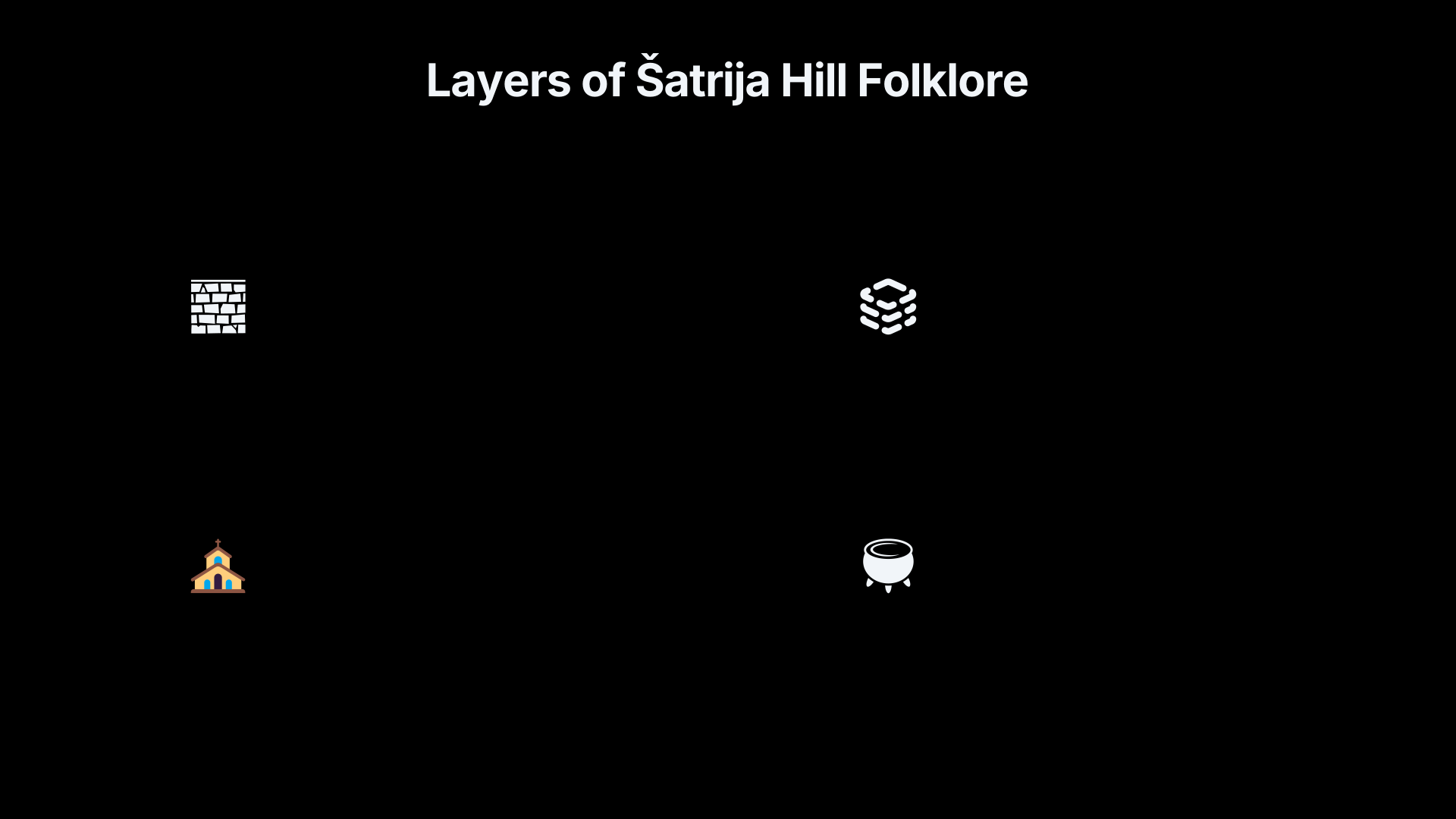
Long before written folklore collections existed, prominent hills occupied a special place in Lithuanian imagination. Archaeological evidence shows that many famous hills were once fortified settlements, ritual centres or important landmarks. Over time, abandoned hillforts accumulated stories about buried treasures, vanished castles, giants, devils and witches. The physical prominence of these sites helped them remain visible long after their original functions were forgotten.[Saugoma]saugoma.ltSaugomaŠatrija hill |Šatrija is one of the most famous archeological monuments not only in Samogitia, but also in Lithuania. This is evid…
In Lithuanian folklore, hills often act as meeting points between the ordinary world and the supernatural. Legends explain unusual shapes in the landscape through magical events, while local traditions frequently describe hilltops as places where spirits gather, hidden churches lie underground, or ancient powers remain dormant. These stories are less about proving supernatural events than about giving cultural meaning to places that dominate the surrounding countryside.[campingroutes.com]campingroutes.comQueen of Lithuanian Mountains.Read more…
Satrija Hill and the Memory of Witches
Among all Lithuania’s legendary hills, Šatrija in the Samogitia region is the most famous witch place. Rising above the surrounding landscape, it has become the country’s best-known location associated with witches’ gatherings and supernatural assemblies. Folklore collected over many generations describes witches flying to the hill, especially on midsummer nights, to celebrate, dance and perform magical rites.[Unknown Lithuania]unknown.ltUnknown LithuaniaŠatrija Hill — Telšiai, LithuaniaThe legendary gathering place of Lithuanian witches, rising 228 meters above the Samogi…
The reputation of Šatrija is not merely a modern tourist invention. Recent research examining dozens of archived folk legends found that the hill repeatedly appears as a location for the witches’ sabbath in Lithuanian storytelling traditions. These narratives connect the landscape to broader European witch beliefs while preserving distinctly local features tied to Samogitian culture and geography.[ResearchGate]researchgate.netThis study analyses 99 folk legends concerning…Read more…
Several legends claim that a church lies buried beneath the hill or that supernatural forces once interfered with attempts to Christianise the site. Such stories reflect a common pattern in Lithuanian folklore: places that may once have had ritual significance are later reinterpreted through Christian-era legends involving witches, devils or hidden sacred buildings.[campingroutes.com]campingroutes.comQueen of Lithuanian Mountains.Read more…
Archaeology adds another layer to the story. Finds from the area show that people lived around Šatrija for centuries and that it was an important hillfort site. The coexistence of archaeological importance and witch folklore helps explain why the hill occupies such a powerful place in Lithuanian cultural memory.[Saugoma]saugoma.ltSaugomaŠatrija hill |Šatrija is one of the most famous archeological monuments not only in Samogitia, but also in Lithuania. This is evid…
The Hill of Crosses as a Sacred Landscape
If Šatrija represents the mysterious side of Lithuania’s sacred geography, the Hill of Crosses represents its devotional side. Located near Šiauliai in northern Lithuania, the site consists of a hill covered with an immense accumulation of crosses, rosaries and religious symbols left by pilgrims over generations. Its exact origin remains uncertain, though many accounts connect the earliest crosses with nineteenth-century uprisings against Russian rule and memorials for those who never returned.[Wikipedia]WikipediaHill of CrossesHill of Crosses
What makes the Hill of Crosses remarkable is that it functions simultaneously as a religious shrine, a national memorial and a folklore landscape. Families have long left crosses there while praying for health, protection, family well-being or the fulfilment of hopes. The act of leaving a cross became a ritual in itself, turning the hill into a living accumulation of personal stories and collective memory.[Lithuania Travel]lithuania.travelHill of Crosses | Lithuania TravelPraying for health, family well-being, and wish fulfilment, pilgrims leave crosses, rosaries, and other…
During Soviet occupation, the hill acquired an additional meaning. Authorities repeatedly bulldozed and removed the crosses, yet people continued returning to replace them. In folklore terms, this transformed the hill into a symbol of endurance. Stories about secret nighttime visits, hidden acts of devotion and repeated reconstruction became part of the site’s cultural significance. The hill came to embody peaceful resistance as much as religious faith.[wikipedia.org]WikipediaHill of CrossesHill of Crosses
The site gained international recognition after the visit of Pope John Paul II in 1993, but its deeper significance lies in the way it connects personal ritual, national history and sacred landscape.[Visit Šiauliai]visitsiauliai.ltVisit ŠiauliaiThe Hill of CrossesThe Hill of Crosses became famous around the world when Pope John Paul II visited it on September 7, 199…
Why Crosses Fill the Lithuanian Countryside
The Hill of Crosses is only the most famous expression of a much wider tradition. Lithuania is often called the “Land of Crosses” because carved crosses, shrine poles and chapel posts appear throughout the countryside. They stand beside roads, near farms, at village entrances, by springs and in cemeteries. Many were erected to seek protection, commemorate the dead, mark significant events or express gratitude after surviving hardship.[ltfai.org]ltfai.orguanian landscape for centuries.Read more…
Lithuanian cross-crafting is distinctive because it combines Christian symbolism with older artistic motifs connected to nature. Traditional crosses often feature suns, birds, floral patterns and tree-like forms. Scholars and heritage organisations note that these monuments blend religious devotion with older cultural ideas about the relationship between people, the land and the sacred.[wikipedia.org]WikipediaLithuanian cross craftingLithuanian cross crafting
The tradition is so significant that UNESCO recognised Lithuanian cross-crafting and its symbolism as part of humanity’s intangible cultural heritage. The recognition reflects not only craftsmanship but also the rituals surrounding the making, blessing, placement and ongoing care of crosses.[Intangible Cultural Heritage]ich.unesco.orgIntangible Cultural HeritageCross-crafting and its symbolismCross-crafting refers to a widespread tradition of making crosses and altars…
Protection, Boundaries and Village Memory
Roadside crosses performed practical cultural functions as well as religious ones. In village tradition they marked boundaries, protected travellers, commemorated accidents and helped define communal identity. A cross at the entrance to a settlement signalled both physical arrival and entry into a protected social space.[Wikipedia]WikipediaLithuanian cross craftingLithuanian cross crafting
Many crosses also stood at locations already regarded as special. Some were erected near springs, stones or trees that earlier generations considered sacred. Rather than completely replacing older landscape traditions, Christian monuments often absorbed them. This blending helps explain why Lithuanian folklore frequently presents sacred places as layered rather than belonging exclusively to one religious tradition.[wikipedia.org]WikipediaLithuanian cross craftingLithuanian cross crafting
From Witch Hills to Folklore Parks
Modern Lithuania has found new ways to preserve these legendary landscapes. One example is the Hill of Witches at Juodkrantė on the Curonian Spit. Unlike Šatrija, it is not famous because people believed witches genuinely gathered there. Instead, it is an open-air sculpture trail filled with carvings of witches, devils and other figures from Lithuanian folklore. The site demonstrates how traditional legends continue to shape tourism, public art and cultural education.[ltfai.org]ltfai.orgThe Hill of Witches – Lithuanian Folk Art InstituteThis enchanting site is home to over 80 wooden sculptures, each depicting legendary ch…
This modern reinterpretation highlights an important feature of Lithuanian folklore: sacred and legendary places rarely remain frozen in time. Some become pilgrimage destinations, some become heritage sites, and others become artistic spaces where old stories are retold for new audiences. Yet the underlying idea remains the same. Whether through a witch hill, a hillfort legend or a roadside cross, the landscape itself is treated as a keeper of memory.
Why These Places Still Matter
Sacred hills, crosses and witch places remain among the most visible expressions of Lithuanian folklore because they link stories to locations that people encounter directly. A legend attached to a hill can survive for centuries because the hill remains on the horizon. A cross beside a road continues to carry memories long after the people who erected it have died.
For modern visitors, places such as Šatrija and the Hill of Crosses offer more than folklore attractions. They reveal how Lithuanians have used the landscape to express belief, identity, resistance and remembrance. The result is a folklore tradition that is not confined to books or archives but remains embedded in the countryside itself.[researchgate.net]researchgate.netThis study analyses 99 folk legends concerning…Read more…
Amazon book picks
Further Reading
Books and field guides related to Where Do Lithuanian Legends Live?. Use these as the next step if you want deeper reading beyond the article.
The Norse Myths
Appeals to readers exploring European myth traditions beyond Lithuania.
eBay marketplace picks
Marketplace Samples
Live-tested eBay searches with available results related to this page.
Endnotes
1.
Source: saugoma.lt
Link:https://saugoma.lt/en/objects/objects-satrija-hill
Source snippet
SaugomaŠatrija hill |Šatrija is one of the most famous archeological monuments not only in Samogitia, but also in Lithuania. This is evid...
2.
Source: ich.unesco.org
Link:https://ich.unesco.org/en/RL/cross-crafting-and-its-symbolism-00013
Source snippet
Intangible Cultural HeritageCross-crafting and its symbolismCross-crafting refers to a widespread tradition of making crosses and altars...
3.
Source: campingroutes.com
Link:https://www.campingroutes.com/en/sightseeing-places/mount-shatria/
Source snippet
Queen of Lithuanian Mountains.Read more...
4.
Source: unknown.lt
Link:https://www.unknown.lt/en/location/satrija-hill
Source snippet
Unknown LithuaniaŠatrija Hill — Telšiai, LithuaniaThe legendary gathering place of Lithuanian witches, rising 228 meters above the Samogi...
5.
Source: researchgate.net
Link:https://www.researchgate.net/publication/398888416_The_Flight_to_Satrija_Hill_Lithuanian_Folk_Legends_of_the_Witches%27_Sabbath
Source snippet
This study analyses 99 folk legends concerning...Read more...
6.
Source: Wikipedia
Title: Hill of Crosses
Link:https://en.wikipedia.org/wiki/Hill_of_Crosses
7.
Source: lithuania.travel
Link:https://lithuania.travel/en/where-to-visit/top-sites-in-lithuania/hill-of-crosses
Source snippet
Hill of Crosses | Lithuania TravelPraying for health, family well-being, and wish fulfilment, pilgrims leave crosses, rosaries, and other...
8.
Source: ltfai.org
Link:https://ltfai.org/crosses-kryziai/
Source snippet
uanian landscape for centuries.Read more...
9.
Source: Wikipedia
Title: Lithuanian cross crafting
Link:https://en.wikipedia.org/wiki/Lithuanian_cross_crafting
10.
Source: lithuania.travel
Link:https://lithuania.travel/en/what-to-do/history-culture-art/lithuania-for-spiritual-travelers-sacred-places-and-piligrimage-experiences/religious-museums-expositions-and-sacred-spaces/exhibition-lithuania-the-land-of-crosses
Source snippet
Exhibition Lithuania – The Land of CrossesIt highlights the unique tradition of Lithuanian cross-crafting, which is included on UNESCO's...
11.
Source: ciurlionis.lt
Title: kryziu lietuva en
Link:https://ciurlionis.lt/activity/branches/m-k-ciurlionis-national-museum-of-art/expositions/kryziu-lietuva-en/
Source snippet
LITHUANIA – THE LAND OF CROSSES19 Jun 2026 — For Lithuanians, the cross holds a special meaning. Crosses were erected to honor the dead a...
12.
Source: ltfai.org
Link:https://ltfai.org/the-hill-of-witches/
Source snippet
The Hill of Witches – Lithuanian Folk Art InstituteThis enchanting site is home to over 80 wooden sculptures, each depicting legendary ch...
13.
Source: Wikipedia
Link:https://en.wikipedia.org/wiki/Hill
Source snippet
HillA hill is a landform that extends above the surrounding terrain. It often has a distinct summit, and is usually applied to peaks w...
14.
Source: unesco.lt
Link:https://unesco.lt/wp-content/uploads/2026/03/cross-crafting_CandidatureFile.pdf
Source snippet
sses and shrines that serves various spiritual...Read more...
15.
Source: nationalgeographic.com
Title: things to do hill of crosses religious tourism
Link:https://www.nationalgeographic.com/travel/article/things-to-do-hill-of-crosses-religious-tourism
Source snippet
Visit the Hill of Crosses in LithuaniaFeb 26, 2018 — UNESCO recognizes cross-making as intangible cultural heritage of Lithuania, a “symb...
16.
Source: visitsiauliai.lt
Link:https://www.visitsiauliai.lt/en/sightseeing-places/the-hill-of-crosses/
Source snippet
Visit ŠiauliaiThe Hill of CrossesThe Hill of Crosses became famous around the world when Pope John Paul II visited it on September 7, 199...
Additional References
17.
Source: culturaobscura.com
Link:https://www.culturaobscura.com/hill-of-witches-lithuania/
Source snippet
Exploring the Hill of WitchesThe Hill of Witches in Juodkrantė, Lithuania is a bewitching hike through the forest that enchants with loca...
18.
Source: russiasperiphery.pages.wm.edu
Link:https://russiasperiphery.pages.wm.edu/baltic-states/lithuania/general/the-hill-of-crosses/
Source snippet
Russia's PeripheryThe Hill of CrossesFrom its beginning, the Hill of Crosses has served as a symbol of both the Lithuanian people's devot...
19.
Source: m.atostogoskaime.lt
Link:https://m.atostogoskaime.lt/en/unesco/cross-crafting-kryzdirbyste-and-cross-symbolism/
20.
Source: eioco.nl
Link:https://eioco.nl/en/hill-of-crosses-in-lithuania-a-pilgrimage-destination-and-a-site-of-peaceful-resistance/
Source snippet
Hill of Crosses in Lithuania a pilgrimage destination and...15 Sept 2022 — During Soviet totalitarian oppression the Hill of Crosses was...
21.
Source: picnicatthecathedral.com
Title: the hill of crosses and the power of a shared narrative in lithuania
Link:https://picnicatthecathedral.com/2017/11/05/the-hill-of-crosses-and-the-power-of-a-shared-narrative-in-lithuania/
Source snippet
The Hill of Crosses and the power of a shared narrative in...5 Nov 2017 — The best way to enjoy the Hill of Crosses is to appreciate the...
22.
Source: visit.telsiai.lt
Link:https://visit.telsiai.lt/en/sightseeing-places/pasatria-mound-satatia/
Source snippet
From Šatrija there are views of the hilly Samogitia of unique beauty. On a sunny day...Read more...
23.
Source: religionunplugged.com
Title: Just outside the northern city of Šiauliai, thousands
Link:https://religionunplugged.com/news/2019/1/7/pilgrimage-a-journey-to-lithuanias-enigmatic-hill-of-crosses
Source snippet
Religion UnpluggedPilgrimage: A journey to Lithuania's enigmatic Hill of CrossesFeb 11, 2019 — The exact origins of Lithuania's Kryžių Ka...
24.
Source: deepbaltic.com
Title: The Hill of Crosses: A Monument to the Defiant Spirit
Link:https://deepbaltic.com/2016/05/21/the-hill-of-crosses-a-monument-to-the-defiant-spirit-of-lithuania/
Source snippet
May 21, 2016 — The famous Hill of Crosses is the very masterstroke of that movement: a memorial not just to resistance, but moreover to c...
Published: May 21, 2016
25.
Source: noba.ac
Title: Contemporary Art LITHUANIA – THE LAND OF CROSSES
Link:https://noba.ac/en/exhibition-posts/lithuania-the-land-of-crosses/
Source snippet
LITHUANIA – THE LAND OF CROSSES - NOBA.acLithuanians built crosses in memory of the dead or as symbols of spiritual protection. It is bel...
26.
Source: facebook.com
Link:https://www.facebook.com/groups/170790266633157/posts/2327708197608009/
Source snippet
Does anyone have a personal experience with them? I went there many years...
Topic Tree