Within Senegal Folklore
Who Are the Pangool Spirits?
Serer Pangool traditions link ancestors, trees, water, lineage and protection into one of Senegal's richest spirit worlds.
On this page
- Ancestral spirits and sacred places
- Trees, snakes, water and lineage memory
- How Serer spirit traditions are understood today
Page outline Jump by section
Introduction
Among the many spirit traditions of Senegal, few are as deeply tied to place as the Serer belief in the Pangool. These spirits are not usually imagined as distant gods or wandering ghosts. Instead, they are ancestral and protective beings connected to particular trees, groves, wells, stones, waterways, shrines and family territories. In Serer religious thought, the landscape itself preserves memory: ancestors remain present through sacred places, and communities maintain relationships with them through ritual, offerings and respect for inherited sites. The Pangool therefore sit at the meeting point of ancestry, territory and spiritual protection, making them one of the most distinctive features of Senegal’s indigenous religious heritage.[Wikipedia]WikipediaOpen source on wikipedia.org.

Unlike folklore that survives mainly in stories, Pangool traditions are rooted in physical locations that families and communities have recognised for generations. Sacred trees, serpents associated with ancestors, and ritual sites linked to village founders all help explain why Serer sacred geography remains central to understanding the country’s folklore and religious history.[Wikipedia]WikipediaOpen source on wikipedia.org.
Who Are the Pangool Spirits?
The Pangool are generally understood as ancestral spirits and revered intermediaries between human beings and the supreme creator, known in Serer religion as Roog. They are neither equal to the creator nor simply the spirits of any deceased person. Many traditions describe them as honoured ancestors, founders, guardians or spiritually powerful figures whose influence continues after death. Communities call upon them for protection, healing, fertility, guidance and the welfare of the land.[Wikipedia]WikipediaOpen source on wikipedia.org.
Historical traditions connect the Pangool to the early settlement of Serer territories. Oral accounts describe village founders and lineage leaders establishing shrines and sacred places associated with particular Pangool. Over time these locations became centres of ritual life, linking family history to the wider landscape. The result is a spiritual map in which certain forests, trees, water sources and burial sites are remembered not simply as natural features but as places where ancestral presence remains active.[Wikipedia]WikipediaOpen source on wikipedia.org.
This connection to place helps explain why Pangool traditions are often described through locations rather than through elaborate mythological biographies. A sacred grove, a venerable tree or a protected water source may be more important than a detailed narrative about the spirit itself. The landscape serves as a living archive of lineage memory.[Jeremy Varner]jeremyvarner.comThey tend to live within the sacred trees, sacred waters, or in tombsJeremy VarnerMythology World Tour: The Serer - jeremyvarner.com30 Mar 2015 — The Pangool are spirits which may either be human or non-hum…
Ancestral Spirits and Sacred Places
One of the defining features of Pangool belief is that spirits are associated with specific sacred sites. Ethnographic accounts describe shrines, groves and ritual locations maintained by families or communities who regard them as points of contact with ancestral powers. These sites are often linked to particular lineages and may play roles in ceremonies concerning protection, healing, agriculture or communal welfare.[Wikipedia]WikipediaOpen source on wikipedia.org.
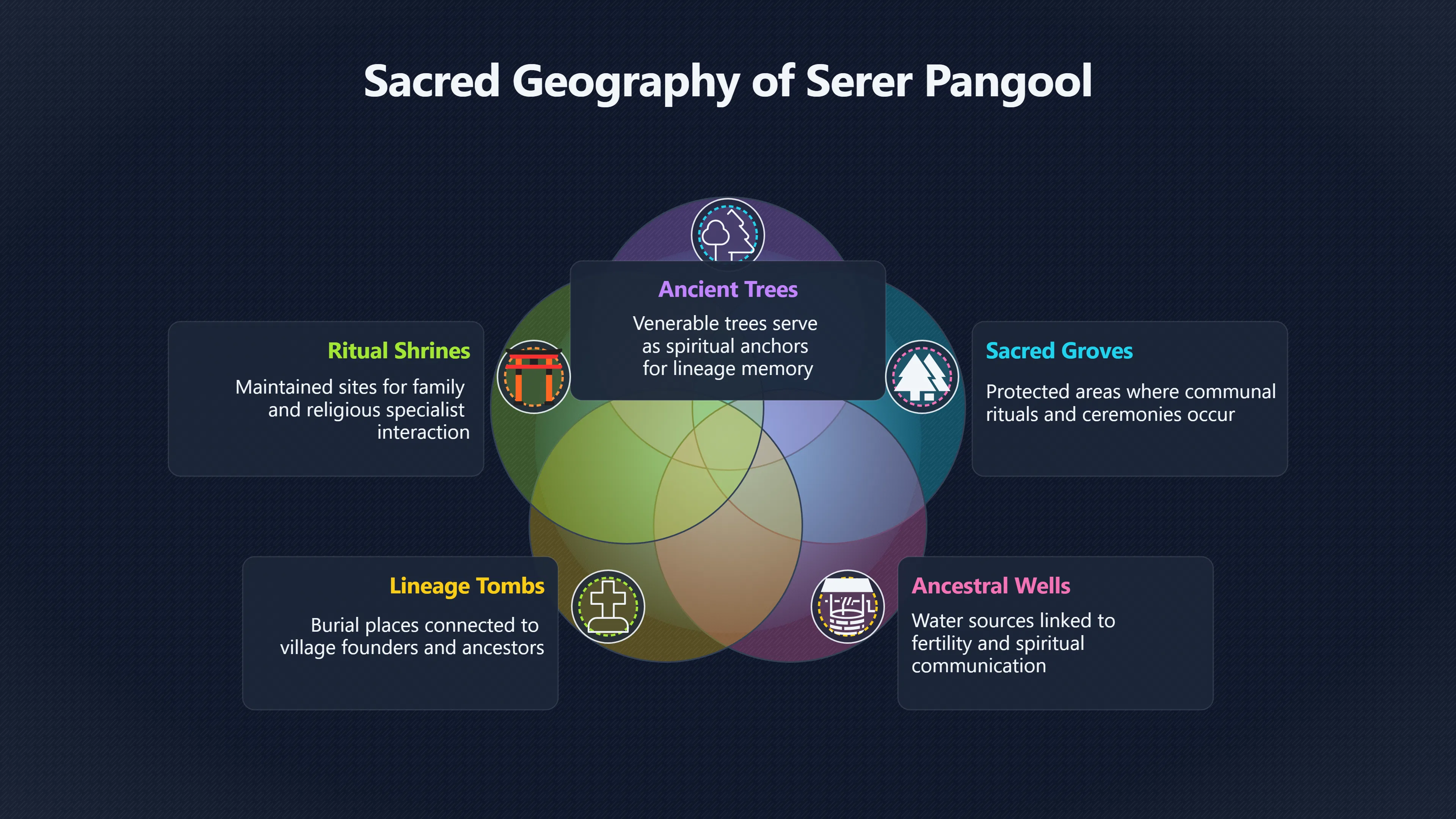
Sacred landscapes in Serer areas traditionally include:
- Ancient trees regarded as spiritually significant.
- Sacred groves where rituals are performed.
- Wells and water sources associated with ancestral presence.
- Tombs and burial places connected with lineage founders.
- Ritual shrines maintained by families or religious specialists.[Wikipedia]WikipediaOpen source on wikipedia.org.
What makes these places folklorically important is that they blur the distinction between geography and story. A grove is not merely a grove; it may be remembered as the dwelling place of a protective spirit. A tree is not merely old; it may embody generations of family memory. Stories, rituals and landscape reinforce one another, helping communities remember origins, obligations and relationships with ancestors.[Jeremy Varner]jeremyvarner.comThey tend to live within the sacred trees, sacred waters, or in tombsJeremy VarnerMythology World Tour: The Serer - jeremyvarner.com30 Mar 2015 — The Pangool are spirits which may either be human or non-hum…
The importance of sacred sites also helps explain why some Serer traditions have endured despite centuries of religious change. While beliefs may evolve, the locations themselves often remain visible reminders of ancestral history.[Wikipedia]WikipediaOpen source on wikipedia.org.
Trees, Snakes, Water and Lineage Memory
Perhaps the most striking symbol associated with the Pangool is the serpent. In Serer religious thought, snakes are frequently linked with ancestors and spiritual continuity. Several scholarly descriptions note that the serpent functions as a symbol of the Pangool, and traditional beliefs often discourage harming certain snakes because they may be connected with ancestral souls.[wikipedia.org]WikipediaOpen source on wikipedia.org.
The relationship between trees and serpents is especially important. Serer cosmological traditions describe ancestral souls becoming associated with snakes that dwell among sacred trees. Certain trees therefore become powerful symbols of continuity between the living and the dead. The image of a snake concealed within an ancient tree reflects a broader idea that ancestral presence remains embedded within the landscape rather than separated from it.[Encyclopedia.pub]encyclopedia.pubSerer Creation Myth | Encyclopedia MDPI1 Nov 2022 — In Serer mythology, there is a relationship between trees and the serpent…. snakes…
Water also occupies a significant place in Pangool traditions. Ethnographic accounts describe some spirits as being connected to sacred waters, wells and other natural features. As in many West African traditions, water is often associated with life, fertility, healing and communication between visible and invisible worlds. Sacred water sites can therefore function as places of ritual attention and communal memory.[Jeremy Varner]jeremyvarner.comThey tend to live within the sacred trees, sacred waters, or in tombsJeremy VarnerMythology World Tour: The Serer - jeremyvarner.com30 Mar 2015 — The Pangool are spirits which may either be human or non-hum…
These natural symbols are closely tied to lineage identity. Families may maintain relationships with particular sacred places over many generations. The landscape becomes a record of ancestry, helping communities remember who they are, where they came from and which obligations they inherited from earlier generations.[Wikipedia]WikipediaSerer maternal clansAugust 13, 2012 — Serer maternal clans or Serer matriclans are the maternal clans of the Serer people of Senegal, the Gambia and Mauritan…
Pangool and the Serer Ritual World
The Pangool are not merely figures from old stories. They remain part of a broader ritual system that includes divination, ancestral remembrance and community ceremonies. One of the best-known public expressions of Serer religious tradition is the Xooy divination ceremony, recognised by UNESCO as part of the Intangible Cultural Heritage of Humanity. During this annual event, religious specialists known as Saltigues deliver predictions and guidance concerning matters such as rainfall, disease and community welfare.[unesco.org]ich.unesco.orgXooy, a divination ceremony among the Serer of SenegalThe Xooy ceremony provides answers to key issues for the community such a…
Although the Xooy is a public ceremony rather than a direct worship service for individual Pangool, it exists within the same spiritual universe. The ceremony reflects the continuing importance of ancestral knowledge, sacred relationships and the balance between people and their environment. UNESCO notes that the ceremony is understood as helping maintain harmony between human communities and the world around them.[ICH UNESCO]ich.unesco.orgXooy, a divination ceremony among the Serer of SenegalThe Xooy ceremony provides answers to key issues for the community such a…
This connection between spirit traditions and environmental awareness is a recurring theme in Serer culture. Sacred sites are often respected not only for religious reasons but also because they represent inherited responsibilities to land, water and community memory.[ICH UNESCO]ich.unesco.orgOpen source on unesco.org.

How Serer Spirit Traditions Are Understood Today
Modern Senegal is overwhelmingly Muslim, with Christian minorities and a long history of religious coexistence. Within this context, Serer traditions involving the Pangool have not disappeared, but they are understood in different ways by different people. Some communities continue to regard them as part of a living religious heritage. Others see them primarily as ancestral culture, historical identity or traditional knowledge.[ICH UNESCO]ich.unesco.orgXooy, a divination ceremony among the Serer of SenegalThe Xooy ceremony provides answers to key issues for the community such a…
Researchers often point out that Serer religion is among the most thoroughly documented indigenous spiritual systems in Senegal. This has made the Pangool important not only in religious practice but also in discussions of heritage, identity and cultural preservation. Sacred groves, ritual sites and ceremonial traditions are frequently presented as evidence of a long continuity between present-day communities and earlier generations.[Wikipedia]WikipediaOpen source on wikipedia.org.
For folklore enthusiasts, the enduring appeal of the Pangool lies in the way they connect story to landscape. Rather than inhabiting a distant mythical realm, these spirits are remembered through real places: an ancient tree, a village shrine, a sacred grove or a water source. In Serer tradition, the land itself becomes a repository of ancestral presence, making the Pangool one of Senegal’s richest examples of a sacred landscape tradition.[wikipedia.org]WikipediaOpen source on wikipedia.org.
Amazon book picks
Further Reading
Books and field guides related to Who Are the Pangool Spirits?. Use these as the next step if you want deeper reading beyond the article.
African Religions and Philosophy
Explains ancestor veneration, intermediary spirits and sacred places.
Oral Literature in Africa
Helps explain how sacred histories and lineage memories are preserved.
African Traditional Religion
Covers concepts of ancestors, ritual protection and community belief.
A History of the Serer of Senegal
Directly supports understanding of Serer religious traditions, ancestry and sacred landscapes.
eBay marketplace picks
Marketplace Samples
Live-tested eBay searches with available results related to this page.
Endnotes
1.
Source: Wikipedia
Link:https://en.wikipedia.org/wiki/Pangool
2.
Source: encyclopedia.pub
Link:https://encyclopedia.pub/entry/32172
Source snippet
Serer Creation Myth | Encyclopedia MDPI1 Nov 2022 — In Serer mythology, there is a relationship between trees and the serpent.... snakes...
3.
Source: Wikipedia
Title: Serer creation myth
Link:https://en.wikipedia.org/wiki/Serer_creation_myth
Source snippet
Serer creation mythThe serpent itself is the symbol of the Pangool (ancient Serer saints or ancestral spirits). Fangool, the singular...
4.
Source: Wikipedia
Title: Serer maternal clans
Link:https://en.wikipedia.org/wiki/Serer_maternal_clans
Source snippet
August 13, 2012 — Serer maternal clans or Serer matriclans are the maternal clans of the Serer people of Senegal, the Gambia and Mauritan...
Published: August 13, 2012
5.
Source: ich.unesco.org
Link:https://ich.unesco.org/en/RL/xooy-a-divination-ceremony-among-the-serer-of-senegal-00878
Source snippet
Xooy, a divination ceremony among the Serer of SenegalThe Xooy ceremony provides answers to key issues for the community such a...
6.
Source: unesco.org
Link:https://www.unesco.org/archives/multimedia/document-3510
Source snippet
Xooy, A Divination Ceremony Among the Serer of Senegal26 Nov 2013 — The Xooy is a traditional divination ceremony among the Serer c...
7.
Source: ich.unesco.org
Link:https://ich.unesco.org/fr/decisions/8.COM/8.25
8.
Source: Wikipedia
Link:https://fr.wikipedia.org/wiki/S%C3%A9n%C3%A9gal
Source snippet
SénégalLe Sénégal, en forme longue la république du Sénégal, est un État d'Afrique de l'Ouest bordé à l'ouest par l'Océan Atlantique...
9.
Source: Wikipedia
Link:https://fr.wikipedia.org/wiki/Xooy
Source snippet
XooyLe Xooy, parfois écrit Xoy, est une cérémonie divinatoire organisée sur la place du village, à l'approche de la saison des pluies...
10.
Source: ich.unesco.org
Link:https://ich.unesco.org/fr/video/17739
Source snippet
unesco.orgVidéo: Le xooy, une cérémonie divinatoire chez les Serer du...Le xooy, une cérémonie divinatoire chez les Serer du Sénégal (Sé...
11.
Source: jeremyvarner.com
Title: They tend to live within the sacred trees, sacred waters, or in tombs
Link:https://jeremyvarner.com/blog/2015/03/mythology-world-tour-the-serer/
Source snippet
Jeremy VarnerMythology World Tour: The Serer - jeremyvarner.com30 Mar 2015 — The Pangool are spirits which may either be human or non-hum...
Additional References
12.
Source: senegal-original.com
Link:https://www.senegal-original.com/conseils-voyage/tout-savoir
Source snippet
Tout savoir sur le SénégalClassé au Patrimoine mondial de l'UNESCO, il abrite une variété remarquable de grands mammifères, notamment des...
13.
Source: routard.com
Link:https://www.routard.com/fr/guide/afrique/senegal
Source snippet
Voyage Sénégal | Partir en vacances au SénégalPréparez votre voyage au Sénégal: incontournables et itinéraires, infos culturelles et pra...
14.
Source: jstor.org
Link:https://www.jstor.org/content/pdf/oa_book_monograph/10.2307/j.ctv2r65h8c.pdf
15.
Source: africanmythology.com
Link:https://africanmythology.com/the-spirits-of-senegambia
Source snippet
The Snake Beneath the Baobab. A recurring Serer symbol, a creature said to...Read more...
16.
Source: au-senegal.com
Title: Au Sénégal, le cœur du Sénégal
Link:https://www.au-senegal.com/
Source snippet
Le guide du tourisme, du...Le guide complet pour découvrir la richesse culturelle, la beauté naturelle et l'hospitalité chaleureuse du p...
17.
Source: arte.tv
Title: Sénégal: une île à la dérive
Link:https://www.arte.tv/fr/videos/076707-000-A/senegal-une-ile-a-la-derive/
Source snippet
ARTE Reportage - Regarder le...A l'embouchure du fleuve Casamance, l'océan monte, au risque de submerger l'île de Carabane… Une conséque...
18.
Source: academia.edu
Title: They are the pivot around
Link:https://www.academia.edu/164547077/Supreme_Deities_in_Africa_Religious_Myths_and_Cultural_Groups
Source snippet
Supreme Deities in Africa: Religious Myths and Cultural...Professor Simone Kalis writes that: “Religious life or “path of God” /...
19.
Source: lonelyplanet.fr
Title: Guide de voyage Sénégal
Link:https://www.lonelyplanet.fr/destinations/afrique/senegal
Source snippet
AfriqueLonely Planet: un guide de référence pour découvrir le Sénégal! Infos pratiques, transports, visas, incontournables à visiter, h...
20.
Source: youtube.com
Link:https://www.youtube.com/watch?v=TukKCYxG4PM
Source snippet
The Serer People and the Serer Religion (Part 1)...
21.
Source: kwekudee-tripdownmemorylane.blogspot.com
Link:https://kwekudee-tripdownmemorylane.blogspot.com/2014/01/serer-people-beautiful-intellectual-and.html
Source snippet
Many of the Serer Pangool (saints and ancestral spirits) came from this family. Though...Read more...
Topic Tree