Why Timor Leste Dreams of a Crocodile
Timor-Leste’s folklore is best understood through three living centres of gravity: the crocodile origin story, the sacred power often described by the Timorese term lulik, and the clan-based sacred houses known as uma lulik. These are not just old stories kept in books.
Page outline Jump by section
Introduction
The important caution is that Timor-Leste is not a single, uniform folklore zone. It is a small country with many language communities and local histories, so traditions vary sharply between districts, villages, houses and families. The best evidence points to a layered culture: older oral and ritual traditions, Portuguese Catholic influence, Indonesian occupation-era disruption, post-independence heritage revival, tourism retellings, conservation debates, and modern digital summaries all coexist.[cambridge.org]cambridge.orgOpen source on cambridge.org.
The crocodile that became Timor
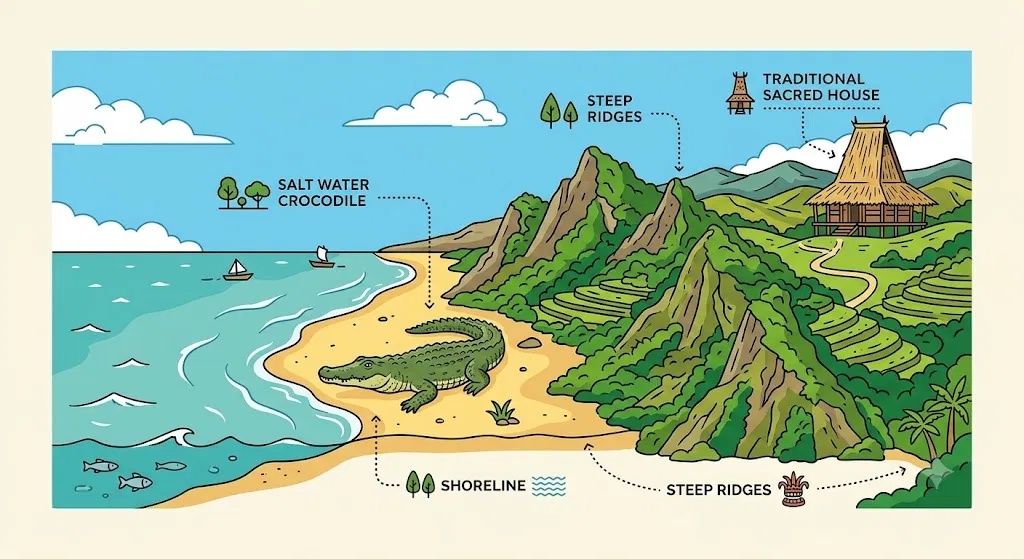
The best-known Timorese legend tells of a boy and a crocodile. In common versions, a young boy helps a weak crocodile reach the sea; later the crocodile carries him on journeys across the ocean. When the crocodile dies, its body becomes the island of Timor. The ridges and mountains of the island are then imagined as the back of the great crocodile, giving the land itself an ancestral body.[kommunikation.uni-freiburg.de]kommunikation.uni-freiburg.degrandfather crocodile16 Jul 2019 — When the crocodile died, the island of East Timor was formed," explains Brackhane, a doctoral candidate of the Faculty of E…
This story matters because it turns geography into kinship. The crocodile is not merely a monster, mascot, or dangerous animal; in many Timorese communities it is spoken of as a grandparent-like ancestor. Researchers on human-crocodile relations in Timor-Leste note that the creation myth gives crocodiles a cultural status that affects how people interpret attacks, coexistence and management.[ResearchGate]researchgate.netResearch Gate Crocodile management in Timor-Leste: Drawing uponResearch Gate Crocodile management in Timor-Leste: Drawing upon
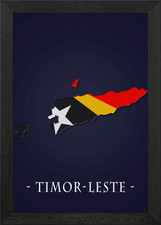
The same tradition has also become a national image. Public-facing accounts regularly describe Timor-Leste as the “land of the sleeping crocodile”, and crocodile motifs appear in art, tourist storytelling and cultural explanation. This does not mean every Timorese person believes the story in the same literal way. It means the crocodile has become a powerful shared symbol through which ancestry, land and national identity can be discussed.[The Corner Store Network]cornerstorenetwork.org.auOpen source on cornerstorenetwork.org.au.
There is a modern tension at the heart of the legend. Saltwater crocodiles are real and dangerous, and reported attacks have risen in recent decades. A 2024 conservation paper reported a 23-fold rise in reported attacks during 2007–2014, while also stressing that public tolerance and reluctance to harm crocodiles are entwined with reverence for them as sacred beings among many, though not all, Timorese people.[Cambridge University Press & Assessment]cambridge.orgOpen source on cambridge.org.
That tension makes the crocodile story unusually vivid for modern readers. In some countries, an origin myth may feel distant from daily life; in Timor-Leste, the creature at the centre of the story still lives in rivers, lagoons, mangroves and coastal waters. Conservation, public safety and ancestral respect all meet in the same animal.[Conservation International]conservation.orgOpen source on conservation.org.
Sacred power is not just “superstition”
A key idea in Timorese belief culture is lulik, often translated as sacred, forbidden, taboo or holy. None of those English words captures the whole idea. Anthropologist Judith Bovensiepen argues that lulik is not simply a category for objects set apart from daily life; it is understood as a potency that can animate landscapes, ancestral objects, houses and relationships.[ResearchGate]researchgate.netOpen source on researchgate.net.
For a folklore reader, this matters because Timorese supernatural tradition is not organised only around named monsters or separate “myths”. It is often about relations: between the living and the dead, younger and older kin, houses and land, people and animals, ordinary conduct and sacred restriction. In this sense, a spring, stone, heirloom, house, ritual object or crocodile can become part of the story-world because it is involved in sacred power and social obligation.[Kent Academic Repository]kar.kent.ac.ukOpen source on kent.ac.uk.
The idea also helps explain why Timor-Leste’s folklore cannot be cleanly separated from law, land and ethics. Customary prohibitions known as tara bandu are used in some communities to regulate behaviour, protect resources and reduce conflict. Development and environmental organisations have described these practices as local customary law rooted in community norms, ritual and leadership; a United Nations source connects them with sacred obligations towards land, environment and future generations.[Belun]belun.tlTARA BANDU: ITS ROLE AND USE IN COMMUNITYTARA BANDU: ITS ROLE AND USE IN COMMUNITY
Yet this is not a frozen survival from a timeless past. Researchers have warned that modern enthusiasm for tara bandu can sometimes idealise or reinvent local practice, especially when state agencies, NGOs and conservation programmes formalise it in writing. That makes it a good example of how folklore and ritual authority can be revived, reshaped and argued over in a new nation-state.[ScienceDirect]sciencedirect.comOpen source on sciencedirect.com.
Sacred houses keep ancestry in public view
The most visible architectural expression of Timorese sacred tradition is the uma lulik, usually described in English as a sacred house. These houses are not simply picturesque old buildings. They are clan and ancestral centres, places where sacred heirlooms may be kept, rituals are performed, kinship is remembered, and relations between the living, the dead and the land are made visible.[Moodle@Units]moodle2.units.itOpen source on units.it.
Scholars and heritage writers stress that the “house” is more than the structure itself. It can represent a descent group, a moral community, a political memory and a ritual relationship with a particular place. This is why the rebuilding or preservation of sacred houses after destruction is not merely an architectural issue; it can be a restoration of social identity and ancestral connection.[Moodle@Units]moodle2.units.itOpen source on units.it.
Different regions have different sacred-house styles. The tall, steep-roofed houses associated with the Fataluku people in the east are especially recognisable and have become a prominent national visual symbol, but they should not be mistaken for the only Timorese form. The nationalisation of one striking regional style is itself part of the modern heritage story: a local form becomes a shorthand for the country.[Wikipedia]WikipediaUma lulikUma lulik
Sacred houses also show how folklore, politics and modernity overlap. During the twentieth century, Catholic missions, colonial rule, Indonesian occupation and later independence all affected sacred-house practice. Bovensiepen’s work on the transformation of the sacred describes early twentieth-century missionary hostility to sacred houses, while later research on heritage shows how uma lulik have been reframed as national cultural heritage after independence.[cambridge.org]cambridge.orgOpen source on cambridge.org.
Catholicism did not erase older belief
Timor-Leste is overwhelmingly Catholic in formal religious identity: the 2022 census figure cited by the US State Department gives 97.5% of the population as Catholic, with small Protestant, Muslim, Buddhist and Hindu minorities.[State.gov]state.govOpen source on state.gov.
That statistic can mislead readers if it is taken to mean older traditions disappeared. In Timor-Leste, Catholic practice and ancestral or sacred traditions often coexist, overlap or reinterpret one another. Research on the sacred in East Timor notes that Catholic items could themselves become lulik, while many communities continue to recognise ancestral houses, sacred landscapes and ritual authority alongside Catholic life.[Cambridge University Press & Assessment]cambridge.orgOpen source on cambridge.org.
This layered religious landscape is partly historical. Portuguese Catholic influence reached Timor centuries ago, but deep mass Catholic identification expanded especially under Indonesian rule, when Catholicism became closely tied to resistance, refuge and national identity. Contemporary Timor-Leste can therefore be both intensely Catholic and deeply marked by older sacred geographies and ancestral obligations.[Vatican News]vaticannews.vaVatican News An overview of the Church in Timor-LesteVatican News An overview of the Church in Timor-Leste
For folklore, the result is not a simple replacement story. Saints, churches, sacred houses, ancestors, crocodiles, ritual objects and local prohibitions may all belong to the same cultural world, though not always without tension. The practical question is often not “Is this Catholic or traditional?” but “How does this community understand the relationship between church, house, land and ancestors?”[Cambridge University Press & Assessment]cambridge.orgOpen source on cambridge.org.
Oral tradition is history, identity and performance
Timor-Leste’s folklore has long been carried through oral tradition: origin narratives, house histories, ritual speech, poetry, genealogies and local accounts of settlement. Work on writing and translating Timorese oral tradition argues that oral forms are central to understanding East Timorese historical and cultural identity, especially in a society where writing and formal archives have not always held the same authority as spoken transmission.[OpenEdition Journals]journals.openedition.orgOpen source on openedition.org.
This matters because many Timorese stories are not best treated as isolated fairy tales. A story about a first ancestor, a migration from the sea, a sacred spring, a mountain, a house or a crocodile may also explain land rights, marriage relations, ritual duties or political authority. The folklore is not just entertainment; it can be social memory in narrative form.[Get Started with OpenScholar]uva.theopenscholar.comOpen source on theopenscholar.com.
The sea is especially important in some origin and settlement traditions. Anthropologist Susanna Barnes has explored the significance of water and the sea as sources of generative power in local and regional accounts of origin and settlement in Timor-Leste. That emphasis sits naturally beside the crocodile myth, where a sea journey and an animal body turn movement into homeland.[Get Started with OpenScholar]uva.theopenscholar.comOpen source on theopenscholar.com.
Modern language conditions affect preservation too. Tetum and Portuguese are official languages, and Tetum functions as a major public language, but Timor-Leste is linguistically diverse and many oral traditions are rooted in local languages. Recent research describes Tetum as a low-resource language in digital terms, which is a reminder that online visibility is not the same as cultural importance: many traditions may be alive locally while remaining hard to find in searchable English-language sources.[arXiv]arxiv.orgarXiv Text Information Retrieval in Tetun: A Preliminary StudyarXiv Text Information Retrieval in Tetun: A Preliminary Study
Textiles, objects and animal motifs
Timorese folklore is also carried through objects. The woven cloth known as tais is a major cultural form used in ceremony, gift-giving, dress and public identity. Patterns vary by region and community, and crocodile imagery can appear among the motifs because of the island’s origin legend.[Wikipedia]WikipediaOpen source on wikipedia.org.
Sacred houses may also hold heirlooms and ritual objects whose importance is not purely decorative. Sources on uma lulik mention sacred cloths, swords, ancestor figures, headdresses and other inherited objects that are displayed only in particular circumstances. Such objects can act as anchors of memory: they connect a house to ancestors, rights, ceremonies and stories.[Wikipedia]WikipediaUma LulikUma Lulik
For readers looking for “monsters” in the familiar horror-folklore sense, Timor-Leste may feel different from countries with a large published bestiary. The better-attested material is often less about named creatures stalking the night and more about sacred animals, ancestral presences, forbidden places, ritual danger and the moral force of inherited objects. The crocodile is the clearest national creature, but its role is grander and more complicated than a monster tale.[ResearchGate]researchgate.netResearch Gate Crocodile management in Timor-Leste: Drawing uponResearch Gate Crocodile management in Timor-Leste: Drawing upon
Haunted places and sacred landscapes
Timor-Leste has many places that are treated as powerful because of ancestry, history, ritual restriction or local memory. Sacredness may attach to houses, mountains, stones, springs, groves, graves, heirlooms or whole landscapes. The point is not always that a place is “haunted” in the popular ghost-tour sense, but that it is charged with obligations and danger if approached wrongly.[ResearchGate]researchgate.netOpen source on researchgate.net.
This is why “sacred landscape” is often a better phrase than “haunted site”. A mountain linked to origin, a house containing ancestral objects, or a river associated with crocodiles may be a place where story, caution and ritual conduct meet. The supernatural element lies in relationship and rule: who may enter, what may be touched, what may be said, what must be offered, and what consequences are feared if boundaries are ignored.[UN Special Rapporteur on Indigenous Rights]un.arizona.eduOpen source on arizona.edu.
Some modern heritage and tourism accounts highlight sacred houses and crocodile legends for visitors, but careful readers should separate local ritual significance from simplified tourist retelling. A sacred house built or restored for display may still teach visitors something real, but it is not the same as entering the full ritual life of a particular clan.[Moodle@Units]moodle2.units.itOpen source on units.it.
What is old, what is modern, and what is uncertain?
The crocodile origin story, ancestral sacred houses and lulik are well-attested across academic, conservation, heritage and public sources. They should be treated as central to Timor-Leste’s folklore and belief culture. The exact wording of a myth, however, changes depending on teller, region, language, audience and purpose. A tourist-board version, a school retelling, a clan narrative and an anthropologist’s field account may not be identical.[uni-freiburg.de]kommunikation.uni-freiburg.degrandfather crocodile16 Jul 2019 — When the crocodile died, the island of East Timor was formed," explains Brackhane, a doctoral candidate of the Faculty of E…
Modern statehood has also changed the frame. Timor-Leste restored independence in 2002, and post-independence heritage work has made sacred houses and traditional practices part of national identity. This can preserve culture, but it can also simplify local diversity into a few recognisable national symbols, especially the crocodile and the steep-roofed sacred house.[UNFPA Timor-leste]timor-leste.unfpa.orgfinal main report tlphc census 2022final main report tlphc census 2022
The available English-language evidence is strongest for the crocodile myth, lulik, sacred houses, Catholic-traditional overlap, customary prohibitions and heritage revival. It is thinner for many village-level legends, ghost stories, witches, fairies or named local spirits, partly because much of that knowledge is oral, local-language, family-based or recorded in specialist ethnography rather than popular English sources.[OpenEdition Journals]journals.openedition.orgOpen source on openedition.org.
That thinness should not be mistaken for absence. It means public-facing accounts need humility. Timor-Leste’s folklore is not a neat catalogue of creatures; it is a living field of oral memory, sacred authority, ancestral houses, Catholic reinterpretation, environmental practice and national storytelling. The result is a tradition in which the land may be a crocodile, a house may be an ancestor’s presence, a rule may be ritually binding, and a story may still matter in decisions about rivers, forests, families and the state.
Amazon book picks
Further Reading
Books and field guides related to Why Timor Leste Dreams of a Crocodile. Use these as the next step if you want deeper reading beyond the article.
The Art of Not Being Governed
Offers broader insight into upland cultures, tradition and identity in the region.
East Timor: A Nation's Bitter Dawn
Provides essential cultural and historical context for Timorese traditions.
From the Crocodile's Back
Focuses on stories and lived traditions connected to Timor-Leste.
eBay marketplace picks
Marketplace Samples
Live-tested eBay searches with available results related to this page.
Endnotes
1.
Source: kommunikation.uni-freiburg.de
Title: grandfather crocodile
Link:https://kommunikation.uni-freiburg.de/pm-en/online-magazine/research-and-discover/grandfather-crocodile
Source snippet
16 Jul 2019 — When the crocodile died, the island of East Timor was formed," explains Brackhane, a doctoral candidate of the Faculty of E...
2.
Source: cambridge.org
Link:https://www.cambridge.org/core/journals/comparative-studies-in-society-and-history/article/transformations-of-the-sacred-in-east-timor/0876615373803A24F7C0323A7A31FD1A
3.
Source: moodle2.units.it
Link:https://moodle2.units.it/pluginfile.php/379727/mod_forum/attachment/34481/eces-5298.pdf?forcedownload=1
4.
Source: state.gov
Link:https://www.state.gov/reports/2023-report-on-international-religious-freedom/timor-leste
5.
Source: Wikipedia
Title: Lafaek Diak
Link:https://en.wikipedia.org/wiki/Lafaek_Diak
6.
Source: researchgate.net
Title: Research Gate Crocodile management in Timor-Leste: Drawing upon
Link:https://www.researchgate.net/publication/333220611_Crocodile_management_in_Timor-Leste_Drawing_upon_traditional_ecological_knowledge_and_cultural_beliefs
7.
Source: cambridge.org
Link:https://www.cambridge.org/core/journals/oryx/article/wildlife-conservation-through-traditional-values-alarming-numbers-of-crocodile-attacks-reported-from-timorleste/F87981A26E058E5A48B72B326358B08D
8.
Source: conservation.org
Link:https://www.conservation.org/news/on-island-nation-ancestral-bond-to-crocodiles-is-tested
9.
Source: dtbar.nt.gov.au
Title: territory to partner with timor leste on crocodile management
Link:https://dtbar.nt.gov.au/news/2025/territory-to-partner-with-timor-leste-on-crocodile-management
10.
Source: researchgate.net
Link:https://www.researchgate.net/publication/264087094_Lulik_Taboo_Animism_or_Transgressive_Sacred_An_Exploration_of_Identity_Morality_and_Power_in_Timor-Leste
11.
Source: belun.tl
Title: TARA BANDU: ITS ROLE AND USE IN COMMUNITY
Link:https://belun.tl/wp-content/uploads/2013/08/Tara-Bandu-PB-English.pdf
12.
Source: sciencedirect.com
Link:https://www.sciencedirect.com/org/science/article/pii/S0006229419000248
13.
Source: Wikipedia
Title: Uma lulik
Link:https://fr.wikipedia.org/wiki/Uma_lulik
14.
Source: Wikipedia
Title: Uma Lulik
Link:https://en.wikipedia.org/wiki/Uma_Lulik
15.
Source: run.unl.pt
Link:https://run.unl.pt/entities/publication/c48af878-777b-4950-9b22-93a88fc86227
16.
Source: books.openedition.org
Link:https://books.openedition.org/irasec/663?lang=en
17.
Source: Wikipedia
Title: Traditionelle Religion Timors
Link:https://de.wikipedia.org/wiki/Traditionelle_Religion_Timors
18.
Source: journals.openedition.org
Link:https://journals.openedition.org/configuracoes/3284?lang=en
19.
Source: arxiv.org
Title: arXiv Text Information Retrieval in Tetun: A Preliminary Study
Link:https://arxiv.org/abs/2406.07331
20.
Source: arxiv.org
Link:https://arxiv.org/abs/2411.12262
21.
Source: Wikipedia
Link:https://en.wikipedia.org/wiki/Tais
22.
Source: Wikipedia
Link:https://de.wikipedia.org/wiki/Lulik
23.
Source: timor-leste.unfpa.org
Title: final main report tlphc census 2022
Link:https://timor-leste.unfpa.org/sites/default/files/pub-pdf/final-main-report_tlphc-census_2022.pdf
24.
Source: pmo.gov.sg
Link:https://www.pmo.gov.sg/newsroom/pm-lawrence-wong-at-the-joint-press-conference-with-prime-minister-of-timor-leste-xanana-gusmao–july-2026-/
Published: july 2026
25.
Source: journals.openedition.org
Link:https://journals.openedition.org/eces/5298?lang=en
26.
Source: journals.openedition.org
Link:https://journals.openedition.org/eces/5298
27.
Source: state.gov
Link:https://www.state.gov/reports/2022-report-on-international-religious-freedom/timor-leste
28.
Source: researchgate.net
Title: 233606321 Glimpses of Alternatives The Uma Lulik of East Timor
Link:https://www.researchgate.net/publication/233606321_Glimpses_of_Alternatives_The_Uma_Lulik_of_East_Timor
29.
Source: researchgate.net
Link:https://www.researchgate.net/figure/Local-landscapes-reinforce-Timorese-beliefs-that-the-island-of-Timor-was-created-by-a_fig1_333220611
30.
Source: researchgate.net
Title: 347626049 Uma Lulik as Heritage Authorised Heritage Discourse in Timor Leste
Link:https://www.researchgate.net/publication/347626049_Uma_Lulik_as_Heritage_Authorised_Heritage_Discourse_in_Timor-Leste
31.
Source: researchgate.net
Title: 377772569 Sharing a pond with grandfather crocodile
Link:https://www.researchgate.net/publication/377772569_Sharing_a_pond_with_grandfather_crocodile
32.
Source: researchgate.net
Link:https://www.researchgate.net/publication/355788735_On_the_Influence_of_Customary_Law_Tara_Bandu_in_Community_Based_Forest_Management_at_the_Mountains_of_Timor-Leste
33.
Source: Wikipedia
Link:https://en.wikipedia.org/wiki/Timor
34.
Source: Wikipedia
Title: Religion in Timor Leste
Link:https://en.wikipedia.org/wiki/Religion_in_Timor-Leste
35.
Source: Wikipedia
Title: Catholic Church in Timor Leste
Link:https://en.wikipedia.org/wiki/Catholic_Church_in_Timor-Leste
36.
Source: inetl-ip.gov.tl
Title: main report timor leste population and housing census 2022
Link:https://inetl-ip.gov.tl/2023/05/18/main-report-timor-leste-population-and-housing-census-2022/
37.
Source: timor-leste.unfpa.org
Title: censuspreliminaryresults2022 4
Link:https://timor-leste.unfpa.org/sites/default/files/pub-pdf/censuspreliminaryresults2022_4.pdf
38.
Source: kommunikation.uni-freiburg.de
Title: holy crocodiles
Link:https://kommunikation.uni-freiburg.de/pm-en/press-releases-2019/holy-crocodiles
39.
Source: timor-leste.gov.tl
Link:https://timor-leste.gov.tl/?lang=en&p=30931
40.
Source: collection.qagoma.qld.gov.au
Title: qagoma.qld.gov.au Mariano Lafu
Link:https://collection.qagoma.qld.gov.au/page/mariano-lafu
41.
Source: cornerstorenetwork.org.au
Link:https://cornerstorenetwork.org.au/blogs/blog/how-a-crocodile-shaped-timor-leste-myth-culture-and-conservation?srsltid=AfmBOooRcWvRnQ2dRGx1K8lnXKW2B7LqpmR9VO-SNFfBMSoFCoABqSdj
42.
Source: kar.kent.ac.uk
Link:https://kar.kent.ac.uk/id/document/48356
43.
Source: un.arizona.edu
Link:https://un.arizona.edu/search-database/report-special-rapporteur-rights-indigenous-peoples-1
44.
Source: vaticannews.va
Title: Vatican News An overview of the Church in Timor-Leste
Link:https://www.vaticannews.va/en/church/news/2024-09/pope-francis-apostolic-journey-timor-leste-church-overview.html
45.
Source: uva.theopenscholar.com
Link:https://uva.theopenscholar.com/files/geometries-of-polity/files/12barnesgeometriespaper_5.pdf
46.
Source: cornerstorenetwork.org.au
Link:https://cornerstorenetwork.org.au/blogs/blog/how-a-crocodile-shaped-timor-leste-myth-culture-and-conservation?srsltid=AfmBOopUYR3nBYS4LE7CPdQikiKLVZ-74jGHz6-EMp9nJaWRcgsJgsum
47.
Source: cornerstorenetwork.org.au
Link:https://cornerstorenetwork.org.au/blogs/blog/how-a-crocodile-shaped-timor-leste-myth-culture-and-conservation?srsltid=AfmBOooF7XnrKlvx6DhrrI0AzPvrqvcPEkpBYt5NxHaB8abBK1Gqx68n
48.
Source: cornerstorenetwork.org.au
Link:https://cornerstorenetwork.org.au/blogs/blog/how-a-crocodile-shaped-timor-leste-myth-culture-and-conservation?srsltid=AfmBOorDirdBpTirmRwBusemu1LZVEH-ZTxJX8gQ0PEB9gfOorEcvyS0
49.
Source: atlasobscura.com
Title: uma lulik
Link:https://www.atlasobscura.com/places/uma-lulik
50.
Source: timorleste.tl
Link:https://www.timorleste.tl/east-timor/about/people-culture/
51.
Source: slowly.app
Title: Uma Lulik
Link:https://slowly.app/stamp/tl-umalulik/
Additional References
52.
Source: reuters.com
Link:https://www.reuters.com/world/pope-francis-visit-keenly-awaited-deeply-catholic-east-timor-2024-09-08/
Source snippet
Despite scandals within the church, including high-profile sexual abuse cases, the church remains a unifying force in East Timor, which g...
53.
Source: phys.org
Title: 2019 07 holy crocodiles cultural status saltwater
Link:https://phys.org/news/2019-07-holy-crocodiles-cultural-status-saltwater.html
Source snippet
The cultural status of saltwater crocodiles in East Timor2 Jul 2019 — "The cultural status of crocodiles can be traced back to the creati...
54.
Source: academia.edu
Link:https://www.academia.edu/7450617/Lulik_The_Core_of_Timorese_Values
55.
Source: scribd.com
Link:https://www.scribd.com/document/962672457/Legend-of-the-crocodile-island-image
56.
Source: etan.org
Link:https://www.etan.org/timor/croc.htm
57.
Source: instagram.com
Link:https://www.instagram.com/p/DKZBQRWtiAS/
58.
Source: facebook.com
Link:https://www.facebook.com/cornerstorenetwork/posts/have-you-heard-the-story-of-the-crocodile-that-became-an-island-in-timor-leste-t/1285912590200694/
59.
Source: instagram.com
Link:https://www.instagram.com/reel/DQvWFvVD2WD/
60.
Source: visiteasttimor.com
Link:https://visiteasttimor.com/legend-history-timor-leste/
61.
Source: asiafoundation.org
Link:https://asiafoundation.org/wp-content/uploads/2023/12/Local-Justice-in-TImor-Leste_EN.pdf
Topic Tree
Follow this branch
Related pages 192
- Afghan Folklore
- Albanian Folklore
- Algerian Folklore
- Australian Folklore
- Azerbaijan Folklore
- +187 more in sidebar