Within Iran Folklore
Why Iran's Epic Heroes Still Matter
The Shahnameh turns kings, champions and monsters into a living storehouse of Iranian cultural memory.
On this page
- The Shahnameh as national epic
- Rostam, kings and moral conflict
- How epic stories entered popular culture
Page outline Jump by section
Introduction
Iran’s most famous legendary heroes are not remembered only because they appear in an old book. They endure because the Shahnameh (“Book of Kings”), completed by the poet Ferdowsi around the turn of the eleventh century, became a vast storehouse of cultural memory in which kings, warriors, monsters, betrayals and moral choices were woven into a single narrative about the Iranian past. More than a literary masterpiece, the epic has functioned for centuries as a shared reference point through which generations have imagined heroism, justice, loyalty and national continuity. Scholars describe the Shahnameh as Iran’s national epic because it presents a continuous story of the Iranian people and their struggles across mythical, legendary and historical time.[Iranica Online]iranicaonline.orgIranica OnlineŠĀH-NĀMAEncyclopaedia IranicaŠāh-nāma is regarded as Iran's national epic in that it presents a continuous narrative of the Iranian people in a l…
For readers interested in folklore, what makes the Shahnameh especially important is that its heroes escaped the page. Their stories entered oral storytelling, popular performance, painting, education, political symbolism and everyday cultural language. As a result, figures such as Rostam, Sohrab and Siyavash became more than characters. They became part of how Iranians remember the past and discuss moral dilemmas in the present.[Iranica Online]iranicaonline.orgIranica OnlineORAL LITERATURE IN IRANby E Yarshater — Oral traditions, especially epic or romantic themes, may inspire highly literary wo…
The Shahnameh as a National Epic
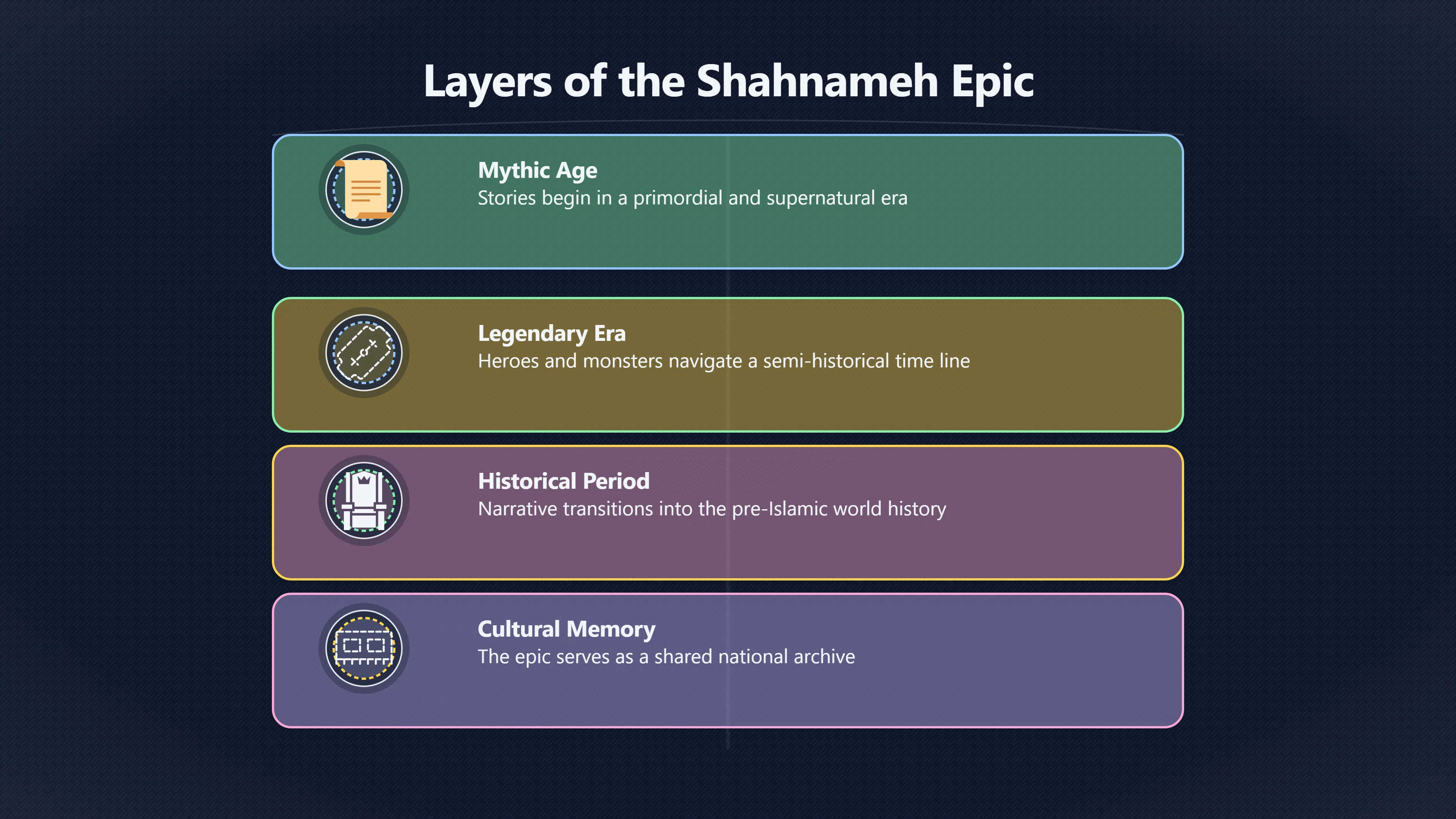
The Shahnameh tells the story of roughly fifty rulers, beginning in a mythic age and continuing through legendary and historical eras. Although it contains battles, monsters and supernatural episodes, its deeper purpose is not simply entertainment. The epic links different layers of Iranian memory into a single narrative stretching from primordial kings to the end of the pre-Islamic world.[shahnameh.fitzmuseum.cam.ac.uk]shahnameh.fitzmuseum.cam.ac.ukStructure and Themes: Myth, Legend and HistoryThe Shahnameh is essentially a chronicle of kings, with the larger sections divided accordi…
This continuity helps explain why the poem occupies a special place in Iranian culture. Unlike many ancient epics that became the preserve of specialists, the Shahnameh remained broadly accessible to Persian speakers over centuries because the language of the poem stayed relatively understandable. That accessibility allowed its heroes to remain living cultural figures rather than distant literary relics.[Iranica Online]iranicaonline.orgIranica OnlineŠĀH-NĀMAEncyclopaedia IranicaŠāh-nāma is regarded as Iran's national epic in that it presents a continuous narrative of the Iranian people in a l…
The epic also preserves a particular vision of history. Myth, legend and remembered historical events are blended together, not to create a modern historical record, but to express ideas about kingship, justice, duty and the survival of a civilisation. The result is a narrative in which cultural memory matters as much as factual chronology.[Iranica Online]iranicaonline.orgIranica OnlineŠĀH-NĀMA i. The Šāh-nāma as a historical sourceThe Šāh-nāma, although quintessentially a national epic, also incorporates e…
Rostam, Kings and Moral Conflict
No hero dominates Iranian epic memory more than Rostam. Enormously strong, undefeated in battle for much of his career and fiercely devoted to Iran, he appears at first glance to be a straightforward champion. Yet the stories that made him famous are often tragedies rather than simple triumphs.[edblogs.columbia.edu]edblogs.columbia.eduFerdowsi, Shahnameh | World EpicsThe prowess of the hero Rostam as a fighter is linked to his sense of duty towards the kings of Iran, since his self-avowed missio…
Rostam’s importance comes from the tensions built into his character. He protects kings whom he sometimes considers flawed. He serves the state while maintaining an independent moral authority. He wins victories that carry devastating personal consequences. These contradictions make him memorable not merely as a warrior but as a figure through whom audiences can explore difficult questions about loyalty and responsibility.[edblogs.columbia.edu]edblogs.columbia.eduFerdowsi, Shahnameh | World EpicsThe prowess of the hero Rostam as a fighter is linked to his sense of duty towards the kings of Iran, since his self-avowed missio…
The Tragedy of Rostam and Sohrab
The best-known example is the story of Rostam and Sohrab. Unaware that the young warrior opposing him is his own son, Rostam kills him in combat and discovers the truth only afterwards. The episode remains one of the most powerful tragedies in world epic literature because the catastrophe emerges from misunderstanding, concealment and fate rather than villainy alone.[leidenmedievalistsblog.nl]leidenmedievalistsblog.nlrostam and sohrab a story filling the eyes with tearsLeiden Medievalists BlogRostam and Sohrab: 'A Story Filling the Eyes with Tears'30 Oct 2020 — The most popular story in the epic recounts…
For many readers, this story explains why the Shahnameh still resonates. Heroism does not guarantee happiness. Great strength cannot prevent irreversible mistakes. The emotional force of the tale has helped keep Rostam central to Iranian cultural memory for centuries.[Leiden Medievalists Blog]leidenmedievalistsblog.nlrostam and sohrab a story filling the eyes with tearsLeiden Medievalists BlogRostam and Sohrab: 'A Story Filling the Eyes with Tears'30 Oct 2020 — The most popular story in the epic recounts…
Kings Who Succeed and Fail
The epic is equally concerned with rulers. Some kings embody wisdom and justice; others are arrogant, fearful or destructive. Their successes and failures shape the fate of entire generations. Through these stories, the Shahnameh repeatedly asks what qualities make legitimate leadership possible.[shahnameh.fitzmuseum.cam.ac.uk]shahnameh.fitzmuseum.cam.ac.ukStructure and Themes: Myth, Legend and HistoryThe Shahnameh is essentially a chronicle of kings, with the larger sections divided accordi…
The hero often depends on the king, yet the king also depends on the hero. This relationship creates recurring tensions throughout the narrative. Rostam may save the kingdom, but he cannot always save it from poor decisions made at court. Such conflicts give the epic much of its dramatic and moral depth.[edblogs.columbia.edu]edblogs.columbia.eduFerdowsi, Shahnameh | World EpicsThe prowess of the hero Rostam as a fighter is linked to his sense of duty towards the kings of Iran, since his self-avowed missio…
Why Tragedy Matters
Modern readers sometimes expect national epics to celebrate victories and glorious ancestors. The Shahnameh certainly contains triumphs, but many of its most memorable episodes are marked by loss. Scholars have noted that tragedy runs through the work as a defining feature rather than an occasional interruption. Innocent figures die, noble rulers fall, and heroic actions often carry painful consequences.[Iranica Online]iranicaonline.orgfate as the price for slaying of Sohrab and Esfandiyar…Read more…
This emphasis on tragedy may be one reason the epic has remained culturally powerful. The stories do not simply praise the past. They invite reflection on fate, justice, memory and the cost of human choices.
How Epic Stories Entered Popular Culture
The survival of Shahnameh heroes cannot be explained by the text alone. Their continuing presence owes much to storytelling traditions that carried the epic beyond manuscripts and books.
One of the most important traditions is naqqali, a dramatic form of storytelling in which performers recite and enact heroic narratives for audiences. UNESCO describes it as one of Iran’s oldest performance traditions, historically practised in settings ranging from royal courts to villages. Storytellers use voice, gesture and performance techniques to bring epic characters to life.[unesco.org]ich.unesco.orgUNESCO Intangible Cultural HeritageNaqqāli, Iranian dramatic story-tellingNaqqāli is the oldest form of dramatic performance in the Islam…
In these performances, heroes such as Rostam become public figures rather than literary ones. Audiences encounter them through spoken narration, emotional delivery and communal experience. This process helped transform epic stories into shared cultural memory.[Iranica Online]iranicaonline.orgIranica Online NAQQĀLIIranica OnlineNAQQĀLI - Encyclopaedia IranicaNAQQĀLI, professional Iranian storytelling tradition of epic and religious narratives. It is…
The relationship worked in both directions. Iranian oral traditions influenced written literature, while written epics returned to the oral sphere through performance and retelling. Stories could be adapted, simplified, localised or reshaped for new audiences without losing their core significance.[Iranica Online]iranicaonline.orgIranica OnlineORAL LITERATURE IN IRANby E Yarshater — Oral traditions, especially epic or romantic themes, may inspire highly literary wo…
From Epic Characters to Cultural Symbols
Over time, Shahnameh heroes became symbols that could be interpreted in different ways by different generations.
Rostam, for example, appears not only as a legendary warrior but also as a model of courage, endurance and service. Other figures gained symbolic meanings of their own. The innocent prince Siyavash often became associated with unjust suffering and moral purity. Heroic kings could be remembered as examples of wise rule, while tyrants served as warnings about the abuse of power.[Iranica Online]iranicaonline.orgfate as the price for slaying of Sohrab and Esfandiyar…Read more…
Popular retellings also reshaped characters. Some traditions adapted epic heroes to fit later religious and cultural environments, demonstrating how flexible these stories could be while remaining recognisably connected to the Shahnameh.[Iranica Online]iranicaonline.orgIranica OnlineŠĀH-NĀMA ivThe Šāh-nāma as a Source for Popular…29 Jun 2015 — Sorour Soroudi, “The Islamization of the Iranian National Hero Rostam as Reflected…
This adaptability helps explain the remarkable longevity of the epic. The heroes were never frozen in a single historical moment. They continued to acquire new meanings while retaining their connection to older traditions.

Why Iran’s Epic Heroes Still Matter
The enduring significance of the Shahnameh lies in its ability to unite folklore, literature and cultural memory. Its heroes inhabit a space between myth and history, between written text and oral performance. They are remembered not because they are believed to have existed exactly as described, but because their stories offer a language for discussing identity, morality, leadership and loss.[Iranica Online]iranicaonline.orgIranica OnlineŠĀH-NĀMAEncyclopaedia IranicaŠāh-nāma is regarded as Iran's national epic in that it presents a continuous narrative of the Iranian people in a l…
For many Iranians, the epic remains a cultural archive filled with familiar characters and shared references. For outsiders, it offers a window into how a society remembers itself through narrative. The heroes of the Shahnameh continue to matter because they are more than legendary figures: they are vessels through which centuries of Iranian memory, imagination and storytelling have been carried forward.[iranicaonline.org]iranicaonline.orgIranica OnlineŠĀH-NĀMAEncyclopaedia IranicaŠāh-nāma is regarded as Iran's national epic in that it presents a continuous narrative of the Iranian people in a l…
Amazon book picks
Further Reading
Books and field guides related to Why Iran's Epic Heroes Still Matter. Use these as the next step if you want deeper reading beyond the article.
Iran: Empire of the Mind
First published 2008. Subjects: History, Nonfiction, Iran, history, Iran, civilization.
eBay marketplace picks
Marketplace Samples
Live-tested eBay searches with available results related to this page.
Endnotes
1.
Source: shahnameh.fitzmuseum.cam.ac.uk
Link:https://shahnameh.fitzmuseum.cam.ac.uk/structure-and-themes
Source snippet
Structure and Themes: Myth, Legend and HistoryThe Shahnameh is essentially a chronicle of kings, with the larger sections divided accordi...
2.
Source: edblogs.columbia.edu
Title: Ferdowsi, Shahnameh | World Epics
Link:https://edblogs.columbia.edu/worldepics/project/ferdowsi-shahnameh/
Source snippet
The prowess of the hero Rostam as a fighter is linked to his sense of duty towards the kings of Iran, since his self-avowed missio...
3.
Source: Wikipedia
Title: Rostam and Sohrab
Link:https://en.wikipedia.org/wiki/Rostam_and_Sohrab
Source snippet
Rostam and SohrabThe tragedy of "Rostam and Sohrab" forms part of the Shahnameh, the 10th-century Persian epic by the Persian poet Fer...
4.
Source: ich.unesco.org
Link:https://ich.unesco.org/en/USL/naqqli-iranian-dramatic-story-telling-00535
Source snippet
UNESCO Intangible Cultural HeritageNaqqāli, Iranian dramatic story-tellingNaqqāli is the oldest form of dramatic performance in the Islam...
5.
Source: unesco.org
Title: document 2205
Link:https://www.unesco.org/archives/multimedia/document-2205
Source snippet
Naqqali, Iranian Dramatic Story-telling | Intangible Heritage17 Nov 2011 — Naqqali dramatic performance has long played an important role...
6.
Source: unesco.org
Link:https://www.unesco.org/en/memory-world/bayasanghori-shahnameh-prince-bayasanghors-book-kings
Source snippet
e 'Iliad' and the 'Aeniad' of the Greco-Romano cultural communities.Read more...
7.
Source: Wikipedia
Link:https://en.wikipedia.org/wiki/Shahnameh
Source snippet
ShahnamehThe Shahnameh, also romanized Shahnama (lit. 'Book of Kings'), is a long epic poem written by the Persian poet Ferdowsi betw...
8.
Source: Wikipedia
Link:https://en.wikipedia.org/wiki/Naqqali
Source snippet
NaqqaliA naqqal or naghghal is a storyteller who recites epic tales, primarily revolving around the stories of Iranian mythological ki...
9.
Source: ich.unesco.org
Link:https://ich.unesco.org/en/8-urgent-safeguarding-list-00407?id=00535&include=slideshow_inc.php
Source snippet
unesco.orgPhotos: Naqqāli, Iranian dramatic story-tellingNaqqāli, Iranian dramatic story-telling (Iran (Islamic Republic of)) Nomination...
10.
Source: ich.unesco.org
Title: search 00795
Link:https://ich.unesco.org/en/search-00795?call=film&id=05205&include=film_inc.php&width=700
Source snippet
within UNESCO ICH websiteNaqqāli, Iranian dramatic story-telling (Iran (Islamic Republic of)) Urgent Safeguarding List - 2011. Tap to unm...
11.
Source: ich.unesco.org
Title: photo pop up 00973
Link:https://ich.unesco.org/en/photo-pop-up-00973?photoID=03710
Source snippet
pop-up - UNESCO Intangible Cultural HeritageElement Naqqāli, Iranian dramatic story-telling (Iran (Islamic Republic of)): Inscribed in 20...
12.
Source: ich.unesco.org
Link:https://ich.unesco.org/en/video/5205
Source snippet
unesco.orgVideo:Intangible Cultural Heritage. Toggle navigation. International Day of the Intangible Cultural Heritage · 20th anni...
13.
Source: iranicaonline.org
Title: Iranica OnlineŠĀH-NĀMA
Link:https://www.iranicaonline.org/articles/sah-nama/
Source snippet
Encyclopaedia IranicaŠāh-nāma is regarded as Iran's national epic in that it presents a continuous narrative of the Iranian people in a l...
14.
Source: iranicaonline.org
Link:https://www.iranicaonline.org/articles/ferdowsi/
Source snippet
, ABU'L-QĀSEMFERDOWSĪ, ABU'L-QĀSEM (329-410 or 416/940-1019 or 1025), one of the greatest epic poets and author of the Šāh-nāma, the nati...
15.
Source: iranicaonline.org
Link:https://www.iranicaonline.org/articles/oral-literature-in-iran/
Source snippet
Iranica OnlineORAL LITERATURE IN IRANby E Yarshater — Oral traditions, especially epic or romantic themes, may inspire highly literary wo...
16.
Source: iranicaonline.org
Title: Iranica Online NAQQĀLI
Link:https://www.iranicaonline.org/articles/naqqali/
Source snippet
Iranica OnlineNAQQĀLI - Encyclopaedia IranicaNAQQĀLI, professional Iranian storytelling tradition of epic and religious narratives. It is...
17.
Source: iranicaonline.org
Title: Iranica OnlineŠĀH-NĀMA iv
Link:https://www.iranicaonline.org/articles/shahnameh/iv-popular-narratives/
Source snippet
The Šāh-nāma as a Source for Popular...29 Jun 2015 — Sorour Soroudi, “The Islamization of the Iranian National Hero Rostam as Reflected...
18.
Source: iranicaonline.org
Link:https://www.iranicaonline.org/articles/sah-nama/i-historical-source/
Source snippet
Iranica OnlineŠĀH-NĀMA i. The Šāh-nāma as a historical sourceThe Šāh-nāma, although quintessentially a national epic, also incorporates e...
19.
Source: iranicaonline.org
Link:https://www.iranicaonline.org/articles/shahnameh/v-excursus/
Source snippet
fate as the price for slaying of Sohrab and Esfandiyar...Read more...
20.
Source: leidenmedievalistsblog.nl
Title: rostam and sohrab a story filling the eyes with tears
Link:https://www.leidenmedievalistsblog.nl/articles/rostam-and-sohrab-a-story-filling-the-eyes-with-tears
Source snippet
Leiden Medievalists BlogRostam and Sohrab: 'A Story Filling the Eyes with Tears'30 Oct 2020 — The most popular story in the epic recounts...
Additional References
21.
Source: researchgate.net
Link:https://www.researchgate.net/publication/225279748_The_Most_Important_Performing_Arts_Arisen_from_Shahnameh_of_Ferdowsi_Shahnameh-khani_and_Naqqali_of_Shahnameh
Source snippet
(PDF) The Most Important Performing Arts Arisen from...21 Aug 2017 — Shahnameh of Ferdowsi is the Iranian National Epic which reflects h...
22.
Source: facebook.com
Link:https://www.facebook.com/groups/persianversion/posts/1762184544478570/
Source snippet
Iranian heroes from Shahnameh epic poemA statue of Rostam, hero of Shahnameh in Zahedan- Iran. Shahnameh is the national epic of Iran. It...
23.
Source: kingorama.com
Link:https://www.kingorama.com/epic-shahnameh
Source snippet
Shahnameh: The Epic of the Persian KingsEleventh-century Persian poet Abolqasem Ferdowsi devoted more than thirty years to crafting the S...
24.
Source: ecieco.org
Link:https://www.ecieco.org/en/article/229/The-Shahnameh-of-Ferdowsi-The-National-Epic-of-Iran-and-the-Foundation-of-Identity-for-Persian-Speaking-Countries
Source snippet
The Shahnameh of Ferdowsi – The National Epic of Iran...26 Apr 2026 — The Shahnameh, composed by Hakim Abul-Qâsem Ferdowsi Tusi (940–102...
25.
Source: persian.pem.cam.ac.uk
Link:https://persian.pem.cam.ac.uk/projects/all
Source snippet
ProjectThe epic became established as an expression of Persian culture and political ethics throughout the Middle Ages and remains so tod...
26.
Source: pmc.ncbi.nlm.nih.gov
Link:https://pmc.ncbi.nlm.nih.gov/articles/PMC4411917/
Source snippet
of Rostam and Sohrab: First Example Introducing the...by AN MOGHADASI · 2014 · Cited by 6 — This is the story of a son killed by his fat...
27.
Source: youtube.com
Link:https://www.youtube.com/watch?v=eLyu-FkyWkI
Source snippet
Naqqali, Iranian dramatic story-telling | Iran Art GuideNaqqali and reciting Shahnameh has always been a common and favorite tradition am...
28.
Source: youtube.com
Link:https://www.youtube.com/watch?v=3pudGL0QmeU
Source snippet
Naqqāli, Iranian dramatic story-tellingUNESCO: List of Intangible Cultural Heritage in Need of Urgent... Naqqāli, Iranian dramatic story...
29.
Source: kalouttour.com
Title: naqqali intangible iranian cultural heritage dramatic story telling
Link:https://kalouttour.com/naqqali-intangible-iranian-cultural-heritage-dramatic-story-telling/
Source snippet
Naqqali the Intangible Iranian Cultural Heritage of...15 Jul 2017 — Naqqali and reciting Shahnameh has always been a common and favorite...
30.
Source: jstor.org
Link:https://www.jstor.org/stable/43997113
Source snippet
Ethics of War and Peace in the "Shahnameh" of Ferdowsiby MJA Mahallati · 2015 · Cited by 7 — In the history of Islamic law, Abu'l-Hasan a...
Topic Tree