Within Yemen Folklore
Why Does Socotra Feel Made for Myths?
Socotra's strange ecology feeds stories of red resin, jinn, caves and clever islanders outwitting outsiders.
On this page
- Dragon's blood trees and red resin legends
- Rehabhen and island trickster wit
- Folklore under tourism and climate pressure
Page outline Jump by section
Introduction
Socotra feels made for myths because its landscape already looks like a story. This Yemeni archipelago in the Arabian Sea is famous for umbrella-shaped dragon’s blood trees, limestone caves, towering cliffs and a remarkable number of plants and animals found nowhere else. That unusual environment has encouraged generations of travellers to describe the island as magical, while local communities have preserved their own oral traditions about strange places, clever heroes, hidden beings and the deep red resin that made Socotra famous across the ancient world. The result is a folklore that is inseparable from the island itself: stories explain the landscape, and the landscape gives those stories lasting power.[National Geographic]nationalgeographic.comNational Geographic Where the Weird Things Are | National GeographicNational Geographic Where the Weird Things Are | National Geographic
Unlike many romantic accounts written by outsiders, however, Socotra’s folklore is not simply a collection of fantasy tales. It reflects the island’s history as a crossroads of sailors, traders and pastoral communities, and today it is also shaped by conservation, tourism and climate change. Understanding Socotra’s legends means separating long-standing local traditions from later literary embellishments while recognising that both have influenced how the island is imagined.
Why do the dragon’s blood trees inspire so many legends?
No feature of Socotra has inspired more stories than the dragon’s blood tree (Dracaena cinnabari). Its broad canopy resembles an enormous green umbrella, while cuts in its bark release a dark crimson resin. For centuries that resin was traded as a medicine, dye, varnish and pigment, making the tree valuable far beyond Yemen.[National Geographic]nationalgeographic.comNational Geographic Dragon's blood trees in Socotra, Yemen | National GeographicNational Geographic Dragon's blood trees in Socotra, Yemen | National Geographic
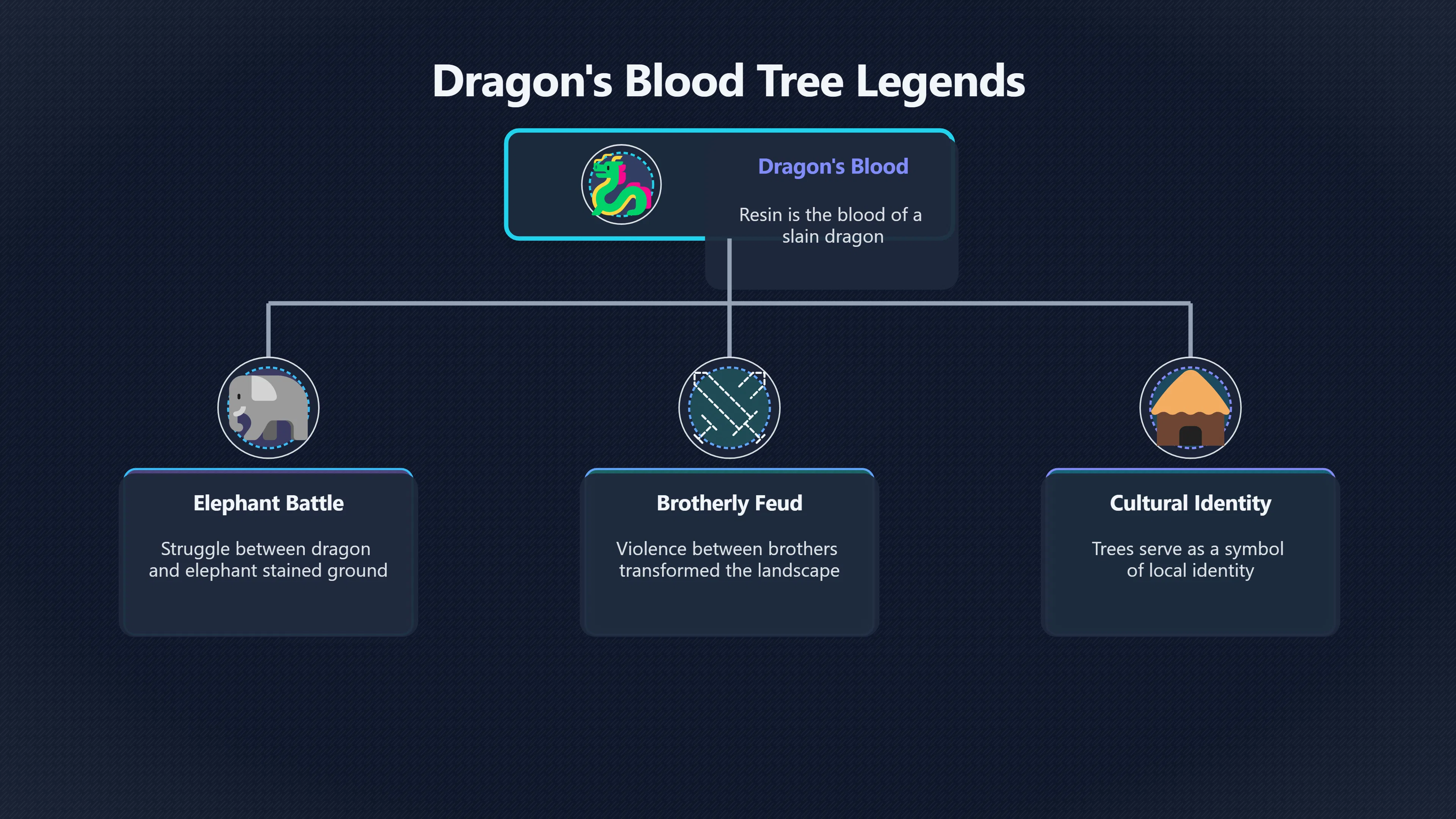
The striking appearance of both tree and resin encouraged legendary explanations. One of the best-known stories claims the resin is the blood of a dragon killed on the island. Another version tells of a battle between a dragon and an elephant, whose struggle stained the ground red before the trees sprang from the spilled blood. Other accounts replace the dragon with feuding brothers whose violence transformed the landscape. These stories differ in detail, but they all explain the same remarkable natural phenomenon: why a living tree appears to “bleed”.[National Geographic]nationalgeographic.comOpen source on nationalgeographic.com.
Rather than treating these tales as literal beliefs, it is more useful to see them as examples of landscape folklore. Around the world, unusual geological formations or rare plants often acquire origin stories that make them memorable. On Socotra, the dragon’s blood tree became a natural focus because its appearance is unlike almost anything else on Earth.
The tree also occupies an emotional place in island life. Local harvesters have long gathered its resin carefully, using it in traditional medicine, decoration and everyday craftwork. Modern conservationists note that many islanders describe the tree not simply as a resource but as part of their identity, giving the old legends continued cultural meaning rather than leaving them as museum pieces.[National Geographic]nationalgeographic.comOpen source on nationalgeographic.com.
What are the Rehabhen stories, and why do tricksters matter?
Socotra’s oral tradition is not dominated by monsters or terrifying spirits. Instead, many stories celebrate wit. Folklore researchers have recorded tales in which clever islanders outsmart stronger rivals, boastful strangers or foolish authority figures. Within this tradition, the figure often referred to in English as Rehabhen belongs to a wider cycle of trickster storytelling that rewards intelligence, humour and quick thinking over physical strength.
Although versions vary between storytellers and villages, these narratives usually share several features:
- The apparent underdog wins by observation rather than force.
- Outsiders underestimate local knowledge and pay the price.
- Everyday objects or familiar landscapes become the tools of victory.
- Humour carries a moral lesson without becoming preachy.
These stories probably served practical purposes alongside entertainment. On an island where survival depended on understanding weather, water sources and difficult terrain, cleverness was a highly valued quality. Trickster tales reinforce that value while allowing listeners to laugh at arrogance and misplaced confidence.
Unlike famous international tricksters such as Anansi or Nasreddin, Socotra’s trickster tradition remains comparatively little known outside specialist collections of Arabian oral literature. That relative obscurity reflects limited documentation rather than a lack of storytelling. Much of the tradition has survived through spoken performance rather than extensive written publication.
Caves, hidden places and the unseen world
Socotra’s caves, sinkholes and isolated valleys naturally attract supernatural stories. Across Yemen, lonely places are often associated with jinn, and Socotra shares that broader cultural background while developing its own local emphasis on dramatic landscapes.
Rather than presenting caves simply as haunted locations, many island narratives treat them as places demanding respect. Stories warn against reckless behaviour, careless trespass or arrogance in unfamiliar places. Such tales function as practical guidance as much as supernatural entertainment, encouraging caution in an environment where caves, cliffs and remote plateaus could genuinely be dangerous.
Older travel writers often exaggerated these traditions, portraying Socotra as a mysterious island at the edge of the known world populated by magicians or people who controlled winds and ships. These descriptions reveal at least as much about the imagination of foreign sailors as about Socotran belief itself. Modern scholarship is therefore careful to distinguish outsider legend from locally transmitted oral tradition.[National Geographic]nationalgeographic.comNational Geographic Where the Weird Things Are | National GeographicNational Geographic Where the Weird Things Are | National Geographic
How much of Socotra’s mythical reputation comes from outsiders?
Socotra has been described for centuries as an island of marvels. Ancient and medieval writers praised its incense, medicinal plants and rare products, while later European travellers emphasised its apparent isolation. This reputation encouraged the growth of stories that blended observation with fantasy.
Some famous legends, such as visits by the Queen of Sheba or tales of lost civilisations, circulate widely in tourism and popular media but are supported far more by literary tradition than by local oral evidence. Similarly, modern internet articles often repeat dragon legends without explaining that multiple versions exist or that the stories evolved over time.
This distinction matters because it highlights two overlapping traditions:
- Local folklore, preserved through Socotran storytelling and everyday cultural practice.
- Traveller folklore, created or expanded by generations of visitors fascinated by an island that seemed unlike anywhere else.
Both have shaped Socotra’s global image, but they should not be confused.

Folklore under tourism and climate pressure
Today the greatest challenge facing Socotra’s folklore may not be disbelief but environmental change. The dragon’s blood tree itself is under increasing pressure from stronger cyclones, changing rainfall patterns, grazing by goats and limited natural regeneration. Conservation projects increasingly combine ecological protection with efforts to preserve the cultural traditions associated with the tree.[socotradragonbloodtreeassociation.org]socotradragonbloodtreeassociation.orgSocotra Dragon Blood Tree AssociationSocotra Dragon Blood Tree Association
Tourism creates a second tension. Visitors are often drawn by dramatic photographs of dragon’s blood forests and descriptions of an “alien” island. While this attention can support local livelihoods and conservation, it also risks reducing complex oral traditions to simplified marketing stories about dragons and magic. Folklore becomes a souvenir rather than a living cultural practice if stripped of its local context.
At the same time, renewed interest has encouraged documentation of Socotri language, poetry and storytelling, helping preserve traditions that might otherwise be overshadowed by environmental and political pressures. Protecting the dragon’s blood tree and protecting the stories surrounding it increasingly appear as connected tasks: both are part of what makes Socotra unlike anywhere else in Yemen or the wider world.[socotradragonbloodtreeassociation.org]socotradragonbloodtreeassociation.orgSocotra Dragon Blood Tree AssociationSocotra Dragon Blood Tree Association
Amazon book picks
Further Reading
Books and field guides related to Why Does Socotra Feel Made for Myths?. Use these as the next step if you want deeper reading beyond the article.
Legends of the Fire Spirits
Expands interest from island myths into wider Arabian supernatural traditions.
Arab Folktales
Introduces regional storytelling traditions related to trickster motifs.
eBay marketplace picks
Marketplace Samples
Live-tested eBay searches with available results related to this page.
Endnotes
1.
Source: socotradragonbloodtreeassociation.org
Title: Socotra Dragon Blood Tree Association
Link:https://www.socotradragonbloodtreeassociation.org/
2.
Source: socotradragonbloodtreeassociation.org
Link:https://www.socotradragonbloodtreeassociation.org/protection-dragon-blood-tree/
Source snippet
Protection of the Dragon Blood Tree – Socotra Dragon Blood Tree AssociationProtection of the Dragon Blood Tree We Must Save the Dragon Bl...
3.
Source: youtube.com
Title: Socotra: The Strange Island of Yemen: Travel Documentary
Link:https://www.youtube.com/watch?v=YOgO1vR4B8I
Source snippet
Dragon's Blood Tree | Beast challenge Stories...
4.
Source: youtube.com
Title: Dragon’s Blood Tree | Beast challenge Stories
Link:https://www.youtube.com/watch?v=o8jnez32Nuo
Source snippet
The Guardian of Socotra's Dragon Blood Trees...
5.
Source: nationalgeographic.com
Title: National Geographic Where the Weird Things Are | National Geographic
Link:https://www.nationalgeographic.com/magazine/article/socotra
6.
Source: nationalgeographic.com
Title: National Geographic Dragon’s blood trees in Socotra, Yemen | National Geographic
Link:https://www.nationalgeographic.com/travel/article/see-the-otherworldly-tree-of-life-socotra-dragon-blood
7.
Source: nationalgeographic.com
Link:https://www.nationalgeographic.com/environment/article/socotra-yemen-biodiversity-photography
8.
Source: soqotraculturalheritage.org
Link:https://www.soqotraculturalheritage.org/tourism/
Source snippet
It is spectacularly beautiful, genuinely unique and remarkably difficult to reach, especially with the all too frequent broad-b...
Additional References
9.
Source: intechopen.com
Title: Dragon’s Blood Tree (Dracaena cinnabari): A Cenozoic Relict | Intech Open
Link:https://www.intechopen.com/chapters/87893
Source snippet
The map of the distribution of the toponyms related to the D. cinnabari tree (green circles) in Socotra Island, in red, the current distr...
10.
Source: mdpi.com
Title: Local Management System of Dragon’s Blood Tree (Dracaena cinnabari Balf
Link:https://www.mdpi.com/1999-4907/11/4/389
Source snippet
f.) Resin in Firmihin Forest, Socotra Island, YemenApril 1, 2020 — LOCAL MANAGEMENT SYSTEM OF DRAGON’S BLOOD TREE (DRACAENA CINNABARI BAL...
Published: April 1, 2020
11.
Source: cntraveler.com
Title: One such spot is the island of Socotra, part of the Republic of Yemen
Link:https://www.cntraveler.com/stories/2010-10-05/in-the-land-of-the-dragon-s-blood-tree
Source snippet
Socotra Island: Exploring the Land of the Dragon's Blood Tree | Condé Nast TravelerOctober 5, 2010 — SOCOTRA ISLAND: EXPLORING THE LAND O...
Published: October 5, 2010
12.
Source: theguardian.com
Title: Photograph: Sylvain Cordier The ag
Link:https://www.theguardian.com/environment/2022/nov/12/saving-dragons-blood-island-refused-let-tree-die-out-socotra-yemen
Source snippet
Saving the dragon’s blood: how an island refused to let a legendary tree die out | Yemen | The GuardianNovember 12, 2022 — Scientists thi...
Published: November 12, 2022
13.
Source: yementourism.com
Title: Yemen Tourism Promotion Board
Link:https://www.yementourism.com/explore-yemen/echo-natural-tourism/34-socotra
Source snippet
Located about 400km south of the mainland in the Indian Ocean, these arid islands play host to a stunning array of plant and anim...
14.
Source: toursocotra.com
Title: Tour Socotra Myths | Stories of the Dragon’s Blood Tree & Beyond | Tour Socotra
Link:https://toursocotra.com/socotra-myths/
15.
Source: youtube.com
Title: The Insane Dragon Blood Tree
Link:https://www.youtube.com/watch?v=V_H60WDBaT4
Source snippet
Dragon Blood - A Photographer's Journey to Socotra, Yemen...
16.
Source: youtube.com
Title: The Guardian of Socotra’s Dragon Blood Trees
Link:https://www.youtube.com/watch?v=Q32w_ZjhOKM
Source snippet
The Insane Dragon Blood Tree...
17.
Source: youtube.com
Title: Dragon Blood
Link:https://www.youtube.com/watch?v=y-ckI811gII
Topic Tree