Within Eswatini Folklore
How Ancestors Shape Swazi Folk Belief
Swazi folklore often centres less on distant gods than on ancestors, healing, dreams, misfortune and the duties of family life.
On this page
- Ancestors, health and family obligation
- Diviners, healers and hidden causes
- Rain, fertility and sacred balance
Page outline Jump by section
Introduction
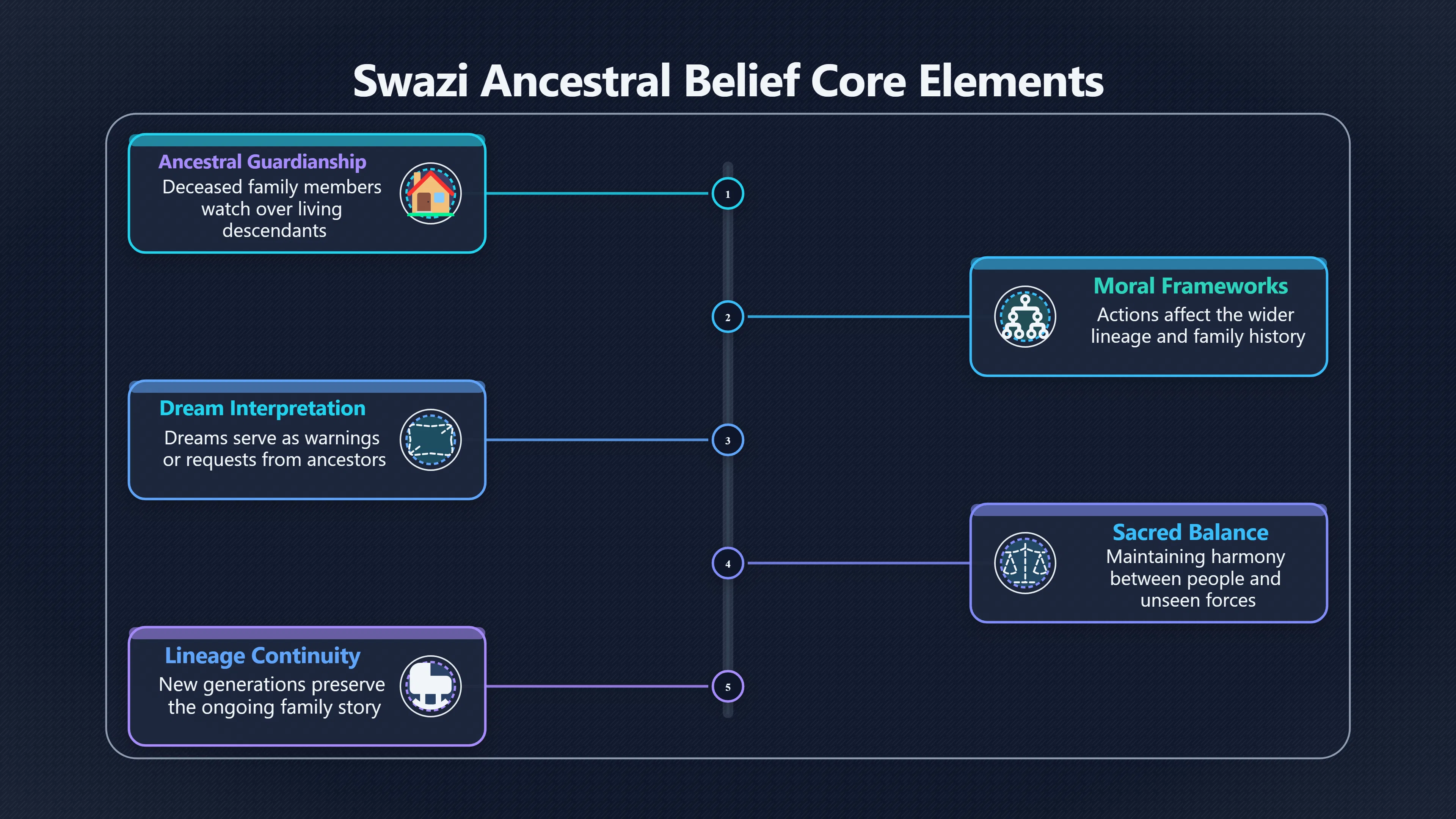
In Eswatini, many traditional beliefs about misfortune, healing, fertility and family life begin with a simple idea: the dead are not entirely gone. Ancestors remain part of the moral and spiritual community, watching over descendants, offering protection, and sometimes expressing displeasure when family obligations are neglected. Rather than focusing on distant gods or elaborate creation myths, much Swazi traditional belief centres on the relationship between the living and their forebears. This helps explain why stories about illness, dreams, unexplained bad luck and healing often carry both social and spiritual meaning. Ancestor belief is not merely a religious doctrine; it forms part of a wider unseen order linking family, health, land, rain, fertility and communal harmony.[EveryCulture]everyculture.comEvery Culture SwaziSwazi - Religion and Expressive CultureDespite the important role of men in religious matters, female diviners also communica…
Understanding this worldview is essential for understanding Swazi folklore. Tales, rituals and everyday explanations of events often assume that visible events have invisible causes. Diviners and healers occupy a special place because they are believed to help interpret those hidden connections and restore balance when something has gone wrong.[everyculture.com]everyculture.comEvery Culture SwaziSwazi - Religion and Expressive CultureDespite the important role of men in religious matters, female diviners also communica…
Ancestors, Health and Family Obligation
Traditional Swazi belief recognises a supreme creator, but everyday spiritual life has long focused on ancestors. These ancestral spirits are generally understood not as distant deities but as deceased family members who retain an interest in the welfare of their descendants. They are believed to influence health, prosperity, fertility and social harmony.[EveryCulture]everyculture.comEvery Culture SwaziSwazi - Religion and Expressive CultureDespite the important role of men in religious matters, female diviners also communica…
This belief creates a moral framework that reaches beyond the individual. A person’s actions affect not only themselves but also the wider lineage. Respect for elders, proper funeral observances, care for relatives and continuation of the family line are often understood as duties that honour both the living and the dead. Traditional accounts describe ancestors as guardians of family wellbeing who may reward proper conduct or signal dissatisfaction when obligations are ignored.[Encyclopedia.com]encyclopedia.comOpen source on encyclopedia.com.
Many stories and explanations of misfortune follow this logic. An unexpected illness, repeated accidents, infertility or family conflict may be interpreted not simply as random events but as signs that a relationship within the family or ancestral line has become strained. In such cases, the question is often not merely “What happened?” but “Why has this happened to us?”[UC Press E-Books Collection]publishing.cdlib.orgUC Press E-Books CollectionNgoma: Discourses of Healing in Central and Southern AfricaThese mechanisms of group renewal are frequently in…
Dreams frequently occupy an important place within this worldview. Encounters with deceased relatives in dreams may be interpreted as warnings, requests, reminders of neglected duties or indications that attention should be paid to family matters. Such experiences are woven into everyday understanding rather than being treated solely as private psychological events.[UPSpace Repository]repository.up.ac.zaSpace Repositorymicah mhlupheki nthaliby MM Nthali · 2023 — 2.7 The Swazi Life after Death: The Swazi African Traditional Religious bel…
Why Diviners Matter
Because misfortune is often believed to have hidden causes, diviners traditionally serve as interpreters of the unseen world. In Eswatini, diviners have historically occupied a recognised social role alongside herbalists and other healers. Research on traditional healing in the country found that diviners formed a substantial portion of the traditional healing community, reflecting their importance in local society.[Academia]academia.eduThe Ministry of Health aims to improve cooperation betweenAcademia(PDF) Traditional healers in Swaziland: Toward improved…Swaziland has approximately 5,400 traditional healers, with 50% being…
A diviner’s task is not simply to identify a disease. Instead, they seek to uncover relationships and causes that may not be obvious. A sickness might have a physical aspect, but it could also be linked, in traditional interpretation, to ancestral displeasure, social conflict, neglected obligations or harmful spiritual influences. Divination therefore functions as a way of making sense of uncertainty.[UC Press E-Books Collection]publishing.cdlib.orgUC Press E-Books CollectionNgoma: Discourses of Healing in Central and Southern AfricaThese mechanisms of group renewal are frequently in…
In many southern African traditions closely related to those of Eswatini, becoming a diviner is itself often understood as the result of an ancestral calling. Experiences such as vivid dreams, unusual perceptions, recurring illness or persistent disturbances may be interpreted as signs that ancestors are directing a person towards healing work. Training then teaches the individual how to understand and manage those experiences within a recognised cultural framework.[rug.nl]pure.rug.nlSURFconextAncestral calling, traditional health practitioner training and…Today — The purpose of this study is to describe the ancestr…
This helps explain why diviners appear so often in traditional narratives. They are mediators between visible and invisible realities, people who can interpret signs that others cannot fully understand.
Hidden Causes and the Logic of Misfortune
One of the most distinctive features of Swazi traditional belief is the assumption that important events often have layers of meaning. A drought may have environmental causes, but it may also provoke questions about social harmony and ritual balance. An illness may require medicine, but people may also seek an explanation for why it affected a particular person at a particular time.[UC Press E-Books Collection]publishing.cdlib.orgUC Press E-Books CollectionNgoma: Discourses of Healing in Central and Southern AfricaThese mechanisms of group renewal are frequently in…
This way of thinking appears repeatedly in folklore and oral tradition. Stories rarely present suffering as meaningless. Instead, misfortune often reveals neglected responsibilities, broken relationships, envy, spiritual imbalance or failures of respect. The lesson is usually social as much as supernatural.
Such narratives perform an important cultural function. They encourage reflection on obligations to family, neighbours and ancestors. They also reinforce the idea that individual wellbeing depends upon the wellbeing of the wider community. The hidden cause of a problem is often found not in a monster or malevolent spirit but in a damaged relationship that needs repair.[UC Press E-Books Collection]publishing.cdlib.orgUC Press E-Books CollectionNgoma: Discourses of Healing in Central and Southern AfricaThese mechanisms of group renewal are frequently in…
Rain, Fertility and Sacred Balance
Ancestor belief in Eswatini is closely linked to ideas about fertility and renewal. Fertility refers not only to childbirth but also to cattle, crops, land and the continuing strength of the family line. Traditional beliefs often connect these forms of prosperity to proper relationships between the living and the ancestral world.[EveryCulture]everyculture.comEvery Culture SwaziSwazi - Religion and Expressive CultureDespite the important role of men in religious matters, female diviners also communica…
Rain occupies a particularly important symbolic position. In a region where agriculture historically depended on seasonal rainfall, rain came to represent blessing, continuity and balance. Traditional accounts note that important ritual authority over rain was associated with the monarchy, especially the Queen Mother, who was regarded as custodian of rain medicines. This linked environmental wellbeing to both sacred authority and ancestral order.[EveryCulture]everyculture.comEvery Culture SwaziSwazi - Religion and Expressive CultureDespite the important role of men in religious matters, female diviners also communica…
Within this worldview, drought or poor harvests could be interpreted not only as natural events but also as signs that harmony had been disturbed. Rituals of renewal sought to restore the proper relationship between people, land and the unseen forces believed to sustain life. The idea was less about controlling nature than about maintaining balance within a connected world.[EveryCulture]everyculture.comEvery Culture SwaziSwazi - Religion and Expressive CultureDespite the important role of men in religious matters, female diviners also communica…
The same principle extends to human fertility. The continuation of the lineage has traditionally carried spiritual significance because descendants ensure the ongoing life of the family and preserve the connection between generations. Ancestors remain part of the family story, and new generations continue that story into the future.[UPSpace Repository]repository.up.ac.zaSpace Repositorymicah mhlupheki nthaliby MM Nthali · 2023 — 2.7 The Swazi Life after Death: The Swazi African Traditional Religious bel…
How These Beliefs Changed
Ancestor-centred belief did not disappear with the arrival of Christianity, colonial rule or modern medicine. Instead, Eswatini developed a complex religious landscape in which many people draw on multiple traditions at once. Historical studies of missionary encounters show that conversion did not simply erase older beliefs; rather, traditional ideas often continued alongside newer religious practices.[Academia]academia.eduThe early encounter between the Swazi and the WesternThe early encounter between the Swazi and the Western…January 1, 2004 — This historical study explores the early interactions…
Today, churches, biomedical healthcare and traditional healing frequently coexist. Some people interpret ancestral experiences through Christian language, while others continue to consult diviners and traditional healers. Scholars studying contemporary Eswatini note that ancestral veneration, healing and divination remain visible elements of cultural life despite social change.[Journals]journals.co.zaZionism as “a place to feel at home”3: Healing, Prophecy…by S Nyawo · 2024 · Cited by 1 — Forms of Swazi Traditional Religion…
For folklore, this continuity is significant. Ancestors are not merely figures from old stories. They remain part of living traditions that influence how many people understand dreams, illness, family responsibility and the meaning of unexpected events.
The Unseen Order in Swazi Folklore
The most important lesson of Swazi ancestor belief is that the world is understood as relational rather than purely individual. The living are connected to the dead, families are connected across generations, and visible events may reflect invisible relationships. Diviners, healers and ritual specialists help interpret these connections, while stories and oral traditions teach the responsibilities that come with them.[everyculture.com]everyculture.comEvery Culture SwaziSwazi - Religion and Expressive CultureDespite the important role of men in religious matters, female diviners also communica…
For outsiders seeking dramatic legends or supernatural creatures, this can be surprising. The heart of much Swazi folklore lies not in monsters but in a moral universe where ancestors remain present, hidden causes matter, and wellbeing depends on maintaining balance between family, community, land and the unseen order that binds them together.[EveryCulture]everyculture.comEvery Culture SwaziSwazi - Religion and Expressive CultureDespite the important role of men in religious matters, female diviners also communica…
Amazon book picks
Further Reading
Books and field guides related to How Ancestors Shape Swazi Folk Belief. Use these as the next step if you want deeper reading beyond the article.
Myths and Legends of Southern Africa
Covers legendary traditions closely related to Eswatini's cultural setting.
African Religions and Philosophy
Directly addresses ancestors, spiritual causation and community obligations.
African Traditional Religion
Provides context for ancestor veneration and spiritual mediation.
eBay marketplace picks
Marketplace Samples
Live-tested eBay searches with available results related to this page.


Endnotes
1.
Source: everyculture.com
Title: Every Culture Swazi
Link:https://www.everyculture.com/Africa-Middle-East/Swazi-Religion-and-Expressive-Culture.html
Source snippet
Swazi - Religion and Expressive CultureDespite the important role of men in religious matters, female diviners also communica...
2.
Source: encyclopedia.com
Link:https://www.encyclopedia.com/environment/encyclopedias-almanacs-transcripts-and-maps/swazi-religion
3.
Source: pure.uva.nl
Title: Pure UVAThesis
Link:https://pure.uva.nl/ws/files/85951050/Thesis.pdf
Source snippet
DARE (Digital Academic Repository)18 Different typologies for traditional healers exist in eSwatini, of which the main two types are...
4.
Source: academia.edu
Title: The Ministry of Health aims to improve cooperation between
Link:https://www.academia.edu/48250111/Traditional_healers_in_Swaziland_Toward_improved_cooperation_between_the_traditional_and_modern_health_sectors
Source snippet
Academia(PDF) Traditional healers in Swaziland: Toward improved...Swaziland has approximately 5,400 traditional healers, with 50% being...
5.
Source: academia.edu
Title: The early encounter between the Swazi and the Western
Link:https://www.academia.edu/65607503/The_early_encounter_between_the_Swazi_and_the_Western_missionaries_the_establishment_of_the_Evangelical_church_in_Swaziland
Source snippet
The early encounter between the Swazi and the Western...January 1, 2004 — This historical study explores the early interactions...
Published: January 1, 2004
6.
Source: repository.up.ac.za
Link:https://repository.up.ac.za/bitstreams/8f2bac11-c2f0-4a91-a861-b904c124f91c/download
Source snippet
Space Repositorymicah mhlupheki nthaliby MM Nthali · 2023 — 2.7 The Swazi Life after Death: The Swazi African Traditional Religious bel...
7.
Source: publishing.cdlib.org
Link:https://publishing.cdlib.org/ucpressebooks/public/book/ngoma-discourses-of-healing-in-central-and-southern-africa.html
Source snippet
UC Press E-Books CollectionNgoma: Discourses of Healing in Central and Southern AfricaThese mechanisms of group renewal are frequently in...
8.
Source: journals.co.za
Link:https://journals.co.za/doi/10.10520/ejc-atjack_v1_nse3_a3
Source snippet
Zionism as “a place to feel at home”3: Healing, Prophecy...by S Nyawo · 2024 · Cited by 1 — Forms of Swazi Traditional Religion...
9.
Source: pure.rug.nl
Link:https://pure.rug.nl/ws/portalfiles/portal/125894807/Ancestral_calling_traditional_health.pdf
Source snippet
SURFconextAncestral calling, traditional health practitioner training and...Today — The purpose of this study is to describe the ancestr...
10.
Source: pubmed.ncbi.nlm.nih.gov
Link:https://pubmed.ncbi.nlm.nih.gov/32151201/
Source snippet
ethnographic study from rural KwaZulu-Natal, South Africaby M van der Zeijst · 2021 · Cited by 50 — The purpose of this study is to descr...
11.
Source: journals.co.za
Link:https://journals.co.za/doi/pdf/10.10520/EJC198196
Source snippet
A biblical critique of the veneration of ancestors...by N Curle · 2016 · Cited by 2 — The roles of God, the ancestors, their mediators (...
12.
Source: 101lasttribes.com
Link:https://www.101lasttribes.com/tribes/swazi.html
Source snippet
AFRICA | 101 Last Tribes - Swazi peopleSwazi men play important roles in Swazi traditional religious life, offering sacrifices for the an...
Additional References
13.
Source: facebook.com
Link:https://www.facebook.com/groups/1520012424900108/posts/3206235832944417/
Source snippet
Astrotheology in Swaziland's traditional ceremoniesThe traditional Swazi religion recognizes a supreme God/Deity/Creator in its pure form...
14.
Source: library.oapen.org
Link:https://library.oapen.org/bitstream/id/7f063f0f-ddf3-458b-a437-aa4a35fa5d57/9781920382230.pdf
Source snippet
SWAZILANDby RS KUMALO · Cited by 20 — Research, academic and reference works are published under this imprint in print and electronic for...
15.
Source: researchgate.net
Link:https://www.researchgate.net/publication/339820996_Ancestral_calling_traditional_health_practitioner_training_and_mental_illness_An_ethnographic_study_from_rural_KwaZulu-Natal_South_Africa
Source snippet
An ethnographic study from rural KwaZulu-Natal, South AfricaThe purpose of this study is to describe the ancestral calling, and to explor...
16.
Source: facebook.com
Link:https://www.facebook.com/groups/904889201264040/posts/1496391542113800/
Source snippet
Swazi mythology and traditional spirituality in South AfricaThe Swati (or Swazi) people are a Bantu ethnic group in Southern Africa, prim...
17.
Source: scholarlypublications.universiteitleiden.nl
Title: Natal, South Africa. It seeks to detect where transformations in healing
Link:https://scholarlypublications.universiteitleiden.nl/access/item%3A3151856/view
Source snippet
in the wind of change: Zulu sangomas in transitionThis thesis investigates the changing healing practice of Zulu sangomas in KwaZulu...
18.
Source: theologiaviatorum.org
Link:https://theologiaviatorum.org/index.php/tv/article/view/208/584
Source snippet
ancestral belief systems with Christianity. This homogenisation of cultural and religious traditions is a common phenomenon observed in v...
19.
Source: amsacta.unibo.it
Title: AMS Acta Ancestral Beliefs and Fertility in Sub-Saharan Africa
Link:https://amsacta.unibo.it/id/eprint/9004/1/WP1226.pdf
Source snippet
Conventional demographic models systematically overestimate fertility decline in sub-Saharan Africa.Read more...
20.
Source: jstor.org
Title: He may then prescribe a selection of herbs
Link:https://www.jstor.org/stable/29734388
Source snippet
The Transmission of Knowledge in South African...by R Thornton · 2009 · Cited by 144 — divination - for instance, when a healer div...
21.
Source: facebook.com
Link:https://www.facebook.com/InyoniTV/posts/over-80000-witches-and-wizards-in-eswatini-says-traditional-healers-associationm/122227387952544171/
Source snippet
ss supernatural powers that can cause illness, misfortune, or...
22.
Source: youtube.com
Title: African Divination Systems: Unlocking the Secrets of the Ancestors
Link:https://www.youtube.com/watch?v=FJY7DV1tyug
Source snippet
Intwaso | Sangoma Graduation | Gogo Mhlongo | Thenjiwe TV | Cultural Ritual...
Topic Tree