Where Malawi's Spirits Still Tell Stories
Malawi’s folklore is best understood as a living story world rather than a single “mythology”. It includes fireside animal tales, masked ancestral performance, healing dances, rain shrines, mountain spirits, witchcraft beliefs, and modern literary retellings of old images such as the serpent of floods and landslides.
Page outline Jump by section
What makes Malawian folklore distinctive?
Malawi sits within a wider south-central African cultural zone, so many traditions overlap with neighbouring Zambia, Mozambique and Tanzania. The Chewa, Tumbuka, Mang’anja, Yao, Lhomwe, Tonga, Nkhonde, Ngoni and other communities have their own local histories, languages and performance styles, but their folklore often shares common concerns: the authority of ancestors, the moral force of community life, the danger of envy and witchcraft accusations, the sacredness of particular hills, forests and waters, and the use of stories to teach children how to live well. A general reader should therefore expect variety rather than one neat pantheon.[orantcharitiesafrica.org]orantcharitiesafrica.orgOrant Charities Africa The Culture of Malawi: Tribes of MalawiOrant Charities Africa The Culture of Malawi: Tribes of Malawi
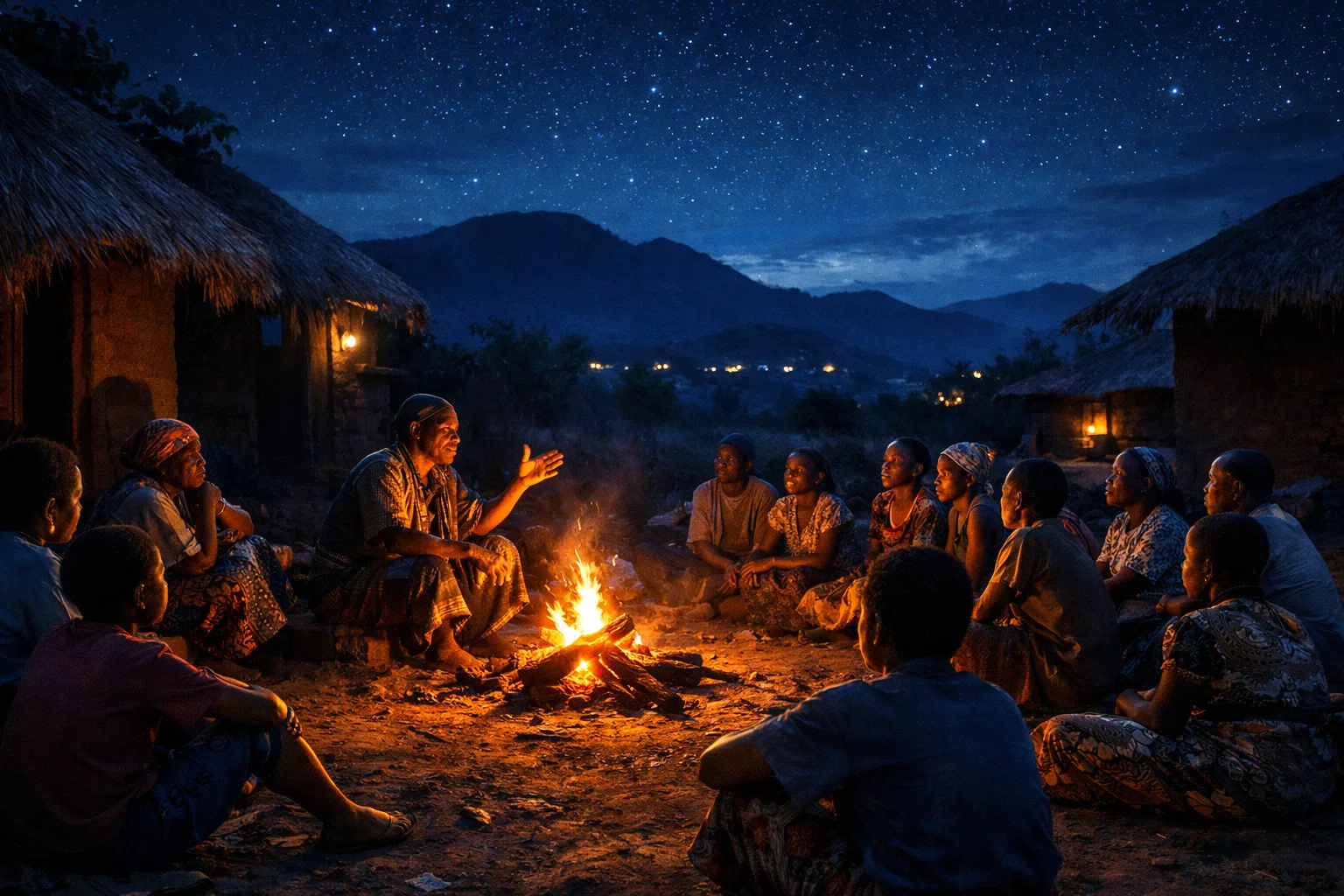
A useful starting point is the difference between a written myth and a performed tradition. In Malawi, folktales are not merely texts with plots. A study of Malawi Tonga folktales stresses that African and Malawian folktales are often performances involving voice changes, dramatisation, song, instrumentation and audience participation. This matters because a story’s “real” form may be partly in the telling: the rhythm, the chorus, the teasing correction from listeners, and the moral pressure created by everyone present.[ISDS]isdsnet.comOpen source on isdsnet.com.
Recent heritage work also shows that Malawian folklore is not simply vanishing into the past. The Malawi Folktales project says it collected more than 250 stories from across the country in several languages and translated them for wider access, while UNESCO-supported work has focused on documenting Nkhonde, Tumbuka and Chewa proverbs and folktales as oral expressions carrying knowledge, wisdom and culture. These projects are a reminder that “folklore” in Malawi is both inherited and actively curated in the present.[malawifolklore.mw]malawifolklore.mwAboutThe project collected over 250 stories recorded all over the country and in several languages. To ensure the widest accessibility, e…
Fireside tales, tricksters and moral lessons
One of the most accessible parts of Malawian folklore is the folktale: short, memorable stories often involving animals with human speech and motives. The hare appears especially often as a trickster figure in Malawian tales, using cleverness, nerve and verbal agility to survive among stronger creatures. A study of Tonga folktales notes that most Malawian folktales feature the hare as trickster, while also warning that categories such as fable, trickster tale, origin story and fairy tale can overlap in practice.[ISDS]isdsnet.comOpen source on isdsnet.com.
These stories are not just entertainment for children. They are a social classroom. Trickster tales can reward intelligence over brute force, but they can also warn against greed, impatience, deceit or arrogance. Because the stories are performed, not merely recited, the audience helps shape the lesson. The storyteller may vary the sequence or details, while regular listeners recognise the underlying structure and moral. That makes oral tradition flexible: it can preserve old patterns while adapting to new circumstances.[ISDS]isdsnet.comOpen source on isdsnet.com.
Digital preservation has made some of this material easier to encounter outside its original setting. The Malawi Folklore website lists stories such as “The Girl Who Married A Thief”, “The Herdboy Who Died Suddenly” and other orally transmitted narratives, while the Rei Foundation and Sony describe a project with the Malawi National Commission for UNESCO to record and document folktales passed down through generations. This kind of archive is useful, but it also changes the experience: a searchable recording or written translation cannot fully reproduce the social atmosphere of a night-time performance.[malawifolklore.mw]malawifolklore.mwOpen source on malawifolklore.mw.
Gule Wamkulu: when ancestors enter the village
The most internationally recognised Malawian tradition is Gule Wamkulu, the “great dance” of the Chewa, practised in Malawi and also in Chewa communities in Zambia and Mozambique. UNESCO describes it as a ritual dance associated with the Nyau brotherhood, a secret society of initiated men, and notes its performance at events including funerals, initiations and other social occasions. It is not simply a dance show; it is a masked ancestral drama in which social rules, memory and spiritual authority become visible.[UNESCO Intangible Cultural Heritage]ich.unesco.orgOpen source on unesco.org.
In many accounts, masked Gule Wamkulu figures are understood as embodiments or representations of ancestral and moral forces. The masks and costumes may represent animals, human types, spirits, social problems or comic figures. A strong public explanation from Mua Mission’s cultural work describes Gule Wamkulu as commenting on society and preserving a moral code associated with the ancestors, while noting that Father Claude Boucher documented hundreds of characters and preserved many masks.[Africa Geographic]africageographic.comAfrica Geographicgule wamkuluAfrica Geographicgule wamkulu
For folklore readers, the important point is that Gule Wamkulu is both sacred and theatrical. It can be visually spectacular, but its meanings are not fully open to casual spectators. Some knowledge belongs to initiates, and some symbolism depends on local context. This is why tourism and heritage recognition can be double-edged: they can bring respect, income and preservation, but they can also risk turning a ritual system into a public performance stripped of its deeper meanings. Malawian commentary on intangible heritage has noted both pride in UNESCO recognition and concern about exposing or diluting a secret tradition.[Africultures]africultures.comOpen source on africultures.com.
Vimbuza: spirits, illness and healing through dance
In northern Malawi, Vimbuza is one of the clearest examples of folklore crossing into healing, music and embodied religious practice. UNESCO describes Vimbuza as a healing dance popular among the Tumbuka people and as an important form of the wider ng’oma healing tradition found across Bantu-speaking Africa. It involves drumming, singing, diagnosis by healers and a ritual process in which patients may enter trance.[unesco.org]ich.unesco.orgOpen source on unesco.org.
Vimbuza is sometimes discussed in terms of “spirit possession”, but that phrase can mislead if it is heard only through horror-film or church-exorcism assumptions. In local terms, the ritual gives distress a recognised social form. UNESCO’s account emphasises that patients, often women, are treated over weeks or months; songs call the spirits, drums use spirit-specific rhythms, and the performance creates a space where suffering can be expressed and worked through.[UNESCO Intangible Cultural Heritage]ich.unesco.orgOpen source on unesco.org.
This is one of the places where modern interpretation must be careful. Vimbuza should not be reduced either to “superstition” or to a simple equivalent of modern psychotherapy. It is a traditional healing system with artistic, social and spiritual dimensions, and it has faced pressure from Christian churches and biomedical institutions while continuing in rural Tumbuka culture. A folklore page should therefore treat it as living heritage and as a local theory of affliction, not as proof of spirits or as a medical recommendation.[jstor.org]jstor.orgOpen source on jstor.org.
Sacred landscapes: Mount Mulanje and the Mbona rain shrines
Malawian folklore is strongly tied to place. The most famous example is Mount Mulanje in southern Malawi, now listed by UNESCO as the Mount Mulanje Cultural Landscape. UNESCO describes the mountain as one of the world’s largest inselbergs and as a sacred place inhabited by gods, spirits and ancestors, with its geological and water features linked to the beliefs and practices of the Yao, Mang’anja and Lhomwe peoples.[UNESCO World Heritage Centre]whc.unesco.orgWorld Heritage Centre Mount Mulanje Cultural LandscapeWorld Heritage Centre Mount Mulanje Cultural Landscape
Around Mulanje, stories often concern mountain spirits, dangerous mist, mysterious disappearances, sacred trees and gifts left for travellers. Local and travel accounts should be read cautiously, because tourist retellings can simplify or dramatise traditions. Even so, institutional and community-facing sources agree on the larger point: Mulanje is not only scenery. It is a sacred landscape where environmental features, ritual practice and ancestral presence are understood together.[mountmulanje.org.mw]mountmulanje.org.mwOpen source on mountmulanje.org.mw.
Further south, the Khulubvi and associated Mbona rain shrines form one of Malawi’s most important sacred traditions. Malawi’s World Heritage tentative-list submission describes this cultural landscape as rooted in the centuries-old rain cult of Mbona, an ancestral spirit and rainmaker of the Mang’anja people, with sacred sites including shrines, forests, rivers, pools and thickets connected to Mbona’s mythic life, martyrdom and afterlife.[UNESCO World Heritage Centre]whc.unesco.orgOpen source on unesco.org.
The Mbona tradition matters because it joins myth, ecology and authority. The Khulubvi shrine in Nsanje District is described as a focal point for rituals and spiritual governance, with ceremonies, sacred taboos and shrine custodianship continuing in relation to drought, disease, communal wellbeing and environmental stress. Whether a reader approaches this as religion, folklore, sacred geography or heritage conservation, the same lesson emerges: in Malawi, landscape can be a story-bearing place with obligations attached.[unesco.org]whc.unesco.orgOpen source on unesco.org.
Napolo: the flood serpent between myth and climate memory
Napolo is one of the most striking legendary beings in Malawian folklore. It is commonly described as a giant or many-headed serpent associated with mountains, water, floods and landslides. A recent African Arguments report explains that in southern Malawi, some people interpreted the devastation of Cyclone Freddy through the older story of Napolo: a serpent living in a sacred pool under the mountains whose movement causes floods and landslides with the sound of drumming.[African Arguments]africanarguments.orgOpen source on africanarguments.org.
The tradition is especially interesting because it sits at the boundary between mythic explanation and disaster memory. Academic discussion of Steve Chimombo’s Napolo Poems describes Napolo as an underground mountain snake that causes landslides when it changes abode from mountain to lower land, and notes that the myth links rain, mountains, flooding, valleys and the spirit world. In this reading, Napolo is not a random monster but a cultural image for a specific environmental terror: saturated slopes giving way after heavy rain.[pdfproc.lib.msu.edu]pdfproc.lib.msu.eduLandscape and national memory in Steve Chimombo's Napolo Poems…
Modern use of Napolo shows how folklore changes without disappearing. Environmental campaigners have used the image to discuss disaster preparedness, tree planting and risk areas, while also distinguishing harmful accusations from useful cultural language. That is an important balance. Saying “Napolo moved” may express grief, awe and inherited memory, but it does not replace meteorology, climate science or early-warning systems. The myth can help people talk about danger; it should not be treated as the physical cause of cyclones.[African Arguments]africanarguments.orgOpen source on africanarguments.org.
Napolo has also entered modern Malawian literature. Steve Chimombo’s work, including Napolo Poems and later collections, uses traditional mythic material to address national suffering, political repression, landscape and memory. This is a good example of the difference between old oral tradition and literary reinterpretation: the serpent belongs to inherited folklore, but Chimombo’s use of it is a modern artistic act.[msu.edu]pdfproc.lib.msu.eduLandscape and national memory in Steve Chimombo's Napolo Poems…
Witchcraft beliefs and why they must be handled carefully
Witchcraft belief is part of Malawi’s contemporary belief culture, but it is also one of the most sensitive subjects in any folklore account. Afrobarometer reported in 2022 that many Malawians believe witchcraft exists and support criminalising it, and that many associate it with using magic to kill, sicken or bring misfortune. The same report highlights a serious social danger: elderly people, especially elderly women, are at greatest risk of accusation.[Afrobarometer]afrobarometer.orgOpen source on afrobarometer.org.
For a folklore reader, this means two things at once. First, witchcraft is not merely a museum-piece belief; it remains part of how many people interpret illness, misfortune, inequality, envy and social conflict. Second, accusations can cause real harm, including stigma and violence. Responsible writing should therefore describe beliefs as beliefs, not confirm them as supernatural facts, and should avoid repeating local accusations or “witch stories” as entertainment.[afsaap.org.au]afsaap.org.auThe Intersection of Witchcraft and Development in MalawiThe Intersection of Witchcraft and Development in Malawi
Christianity and Islam have also shaped how older beliefs are discussed. Some mission and church sources frame witchcraft and spirit practices as spiritual threats, while heritage and anthropology sources are more likely to describe them as social, ritual or symbolic systems. Neither angle alone is enough. The most useful public approach is to ask what the belief does in daily life: how it explains fear, regulates behaviour, targets vulnerable people, adapts under modern pressures and interacts with churches, courts, healers and families.[missionexus.org]missionexus.orgMissio Nexus The Problem of Witchcraft in MalawiMissio Nexus The Problem of Witchcraft in Malawi
How old are these traditions?
Some Malawian folklore is very old, but exact dates are often hard to prove. Oral traditions change with each performance, and many were documented only after colonial contact, missionary writing, ethnographic research or modern heritage projects. That does not make them “fake”; it means their age has to be discussed carefully. UNESCO’s and Malawi’s heritage materials often speak of long continuity, but they also depend on present-day communities, oral histories and ritual practice as evidence.[UNESCO World Heritage Centre]whc.unesco.orgOpen source on unesco.org.
Gule Wamkulu and Vimbuza are especially well-attested because they have been recognised by UNESCO and studied by scholars, but their older histories are still partly reconstructed through oral memory and performance practice. The same is true of the Mbona shrines: the tradition is described as centuries old, yet specific historical claims about origins, destruction, rebuilding and changing authority can vary between sources and interpretations.[unesco.org]ich.unesco.orgOpen source on unesco.org.
Folktales are even more fluid. A hare trickster story may exist in several variants across Malawi and neighbouring countries; a performer may alter details for the audience; and a written collection may freeze one version that was never meant to be final. The safest way to read Malawian folklore is therefore not to ask, “Which version is the original?” but “What does this version reveal about the community, setting and moment in which it is told?”[ISDS]isdsnet.comOpen source on isdsnet.com.
Malawi’s folklore today
Today, Malawian folklore survives in several overlapping forms: ritual practice, village storytelling, sacred-site custodianship, school and archive projects, museum displays, tourism, literature, music, journalism and social media. The country’s Department of Museums and Monuments has a mandate to preserve, conserve, promote, study and present Malawi’s natural and cultural heritage, while specific projects have digitised folktales, inventoried intangible heritage and documented endangered mask-making crafts.[visitmalawi.mw]visitmalawi.mwDepartment of Culture – Visit MalawiDepartment of Culture – Visit Malawi
This modern visibility brings benefits and risks. Public recognition can support cultural pride, intergenerational transmission and economic opportunities. It can also flatten complex traditions into “content”, especially when sacred or restricted practices are presented mainly for tourists or online audiences. Gule Wamkulu is the clearest example: it is world-famous and visually compelling, but its deepest meanings remain embedded in Chewa initiation, ancestral authority and local moral life.[africultures.com]africultures.comOpen source on africultures.com.
The most useful way to approach Malawi’s folklore is therefore with curiosity and restraint. The stories are vivid, but they are not simply spooky tales. Napolo speaks to disaster and memory; Mbona to rain, land and sacred authority; Vimbuza to illness and communal healing; Gule Wamkulu to ancestors, masks and moral order; animal tales to wit, danger and social teaching. Taken together, they show a country where folklore is not a decorative extra to culture, but one of the ways culture thinks aloud.
eBay marketplace picks
Marketplace Samples
Live-tested eBay searches with available results related to this page.

Endnotes
1.
Source: malawifolklore.mw
Link:https://malawifolklore.mw/about/
Source snippet
AboutThe project collected over 250 stories recorded all over the country and in several languages. To ensure the widest accessibility, e...
2.
Source: ich.unesco.org
Link:https://ich.unesco.org/en/RL/gule-wamkulu-00142
3.
Source: ich.unesco.org
Link:https://ich.unesco.org/en/RL/vimbuza-healing-dance-00158
4.
Source: whc.unesco.org
Link:https://whc.unesco.org/en/tentativelists/6908/
5.
Source: whc.unesco.org
Title: World Heritage Centre Mount Mulanje Cultural Landscape
Link:https://whc.unesco.org/en/list/1201/
6.
Source: malawigulf.com
Link:https://malawigulf.com/malawi-people-culture/
7.
Source: isdsnet.com
Link:https://isdsnet.com/ijds-v4n5-9.pdf
8.
Source: ich.unesco.org
Link:https://ich.unesco.org/en/project-education/safeguarding-of-nkhonde-tumbuka-and-chewa-proverbs-and-folktales-00431
9.
Source: ich.unesco.org
Link:https://ich.unesco.org/en/decisions/10.COM/10.c.1
10.
Source: malawifolklore.mw
Link:https://malawifolklore.mw/
11.
Source: sony.com
Link:https://www.sony.com/en/SonyInfo/csr/ForTheNextGeneration/malawi/
12.
Source: africultures.com
Link:https://africultures.com/murmures/?no=17794
13.
Source: emkp.org
Link:https://www.emkp.org/documenting-the-endangered-mask-making-craft-of-the-gule-wamkulu-cultural-dance-among-the-nyau-secret-societies-of-malawi/
14.
Source: unesco.org
Title: document 3758
Link:https://www.unesco.org/archives/multimedia/document-3758
15.
Source: ich.unesco.org
Link:https://ich.unesco.org/en/projects/action-plan-for-the-safeguarding-of-the-vimbuza-healing-dance-00043
16.
Source: jstor.org
Link:https://www.jstor.org/stable/10.2979/jfolkrese.52.2-3.199
17.
Source: academia.edu
Title: Boston Soko
Link:https://www.academia.edu/103985053/Boston_Soko_Vimbuza_the_Healing_Dance_June_122014_Mzuni_Press
18.
Source: mountmulanje.org.mw
Link:https://mountmulanje.org.mw/people/
19.
Source: pdfproc.lib.msu.edu
Link:https://pdfproc.lib.msu.edu/?file=%2FDMC%2FAfrican+Journals%2Fpdfs%2Ftransformation%2Ftran044%2Ftran044007.pdf
Source snippet
Landscape and national memory in Steve Chimombo's Napolo Poems...
20.
Source: afrobarometer.org
Link:https://www.afrobarometer.org/articles/most-malawians-believe-in-the-existence-of-witchcraft-and-support-criminalising-it/
21.
Source: afsaap.org.au
Title: The Intersection of Witchcraft and Development in Malawi
Link:https://afsaap.org.au/assets/McNamara-Thomas.pdf
22.
Source: academia.edu
Link:https://www.academia.edu/29798693/Development_Witchcraft_and_Malawis_Elite
23.
Source: ich.unesco.org
Link:https://ich.unesco.org/en/Decisions/17.COM/7.d
24.
Source: jstor.org
Link:https://www.jstor.org/stable/29545670
25.
Source: visitmalawi.mw
Title: Department of Culture – Visit Malawi
Link:https://visitmalawi.mw/department-of-culture/
26.
Source: ich.unesco.org
Link:https://ich.unesco.org/fr/assistances/la-sauvegarde-des-proverbes-et-contes-populaires-des-nkhonde-tumbuka-et-chewa-01060
27.
Source: ich.unesco.org
Link:https://ich.unesco.org/es/asistencias/salvaguardia-de-proverbios-y-cuentos-populares-de-las-comunidades-nkhonde-tumbuka-y-chewa-01060
28.
Source: ich.unesco.org
Title: Malawi testimonials
Link:https://ich.unesco.org/doc/src/Malawi_testimonials.pdf
29.
Source: ich.unesco.org
Title: International Assistance EN.docx
Link:https://ich.unesco.org/doc/src/International_Assistance_EN_.docx
30.
Source: ich.unesco.org
Title: malawi MW
Link:https://ich.unesco.org/en/state/malawi-MW?cp=MW&info=projects&topic=fr-etat
31.
Source: unesco.org
Link:https://www.unesco.org/en/articles/ethiopia-host-11th-meeting-committee-safeguarding-intangible-cultural-heritage
32.
Source: ich.unesco.org
Title: ITH 18 13.CO M 7.c EN.docx
Link:https://ich.unesco.org/doc/src/ITH-18-13.COM-7.c-EN.docx
33.
Source: whc.unesco.org
Link:https://whc.unesco.org/fr/listesindicatives/6908/
34.
Source: ich.unesco.org
Title: 26206 EN
Link:https://ich.unesco.org/doc/src/26206-EN.pdf
35.
Source: ich.unesco.org
Link:https://ich.unesco.org/en/video/41676
36.
Source: malawifolklore.mw
Title: Kalulu The Hare’s Tricks
Link:https://malawifolklore.mw/stories/folktale/kalulu-the-hares-tricks-1/
37.
Source: academia.edu
Link:https://www.academia.edu/7765274/RETURN_TO_AFRICAN_ROOTS_The_Use_of_Myth_in_Chimombos_and_Nazombes_Epic_Poetry
38.
Source: academia.edu
Title: Postcolonial Tragic Vision in Steve Chimombo
Link:https://www.academia.edu/83987440/Postcolonial_Tragic_Vision_in_Steve_Chimombo
39.
Source: d.lib.msu.edu
Link:https://d.lib.msu.edu/tran/418?q=Life
40.
Source: jstor.org
Link:https://www.jstor.org/stable/29778713
41.
Source: folktales.africa
Title: kalulu the hare and the snake a bemba folktale from zambia
Link:https://folktales.africa/kalulu-the-hare-and-the-snake-a-bemba-folktale-from-zambia/
42.
Source: open.edu
Link:https://www.open.edu/openlearncreate/mod/oucontent/view.php?id=156855§ion=3.8
43.
Source: youtube.com
Title: The Vimbuza Healing Dance
Link:https://www.youtube.com/watch?v=XInX8QdfOeU
Source snippet
Mount Mulanje Cultural Landscape...
44.
Source: youtube.com
Title: Mount Mulanje Cultural Landscape
Link:https://www.youtube.com/watch?v=IXLl-DpYtns
Source snippet
Traditional Songs from Malawi...
45.
Source: orantcharitiesafrica.org
Title: Orant Charities Africa The Culture of Malawi: Tribes of Malawi
Link:https://orantcharitiesafrica.org/the-culture-of-malawi-tribes-of-malawi/
46.
Source: reifoundation.com
Title: Rei Foundation Documenting Malawian folktales
Link:https://reifoundation.com/projects/documenting-malawian-folktales
47.
Source: africageographic.com
Title: Africa Geographicgule wamkulu
Link:https://africageographic.com/stories/african-dance-malawi-gule-wamkulu-chewa/
48.
Source: malawiplus.com
Link:https://malawiplus.com/mountmulanje/
49.
Source: mwnation.com
Title: khulubvi mbona shrines seek world heritage status
Link:https://mwnation.com/khulubvi-mbona-shrines-seek-world-heritage-status/
50.
Source: mwnation.com
Title: scholars learn from mbona
Link:https://mwnation.com/scholars-learn-from-mbona/
51.
Source: africanarguments.org
Link:https://africanarguments.org/2023/08/a-mythical-giant-snake-is-helping-raise-climate-awareness-in-malawi/
52.
Source: poetryfoundation.org
Title: steve chimombo
Link:https://www.poetryfoundation.org/poets/steve-chimombo
53.
Source: missionexus.org
Title: Missio Nexus The Problem of Witchcraft in Malawi
Link:https://missionexus.org/uncategorized/the-problem-of-witchcraft-in-malawi/
54.
Source: scielo.org.za
Link:https://scielo.org.za/scielo.php?pid=S1017-04992018000300019&script=sci_arttext
55.
Source: africanarguments.org
Title: malawi gule wamkulu ritual under threat christian preachers
Link:https://africanarguments.org/2020/04/malawi-gule-wamkulu-ritual-under-threat-christian-preachers/
56.
Source: Wikipedia
Link:https://en.wikipedia.org/wiki/Nyau
57.
Source: Wikipedia
Link:https://en.wikipedia.org/wiki/Vimbuza
58.
Source: malawiplus.com
Link:https://malawiplus.com/mbona/
59.
Source: malawiplus.com
Link:https://malawiplus.com/napolo/
60.
Source: abookofcreatures.com
Link:https://abookofcreatures.com/category/malawi/
61.
Source: macdowell.org
Title: Steve Chimombo
Link:https://www.macdowell.org/artists/steve-chimombo
Additional References
62.
Source: facebook.com
Link:https://www.facebook.com/mlakatuliraphaelsitima/posts/the-story-of-mbona-coming-soon/264306188530895/
63.
Source: facebook.com
Link:https://www.facebook.com/RamyWaheedmw/posts/gule_wamkulu-%EF%B8%8Fi-am-totally-in-love-with-the-malawian-culture-dances-tidziyamband/274315002060039/
64.
Source: researchgate.net
Link:https://www.researchgate.net/publication/366756560_Conservation_of_Natural_Forests_Through_Indigenous_Religious_Beliefs_and_Practices_A_Case_Study_of_M%27bona_Cult_Nsanje_District_Malawi
65.
Source: researchgate.net
Link:https://www.researchgate.net/publication/383987688_Preserving_Cultural_Heritage_A_Community-Centric_Approach_to_Safeguarding_the_Khulubvi_Traditional_Temple_Malawi
66.
Source: researchgate.net
Link:https://www.researchgate.net/publication/400300235_Witchcraft_and_the_Theology_of_Development_in_Malawi_A_Case_Study_of_Youths%27_Involvement_in_Witchcraft_Accusations_and_Violence
67.
Source: africanbookscollective.com
Link:https://africanbookscollective.com/books/napolo-and-other-poems/
68.
Source: facebook.com
Link:https://www.facebook.com/ngogcn.mw/posts/appreciating-the-beauty-of-malawi-through-traditional-dances/2378637505515523/
69.
Source: dokumen.pub
Link:https://dokumen.pub/archaeology-and-oral-tradition-in-malawi-origins-and-early-history-of-the-chewa-1847012531-9781847012531.html
70.
Source: themuseumslab.org
Link:https://themuseumslab.org/en/Gule-Wamkulu-Masks
71.
Source: facebook.com
Link:https://www.facebook.com/groups/610977252926691/posts/950081519016261/
Topic Tree
Follow this branch
Related pages 192
- Afghan Folklore
- Albanian Folklore
- Algerian Folklore
- Australian Folklore
- Azerbaijan Folklore
- +187 more in sidebar