Within Salvadoran Folklore
Why So Many Salvadoran Legends Begin Near Water
Rivers, lakes and volcanic places shape Salvadoran legends, from Chasca's moonlit waters to the rain-bringing Cuyancua.
On this page
- Chasca and moonlit water stories
- Cuyancua, rain and underground rumbling
- Lake Guija as landscape, archaeology and legend
Page outline Jump by section
Introduction
Many of El Salvador’s most enduring supernatural stories begin beside water. Rivers, lagoons, volcanic lakes and marshy shorelines are not simply backdrops in the country’s folklore; they are places where the boundary between the ordinary and the uncanny is thought to become thin. Water provides food, transport and life, but it can also flood, drown, disappear underground or emerge unexpectedly from volcanic terrain. As a result, Salvadoran oral tradition often treats lakes and rivers as living landscapes inhabited by spirits, guardians and mysterious beings. Among the most famous are Chasca, the moonlit “Virgin of the Water”, and the Cuyancua, a strange creature linked to rain, springs and underground forces. Around places such as Lake Güija, folklore, archaeology and dramatic natural scenery merge into a single cultural landscape.[wikipedia.org]WikipediaChasca (Salvadoran folkloreChasca (Salvadoran folklore
Rather than presenting water spirits as proven realities, Salvadoran tradition preserves them as stories that explain why particular places feel special, dangerous or sacred. These legends reveal how communities have understood their environment across generations and why certain rivers, lakes and volcanic regions continue to inspire storytelling today.[Wikipedia]WikipediaSalvadoran folkloreSalvadoran folklore
Why Water Holds Such a Powerful Place in Salvadoran Legend
El Salvador is a country shaped by volcanoes, crater lakes, rivers and seasonal rains. Many communities historically depended on fishing, agriculture and access to fresh water. Water could bring abundance, but it could also bring disaster through floods, storms or accidents. Folklore helped people interpret these forces and pass practical warnings between generations.[Wikipedia]WikipediaLake GüijaLake Güija
Across Salvadoran oral tradition, supernatural beings connected with water often serve several purposes at once:
- They explain unusual natural events.
- They encourage respect for dangerous places.
- They connect present communities to Indigenous memory.
- They transform ordinary landscapes into locations with moral and spiritual meaning.
This pattern appears repeatedly in stories about rivers, lagoons and lakes throughout the country.[Wikipedia]WikipediaSalvadoran folkloreSalvadoran folklore
Chasca and the Moonlit Waters
The Legend of the Virgin of the Water
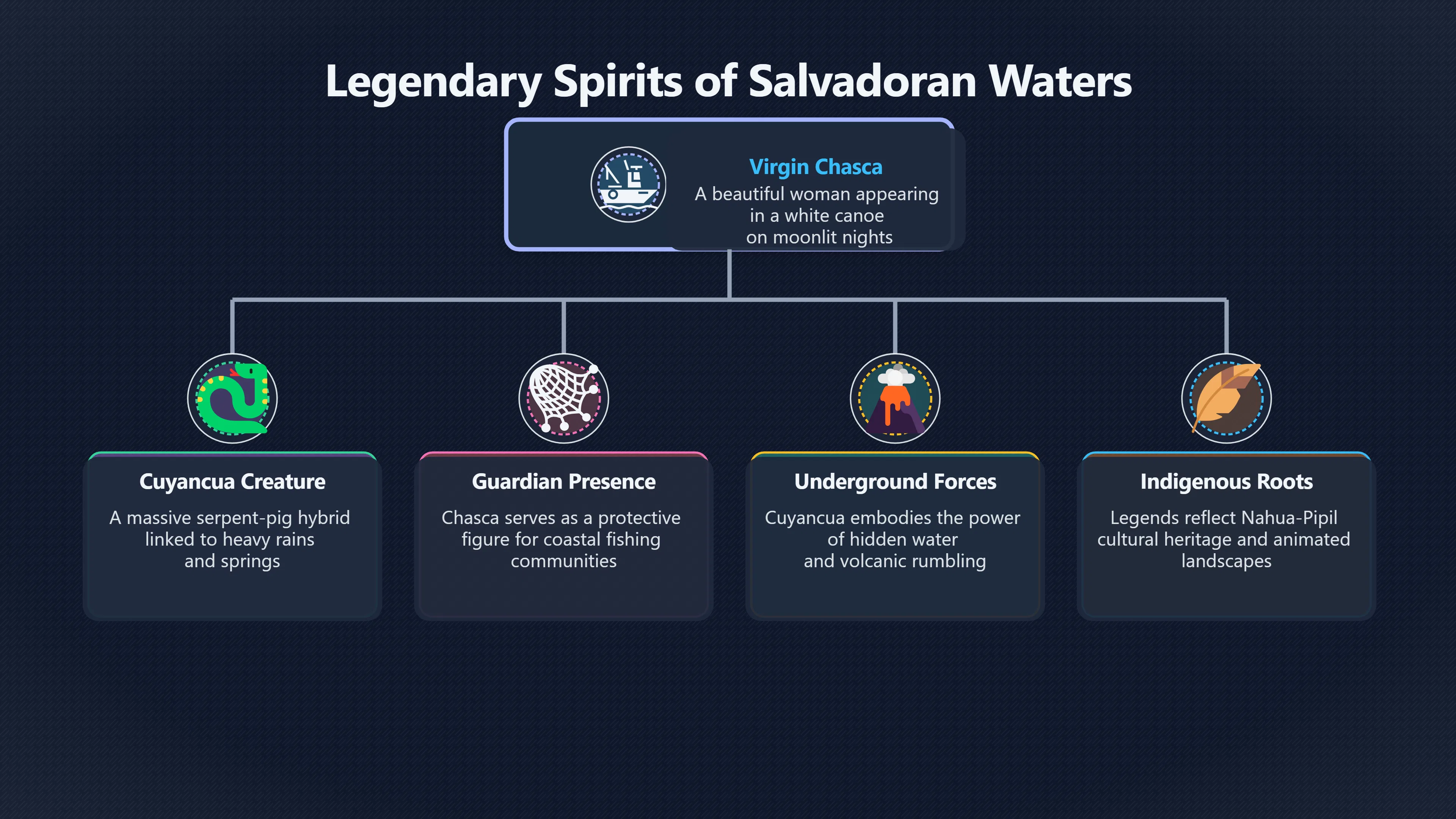
Among Salvadoran water spirits, Chasca is one of the most distinctive. She is commonly remembered as the “Virgin of the Water”, a beautiful young woman whose story is tied to fishing communities on the Pacific coast, especially around Barra de Santiago. According to traditional accounts, Chasca fell in love with a fisherman named Acayatl despite her father’s plans for a politically advantageous marriage. After Acayatl was murdered, Chasca threw herself into the water in grief. Her spirit was later said to return on moonlit nights, travelling in a white canoe alongside her lost lover.[wikipedia.org]WikipediaChasca (Salvadoran folkloreChasca (Salvadoran folklore
The story survives in several versions, but most share the same core themes: forbidden love, tragic loss and a continuing presence on the water after death. Fishermen were said to treat sightings of Chasca with respect rather than fear. In some tellings, disturbing her moonlit passage could bring bad luck, while showing reverence could lead to successful fishing.[Wikipedia]WikipediaChasca (Salvadoran folkloreChasca (Salvadoran folklore
More Spirit Than Monster
Unlike many frightening figures in Central American folklore, Chasca is not usually portrayed as a punishing ghost. She functions more as a guardian presence associated with the sea, fishing and memory. This makes her unusual within Salvadoran supernatural tradition, where many famous beings exist primarily to frighten or warn. Chasca instead reflects the emotional relationship between coastal communities and the waters that sustain them.[Wikipedia]WikipediaChasca (Salvadoran folkloreChasca (Salvadoran folklore
Her continued appearance in folklore, tourism materials and modern retellings shows how older oral traditions can evolve into symbols of local identity while retaining their supernatural character.[Wikipedia]WikipediaTimeless Stories of El SalvadorDecember 12, 2022 — Timeless Stories of El Salvador is a series of fairytales and legends by Salvadoran author Federico Navarrete…
Cuyancua, Rain and Underground Rumbling
A Creature Between Animal and Landscape
If Chasca represents the beauty of water, the Cuyancua represents its unpredictable power. Salvadoran tradition describes the Cuyancua as a huge creature combining features of a serpent and a pig. Stories are especially associated with western El Salvador, including the region around Izalco.[reddit.com]reddit.comThe Cuyancua is real!: r/ShadowrunThe Cuyancua is real!: r/ShadowrunApril 5, 2021 — La Cuyancúa or Cuyancuat, is a Salvadoran (Pre Awakening) legend narrated mainly…
Descriptions vary from place to place, but the creature is generally connected with rivers, springs, wetlands and heavy rains. It is often portrayed not as an ordinary animal but as a supernatural force that inhabits remote waters and hidden places beneath the earth.[centralamericancollective.com]centralamericancollective.comCentral American myths and legendsThe exact origin of the Legend of La Cuyancúa is unknown, however, it is known that it comes from the l…

Explaining Rain and Strange Sounds
One reason the Cuyancua remains memorable is its connection to environmental phenomena. Traditional accounts link the creature to storms, water sources and mysterious rumbling sounds. In a country dominated by volcanic landscapes and seasonal weather patterns, underground noises, sudden springs and dramatic rainfall naturally invited supernatural explanations.[centralamericancollective.com]centralamericancollective.comCentral American myths and legendsThe exact origin of the Legend of La Cuyancúa is unknown, however, it is known that it comes from the l…
The Cuyancua therefore occupies a space between monster and nature spirit. Rather than attacking people in a straightforward horror-story fashion, it embodies the idea that water emerges from hidden, powerful forces beneath the landscape. The legend reflects a worldview in which rivers, springs and rain are animated by living agencies rather than being purely mechanical natural processes.[centralamericancollective.com]centralamericancollective.comCentral American myths and legendsThe exact origin of the Legend of La Cuyancúa is unknown, however, it is known that it comes from the l…
Indigenous Roots and Regional Connections
The Cuyancua is frequently associated with traditions linked to Nahua-Pipil cultural heritage. Variants of serpent-like water beings appear throughout Mesoamerica, but the Salvadoran version developed its own distinctive imagery and local settings. The creature’s persistence in oral tradition demonstrates how Indigenous concepts of animated landscapes continued alongside later colonial and Christian influences.[centralamericancollective.com]centralamericancollective.comCentral American myths and legendsThe exact origin of the Legend of La Cuyancúa is unknown, however, it is known that it comes from the l…
Lake Güija: Where Archaeology Meets Legend
A Landscape That Invites Stories
Few places in El Salvador combine natural beauty, ancient history and folklore as completely as Lake Güija. Located on the border with Guatemala, the volcanic lake is surrounded by hills, islands and archaeological sites. Modern tourism descriptions frequently highlight not only its scenery but also the legends associated with it.[El Salvador Travel]elsalvador.travelEl Salvador TravelGüija LakeThe natural beauty, archaeological findings, and legends of Lake Güija are just some of the attractions that…
The lake’s appearance alone helps explain its legendary reputation. Volcanic cones rise around the water, while islands and peninsulas create a landscape that can appear isolated and mysterious, especially in changing light or mist. Such environments naturally attract stories about hidden powers and ancient presences.[Wikipedia]WikipediaLake GüijaLake Güija
Ancient Settlements and Sacred Memory
Lake Güija is not merely a scenic location. Archaeologists have documented numerous sites around its shores, including settlements dating back many centuries before European arrival. UNESCO’s tentative World Heritage documentation notes the concentration of archaeological remains around the lake and records evidence of important pre-Columbian occupation and religious activity.[UNESCO World Heritage Centre]whc.unesco.orgUNESCO World Heritage CentreLake GuijaOver 20 archaeological sites have been recorded in the lakes environs, including a Late Preclassic…
Because communities have lived around the lake for so long, folklore and archaeology often overlap in popular imagination. Stories about mysterious islands, sacred waters and ancient peoples gain additional power when physical traces of past civilisations remain visible in the landscape. The result is a place where history and legend reinforce one another rather than existing as separate categories.[unesco.org]whc.unesco.orgUNESCO World Heritage CentreLake GuijaOver 20 archaeological sites have been recorded in the lakes environs, including a Late Preclassic…
Haunted Landscapes Rather Than Haunted Buildings
Unlike European traditions that often focus on castles or old houses, Salvadoran folklore frequently treats entire landscapes as haunted. Around Lake Güija, the sense of mystery comes from the combination of water, volcanic geology and ancient human presence. The lake itself becomes the supernatural setting. Stories are attached to islands, shorelines, hidden places and the water’s depths rather than to a single structure.[elsalvador.travel]elsalvador.travelEl Salvador TravelLago de GüijaThe natural beauty, ancient archaeological sites, and rich legends of Güija Lake will captivate you. This…
Haunted Water in cultural memory
The continuing popularity of Chasca, the Cuyancua and legendary lakes such as Güija reveals an important feature of Salvadoran folklore: supernatural traditions remain closely tied to real places. People may debate whether the stories are literally true, but the locations themselves still exist. Visitors can stand beside the same waters, see the same moonlit reflections and hear the same seasonal storms that inspired generations of storytellers.[El Salvador Travel]elsalvador.travelEl Salvador TravelGüija LakeThe natural beauty, archaeological findings, and legends of Lake Güija are just some of the attractions that…
These legends also preserve older ways of understanding nature. Water is not treated as a passive resource but as something with character, memory and agency. Chasca transforms the shoreline into a place of romance and loss. The Cuyancua turns rainfall and springs into signs of hidden powers. Lake Güija becomes more than a lake, functioning as a meeting point between ancient history, local identity and supernatural imagination.[wikipedia.org]WikipediaChasca (Salvadoran folkloreChasca (Salvadoran folklore
In this sense, Salvadoran haunted waters are less about fear than about relationship. They express the idea that landscapes remember human stories and that rivers, lakes and rain continue to shape cultural memory long after the original events have passed into legend.[Wikipedia]WikipediaSalvadoran folkloreSalvadoran folklore
Amazon book picks
Further Reading
Books and field guides related to Why So Many Salvadoran Legends Begin Near Water. Use these as the next step if you want deeper reading beyond the article.
The Mythology Book
Introduces common mythic motifs including water spirits and sacred places.
eBay marketplace picks
Marketplace Samples
Live-tested eBay searches with available results related to this page.




Endnotes
1.
Source: Wikipedia
Title: Chasca (Salvadoran folklore)
Link:https://en.wikipedia.org/wiki/Chasca_%28Salvadoran_folklore%29
2.
Source: Wikipedia
Title: Salvadoran folklore
Link:https://en.wikipedia.org/wiki/Salvadoran_folklore
3.
Source: Wikipedia
Title: Lake Güija
Link:https://en.wikipedia.org/wiki/Lake_G%C3%BCija
4.
Source: federicostories.blogspot.com
Title: chasca virgin of water
Link:https://federicostories.blogspot.com/2017/12/chasca-virgin-of-water.html
Source snippet
Chasca “The Virgin of The Water”1 Dec 2017 — Chasca was a really beautiful girl with a magnificent smile, body, and hair. She was the sta...
5.
Source: Wikipedia
Title: Timeless Stories of El Salvador
Link:https://en.wikipedia.org/wiki/Timeless_Stories_of_El_Salvador
Source snippet
December 12, 2022 — Timeless Stories of El Salvador is a series of fairytales and legends by Salvadoran author Federico Navarrete...
Published: December 12, 2022
6.
Source: reddit.com
Title: The Cuyancua is real!: r/Shadowrun
Link:https://www.reddit.com/r/Shadowrun/comments/mkmqpv/the_cuyancua_is_real/
Source snippet
The Cuyancua is real!: r/ShadowrunApril 5, 2021 — La Cuyancúa or Cuyancuat, is a Salvadoran (Pre Awakening) legend narrated mainly...
Published: April 5, 2021
7.
Source: facebook.com
Link:https://www.facebook.com/askeltenpalo/posts/feliz-d%C3%ADa-de-ultratumbadesde-el-salvador-les-presentamos-la-leyenda-de-cuyanc%C3%BAa-/3469603486437195/
Source snippet
cipio de Izalco, en el departamento de Sonsonate. Según la...Read more...
8.
Source: centralamericancollective.com
Link:https://centralamericancollective.com/myths-legends/
Source snippet
Central American myths and legendsThe exact origin of the Legend of La Cuyancúa is unknown, however, it is known that it comes from the l...
9.
Source: whc.unesco.org
Link:https://whc.unesco.org/en/tentativelists/210/
Source snippet
UNESCO World Heritage CentreLake GuijaOver 20 archaeological sites have been recorded in the lakes environs, including a Late Preclassic...
10.
Source: federicostories.blogspot.com
Title: the cuyancua
Link:https://federicostories.blogspot.com/2017/11/the-cuyancua.html
Source snippet
16 Nov 2017 — The Cuyancua has been polished up, expanded and completed in Timeless Stories of El Salvador. Get your copy and enjoy 31 of...
11.
Source: facebook.com
Link:https://www.facebook.com/100057590495339/videos/%EF%B8%8F-la-cuyanc%C3%BAa-el-grito-de-los-r%C3%ADos-de-izalco-/1558446262066634/
Source snippet
l río grande son sagrados porque ella los habita, pero su...
12.
Source: facebook.com
Link:https://www.facebook.com/coco.maata/posts/i-love-folklore-because-it-turns-a-landscape-from-rocks-and-trees-into-a-living-/4443219962616048/
Source snippet
storybook. it gives us an idea of how people centuries ago...
13.
Source: youtube.com
Title: El Salvador
Link:https://www.youtube.com/watch?v=B2RR3P1iDk4
Source snippet
Lake Ilopango: Cradle of Fire and Water | El Salvador...
14.
Source: elsalvador.travel
Link:https://elsalvador.travel/destination/lago-de-guija/en/
Source snippet
El Salvador TravelGüija LakeThe natural beauty, archaeological findings, and legends of Lake Güija are just some of the attractions that...
15.
Source: elsalvador.travel
Link:https://elsalvador.travel/esp/en/lago-de-guija/
Source snippet
El Salvador TravelLago de GüijaThe natural beauty, ancient archaeological sites, and rich legends of Güija Lake will captivate you. This...
Additional References
16.
Source: deviantart.com
Link:https://www.deviantart.com/kamazotz/art/Chasca-411482781
Source snippet
Chasca by Kamazotz on DeviantArt"Chasca era la diosa de los pescadores. Según los pobladores, Chasca salía en la Barra de Santiago, en la...
17.
Source: lacocoteraresort.com
Link:https://lacocoteraresort.com/blog/?tag=legend-of-chasca
Source snippet
Legend Of Chasca | La Cocotera Eco Resort BlogA tale about the goddess of fishing. According to the story, Chasca was once a beautiful pr...
18.
Source: researchgate.net
Link:https://www.researchgate.net/profile/Anthony-Andrews-6/publication/232029084_A_Brief_History_of_Underwater_Archaeology_in_the_Maya_Area/links/55328d180cf2f2a588b052c0/A-Brief-History-of-Underwater-Archaeology-in-the-Maya-Area.pdf
Source snippet
El Salvador, is surrounded by a number of archaeological sites. Several of these cluster around the...Read more...
19.
Source: youtube.com
Link:https://www.youtube.com/watch?v=IG2-lai-Emw
20.
Source: visitelsalvador.ai
Link:https://www.visitelsalvador.ai/blog/legendes-mythes-el-salvador
Source snippet
La Siguanaba, El Cipitío and the Cadejo | Visit El Salvador5 Jan 2026 — La Siguanaba is undoubtedly the most famous legend of El Salvador...
21.
Source: academia.edu
Link:https://www.academia.edu/59131149/The_Cultural_Evolution_of_Ancient_Nahua_Civilizations_The_Pipil_Nicarao_of_Central_America
Source snippet
l populations, has an annual mean of 25.1 degrees C, entire landscape of El...
22.
Source: nationalgeographic.com
Title: paid content el salvador tour ancient landscapes
Link:https://www.nationalgeographic.com/travel/article/paid-content-el-salvador-tour-ancient-landscapes
Source snippet
Tour El Salvador's ancient landscapes11 Sept 2025 — Sacred stones and sleeping giants—touring El Salvador's ancient landscapes … is one o...
23.
Source: instagram.com
Link:https://www.instagram.com/p/DVHGSQUj6fb/
Source snippet
The Story of Chasca and Acayatl In ancient El Salvador...In ancient El Salvador amongst the Pipil, there was a beautiful woman named Chasca...
24.
Source: astadventures.com
Title: myths legends of el salvador
Link:https://www.astadventures.com/blogs/blog-ast/myths-legends-of-el-salvador
Source snippet
Myths & Legends of El Salvador14 Sept 2015 — El Salvador is rich with legends and folklore that help to contribute to the unique people a...
25.
Source: youtube.com
Link:https://www.youtube.com/shorts/l9tOFPBRJYs
Source snippet
er. A forbidden love between the daughter of a chief and a humble...
Topic Tree