Where Gambia's Spirits Still Meet Everyday Life
Gambian folklore is best understood as living story culture rather than a single fixed “mythology”. It sits in oral histories, praise songs, initiation masquerades, sacred pools, village memories, charms, spirit beliefs, river monsters, and newer heritage tourism built around older traditions.
Page outline Jump by section
Why Gambian folklore is hard to separate from everyday culture
The Gambia is small in land area but culturally dense. Its folklore is shaped by Mandinka, Wolof, Jola, Fula, Serer, Aku and other communities, by the River Gambia, and by long-standing links with Senegal and the wider Mande world. That matters because many stories and ritual forms do not stop neatly at the national border. The Kankurang, for example, is officially listed by UNESCO as a Manding initiatory rite of both The Gambia and Senegal, while the Ninki Nanka is usually described as a West African or Senegambian river-and-swamp being rather than an exclusively Gambian monster.[unesco.org]ich.unesco.orgOpen source on unesco.org.
Another important point is that Gambian folklore often survives through performance and social use rather than through old written myth books. The National Centre for Arts and Culture says its oral archive holds thousands of audio recordings covering Gambian history, culture, genealogy, traditions, folklore and music, many transcribed from national languages into English. The University of Hamburg’s description of the National Digital Archive likewise stresses recordings of spoken art and oral tradition, plus written documents on Senegambia, Guinea and Mali. That archive-based picture is useful: it reminds readers that Gambian folklore is not merely “lost” village memory, but a recorded and curated national heritage.[ncac.gm]ncac.gmNATIONAL CENTRE FOR ARTS & CALTUREOral ArchiveNATIONAL CENTRE FOR ARTS & CALTUREOral Archive
Gambia is also overwhelmingly Muslim today: the US State Department’s 2023 religious freedom report estimated that about 96.4 per cent of the population is Muslim, mostly Sunni. Yet older spirit ideas, charms, sacred places and local ritual specialists have continued to interact with Islamic practice. A scholarly study of malaria beliefs in The Gambia found that illness could be interpreted through biomedical causes, spirits or witchcraft, showing how supernatural explanation can remain part of everyday reasoning even where people also know modern medical explanations.[State.gov]state.gov547499 GAMBIA 2023 INTERNATIONAL RELIGIOUS FREEDOM REPORT547499 GAMBIA 2023 INTERNATIONAL RELIGIOUS FREEDOM REPORT
The Kankurang: guardian, enforcer and symbol of Manding identity
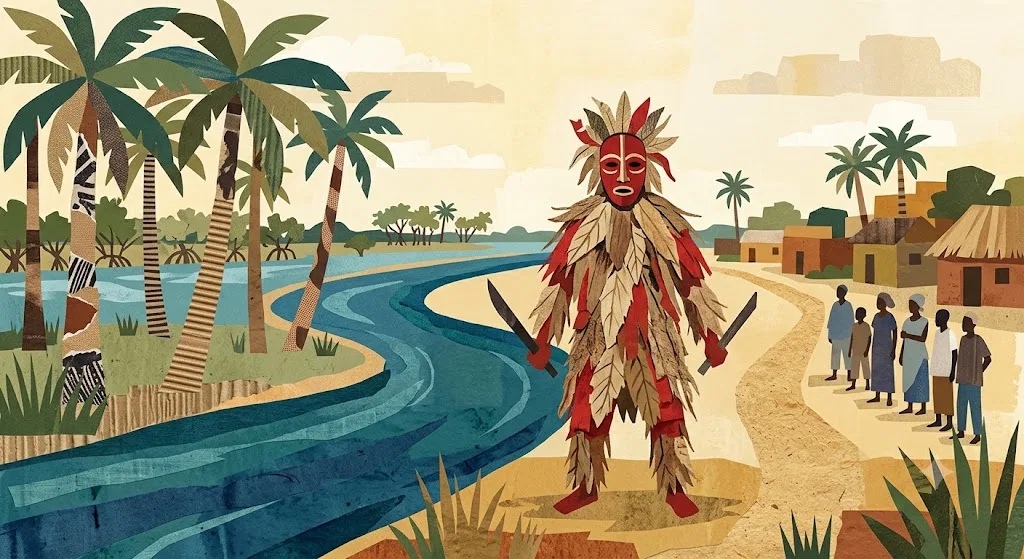
The Kankurang is the most internationally recognised Gambian folklore figure. UNESCO describes it as an initiatory rite practised in Manding provinces of Senegal and The Gambia, with origins traditionally linked to Komo, a hunters’ secret society associated with Manding esoteric knowledge. At its centre is a masked, costumed figure understood as a protective spirit. In public descriptions, the Kankurang is not treated simply as theatre: it is connected with initiation, order, protection and the teaching of community rules.[Intangible Cultural Heritage]ich.unesco.orgOpen source on unesco.org.
For readers used to thinking of folklore as “stories about creatures”, the Kankurang is a useful correction. It is a being, a costume, a performance, a social institution and a sacred discipline all at once. UNESCO’s safeguarding material describes the Kankurang as protector of order and justice and as an exorcist of evil spirits. The rite gives boys in the Manding cultural sphere a period of instruction in social rules, medicinal plants, hunting techniques and communal obligations.[UNESCO Japan]unesco.emb-japan.go.jpOpen source on go.jp.
The Kankurang’s public visibility has changed over time. It remains tied to initiation and secrecy, but it is also presented in festivals, cultural programmes and tourism. The Janjanbureh Kankurang Festival is a clear example of this shift: a revived cultural event uses masquerade to preserve heritage, attract visitors and create local economic opportunities. The EU’s account of the festival’s 2018 revival says the event aimed to preserve cultural heritage while supporting youth employment through hospitality, souvenirs and guiding.[Emergency Trust Fund for Africa]trust-fund-for-africa.europa.euOpen source on europa.eu.
This public-facing version can create tension. A sacred masquerade is not the same thing as a stage act, even when visitors encounter it in a festival setting. The safest way to understand the modern Kankurang is as a tradition with several layers: an older initiatory and protective system, a community performance, a national heritage emblem, and a tourism-facing symbol of Gambian identity.[Intangible Cultural Heritage]ich.unesco.orgOpen source on unesco.org.
Other masquerades: spirits that dance, discipline and entertain
Gambian masquerade culture is broader than the Kankurang. Local cultural guides and heritage tourism sources commonly identify Zimba or Simba, Kumpo, Mamapara, Fairy and Hunting Devil traditions alongside Mandinka Kankurang. These forms differ by community, setting and religious history, but they share an important feature: the mask is not just decoration. It can represent a spirit presence, a social force, a comic or frightening visitor, an enforcer of rules, or an entertainer at festivals and life-cycle ceremonies.[My Gambia]my-gambia.comMy Gambia Most significant masquerades of The GambiaMy Gambia Most significant masquerades of The Gambia
Kumpo is especially important in Jola cultural contexts in The Gambia and Casamance. It is usually described as a palm-leaf masquerade associated with sacred forest, community order and protection from harmful forces. Harvard’s programme description of Jola Kumpo masquerade emphasises that such figures are treated as more-than-human presences residing in sacred forests in The Gambia and Senegal, demanding reverence and fear rather than being reduced to ordinary performers.[pes.hds.harvard.edu]pes.hds.harvard.eduOpen source on harvard.edu.
Zimba or Simba, often described as a lion-like Wolof masquerade, is more commonly encountered as an urban or festive performance in The Gambia and Senegal. Aku masquerades such as Fairy and Hunting Devil show another route by which folklore travels: through Christian festive calendars, returnee Atlantic histories, Sierra Leonean and Yoruba-linked influences, and Banjul’s multi-ethnic urban culture. This is why Gambian folklore should not be imagined as one ancient village system. It is layered: Mande, Jola, Wolof, Islamic, Christian, Atlantic and tourist-facing traditions all meet in the same national space.[My Gambia]my-gambia.comMy Gambia Most significant masquerades of The GambiaMy Gambia Most significant masquerades of The Gambia
Sacred crocodile pools and the power of water
The best-known sacred place in Gambian folklore is Kachikally Crocodile Pool in Bakau. It is commonly presented as one of three sacred crocodile pools in the country, with the others usually named as Folonko in Kartong and Berending on the north bank. Kachikally is both a sacred site and a visitor attraction: people go there to see crocodiles, but local accounts also describe the pool as a place of prayer, fertility hopes, blessing, healing and communal ritual.[kachikally.com]kachikally.comOpen source on kachikally.com.
The folklore of Kachikally is especially memorable because it joins animal, water and family guardianship. The site is associated with the Bojang family of Bakau, and retellings often describe a spirit-linked origin story in which a woman or spirit figure reveals the pool’s power and entrusts its care to the family. Modern visitors may focus on the unusual experience of seeing or touching crocodiles, but the older story logic is about sacred water, fertility, guardianship and obligation.[dimbayaafertilityafrica.com]dimbayaafertilityafrica.comKatchikaly, the Sacred Crocodile PoolKatchikaly, the Sacred Crocodile Pool
Crocodiles in these traditions should not be treated as mere tourist props. They are understood in local sacred geography as beings connected to blessing, protection and fertility. Travel accounts can sometimes flatten this into novelty — “touch a crocodile and live” — but heritage descriptions and local site material make clear that Kachikally is still framed as a place requiring respect.[Kachikally]kachikally.comOpen source on kachikally.com.
The crocodile pools also show how Gambian folklore is attached to landscape. The sacred is not only in a tale told indoors; it is in a pool, a family’s custodianship, the behaviour expected of visitors, and the ongoing relationship between humans and animals. That is why Kachikally belongs on any serious page about Gambian folklore, even though it is also a popular excursion from the coast.[The Point]thepoint.gmThe Point Kachikally Pool: Spiritual and Social by NatureThe Point Kachikally Pool: Spiritual and Social by Nature
Ninki Nanka: river monster, warning tale and tourism emblem
The Ninki Nanka is The Gambia’s most famous legendary monster in English-language popular culture. It is usually described as a dangerous river or swamp creature: part serpent, part dragon, sometimes with crocodile, horse or giraffe-like features. Modern tourism projects describe it as a mythical dragon said to live in quieter creeks of the River Gambia, feared because seeing it directly may bring death, while seeing it by reflection may be safer.[Ninki Nanka Encounters]ninkinanka.foundationOpen source on ninkinanka.foundation.
The creature’s older value is probably not as a cryptid to be “proved”, but as a story about dangerous landscapes. Swamps, creeks, river edges and dense bush are places of real risk: crocodiles, snakes, disease, getting lost, or trespassing into spiritually charged ground. A monster that warns children and travellers away from such places can be both frightening and practical. That does not make the belief fake or foolish; it shows how folklore often gives social and emotional shape to environmental danger.[Wikipedia]WikipediaNinki NankaNinki Nanka
In 2006, the Ninki Nanka briefly gained international attention through cryptozoological interest and media coverage, but that kind of “monster hunt” is only one modern layer. The more culturally interesting development is the Ninki Nanka Trail, a community-based tourism route along the River Gambia. National Geographic Traveller described the route as tracing the river upstream from Banjul and using the mythical beast’s name to draw visitors inland, away from the beach-focused tourism corridor and towards river communities.[National Geographic]nationalgeographic.comexploring gambias new ninki nanka trailexploring gambias new ninki nanka trail
Today, then, the Ninki Nanka sits in three overlapping worlds: oral warning tale, internet-era monster lore, and responsible tourism branding. The strongest reading is not “Is it real?” but “What does it reveal?” It reveals the River Gambia as both lifeline and danger zone, the power of frightening stories in children’s folklore, and the way a local legend can be reworked into a modern heritage route.[National Geographic]nationalgeographic.comexploring gambias new ninki nanka trailexploring gambias new ninki nanka trail
Oral historians, praise singers and the memory of families
No account of Gambian folklore makes sense without oral tradition. Mandinka griots, often called jali in Mande contexts, are singers, musicians, genealogists, praise poets and keepers of family and political memory. The Smithsonian catalogue record for Donald R. Wright’s Oral Traditions from the Gambia identifies one volume specifically with Mandinka griots and another with family elders, showing how central oral testimony has been to scholarship on Gambian history and culture.[Smithsonian Institution]si.eduOpen source on si.edu.
The kora is one of the best-known instruments linked to this world. It is a 21-string West African harp-lute strongly associated with Mandinka hereditary musician families and oral historical performance. Modern explanations of the kora tradition stress that stories, genealogies and praise songs are learned within families over many years, not simply picked up as casual entertainment.[Transitions Abroad]transitionsabroad.comOpen source on transitionsabroad.com.
Yet oral tradition is not a tape recorder. Historians have repeatedly warned that oral accounts can be contradictory, selective and shaped by present-day status or memory. Wright himself later wrote critically about using oral tradition to reconstruct the precolonial history of the lower Gambia, arguing that some traditions he had collected were far less reliable for early history than he had first thought. For folklore readers, this does not make oral tradition worthless. It means it should be read as memory, performance, identity and social claim, not always as exact chronological record.[AfricaBib]africabib.orgOpen source on africabib.org.
This distinction is vital for famous stories such as the Kunta Kinte and Roots tradition. Alex Haley’s work drew worldwide attention to Juffureh, the Gambia River and Mandinka oral history, but reviewers and historians have long noted the blend of archival research, family memory and imaginative reconstruction in Roots. The story’s cultural influence is enormous, but its status is not the same as a fully documented archival biography.[The New Yorker]newyorker.comThe New Yorker SourcesThe New Yorker Sources

Spirits, charms and witchcraft beliefs in a Muslim-majority country
Gambian supernatural belief is often intertwined with Islam rather than separate from it. Charms, Qur’anic inscriptions, marabouts, jinn, witches and protective objects all appear in popular descriptions of Gambian spiritual life. This does not mean every Gambian believes the same things, or that such practices are uncontested. It means that everyday religious culture can include both mosque-centred Islam and local ideas about protection, blessing, illness and hidden harm.[State.gov]state.gov547499 GAMBIA 2023 INTERNATIONAL RELIGIOUS FREEDOM REPORT547499 GAMBIA 2023 INTERNATIONAL RELIGIOUS FREEDOM REPORT
Academic health research gives a careful window into this world. A 2015 study of malaria conceptions in The Gambia found that people could understand malaria through mosquitoes and biomedical treatment while also discussing other categories such as foul wind, spirits and witchcraft. In some interviews, witches were described as worsening illness, while marabouts and traditional healers formed part of the wider health-seeking landscape.[PMC]pmc.ncbi.nlm.nih.govOpen source on nih.gov.
Older scholarship also recorded belief in witchcraft among rural Wolof communities in The Gambia. Such evidence should be handled carefully. Witchcraft belief is an important folklore topic, but accusations can have serious human consequences. Recent research and reporting on the legacy of state-led witchcraft accusations in The Gambia underlines that “witchcraft” is not just a quaint supernatural category; it can become a language of fear, blame and social harm.[JSTOR]jstor.orgBelief in 'Witches' among the Rural Wolof of the GambiaBelief in 'Witches' among the Rural Wolof of the Gambia
For a folklore page, the fairest approach is to separate belief from endorsement. It is accurate to say that jinn, witches, charms and spirit causation appear in Gambian belief culture. It is not responsible to present accusations as fact, or to romanticise practices that have been used to target vulnerable people.[PMC]pmc.ncbi.nlm.nih.govOpen source on nih.gov.
Ancient stones and sacred landscapes
The Stone Circles of Senegambia are not folklore in the simple sense of a fairy tale, but they are crucial to the sacred landscape of The Gambia. UNESCO describes the wider Senegambian stone-circle zone as an extraordinary concentration of more than 1,000 monuments in a band about 100 kilometres wide and 350 kilometres long along the River Gambia. The four UNESCO-listed groups include Wassu and Kerbatch in The Gambia, along with Sine Ngayène and Wanar in Senegal.[UNESCO World Heritage Centre]whc.unesco.orgWorld Heritage Centre Stone Circles of SenegambiaWorld Heritage Centre Stone Circles of Senegambia
These sites combine archaeology, ancestral memory and speculation. Excavations of some circles and burial mounds suggest dates ranging from the third century BC to the sixteenth century AD, but the builders’ exact identities and the full ritual meanings of the monuments remain debated. That uncertainty is part of their fascination. They are visible, material remains of a long sacred landscape, but they do not come with a neat written myth explaining everything.[UNESCO World Heritage Centre]whc.unesco.orgWorld Heritage Centre Stone Circles of SenegambiaWorld Heritage Centre Stone Circles of Senegambia
For visitors, Wassu and Kerbatch often function as heritage sites rather than active folklore centres. Even so, they matter for Gambian legendary culture because they show how the past becomes meaningful through place. Like the crocodile pools, the stone circles anchor memory in landscape. They invite stories about ancestors, burial, power and the people who lived along the river before modern national borders.[UNESCO World Heritage Centre]whc.unesco.orgWorld Heritage Centre Stone Circles of SenegambiaWorld Heritage Centre Stone Circles of Senegambia
How Gambian folklore is changing today
Modern Gambian folklore is not frozen. Some traditions are protected through UNESCO recognition, archives and festivals. Others are repackaged through tourism, photography, travel writing and social media. The Kankurang has moved from initiation-centred secrecy into carefully managed heritage display; the Ninki Nanka has moved from frightening oral tale into river-trail branding; Kachikally has become both sacred site and tourist stop.[unesco.org]ich.unesco.orgOpen source on unesco.org.
That change can be positive when communities control the presentation and benefit from it. The revival of the Janjanbureh Kankurang Festival, for example, was explicitly linked to cultural preservation and local economic opportunity. The Ninki Nanka Trail similarly uses legend to encourage travel inland, where visitors can encounter river communities, wildlife and oral storytelling rather than remaining only in coastal resort areas.[Emergency Trust Fund for Africa]trust-fund-for-africa.europa.euOpen source on europa.eu.
But there are risks. Sacred figures can be flattened into photo opportunities. Spirit beliefs can be sensationalised for outsiders. Complex oral histories can be treated either as unquestionable fact or dismissed as “just stories”. The most respectful reading sits between those extremes: Gambian folklore is evidence of how communities remember, warn, bless, initiate, entertain, protect and explain their world.[Cambridge University Press & Assessment]cambridge.orgOpen source on cambridge.org.
What to remember about folklore in The Gambia
The strongest Gambian folklore traditions are rooted in performance, place and social function. The Kankurang is not simply a mask but a guardian figure tied to initiation, discipline and Manding identity. Kachikally and other crocodile pools are not just wildlife attractions but sacred water sites associated with fertility, blessing and family custodianship. The Ninki Nanka is not best understood as a monster to be proved, but as a river-and-swamp legend that has moved from oral warning tale into modern tourism.[unesco.org]ich.unesco.orgOpen source on unesco.org.
The deeper pattern is that Gambian folklore lives where community meets landscape: river, forest, pool, village, festival ground, family compound, archive and song. Its stories are shared across borders, especially with Senegal, but they have distinct Gambian forms through Bakau, Janjanbureh, the River Gambia, Mandinka oral history, Jola masquerade and national heritage institutions.[ncac.gm]ncac.gmNATIONAL CENTRE FOR ARTS & CALTUREOral ArchiveNATIONAL CENTRE FOR ARTS & CALTUREOral Archive
Amazon book picks
Further Reading
Books and field guides related to Where Gambia's Spirits Still Meet Everyday Life. Use these as the next step if you want deeper reading beyond the article.
African Folktales
Provides broad West African folklore context that helps readers understand Gambian oral traditions.
Oral Literature in Africa
Explains how oral traditions, praise songs and folklore function in African societies.
West African Folktales
Covers story traditions shared across Senegambia and neighbouring cultures.
African Myths of Origin
Places Gambian legends within wider African mythic storytelling.
eBay marketplace picks
Marketplace Samples
Live-tested eBay searches with available results related to this page.

Endnotes
1.
Source: ich.unesco.org
Link:https://ich.unesco.org/en/RL/kankurang-manding-initiatory-rite-00143
2.
Source: whc.unesco.org
Title: World Heritage Centre Stone Circles of Senegambia
Link:https://whc.unesco.org/en/list/1226/
3.
Source: ncac.gm
Title: NATIONAL CENTRE FOR ARTS & CALTUREOral Archive
Link:https://ncac.gm/oralarchieve/
4.
Source: aai.uni-hamburg.de
Title: National Digital Archive of The Gambia
Link:https://www.aai.uni-hamburg.de/afrika/forschung/ncac-nda.html
5.
Source: ncac.gm
Link:https://ncac.gm/
6.
Source: state.gov
Title: 547499 GAMBIA 2023 INTERNATIONAL RELIGIOUS FREEDOM REPORT
Link:https://www.state.gov/wp-content/uploads/2024/04/547499-GAMBIA-2023-INTERNATIONAL-RELIGIOUS-FREEDOM-REPORT.pdf
7.
Source: ich.unesco.org
Title: Intangible Cultural Heritage Senegal
Link:https://ich.unesco.org/en/state/senegal-SN?info=projects
8.
Source: my-gambia.com
Title: My Gambia Most significant masquerades of The Gambia
Link:https://www.my-gambia.com/mymagazine/most-significant-masquerades-of-the-gambia/
9.
Source: pes.hds.harvard.edu
Link:https://pes.hds.harvard.edu/publication/jola-kumpo-masquerade-more-human
10.
Source: kachikally.com
Link:https://kachikally.com/
11.
Source: Wikipedia
Title: Kachikally Museum and Crocodile Pool
Link:https://en.wikipedia.org/wiki/Kachikally_Museum_and_Crocodile_Pool
12.
Source: dimbayaafertilityafrica.com
Title: Katchikaly, the Sacred Crocodile Pool
Link:https://dimbayaafertilityafrica.com/katchikaly-the-sacred-crocodile-pool/
13.
Source: Wikipedia
Title: Gambia National Museum
Link:https://en.wikipedia.org/wiki/Gambia_National_Museum
14.
Source: Wikipedia
Title: Ninki Nanka
Link:https://en.wikipedia.org/wiki/Ninki_Nanka
15.
Source: resolve.cambridge.org
Link:https://resolve.cambridge.org/core/services/aop-cambridge-core/content/view/AB4AAAD4DE388EDACB3308F65F63C575/9781782048701c3_p84-110_CBO.pdf/power_of_the_wild_spirits.pdf
16.
Source: africabib.org
Link:https://www.africabib.org/rec.php?RID=097485721
17.
Source: cambridge.org
Link:https://www.cambridge.org/core/journals/history-in-africa/article/requiem-for-the-use-of-oral-tradition-to-reconstruct-the-precolonial-history-of-the-lower-gambia/525B747DEE216367556AF264FBC23619
18.
Source: my-gambia.com
Link:https://www.my-gambia.com/mymagazine/juju-and-charms-superstition-in-the-gambia/
19.
Source: jstor.org
Title: Belief in ‘Witches’ among the Rural Wolof of the Gambia
Link:https://www.jstor.org/stable/1157616
20.
Source: archive.org
Title: Oral traditions from the Gambia: Wright, Donald R
Link:https://archive.org/details/oraltraditionsfr0000wrig
21.
Source: jstor.org
Link:https://www.jstor.org/stable/3172074
22.
Source: Wikipedia
Title: The Gambia
Link:https://en.wikipedia.org/wiki/The_Gambia
23.
Source: Wikipedia
Link:https://en.wikipedia.org/wiki/Griot
24.
Source: Wikipedia
Title: Mandinka people
Link:https://en.wikipedia.org/wiki/Mandinka_people
25.
Source: Wikipedia
Link:https://en.wikipedia.org/wiki/Kumpo
26.
Source: Wikipedia
Title: Senegambian stone circles
Link:https://en.wikipedia.org/wiki/Senegambian_stone_circles
27.
Source: Wikipedia
Title: Kunta Kinte
Link:https://en.wikipedia.org/wiki/Kunta_Kinte
28.
Source: Wikipedia
Title: Religion in the Gambia
Link:https://en.wikipedia.org/wiki/Religion_in_the_Gambia
29.
Source: unesco.org
Link:https://www.unesco.org/en
30.
Source: ich.unesco.org
Title: gambia GM
Link:https://ich.unesco.org/en/state/gambia-GM
31.
Source: ich.unesco.org
Title: gambia GM
Link:https://ich.unesco.org/en/state/gambia-GM?call=film&id=41681&include=film_inc.php&width=700
32.
Source: ich.unesco.org
Link:https://ich.unesco.org/en/video/41681
33.
Source: ich.unesco.org
Title: action plan for the safeguarding of the kankurang manding initiatory rite 00039
Link:https://ich.unesco.org/en/projects/action-plan-for-the-safeguarding-of-the-kankurang-manding-initiatory-rite-00039
34.
Source: unesco.org
Title: le Kankurang Rite D’initiation Mandingue
Link:https://www.unesco.org/archives/multimedia/document-625
35.
Source: ich.unesco.org
Link:https://ich.unesco.org/doc/src/Signed%20periodic%20report%20-%20Periodic%20report-62616.pdf
36.
Source: whc.unesco.org
Link:https://whc.unesco.org/fr/listesindicatives/6063/
37.
Source: unesco.org
Link:https://www.unesco.org/en/intangible-cultural-heritage/list?fq%5Bsm_unsc_field_ref_countries_label%5D%5B0%5D=Gambia
38.
Source: resolve.cambridge.org
Link:https://resolve.cambridge.org/core/services/aop-cambridge-core/content/view/E0AFA089853BF0BF7F1185634C70880D/9781782048701c5_p137-161_CBO.pdf/spiritual_persistence_through_change.pdf
39.
Source: gambia.gov.gm
Link:https://gambia.gov.gm/
40.
Source: gambiadaily.gov.gm
Title: uk based gambian artist unveils jaliya silokang tracing path griot
Link:https://gambiadaily.gov.gm/index.php/uk-based-gambian-artist-unveils-jaliya-silokang-tracing-path-griot
41.
Source: motc.gov.gm
Link:https://motc.gov.gm/historical-georgetown-inscribed-into-unescos-prestigious-network-of-places-of-history-and-memory-linked-to-enslavement/
42.
Source: my-gambia.com
Link:https://www.my-gambia.com/mymagazine/viajes-national-geographic-in-the-gambia/
43.
Source: my-gambia.com
Title: kankurang festival 2025 confirmed
Link:https://www.my-gambia.com/article/kankurang-festival-2025-confirmed/
44.
Source: 2021-2025.state.gov
Link:https://2021-2025.state.gov/reports/2022-report-on-international-religious-freedom/gambia/
45.
Source: resourcepage.gambia.dk
Title: dk Gambian Bibliography
Link:https://resourcepage.gambia.dk/biblio/citations/culture.htm
46.
Source: youtube.com
Title: The Spirit of The Gambian Culture
Link:https://www.youtube.com/watch?v=p_5eVjE88_Y
Source snippet
The Ninki Nanka | West Africa's Swamp Dragon...
47.
Source: youtube.com
Title: The Ninki Nanka | West Africa’s Swamp Dragon
Link:https://www.youtube.com/watch?v=Wru7DkEfgVU
Source snippet
Touching a Live Crocodile at Gambia's Sacred Kachikally Pool...
48.
Source: nationalgeographic.com
Title: exploring gambias new ninki nanka trail
Link:https://www.nationalgeographic.com/travel/article/exploring-gambias-new-ninki-nanka-trail
49.
Source: ninkinanka.foundation
Link:https://ninkinanka.foundation/ninki-nanka-trail
50.
Source: pmc.ncbi.nlm.nih.gov
Link:https://pmc.ncbi.nlm.nih.gov/articles/PMC4408602/
51.
Source: unesco.emb-japan.go.jp
Link:https://www.unesco.emb-japan.go.jp/htm/d_ich_kankurang.htm
52.
Source: trust-fund-for-africa.europa.eu
Link:https://trust-fund-for-africa.europa.eu/news/yep-and-revival-janjanbureh-kankurang-festival-2018-03-13_en
53.
Source: gambianexcursions.com
Title: kachikally museum and crocodile pool
Link:https://www.gambianexcursions.com/tourist-trips/kachikally-museum-and-crocodile-pool/
54.
Source: thepoint.gm
Title: The Point Kachikally Pool: Spiritual and Social by Nature
Link:https://thepoint.gm/africa/gambia/article/kachikally-pool-spiritual-and-social-by-nature
55.
Source: si.edu
Link:https://www.si.edu/object/oral-traditions-gambia-interviews-donald-r-wright%3Asiris_sil_187110
56.
Source: transitionsabroad.com
Link:https://www.transitionsabroad.com/listings/travel/articles/kora-griot-the-gambia.shtml
57.
Source: newyorker.com
Title: The New Yorker Sources
Link:https://www.newyorker.com/magazine/1977/02/14/sources
58.
Source: cryptidarchives.fandom.com
Title: Ninki nanka
Link:https://cryptidarchives.fandom.com/wiki/Ninki_nanka
59.
Source: cryptidz.fandom.com
Title: Ninki Nanka
Link:https://cryptidz.fandom.com/wiki/Ninki_Nanka
60.
Source: facebook.com
Link:https://www.facebook.com/media/set/?set=a.122101070163098038&vanity=
61.
Source: facebook.com
Link:https://www.facebook.com/groups/1948839472064649/posts/4059112947703947/
62.
Source: facebook.com
Link:https://www.facebook.com/JJBKankurangFestivalJan2020/photos/breaking-unesco-inscribes-historic-georgetown-on-janjanburehin-february-janjanbu/1276087004518351/
63.
Source: destinationjanjanbureh.com
Link:https://www.destinationjanjanbureh.com/unesco
64.
Source: tripadvisor.com
Title: Kachikally Crocodile Pool
Link:https://www.tripadvisor.com/Attraction_Review-g479198-d2462024-Reviews-Kachikally_Crocodile_Pool-Bakau_Banjul_Division.html
65.
Source: nationalgeographic.com
Title: photo story cockle farmers chieftains portraits life banks gambia river
Link:https://www.nationalgeographic.com/travel/article/photo-story-cockle-farmers-chieftains-portraits-life-banks-gambia-river
66.
Source: gambiabirdtour.com
Title: The Senegambian Stone Circles
Link:https://www.gambiabirdtour.com/post/senegambian-stone-circles
67.
Source: thepoint.gm
Title: kora the 21 string west african harp lute founded in gambia
Link:https://thepoint.gm/africa/gambia/headlines/kora-the-21-string-west-african-harp-lute-founded-in-gambia
68.
Source: thepoint.gm
Link:https://thepoint.gm/africa/gambia/headlines/celebrating-9th-edition-of-janjanbureh-kankurang-festival-a-landmark-reflection-of-soul-of-the-nation
69.
Source: kumakonda.com
Link:https://kumakonda.com/kankurang/
Additional References
70.
Source: youtube.com
Title: Kankurang Cultural Experience | Sacred Traditions of Janjanbureh | My Gambia
Link:https://www.youtube.com/watch?v=X4dczmBJ_Lc
Source snippet
The Spirit of The Gambian Culture - Kankurang Dance | Africa Creates...
71.
Source: youtube.com
Title: I Took Part in Africa’s TOUGHEST Ritual!
Link:https://www.youtube.com/watch?v=TVNuKB7mi18
Source snippet
Kankurang Cultural Experience | Sacred Traditions of Janjanbureh | My Gambia...
72.
Source: youtube.com
Title: Touching a Live Crocodile at Gambia’s Sacred Kachikally Pool
Link:https://www.youtube.com/watch?v=ufxGGyXKPeY
Source snippet
Hidden Histories: Celebrating through Masquerade...
73.
Source: facebook.com
Link:https://www.facebook.com/Welcometogambia/posts/ilovegambia-thegambia-culture-tradition-the-different-types-of-kankurang-masquer/974032385219402/
74.
Source: researchgate.net
Link:https://www.researchgate.net/publication/275356560_Foul_wind_spirits_and_witchcraft_Illness_conceptions_and_health-seeking_behaviour_for_malaria_in_the_Gambia
75.
Source: researchgate.net
Link:https://www.researchgate.net/publication/397838000_2829Jeliya_goes_Spotify_From_Griot_Oral_Traditions_to_Multimodal_Representations_of_Contemporary_West_African_Music_and_Languages
76.
Source: accessgambia.com
Link:https://www.accessgambia.com/information/bakau-kachikally.html
77.
Source: accessgambia.com
Link:https://www.accessgambia.com/information/kumpo-mask.html
78.
Source: accessgambia.com
Link:https://www.accessgambia.com/information/masquerades.html
79.
Source: facebook.com
Link:https://www.facebook.com/groups/275114380263865/posts/541281630313804/
Topic Tree
Follow this branch
Related pages 192
- Afghan Folklore
- Albanian Folklore
- Algerian Folklore
- Australian Folklore
- Azerbaijan Folklore
- +187 more in sidebar