Within Liberian Folklore
Why Is Spider So Clever and Dangerous?
Liberia's spider stories turn cleverness, hunger and danger into comic tales with sharp social lessons.
On this page
- Spider as trickster, survivor and troublemaker
- How performance changes the tale
- Greed, wit and moral judgement
Page outline Jump by section
Introduction
Spider tales are among the most famous and enduring forms of storytelling in Liberia. Across many Liberian communities, the spider appears not as a heroic figure but as a trickster: clever, hungry, amusing, selfish, inventive and often dangerous. He survives through intelligence rather than strength, deceives larger animals, bends social rules, and repeatedly gets himself into trouble. Yet these stories are not merely comic entertainment. They are moral lessons disguised as laughter, teaching audiences about greed, pride, selfishness, patience, responsibility and the limits of cleverness. Collections of Liberian folktales, including stories preserved in Legends of Liberia and later retellings, place spider narratives among the most recognisable elements of the country’s oral tradition.[patricksplace.org]patricksplace.orgto a small sample of Liberian folktales. The primary goal is to increase interest in Liberia's storehouse of oral literature.Read more…

The Liberian spider belongs to a wider West African family of trickster figures often compared with Anansi traditions known from Ghana, Sierra Leone and the African diaspora. However, Liberian storytellers adapted the character to local settings, local humour and local moral concerns. What makes these tales memorable is that the audience is rarely told directly what lesson to learn. Instead, listeners watch Spider cheat, boast, manipulate or scheme and then judge the consequences for themselves.[patricksplace.org]patricksplace.orgto a small sample of Liberian folktales. The primary goal is to increase interest in Liberia's storehouse of oral literature.Read more…
Why Is Spider So Clever and Dangerous?
The spider occupies a special place because he combines qualities that would normally be opposites. He is weak but successful, funny but threatening, admirable but morally unreliable.
In many stories Spider defeats stronger animals through planning, deception or verbal skill. He rarely wins through physical force. This makes him appealing in societies where intelligence, negotiation and quick thinking are valued survival skills. At the same time, Spider’s cleverness often crosses into dishonesty. He lies, steals, manipulates relatives, breaks promises and exploits the trust of others. The audience is therefore encouraged to admire his ingenuity while questioning his behaviour.[Wikipedia]WikipediaOpen source on wikipedia.org.
This tension is central to the trickster tradition. Spider is not a model citizen. He is a test case. Every story asks how far intelligence should be allowed to go before it becomes destructive.
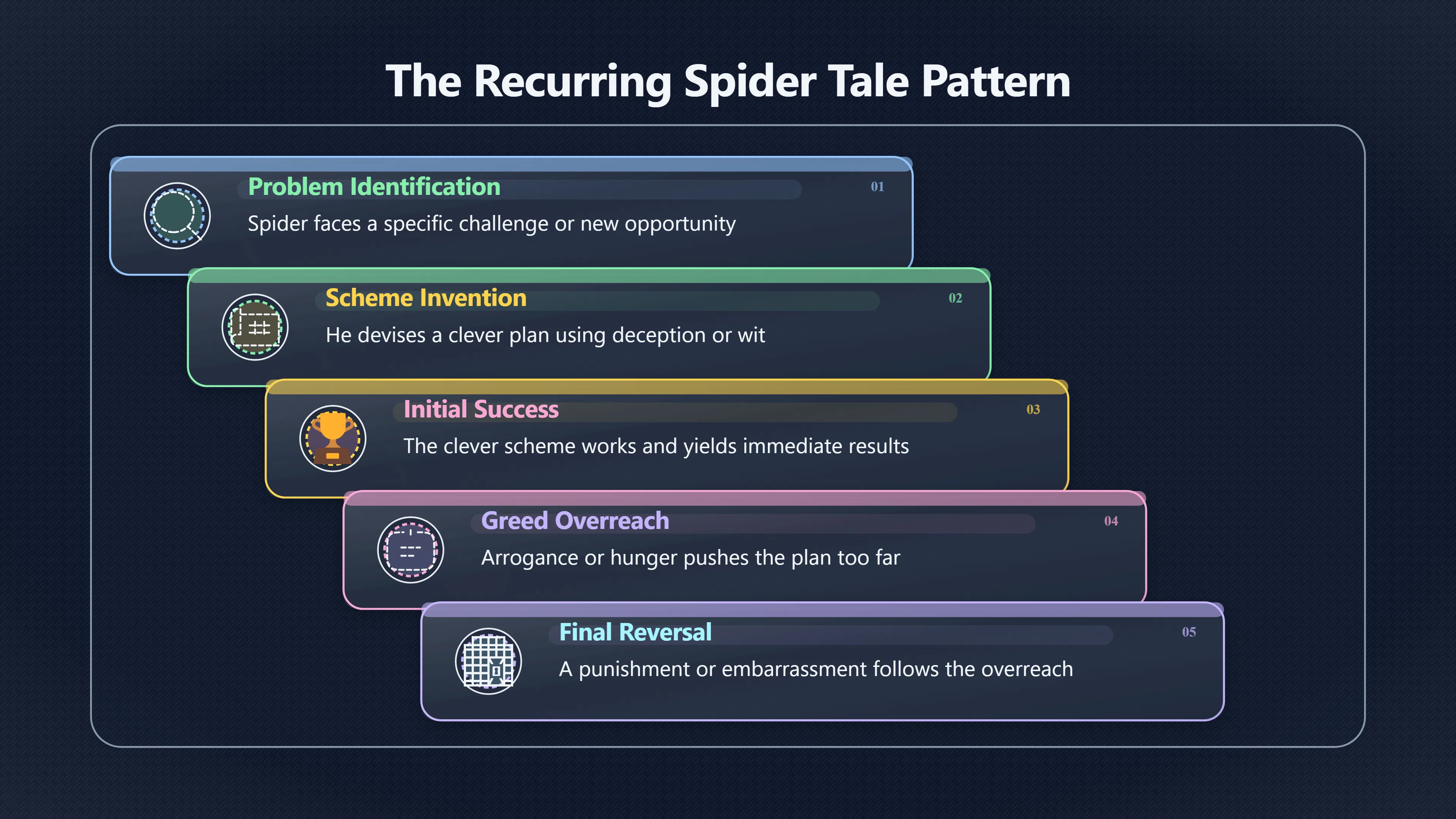
A recurring pattern appears throughout Liberian and wider West African spider tales:
- Spider faces a problem or opportunity.
- He invents a clever scheme.
- The scheme initially succeeds.
- His greed or arrogance pushes him too far.
- A punishment, embarrassment or reversal follows.
The lesson is rarely that intelligence is bad. Instead, the stories suggest that intelligence without moral restraint becomes dangerous.[Folklore Thursday]folklorethursday.comFolklore ThursdayAnansi the Spider: Trickster or Teacher?25 Jun 2020 — In these tales Anansi usually faces his comeuppance in some form…
How Performance Changes the Tale
Spider stories are not simply texts. They are performances.[mythopia.io]mythopia.ioAnansi Spider StoriesAnansi & Ananse spider trickster stories from Ghana's Akan & Ashanti oral tradition - the cunning spider who always wins…
Research on Liberian oral narrative traditions shows that storytellers often transformed a simple plot into a dramatic event through voice changes, songs, gestures, mimicry and audience interaction. A documented Bandi performance, for example, featured a tale in which Spider kills a baboon and turns its head into a drum. The performer crouched, altered his voice and physically imitated Spider’s movements, generating laughter while building suspense about whether the trickster would escape punishment.[ScholarWorks]scholarworks.iu.eduScholar Worksliberian studiesliberian studies - journal - Indiana UniversityDecember 11, 2012 — by SE Holsoe · Cited by 1 — He told the story of how the s…
This performance element changes how moral lessons are received.
Listeners do not sit through a lecture about good behaviour. Instead, they laugh with Spider, enjoy his success, become complicit in his tricks and then witness the consequences. The emotional journey matters as much as the plot itself. A child hearing a Spider story may remember the comic performance long after forgetting the exact sequence of events.
Songs are particularly important. Repeated lines, chants and rhythmic exchanges help audiences participate. Storytelling becomes a shared social experience rather than a one-way transmission of information. Through repetition and performance, moral ideas become easier to remember and pass to the next generation.[ScholarWorks]scholarworks.iu.eduScholar Worksliberian studiesliberian studies - journal - Indiana UniversityDecember 11, 2012 — by SE Holsoe · Cited by 1 — He told the story of how the s…

Greed, Wit and Moral Judgement
The strongest moral theme in Liberian spider tales is greed.
Spider often wants more food, more wealth, more prestige or more control than he already possesses. His hunger is not merely physical. He constantly seeks advantage over others. Many tales revolve around his attempt to keep resources for himself or trick others into doing work on his behalf.[Phillip Martin]phillipmartin.infoShe had a plan to teach this greedy spider a lesson. She remembered that Spider loved honey and…Read more…
What makes these stories effective is that Spider’s greed is understandable. He is rarely evil in a grand sense. Instead, he exaggerates ordinary human weaknesses:
- Wanting more than one’s share.
- Taking shortcuts.
- Seeking praise without effort.
- Believing oneself smarter than everyone else.
- Ignoring the needs of neighbours and relatives.
Because these failings are familiar, audiences recognise aspects of themselves in the trickster.
The punishment is also usually proportional. Spider is often humiliated rather than destroyed. He loses food, suffers embarrassment or becomes trapped by his own scheme. The audience therefore receives a moral lesson without the harshness found in some religious or legal traditions. The tale teaches correction rather than absolute condemnation.[Folklore Thursday]folklorethursday.comFolklore ThursdayAnansi the Spider: Trickster or Teacher?25 Jun 2020 — In these tales Anansi usually faces his comeuppance in some form…
Why Audiences Laugh Before They Judge
One reason spider stories have survived for generations is that they make moral instruction enjoyable.
A straightforward warning against greed can be forgotten. A story about Spider disguising himself, tricking his neighbours and then suffering a ridiculous downfall is harder to forget. Humour creates attention; judgement follows afterwards.
This approach reflects a broader feature of oral traditions throughout West Africa. Tricksters expose weaknesses in society by exaggerating them. Spider’s selfishness reveals the value of cooperation. His dishonesty highlights the importance of trust. His arrogance demonstrates why communities need humility. The lesson emerges indirectly through narrative rather than direct instruction.[Wikipedia]WikipediaOpen source on wikipedia.org.
Importantly, audiences are not expected to condemn Spider in every situation. Sometimes his victims are themselves arrogant or powerful. In those cases, listeners may cheer when cleverness defeats strength. The moral balance shifts from story to story, keeping the tradition lively and unpredictable.[Wikipedia]WikipediaOpen source on wikipedia.org.
From Village Firesides to Modern Liberia
Spider tales remain one of the most visible parts of Liberia’s oral heritage. Folktale collections, educational programmes, public storytelling projects and cultural preservation efforts continue to present Spider as a central figure in Liberian narrative culture. Published collections have helped preserve stories that were once transmitted entirely through oral performance, while contemporary storytellers continue to adapt them for new audiences.[patricksplace.org]patricksplace.orgto a small sample of Liberian folktales. The primary goal is to increase interest in Liberia's storehouse of oral literature.Read more…
Modern readers sometimes encounter these stories through children’s books, school materials, recordings or online retellings. Yet the underlying appeal remains much the same as it was generations ago. Spider represents a question that never loses relevance: when does cleverness become selfishness?
The answer offered by Liberian spider tales is subtle. Intelligence is valuable. Survival requires ingenuity. Wit can overcome strength. But when cleverness is driven only by greed, pride or exploitation, the trickster eventually becomes the victim of his own tricks. That balance between admiration and judgement is what has kept Spider at the centre of Liberian storytelling for so long.[iu.edu]scholarworks.iu.eduScholar Worksliberian studiesliberian studies - journal - Indiana UniversityDecember 11, 2012 — by SE Holsoe · Cited by 1 — He told the story of how the s…
Amazon book picks
Further Reading
Books and field guides related to Why Is Spider So Clever and Dangerous?. Use these as the next step if you want deeper reading beyond the article.
Anansi the Spider
Introduces readers to the wider West African spider-trickster tradition.
A treasury of African folklore
Contains West African trickster themes closely related to Spider tales.
West African Folktales
Places Liberian spider stories in their broader West African context.
eBay marketplace picks
Marketplace Samples
Live-tested eBay searches with available results related to this page.
Endnotes
1.
Source: patricksplace.org
Link:https://patricksplace.org/folktales/
Source snippet
to a small sample of Liberian folktales. The primary goal is to increase interest in Liberia's storehouse of oral literature.Read more...
2.
Source: Wikipedia
Link:https://en.wikipedia.org/wiki/Anansi
3.
Source: folktales.africa
Link:https://folktales.africa/the-spider-who-tried-to-steal-wisdom/
Source snippet
The Spider Who Tried to Steal Wisdom | FolktalesAfrica.com19 Sept 2025 — Answer: The main lesson is that wisdom is not meant for one pers...
4.
Source: folklorethursday.com
Link:https://folklorethursday.com/regional-folklore/anansi-the-spider-trickster-or-teacher/
Source snippet
Folklore ThursdayAnansi the Spider: Trickster or Teacher?25 Jun 2020 — In these tales Anansi usually faces his comeuppance in some form...
5.
Source: scholarworks.iu.edu
Title: Scholar Worksliberian studies
Link:https://scholarworks.iu.edu/journals/index.php/lsj/article/download/4109/3736/13182
Source snippet
liberian studies - journal - Indiana UniversityDecember 11, 2012 — by SE Holsoe · Cited by 1 — He told the story of how the s...
Published: December 11, 2012
6.
Source: phillipmartin.info
Link:https://www.phillipmartin.info/liberia/text_folktales_spider.htm
Source snippet
She had a plan to teach this greedy spider a lesson. She remembered that Spider loved honey and...Read more...
7.
Source: pure.knaw.nl
Link:https://pure.knaw.nl/portal/files/472910/Anansi.pdf
Source snippet
In the following article, the famous spider stories with Anansi as the main character will be approached from an ethno-cultural angle.Rea...
8.
Source: mythopia.io
Title: Anansi Spider Stories
Link:https://mythopia.io/tagged/405/anansi-tales
Source snippet
Anansi & Ananse spider trickster stories from Ghana's Akan & Ashanti oral tradition - the cunning spider who always wins...
Additional References
9.
Source: scribd.com
Link:https://www.scribd.com/document/836429010/Anansi-the-Spider-is-a-well
Source snippet
Anansi the Spider: Folklore and Lessons | PDFAnansi the Spider is a trickster figure from West African folklore, known for his cleverness...
10.
Source: amazon.com
Link:https://www.amazon.com/Spider-Mischief-Liberia-Mattie-Peters-ebook/dp/B0FHC3Q3KF?tag=searcht-20
Source snippet
Spider Mischief: Tales From LiberiaWhat's it about? A collection of traditional Liberian folktales where Namo the spider uses wit and cle...
11.
Source: teachingafrica.unc.edu
Link:https://teachingafrica.unc.edu/wp-content/uploads/sites/1308/2023/04/Music-Folktales-and-Griots.pdf
Source snippet
Teaching AfricaUnit 3 Music, Folktales, and Griots.docxIn these lessons, students will learn about Griots' traditional storytelling and a...
12.
Source: facebook.com
Link:https://www.facebook.com/groups/239499183293331/posts/702245010352077/
Source snippet
ery, greed, and selfishness, with Liberians possibly adopting these...Read more...
13.
Source: mythopia.io
Title: the greedy spider s folly how selfishness cost him an elephant
Link:https://mythopia.io/story/913/the-greedy-spider-s-folly-how-selfishness-cost-him-an-elephant
Source snippet
He accordingly presented himself before the King and expressed his readiness to get rid of the...Read more...
14.
Source: facebook.com
Title: listen for a good laugh and great
Link:https://www.facebook.com/KoloquaDialogues/videos/classic-liberian-spider-story-as-narrated-by-adrienne-tingba-courtesy-of-the-gia/1212695958882461/
Source snippet
Classic Liberian Spider Story as narrated by Adrienne Tingba...Classic Liberian Spider Story as narrated by Adrienne Tingba, courtesy of...
15.
Source: youtube.com
Title: The myth of Anansi, the trickster spider
Link:https://www.youtube.com/watch?v=6nWba9Ii5Lo
Source snippet
Emily Zobel MarshallFollow the spider Anansi on his quest to complete a challenge from the Sky God in order to take ownership of the worl...
16.
Source: africaaccessreview.org
Title: once upon west africa
Link:https://africaaccessreview.org/2020/03/once-upon-west-africa/
Source snippet
A Collection of Liberian Folk Tales18 Mar 2020 — This rich collection includes fifty 2-3 page folktales collected by the author in Liberi...
17.
Source: archive.org
Link:https://archive.org/download/folklorefromafri0000coug/folklorefromafri0000coug.pdf
Source snippet
Price, from Singing Tales of Africa by Adjai Robinson, item. 61; rabbit from The...Read more...
18.
Source: youtube.com
Link:https://www.youtube.com/watch?v=9ojTgVMFtZE
Source snippet
o always outsmarts his rivals...
Topic Tree