Within North Korean Folklore
Was Dangun Myth, Ancestor or State Evidence?
The Dangun story links Korea's first kingdom to sacred ancestry, while North Korea's tomb claims show how myth can become national evidence.
On this page
- The bear, tiger and heavenly descent
- Pyongyang in the founding myth
- The tomb claim and modern scepticism
Page outline Jump by section
Introduction
Was Dangun a mythical founder, a revered ancestor, or a figure who can be treated as historical evidence? In North Korea, that question lies at the heart of one of the most striking encounters between folklore and state identity. The Dangun story is Korea’s best-known foundation myth, explaining the origin of the first Korean kingdom through a tale of heavenly descent, animal transformation and sacred ancestry. Yet in the 1990s North Korea went further, announcing that it had discovered Dangun’s tomb near Pyongyang and presenting the site as proof of a 5,000-year-old national history. The result is a fascinating case in which an ancient legend became part of a modern argument about archaeology, nationhood and historical legitimacy.[aks.ac.kr]aks.ac.krKorea's Representative MythsThe myth of Dangun is the oldest form, and perhaps the best-known, of all the myths of Korea. Its content can…
Was Dangun Myth, Ancestor or State Evidence?
For many Koreans, Dangun occupies a space between legend and symbolic ancestry. He is not simply a character in a folktale. He represents the traditional beginning of Korean civilisation and serves as a shared cultural ancestor in stories about national origins. The earliest surviving written version of the tale appears in the thirteenth-century Samguk Yusa, a collection of legends and historical traditions compiled by the monk Il-yeon, although the story itself is believed to be much older.[wikipedia.org]WikipediaSamguk yusaSamguk yusa
The importance of Dangun extends beyond questions of historical accuracy. Foundation myths often explain who a people believe themselves to be rather than providing a modern historical record. In Korea, the Dangun narrative became a powerful symbol of unity, continuity and distinct identity. Scholars have noted that the legend gained increasing national significance during periods when Korean intellectuals sought to emphasise a distinct Korean heritage.[Wikipedia]WikipediaKorean mythologyKorean mythology
In North Korea, however, Dangun was eventually presented not only as a legendary ancestor but as a historical ruler whose physical remains could be identified and displayed. That shift transformed a traditional myth into a form of state-sponsored evidence.[Reuters]reuters.comNorth Korea's box of bones: A mythical king and the dream…20 Oct 2018 — In the mid-1990s, North Korean authorities announced th…
The Bear, Tiger and Heavenly Descent
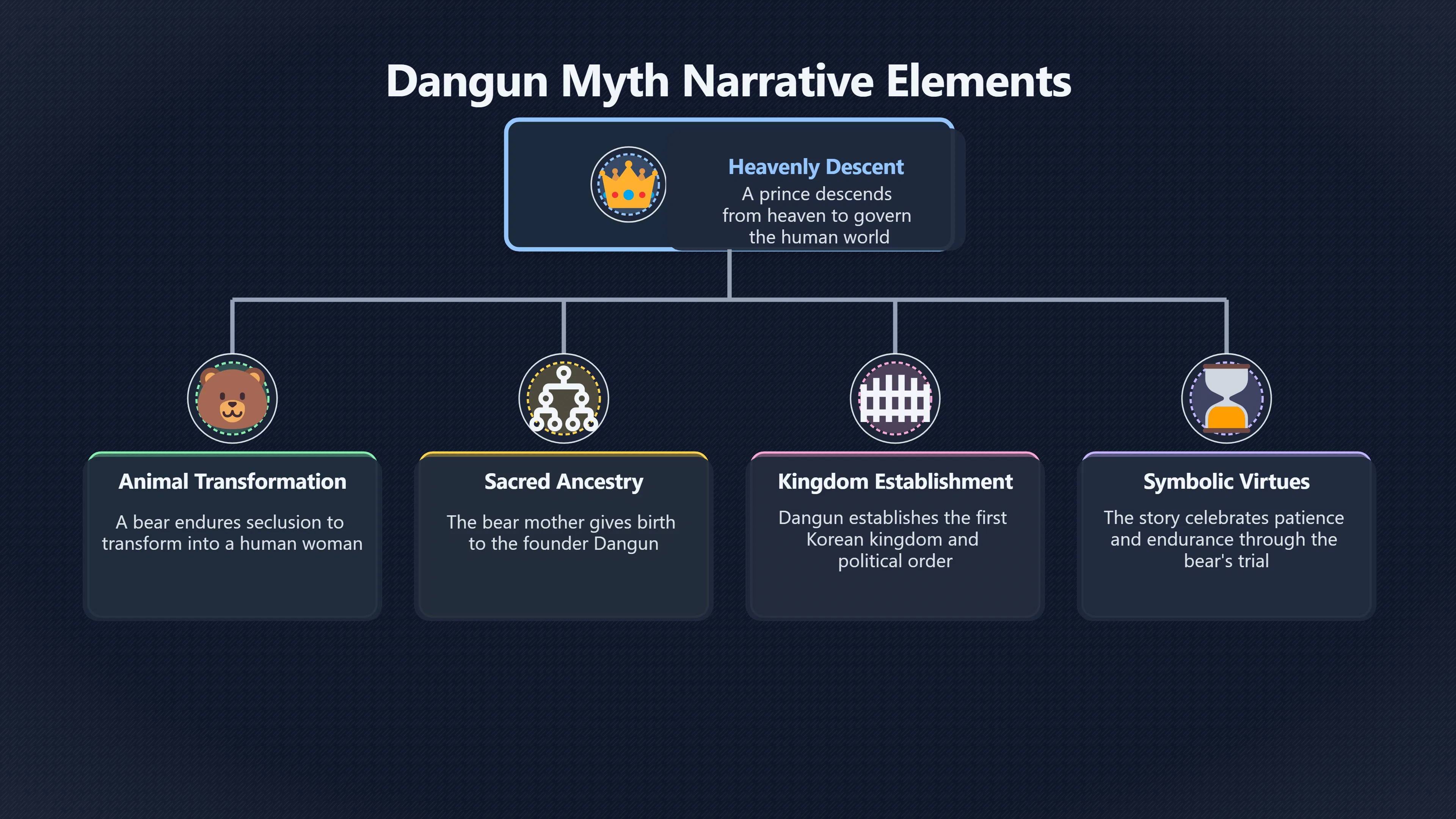
The most memorable part of the Dangun story begins in heaven. According to the traditional narrative, a heavenly prince descended to earth with thousands of followers to govern the human world. A bear and a tiger then approached him and asked to become human. The heavenly ruler instructed them to endure a period of seclusion while eating only mugwort and garlic. The tiger abandoned the trial, but the bear persevered and was transformed into a woman. She later became the mother of Dangun, who founded the first Korean kingdom.[aks.ac.kr]aks.ac.krKorea's Representative MythsThe myth of Dangun is the oldest form, and perhaps the best-known, of all the myths of Korea. Its content can…
For folklore scholars, the bear and tiger are among the most intriguing elements of the myth. Some interpret them as traces of ancient clan symbols or totemic traditions rather than literal animals. Others see the story as a symbolic account of different groups being absorbed into a new political community. While interpretations vary, the tale clearly combines supernatural transformation, sacred ancestry and the establishment of political order—features common in foundation myths around the world.[Wikipedia]WikipediaKorean mythologyKorean mythology
The bear’s success is particularly significant. Korean writers and folklorists have often pointed to the animal’s patience and endurance as virtues celebrated by the story. Whether or not such readings reflect the original meaning, they show how the myth continues to be reinterpreted by later generations.[Seoul National University]en.snu.ac.krDangun, who later founded the ancient kingdom of Korea. It is a mystery why our ancestors chose a bear over a tiger as their national sym…
Why Pyongyang Matters in the Founding Story
Pyongyang occupies a special place within the Dangun tradition because many versions of the legend associate the city with the founding of the first Korean state. In the Samguk Yusa account, Dangun establishes his kingdom at the site of Pyongyang before later moving elsewhere. This connection allows the city to be portrayed not merely as an ancient settlement but as the symbolic birthplace of Korean civilisation itself.[Wikipedia]WikipediaKorean mythologyKorean mythology
For North Korea, this detail carries enormous cultural and political weight. If Pyongyang can be presented as the location where Korea’s foundational ruler established his kingdom, then the city becomes more than a modern capital. It becomes the cradle of the nation. The association fits comfortably within North Korean presentations of Pyongyang as a city of exceptional historical depth and national significance.[Reuters]reuters.comNorth Korea's box of bones: A mythical king and the dream…20 Oct 2018 — In the mid-1990s, North Korean authorities announced th…
From a folklore perspective, this illustrates how sacred geography works. Myths are often attached to real landscapes, giving places special meaning beyond their archaeological record. The power of Pyongyang in the Dangun story comes not only from history but from narrative memory—the belief that important beginnings happened there.[aks.ac.kr]aks.ac.krKorea's Representative MythsThe myth of Dangun is the oldest form, and perhaps the best-known, of all the myths of Korea. Its content can…
The Tomb Claim and Modern Scepticism
In 1993 North Korean authorities announced that archaeologists had discovered the tomb of Dangun and his wife in Kangdong County, near Pyongyang. The following year a large reconstructed mausoleum was opened. The site features a monumental stone structure and has been promoted as the burial place of the legendary founder. North Korean accounts presented the discovery as confirmation that Dangun was a real historical ruler rather than a mythical figure.[Reuters]reuters.comNorth Korea's box of bones: A mythical king and the dream…20 Oct 2018 — In the mid-1990s, North Korean authorities announced th…
The claim attracted international attention because it appeared to transform a legendary narrative into archaeological fact. North Korean statements linked the discovery to the idea that Korea possesses a continuous history stretching back five millennia. The reconstructed tomb became both a tourist destination and a symbolic national monument.[Reuters]reuters.comNorth Korea's box of bones: A mythical king and the dream…20 Oct 2018 — In the mid-1990s, North Korean authorities announced th…
Outside North Korea, however, historians and archaeologists have generally remained unconvinced. Critics note that Dangun first appears in surviving written sources many centuries after the period in which he is said to have lived. Independent verification of the excavation and dating evidence has been extremely limited. As a result, most scholars continue to treat Dangun as a legendary founder rather than a historically demonstrated individual.[reuters.com]reuters.comNorth Korea's box of bones: A mythical king and the dream…20 Oct 2018 — In the mid-1990s, North Korean authorities announced th…
This does not mean the tomb is unimportant. Even sceptical observers recognise its cultural significance. The mausoleum demonstrates how nations sometimes use myths to express identity, continuity and collective memory. The debate is therefore not only about archaeology; it is also about the role that origin stories play in shaping modern understandings of the past.[Reuters]reuters.comNorth Korea's box of bones: A mythical king and the dream…20 Oct 2018 — In the mid-1990s, North Korean authorities announced th…

Why the Dangun Debate Endures
The continuing fascination of Dangun lies in the way the story operates on several levels at once. It is a traditional myth featuring heavenly beings, sacred animals and supernatural transformation. It is also a national origin narrative that many Koreans regard as a symbol of shared ancestry. Finally, in North Korea, it became part of a state effort to anchor modern identity in a very ancient past.[aks.ac.kr]aks.ac.krKorea's Representative MythsThe myth of Dangun is the oldest form, and perhaps the best-known, of all the myths of Korea. Its content can…
For readers interested in folklore, the most revealing lesson is that myths do not remain frozen in ancient texts. They continue to acquire new meanings. The Dangun legend began as a sacred story about origins, became a symbol of Korean nationhood, and was later invoked in debates over archaeology and historical evidence. Pyongyang’s claimed connection to Dangun shows how a legendary landscape can become central to modern political and cultural narratives long after the original tale was first told.[reuters.com]reuters.comNorth Korea's box of bones: A mythical king and the dream…20 Oct 2018 — In the mid-1990s, North Korean authorities announced th…
Amazon book picks
Further Reading
Books and field guides related to Was Dangun Myth, Ancestor or State Evidence?. Use these as the next step if you want deeper reading beyond the article.
The Cleanest Race
Helps readers understand how national myths can be repurposed by modern states.

Korea : The Impossible Country : South Korea's Amazing Rise f...
First published 2018. Subjects: Economic development, Korea, civilization, Civilization.
eBay marketplace picks
Marketplace Samples
Live-tested eBay searches with available results related to this page.
Endnotes
1.
Source: aks.ac.kr
Link:https://www.aks.ac.kr/cefia/webzine/2206/focus_eng.html
Source snippet
Korea's Representative MythsThe myth of Dangun is the oldest form, and perhaps the best-known, of all the myths of Korea. Its content can...
2.
Source: reuters.com
Link:https://www.reuters.com/article/world/north-koreas-box-of-bones-a-mythical-king-and-the-dream-of-korean-unification-idUSKCN1MV020/
Source snippet
North Korea's box of bones: A mythical king and the dream...20 Oct 2018 — In the mid-1990s, North Korean authorities announced th...
3.
Source: folkency.nfm.go.kr
Title: Myth of Dangun
Link:https://folkency.nfm.go.kr/en/topic/detail/5336
Source snippet
한국민속대백과사전“Dangunsinhwa ”is the first sovereignty myth in Korean mythology, which tells the story of the founding of Korea's first kingdom...
4.
Source: Wikipedia
Title: Samguk yusa
Link:https://en.wikipedia.org/wiki/Samguk_yusa
5.
Source: Wikipedia
Link:https://en.wikipedia.org/wiki/Tan%27gun
Source snippet
Tan'gunThe earliest recorded version of the Tan'gun legend appears in the 13th-century Samguk yusa, which purportedly cites Korea's lo...
6.
Source: Wikipedia
Title: Korean mythology
Link:https://en.wikipedia.org/wiki/Korean_mythology
7.
Source: korea.net
Link:https://www.korea.net/NewsFocus/Culture/view?articleId=121092
Source snippet
Dangun, Father of Korea: Korea's foundation tale lends...Aug 14, 2014 — The Dangun story begins with Hwanung, son of Hwanin, a god who l...
8.
Source: worldhistory.org
Title: Samguk Yusa
Link:https://www.worldhistory.org/Samguk_Yusa/
Source snippet
World History EncyclopediaSamguk YusaOct 26, 2016 — The Samguk yusa is an important source for two foundation myths. There is the story o...
9.
Source: en.snu.ac.kr
Link:https://en.snu.ac.kr/snunow/snu_media/news?bbsidx=71897&md=v
Source snippet
Dangun, who later founded the ancient kingdom of Korea. It is a mystery why our ancestors chose a bear over a tiger as their national sym...
10.
Source: facebook.com
Link:https://www.facebook.com/groups/119396741908738/posts/342303502951393/
11.
Source: figuresofkorea.wordpress.com
Link:https://figuresofkorea.wordpress.com/tag/dangun/
Source snippet
Figures of Korean History - WordPress.com5 Jan 2014 — Dangun is a foundation myth that gives the people of Korea a national identity, a...
Additional References
12.
Source: journals.sagepub.com
Link:https://journals.sagepub.com/doi/10.1177/0309089217734731
Source snippet
Sage JournalsA perspective from ancient Korean historyAn important role in instilling the sense of unity among Koreans is played by a sha...
13.
Source: afe.easia.columbia.edu
Link:https://afe.easia.columbia.edu/ps/korea/tangun.pdf
Source snippet
Tangun legend tells of the birth of Korea's first king and the foundation of the first Korean state, (Old) Chosŏn, in a date often calcul...
14.
Source: facebook.com
Link:https://www.facebook.com/groups/290129349137313/posts/1093184565498450/
15.
Source: newworldencyclopedia.org
Link:https://www.newworldencyclopedia.org/entry/Samguk_Yusa
Source snippet
Samguk YusaSamguk Yusa contains the earliest documentary version of the legend of Tan' gun, who is said to have founded Korea about four...
16.
Source: downloads.cs.stanford.edu
Title: eduthan born became states including american
Link:https://downloads.cs.stanford.edu/nlp/data/jiwei/data/vocab_wiki.txt
Source snippet
1993 navy christian active standard decided italian put star los governor senior come traditional airport buildings interest real means p...
17.
Source: kstory.storymama.kr
Title: kr The Story of Dangun Theme: Patience. Story
Link:https://kstory.storymama.kr/stories/49?locale=en
Source snippet
Story of DangunTheme: Patience. Story Introduction: Do you know the roots of South Korea? Let's find out how Dangun, the descendant of he...
18.
Source: youtube.com
Title: Was the capital of Gojoseon not Pyongyang? Shocking archaeological evidence
Link:https://www.youtube.com/watch?v=pcj_ryO3ek8
Source snippet
The Conspiracy of the Noron Vested Interests Hidden in the Byeongin Incident and Imperial Japan's...
19.
Source: koreatimes.co.kr
Title: 61st korea in the beginning
Link:https://www.koreatimes.co.kr/southkorea/society/20111101/61st-korea-in-the-beginning
Source snippet
[61ST] Korea: in the beginning …Nov 1, 2011 — King Dangun founded Korea's first kingdom called Gojoseon and governed the country, which c...
20.
Source: pclar09.wordpress.com
Title: the myth of dangun wanggeom
Link:https://pclar09.wordpress.com/2012/10/07/the-myth-of-dangun-wanggeom/
Source snippet
From AfarOct 7, 2012 — The myth states that Dangun ruled for 1500 years before he moved to Changtang-kyong for a time. He returned to Asa...
21.
Source: cosmundus.com
Title: dangun founding of korea
Link:https://www.cosmundus.com/en/dangun-founding-of-korea/
Source snippet
Dangun and the story of the mythical founding of Korea2 Oct 2023 — According to Korean tradition, Dangun was the mythical founder of Gojo...
Topic Tree