Which Stories Haunt Papua New Guinea?
Papua New Guinea is not a country with one neat mythology. It is a country of many story-worlds: coastal trading legends, Highlands spirit beliefs, Sepik river cults, Papuan Gulf masks, Trobriand folktales, ancestor traditions, sorcery fears, Christian reinterpretations, festival performances and modern museum debates.
Page outline Jump by section
Introduction
For a folklore reader, the most useful way in is not to ask, “What is the myth of Papua New Guinea?” but “Which community, landscape and occasion does this story belong to?” A tale from the Trobriand Islands, a Motu account of the hiri trading voyage, a Sepik crocodile initiation story and a Highlands account of dangerous bush spirits may all be Papua New Guinean, but they come from different social worlds. The common thread is that stories are not just entertainment. They explain land, kinship, danger, exchange, moral conduct, ritual authority and the changing relationship between old custom and modern life.
Why Papua New Guinea’s folklore is so varied
Papua New Guinea’s folklore is inseparable from its extreme cultural and linguistic diversity. The Papua New Guinea embassy’s cultural profile stresses that there is “no such thing as a typical Papua New Guinean” and identifies hundreds of cultures with different traditions.[pngembassy.org]pngembassy.orgOpen source on pngembassy.org. Ethnologue’s country profile lists 840 living Indigenous languages, while Papua New Guinea’s tourism authority also describes the country as the world’s most linguistically diverse.[Ethnologue]ethnologue.comOpen source on ethnologue.com.
That matters because oral tradition is usually local. A story may belong to a clan, a village, a trade route, a river bend, a mountain, a men’s house, a garden place, a funeral context or a language community. In many cases, the same broad theme — an origin ancestor, a dangerous spirit, a magic object, a journey, a trickster, a taboo broken — appears in different forms from place to place. The result is not a single national pantheon, but a mosaic.
This also explains why careful sources avoid treating Papua New Guinea’s legends as if they were a single fixed book of myths. A 2005 Divine Word University paper on language research describes Papua New Guinea’s languages as carriers of cultural identity and “a vision of the world”, while noting that many are rooted in oral tradition.[dwu.ac.pg]dwu.ac.pgOpen source on dwu.ac.pg. In folklore terms, every language community can preserve its own map of remembered places, named ancestors, spirit beings, social rules and explanations of why the world is as it is.
Oral storytelling: memory, entertainment and local authority
Oral stories in Papua New Guinea often do several jobs at once. They may amuse, warn, explain a landscape, preserve a genealogy, mark a boundary, teach behaviour or connect a present community to a founding event. This is why a “folktale” can be more than a children’s story. It may carry claims about land, marriage, trading rights, ritual power or the origin of a community.
One of the strongest examples is the Trobriand Islands. The Smithsonian’s 2021 volume Trobriand Tales presents 79 traditional narratives selected with community involvement from material collected by anthropologist Jerry W. Leach in 1970. The Smithsonian describes the narratives as “an elaborate but fragile system of knowledge” threatened by rapid social change.[scholarlypress.si.edu]scholarlypress.si.eduOpen source on si.edu. A related catalogue record notes that the Leach papers and sound recordings came from his period at the University of Papua New Guinea, when he studied folklore and culture change in the Trobriands.[sirismm.si.edu]sirismm.si.eduGuide to the Jerry W. Leach Trobriand Papers and SoundGuide to the Jerry W. Leach Trobriand Papers and Sound
The Trobriand case shows two important things. First, Papua New Guinean folklore is well-attested in archives, field recordings and scholarly editions, not only in tourist summaries. Second, preservation is not neutral: modern editors and communities must decide which stories may be shared, how they should be translated and what should remain within local knowledge systems.
A broader printed example is Thomas H. Slone’s two-volume One Thousand One Papua New Guinean Nights, a collection of 1,047 folktales originally published in Tok Pisin in Wantok newspaper between 1972 and 1997.[Google Books]books.google.ttOpen source on google.tt. That collection is especially useful because it captures stories circulating in a national newspaper context, where local oral material moved into a modern print medium.
Spirits of place: rivers, trees, caves and dangerous ground
One of the most widely discussed spirit concepts in Papua New Guinea is the idea of place-linked beings often described in Tok Pisin as masalai. The details vary sharply by region, and the word should not be treated as a single creature with one fixed appearance. Sources describe these beings as spirits associated with particular places such as water holes, rivers, waterfalls, caves, marshes, trees or forested areas.[NomadIT]nomadit.co.ukOpen source on nomadit.co.uk.
For a reader used to European “fairies” or “land spirits”, the nearest comparison is not exact but helpful: these are often beings of place, danger and boundary. They are not simply “ghosts”, nor are they always gods. They may be linked to kinship, local territory, fear, illness, sexual danger, hunting places or the strange feeling that a particular landscape is socially alive.
Anthropologist Shirley Lindenbaum’s work on the Fore of the Eastern Highlands traces how stories of bush-spirit sightings changed over time, showing that such narratives are not frozen survivals. They respond to new social circumstances, memories and anxieties.[Chicago Journals]journals.uchicago.eduOpen source on uchicago.edu. This is a key point for understanding Papua New Guinean folklore today: a spirit tradition can be old in its roots while still changing in its telling.
The same applies to stories represented in art. A study of East Sepik storyboards describes a narrative in which a fisherman is stopped from fishing by a river spirit portrayed as half-woman and half-snake.[Národní muzeum]publikace.nm.czOpen source on nm.cz. That kind of image makes a folklore idea visible: rivers and forests are not just scenery but inhabited moral spaces.
Sepik crocodiles, spirit houses and initiation
The Sepik River region is one of the most famous Papua New Guinean folklore landscapes internationally, partly because its ritual art and architecture have long attracted museums, collectors and travellers. The National Gallery of Australia’s exhibition page on Sepik “Myth and Magic” describes the region’s distinctive cultures, while museum and journal sources document spirit houses, carvings and crocodile imagery as central to ritual life.[nga.gov.au]nga.gov.auOpen source on nga.gov.au.
Crocodile symbolism is especially prominent in parts of the Sepik. Research on Karawari carved crocodiles explains that long wooden crocodile spirit-beings were kept in men’s houses and were involved in initiation, hunting, warfare and other collective activities.[OpenEdition Journals]journals.openedition.orgOpen source on openedition.org. These carvings were not merely decorative “tribal art”. In their original setting, they were part of a ritual world in which carved forms, ancestors, men’s houses and social authority were connected.
The well-known “crocodile men” scarification tradition is often presented in travel writing as spectacle, but its meaning is deeper than appearance. Accounts of Sepik initiation describe the cutting of the skin to create raised scars associated with crocodile skin, symbolising rebirth, strength and separation from childhood.[Condé Nast Traveller India]cntraveller.inOpen source on cntraveller.in. A careful webpage should treat this as a living cultural and ritual practice where communities permit it to be shown, not as a monster costume or exotic performance.
Spirit houses also matter because they show how folklore can be architectural. These buildings are places where stories, carvings, ritual knowledge and male authority are concentrated. Some sources describe them as ceremonial centres for discussion, initiation and art-making.[ramdasiyerphotography.com]ramdasiyerphotography.comOpen source on ramdasiyerphotography.com. In many Sepik contexts, the supernatural is not separate from politics, age, gender and clan life.
The hiri voyage: trade, myth and the sea
Papua New Guinea’s southern coast offers a different kind of legendary world: the hiri trading voyages of the Motu people. Historically, Motu communities made clay pots and sailed large multi-hulled canoes westwards to exchange them for sago and other goods from the Gulf of Papua. A detailed archaeological and ethnographic study of the hiri network stresses that oral traditions are important for understanding exchange, agency and social relationships along the south coast.[Research Management Monash]researchmgt.monash.eduResearch Management Monash Oral traditions and archaeologyResearch Management Monash Oral traditions and archaeology
The hiri is also remembered through origin stories. One commonly retold account centres on Edai Siabo of Boera, who is instructed by a sea spirit to build a great trading canoe and sail west with pots.[Wikipedia]WikipediaHiri trade cycleHiri trade cycle The story gives a mythic frame to a real economic and maritime system: trade becomes not just a practical journey but a spirit-authorised undertaking involving courage, waiting, danger and ritual discipline.
Modern scholarship is cautious about using such stories as simple historical dates. Research on Motu ceramics and hiri trade notes that oral histories relating to hiri may preserve important memory while also having limits for dating the trade’s origins.[ResearchGate]researchgate.netResearch Gate(PDF) Historicizing Motu Ceramics and the Hiri TradeResearch Gate(PDF) Historicizing Motu Ceramics and the Hiri Trade That tension is part of what makes the hiri so interesting. It is not “just myth” and not “just history”. It is a case where story, trade, archaeology and identity overlap.
Culture heroes and origin journeys
Across parts of southern Papua New Guinea, stories of wandering heroes explain how people, customs and places came to be. Anthropologist Mark Busse’s work on southern lowland New Guinea discusses “wandering hero stories” in which culture heroes give people physical form and cultural practices. He argues that these stories should be taken seriously as local ways of comparing cultures and explaining historical connections.[ResearchGate]researchgate.netResearch Gate Wandering Hero Stories in the Southern Lowlands of NewResearch Gate Wandering Hero Stories in the Southern Lowlands of New
One major example is Sido, a culture hero in Kiwai-speaking traditions of the Fly River and neighbouring regions. A study of Papua New Guinea’s Fly estuary describes the Sido story as the principal origin myth of Kiwai-speaking people and notes that Sido’s journeys link movements along the southwestern coast of Papua.[ANU Press]press-files.anu.edu.auANU Press PAPUA NEW GUINEA FLY ESTUARY ^ ^ANU Press PAPUA NEW GUINEA FLY ESTUARY ^ ^ More recent archaeological work on Walufeni Cave also refers to Sido or Souw traditions as evidence of socio-cultural connections across Torres Strait, the southern coast of Papua New Guinea and nearby regions.[James Cook University Research Online]researchonline.jcu.edu.auOpen source on edu.au.
For folklore readers, this is a useful reminder that a “hero” in Papua New Guinea is not necessarily a warrior in the modern fantasy sense. A culture hero may be a traveller, transformer, ancestor, founder or law-giver whose movement across the landscape explains why communities are related yet different.
Masks, spirit boards and beings made visible
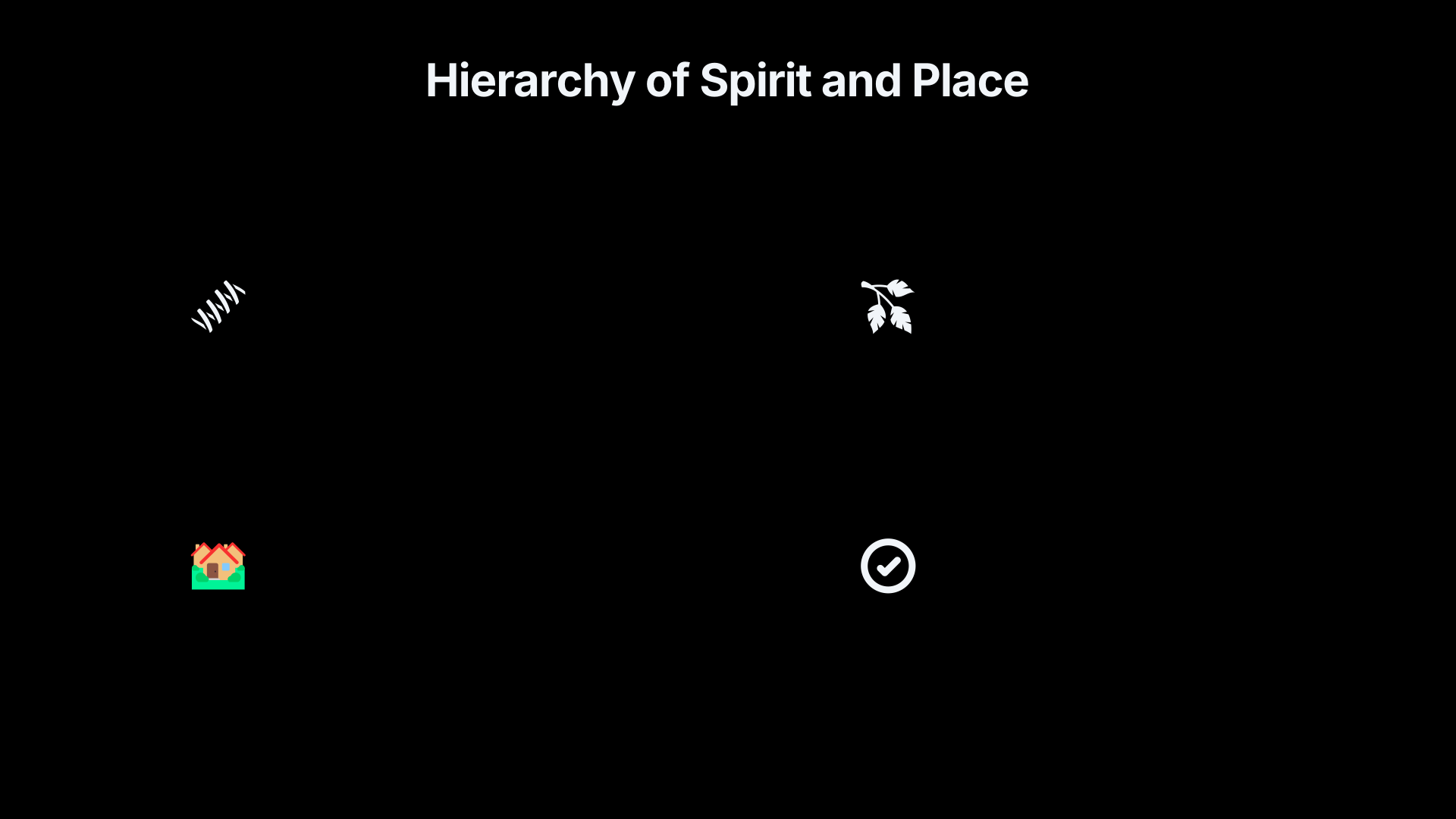
Many Papua New Guinean traditions are not preserved only in words. They are made visible in masks, boards, carvings, headdresses, drums, figures and decorated houses. Museums outside Papua New Guinea hold large collections of such material, but those objects can be misunderstood when removed from performance and ritual context.
The Papuan Gulf is especially important for spirit boards and masks. The Metropolitan Museum of Art describes Papuan Gulf masks, figures and ancestor or spirit boards as representations of spirits used to coax supernatural beings into attending to human needs.[The Metropolitan Museum of Art]metmuseum.orgOpen source on metmuseum.org. The Saint Louis Art Museum’s 2026 display of Papua New Guinea art describes masks used in celebrations honouring water spirits, including smaller masks that followed the appearance of larger, more dangerous water-spirit forms.[Slam]slam.orgArt from Papua New Guinea spotlighted for country'sArt from Papua New Guinea spotlighted for country's
Te Papa in New Zealand likewise notes that its Papua New Guinea collection includes tapa dance masks worn during ceremonial rituals in the early twentieth century.[tepapa.govt.nz]tepapa.govt.nzOpen source on govt.nz. These examples show why “mask” is too small a word if it suggests disguise only. In many Papua New Guinean contexts, a mask can be a temporary body for a spirit, a sign of ancestral presence, a performance technology, a social marker and a visual story.
The same is true of Sepik and Gulf objects now held in museums. The National Museum and Art Gallery in Port Moresby is described by the National Capital District Commission as a repository for cultural heritage, with objects from across the country’s many cultures.[ncdc.gov.pg]ncdc.gov.pgOpen source on ncdc.gov.pg. The Australian High Commission’s page on the 2015 Built on Culture exhibition says the National Museum’s wider collection held more than 80,000 objects, with the exhibition featuring headdresses, masks and ceremonial objects connected to village performance.[png.embassy.gov.au]png.embassy.gov.auOpen source on embassy.gov.au.
Sorcery beliefs: folklore, fear and real-world harm
No honest account of Papua New Guinea’s supernatural traditions can ignore sorcery accusation-related violence. Beliefs about sorcery, witchcraft, spirits and invisible causes of illness or death are part of the country’s broader belief culture, but accusations can lead to serious harm. The distinction is crucial: describing a belief tradition does not excuse violence carried out in its name.
Medical and anthropological sources have long noted that, for some communities in remote parts of Papua New Guinea, illness and injury may be explained through spirits, ghosts or sorcerers.[PubMed]pubmed.ncbi.nlm.nih.govOpen source on nih.gov. Papua New Guinea’s National Research Institute has published multiple papers on sorcery accusation-related violence, including work based on 198 incidents in Enga Province and studies of how accusations are catalysed by diviners or investigators sometimes called glasman or glasmeri.[pngnri.org]pngnri.orgSORCER Y ACCUSATION- RELATED VIOLENCE IN ENGASORCER Y ACCUSATION- RELATED VIOLENCE IN ENGA
This is folklore with consequences. A 2024 National Research Institute paper discusses the difficulty of addressing such cases in village courts, while earlier policy material links sorcery-related violence to poor understanding of natural causes of illness and death.[pngnri.org]pngnri.orgOpen source on pngnri.org. Journalism has also documented the human toll, including attacks on women and children accused of sorcery.[TIME]qa.time.comHow a 7-Year-Old Girl Survived Papua New Guinea's Crucible of SorceryShe was finally rescued by the Papua New Guinea Tribal Foundation and is now cared for by Ruth J. Kissam, the organization's director of…
For readers, the key is to avoid two mistakes. One mistake is to sensationalise Papua New Guinea as if belief in sorcery were a lurid curiosity. The other is to flatten all supernatural tradition into violence. Many spirit beliefs, ritual practices and oral stories are about identity, morality, land and memory. Sorcery accusation-related violence is a specific and urgent social problem within that wider field.
Christianity and older traditions now live side by side
Papua New Guinea is now overwhelmingly Christian, but Christianity has not simply erased older traditions. The Department of Foreign Affairs states that the majority of people are at least nominally Christian, with Protestant, Catholic, Seventh-day Adventist and other communities present.[DFA | Department of Foreign Affairs]dfa.gov.pgOpen source on dfa.gov.pg. Georgetown’s Berkley Center similarly notes that more than 96 per cent of Papua New Guineans are Christian and that churches often reach places where state institutions have limited presence.[Berkley Center]berkleycenter.georgetown.eduOpen source on georgetown.edu.
Yet the relationship between Christianity and Indigenous traditions is complex. A 2023 Cambridge article describes Papua New Guinea as a place where Christianisation and older cultural and religious traditions continue to encounter one another.[Cambridge University Press & Assessment]cambridge.orgOpen source on cambridge.org. The older world may be rejected, reinterpreted, hidden, blended with Christian ideas or reworked in art.
Modern Papua New Guinean art makes this visible. A 2026 review of a National Gallery of Australia exhibition describes works by Michael Kauage in which Christian scenes are rendered through Papua New Guinean visual forms, including traditional dress, masks and ancestral references.[The Australian]theaustralian.com.auThe Australian National Gallery showcases Papua New Guinea's artistic journeyThe exhibition includes historical items such as early colonial carvings, ancestor figures, and the ancient Ambum Stone sculpture, believ… Such works are not folklore in the narrow sense of anonymous oral tradition, but they show how mythic and ancestral imagery continues to shape public imagination.
Festivals, tourism and the reinvention of tradition
Some Papua New Guinean traditions are now best known internationally through festivals and tourism. The Goroka Show, held each September in the Eastern Highlands, is promoted by Papua New Guinea’s tourism authority as a major cultural event during Independence Week.[Papua New Guinea]papuanewguinea.travelOpen source on papuanewguinea.travel. Travel sources describe it as a gathering where groups share songs, dances and ceremonial dress in a large public setting.[Responsible Travel]responsibletravel.comOpen source on responsibletravel.com.
This public festival setting can preserve, celebrate and transform tradition at the same time. A performance that once belonged to a local ritual context may become a national symbol, a tourist attraction or a staged identity marker. That does not automatically make it fake, but it changes how it works.
The Asaro Mudmen are the clearest example. Their clay masks and pale body covering are often explained through a legend in which people hiding in mud frightened enemies who mistook them for spirits.[mysite]visitnatives.commysite Exploring the Enigmatic Asaro Mudmen of Papua Newmysite Exploring the Enigmatic Asaro Mudmen of Papua New However, scholarship on the Asaro Mudmen stresses that the tradition has also developed through public culture, tourism and performance; Todd Otto’s study describes it as an internationally recognised symbol of Papua New Guinea.[scholarspace.manoa.hawaii.edu]scholarspace.manoa.hawaii.eduOpen source on hawaii.edu.
This is exactly the kind of tradition that needs careful wording. The Mudmen are not merely an “ancient tribe of ghosts”, as sensational travel copy sometimes implies. They are a local performance tradition with origin stories, community identity, modern staging and national visibility all layered together.

Museums, repatriation and the afterlife of sacred objects
Papua New Guinea’s folklore also lives uneasily in museums. Masks, skulls, spirit boards and carved figures collected during colonial and missionary periods often moved far from the communities that made them. Today, museums, governments and communities face difficult questions about return, display, storage and cultural authority.
The National Gallery of Australia reported in 2023 that 225 objects of Papua New Guinean heritage were returned as part of a long-term project with the National Museum and Art Gallery of Papua New Guinea.[nga.gov.au]nga.gov.auA return to Papua New GuineaA return to Papua New Guinea That kind of return can be straightforward when communities and institutions agree that objects should come home. But not every case is simple.
A 2025 report on Iatmul ritual skulls described a Dutch museum’s attempted return of decorated skulls collected by missionaries in the early twentieth century. Modern Iatmul communities reportedly rejected the return because the skulls might have belonged to enemies rather than ancestors and were therefore considered potentially dangerous.[The Times]thetimes.co.ukThe Times Papua New Guinea tribe rejects return of 'cursed' ritual skullsThe Times Papua New Guinea tribe rejects return of 'cursed' ritual skulls The case is a powerful warning against assuming that repatriation is always just a matter of sending objects back. Folklore, fear, memory and community consent all matter.
For a public reader, this changes how museum objects should be seen. A carved board or mask in a glass case is not simply an artwork with a label. It may be the remnant of a relationship among people, spirits, ancestors, colonial collectors, missionaries, national institutions and present-day communities deciding what kind of future the object should have.
How old are these traditions, and how reliable is the evidence?
Some Papua New Guinean traditions are ancient in theme, but exact dates are often hard to prove. Oral traditions can preserve memory over long periods, yet they also adapt to new events, migrations, missions, schools, markets, warfare, government, tourism and media. The safest approach is to separate three kinds of evidence.
Well-documented oral collections include Trobriand narratives, Wantok newspaper folktales and archival recordings, where we can trace who collected or published the material and when.[scholarlypress.si.edu]scholarlypress.si.eduOpen source on si.edu.
Ritual and material traditions include Sepik carvings, Papuan Gulf masks and spirit boards, which are documented in museums, exhibitions and field studies but may lose meaning when removed from performance settings.[OpenEdition Journals]journals.openedition.orgOpen source on openedition.org.
Historical-memory traditions include the hiri voyage and culture-hero journeys, where oral accounts can be compared with archaeology, trade goods, settlement history and regional movement, but should not be treated as simple calendars.[Research Management Monash]researchmgt.monash.eduResearch Management Monash Oral traditions and archaeologyResearch Management Monash Oral traditions and archaeology
Recent research has become more interested in combining oral tradition with scientific methods rather than choosing one over the other. A Radiocarbon study on the Gulf of Papua combines oral traditions with Bayesian chronological modelling to understand village development.[Cambridge University Press & Assessment]cambridge.orgOpen source on cambridge.org. This kind of work shows a respectful middle path: oral tradition is not dismissed, but it is read alongside archaeology and local expertise.
Folklore in Papua New Guinea today
Papua New Guinea’s folklore is alive because the conditions that sustain it are alive: language, land, kinship, ritual, Christian reinterpretation, performance, art, local memory and community authority. At the same time, it is under pressure from urban migration, schooling, church influence, resource development, tourism, language shift and the loss or removal of cultural objects.
Digital preservation is becoming part of the story. A 2026 paper on Vavanagi, a community-run platform for the Hula language, describes a project governed by Hula community members, with elder-led review and thousands of sentence pairs and recordings.[arXiv]arxiv.orgOpen source on arxiv.org. While that project is about language technology rather than folklore alone, it points to a wider future: communities increasingly want tools that preserve language and story on their own terms.
That phrase — on their own terms — is the central lesson. Papua New Guinea’s folklore is not a cabinet of strange creatures waiting to be collected by outsiders. It is a living field of local knowledge. Some stories can be published, translated and enjoyed by wide audiences. Some belong in ceremonies, families or restricted settings. Some have become national symbols. Some are now debated in courts, museums and development policy. The best way to approach them is with curiosity, but also with care.
Amazon book picks
Further Reading
Books and field guides related to Which Stories Haunt Papua New Guinea?. Use these as the next step if you want deeper reading beyond the article.
Myths and Legends of the Pacific
Provides wider Pacific context for Papua New Guinean oral traditions.
The Anthropology of Religion, Magic, and Witchcraft
Relevant to spirit beliefs, sorcery traditions and folklore interpretation.

The Penguin Book of Dragons
Appeals to readers interested in legendary creatures and comparative folklore.
eBay marketplace picks
Marketplace Samples
Live-tested eBay searches with available results related to this page.

Endnotes
1.
Source: ethnologue.com
Link:https://www.ethnologue.com/country/PG/
2.
Source: pngembassy.org
Link:https://www.pngembassy.org/culture.html
3.
Source: dwu.ac.pg
Link:https://www.dwu.ac.pg/en/images/All_Attachements/Research%20Journals/vol_02/2004-V2%207%20Levy%20Language%20Research%20in%20PNG%2079-92.pdf
4.
Source: scholarlypress.si.edu
Link:https://scholarlypress.si.edu/store/anthropology-archaeology/trobriand-tales-kwanebuyee-kilivila-folktales-and/
5.
Source: sirismm.si.edu
Title: Guide to the Jerry W. Leach Trobriand Papers and Sound
Link:https://sirismm.si.edu/EADpdfs/NAA.1988-38.pdf
6.
Source: books.google.tt
Link:https://books.google.tt/books?cad=3&id=8BePAAAAMAAJ&source=gbs_book_other_versions_r
7.
Source: nga.gov.au
Link:https://nga.gov.au/exhibitions/myth-and-magic/
8.
Source: journals.openedition.org
Link:https://journals.openedition.org/jso/8838
9.
Source: ramdasiyerphotography.com
Link:https://www.ramdasiyerphotography.com/crocodile-initiation-ceremony-sepik-river-papua-new-guinea/
10.
Source: researchmgt.monash.edu
Title: Research Management Monash Oral traditions and archaeology
Link:https://researchmgt.monash.edu/ws/portalfiles/portal/639007548/430290287-oa.pdf
11.
Source: Wikipedia
Title: Hiri trade cycle
Link:https://en.wikipedia.org/wiki/Hiri_trade_cycle
12.
Source: researchgate.net
Title: Research Gate(PDF) Historicizing Motu Ceramics and the Hiri Trade
Link:https://www.researchgate.net/publication/319127540_Historicizing_Motu_Ceramics_and_the_Hiri_Trade
13.
Source: researchgate.net
Title: Research Gate Wandering Hero Stories in the Southern Lowlands of New
Link:https://www.researchgate.net/publication/227889426_Wandering_Hero_Stories_in_the_Southern_Lowlands_of_New_Guinea_Culture_Areas_Comparison_and_History
14.
Source: press-files.anu.edu.au
Title: ANU Press PAPUA NEW GUINEA FLY ESTUARY ^ ^
Link:https://press-files.anu.edu.au/downloads/press/p72111/pdf/article067.pdf
15.
Source: researchonline.jcu.edu.au
Link:https://researchonline.jcu.edu.au/89386/1/barker_etal_2025_australianarchaeology.pdf
16.
Source: slam.org
Title: Art from Papua New Guinea spotlighted for country’s
Link:https://www.slam.org/blog/art-from-papua-new-guinea-spotlighted-for-countrys-anniversary-of-independence/
17.
Source: tepapa.govt.nz
Link:https://tepapa.govt.nz/digital-museum/explore-digital-museum/papua-new-guinea
18.
Source: ncdc.gov.pg
Link:https://www.ncdc.gov.pg/places-to-visit/place_to_visit/the-png-national-museum-art-gallery.html
19.
Source: png.embassy.gov.au
Link:https://png.embassy.gov.au/pmsb/450.html
20.
Source: pngnri.org
Title: SORCER Y ACCUSATION- RELATED VIOLENCE IN ENGA
Link:https://pngnri.org/images/Publications/Sorcery_Accusation-Related_Violence_SARV_in_Enga_Province.pdf
21.
Source: pngnri.org
Title: Issues Paper No 36
Link:https://pngnri.org/images/Publications/Issues_Paper_No_36.pdf
22.
Source: pngnri.org
Link:https://pngnri.org/images/Publications/Issue_Paper_47-_Addressing_sorcery_accusation-related_violence_in_the_Village_Court_System_of_Papua_New_Guinea-William_Kipongi_and_Miranda_Forsyth.pdf
23.
Source: pngnri.org
Link:https://pngnri.org/images/Publications/Spotlight_Vol_15_Issue_2.pdf
24.
Source: qa.time.com
Title: How a 7-Year-Old Girl Survived Papua New Guinea’s Crucible of Sorcery
Link:https://qa.time.com/5616475/papua-new-guinea-witchcraft-justice/
Source snippet
She was finally rescued by the Papua New Guinea Tribal Foundation and is now cared for by Ruth J. Kissam, the organization's director of...
25.
Source: dfa.gov.pg
Link:https://www.dfa.gov.pg/religion/
26.
Source: berkleycenter.georgetown.edu
Link:https://berkleycenter.georgetown.edu/visual_stories/papua-new-guinea
27.
Source: cambridge.org
Link:https://www.cambridge.org/core/journals/horizons/article/encounter-of-religions-in-papua-new-guineatoward-a-relationship-between-christianity-and-original-traditions/40C2550D993699F9FE1897A9BCAFBF25
28.
Source: scholarspace.manoa.hawaii.edu
Link:https://scholarspace.manoa.hawaii.edu/items/f29bacee-f0f5-4295-9d2b-60a19d1f743d
29.
Source: nga.gov.au
Title: A return to Papua New Guinea
Link:https://nga.gov.au/stories-ideas/A-return-to-Papua-New-Guinea/
30.
Source: cambridge.org
Link:https://www.cambridge.org/core/journals/radiocarbon/article/combining-oral-traditions-and-bayesian-chronological-modeling-to-understand-village-development-in-the-gulf-of-papua-papua-new-guinea/C9ADD9CF866DED90B02732F480CE626F
31.
Source: arxiv.org
Link:https://arxiv.org/abs/2603.14210
32.
Source: nla.gov.au
Link:https://nla.gov.au/nla.cat-vn4514296
33.
Source: catalogue.nla.gov.au
Link:https://catalogue.nla.gov.au/catalog/facet/subject_ssim?q=%22Tales+–+Papua+New+Guinea%22&search_field=subject_ssim&sort=relevance
34.
Source: Wikipedia
Title: Papua New Guinea National Museum and Art Gallery
Link:https://en.wikipedia.org/wiki/Papua_New_Guinea_National_Museum_and_Art_Gallery
35.
Source: Wikipedia
Title: Papua (province)
Link:https://en.wikipedia.org/wiki/Papua_%28province%29
36.
Source: Wikipedia
Title: Papua New Guinea
Link:https://en.wikipedia.org/wiki/Papua_New_Guinea
37.
Source: Wikipedia
Title: Melanesian mythology
Link:https://en.wikipedia.org/wiki/Melanesian_mythology
38.
Source: Wikipedia
Link:https://en.wikipedia.org/wiki/Masalai
39.
Source: Wikipedia
Title: Mount Wilhelm
Link:https://en.wikipedia.org/wiki/Mount_Wilhelm
40.
Source: Wikipedia
Title: Asaro Mudmen
Link:https://en.wikipedia.org/wiki/Asaro_Mudmen
41.
Source: Wikipedia
Title: Religion in Papua New Guinea
Link:https://en.wikipedia.org/wiki/Religion_in_Papua_New_Guinea
42.
Source: journals.openedition.org
Link:https://journals.openedition.org/jso/8838?lang=en
43.
Source: pngnri.org
Title: Sorcery Accusation PNG online Brochure
Link:https://www.pngnri.org/images/Events/Sorcery_Accusation_PNG_online_Brochure.pdf
44.
Source: pngnri.org
Link:https://pngnri.org/images/Publications/02_Gibbs__2009_2.pdf
45.
Source: pngnri.org
Link:https://pngnri.org/images/Blogs/PPBLOG_No22.pdf
46.
Source: pngnri.org
Link:https://pngnri.org/index.php/blog-release?start=42
47.
Source: pngnri.org
Link:https://pngnri.org/images/Publications/Other_Pub_Respect_yourself_respect_others_and_lets_stand_united_-_Prevent_violence_and_Promote_Peace.pdf
48.
Source: pngnri.org
Title: Discussion Paper 193 Safer communities
Link:https://pngnri.org/images/Publications/Discussion_Paper_193_Safer_communities.pdf
49.
Source: pngnri.org
Link:https://www.pngnri.org/index.php/news-events/news/563-there-is-a-need-to-protect-png-s-cultural-artifacts
50.
Source: researchgate.net
Link:https://www.researchgate.net/publication/350047621_Trobriand_Tales_Kwanebuyee_Kilivila_Folktales_and_Mythical_Stories_from_the_Trobriand_Islands_of_Papua_New_Guinea_Collected_by_Jerry_W_Leach_and_Held_at_the_National_Anthropological_Archives_Smithsoni
51.
Source: researchgate.net
Title: 381408676 Sorcery and Witchcraft A Critical Challenge in Papua New Guinea
Link:https://www.researchgate.net/publication/381408676_Sorcery_and_Witchcraft_A_Critical_Challenge_in_Papua_New_Guinea
52.
Source: researchgate.net
Link:https://www.researchgate.net/publication/397872811_From_Oral_Tradition_to_Digital_Archives_How_Global_Storytelling_Ecosystems_Influence_National_Identity
53.
Source: researchgate.net
Title: Short History of the Papua New Guinea
Link:https://www.researchgate.net/profile/Mark-Busse/publication/293272192_Short_history_of_the_Papua_New_Guinea_National_Museum/links/5a1a434aaca272df080d875c/Short-history-of-the-Papua-New-Guinea-National-Museum.pdf
54.
Source: ict.gov.pg
Link:https://www.ict.gov.pg/wp-content/uploads/APAU%20TRADITIONS%20-%20The%20Legend%20of%20an%20Ancient%20Seafaring%20Tribe.pdf
55.
Source: researchmgt.monash.edu
Title: 430290287 oa
Link:https://researchmgt.monash.edu/ws/files/639007548/430290287-oa.pdf
56.
Source: guides.library.manoa.hawaii.edu
Link:https://guides.library.manoa.hawaii.edu/ENG380
57.
Source: scholarspace.manoa.hawaii.edu
Link:https://scholarspace.manoa.hawaii.edu/bitstreams/56a66e7e-76e5-46be-857e-40de4b111dbb/download
58.
Source: findanexpert.unimelb.edu.au
Link:https://findanexpert.unimelb.edu.au/scholarlywork/1508411-trobriand-tales–kwanebuyee-kilivila–folktales-and-mythical-stories-from-the-trobriand-islands-of-papua-new-guinea–collected-by-jerry-w.-leach-and-held-at-the-national-anthropological-archives–smithsonian-institution
59.
Source: australian.museum
Title: spirit faces
Link:https://australian.museum/about/organisation/media-centre/spirit-faces/
60.
Source: press-files.anu.edu.au
Link:https://press-files.anu.edu.au/downloads/press/p316611/pdf/Foreword-Sorcery-and-Witchcraft-Related-Killings-in-Papua-New-Guinea.pdf
61.
Source: openresearch-repository.anu.edu.au
Title: anu.edu.au Papuan pasts
Link:https://openresearch-repository.anu.edu.au/bitstreams/6206a12a-2a3c-4186-b69e-068496ab7c42/download
62.
Source: tepapa.govt.nz
Link:https://tepapa.govt.nz/digital-museum/explore-digital-museum/papua-new-guinea/ceremonial-masks-of-papua-new-guinea
63.
Source: youtube.com
Link:https://www.youtube.com/watch?v=F18f0k5hPw4
Source snippet
Ancestral Tradition Asaro Tribe...
64.
Source: youtube.com
Title: Ancestral Tradition Asaro Tribe
Link:https://www.youtube.com/watch?v=0yvqm1tjVU8
Source snippet
Papua New Guinea Talk to the spirits of the dead...
65.
Source: youtube.com
Title: Papua New Guinea Talk to the spirits of the dead
Link:https://www.youtube.com/watch?v=e3MT4SC0B8c
Source snippet
Kama Wosi: Music in the Trobriand Islands - PREVIEW...
66.
Source: papuanewguinea.travel
Link:https://papuanewguinea.travel/travel-tips/languages-spoken-in-papua-new-guinea/
67.
Source: nomadit.co.uk
Link:https://nomadit.co.uk/conference/rai2016/paper/28041
68.
Source: journals.uchicago.edu
Link:https://www.journals.uchicago.edu/doi/full/10.1086/339562
69.
Source: publikace.nm.cz
Link:https://publikace.nm.cz/file/f296f71a42db8b19f4505a2b2625aabd/20479/10622-Volume40-Issue1_Paper5.pdf
70.
Source: cntraveller.in
Link:https://www.cntraveller.in/story/in-papua-new-guineas-secret-spirit-houses-the-cult-of-the-crocodile-thrives/
71.
Source: metmuseum.org
Link:https://www.metmuseum.org/exhibitions/listings/2006/papuan-gulf
72.
Source: pubmed.ncbi.nlm.nih.gov
Link:https://pubmed.ncbi.nlm.nih.gov/6961625/
73.
Source: theaustralian.com.au
Title: The Australian National Gallery showcases Papua New Guinea’s artistic journey
Link:https://www.theaustralian.com.au/culture/new-exhibition-charts-papua-new-guineas-journey-from-colonial-past-to-modern-nation/news-story/ac568c39b8654df2780b13097ba81551
Source snippet
The exhibition includes historical items such as early colonial carvings, ancestor figures, and the ancient Ambum Stone sculpture, believ...
74.
Source: papuanewguinea.travel
Link:https://papuanewguinea.travel/events/goroka-show/
75.
Source: responsibletravel.com
Link:https://www.responsibletravel.com/holidays/papua-new-guinea/travel-guide/goroka-show
76.
Source: visitnatives.com
Title: mysite Exploring the Enigmatic Asaro Mudmen of Papua New
Link:https://www.visitnatives.com/post/unveiling-the-asaro-mudmen-origins-traditions-and-cultural-significance-of-papua-new-guinea-s-ico
77.
Source: thetimes.co.uk
Title: The Times Papua New Guinea tribe rejects return of ‘cursed’ ritual skulls
Link:https://www.thetimes.co.uk/article/papua-new-guinea-tribe-rejects-return-of-cursed-ritual-skulls-qnshvx65d
78.
Source: scribd.com
Link:https://www.scribd.com/document/1023841226/Papua-New-Guinea-Mythologies-Oral-Traditions
79.
Source: thecultureatlas.com
Link:https://thecultureatlas.com/cultures/papua-new-guinean
80.
Source: facebook.com
Link:https://www.facebook.com/iampasifika/posts/the-culture-of-papua-new-guinea-is-very-complex-and-diverse-we-learned-that-this/3235830659811666/
81.
Source: facebook.com
Title: Papua New Guinea Folklore
Link:https://www.facebook.com/cleanboylegacy/posts/papua-new-guinea-folklore-the-legend-of-the-mountain-of-gold-mt-wingima-enga-pro/1447883234008523/
82.
Source: hal.science
Link:https://hal.science/hal-03314396v1/document
83.
Source: youtube.com
Link:https://www.youtube.com/watch?v=wLsCNBp_edU
84.
Source: aph.org.au
Title: papua new guinean cultural heritage community centred museum development
Link:https://aph.org.au/2025/09/papua-new-guinean-cultural-heritage-community-centred-museum-development/
85.
Source: wanbelglobal.com
Link:https://wanbelglobal.com/papua-new-guinea-national-museum-art-gallery
86.
Source: papuanewguinea.travel
Link:https://papuanewguinea.travel/
87.
Source: oceanianfolktales.com
Link:https://oceanianfolktales.com/category/melanesian-folktales/papua-new-guinea-folktales/
88.
Source: new-guinea-tribal-arts.com
Link:https://www.new-guinea-tribal-arts.com/papuan-gulf-masks/
89.
Source: digitalpasifik.org
Link:https://digitalpasifik.org/content_partners/papua-new-guinea-national-museum-and-art-gallery
Additional References
90.
Source: academia.edu
Link:https://www.academia.edu/45510744/Trobriand_Tales_Kwanebuyee_Kilivila_preview_
91.
Source: thelasttuesdaysociety.org
Link:https://thelasttuesdaysociety.org/expedition/in-search-of-spirits-crocodile-warriors-a-collecting-expedition-to-the-sepik-river-2/
92.
Source: freewestpapua.org
Link:https://www.freewestpapua.org/info/about-west-papua/
93.
Source: worldnomads.com
Link:https://www.worldnomads.com/explore/southeast-asia/indonesia/exploring-west-papua
94.
Source: facebook.com
Link:https://www.facebook.com/RNZPacific/posts/belief-in-sorcery-is-relatively-widespread-in-png-it-appears-to-have-roots-in-th/1046057698869024/
95.
Source: pacific-credo.fr
Link:https://pacific-credo.fr/en/seminaire-du-credo/causes-of-religious-beliefs-among-the-asabano-of-papua-new-guinea/
96.
Source: facebook.com
Link:https://www.facebook.com/groups/536667957062069/posts/1243755429686648/
97.
Source: diu.edu
Link:https://www.diu.edu/documents/gialens/Vol4-3/Franklin-Comments-on-Sorcery-in-PNG.pdf
98.
Source: dl.ndl.go.jp
Link:https://dl.ndl.go.jp/view/prepareDownload?bundleNo=1&contentNo=1&itemId=info%3Andljp%2Fpid%2F10209822
99.
Source: nolimitadventures.com.au
Link:https://www.nolimitadventures.com.au/goroka-show-tour/
Topic Tree
Follow this branch
Related pages 192
- Afghan Folklore
- Albanian Folklore
- Algerian Folklore
- Australian Folklore
- Azerbaijan Folklore
- +187 more in sidebar