Where Morocco's Spirits Still Tell Stories
Moroccan folklore is not a single book of myths, but a living mix of oral tales, spirit beliefs, saintly landscapes, seasonal festivals, music, healing rites and modern retellings.
Page outline Jump by section
Introduction
Moroccan folklore is not a single book of myths, but a living mix of oral tales, spirit beliefs, saintly landscapes, seasonal festivals, music, healing rites and modern retellings. Its best-known figures include the seductive and dangerous spirit Aisha Qandisha, the cemetery-haunting Grave Mule, named jinn linked to illness or trance, and the saints whose whitewashed shrines shape Morocco’s sacred geography. Just as important is the setting: stories told by mothers and grandmothers in mountain homes, public storytelling circles in Marrakesh, Saharan gatherings at Tan-Tan, and ritual music that has moved from marginal healing practice to global stage. Morocco’s folklore matters because it shows how Amazigh, Arab, Saharan, Jewish, sub-Saharan African and Islamic traditions have met, argued, blended and survived in everyday culture. It is old in parts, but not frozen: tourism, festivals, film, archives and digital storytelling are constantly changing how these traditions are remembered and performed.
What makes Moroccan folklore distinctive?
Moroccan folklore is unusually layered. It includes rural Amazigh oral tales from the Atlas and other mountain regions, urban storytelling traditions, Islamic beliefs about jinn, saint veneration, Jewish pilgrimage customs, Saharan nomadic festivals, healing rituals, seasonal celebrations and modern horror adaptations. A SOAS-hosted project on Tamazight tales describes Morocco as a cultural mosaic formed by Amazigh, Arabic, Jewish, Morisco, Saharan and sub-Saharan inheritances, with rites of passage, storytelling and festive moments helping to shape a shared cultural imagination.[Mulosige]mulosige.soas.ac.ukMulosige Tamazight TalesTamazight Tales - Mulosige…
That diversity means Moroccan folklore is best understood as a set of local traditions rather than a neat national pantheon. A tale told in an Atlas village, a spirit invoked in a healing ceremony, a saint’s shrine outside a town and a public performance in Marrakesh may all belong to “Moroccan folklore”, but they work in different ways. Some are family entertainment. Some are moral instruction. Some are ritual technologies for misfortune, illness or protection. Some are now heritage performances for national and international audiences.
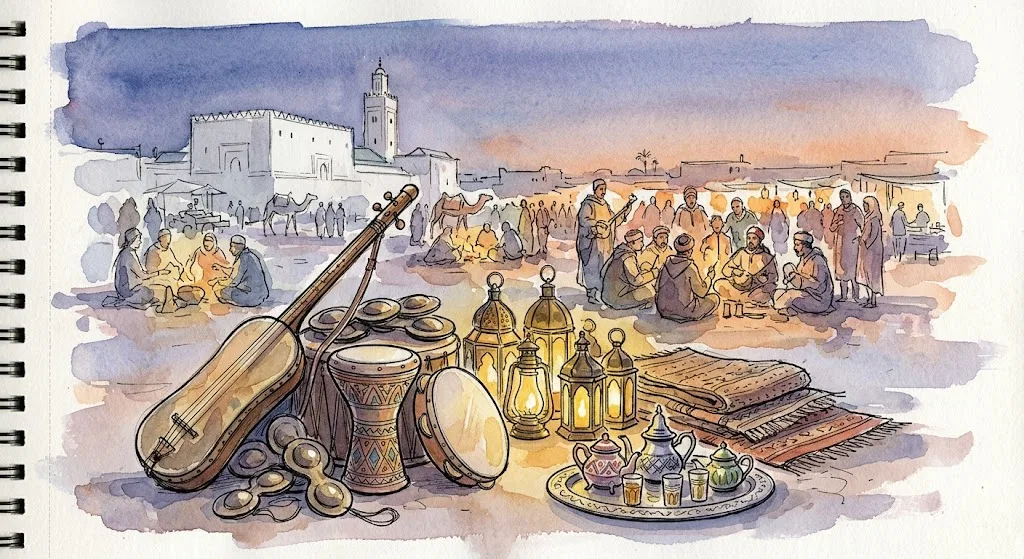
A major reason these traditions remain visible is that Morocco has strong public forms of intangible heritage. UNESCO lists the cultural space of Jemaa el-Fna Square in Marrakesh, the Gnawa tradition, the Moussem of Tan-Tan and the Cherry Festival in Sefrou among Moroccan heritage practices, though these are not all “myths” in a narrow sense. They show how storytelling, music, ritual, food, poetry, trade, pilgrimage and public celebration overlap in Moroccan cultural life.[ICH UNESCO]ich.unesco.orgCultural space of Jemaa el-Fna SquareThe Jemaa el-Fna Square is a major place of cultural exchange and has enjoyed protection a…
Aisha Qandisha: Morocco’s most famous spirit
Aisha Qandisha is probably the most internationally recognisable figure from Moroccan supernatural tradition. She is usually described as a beautiful female spirit who appears near water, seduces or terrifies men, and may reveal animal traits such as camel or goat legs. The details vary by region and retelling, which is typical of oral tradition: she is not a fixed “character” with one official story, but a cluster of beliefs, warnings, fears and ritual associations.[Wikipedia]WikipediaAisha QandichaAisha Qandicha
Her importance lies in the way she sits between several categories at once. She is often treated as a named jinn-like being, but unlike a generic spirit she has a personality, a recognisable name and specific associations with water, sexuality, possession and danger. Recent scholarship on spirit-induced illness in Moroccan folk belief places her alongside the Grave Mule as a figure through whom communities discuss possession, taboo, morality and bodily disorder.[ResearchGate]researchgate.netOpen source on researchgate.net.
Older ethnographic writing, especially Edward Westermarck’s early twentieth-century work on Moroccan ritual and belief, remains important because it recorded many local beliefs about saints, spirits, magic and ritual practice. Westermarck spent years in Morocco and his work is still widely cited, though modern readers should treat some of his evolutionary and “survivalist” explanations with caution rather than accepting every origin theory at face value.[Scribd]scribd.comRitual and Belief in Morocco VOL IRitual and Belief in Morocco VOL I
Aisha Qandisha has also changed in modern culture. In family memory she may be a frightening bedtime warning; in ritual contexts she may be linked with possession and healing; in recent media she can become a feminist avenger or horror-film monster. The French film Kandisha reworks the figure as a summoned Moroccan legend in a modern urban horror story, showing how a local spirit tradition can be detached from its ritual setting and repackaged for global genre audiences.[IMDb]imdb.comOpen source on imdb.com.
Jinn, illness and ritual: belief as explanation, not just story
In Moroccan folk belief, jinn are not merely decorative monsters. They can explain misfortune, illness, infertility, failed plans, nightmares, obsession or sudden changes in behaviour. That does not mean every Moroccan interprets distress in this way, or that such beliefs replace medicine, but they remain part of a wider cultural vocabulary for talking about invisible causes and social vulnerability. A study of Moroccan Sufi ritual notes that local belief may attribute misfortunes to jinn and that ritual sessions can be sought for concerns such as employment, marriage, motherhood and cure.[КиберЛенинка]cyberleninka.ruinterpreting djinn s actions ritual and theological knowledge in moroccan sufisminterpreting djinn s actions ritual and theological knowledge in moroccan sufism
This is where folklore meets healing practice. The Gnawa tradition, now internationally famous for music, includes therapeutic possession rituals using all-night rhythm and trance ceremonies. UNESCO describes Gnawa practice as combining ancestral African practices, Arab-Muslim influences and native Berber cultural performances, with urban ceremonies often centred on music and trance and rural practices also involving communal meals offered to saints.[ICH UNESCO]ich.unesco.orgICH UNESCOGnawaUNESCO Intangible Cultural HeritageThe Gnawa, especially in the city, practise a therapeutic possession ritual through all-night rhythm a…
The Hamadsha brotherhood provides another example of the blurred line between religion, bodily experience and supernatural explanation. Work on Moroccan Sufi ritual describes efforts to interpret jinn’s actions through theological and ritual knowledge, while older ethnographic accounts of the Hamadsha emphasise ecstatic states that may be interpreted as union with God or possession by a spirit.[КиберЛенинка]cyberleninka.ruinterpreting djinn s actions ritual and theological knowledge in moroccan sufisminterpreting djinn s actions ritual and theological knowledge in moroccan sufism
For readers coming from a modern “mythology” frame, the key point is that Moroccan jinn traditions are not just stories about beings. They are part of a practical system for naming danger, negotiating fear, diagnosing affliction and seeking protection. Aisha Qandisha becomes more meaningful when seen in that context: not only as a creature from folklore, but as a figure at the edge of desire, illness, gender anxiety, water, ritual and social control.
The Grave Mule and moral horror
The Grave Mule is another striking Moroccan folk figure, though less internationally famous than Aisha Qandisha. Recent scholarship describes it as a hybrid being tied to death, taboo and moral boundaries, often discussed alongside Aisha Qandisha in relation to spirit-induced illness and social fear.[ResearchGate]researchgate.netOpen source on researchgate.net.
The basic pattern is memorable: a mule-like or part-human creature haunts cemeteries and night spaces, frightening or punishing those who cross moral lines. Popular retellings often connect the figure to a widow who violates expected conduct after her husband’s death, although versions differ and the tale’s force depends on local social codes as much as on supernatural detail. A 2024 Moroccan press retelling presents the creature as an Atlas-village terror associated with cemeteries, night wandering, illness, madness and death.[Yabiladi]en.yabiladi.comOpen source on yabiladi.com.
The Grave Mule shows how folklore can police boundaries. It is frightening because it brings together several charged zones: death, sexuality, widowhood, night travel, cemetery space and the unstable body. The creature is less useful as “evidence” of an ancient monster belief than as a window into how communities have used horror to dramatise moral disorder, especially around gendered expectations.
Storytelling: from family hearths to Jemaa el-Fna
Moroccan oral storytelling has both intimate and public forms. In rural settings, stories have often been transmitted by mothers and grandmothers in domestic spaces. The SOAS Tamazight tales project records memories of family members gathering after dinner around the fireplace to hear long tales that entertained children, relieved adults after hard days and carried religious morality, social norms and community values before television and the internet reached remote mountain villages.[Mulosige]mulosige.soas.ac.ukMulosige Tamazight TalesTamazight Tales - Mulosige…
These tales are not simple children’s stories. They may include witches, monsters, abandoned children, clever sisters, magical escapes and poetic openings or endings that do not translate neatly as “once upon a time”. The same SOAS project warns that reducing local openings to a generic English formula can flatten their historical and cultural meanings, because the phrasing may evoke older memories of raids, wealth, danger and sacred protection.[Mulosige]mulosige.soas.ac.ukMulosige Tamazight TalesTamazight Tales - Mulosige…
Marrakesh’s Jemaa el-Fna gives Moroccan storytelling a different stage. UNESCO describes the square as a major place of cultural exchange protected as part of Morocco’s artistic heritage since 1922, while also warning that urbanisation, real-estate pressure, road development, tourism and acculturation threaten the cultural practices associated with it.[ICH UNESCO]ich.unesco.orgCultural space of Jemaa el-Fna SquareThe Jemaa el-Fna Square is a major place of cultural exchange and has enjoyed protection a…
Recent reporting has presented Marrakesh storytelling as a tradition under pressure but also in revival. Storytellers who once worked in public circles have faced competition from modern entertainment and changing urban life, while newer initiatives such as storytelling cafés and festivals have tried to adapt the art for contemporary audiences.[Condé Nast Traveler]cntraveler.comOpen source on cntraveler.com.
The tension is important. When a tourist watches a storyteller in Marrakesh, they may be seeing a living art, a heritage performance, a commercial encounter and a threatened tradition at the same time. Moroccan folklore survives partly because it can adapt, but adaptation also changes who tells the story, who listens and what the performance is for.
Saints, shrines and sacred landscapes
Morocco’s sacred geography is central to its folklore. Across the country, whitewashed saints’ tombs and shrines mark landscapes, villages, cemeteries and pilgrimage routes. A study of Moroccan saints’ shrines notes that such tombs are usually four-sided stone or rammed-earth buildings, plastered, whitewashed and often surmounted by a dome, making them visually distinctive against the landscape.[Manifold at UCalgary Press]ucp.manifoldapp.orgOpen source on manifoldapp.org.
These shrines are not only buildings. They organise memory, community and ritual action. The same study describes practices such as animal sacrifice, processions around tombs, oath-swearing at shrines and requests made to God through the saint buried there. It also notes that major commemorations can grow into pilgrimage fairs attracting people from long distances.[Manifold at UCalgary Press]ucp.manifoldapp.orgOpen source on manifoldapp.org.
This is one of the places where outsiders can misunderstand Moroccan folklore. Saint veneration is not simply “myth” in the sense of fiction, nor is it identical with official theology. It sits in the lived space between Islamic devotion, local memory, lineage, healing, protection, blessing and social belonging. Urban religious scholars have often regarded some saintly and magical practices as marginal or unorthodox, yet maraboutism has also been a major force in Moroccan history and community life.[Manifold at UCalgary Press]ucp.manifoldapp.orgOpen source on manifoldapp.org.
Jewish Moroccan saint veneration adds another layer. Moroccan Jewish pilgrimage traditions honour revered rabbis and holy figures at tombs, with prayers, candles and communal gatherings. Research on the pilgrimage to the grave of Amran Ben Diwan near Ouezzane notes that such annual pilgrimages can connect diasporic Moroccan Jews with an idealised Moroccan Jewish folklore and memory of place.[Cambridge Repository]repository.cam.ac.ukOpen source on cam.ac.uk.

Festivals where folklore becomes public heritage
Some Moroccan traditions are best understood through festivals rather than through tales of named beings. The Moussem of Tan-Tan, in south-west Morocco, is an annual gathering of Saharan nomadic peoples and more than thirty tribes. UNESCO presents it as a space of cultural exchange involving music, poetry, social ties, traditional knowledge, camel and horse practices, and the maintenance of Saharan nomadic heritage.[ICH UNESCO]ich.unesco.orgMoussem of Tan-TanThe Moussem of Tan-Tan in southwest Morocco is an annual gathering of nomadic peoples of the Sahara that brin…
This matters for folklore because many traditions survive through repeated public occasions. Songs, oral poetry, costume, animal-handling skills, marriage customs, trade relationships and tribal memory are not preserved as isolated museum objects; they are renewed through gathering, performance and participation. Tan-Tan is therefore not a “legend” page in the narrow sense, but it belongs firmly within Morocco’s traditional story culture.
The Cherry Festival in Sefrou shows another pattern. UNESCO describes it as a three-day June celebration in which the local population celebrates the region’s natural and cultural beauty through the cherry fruit.[ICH UNESCO]ich.unesco.orgOpen source on unesco.org. This may sound less supernatural than Aisha Qandisha or jinn possession, but seasonal festivals are part of folklore because they turn local crops, place identity, music, dress, pageantry and communal memory into repeated ritual time.
A useful way to read Moroccan festivals is to ask what they preserve beyond spectacle. Tan-Tan preserves Saharan social and oral traditions; Sefrou preserves a local seasonal identity; Jemaa el-Fna preserves a public cultural space; Gnawa ceremonies preserve music linked to healing, spirit belief and historical memory. In each case, folklore is not only what people say, but what they do together.
Amazigh tales and the role of women storytellers
Amazigh oral literature is one of the foundations of Moroccan folklore. The SOAS Tamazight tales project emphasises that tales from the Atlas Mountains were often memorised and handed down by women, especially mothers and grandmothers, and that they carried community values long before mass media transformed rural life.[Mulosige]mulosige.soas.ac.ukMulosige Tamazight TalesTamazight Tales - Mulosige…
These tales often work through fantasy, but their concerns are recognisably social. Stories may feature witches, jealous relatives, clever heroines, unwanted sisters, monsters, impossible tasks and magical rescues. In one example discussed by the SOAS project, a heroine escapes sorcery and defeats witchcraft; in another, a sister’s courage disrupts patriarchal assumptions about gender and weakness.[Mulosige]mulosige.soas.ac.ukMulosige Tamazight TalesTamazight Tales - Mulosige…
This makes Moroccan folktales more than quaint survivals. They can challenge as well as reinforce social norms. A monster may embody danger, but a heroine may also expose injustice. A witch may represent destructive envy, while a clever girl may model resilience, tact and self-rescue. The result is a storytelling world where morality is vivid but not always simple.
Preservation is now a real issue. The same project describes folktales as threatened by modern technology and globalisation, with many falling into neglect in some regions despite their former importance in entertainment, morality and local belonging.[Mulosige]mulosige.soas.ac.ukMulosige Tamazight TalesTamazight Tales - Mulosige… Digital archives, university projects and community storytelling initiatives are therefore not just academic exercises; they are attempts to keep fragile oral repertoires from disappearing with the last confident tellers.
What is old, what is recorded, and what is modern retelling?
Moroccan folklore contains old elements, but not every popular version is equally old or equally well attested. This distinction matters because internet-era folklore often flattens local variation into a single dramatic backstory.
The strongest evidence usually comes from a combination of sources: older ethnographic collections, living oral testimony, local-language archives, UNESCO heritage documentation, academic studies and observed ritual practice. Westermarck’s Ritual and Belief in Morocco, first published in 1926, remains a major historical source for beliefs about sanctity, spirits, magic, ceremony, luck, funerals, animals and plants, though it reflects the assumptions and limits of its period.[Internet Archive]archive.orgOpen source on archive.org.
Modern retellings can still be valuable, but they should be read for what they are. Aisha Qandisha as a fireside warning, Aisha Qandisha as a ritual spirit, Aisha Qandisha as an internet “succubus” and Aisha Qandisha as a horror-film avenger are related but not identical. The same is true of the Grave Mule: local moral tale, scholarly symbol of taboo, and online horror creature are overlapping forms, not one stable ancient text.[ResearchGate]researchgate.netOpen source on researchgate.net.
For a reader trying to separate older tradition from modern invention, three questions help:
Where is the story being told? A village tale, a shrine ritual, a UNESCO festival page and a horror blog may all preserve something, but they do different kinds of work.
Who is telling it? A grandmother, ritual specialist, scholar, tourist guide, filmmaker or social-media narrator will frame the same figure differently.
What is the story being used for? Entertainment, warning, healing, heritage, national identity, tourism and horror all reshape tradition.
Morocco’s folklore today
Moroccan folklore today is not disappearing in a simple way; it is being redistributed. Some domestic storytelling settings have weakened, especially where television, smartphones and migration have changed family life. Some public traditions have become heritage attractions. Some ritual practices remain meaningful to participants but are also performed on festival stages. Some spirits have migrated into films, articles, podcasts and internet horror lists.
That change brings both risk and opportunity. UNESCO recognition can protect visibility, attract funding and give prestige to once-marginal practices, as in the case of Jemaa el-Fna, Gnawa and Tan-Tan. But heritage status can also turn living practices into performances shaped by tourism, official narratives or audience expectation. UNESCO itself warns that Jemaa el-Fna’s cultural practices may suffer from acculturation linked to tourism and urban pressure.[ICH UNESCO]ich.unesco.orgCultural space of Jemaa el-Fna SquareThe Jemaa el-Fna Square is a major place of cultural exchange and has enjoyed protection a…
The most interesting Moroccan folklore is therefore neither “ancient myth” nor “invented tourist colour”. It is a living field of negotiation. A white shrine on a hillside, a tale told in an Atlas home, a night-long Gnawa ceremony, a Saharan gathering, a Jewish pilgrimage, a Marrakesh storytelling circle and a horror film about Aisha Qandisha all show different ways in which Moroccans and Moroccan diasporas continue to handle memory, fear, blessing, danger and belonging.
Morocco’s legendary culture is strongest when read through that tension: old and new, sacred and commercial, local and global, frightening and protective, oral and digital. Its monsters are memorable, but its deeper folklore lies in the social worlds that keep telling, fearing, singing, visiting and reinventing them.
Amazon book picks
Further Reading
Books and field guides related to Where Morocco's Spirits Still Tell Stories. Use these as the next step if you want deeper reading beyond the article.
Moroccan Folktales
Directly covers Moroccan folk narratives, legends and oral traditions.
The Arabian Nights
Shares themes of jinn, magic, oral storytelling and Islamic-era folklore.
In Arabian Nights
Explores living storytelling culture in Morocco and the wider Arab world.
![Cover for The Arabian Nights Entertainments [7 stories]](https://covers.openlibrary.org/b/id/1046897-M.jpg)
eBay marketplace picks
Marketplace Samples
Live-tested eBay searches with available results related to this page.
Endnotes
1.
Source: ich.unesco.org
Link:https://ich.unesco.org/en/RL/cultural-space-of-jemaa-el-fna-square-00014
Source snippet
Cultural space of Jemaa el-Fna SquareThe Jemaa el-Fna Square is a major place of cultural exchange and has enjoyed protection a...
2.
Source: ich.unesco.org
Title: ICH UNESCOGnawa
Link:https://ich.unesco.org/en/RL/gnawa-01170
Source snippet
UNESCO Intangible Cultural HeritageThe Gnawa, especially in the city, practise a therapeutic possession ritual through all-night rhythm a...
3.
Source: ich.unesco.org
Link:https://ich.unesco.org/en/RL/moussem-of-tan-tan-00168
Source snippet
Moussem of Tan-TanThe Moussem of Tan-Tan in southwest Morocco is an annual gathering of nomadic peoples of the Sahara that brin...
4.
Source: ich.unesco.org
Link:https://ich.unesco.org/en/RL/cherry-festival-in-sefrou-00641
5.
Source: Wikipedia
Title: Aisha Qandicha
Link:https://en.wikipedia.org/wiki/Aisha_Qandicha
6.
Source: researchgate.net
Link:https://www.researchgate.net/publication/395844879_Spirit-Induced_Illness_In_Moroccan_Folk_Belief_A_Comparative_Study_Of_Aisha_Qandisha_And_The_Grave_Mule
7.
Source: scribd.com
Title: Ritual and Belief in Morocco VOL I
Link:https://www.scribd.com/document/322726759/Ritual-and-Belief-in-Morocco-VOL-I-Edward-Westermarck
8.
Source: imdb.com
Link:https://www.imdb.com/title/tt11058930/
9.
Source: ich.unesco.org
Link:https://ich.unesco.org/en/decisions/14.COM/10.B.26
10.
Source: researchgate.net
Link:https://www.researchgate.net/figure/Comparative-features-of-Aisha-Qandisha-and-the-Grave-Mule-in-Moroccan-folk-belief_tbl1_395844879
11.
Source: en.yabiladi.com
Link:https://en.yabiladi.com/articles/details/154777/moroccan-horror-stories-cursed-mule
12.
Source: archive.org
Link:https://archive.org/details/in.ernet.dli.2015.174945
13.
Source: courier.unesco.org
Title: jemaa el fnas thousand and one nights
Link:https://courier.unesco.org/en/articles/jemaa-el-fnas-thousand-and-one-nights
14.
Source: ich.unesco.org
Link:https://ich.unesco.org/en/video/41638
15.
Source: ich.unesco.org
Link:https://ich.unesco.org/en/events/international-consultation-on-the-preservation-of-popular-cultural-spaces-declaration-of-the-oral-heritage-of-mankind-00803
16.
Source: ich.unesco.org
Title: 42988 EN.docx
Link:https://ich.unesco.org/doc/src/42988-EN.docx
17.
Source: unesco.org
Title: document 3461
Link:https://www.unesco.org/archives/multimedia/document-3461
18.
Source: ich.unesco.org
Link:https://ich.unesco.org/en/video/48635
19.
Source: ich.unesco.org
Link:https://ich.unesco.org/en/decisions/7.COM/11.23
20.
Source: ich.unesco.org
Link:https://ich.unesco.org/en/lists
21.
Source: ich.unesco.org
Title: 01857 EN
Link:https://ich.unesco.org/doc/src/01857-EN.pdf
22.
Source: whc.unesco.org
Link:https://whc.unesco.org/en/activities/773/
23.
Source: ich.unesco.org
Title: klapa multipart singing of dalmatia southern croatia 00746
Link:https://ich.unesco.org/en/RL/klapa-multipart-singing-of-dalmatia-southern-croatia-00746?RL=00746&id=16691&include=film_inc.php
24.
Source: ich.unesco.org
Link:https://ich.unesco.org/
25.
Source: ich.unesco.org
Title: what is intangible heritage 00003
Link:https://ich.unesco.org/en/what-is-intangible-heritage-00003?id=16691&include=film_inc.php
26.
Source: researchgate.net
Link:https://www.researchgate.net/publication/274256696Jemaa_el_Fna_Square_in_Marrakech-_Changes_to_a_Social_Space_and_to_a_UNESCO_Masterpiece_of_the_Oral_and_Intangible_Heritage_of_Humanity_as_a_Result_of_Global_influence
27.
Source: researchgate.net
Link:https://www.researchgate.net/publication/403901436_Commoditised_the_Sacred_Gnawa_from_Rituals_and_Traditions_to_Stardom
28.
Source: researchgate.net
Link:https://www.researchgate.net/publication/396107277_Feminism_with_Swords_and_Hooves_Aisha_Kandisha_Transnational_Cinema_and_Postcolonial_HorrorAisha_Kandisha_Transnational_Cinema_and_Postcolonial_Horror
29.
Source: researchgate.net
Title: 360055661 Waiting for jinn’s actions Ritual and Knowledge in Moroccan Sufism
Link:https://www.researchgate.net/publication/360055661_Waiting_for_jinn%27s_actions_Ritual_and_Knowledge_in_Moroccan_Sufism
30.
Source: researchgate.net
Link:https://www.researchgate.net/figure/Distribution-of-collective-pilgrimages-to-the-tombs-of-Moslem-saints-in-Morocco-based-on_fig1_331861928
31.
Source: researchgate.net
Link:https://www.researchgate.net/publication/378661360_Post-secular_Anthropology_as_Recognition_and_the_Limits_of_Understanding_Responding_to_Experiences_of_Jinn_Possession_in_Morocco
32.
Source: Wikipedia
Title: Gnawa music
Link:https://en.wikipedia.org/wiki/Gnawa_music
33.
Source: Wikipedia
Title: Jemaa el Fnaa
Link:https://en.wikipedia.org/wiki/Jemaa_el-Fnaa
34.
Source: Wikipedia
Title: Tan Tan Moussem
Link:https://en.wikipedia.org/wiki/Tan-Tan_Moussem
35.
Source: Wikipedia
Title: Masterpieces of the Oral and Intangible Heritage of Humanity
Link:https://en.wikipedia.org/wiki/Masterpieces_of_the_Oral_and_Intangible_Heritage_of_Humanity
36.
Source: Wikipedia
Title: List of Intangible Cultural Heritage elements in Morocco
Link:https://en.wikipedia.org/wiki/List_of_Intangible_Cultural_Heritage_elements_in_Morocco
37.
Source: Wikipedia
Title: Kandisha (2020 film)
Link:https://en.wikipedia.org/wiki/Kandisha_%282020_film%29
38.
Source: archive.org
Link:https://archive.org/details/taleslegendsofmo00chim
39.
Source: scribd.com
Title: Myth Horror Legend
Link:https://www.scribd.com/document/975475407/Myth-Horror-Legend
40.
Source: mulosige.soas.ac.uk
Title: Mulosige Tamazight Tales
Link:https://mulosige.soas.ac.uk/tamazight-tales/
Source snippet
Tamazight Tales - Mulosige...
41.
Source: cyberleninka.ru
Title: interpreting djinn s actions ritual and theological knowledge in moroccan sufism
Link:https://cyberleninka.ru/article/n/interpreting-djinn-s-actions-ritual-and-theological-knowledge-in-moroccan-sufism
42.
Source: cntraveler.com
Link:https://www.cntraveler.com/story/moroccos-storytelling-tradition
43.
Source: cntraveler.com
Link:https://www.cntraveler.com/story/meet-the-people-reviving-the-ancient-art-of-storytelling-in-marrakech
44.
Source: ucp.manifoldapp.org
Link:https://ucp.manifoldapp.org/read/shrines-in-africa-history-politics-and-society/section/63f2a1f2-23f7-4d5c-82b0-a844088f077d
45.
Source: repository.cam.ac.uk
Link:https://www.repository.cam.ac.uk/items/5f6489ff-efc8-4f21-bdf2-73a754465afa
46.
Source: genies.fandom.com
Title: Aisha Qandisha
Link:https://genies.fandom.com/wiki/Aisha_Qandisha
47.
Source: jinn.fandom.com
Title: Aisha Qandisha
Link:https://jinn.fandom.com/wiki/Aisha_Qandisha
48.
Source: memphistours.com
Link:https://www.memphistours.com/blog/moroccan-myths
49.
Source: youtube.com
Link:https://www.youtube.com/hashtag/kandisha
50.
Source: youtube.com
Link:https://www.youtube.com/watch?v=vOXEV2EdjRc
51.
Source: moviemeter.nl
Link:https://www.moviemeter.nl/film/1139844
52.
Source: jstor.org
Link:https://www.jstor.org/stable/40997575
Additional References
53.
Source: youtube.com
Title: A Moroccan Legend
Link:https://www.youtube.com/watch?v=2N33XCOTmZA
Source snippet
Morocco's Living Heritage: Jemaa El Fna and Architecture Made of Earth...
54.
Source: youtube.com
Title: The Pirate and the Mermaid | A Moroccan Folktale
Link:https://www.youtube.com/watch?v=95zLTvSU5mw
Source snippet
A Moroccan Legend - Aicha Kandicha in Moroccan culture...
55.
Source: academia.edu
Link:https://www.academia.edu/31057850/Timeless_Belief_in_Saints_and_Spirits_in_Morocco
56.
Source: moroccotravelblog.com
Link:https://moroccotravelblog.com/8-sacred-sites-in-morocco-hidden-secrets-of-sufi-zaouias-mosques-tombs/
57.
Source: facebook.com
Link:https://www.facebook.com/Berit.Aicha/posts/aicha-kandicha-also-known-as-aisha-or-qandisha-is-a-complex-mythical-figure-from/10164078182099890/
58.
Source: reddit.com
Link:https://www.reddit.com/r/Paranormal/comments/e5h90n/aicha_kandisha_or_whatever/
59.
Source: facebook.com
Link:https://www.facebook.com/groups/2080532725677691/posts/2248089505588678/
60.
Source: shewhoseestheunknown.com
Link:https://shewhoseestheunknown.com/aisha-qandisha/
61.
Source: smb.museum
Link:https://www.smb.museum/en/exhibitions/detail/al-halqa-the-last-storytellers/
62.
Source: visitmorocco.com
Link:https://www.visitmorocco.com/en/discover-morocco/astounding-array-human-heritage-recognized-unesco
Topic Tree
Follow this branch
Related pages 192
- Afghan Folklore
- Albanian Folklore
- Algerian Folklore
- Australian Folklore
- Azerbaijan Folklore
- +187 more in sidebar