Where Turkmen Legends Still Ride and Sing
Turkmenistan’s folklore is best understood as a living culture of spoken epic, sung poetry, sacred landscape, desert imagery, heroic horses, household wisdom and local pilgrimage.
Page outline Jump by section
What makes Turkmen folklore distinctive?
Turkmen folklore is unusually tied to performance. Many of its most important stories were not meant to be silently read from a page. They were sung, recited, dramatised and remembered in front of listeners. The central figure in this world is the traditional bard: a singer-storyteller whose art can carry genealogy, humour, moral instruction, heroic history and entertainment at once. UNESCO describes the epic art of Gorogly as an oral performing tradition involving narration, singing, poetry, vocal improvisation and music, with performers in Turkmenistan specialising in the heroic cycle.[UNESCO]unesco.orgTurkmen Epic Art of Gorogly | Intangible HeritageTurkmen Epic Art of Gorogly | Intangible Heritage
That performance setting matters because it changes how a reader should approach the material. A Turkmen epic is not simply a “plot”. It is a social event, a memory system and a display of skill. The story may teach courage, loyalty, hospitality, honour, fairness and respect for elders, but it does so through a night of music, formulaic language, dramatic pauses and audience familiarity. UNESCO’s account of Gorogly specifically links the tradition to community identity and values such as bravery, honesty, friendship and fairness.[UNESCO]unesco.orgTurkmen Epic Art of Gorogly | Intangible HeritageTurkmen Epic Art of Gorogly | Intangible Heritage
The second distinctive feature is the closeness between folklore and landscape. Mountains, caves, ruins, shrines, oases, deserts and ancient towns are often more than scenery. They become proof-like anchors for local legend. A split rock, a cave niche, a saint’s shrine, a stone said to have changed shape at a miraculous moment, or the remains of an old settlement can all turn a story into a place people visit. This is especially clear at Paraw Bibi, where the legend of a pious young woman disappearing into the mountain is attached to an active pilgrimage site in western Turkmenistan.[Eurasianet]eurasianet.orgTurkmen Pilgrims Make A Homegrown Hajj | EurasianetTurkmen Pilgrims Make A Homegrown Hajj | Eurasianet
Gorogly: the hero at the centre of national legend
Gorogly is the best-known heroic figure in Turkmenistan’s folklore. In broad terms, the epic tells of a legendary hero and his forty cavalrymen, but its cultural importance is larger than any one adventure. It is a heroic cycle, a musical tradition, a storehouse of values and a national symbol. UNESCO’s multimedia archive describes the tradition as one that reflects Turkmen aspirations for a happy life while promoting bravery, honesty, friendship and fairness.[UNESCO]unesco.orgTurkmen Epic Art of Gorogly | Intangible HeritageTurkmen Epic Art of Gorogly | Intangible Heritage
The tradition belongs to a wider Turkic story-world. Versions of the Koroghlu or Gorogly hero are known across Turkic-speaking and neighbouring cultures, but the Turkmen version has its own social role and performance style. In Turkmenistan, the story is closely associated with specialist performers, musical accompaniment and the transmission of oral memory. A Turkmen state account calls the epic a national treasure and notes that Gorogly has appeared on currency, in monuments and in place-name traditions, showing how folklore has been folded into modern national symbolism.[tdh.gov.tm]tdh.gov.tmThe epic "Gorogly" is the epic heritage of the Turkmen peopleThe epic "Gorogly" is the epic heritage of the Turkmen people
A useful way to read Gorogly is as heroic folklore rather than as straightforward history. It preserves memories of horse culture, warrior ethics, kinship, promise-keeping, loyalty and resistance to injustice, but it does so through legendary structure. The hero’s world is heightened: companions are idealised, enemies are dramatic, horses can become almost miraculous, and the boundary between social memory and wonder tale is deliberately porous. That is part of the epic’s power. It gives listeners a past that feels morally charged, memorable and emotionally usable.
Storytellers, music and the dutar
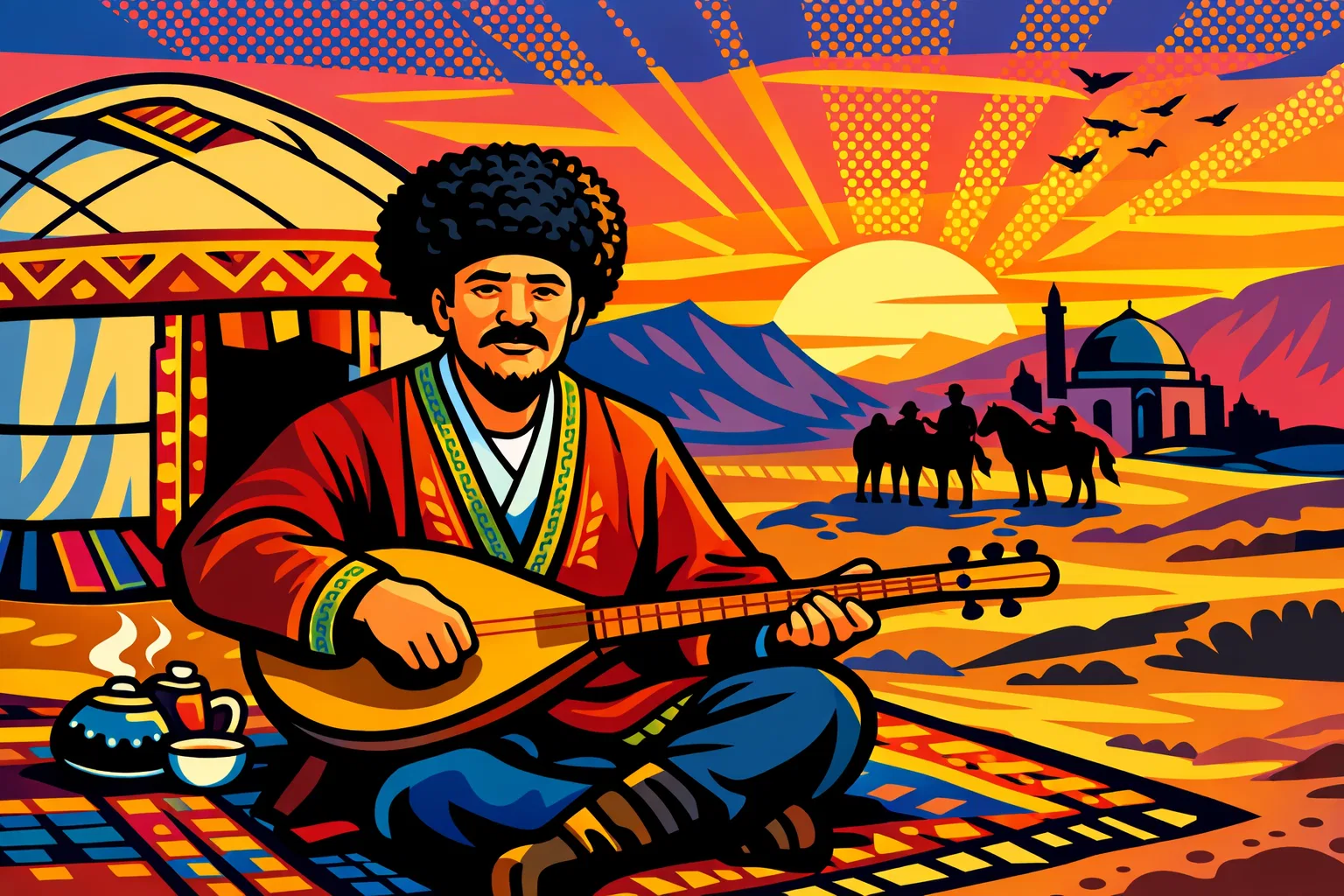
Turkmen folklore is carried by sound as much as by words. The dutar, a long-necked two-stringed lute, is one of the most important instruments in Turkmen traditional performance. UNESCO describes it as both a traditional instrument and a musical genre from Turkmenistan, used across the main genres of Turkmen music and singing; dutar music may be played alone or accompanied by singing, poetry and prose.[UNESCO]unesco.orgOpen source on unesco.org.
This makes the dutar central to the way folklore survives. A heroic episode, a moral tale or a remembered lineage can be made memorable through melody, repetition and performance technique. The craft of making the instrument is itself heritage: UNESCO notes that skills in making and playing the dutar are passed down through family transmission, oral teaching and demonstration.[UNESCO]unesco.orgOpen source on unesco.org.
For a folklore reader, this is a reminder not to separate “myth” from “music” too quickly. In Turkmenistan, some of the most important legendary material lives in the combined art of voice, instrument and audience. A written summary of Gorogly can tell a reader what happens, but it cannot fully reproduce what the tradition does when performed: creating suspense, stirring pride, inviting recognition and turning inherited values into something felt in the room.

Older Oghuz epics and the shared Turkic story-world
Turkmen folklore also belongs to the wider Oghuz Turkic world. One of the most important related traditions is the cycle known internationally through Dede Korkut or Korkut Ata. UNESCO’s listing for the heritage of Dede Qorqud/Korkyt Ata/Dede Korkut describes it as epic culture, folk tales and music based on twelve heroic legends, stories and tales, although the formal multinational UNESCO inscription is associated with Azerbaijan, Kazakhstan and Türkiye rather than Turkmenistan.[UNESCO ICH]ich.unesco.orgOpen source on unesco.org.
For Turkmenistan, the relevance is cultural rather than simply administrative. Oghuz heroic storytelling has long circulated across regions, languages and political borders. These epics typically combine warrior honour, family loyalty, trials of courage, counsel from wise elders, supernatural hints and the moral problems of nomadic and semi-nomadic society. Turkmen traditions sit within that larger zone of exchange while retaining local performers, dialects, emphases and national framing.
This shared background helps explain why some figures, motifs and tale types feel familiar across Central Asia, the Caucasus, Iran and Anatolia. A reader may meet similar heroic structures in neighbouring countries, but the Turkmen version is shaped by local horse culture, desert geography, tribal memory, Islamic saintly traditions and the modern state’s strong emphasis on national heritage.
Monsters, magical beings and fairy-tale worlds
Turkmen folk tales include a lively world of giants, monsters, magical animals, beautiful supernatural women, dragons, brave poor heroes and clever children. These tales are less internationally famous than Gorogly, but they are crucial for understanding the country’s everyday storytelling imagination. A Turkmen media account of fairy-tale collecting describes tales once told at caravan stops, bazaars, teahouses, homes and yurts, especially among women, elders and children; it also notes that published collection began in the Soviet period, with early documentary recordings and a major collection of fifty tales appearing in 1940.[orient.tm]orient.tmBewitching world of Turkmen fairy tales | OrientBewitching world of Turkmen fairy tales | Orient
The monsters of these stories are often vivid rather than subtle. One common figure is the huge, hairy, horned monster of fairy-tale tradition, usually powerful but foolish. The beautiful supernatural maiden and the monstrous captor form another familiar pattern: the enchanted woman may be seized by a giant or demon-like being and then rescued by a hero. Turkmen fairy tales also share motifs with the broader folklore of the East, including dragons, magical helpers and impossible tasks.[orient.tm]orient.tmBewitching world of Turkmen fairy tales | OrientBewitching world of Turkmen fairy tales | Orient
One especially memorable example is the tale of Ak-Pamyk, in which the heroine revives her brothers with the milk of a white camel. The same account links the “White Camel’s Milk” image to a Turkmen name for the Milky Way, showing how fairy-tale imagery can overlap with folk astronomy and poetic naming.[orient.tm]orient.tmBewitching world of Turkmen fairy tales | OrientBewitching world of Turkmen fairy tales | Orient
Another popular figure is the tiny but brave boy Yartygulak, remembered as a clever small hero who confronts a dangerous giant world. He has moved beyond oral tale into children’s culture, puppet performance, animation and film, including a 1974 fairy-tale film cited in Turkmen coverage.[orient.tm]orient.tmBewitching world of Turkmen fairy tales | OrientBewitching world of Turkmen fairy tales | Orient
Sacred places and the legend of Paraw Bibi
Paraw Bibi is one of the clearest examples of how Turkmen legend, pilgrimage and landscape come together. The shrine lies in western Turkmenistan, near the village of Paraw, set on a rocky mountainside. Travel descriptions identify it as one of the country’s notable pilgrimage places and describe a white shrine structure, guest facilities and nearby remains linked to the old settlement of Ferava or Afraw.[Ayan Travel Agency Turkmenistan]ayan-turkmenistan.travelAyan Travel Agency Turkmenistan Paraw Bibi ShrineAyan Travel Agency Turkmenistan Paraw Bibi Shrine
The core legend tells of a beautiful, virtuous and pious maiden threatened by enemies. In one version, a jealous woman betrays her hiding place; Paraw Bibi curses the betrayer, who turns into black stone. Realising capture is near, Paraw Bibi asks the mountain to open, disappears into it, and is remembered as a blessed heroine. Eurasianet’s account of Turkmen pilgrimage similarly reports that Paraw Bibi is said to have disappeared into the mountains and has long been regarded as a patron figure for pregnant women and children.[Eurasianet]eurasianet.orgTurkmen Pilgrims Make A Homegrown Hajj | EurasianetTurkmen Pilgrims Make A Homegrown Hajj | Eurasianet
The shrine’s folklore is rich in physical details. Visitors are shown stone impressions said to be linked to Paraw Bibi’s hands and knees; a stone melon is connected to a moment of interrupted danger; and the cave-like niche into the mountain is treated as the point of her disappearance. Accounts of the site describe votive offerings such as cloth strips, miniature cradles and textiles brought by women hoping for children.[Ayan Travel Agency Turkmenistan]ayan-turkmenistan.travelAyan Travel Agency Turkmenistan Paraw Bibi ShrineAyan Travel Agency Turkmenistan Paraw Bibi Shrine
The important point is not whether a modern historian can verify the maiden as a biographical person. The value of the legend lies in how it makes virtue, danger, female piety, fertility, prayer and landscape part of one sacred story. The same source notes that motifs such as a rock opening, a heroine disappearing into a mountainside, miraculous stones and bodily impressions in rock recur in legends about other Turkmen holy figures, suggesting a wider pattern of saintly landscape folklore.[Ayan Travel Agency Turkmenistan]ayan-turkmenistan.travelAyan Travel Agency Turkmenistan Paraw Bibi ShrineAyan Travel Agency Turkmenistan Paraw Bibi Shrine
Folk Islam, ancestors and local pilgrimage
Turkmenistan’s religious folklore cannot be understood only through formal doctrine. It has been shaped by local pilgrimage, ancestor respect, saintly lineages and sacred places. A Routledge chapter by Victoria Clement notes that shrine pilgrimage remains popular in Turkmenistan, while the state has also used Islam in nation-building and tightly limited religious pluralism.[Taylor & Francis]taylorfrancis.comOpen source on taylorfrancis.com.
This helps explain why pilgrimage sites can carry both religious and folkloric meaning. A shrine may be visited for prayer, healing, fertility, protection, family vows or respect for a saintly figure; at the same time, it may be explained through a local legend full of miraculous stones, vanished heroines, sacred caves or heroic resistance. A 2009 Eurasianet report on an official internal pilgrimage described a route through thirty-eight “holy” sites inside Turkmenistan, including Paraw Bibi, while also observing that some sites had mixed religious, historical and political significance.[Eurasianet]eurasianet.orgTurkmen Pilgrims Make A Homegrown Hajj | EurasianetTurkmen Pilgrims Make A Homegrown Hajj | Eurasianet
This mixture is typical of living folklore. A sacred place may be a shrine, a patriotic landmark, a family memory site, a tourist destination and a legendary landscape at the same time. In Turkmenistan, the state’s promotion of selected pilgrimage routes and heritage sites adds another layer: older local practices continue, but they are also reframed as national culture.
Horses, carpets and symbols that carry stories
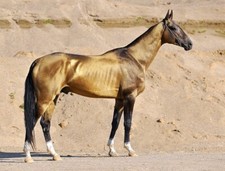
Some of Turkmenistan’s most powerful folklore is attached not to monsters or ghosts, but to cultural symbols. The Akhal-Teke horse is the obvious example. In modern national imagery it represents grace, endurance, nobility and Turkmen identity; in legend and popular retelling it can become almost supernatural, a desert horse that seems able to outrun ordinary limits. Travel and cultural writing often describes the breed through mythic language, but the safer interpretation is that horse folklore grows from a real historical dependence on riding, mobility, status and survival in harsh landscapes.[EciEco]ecieco.orgOpen source on ecieco.org.
Gorogly’s world makes this especially clear. A hero without a remarkable horse would be incomplete. The horse in Turkmen heroic imagination is not merely transport: it is companion, proof of nobility, extension of the warrior’s body and sometimes a near-magical presence. That is why horse stories sit so naturally beside epics, wedding customs, tribal memory and national spectacle.
Carpets carry a different kind of folklore. UNESCO describes traditional Turkmen carpet-making as hand-woven woollen textile art, with dense ornament and coloured patterns linked to the five main Turkmen tribes; designs reflect the weaver’s local environment, including flora and fauna.[UNESCO]unesco.orgTraditional Turkmen Carpet Making Art In Turkmenistan | Intangible HeritageTraditional Turkmen Carpet Making Art In Turkmenistan | Intangible Heritage
For folklore, the carpet matters because pattern can work like memory. It may not “tell a story” in the same way an epic does, but it encodes identity, tribe, household skill, marriage customs, aesthetic inheritance and ideas of home. UNESCO notes that carpets serve as floor coverings, wall decorations and special objects for particular occasions.[UNESCO]unesco.orgTraditional Turkmen Carpet Making Art In Turkmenistan | Intangible HeritageTraditional Turkmen Carpet Making Art In Turkmenistan | Intangible Heritage
Nowruz and the folklore of renewal
Nowruz, the spring festival celebrated across Central Asia and neighbouring regions, is part of Turkmenistan’s seasonal heritage. UNESCO describes Nowruz as an ancestral festivity marking the first day of spring and the renewal of nature, involving rituals, ceremonies, family meals, new clothes, visits, gifts and children’s celebrations. Turkmenistan is one of the countries associated with the multinational UNESCO recognition of Nowruz as intangible cultural heritage.[UNESCO]unesco.orgInternational Day of Nowruz | UNESCOInternational Day of Nowruz | UNESCO
In folklore terms, Nowruz matters because it links cosmic time to household life. Spring is not just a change in weather; it is treated as a renewal of social bonds, family obligations, hospitality, cleanliness, generosity and hope. UNESCO notes that the festival has been celebrated for more than three thousand years across a wide region and promotes peace, solidarity between generations, reconciliation and neighbourliness.[UNESCO]unesco.orgInternational Day of Nowruz | UNESCOInternational Day of Nowruz | UNESCO
For Turkmenistan, Nowruz also shows the difference between shared regional tradition and national expression. The festival is not exclusive to Turkmen culture, but local foodways, music, dress, public celebrations and family customs give it a Turkmen setting. It is a good example of how folklore travels across borders without becoming generic.
How old is the evidence?
The evidence for Turkmen folklore comes in layers. Some motifs are very old, especially those connected to Oghuz heroic culture, spring renewal, sacred landscapes, animal symbolism and Central Asian tale types. But the exact age of any given Turkmen version can be difficult to prove, because oral traditions change as they are performed. A heroic tale may preserve old structures while also absorbing later Islamic language, local politics, new place names and modern national meanings.
For Gorogly, the strongest evidence is not an ancient manuscript in the narrow sense, but a continuous and well-attested performance tradition. UNESCO’s inscription and archive material document the living oral art in modern Turkmenistan and identify it as a tradition transmitted through performers and public practice.[UNESCO]unesco.orgTurkmen Epic Art of Gorogly | Intangible HeritageTurkmen Epic Art of Gorogly | Intangible Heritage
For fairy tales, the publication record is more recent. Turkmen coverage of fairy-tale collecting points to documentary recording and publication beginning in the 1930s and 1940s, which does not mean the tales were invented then. It means that many oral stories entered print under Soviet-era folklore collection and publishing systems.[orient.tm]orient.tmBewitching world of Turkmen fairy tales | OrientBewitching world of Turkmen fairy tales | Orient
For shrine legends, the evidence is often place-based and ethnographic: pilgrim practice, local narration, travel accounts, Soviet anti-religious commentary, and later heritage or tourism descriptions. Paraw Bibi is a strong example because the legend, shrine practices, votive offerings and physical landscape are described together rather than as an isolated tale.[Eurasianet]eurasianet.orgTurkmen Pilgrims Make A Homegrown Hajj | EurasianetTurkmen Pilgrims Make A Homegrown Hajj | Eurasianet
How Soviet and modern heritage policies changed the tradition
Turkmen folklore has not simply survived unchanged from an ancient past. It has been collected, edited, staged, discouraged, revived, translated, nationalised and presented to international audiences. Soviet-era folklore work helped record tales that might otherwise have remained local or oral, but it also filtered them through the expectations of print culture, ideology and ethnographic classification. The reported publication of early Turkmen fairy-tale collections in the 1930s and 1940s is part of that story.[orient.tm]orient.tmBewitching world of Turkmen fairy tales | OrientBewitching world of Turkmen fairy tales | Orient
After independence, folklore became even more visibly tied to national identity. Gorogly, dutar music, carpet art and Nowruz are now presented through UNESCO frameworks and state cultural institutions. This can help preservation: it supports documentation, teaching, festivals, translation and public recognition. It can also tidy up messier local traditions into polished national symbols. The old storyteller’s flexible, local, humorous or unsettling version may not always match the official heritage version.
Recent translation efforts show another modern shift. A 2025 Turkmen state report says Turkmen folk literature has been translated into multiple languages, including English, Russian, German, French, Korean, Turkish, Chinese, Japanese, Spanish, Arabic and Farsi, with illustrated publications aimed at wider readers.[turkmenistan.gov.tm]turkmenistan.gov.tmTurkmen folk tales available in different world languagesTurkmen folk tales available in different world languages
That is a major change in audience. A tale once told in a yurt, bazaar or family setting may now be presented as children’s literature, diplomatic culture, tourism material or national soft power. The folklore remains real, but the setting of transmission has changed.

Old tradition, tourist retelling and internet-era folklore
Readers should be careful with Turkmenistan folklore online. Some modern pages mix well-attested traditions with loose travel mythology, dramatic phrasing and recycled claims. The “Gates of Hell” at Darvaza, for example, is a real and famous gas crater, and its nickname has become a piece of modern tourist folklore. But it should not be confused with an old Turkmen supernatural tradition unless a source shows genuine local legend attached to it.
The same caution applies to mythic claims about horses, ruins or sacred places. A phrase such as “gift from the gods” may be a modern poetic retelling rather than a documented old belief. That does not make it worthless, because modern folklore is still folklore, but it changes how it should be presented. Old oral tradition, Soviet-era collection, heritage performance, tourism copy and internet legend are different kinds of evidence.
A good rule is to ask three questions:
- Is the story attached to a known performer, collection, shrine, ritual or local practice?
- Is the source describing living belief, literary retelling, tourism branding or national symbolism?
- Does the same motif appear across multiple Turkmen contexts, or only in a modern promotional paragraph?
By that standard, Gorogly, dutar performance, Paraw Bibi pilgrimage, Turkmen fairy-tale collections, carpet symbolism and Nowruz customs are much better grounded than many viral “mystery” claims about the country.
Why Turkmen folklore still matters
Turkmenistan’s folklore matters because it preserves ways of thinking that formal history often misses. It shows how people imagine courage, beauty, danger, fertility, hospitality, cleverness, loyalty and sacred place. Gorogly gives the nation a heroic moral world. Fairy tales give children and adults monsters to outwit and magical helpers to hope for. Paraw Bibi turns a mountain into a story of piety, vulnerability and protection. Carpets and horses transform everyday cultural objects into symbols of identity. Nowruz links the renewal of nature to the renewal of family and community.
The strongest picture is therefore not of a vanished mythology, but of a layered living tradition. Turkmen folklore is old in roots, modern in presentation, local in attachment, and regional in its connections. It belongs to Turkmenistan, but it also speaks across Central Asia and the wider Turkic and Persianate worlds. Its most memorable forms are not isolated “creatures” or single legends, but performances, places and symbols that continue to tell people who they are.

eBay marketplace picks
Marketplace Samples
Live-tested eBay searches with available results related to this page.
Endnotes
1.
Source: unesco.org
Title: Turkmen Epic Art of Gorogly | Intangible Heritage
Link:https://www.unesco.org/archives/multimedia/document-4025
2.
Source: unesco.org
Link:https://www.unesco.org/archives/multimedia/document-5621
3.
Source: unesco.org
Title: Traditional Turkmen Carpet Making Art In Turkmenistan | Intangible Heritage
Link:https://www.unesco.org/archives/multimedia/document-4934
4.
Source: unesco.org
Title: International Day of Nowruz | UNESCO
Link:https://www.unesco.org/en/days/nowruz
5.
Source: eurasianet.org
Title: Turkmen Pilgrims Make A Homegrown Hajj | Eurasianet
Link:https://eurasianet.org/turkmen-pilgrims-make-a-homegrown-hajj
6.
Source: tdh.gov.tm
Title: The epic “Gorogly” is the epic heritage of the Turkmen people
Link:https://tdh.gov.tm/en/post/34195/epic-gorogly-epic-heritage-turkmen-people
7.
Source: unesco.org
Title: Dutar making craftsmanship and traditional music performing art
Link:https://www.unesco.org/en/articles/dutar-making-craftsmanship-and-traditional-music-performing-art-combined-singing-was-inscribed
8.
Source: ich.unesco.org
Link:https://ich.unesco.org/en/RL/heritage-of-dede-qorqud-korkyt-ata-dede-korkut-epic-culture-folk-tales-and-music-01399
9.
Source: orient.tm
Title: Bewitching world of Turkmen fairy tales | Orient
Link:https://orient.tm/en/posts/5313
10.
Source: ecieco.org
Link:https://www.ecieco.org/en/article/79/The-Akhal-Teke-Horse-in-Turkmen-Folk-Beliefs-A-Symbol-of-Nobility-Myth-and-National-Identity
11.
Source: turkmenistan.gov.tm
Title: Turkmen folk tales available in different world languages
Link:https://www.turkmenistan.gov.tm/en/post/91138/turkmen-folk-tales-available-different-world-languages
12.
Source: ich.unesco.org
Title: epic art of gorogly 01028
Link:https://ich.unesco.org/en/RL/epic-art-of-gorogly-01028
13.
Source: ich.unesco.org
Link:https://ich.unesco.org/en/RL/dutar-making-craftsmanship-and-traditional-music-performing-art-combined-with-singing-01565
14.
Source: ich.unesco.org
Title: traditional turkmen carpet making art in turkmenistan 01486
Link:https://ich.unesco.org/en/RL/traditional-turkmen-carpet-making-art-in-turkmenistan-01486
15.
Source: ich.unesco.org
Link:https://ich.unesco.org/en/video/58130
16.
Source: ich.unesco.org
Link:https://ich.unesco.org/en/video/49135
17.
Source: ich.unesco.org
Link:https://ich.unesco.org/en/video/44838
18.
Source: ich.unesco.org
Title: 41980 EN.doc
Link:https://ich.unesco.org/doc/src/41980-EN.doc
19.
Source: ich.unesco.org
Title: 49033 EN
Link:https://ich.unesco.org/doc/src/49033-EN.pdf
20.
Source: ich.unesco.org
Link:https://ich.unesco.org/en/RL/nawrouz-novruz-nowrouz-nowrouz-nawrouz-nauryz-nooruz-nowruz-navruz-nevruz-nowruz-navruz-02097
21.
Source: tfl.gov.uk
Title: Central Underground line
Link:https://tfl.gov.uk/tube/route/central/
22.
Source: ecieco.org
Title: Bagshy Music and Turkmen Storytelling A Vibrant Symbol of Nomadic Culture
Link:https://www.ecieco.org/en/article/145/Bagshy-Music-and-Turkmen-Storytelling-A-Vibrant-Symbol-of-Nomadic-Culture
23.
Source: centralbedfordshire.gov.uk
Link:https://www.centralbedfordshire.gov.uk/
24.
Source: dn790003.ca.archive.org
Link:https://dn790003.ca.archive.org/0/items/russianfairytale00rals/russianfairytale00rals.pdf
25.
Source: tdh.gov.tm
Title: carpet carried through ages
Link:https://tdh.gov.tm/en/post/34201/carpet-carried-through-ages
26.
Source: herat.tmconsulate.gov.tm
Link:https://herat.tmconsulate.gov.tm/en/news/93196
27.
Source: uk.tmembassy.gov.tm
Link:https://uk.tmembassy.gov.tm/en/news/48625
28.
Source: youtube.com
Title: Epic art of Gorogly
Link:https://www.youtube.com/watch?v=LDtW7evOGT8
Source snippet
Dutar making craftsmanship and traditional music performing art combined with singing...
29.
Source: ayan-turkmenistan.travel
Title: Ayan Travel Agency Turkmenistan Paraw Bibi Shrine
Link:https://ayan-turkmenistan.travel/paraw-bibi-shrine.html
30.
Source: taylorfrancis.com
Link:https://www.taylorfrancis.com/chapters/edit/10.4324/9781003322160-15/turkmen-islam-paucity-real-pluralism-turkmenistan-post-soviet-nation-building-victoria-clement
31.
Source: Wikipedia
Link:https://en.wikipedia.org/wiki/Nowruz
32.
Source: x.com
Link:https://x.com/UNESCO/status/1205217754061713408
33.
Source: ewalukaszyk.com
Title: TURKMENISTA N
Link:https://www.ewalukaszyk.com/turkmenistan.html
34.
Source: unescobmw.org
Title: nawruz a celebration of renewal and unity
Link:https://unescobmw.org/2026/02/26/nawruz-a-celebration-of-renewal-and-unity/
Additional References
35.
Source: youtube.com
Link:https://www.youtube.com/watch?v=LFSJ2n7zPeM
Source snippet
Oghlan Bakhshi & Zyyada Jumayeva: Turkmen Music from the Steppes of Iran and Central Asia...
36.
Source: youtube.com
Link:https://www.youtube.com/watch?v=uKjsUTYH_VE
Source snippet
Lowell Folk Fest 2025 - OGHLAN BAKHSHI Turkmen dutar and bardic singing...
37.
Source: youtube.com
Link:https://www.youtube.com/watch?v=SR99BL6ljf8
Source snippet
Discover Turkmenistan's Rich Culture-Part 2...
38.
Source: youtube.com
Title: Discover Turkmenistan’s Rich Culture-Part 2
Link:https://www.youtube.com/watch?v=H2l13_NMNns
Source snippet
Turkmenistan folklore epic Gorogly UNESCO Epic art of Gorogly UNESCO...
39.
Source: turkmenistan.un.org
Link:https://turkmenistan.un.org/en/28686-traditional-turkmen-carpet-making-art-turkmenistan-inscribed-list-intangible-cultural
40.
Source: researchgate.net
Link:https://www.researchgate.net/publication/356738112_Turkmen_Islam_and_the_Paucity_of_Real_Pluralism_in_Turkmenistan%27s_Post-Soviet_Nation-building
41.
Source: freebooksforkids.net
Link:https://freebooksforkids.net/mountain-of-gems.html
42.
Source: facebook.com
Link:https://www.facebook.com/shoaib.a.malik.18/posts/fun-find-al-r%C4%81z%C4%AB-records-a-view-that-jinn-were-once-human-souls-after-death-shap/23941070175584040/
43.
Source: wikidata.org
Link:https://www.wikidata.org/wiki/Q903320
44.
Source: sonymusic.co.uk
Link:https://www.sonymusic.co.uk/artist/central-cee/
Topic Tree
Follow this branch
Related pages 192
- Afghan Folklore
- Albanian Folklore
- Algerian Folklore
- Australian Folklore
- Azerbaijan Folklore
- +187 more in sidebar