Distinctive Folklore of Australia
Australian folklore is not one single mythology. It is a layered field of living First Nations law and story, regional oral traditions, colonial bush legend, ghost lore, tourist retelling, children’s books, museums, festivals and internet-era monsters.
Page outline Jump by section
Introduction
The most important thing to understand is that many Australian traditions are not simply “old stories” in the casual sense. For many First Nations communities, ancestral narratives, songlines, sacred sites and seasonal knowledge remain part of living culture, with rules about who may tell particular stories and how they should be shared. Public folklore, therefore, sits beside knowledge that is restricted, locally held or culturally sensitive. Institutions such as AIATSIS, the National Museum of Australia, Parks Australia and state libraries increasingly stress that these stories should be approached through community authority, not treated as free-floating curiosities.[aiatsis.gov.au]aiatsis.gov.auOpen source on aiatsis.gov.au.
The Dreaming is not just “mythology”
Many general readers meet Australian folklore through the English words “Dreaming” or “Dreamtime”, but those terms can flatten a much more complex set of ideas. In many Aboriginal traditions, ancestral beings shaped the world, made law, formed waterholes, hills, rocks and animal species, and left paths that can still be followed in story, song, ceremony and landscape. The National Museum of Australia’s material on Jukurrpa describes it as a creation concept that also “transcends time”, while Parks Australia explains that Tjukurpa stories at Uluṟu contain lessons about land, survival and proper behaviour as well as accounts of ancestral creation.[National Museum of Australia]nma.gov.auNational Museum of Australia Jukurrpa: The Dreaming or DreamtimeNational Museum of Australia Jukurrpa: The Dreaming or Dreamtime
That matters because Australian folklore often lives in places rather than in detached plots. Uluṟu and Kata Tjuṯa, for example, are not just dramatic landmarks with stories attached. Parks Australia states that for Aṉangu, Tjukurpa “lives in the land and the people”, and that creation ancestors left marks in the land and laws to live by. UNESCO similarly describes Aṉangu law and culture as embodied through stories, songs, language, knowledge and practices used to care for Country.[Uluṟu-Kata Tjuṯa National Park]uluru.gov.auOpen source on uluru.gov.au.
This is why a respectful folklore page about Australia has to distinguish public story from restricted knowledge. Some narratives are widely published, taught or displayed in museums; others are not meant for general circulation. The National Archives’ protocols warn that records concerning Aboriginal and Torres Strait Islander peoples may contain culturally sensitive, secret or sacred material, including references to deceased people and historical terminology that may be painful or inappropriate in some contexts.[NAA]naa.gov.auNAAour wayNAAour way
Rainbow Serpent, water and creation
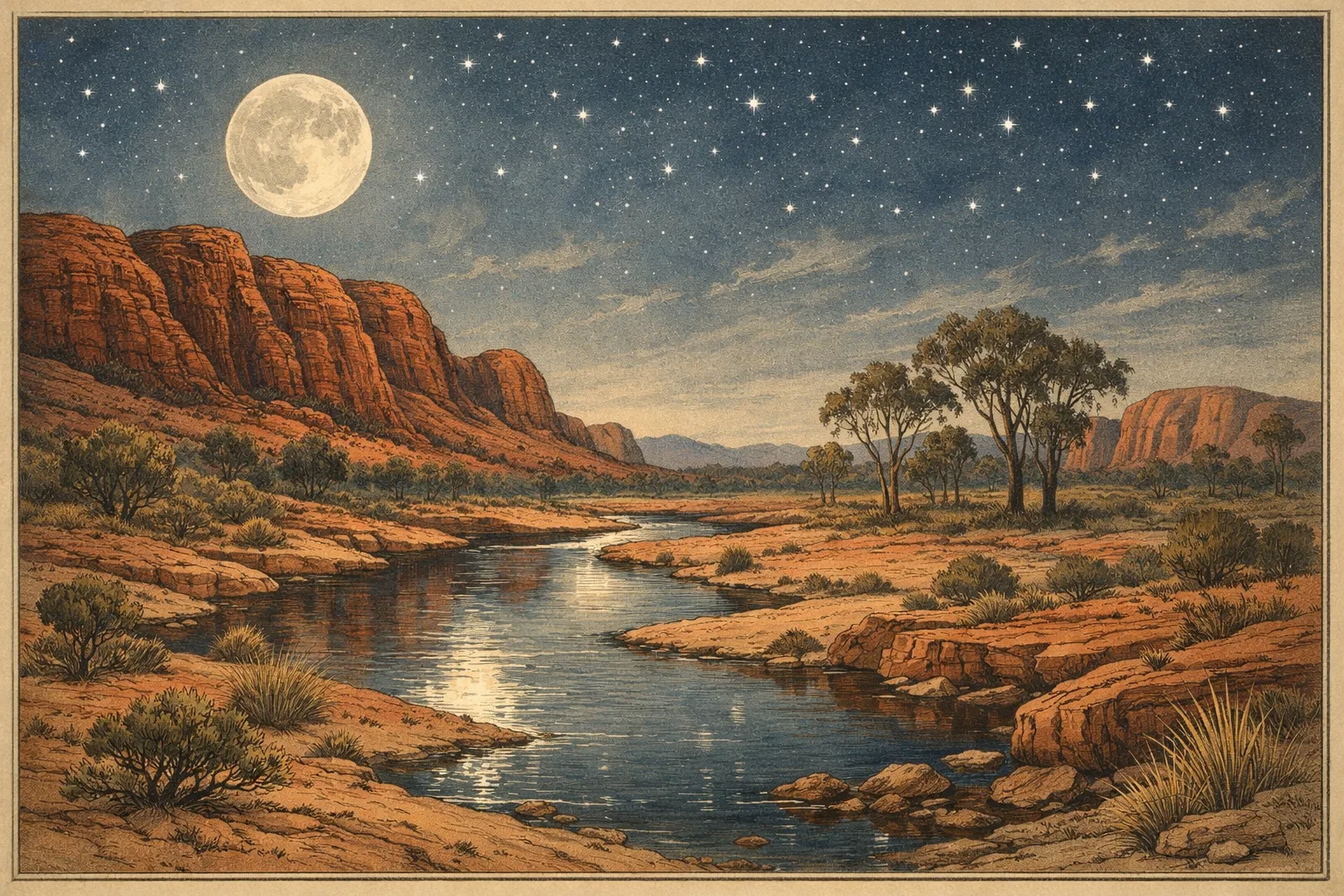
The Rainbow Serpent is one of the best-known figures in Australian Indigenous story, but it is not a single standardised character. Its names, gender, actions and local meanings vary widely across Country. What links many public accounts is an association with water, fertility, creation, danger and the shaping of landscape. The National Museum of Australia describes the Rainbow Serpent as one of the most pervasive figures in Indigenous spiritual life, strongly associated with rain and life-giving water.[National Museum of Australia]nma.gov.auOpen source on nma.gov.au.
Kakadu National Park uses the Rainbow Serpent in its logo as a sign of cultural unity across many clans and languages in the region, while also presenting it as a reminder of power, presence and obligations to care for Country. In Arnhem Land bark painting traditions, the National Museum notes that Rainbow Serpent figures may appear as composite beings and may be connected to billabongs, birth, transformation and particular places.[Kakadu National Park]kakadu.gov.auOpen source on kakadu.gov.au.
Modern retellings have also made the Rainbow Serpent one of the most recognisable Australian mythic figures beyond Indigenous communities. Dick Roughsey’s 1975 children’s book The Rainbow Serpent helped introduce many Australian schoolchildren to a public literary version of the story, while later artworks, exhibitions and museum acquisitions have continued to reinterpret the figure. The National Museum’s 2022 acquisition of Rover Thomas’s Jabanunga Goorialla (Rainbow Serpent) shows how an ancestral being can also be part of contemporary art, historical memory and national collecting.[The Guardian]theguardian.comRoughsey's storytelling, paired with vivid artwork, opened a path for readers—especially children—to engage with First Nations spirituali…
The danger is that popular culture can turn a living, local, law-bearing figure into a generic “Australian dragon”. A better reading is to see the Rainbow Serpent as a family of traditions: powerful, place-based, sometimes public, sometimes restricted, and still meaningful in art, land care, museum interpretation and community teaching.

Songlines, stars and stories that travel
One of Australia’s most distinctive contributions to world folklore is the songline: a route of story, song, place and ancestral movement. At Uluṟu-Kata Tjuṯa, Parks Australia explains that ancestral journeys across the land are called iwara, or songlines, and that people can follow the stories and songs of ancestors along these routes, sometimes for hundreds of kilometres.[Uluṟu-Kata Tjuṯa National Park]uluru.gov.auOpen source on uluru.gov.au.
The Seven Sisters songlines are among the most widely exhibited public examples. The National Museum of Australia’s Songlines: Tracking the Seven Sisters exhibition follows five First Nations songlines from the Western and Central Deserts, presenting a story of pursuit, escape, desire, magic and family bonds through paintings, photographs, objects, song, dance and multimedia. The museum describes the exhibition as Aboriginal-led and grounded in Indigenous voices and immersive display.[National Museum of Australia]nma.gov.auOpen source on nma.gov.au.
Star stories are also central to Torres Strait Islander tradition. The State Library of Queensland’s ReTold project draws on the Margaret Lawrie Collection and works with Torres Strait Islander language speakers and community members to retell selected stories and songs from Myths and Legends of the Torres Strait. In Torres Strait traditions, Tagai is a major sea-and-sky figure; AIATSIS describes Richard Davis’s Stars of Tagai as a study of the “blue-water people” of the Torres Strait, their sea culture, identity and custom, with the title drawn from the story of Tagai.[State Library of Queensland]slq.qld.gov.auState Library of Queensland Torres Strait Islander LanguageState Library of Queensland Torres Strait Islander Language
These traditions also show why “folklore” is not the opposite of knowledge. Researchers in Australian cultural astronomy have argued that Aboriginal and Torres Strait Islander oral traditions encode careful observations of stars, seasons, navigation and natural events. Ray Norris and Duane Hamacher’s overview of Aboriginal astronomy describes astronomical knowledge preserved through oral tradition, ceremony and art, including calendrical and navigational functions.[arXiv]arxiv.orgarXiv Australian Aboriginal Astronomy: OverviewarXiv Australian Aboriginal Astronomy: Overview
Stories can carry environmental memory
Some Australian oral traditions may preserve memories of major environmental change. Patrick Nunn and Nicholas Reid’s research on Aboriginal memories of coastal inundation assembled stories from 21 locations around Australia’s coastline and argued that many plausibly refer to sea-level rise events more than about 7,000 years ago, after the last Ice Age.[Astrophysics Data System]ui.adsabs.harvard.eduOpen source on harvard.edu.
This does not mean every story should be treated as a literal scientific report. Folklore carries social, moral, spiritual and ecological meaning at the same time. But it does challenge the lazy idea that oral tradition is merely fantasy. The University of New England’s description of Reid and Nunn’s work notes that some coastal stories describe places once visible being lost, or places once reachable on foot becoming accessible only by swimming or canoe.[UNE]une.edu.auOpen source on edu.au.
Other studies examine Aboriginal oral traditions associated with meteorite craters and unusual sky events. Hamacher and Goldsmith’s work on impact craters found traditions and artworks associated with several Australian impact sites, while also noting that not every crater known to science has a recorded oral tradition attached. Their caution is important: the strongest evidence comes when oral accounts, landscape, archaeology, language and community knowledge can be considered together, rather than when outsiders force every story into a modern scientific category.[arXiv]arxiv.orgarXiv Aboriginal Oral Traditions of Australian Impact CratersarXiv Aboriginal Oral Traditions of Australian Impact Craters
For readers, the useful takeaway is not “ancient people secretly knew modern science”. It is that Australian story traditions often preserve close observation of Country, sky, water, animals and seasonal change, and that those observations are embedded in social law, ceremony and place.
Bunyips, yowies and the Australian monster tradition
The bunyip is probably Australia’s most famous water monster. In colonial newspapers and later folklore collections, it appears as a frightening creature of swamps, billabongs, creeks and waterholes. Some accounts treat it as an Aboriginal being adapted into settler storytelling; others turn it into a comic or grotesque national monster. The National Library of Australia has treated bunyips as part of “Australia’s folklore of fear”, and the published record shows how Aboriginal terms and beliefs were reframed by colonial writers, newspapers and children’s literature.[National Library of Australia]library.gov.auoral history and folkloreoral history and folklore
The bunyip’s power comes from the landscape it inhabits. Waterholes in a dry continent are practical lifelines, sacred places, ecological refuges and dangerous thresholds. A creature that lives in deep, dark or hidden water can warn children away from danger, mark a place as spiritually charged, or express settler unease about landscapes they did not understand. Later retellings often strip away those local meanings and leave only the monster.
The yowie sits closer to cryptid folklore: a large, hairy, human-like being reported in bush and mountain regions, especially in eastern Australia. Modern yowie culture mixes Aboriginal story fragments, colonial “hairy man” reports, local tourism, tabloid sightings, paranormal investigation and internet communities. The National Library’s catalogue record for Tim the Yowie Man captures the contemporary form of this tradition: part mystery hunting, part travel writing, part performance of Australian weirdness.[National Library of Australia Catalogue]catalogue.nla.gov.auOpen source on nla.gov.au.
The clearest distinction is between tradition and proof. Bunyips and yowies matter as folklore because people tell, localise, market, fear, joke about and reinterpret them. That does not require treating every sighting claim as evidence of an unknown animal. In fact, the shifting descriptions are part of the folklore: the creature changes as it moves from local warning tale to newspaper oddity, tourist mascot, podcast subject or online cryptid file.
Min Min lights and outback uncertainty
The Min Min lights are among Australia’s most enduring strange-light legends. They are usually described as glowing lights seen in remote inland areas, especially in Queensland’s Channel Country around Boulia, though accounts circulate more widely. Folklore gives them agency: they follow travellers, approach, retreat, vanish and reappear. That behaviour makes them feel less like ordinary lights and more like presences in the outback.
Scientific explanations often point to atmospheric refraction, mirage effects or distant vehicle lights seen under unusual temperature conditions. The University of Queensland publicised research in 2003 suggesting that some Min Min sightings could be explained by a Fata Morgana-type optical effect, where light from distant sources is refracted over the horizon.[Wikipedia]WikipediaMin Min lightMin Min light
Yet the legend survives because explanation and experience are not the same thing. A traveller alone on a dark road does not experience an “optical account”; they experience a light that seems to behave strangely in a vast landscape. That gap between explanation and felt encounter is exactly where folklore thrives. The Min Min lights are not just a puzzle to solve but a story form: the outback as open, disorienting, alive with distance and uncertainty.
Haunted Australia and the colonial Gothic
Australia’s ghost lore often clusters around colonial buildings, gaols, quarantine stations, cemeteries, homesteads, hotels and former institutions. These are places where public history and supernatural storytelling overlap. The National Trust of Australia, for example, openly presents supernatural stories connected with its New South Wales house museums, framing them as part of the atmosphere and interpretive life of heritage places.[National Trust]nationaltrust.org.auspooky stories at the national trustspooky stories at the national trust
Haunted-site traditions also reveal what later generations remember uneasily: convict punishment, disease, isolation, violence, dispossession, class hardship, domestic tragedy and institutional control. A ghost tour at an old gaol is rarely only about a ghost. It is also a way of turning difficult history into a walkable, night-time experience with names, rooms, locked doors and stories.
This does not make all ghost claims historically reliable. Haunted tourism often simplifies, exaggerates or repeats stories because they are memorable. But it does make ghost lore culturally useful. It shows which buildings feel emotionally unfinished, which histories are commercialised, and how Australians turn old sites into places of fear, curiosity and heritage.
Bushrangers, ballads and the making of national legend
Not all Australian folklore is supernatural. Colonial bush legend helped build a national mythology around the outback, the road, the campfire, the underdog, the rogue and the anti-authoritarian hero. Bush ballads, yarns, slang, occupational lore and stories of shearers, drovers, railway workers and bushrangers all fed into this tradition. The National Library of Australia’s oral history and folklore collection, described as the largest in Australia, reflects the importance of recorded voices, songs and cultural traditions in preserving this wider folklife.[National Library of Australia]library.gov.auoral history and folkloreoral history and folklore
Ned Kelly is the clearest example of history becoming folk legend. The National Museum of Australia summarises the facts starkly: Kelly was captured after the Glenrowan siege on 28 June 1880; the other gang members died; the gang was wanted for the murder of three police officers; Kelly was tried and executed in November 1880. Yet the museum also notes that the last stand became an Australian folk legend and remains disputed.[Digital Classroom]digital-classroom.nma.gov.auned kellys last standned kellys last stand
That dispute is the legend’s engine. To some, Kelly is a murderer and armed robber. To others, he is a symbol of Irish-Australian grievance, police injustice, rural poverty and defiance. State Library Victoria’s Kelly material shows how physical relics — armour made from plough mouldboards, the Jerilderie Letter, death masks and related documents — anchor the myth in objects people can still see.[State Library Victoria]slv.vic.gov.auned kelly fact sheetned kelly fact sheet
Kelly also shows how folklore changes through art. Sidney Nolan’s 1946–47 Kelly paintings turned the black helmet into one of the most recognisable images in Australian art, while Peter Carey’s True History of the Kelly Gang reworked the outlaw’s voice through literary fiction. The result is not a stable heroic tradition but a continuing argument about class, violence, rebellion and national identity.[National Gallery of Australia]nga.gov.auOpen source on nga.gov.au.
Collectors, archives and who gets to tell the story
Australian folklore has often been shaped by collectors: anthropologists, missionaries, writers, librarians, local historians, schoolteachers, journalists and community knowledge holders. That history is useful but uneven. Some early collectors preserved material that might otherwise have been harder to access; others misunderstood, mistranslated, censored or removed stories from their proper authority and context.
Modern collecting is increasingly aware of these problems. AIATSIS states that it is Australia’s only national institution focused exclusively on Aboriginal and Torres Strait Islander history, cultures and heritage, while its ethical publishing guidelines stress that Aboriginal and Torres Strait Islander stories derive from oral cultures and require respectful handling, permissions and cultural awareness.[AIATSIS]aiatsis.gov.auOpen source on aiatsis.gov.au.
The State Library of Queensland’s ReTold project offers a good model for public folklore work. Rather than simply digitising old Torres Strait stories as museum specimens, it works with language speakers and community members to remember, reclaim and retell stories from the Margaret Lawrie Collection.[State Library of Queensland]slq.qld.gov.auState Library of Queensland Torres Strait Islander LanguageState Library of Queensland Torres Strait Islander Language
This shift matters for readers. A story is not more “authentic” just because it appears in an old book. Sometimes the better source is a contemporary community-led museum page, a cultural centre, a language project, or an exhibition made with custodians. In Australian folklore, the question “Who recorded this?” is often as important as “How old is it?”
How Australian folklore is understood today
Today, Australian folklore operates in several overlapping worlds. First Nations traditions continue as living systems of knowledge, law, art, ceremony, language and Country. Museums and cultural centres present public-facing versions of selected stories, often with stronger attention to Indigenous authority than in the past. Settler traditions survive in bush songs, local yarns, ghost tours, schoolbook legends and heritage tourism. Popular culture adds novels, films, podcasts, games, memes and cryptid communities.
The most interesting modern development is not the survival of a few famous monsters, but the changing ethics of telling. Many Australians are more aware that Dreaming stories, songlines and sacred sites are not generic national property. At the same time, there is renewed public interest in Aboriginal astronomy, environmental memory, language revival and community-led exhibitions. The National Archives notes that communities across Australia are working to revive at least 31 Aboriginal and Torres Strait Islander languages, a reminder that folklore is tied to language survival as well as story survival.[NAA]naa.gov.auOpen source on naa.gov.au.
For a curious reader, the best way to approach Australian folklore is with two ideas in mind. The first is variety: Australia contains hundreds of First Nations language groups and many regional settler traditions, so no single creature or creation story can stand for the whole continent. The second is responsibility: some stories are public, some are local, some are restricted, and some have been distorted by colonial collecting or tourism. The richest understanding comes from seeing folklore not as a cabinet of odd tales, but as a living relationship between story, place, memory and power.
Amazon book picks
Further Reading
Books and field guides related to What Makes Australian Folklore So Distinctive?. Use these as the next step if you want deeper reading beyond the article.
The Native Tribes of Central Australia
Provides historical documentation of traditional stories and beliefs.
eBay marketplace picks
Marketplace Samples
Live-tested eBay searches with available results related to this page.
Endnotes
1.
Source: aiatsis.gov.au
Link:https://aiatsis.gov.au/sites/default/files/2020-09/ethical-publishing-guidelines.pdf
2.
Source: australian.museum
Link:https://australian.museum/learn/first-nations/
3.
Source: whc.unesco.org
Link:https://whc.unesco.org/en/list/447/
4.
Source: aiatsis.gov.au
Link:https://aiatsis.gov.au/publication/35806
5.
Source: arxiv.org
Title: arXiv Australian Aboriginal Astronomy: Overview
Link:https://arxiv.org/abs/1306.0971
6.
Source: une.edu.au
Link:https://www.une.edu.au/about-une/faculty-of-humanities-arts-social-sciences-and-education/hass/news-and-events/linguistics-seminars/seminar-series/oral-traditions-about-sea-level-rises-aboriginal-cultural-transmission-over-great-time-depths
7.
Source: arxiv.org
Title: arXiv Aboriginal Oral Traditions of Australian Impact Craters
Link:https://arxiv.org/abs/1306.0278
8.
Source: Wikipedia
Link:https://en.wikipedia.org/wiki/Bunyip
9.
Source: Wikipedia
Title: Min Min light
Link:https://en.wikipedia.org/wiki/Min_Min_light
10.
Source: aiatsis.gov.au
Link:https://aiatsis.gov.au/
11.
Source: naa.gov.au
Link:https://www.naa.gov.au/students-and-teachers/student-research-portal/learning-resource-themes/first-australians/history/dispossession-and-revival-indigenous-languages
12.
Source: Wikipedia
Title: The Dreaming
Link:https://en.wikipedia.org/wiki/The_Dreaming
13.
Source: Wikipedia
Link:https://en.wikipedia.org/wiki/Australia
14.
Source: Wikipedia
Title: Rainbow Serpent
Link:https://en.wikipedia.org/wiki/Rainbow_Serpent
15.
Source: Wikipedia
Link:https://en.wikipedia.org/wiki/Songline
16.
Source: Wikipedia
Title: Championnat de France de football de National
Link:https://fr.wikipedia.org/wiki/Championnat_de_France_de_football_de_National
17.
Source: Wikipedia
Title: National Australia Bank
Link:https://en.wikipedia.org/wiki/National_Australia_Bank
18.
Source: Wikipedia
Link:https://en.wikipedia.org/wiki/Yowie
19.
Source: Wikipedia
Title: Australian folklore
Link:https://en.wikipedia.org/wiki/Australian_folklore
20.
Source: Wikipedia
Title: Ned Kelly
Link:https://en.wikipedia.org/wiki/Ned_Kelly
21.
Source: Wikipedia
Title: Seven Sisters songline
Link:https://en.wikipedia.org/wiki/Seven_Sisters_songline
22.
Source: australian.museum
Link:https://australian.museum/learn/first-nations/yamuti/
23.
Source: australian.museum
Link:https://australian.museum/publications/birds-storybox/first-nations-storytelling/
24.
Source: folklore.ee
Link:https://www.folklore.ee/folklore/vol8/pdf/aflore.pdf
25.
Source: sea.museum
Link:https://www.sea.museum/first-nations
26.
Source: youtube.com
Title: First Nations Stories: The Rainbow Serpent | History | Click View
Link:https://www.youtube.com/watch?v=vjTM-MJKccg
Source snippet
The Bunyip - Australia's Most Famous Cryptid...
27.
Source: youtube.com
Title: The Bunyip
Link:https://www.youtube.com/watch?v=nCAXF0tvlvs
Source snippet
The Yowie - The Story of Australia's Bigfoot...
28.
Source: youtube.com
Title: The Yowie
Link:https://www.youtube.com/watch?v=ZieBksn2a_o
Source snippet
The Australian Bigfoot - Yowie...
29.
Source: uluru.gov.au
Link:https://uluru.gov.au/discover/culture/stories/
30.
Source: nma.gov.au
Title: National Museum of Australia Jukurrpa: The Dreaming or Dreamtime
Link:https://www.nma.gov.au/__data/assets/pdf_file/0004/19408/Yiwarra-Kuju-Dreaming.pdf
31.
Source: uluru.gov.au
Link:https://uluru.gov.au/discover/culture/tjukurpa/
32.
Source: uluru.gov.au
Link:https://uluru.gov.au/discover/culture/
33.
Source: naa.gov.au
Title: NAAour way
Link:https://www.naa.gov.au/sites/default/files/2021-08/Our-Way-Aboriginal-and-Torres-Strait-Islander-Protocols-210606_0.pdf
34.
Source: nma.gov.au
Link:https://www.nma.gov.au/exhibitions/water/australias-water-story
35.
Source: kakadu.gov.au
Link:https://kakadu.gov.au/discover/culture/stories/
36.
Source: nma.gov.au
Title: old masters
Link:https://www.nma.gov.au/exhibitions/old-masters
37.
Source: theguardian.com
Link:https://www.theguardian.com/books/2026/jan/28/rainbow-serpent-dick-roughsey-spirit-australia-childrens-book
Source snippet
Roughsey's storytelling, paired with vivid artwork, opened a path for readers—especially children—to engage with First Nations spirituali...
38.
Source: nma.gov.au
Title: rover thomas acquisition
Link:https://www.nma.gov.au/about/media/media-releases-listing-by-year/2022/rover-thomas-acquisition
39.
Source: nma.gov.au
Link:https://www.nma.gov.au/exhibitions/songlines
40.
Source: nma.gov.au
Title: from the vault songlines
Link:https://www.nma.gov.au/explore/blog/from-the-vault-songlines
41.
Source: slq.qld.gov.au
Title: State Library of Queensland Torres Strait Islander Language
Link:https://www.slq.qld.gov.au/discover/aboriginal-and-torres-strait-islander-cultures-and-stories/contemporary-stories/retold
42.
Source: ui.adsabs.harvard.edu
Link:https://ui.adsabs.harvard.edu/abs/2016AuGeo..47…11N/abstract
43.
Source: library.gov.au
Title: oral history and folklore
Link:https://www.library.gov.au/discover/what-we-collect/oral-history-and-folklore
44.
Source: catalogue.nla.gov.au
Link:https://catalogue.nla.gov.au/catalog/7498446
45.
Source: nationaltrust.org.au
Title: spooky stories at the national trust
Link:https://www.nationaltrust.org.au/blog/spooky-stories-at-the-national-trust/
46.
Source: digital-classroom.nma.gov.au
Title: ned kellys last stand
Link:https://digital-classroom.nma.gov.au/defining-moments/ned-kellys-last-stand
47.
Source: slv.vic.gov.au
Title: ned kelly fact sheet
Link:https://www.slv.vic.gov.au/search-discover/explore-collections-theme/australian-history/ned-kelly/ned-kelly-fact-sheet
48.
Source: nga.gov.au
Link:https://nga.gov.au/exhibitions/ned-kelly/
49.
Source: nla.gov.au
Link:https://nla.gov.au/nla.cat-vn711741
50.
Source: trove.nla.gov.au
Title: nla.gov.au Recent Australian Publications
Link:https://trove.nla.gov.au/sites/default/files/attachments/2024-06/Recent%20Australian%20Publications%20-%20April%202024%20-%20Alphabetic.pdf
51.
Source: trove.nla.gov.au
Title: nla.gov.au Recent Australian Publications
Link:https://trove.nla.gov.au/sites/default/files/attachments/2024-05/Recent%20Australian%20Publications%20-%20March%202024%20-%20Alphabetic.pdf
52.
Source: trove.nla.gov.au
Link:https://trove.nla.gov.au/sites/default/files/attachments/2024-06/apr24alp_rap.txt
53.
Source: theguardian.com
Link:https://www.theguardian.com/world/2003/nov/30/australia.davidfickling
54.
Source: theguardian.com
Title: indigenous australian storytelling records sea level rises over millenia
Link:https://www.theguardian.com/australia-news/2015/sep/16/indigenous-australian-storytelling-records-sea-level-rises-over-millenia
55.
Source: aiatsis.gov.au
Title: languages alive
Link:https://aiatsis.gov.au/explore/languages-alive
56.
Source: aiatsis.gov.au
Title: indigenous australians aboriginal and torres strait islander people
Link:https://aiatsis.gov.au/explore/indigenous-australians-aboriginal-and-torres-strait-islander-people
57.
Source: aiatsis.gov.au
Title: stolen generations
Link:https://aiatsis.gov.au/explore/stolen-generations
58.
Source: aiatsis.gov.au
Title: right water
Link:https://aiatsis.gov.au/blog/right-water
59.
Source: aiatsis.gov.au
Title: welcome country
Link:https://aiatsis.gov.au/explore/welcome-country
60.
Source: aiatsis.gov.au
Link:https://aiatsis.gov.au/sites/default/files/research_pub/we-have-the-song-so-we-have-the-land_0_2.pdf
61.
Source: aiatsis.gov.au
Title: land rights
Link:https://aiatsis.gov.au/explore/land-rights
62.
Source: aiatsis.gov.au
Title: missions stations and reserves
Link:https://aiatsis.gov.au/explore/missions-stations-and-reserves
63.
Source: shop.aiatsis.gov.au
Link:https://shop.aiatsis.gov.au/products/stars-of-tagai
64.
Source: nma.gov.au
Link:https://www.nma.gov.au/exhibitions/kaninjaku-canning-stock-route/stories/seven-sisters
65.
Source: nma.gov.au
Link:https://www.nma.gov.au/exhibitions/yiwarra-kuju-canning-stock-route/essays/listening-country/country-family
66.
Source: nma.gov.au
Link:https://www.nma.gov.au/exhibitions/old-masters/central-arnhem-land
67.
Source: nma.gov.au
Link:https://www.nma.gov.au/audio/uncategorised/symbols-of-australia-public-forum-with-rod-quantock/transcripts/symbols-of-australia-public
68.
Source: nma.gov.au
Link:https://www.nma.gov.au/audio/old-masters-exhibition-lecture-series/transcripts/seeing-barks
69.
Source: nma.gov.au
Link:https://www.nma.gov.au/exhibitions/yiwarra-kuju-canning-stock-route/essays/drawing-line-sand/history-art
70.
Source: nma.gov.au
Link:https://www.nma.gov.au/__data/assets/pdf_file/0010/19396/Yiwarra_Kuju_all_colour.pdf
71.
Source: nma.gov.au
Link:https://www.nma.gov.au/exhibitions/not-just-ned/bushrangers
72.
Source: nma.gov.au
Title: ned kelly
Link:https://www.nma.gov.au/explore/collection/highlights/ned-kelly
73.
Source: nma.gov.au
Link:https://www.nma.gov.au/defining-moments/resources/uluru-handback-anangu
74.
Source: nma.gov.au
Link:https://www.nma.gov.au/exhibitions/first-australians
75.
Source: nma.gov.au
Link:https://www.nma.gov.au/exhibitions/endeavour-voyage/sky-stories
76.
Source: search.sl.nsw.gov.au
Link:https://search.sl.nsw.gov.au/primo-explore/fulldisplay/SLNSW_ALMA21126013990002626/SLNSW
77.
Source: indigenous.sl.nsw.gov.au
Link:https://indigenous.sl.nsw.gov.au/recent-updates/ancient-aboriginal-stories-preserve-history-rise-sea-level
78.
Source: uluru.gov.au
Link:https://uluru.gov.au/discover/history/
79.
Source: slq.qld.gov.au
Link:https://www.slq.qld.gov.au/visit/spaces/kuril-dhagun
80.
Source: slq.qld.gov.au
Link:https://www.slq.qld.gov.au/discover/exhibitions/spoken
81.
Source: aph.gov.au
Title: Gail Mabo Tagai
Link:https://www.aph.gov.au/Visit_Parliament/Art/Collections/Gail_Mabo_Tagai
82.
Source: lequipe.fr
Link:https://www.lequipe.fr/Football/national/page-classement-equipes/general
83.
Source: findanexpert.unimelb.edu.au
Link:https://findanexpert.unimelb.edu.au/news/64485-rising-seas-and-a-great-southern-star–aboriginal-oral-traditions-stretch-back-more-than-12-000-years
84.
Source: pursuit.unimelb.edu.au
Title: unimelb.edu.au The Boorong pride themselves upon knowing more
Link:https://pursuit.unimelb.edu.au/articles/the-boorong-pride-themselves-upon-knowing-more-of-astronomy-than-any-other
85.
Source: potter-museum.unimelb.edu.au
Link:https://potter-museum.unimelb.edu.au/exhibition/65000-years/rooms/cultural-astronomy
86.
Source: naa.gov.au
Link:https://www.naa.gov.au/
87.
Source: naa.gov.au
Link:https://www.naa.gov.au/sites/default/files/2022-09/Indigenous-cultural-sensitivities.docx
88.
Source: naa.gov.au
Link:https://www.naa.gov.au/explore-collection/first-australians
89.
Source: naa.gov.au
Title: reconciliation action plan 2014 15
Link:https://www.naa.gov.au/about-us/who-we-are/accountability-and-reporting/reconciliation-action-plan
90.
Source: naa.gov.au
Link:https://www.naa.gov.au/students-and-teachers/student-research-portal/learning-resource-themes/first-australians/rights-and-freedoms/land-rights-first-australians-information-supporting-petition
91.
Source: naa.gov.au
Link:https://www.naa.gov.au/sites/default/files/2020-06/research-guide-tracking-family-second-edition_0.pdf
92.
Source: naa.gov.au
Link:https://www.naa.gov.au/sites/default/files/2019-12/agency-ra-2011-00557112.pdf
93.
Source: naa.gov.au
Link:https://www.naa.gov.au/students-and-teachers/student-research-portal/learning-resource-themes/first-australians/history/archaeological-shell-midden-weipa
94.
Source: naa.gov.au
Link:https://www.naa.gov.au/students-and-teachers/student-research-portal/learning-resource-themes/first-australians/history/hand-back-uluru-national-park-its-traditional-owners
95.
Source: mythus.fandom.com
Link:https://mythus.fandom.com/wiki/Yowie
96.
Source: researchrepository.rmit.edu.au
Link:https://researchrepository.rmit.edu.au/discovery/fulldisplay?adaptor=Local+Search+Engine&context=L&docid=alma9917810530001341&lang=en&mode=advanced&offset=10&query=creator%2Cexact%2CDavis%2C+Richard%2CAND&search_scope=Everything_Including_FigShare&tab=Everything_Including_Figshare&vid=61RMIT_INST%3ARMITU
97.
Source: staffportal.curtin.edu.au
Link:https://staffportal.curtin.edu.au/staff/profile/view/graham-seal-b31b18ce/
98.
Source: nationaltrustqld.org.au
Title: real life haunted house
Link:https://nationaltrustqld.org.au/real-life-haunted-house/
99.
Source: kakadu.gov.au
Link:https://kakadu.gov.au/things-do/activities/rock-art/
100.
Source: museum.qld.gov.au
Title: Rare Book Collection
Link:https://www.museum.qld.gov.au/collections-and-research/research-library/rare-book-collection/
101.
Source: jstor.org
Link:https://www.jstor.org/stable/24810672
102.
Source: agriculture.gov.au
Link:https://www.agriculture.gov.au/sites/default/files/documents/uktnp-a4factsheet-tjukurpa-small.pdf
103.
Source: adsabs.harvard.edu
Link:https://adsabs.harvard.edu/pdf/2011IAUS..260…39N
104.
Source: adsabs.harvard.edu
Link:https://adsabs.harvard.edu/full/2014JAHH…17..195W
105.
Source: parks.qld.gov.au
Title: first nations culture
Link:https://parks.qld.gov.au/things-to-do/activities/first-nations-culture
106.
Source: unisc.edu.au
Title: evidence the oral stories of australia s first nations might be 10 000 years old
Link:https://www.unisc.edu.au/about/unisc-news/news-archive/2023/july/evidence-the-oral-stories-of-australia-s-first-nations-might-be-10-000-years-old
107.
Source: boulia.qld.gov.au
Link:https://www.boulia.qld.gov.au/Tourism/Min-Min-Encounter-Visitor-Information-Centre
108.
Source: samuseum.sa.gov.au
Link:https://www.samuseum.sa.gov.au/visit/continuous-culture
109.
Source: research.usc.edu.au
Link:https://research.usc.edu.au/esploro/outputs/magazineArticle/Ancient-Aboriginal-stories-preserve-history-of/99450066202621
110.
Source: thenomadicexplorers.com
Link:https://thenomadicexplorers.com/content/kakadu-national-park-aboriginal-rock-paintings-nanguluwur-and-nourlangleanbangbang-gallery
111.
Source: ebsco.com
Link:https://www.ebsco.com/research-starters/religion-and-philosophy/dreamtime
112.
Source: aitsl.edu.au
Link:https://www.aitsl.edu.au/tools-resources/resource/dreaming-stories-illustration-of-practice
113.
Source: libraryflin.flinders.edu.au
Link:https://libraryflin.flinders.edu.au/content/dam/library/documents/wanampi-rainbow-serpent-of-the-desert.doc
114.
Source: healthinfonet.ecu.edu.au
Title: ecu.edu.au Country, culture and spirituality
Link:https://healthinfonet.ecu.edu.au/learn/health-topics/social-and-emotional-wellbeing/country-culture-spirituality/
115.
Source: studyaustralia.gov.au
Link:https://www.studyaustralia.gov.au/en/tools-and-resources/tips-and-advice-for-students/australian-aboriginal-and-torres-strait-islander-peoples
116.
Source: caseytours.com.au
Title: Min Min Lights
Link:https://www.caseytours.com.au/news/min-min-lights/
Additional References
117.
Source: youtube.com
Title: Bunyip: Australia’s Mysterious Amphibian Monster | Monstrum
Link:https://www.youtube.com/watch?v=TeUGl1rOXx0
Source snippet
First Nations Stories: The Rainbow Serpent | History | ClickView...
118.
Source: academia.edu
Link:https://www.academia.edu/16307214/Indigenous_Australian_Stories_and_Sea_Level_Change
119.
Source: researchgate.net
Link:https://www.researchgate.net/publication/282663789_Aboriginal_Memories_of_Inundation_of_the_Australian_Coast_Dating_from_More_than_7000_Years_Ago
120.
Source: greataustralianoutdoors.com.au
Link:https://greataustralianoutdoors.com.au/5-great-australian-myths-legends/
121.
Source: yha.com.au
Link:https://www.yha.com.au/travel-and-tours/traveller-stories/aboriginal-sacred-sites/
122.
Source: amazon.de
Link:https://www.amazon.de/Dictionary-Australian-Folklore-Legends-Traditions/dp/0670900419?tag=searcht-20
123.
Source: japingkaaboriginalart.com
Link:https://japingkaaboriginalart.com/aboriginal-dreamtime-stories/
124.
Source: natchaculturaltours.com
Link:https://www.natchaculturaltours.com/blog/aboriginal-sacred-sites-australia
125.
Source: lowitja.org.au
Link:https://www.lowitja.org.au/wp-content/uploads/2023/05/DP9-Aboriginal-Spirituality.pdf
126.
Source: uluru-australia.com
Link:https://uluru-australia.com/about-uluru/aboriginal-uluru-dreamtime/
Topic Tree
Follow this branch
Related pages 192
- Afghan Folklore
- Albanian Folklore
- Algerian Folklore
- Azerbaijan Folklore
- Belarus Folklore
- +187 more in sidebar