Within Saint Lucia Folklore
How Saint Lucia Keeps Folklore Alive
Saint Lucian folklore survives through Creole speech, family storytelling, performance, healing beliefs and ritual memory.
On this page
- Grandmothers, villages and oral transmission
- Creole language, place names and performance
- Kele, healing beliefs and respectful boundaries
Page outline Jump by section
Introduction
Saint Lucian folklore survives not only because stories were once told, but because they continue to be spoken, sung, remembered and adapted in everyday life. The island’s legends, supernatural beliefs and traditional knowledge have long travelled through families, villages, religious gatherings, wakes, festivals and community celebrations. In many cases, the most important guardians of folklore were not professional writers or collectors but grandparents, storytellers, singers, healers and religious leaders who passed knowledge from one generation to the next.
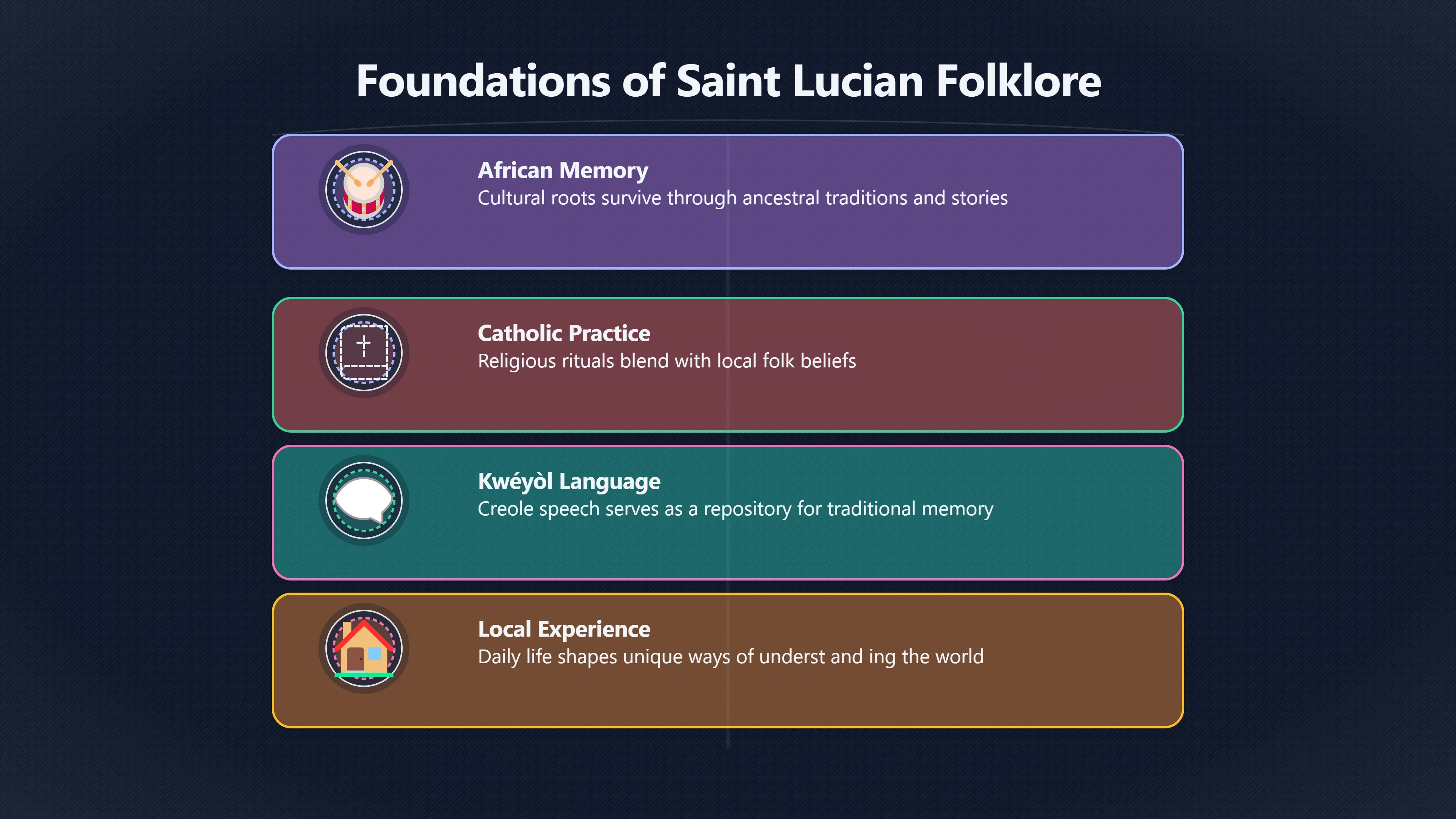
This living tradition reflects the island’s Creole heritage. African cultural memory, Catholic practice, local experience and the Saint Lucian Creole language developed together, creating a distinctive way of understanding the world. Folklore in Saint Lucia is therefore not simply a collection of old tales about spirits and strange beings. It is also a way of preserving identity, values, history and community memory.[waccglobal.org]waccglobal.orgof a unique experience of colonialism, conquest and counter conquest.Read more…
Grandmothers, Villages and Oral Transmission
For much of Saint Lucia’s history, folklore was transmitted orally rather than through books. Stories moved through households, village gatherings, agricultural work parties, wakes and informal evening conversations. Children often encountered folk tales through older relatives, especially grandmothers and elders, who served as keepers of family and community memory.
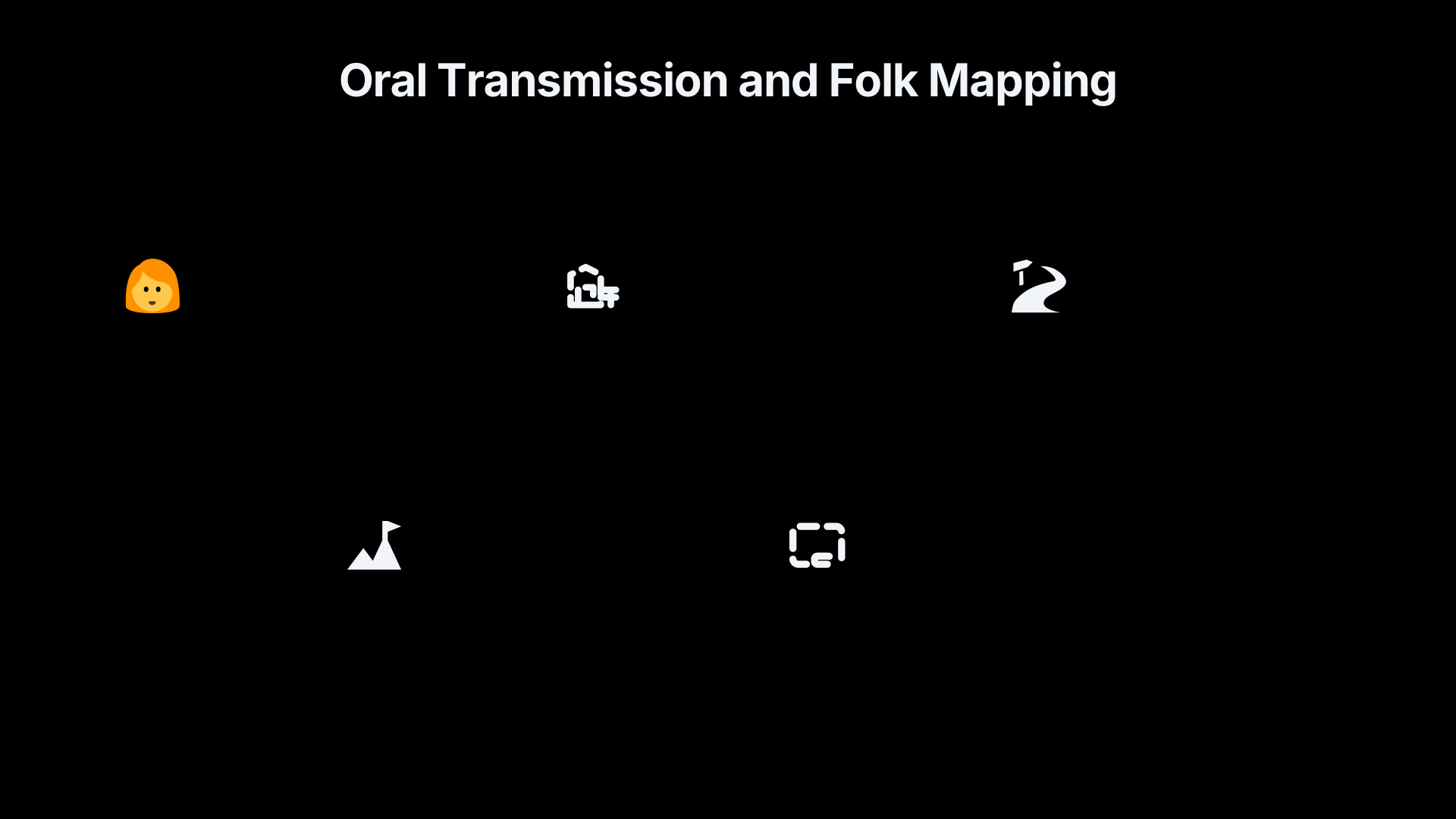
Because stories were passed by word of mouth, they rarely existed in a single fixed version. A tale about a spirit, a warning about travelling at night or a story explaining a local landmark could change slightly from village to village and from one storyteller to another. This flexibility helped folklore remain relevant to changing circumstances while preserving familiar themes about respect, caution, community obligations and spiritual awareness. Recent efforts to record Saint Lucian folklore have found that storytellers frequently connect traditional narratives to specific villages, roads, rivers and landmarks, showing how deeply stories remain rooted in local experience.[jeangoldinginstitute.blogs.bristol.ac.uk]jeangoldinginstitute.blogs.bristol.ac.uktelling tales building a folk map of st luciaTelling Tales: Building a Folk Map of St Lucia7 Oct 2025 — This small archive of Ti Bolom stories demonstrated the fluid and embodied nat…
Oral tradition also helped preserve knowledge that was not strictly supernatural. Practical wisdom, moral lessons, family histories and community values often travelled alongside stories about legendary beings. Folklore functioned as a social education system as much as a source of entertainment.[Wikipedia]WikipediaOral traditionOral tradition
Why the Creole Language Matters
The survival of Saint Lucian folklore is closely tied to the survival of Saint Lucian Creole, often known as Kwéyòl. Many traditional stories, sayings and proverbs lose part of their meaning when removed from the language in which they were created. Expressions, jokes, wordplay and cultural references are often embedded within Creole speech itself.[waccglobal.org]waccglobal.orgof a unique experience of colonialism, conquest and counter conquest.Read more…
For much of the colonial period, Creole speech was sometimes treated as less prestigious than English. Yet it remained the language of everyday life for many Saint Lucians and continued to carry traditional knowledge across generations. Scholars and cultural advocates have argued that preserving Kwéyòl is also a way of preserving folklore, because language serves as a repository for traditional memory and community values.[waccglobal.org]waccglobal.orgof a unique experience of colonialism, conquest and counter conquest.Read more…
The annual celebration known as Jounen Kwéyòl demonstrates this connection clearly. Storytelling, proverbs, songs and traditional performances form an important part of the event. Rather than presenting folklore as a museum piece, the celebration places traditional language and oral culture into contemporary public life, showing that they remain active forms of expression rather than relics of the past.[Saint Lucia News Online]saintlucianewsonline.netSaint Lucia News OnlineThe Vibrant Evolution of Jounen Kwéyòl in Saint LuciaOctober 25, 2023 — 25 Oct 2023 — One of the cornerstones of J…
Place Names, Performance and Cultural Memory
Saint Lucian folklore often lives through performance as much as narration. Music, dance, drama and ritual all help keep traditional stories visible. Modern theatre productions, cultural festivals and community events frequently draw on folklore characters and traditional themes, introducing them to younger audiences who may not encounter them in the same way their grandparents did.
Storytelling is also tied to place. Researchers documenting Saint Lucian folk narratives have noted how stories frequently refer to particular hills, valleys, villages and roads. In this sense, folklore creates a cultural map layered over the physical landscape. A place may be remembered not only for its geography but also for a story associated with it, whether that story concerns a spirit, a warning, a historical event or a remarkable local figure.[jeangoldinginstitute.blogs.bristol.ac.uk]jeangoldinginstitute.blogs.bristol.ac.uktelling tales building a folk map of st luciaTelling Tales: Building a Folk Map of St Lucia7 Oct 2025 — This small archive of Ti Bolom stories demonstrated the fluid and embodied nat…
Cultural institutions have played an increasingly important role in preserving these traditions. Since the 1970s, the Folk Research Centre has documented oral history, language, music and customary practices while supporting public celebrations of Creole culture. Its work reflects a broader effort to ensure that folklore remains a living tradition rather than a disappearing memory.[folkresearchcentre.org]folkresearchcentre.orgFolk Research CentreTraditional Dance · Traditional Practices · Language Studies · Traditional Games · Flower Festivals · Traditional Art…
Kele and the Meeting of Folk Religion and Christianity
One of the most distinctive examples of living folk religion in Saint Lucia is the Kele ceremony. Practised especially in parts of the island’s north-east, Kele preserves elements of African religious tradition that survived slavery and colonial rule. The ceremony includes ritual offerings, drumming, prayers and acts of thanksgiving associated with spiritual figures whose roots can be traced to West African traditions.[folkresearchcentre.org]folkresearchcentre.orgTraditional PracticesKoudmen is a form of co-operative self-help practised in St. Lucia. KéLé CEREMONY This is an African religious cerem…
Historically, these practices were often criticised or dismissed by colonial authorities and by some members of the wider population. Researchers have documented periods when Kele was regarded as a “pagan” custom and pushed to the margins of public life. Yet the tradition survived through family transmission, particularly among communities that identified themselves as descendants of African ancestors sometimes known locally as “Nèg Djiné”.[IAI Publications]publications.iai.spk-berlin.deIAI Publications KÉLÉ IN STLUCIA — A MINORITY CULT EMERGING…These religious rites, directly imported from their African homeland, were termed as “pagan customs”…
An important feature of Kele is that practitioners have often combined participation in the ceremony with active Christian faith. Rather than seeing the two systems as mutually exclusive, many participants historically moved between church life and traditional ritual practice. This blending of influences reflects a wider pattern in Caribbean folk religion, where African-derived traditions and Christianity developed alongside one another rather than existing as completely separate worlds.[folkresearchcentre.org]folkresearchcentre.orgTraditional PracticesKoudmen is a form of co-operative self-help practised in St. Lucia. KéLé CEREMONY This is an African religious cerem…
Healing Beliefs and Respectful Boundaries
Traditional healing beliefs occupy a space between folklore, religion and practical knowledge. Across generations, Saint Lucians have relied on inherited knowledge about plants, spiritual protection, prayer and ritual practices alongside formal medicine. Some of these traditions are understood primarily as cultural heritage, while others continue to be used in daily life.
Folklore surrounding illness and healing often overlaps with beliefs about unseen spiritual forces. Stories may explain misfortune, unusual sickness or bad luck through supernatural causes, while traditional remedies may combine herbal knowledge with prayer, ritual action or protective customs. Such beliefs should not be understood as a single organised system. They vary between communities and families and often exist alongside modern medical practice.[folkresearchcentre.org]folkresearchcentre.orgTraditional PracticesKoudmen is a form of co-operative self-help practised in St. Lucia. KéLé CEREMONY This is an African religious cerem…
Many Saint Lucians approach these traditions with a sense of respect rather than certainty. Even people who do not personally believe every traditional account may still treat certain stories, rituals or places with caution because they remain part of community memory. This respectful boundary between belief, heritage and uncertainty is one reason folklore continues to matter.
How the Tradition Stays Alive Today
The greatest challenge facing Saint Lucian folklore is not whether the stories exist, but whether they continue to be told. Migration, changing media habits and the dominance of global entertainment have altered the conditions under which oral traditions once flourished. Yet folklore has not disappeared.
Today it survives through schools, theatre, festivals, language programmes, archives, community organisations and family storytelling. The continued promotion of Kwéyòl, the work of the Folk Research Centre and public celebrations such as Jounen Kwéyòl provide spaces where traditional stories, songs and beliefs can be shared with new generations.[folkresearchcentre.org]folkresearchcentre.orgFolk Research CentreTraditional Dance · Traditional Practices · Language Studies · Traditional Games · Flower Festivals · Traditional Art…
The result is a tradition that is neither frozen in the past nor entirely transformed into heritage tourism. Saint Lucian folklore remains a living Creole tradition: a body of stories, beliefs, performances and memories that continues to evolve while preserving connections to African ancestry, local history and community identity.[waccglobal.org]waccglobal.orgof a unique experience of colonialism, conquest and counter conquest.Read more…
Amazon book picks
Further Reading
Books and field guides related to How Saint Lucia Keeps Folklore Alive. Use these as the next step if you want deeper reading beyond the article.

Anansi, the Spider Man
Shows how stories are preserved, adapted and retold within Creole cultures.

Rise of the Jumbies
First published 2017. Subjects: Children's fiction, Missing persons, fiction, Blacks, fiction, Caribbean area, fiction, Horror stories.
Caribbean Folk Tales
Demonstrates how oral storytelling traditions survive through communities and generations.
eBay marketplace picks
Marketplace Samples
Live-tested eBay searches with available results related to this page.



Endnotes
1.
Source: waccglobal.org
Link:https://waccglobal.org/traditional-knowledge-the-kweyol-language-and-public-policy-in-a-small-nation-state/
Source snippet
of a unique experience of colonialism, conquest and counter conquest.Read more...
2.
Source: jstor.org
Title: Cultural Preservation and Language Reclamation: The St
Link:https://www.jstor.org/stable/40654548
Source snippet
by H SIMMONS-MCDONALD · 2006 · Cited by 5 — Creole language and traditions are important in defining the St. Lucian experience and identi...
3.
Source: Wikipedia
Title: Saint Lucian Creole
Link:https://en.wikipedia.org/wiki/Saint_Lucian_Creole
4.
Source: jeangoldinginstitute.blogs.bristol.ac.uk
Title: telling tales building a folk map of st lucia
Link:https://jeangoldinginstitute.blogs.bristol.ac.uk/2025/10/07/telling-tales-building-a-folk-map-of-st-lucia/
Source snippet
Telling Tales: Building a Folk Map of St Lucia7 Oct 2025 — This small archive of [Ti Bolom]({{ 'ti-bolom/' | relative_url }}) stories demonstrated the fluid and embodied nat...
5.
Source: Wikipedia
Title: Oral tradition
Link:https://en.wikipedia.org/wiki/Oral_tradition
6.
Source: folkresearchcentre.org
Link:https://folkresearchcentre.org/
Source snippet
Folk Research CentreTraditional Dance · Traditional Practices · Language Studies · Traditional Games · Flower Festivals · Traditional Art...
7.
Source: Wikipedia
Title: Folk Research Centre
Link:https://en.wikipedia.org/wiki/Folk_Research_Centre
8.
Source: folkresearchcentre.org
Link:https://folkresearchcentre.org/heritage-studies/traditional-practices/
Source snippet
Traditional PracticesKoudmen is a form of co-operative self-help practised in St. Lucia. KéLé CEREMONY This is an African religious cerem...
9.
Source: Wikipedia
Link:https://en.wikipedia.org/wiki/K%C3%A9l%C3%A9
10.
Source: jstor.org
Title: The Kele (Chango) Cult in St
Link:https://www.jstor.org/stable/25612555
Source snippet
Luciaby GE Simpson · 1973 · Cited by 11 — Kele devotees believe that an African language is used during a ceremony. Actually, the partici...
11.
Source: youtube.com
Title: The Folk Research Centre
Link:https://www.youtube.com/watch?v=qgFsVhJjS68
Source snippet
Annou Dansé Kwéyòl Sent Lisi...
12.
Source: trippee.com
Title: Holiday Inspiration Folk Research Centre
Link:https://trippee.com/listing/folk-research-centre/
Source snippet
Holiday InspirationFolk Research Centre - TrippeeEstablished in 1973, the Centre plays a vital role in documenting Saint Lucia's oral his...
13.
Source: listwamedia.com
Link:https://listwamedia.com/saint-lucia-kweyol-a-language-rooted-in-culture-and-identity/
Source snippet
Listwa CollectiveSaint Lucia Kweyol – A Language Rooted in Culture and...For many Saint Lucians, Kweyol is a symbol of pride and resilie...
14.
Source: saintlucianewsonline.net
Link:https://www.saintlucianewsonline.net/component/k2/item/283-the-vibrant-evolution-of-jounen-kweyol-in-saint-lucia
Source snippet
Saint Lucia News OnlineThe Vibrant Evolution of Jounen Kwéyòl in Saint LuciaOctober 25, 2023 — 25 Oct 2023 — One of the cornerstones of J...
Published: October 25, 2023
15.
Source: publications.iai.spk-berlin.de
Title: IAI Publications KÉLÉ IN ST
Link:https://publications.iai.spk-berlin.de/servlets/MCRFileNodeServlet/Document_derivate_00002167/BIA_046_093_101.pdf
Source snippet
LUCIA — A MINORITY CULT EMERGING...These religious rites, directly imported from their African homeland, were termed as “pagan customs”...
Additional References
16.
Source: st-martin.org
Link:https://www.st-martin.org/us/dive-into-culture-and-pass-on-legacy-through-storytelling/
17.
Source: facebook.com
Link:https://www.facebook.com/groups/ilovestlucia/posts/26655134407422033/
Source snippet
Rediscovering Saint Lucia's old traditionsIn pursuit of Saint Lucia’s old traditions. Something that has eluded me for years,it was dyin...
18.
Source: researchgate.net
Link:https://www.researchgate.net/publication/8617305_The_Cult_of_St_Lucia_Patroness_of_the_Eyes_Some_Examples_from_Croatian_Ethnomedical_Tradition
Source snippet
The Cult of St. Lucia, Patroness of the EyesIn the introductory part, the authors present several patrons/patronesses of the eyes and sig...
19.
Source: facebook.com
Link:https://www.facebook.com/groups/ilovestlucia/posts/26709142938687846/
Source snippet
West Indian culture and witchcraft traditionsJAB,has remained as part West Indian,culture from the beginning of time, witchcraft and sor...
20.
Source: facebook.com
Link:https://www.facebook.com/CaribbeanTourismOrganization/posts/-saint-lucia-our-cultural-gemon-this-lush-and-legendary-island-culture-dances-in/1272386491589148/
Source snippet
Music and Dance: African rhythms and traditions have greatly influenced Saint Lucian music and dance. Genres like *calypso*...Read more...
21.
Source: facebook.com
Link:https://www.facebook.com/groups/ilovestlucia/posts/7824729510889140/
Source snippet
characters that have African roots. Figures like the *La...Read more...
22.
Source: facebook.com
Link:https://www.facebook.com/StLuciaByKirk/posts/st-lucias-uniquely-kw%C3%A9y%C3%B2l-languageit-is-said-to-be-one-born-out-of-resistance-su/1537063377891506/
Source snippet
St Lucia's Uniquely Kwéyòl Language It is said to be one...These events often include drumming, singing, dancing, and storytelling that...
23.
Source: twossaints.com
Title: learn kweyol saint lucia language culture clone
Link:https://www.twossaints.com/blog/learn-kweyol-saint-lucia-language-culture-clone
Source snippet
It carries African linguistic roots (from Mandinka and Wolof)...Read more...
24.
Source: caribbeanbookblog.wordpress.com
Link:https://caribbeanbookblog.wordpress.com/2010/07/08/telling-tales-from-st-lucia-keeping-st-lucian-children-connected-to-their-roots/
Source snippet
Tales from St Lucia: keeping St Lucian children...8 Jul 2010 — In Telling Tales from St Lucia the narrator engages her young readers and...
25.
Source: asceticlifeofmotherhood.com
Link:https://www.asceticlifeofmotherhood.com/blog/stluciatraditions
Source snippet
Saint Lucia Traditions12 Dec 2024 — Because St Lucia was the bride of Christ and it represents her purity, as she was a virgin martyr. An...
Topic Tree