Within Swedish Folklore
Why Is Water Music Dangerous in Swedish Legend?
Swedish water-spirit stories make music both magical and threatening, linking beauty with the real dangers of rivers and waterfalls.
On this page
- The musical being in rivers and waterfalls
- Luring, learning and the danger of beauty
- Why water folklore stayed so powerful
Page outline Jump by section
Introduction
Why is music dangerous in Swedish legend? The short answer is that many Swedish water-spirit stories treat beautiful music as a supernatural lure. The most famous figure, the water being often known as Näcken or the “stream man”, sits beside rivers, rapids, lakes and waterfalls playing irresistible music. Those who follow the sound may gain extraordinary musical knowledge, but they may also be drawn into deep water and drown. In folklore, the danger is not simply the spirit itself. The deeper warning is that beauty, desire and curiosity can make people ignore real risks. In a country shaped by lakes, rivers and fast-flowing streams, stories about enchanted music became one way of explaining and remembering the dangers of water.[Wikipedia]WikipediaNixie (folkloreNixie (folklore
Unlike many monster tales, these legends are rarely straightforward stories of good versus evil. The same being might drown a victim in one tale, teach a gifted fiddler in another, or simply haunt a riverbank with melancholy music. That ambiguity is one reason the tradition remained so influential in Swedish folklore and later Swedish art.[Wikipedia]WikipediaNixie (folkloreNixie (folklore
The Musical Being in Rivers and Waterfalls
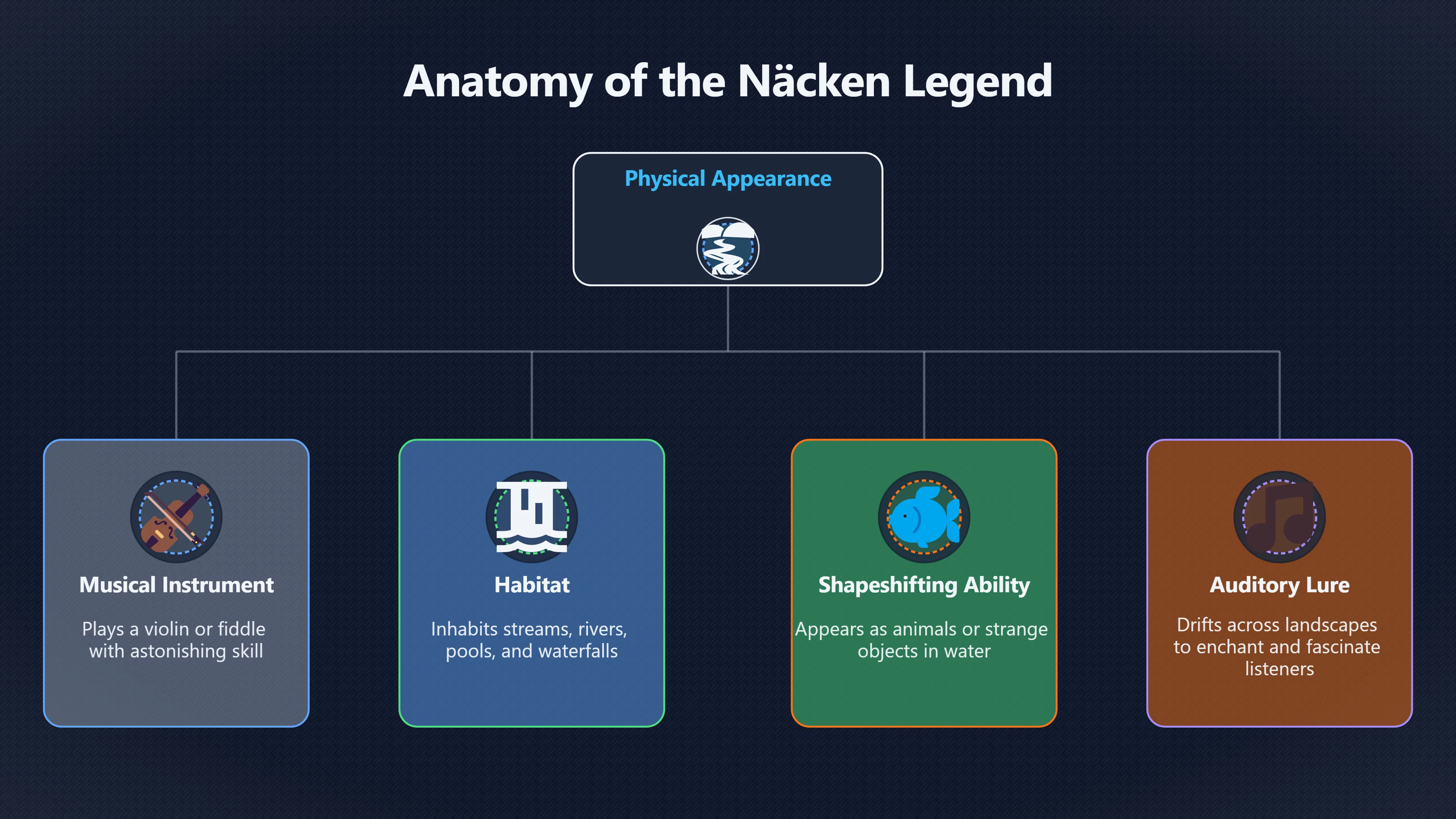
The central figure in Swedish water-music folklore is the male water spirit known by names such as Näcken and Strömkarlen. He is usually associated with fresh water rather than the sea and is said to inhabit streams, rivers, pools, millponds and waterfalls. Folklore descriptions often portray him as a naked or lightly clothed man sitting on a rock beside rushing water, playing a violin or fiddle with astonishing skill.[Wikipedia]WikipediaNixie (folkloreNixie (folklore
His music is his defining power. Rather than attacking people directly, he attracts them. The sound drifts across the landscape and listeners become fascinated, enchanted or unable to resist following it. In many stories, women, children and solitary travellers are especially vulnerable, though some traditions say anyone could be affected.[Wikipedia]WikipediaNixie (folkloreNixie (folklore
The spirit was not always imagined in human form. Swedish traditions also describe him as a shapeshifter who could appear as animals, strange objects in the water or other deceptive forms. Yet the image that endured most strongly in folklore, painting and literature was the supernatural musician beside the water.[Wikipedia]WikipediaNixie (folkloreNixie (folklore
Waterfalls occupy a particularly important place in these stories. The roar of falling water, mist, slippery rocks and hidden currents created natural settings where strange sounds and sudden accidents could occur. Folklore transformed these dangerous places into the dwelling places of musical spirits.[Wikipedia]WikipediaOpen source on wikipedia.org.
Luring, Learning and the Danger of Beauty
One of the most striking features of Swedish water-spirit legends is that the same music can represent both temptation and knowledge.
Many stories describe the spirit luring people toward the water until they fall in, disappear or drown. In this form, the legend acts as a warning. Rural communities depended on rivers and lakes for travel, fishing, milling and work, but these places could also be deadly. Children playing near streams, travellers crossing rivers and workers around mills all faced genuine danger. The supernatural explanation gave a memorable shape to those risks.[Wikipedia]WikipediaNixie (folkloreNixie (folklore
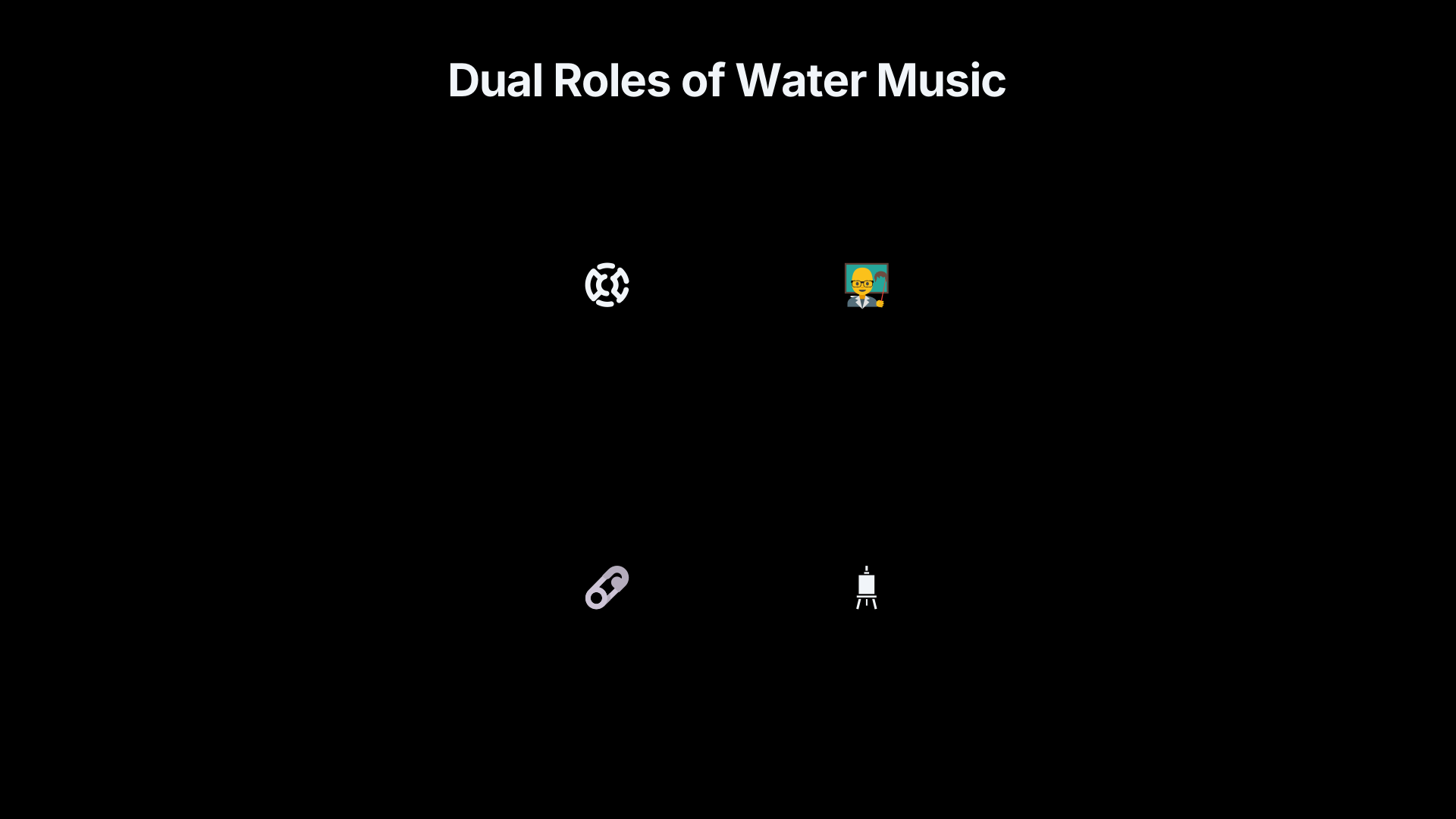
At the same time, the water spirit was also famous as a teacher. Folk traditions recorded across Scandinavia describe musicians seeking him out in hopes of learning impossible skills. Offerings might be left beside the water, and if the encounter succeeded the musician would return able to play with uncanny brilliance. Some traditions claimed the resulting music was so powerful that people, furniture or even the landscape itself seemed to dance.[Wikipedia]WikipediaNixie (folkloreNixie (folklore
This dual role reveals something important about the folklore. Music itself is not presented as evil. Instead, the stories explore the idea that extraordinary talent comes from dangerous places and that great beauty carries risks. The same force that creates artistic inspiration can also lead a person beyond safe boundaries.[Wikipedia]WikipediaNixie (folkloreNixie (folklore
In this sense, the water spirit resembles other morally ambiguous figures in Swedish folklore. He rewards some people, destroys others and cannot easily be classified as either a demon or a helper.[Wikipedia]WikipediaNixie (folkloreNixie (folklore
Why Drowning Became a Folklore Theme
Sweden’s landscape helps explain why drowning legends became so widespread. The country contains vast numbers of lakes, extensive river systems and countless smaller waterways. Before modern safety measures, many communities lived in constant proximity to potentially dangerous water.[Visit Sweden]visitsweden.comVisit Sweden Spirits, trolls, elves and 'näcken' – discover Sweden'sVisit SwedenSpirits, trolls, elves and 'näcken' – discover Sweden's…September 26, 2022 — 9 May 2025 — Born out of Swedish folklore, a…
Folklore often transformed unexplained accidents into stories with human-like agents. Instead of viewing a drowning as random misfortune, a community might say that the water spirit had called someone into the depths. Some traditions even treated the spirit as an omen, claiming that strange cries or unusual sounds near a river foretold a future drowning.[Wikipedia]WikipediaNixie (folkloreNixie (folklore
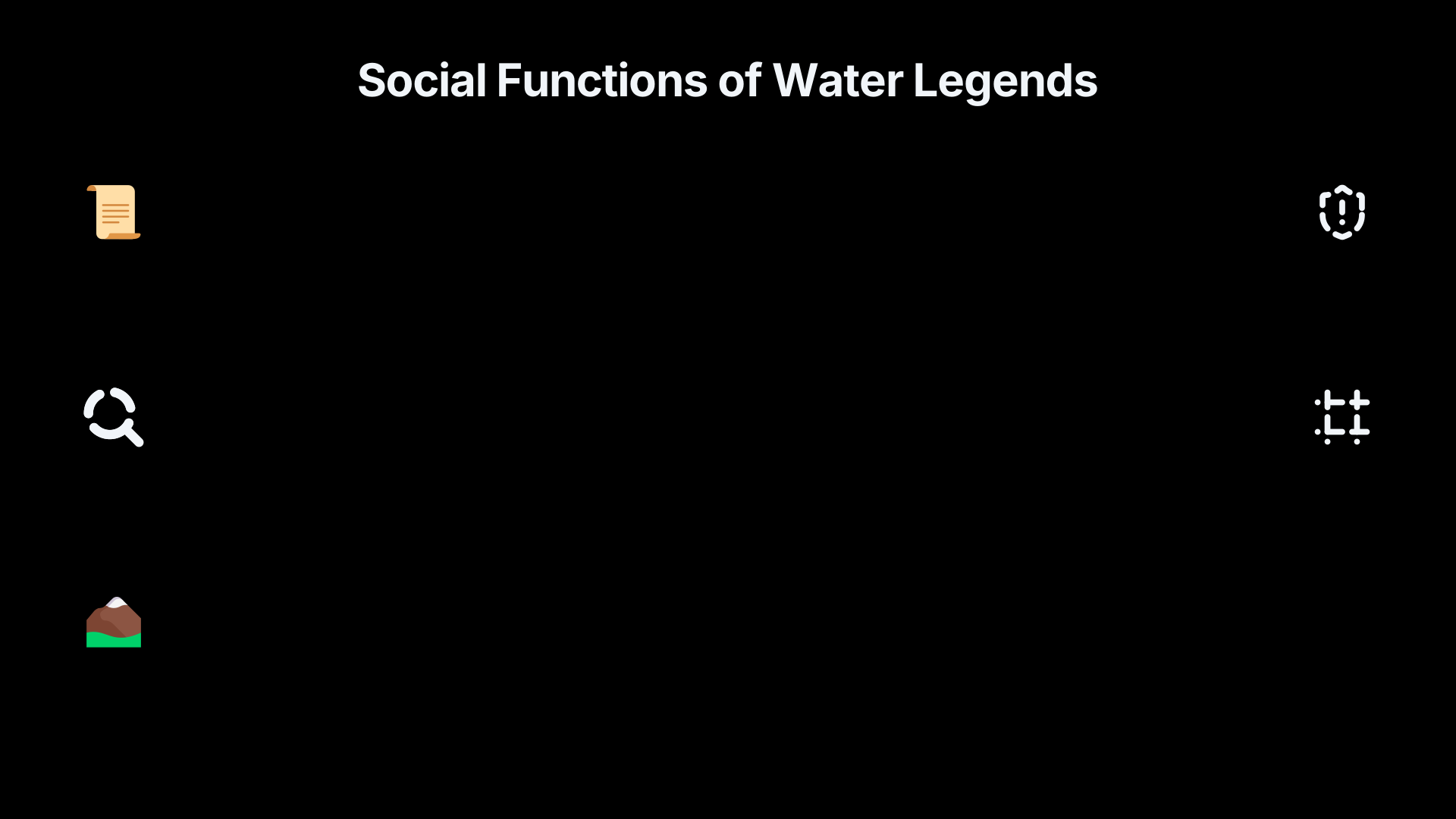
These beliefs served practical social purposes:
- They encouraged children to stay away from hazardous water.
- They explained sudden disappearances and accidents.
- They reinforced respect for rivers, waterfalls and millponds.
- They turned natural danger into memorable stories that could be passed from generation to generation.[Wikipedia]WikipediaNordic folkloreNordic folklore
The legends therefore functioned as both entertainment and informal safety culture. A child might remember the frightening fiddler long after forgetting a simple warning about currents or deep water.
From Folk Belief to Romantic Art
During the nineteenth century, artists, writers and composers became fascinated by the water spirit. Romantic-era culture often emphasised mystery, nature and powerful emotions, making the musical river spirit an ideal subject. The figure increasingly appeared not just as a predator but as a tragic and lonely being connected to the natural world.[Wikipedia]WikipediaNixie (folkloreNixie (folklore
Paintings frequently showed the spirit seated beside a waterfall, absorbed in music. Literary retellings sometimes focused on his isolation, sorrow or longing rather than on drowning victims. This shift did not erase the older folklore, but it changed how many people imagined the character.[Wikipedia]WikipediaNordic folkloreNordic folklore
As a result, modern audiences often encounter a more romantic version of the figure than the one found in traditional cautionary tales. The older stories remain rooted in practical concerns about dangerous waterways, while later artistic interpretations highlight beauty, creativity and melancholy.[Wikipedia]WikipediaNixie (folkloreNixie (folklore
Why Water Folklore Stayed So Powerful
Water-spirit legends survived because they joined several powerful ideas into one memorable figure. They linked everyday landscapes to the supernatural, connected artistic inspiration with danger, and offered explanations for accidents that were emotionally meaningful to local communities.[Wikipedia]WikipediaNixie (folkloreNixie (folklore
The stories also reflect a broader Swedish folklore pattern: nature is never entirely passive. Rivers, lakes and waterfalls are treated as places with personality, intention and power. People may benefit from them, learn from them or fear them, but they cannot safely ignore them.[visitsweden.com]visitsweden.comVisit Sweden Spirits, trolls, elves and 'näcken' – discover Sweden'sVisit SwedenSpirits, trolls, elves and 'näcken' – discover Sweden's…September 26, 2022 — 9 May 2025 — Born out of Swedish folklore, a…
That is why the image of the mysterious fiddler beside the water remains one of the most enduring figures in Swedish legend. His music represents more than a supernatural trick. It symbolises the attraction of things that are beautiful, mysterious and potentially dangerous—a theme that has kept these stories alive long after the original rural world that produced them.[Wikipedia]WikipediaNixie (folkloreNixie (folklore
Amazon book picks
Further Reading
Books and field guides related to Why Is Water Music Dangerous in Swedish Legend?. Use these as the next step if you want deeper reading beyond the article.
Scandinavian Folklore: Folk Belief and Legend in Traditional...
Explains supernatural beings linked to rivers and lakes.
eBay marketplace picks
Marketplace Samples
Live-tested eBay searches with available results related to this page.

Endnotes
1.
Source: Wikipedia
Title: Nixie (folklore)
Link:https://en.wikipedia.org/wiki/Nixie_%28folklore%29
2.
Source: Wikipedia
Title: Nordic folklore
Link:https://en.wikipedia.org/wiki/Nordic_folklore
3.
Source: Wikipedia
Link:https://en.wikipedia.org/wiki/Fossegrim
4.
Source: Wikipedia
Link:https://en.wikipedia.org/wiki/Sj%C3%B6r%C3%A5
5.
Source: visitsweden.com
Title: Visit Sweden Spirits, trolls, elves and ‘näcken’ – discover Sweden’s
Link:https://visitsweden.com/what-to-do/culture-history-and-art/culture/mythological-creatures/
Source snippet
Visit SwedenSpirits, trolls, elves and 'näcken' – discover Sweden's...September 26, 2022 — 9 May 2025 — Born out of Swedish folklore, a...
Published: September 26, 2022
Additional References
6.
Source: facebook.com
Link:https://www.facebook.com/groups/1730259997015827/posts/9974693509239060/
Source snippet
Nacken, the male water spirit from Swedish folkloreThe Näcken is a supernatural male water creature that resides primarily in inland rive...
7.
Source: godsandmonsters.info
Link:https://godsandmonsters.info/nokken/
Source snippet
Nøkken: Norse Water Spirit of Seduction, Song, and DreadNøkken is a shape-shifting Scandinavian water spirit—charming and deceptive—who l...
8.
Source: instagram.com
Link:https://www.instagram.com/p/DYAtDfWCcD6/
Source snippet
READ CAPTION ⬇️ The Nøkken is one of Scandinavia's...READ CAPTION ⬇️ The Nøkken is one of Scandinavia's most feared water spirits, known...
9.
Source: youtube.com
Link:https://www.youtube.com/watch?v=zUdnsGJyp4M
Source snippet
Waterscapes in Nordic Mythology: Näck and StrömkarlThe knicker in folklore reconcines some perspectives of ancient Nordic religiosity and...
10.
Source: facebook.com
Link:https://www.facebook.com/groups/281886105961506/posts/1012385052911604/
Source snippet
ale water spirits who played enchanted songs on the violin...Read more...
11.
Source: reddit.com
Link:https://www.reddit.com/r/UrbanMyths/comments/1m78p2m/the_n%C3%B8kk_is_a_male_scandinavian_water_spirit_who/
Source snippet
ally rivers) and plays his violin to lure children into the water...
12.
Source: facebook.com
Link:https://www.facebook.com/100087751786474/posts/-n%C3%A4cken-is-a-water-spirit-from-swedish-folklore-recorded-in-medieval-ballads-and/793358676932518/
Source snippet
and parish notes. Known also as Nøkken in Norway and Nix in...
13.
Source: facebook.com
Link:https://www.facebook.com/myrkurmyrkur/posts/do-you-know-of-n%C3%B8kken-he-has-many-names-but-he-is-a-creature-from-scandinavian-f/1142330203923638/
Source snippet
notes. Known also as Nøkken in Norway and Nix...Read more...
14.
Source: facebook.com
Link:https://www.facebook.com/groups/208139582937200/posts/2094219994329140/
Source snippet
Appearing as men playing the violin, they lure people...
15.
Source: nightbringer.se
Link:https://nightbringer.se/nightbringer/lair_nacken.html
Source snippet
The spirit has appeared in the myths and...Read more...
Topic Tree