Where Oman's Legends Still Haunt the Landscape
Oman’s folklore is not a single mythology with a fixed cast of gods and monsters. It is a living country-wide tradition of oral stories, jinn beliefs, moral folktales, protective customs, poetry, performance, sacred landscapes and local legends shaped by desert, oasis, mountain, sea and trade.
Page outline Jump by section
Introduction
For a reader coming to Oman through folklore, the key point is that “legend” and “heritage” often overlap. A fort may be a UNESCO-listed mud-brick monument, a tourist landmark and the setting for jinn stories; frankincense may be an ancient trade commodity, a household scent, a ritual purifier and a marker of Dhofari identity. Oman’s folklore is therefore best understood as a set of lived traditions rather than as a closed ancient pantheon.[UNESCO World Heritage Centre]whc.unesco.orgOpen source on unesco.org.
Why Oman’s Folklore Feels So Tied to Place
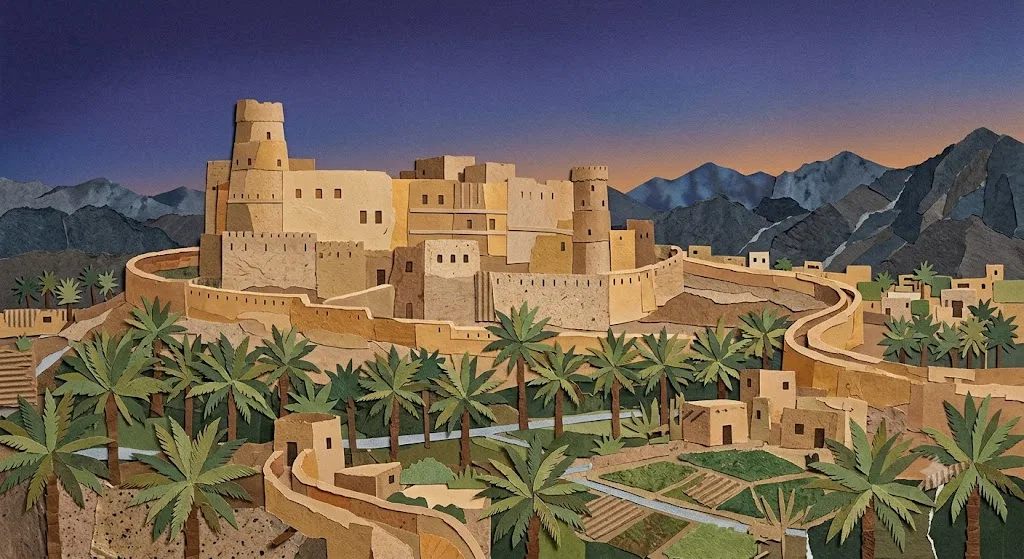
Omani stories are strongly attached to landscapes. The country’s old settlements, caves, wadis, coastal ports, mountains and desert routes give folklore its settings and its emotional force. Bahla’s mud-brick fort and oasis, Dhofar’s frankincense groves, the Selma Plateau’s huge cave chamber and the interior’s falaj irrigation settlements all show how Omani imagination has gathered around places that already feel charged with history. UNESCO describes Bahla as a fortified oasis settlement of the medieval Islamic period, with a fort, old market, mosques, family compounds and water-engineering remains linked to the falaj system. That physical complexity helps explain why it became such a powerful focus for stories about hidden beings, magic and protection.[unesco.org]whc.unesco.orgOpen source on unesco.org.
This does not mean every legend can be dated neatly. Folklore often survives because it is useful: it warns children not to wander at night, marks boundaries between safe and unsafe space, explains misfortune, entertains listeners, teaches hospitality, or gives a memorable shape to local history. In Oman, the supernatural is often not separate from everyday life. It may appear in stories of jinn in ruins, the evil eye, protective incense, healing rituals, enchanted animals, dangerous deserts, brave women, clever children or moral tests hidden inside adventure tales.[sit.edu]digitalcollections.sit.eduDigital Collections Omani Perceptions of the SupernaturalDigital Collections Omani Perceptions of the Supernatural
Oman’s position on old maritime and overland trade routes also matters. Dhofar’s frankincense trade connected southern Oman to Arabia, East Africa, India and the Mediterranean world for centuries; the Land of Frankincense World Heritage property includes Shisr, Sumhuram, Al Baleed and Wadi Dawkah, sites that UNESCO links to the long flourishing of frankincense commerce. Such connections did not simply move goods. They also moved stories, religious ideas, musical forms, healing practices and images of the unseen.[UNESCO World Heritage Centre]whc.unesco.orgOpen source on unesco.org.
Bahla: The Famous “City of Jinn”
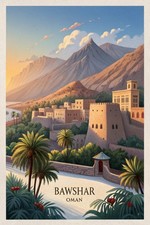
Bahla is the most widely reported supernatural landscape in Oman. Modern accounts describe it as an oasis town in the interior, roughly 200 kilometres south-west of Muscat, where stories of jinn, sorcery and strange transformations remain part of local reputation. Recent journalism has recorded tales of fire-mouthed hyenas, men turned into donkeys, phantom fires and warnings not to go out after sunset. These accounts should be read as folklore and local belief, not as proof of supernatural events, but they show how strongly Bahla’s identity has become associated with the unseen.[thearabweekly.com]thearabweekly.commagical myths thrive omans city jinn reflecting deeply anchored culturemagical myths thrive omans city jinn reflecting deeply anchored culture
The historical Bahla is impressive enough without legend. UNESCO lists Bahla Fort as an outstanding example of a medieval Islamic fortified oasis settlement, built in mud brick and linked to the prosperity of ruling elites, water management and defensive architecture in Oman and the Arabian Peninsula. The fort, the old settlement, the perimeter wall, the market and the falaj-related oasis form a setting that naturally lends itself to stories about night, danger, hidden powers and the protection of a community.[UNESCO World Heritage Centre]whc.unesco.orgOpen source on unesco.org.
One common interpretive thread is that Bahla’s jinn stories may have grown from its history as a fortified religious and military centre. NPR reported a local-historical explanation that rumours of spirits outside the walls could have discouraged people from leaving the protected settlement after dark. That does not “explain away” the folklore in a simple way; rather, it shows how supernatural warning stories can perform social work. A frightening tale about jinn may also be a story about security, obedience, family protection and the hazards of desert travel.[WUNC]wunc.orgOpen source on wunc.org.
Bahla’s reputation has also been amplified by tourism and media. Articles aimed at travellers often repeat stories of jinn building walls overnight, spirits haunting the fort or magic clinging to the town. These retellings are useful as evidence of modern legend circulation, but they are not the same as older oral testimony. A careful reader should distinguish between three layers: the historic fort and oasis, local belief and oral tradition, and later travel writing that packages Bahla as mysterious.[lakshmisharath.com]lakshmisharath.comLakshmi Sharath Tales of djinns and black magic from Bahla Fort OmanLakshmi Sharath Tales of djinns and black magic from Bahla Fort Oman
Jinn, the Evil Eye and Everyday Supernatural Belief
Jinn beliefs are central to many Omani supernatural narratives, but they are not uniquely Omani. In Islamic and wider Arabian tradition, jinn are intelligent unseen beings distinct from humans and angels, and they appear in religious, literary and folk contexts across the region. What makes Oman distinctive is the local geography of these beliefs: Bahla, caves, deserts, abandoned houses, wadis and old settlements become places where the unseen is imagined as especially near.[thearabweekly.com]thearabweekly.commagical myths thrive omans city jinn reflecting deeply anchored culturemagical myths thrive omans city jinn reflecting deeply anchored culture
In everyday belief, the supernatural is often tied to misfortune, illness, envy or protection. A study of Omani perceptions of the supernatural notes the continuing importance of spirits, charms, curses and the evil eye within Islamic cultural settings, while journalistic accounts from Bahla describe healers or ritual specialists using prayer, drums, water and other practices for people who believe they are afflicted by jinn or envy. These practices sit in a sensitive zone: people may distinguish religious healing from condemned magic, and public discussion can be cautious.[SIT Digital Collections]digitalcollections.sit.eduDigital Collections Omani Perceptions of the SupernaturalDigital Collections Omani Perceptions of the Supernatural
Frankincense is one of the most vivid bridges between household practice, religion, scent and protection. In Oman it is burned to perfume homes, welcome guests and mark hospitality, but it is also associated in some accounts with warding off bad luck or harmful influences. Condé Nast Traveler describes bakhoor and frankincense as part of daily Omani scent culture, while ethnographic writing on frankincense use in Oman records protective or curative practices involving smoke, recitation and movement around an afflicted person.[Condé Nast Traveler]cntraveler.comOpen source on cntraveler.com.
This is a good example of how folklore should be handled carefully. The belief that frankincense smoke protects against envy or harmful forces is culturally meaningful whether or not an outsider shares the belief. It reveals how scent, religion, family care and inherited practice can become part of a protective domestic world.
Folktales: What Omani Stories Tend to Do
Omani folktales often teach as much as they entertain. Published collections describe stories of historical figures, beautiful women, daring knights, courage, sadness, humour and moral reversals. Other collections for younger readers include enchanted birds, talking trees, frightening or fantastic creatures and Omani variants of familiar international story patterns. These tales do not form a single sacred canon; they are flexible oral and literary materials that have been collected, translated, rewritten and adapted for new audiences.[archive.org]archive.orgOpen source on archive.org.
A Smithsonian Folklife Festival text on an Omani folktale describes Omani folk literature as reaching across social classes and including genres such as proverbs, which compress human experience into memorable sayings. This matters because folklore in Oman is broader than monster lore. It includes wisdom speech, humorous anecdotes, heroic tales, animal stories, moral warnings, chants, poetry and forms of oral history.[folklife-media.si.edu]folklife-media.si.eduOpen source on si.edu.
Recent scholarship has emphasised women’s role in transmitting Omani folktales. Ahmed Al-Rawi’s 2026 study, Oman’s Folklore, Popular Beliefs, and Women’s Oral Storytelling, is described by its publisher as analysing more than sixty Omani folktales narrated by women, drawing on forty interviews and material from different parts of Oman. The description states that Omani women play a greater role than men in transmitting cultural norms and folktales from generation to generation.[Google Books]books.google.comOman s Folklore Popular Beliefs and WomeOman s Folklore Popular Beliefs and Wome
That is important for how readers imagine folklore. The main archive of Omani story culture has not always been a formal manuscript or museum case. Often it has been a grandmother, mother, aunt or neighbour telling stories in domestic settings, shaping children’s ideas about generosity, danger, cleverness, marriage, kinship, piety and social duty.
Dhofar: Southern Oman’s Distinctive Story World
Dhofar, in southern Oman, deserves special attention because it has its own environmental, linguistic and cultural texture. It is the region most closely associated with frankincense, the monsoon season, mountain communities and a body of collected folk narrative. My Grandmother’s Stories: Folk Tales from Dhofar, collected and transcribed by Khadija bint Alawi al-Dhahab and translated by W. Scott Chahanovich, is catalogued as a collection of folktales from the province, and WorldCat summarises the tales as being bound up with Dhofar’s atmosphere, history and cultural conditions.[sqcc.org]catalog.sqcc.orgOpen source on sqcc.org.
Dhofari tales often carry local environmental knowledge. One academic discussion of a Dhofari folk story treats a tale about the emergence of poultry as a route into indigenous knowledge, linking story material to the Arabian partridge and the domestic chicken. This kind of tale is not merely fantasy; it can encode observation, classification and explanation in story form.[ResearchGate]researchgate.netResearch Gate(PDF) A Folk Story from Dhofar A Pathway to IndigenousResearch Gate(PDF) A Folk Story from Dhofar A Pathway to Indigenous
The southern setting also changes the emotional atmosphere. Dhofar’s annual monsoon turns parts of the landscape green, while its frankincense groves and old ports tie local memory to ancient trade. UNESCO’s Land of Frankincense listing identifies four components across Dhofar that illustrate the historic trade in frankincense and testify to south Arabian civilisations since the Neolithic. For folklore, this matters because Dhofar’s stories are rooted in a landscape that feels different from the arid interior: mist, trees, mountain tracks, coastal trade and scented resin all help shape the region’s imaginative world.[UNESCO World Heritage Centre]whc.unesco.orgOpen source on unesco.org.
Frankincense: Trade Good, Household Scent and Protective Symbol
Frankincense is one of Oman’s strongest cultural symbols. In historical terms, Dhofar’s frankincense helped connect Oman to long-distance trade networks, and UNESCO treats the Land of Frankincense as outstanding testimony to a trade that flourished for many centuries. In everyday cultural terms, frankincense is burned, chewed, sold in souks, used in perfumes and associated with hospitality, religion and memory.[UNESCO World Heritage Centre]whc.unesco.orgOpen source on unesco.org.
The folklore value of frankincense lies in its role as a sensory marker of protection and blessing. Smoke can make a room feel purified; scent can mark a guest’s arrival; incense can connect a modern household to older practices. Travel reporting from Oman describes bakhoor being burned to welcome guests, ward off bad luck and cover ordinary domestic smells, while accounts of curative practice describe frankincense smoke used around someone believed to be affected by the evil eye or malevolent influence.[Condé Nast Traveler]cntraveler.comOpen source on cntraveler.com.
Frankincense also shows how old tradition becomes modern reinterpretation. Oman’s luxury perfume industry, tourist routes, museum displays and even frankincense ice cream in Salalah all rework the old resin into contemporary forms. These are not “fake folklore” simply because they are modern. They are examples of heritage being repackaged, commercialised and made legible to visitors, while still drawing power from older associations of scent, trade and sacredness.[Condé Nast Traveler]cntraveler.comOpen source on cntraveler.com.
Caves, Deserts and the Meeting Place of Spirits
Oman’s landscape also produces folklore through scale and danger. Majlis al Jinn, a huge cave chamber on the Selma Plateau, is a good example. The name is commonly translated as “meeting place of the spirits” or “meeting place of the genies”, and Oman’s tourism development company describes it as one of the Sultanate’s fascinating heritage attractions and a major cave system near Fins village in Qurayyat.[omran.om]omran.omOpen source on omran.om.
The cave is a modern case where geology and folklore meet. Speleological accounts describe Majlis al Jinn as a vast single chamber with roof openings and vertical drops, while the name itself draws on the Omani belief that jinn inhabit caves. A reported history of the cave’s naming says early explorers were told local people did not have a name for the specific holes, and the name Majlis al Jinn was chosen in reference to beliefs about jinn in caves; local usage also includes Khoshilat Maqandeli.[Wikipedia]WikipediaMajlis al JinnMajlis al Jinn
For folklore readers, the cave is not important because it preserves a long documented legend cycle comparable to Bahla. Its value is different: it shows how a spectacular natural feature can invite supernatural language. A place that is dark, vertical, dangerous and almost impossible to enter without ropes naturally lends itself to stories of hidden beings and otherworldly assemblies.
Poetry, Performance and Oral Heritage Beyond Ghost Stories
Oman’s folklore is not only about spirits. Much of its intangible heritage is performed: chanted poetry, camel calls, sword dances, processional praise, wedding arts, coffee hospitality, majlis culture and craft traditions. UNESCO lists a range of Omani or jointly shared elements, including Al-Bar’ah from Dhofar, Al-Taghrooda Bedouin chanted poetry, Al ‘azi, Al-Ayyala, Al-Razfa, camel racing, Alheda’a camel-calling traditions, Al-Khanjar craft and social practices, date palm knowledge, henna and Arabic coffee.[UNESCO Intangible Cultural Heritage]ich.unesco.orgIntangible Cultural Heritage OmanIntangible Cultural Heritage Oman
These forms matter to folklore because oral tradition is not just “stories told at night”. It includes rhythm, gesture, costume, ceremony and public memory. Al-Taghrooda, for example, is described by UNESCO as Bedouin chanted poetry composed and recited by men travelling on camelback through desert areas of Oman and the United Arab Emirates. Al-Ayyala is a traditional performing art shared by Oman and the UAE, performed in rows with sticks, drums and communal participation.[UNESCO Intangible Cultural Heritage]ich.unesco.orgOpen source on unesco.org.
The same applies to camel traditions. Camel racing and Alheda’a are not supernatural in themselves, but they belong to the same oral heritage world: sound, memory, animal knowledge, prestige and festive gathering. A country’s folklore includes the performances through which people remember who they are, not only tales of the uncanny.[UNESCO Intangible Cultural Heritage]ich.unesco.orgIntangible Cultural Heritage OmanIntangible Cultural Heritage Oman
Old Tradition, Modern Collection and Internet-Era Retelling
One of the hardest questions about Omani folklore is how old a specific story is. Some beliefs, such as jinn traditions and protective practices against envy, belong to very old Arabian and Islamic cultural frameworks, but particular local stories may only be recorded recently. Published Omani folktale collections from the 2000s and later are therefore both preservation tools and acts of transformation: oral tales become edited, translated, illustrated and marketed books.[archive.org]archive.orgOpen source on archive.org.
This does not make them less valuable. It simply changes what kind of evidence they are. A tale printed in a children’s collection may preserve an oral motif, but it may also simplify language, sharpen the moral lesson or adapt the story for schools and international readers. A travel article about Bahla may preserve a real local rumour, but it may also heighten the atmosphere for visitors. A UNESCO listing may protect performance heritage, but it also reframes living practice as national and international cultural property.[google.com]books.google.comOpen source on google.com.
Oman’s government and cultural institutions have increasingly treated oral heritage as something to document and safeguard. Reporting in 2025 described efforts by Oman’s Ministry of Culture, Sports and Youth to preserve oral history as part of a wider cultural strategy, while Oman’s foreign ministry has described a UNESCO–Sultan Haitham Prize for intangible cultural heritage covering oral traditions, performing arts, social practices, knowledge of nature and traditional craftsmanship.[AW]thearabweekly.comoman intensifies effort preserve oral heritage cultural strategy gains momentumoman intensifies effort preserve oral heritage cultural strategy gains momentum
For the reader, the practical lesson is simple: when encountering an Omani legend online, ask what layer it belongs to. Is it a locally told belief, a literary retelling, a tourist-board summary, a journalist’s anecdote, a scholarly collection, a UNESCO heritage file or a social-media embellishment? The strongest understanding comes from reading these layers together without confusing them.
What Makes Omani Folklore Distinctive
Omani folklore is distinctive because it is unusually place-centred, sensory and regionally varied. Bahla gives Oman one of the Gulf’s most famous jinn landscapes. Dhofar gives it a southern story world of frankincense, monsoon mountains and collected folktales. The interior gives it oasis settlements, forts, falaj systems and defensive legends. The desert and camel traditions preserve chanted poetry and animal knowledge. The coast and frankincense trade connect Omani memory to wider Indian Ocean and Arabian networks.[unesco.org]whc.unesco.orgOpen source on unesco.org.
Its supernatural beings are not best approached as a tidy monster catalogue. Jinn, enchanted animals, ominous places, the evil eye and protective smoke all appear within a larger moral and social world. The stories ask familiar human questions: Who can be trusted? What happens if a child disobeys a warning? How should a guest be treated? What explains sickness or misfortune? How does a community protect itself? How do women pass on knowledge that formal history overlooks?[sit.edu]digitalcollections.sit.eduDigital Collections Omani Perceptions of the SupernaturalDigital Collections Omani Perceptions of the Supernatural
Oman’s folklore today is therefore both old and active. It survives in family memory, in books, in academic studies, in UNESCO-recognised performances, in tourist retellings, in perfume shops, in Bahla’s reputation, in Dhofari story collections and in the continued habit of explaining landscape through story. Its power lies less in a single national myth than in the way place, scent, warning, hospitality and the unseen still speak to one another.
Amazon book picks
Further Reading
Books and field guides related to Where Oman's Legends Still Haunt the Landscape. Use these as the next step if you want deeper reading beyond the article.
Legends of the Fire Spirits
Directly explores the supernatural beings central to Omani folklore.
The Arabian Nights
Introduces jinn, storytelling traditions, and Middle Eastern legend culture.
![Cover for The Arabian Nights Entertainments [7 stories]](https://covers.openlibrary.org/b/id/1046897-M.jpg)
eBay marketplace picks
Marketplace Samples
Live-tested eBay searches with available results related to this page.
Endnotes
1.
Source: books.google.com
Title: Oman s Folklore Popular Beliefs and Wome
Link:https://books.google.com/books/about/Oman_s_Folklore_Popular_Beliefs_and_Wome.html?id=knOTEQAAQBAJ
2.
Source: folklife-media.si.edu
Link:https://folklife-media.si.edu/docs/festival/program-book-articles/FESTBK2005_10.pdf
3.
Source: whc.unesco.org
Link:https://whc.unesco.org/en/list/433/
4.
Source: whc.unesco.org
Link:https://whc.unesco.org/en/list/1010/
5.
Source: wunc.org
Link:https://www.wunc.org/2019-08-13/in-this-omani-village-locals-say-supernatural-creatures-are-behind-strange-events
6.
Source: digitalcollections.sit.edu
Title: Digital Collections Omani Perceptions of the Supernatural
Link:https://digitalcollections.sit.edu/cgi/viewcontent.cgi?article=2030&context=isp_collection
7.
Source: catalog.sqcc.org
Title: Details for: Halimah and the snake and other Omani folk tales
Link:https://catalog.sqcc.org/cgi-bin/koha/opac-detail.pl?biblionumber=3167
8.
Source: whc.unesco.org
Link:https://whc.unesco.org/en/sustainabletourismtoolkit/guide9/frankincense/
9.
Source: archive.org
Link:https://archive.org/details/omanifolktales0000alta
10.
Source: books.google.com
Link:https://books.google.com/books/about/Halimah_and_the_Snake_and_Other_Omani_Fo.html?hl=ar&id=KLf_GAAACAAJ
11.
Source: researchgate.net
Title: 397966618 Omani Folk Literature and Its Impact on Society
Link:https://www.researchgate.net/publication/397966618_Omani_Folk_Literature_and_Its_Impact_on_Society
12.
Source: play.google.com
Link:https://play.google.com/store/books/details/Ahmed_Al_Rawi_Oman_s_Folklore_Popular_Beliefs_and?id=knOTEQAAQBAJ
13.
Source: catalog.sqcc.org
Link:https://catalog.sqcc.org/cgi-bin/koha/opac-detail.pl?biblionumber=3211
14.
Source: search.worldcat.org
Link:https://search.worldcat.org/cs/title/my-grandmothers-stories-folktales-from-dhofar/oclc/812739193
15.
Source: researchgate.net
Title: Research Gate(PDF) A Folk Story from Dhofar A Pathway to Indigenous
Link:https://www.researchgate.net/publication/319365074_A_Folk_Story_from_Dhofar_A_Pathway_to_Indigenous_Knowledge
16.
Source: omran.om
Link:https://www.omran.om/projects/majlis-al-jinn-cave
17.
Source: Wikipedia
Title: Majlis al Jinn
Link:https://en.wikipedia.org/wiki/Majlis_al_Jinn
18.
Source: ich.unesco.org
Title: Intangible Cultural Heritage Oman
Link:https://ich.unesco.org/en/state/oman-OM?info=elements-on-the-lists
19.
Source: ich.unesco.org
Link:https://ich.unesco.org/en/decisions/7.COM/11.34
20.
Source: ich.unesco.org
Link:https://ich.unesco.org/en/video/33501
21.
Source: ich.unesco.org
Link:https://ich.unesco.org/en/lists
22.
Source: ich.unesco.org
Title: 38965 EN.doc
Link:https://ich.unesco.org/doc/src/38965-EN.doc
23.
Source: ich.unesco.org
Link:https://ich.unesco.org/en/video/16675
24.
Source: unesco.nl
Link:https://unesco.nl/werelderfgoed/fort-bahla
25.
Source: books.google.com
Title: Omani Folk Tales
Link:https://books.google.com/books/about/Omani_Folk_Tales.html?id=bDzpSAAACAAJ
26.
Source: researchgate.net
Link:https://www.researchgate.net/publication/398070912_The_origins_of_the_traditional_approach_towards_the_jinn_of_poetic_inspiration_in_tribal_Arab_culture
27.
Source: researchgate.net
Link:https://www.researchgate.net/publication/381194130_READING_ANCIENT_FOLK_LITERATURE_THE_OMANI_STORY_OF_ABU_QAHIFA_IS_AN_EXAMPLE
28.
Source: researchgate.net
Link:https://www.researchgate.net/publication/399318414_Oman%27s_Folklore_Popular_Beliefs_and_Women%27s_Oral_Storytelling
29.
Source: researchgate.net
Link:https://www.researchgate.net/publication/394246013_Preserving_Omani_Intangible_Heritage_A_Study_of_Folktale_Authenticity_and_Classification
30.
Source: researchgate.net
Link:https://www.researchgate.net/publication/233321212_The_Evil_Eye_and_Cultural_Beliefs_among_the_Bedouin_Tribes_of_the_Negev_Middle_East_1
31.
Source: researchgate.net
Link:https://www.researchgate.net/publication/372576117_Frankincense_and_Its_Arabian_Burner
32.
Source: researchgate.net
Title: 381310138 Olfaction It Makes a World of Scents
Link:https://www.researchgate.net/publication/381310138_Olfaction_It_Makes_a_World_of_Scents
33.
Source: researchgate.net
Link:https://www.researchgate.net/publication/277816715_The_Mythical_Ghoul_in_Arabic_Culture
34.
Source: Wikipedia
Link:https://en.wikipedia.org/wiki/Jinn
35.
Source: Wikipedia
Title: List of Intangible Cultural Heritage elements in Oman
Link:https://en.wikipedia.org/wiki/List_of_Intangible_Cultural_Heritage_elements_in_Oman
36.
Source: Wikipedia
Title: Bahla Fort
Link:https://en.wikipedia.org/wiki/Bahla_Fort
37.
Source: Wikipedia
Link:https://en.wikipedia.org/wiki/Z%C4%81r
38.
Source: Wikipedia
Title: Land of Frankincense
Link:https://en.wikipedia.org/wiki/Land_of_Frankincense
39.
Source: unescochair-whstar.gutech.edu.om
Title: gutech.edu.om00:00:56 Bahla Fort
Link:https://unescochair-whstar.gutech.edu.om/bahla-fort/
40.
Source: jass.squ.edu.om
Link:https://jass.squ.edu.om/journal/vol7/iss2/4/
41.
Source: thearabweekly.com
Title: magical myths thrive omans city jinn reflecting deeply anchored culture
Link:https://thearabweekly.com/magical-myths-thrive-omans-city-jinn-reflecting-deeply-anchored-culture
42.
Source: cntraveler.com
Link:https://www.cntraveler.com/stories/2012-12-26/oman-luxury-perfumes-fragrances-scents
43.
Source: hurriyetdailynews.com
Title: city of jinn magical myths haunt ancient omani oasis 187993
Link:https://www.hurriyetdailynews.com/city-of-jinn-magical-myths-haunt-ancient-omani-oasis-187993
44.
Source: lakshmisharath.com
Title: Lakshmi Sharath Tales of djinns and black magic from Bahla Fort Oman
Link:https://lakshmisharath.com/al-hamra-bahla-fort-oman/
45.
Source: sqcc.overdrive.com
Link:https://sqcc.overdrive.com/media/5519354
46.
Source: thearabweekly.com
Title: oman intensifies effort preserve oral heritage cultural strategy gains momentum
Link:https://thearabweekly.com/oman-intensifies-effort-preserve-oral-heritage-cultural-strategy-gains-momentum
47.
Source: amazon.com
Title: Omani Folktales
Link:https://www.amazon.com/Omani-Folktales/dp/9948036549?tag=searcht-20
48.
Source: taipeitimes.com
Link:https://www.taipeitimes.com/News/world/archives/2023/11/21/2003809504
49.
Source: abebooks.co.uk
Title: omani folktales
Link:https://www.abebooks.co.uk/book-search/title/omani-folktales/
Additional References
50.
Source: youtube.com
Title: Exploring Oman: Hidden Mysteries, Ancient Legends & Amazing Facts
Link:https://www.youtube.com/watch?v=bBOt2bszjkI
Source snippet
Why Oman's Oral Heritage Is More Than Just Folklore...
51.
Source: youtube.com
Title: The Amazing Geology Behind Majlis al Jinn
Link:https://www.youtube.com/watch?v=UC7sL-f46Ig
Source snippet
Exploring Oman: Hidden Mysteries, Ancient Legends & Amazing Facts...
52.
Source: publications.americanalpineclub.org
Link:https://publications.americanalpineclub.org/articles/13201215379
53.
Source: archiqoo.com
Link:https://archiqoo.com/unesco/intangible_sub_lists.php?subsite=al_ayyala_traditional_performing_art_in_uae_and_oman&uw_country=all
54.
Source: everything-everywhere.com
Link:https://everything-everywhere.com/bahla-fort-unesco-world-heritage-site/
55.
Source: reddit.com
Link:https://www.reddit.com/r/Oman/comments/166fir0/bahla_anyone_ever_came_across_someone_who/
56.
Source: amazon.in
Link:https://www.amazon.in/Folklore-Popular-Beliefs-Womens-Storytelling/dp/B0FCY4VDXT?tag=searcht-20
57.
Source: folkculturebh.org
Link:https://www.folkculturebh.org/en/index.php?id=1030&issue=44&page=article
58.
Source: fm.gov.om
Link:https://www.fm.gov.om/en/43079/
59.
Source: facebook.com
Link:https://www.facebook.com/timesofoman/posts/frankincense-merchants-from-dhofar-said-they-have-been-making-less-money-each-ye/1626862460726736/
Topic Tree
Follow this branch
Related pages 192
- Afghan Folklore
- Albanian Folklore
- Algerian Folklore
- Australian Folklore
- Azerbaijan Folklore
- +187 more in sidebar