What Haitian Folklore Really Means
Haiti’s folklore is not a separate shelf of “old stories” beside national life. It is woven through religion, music, oral storytelling, healing, memory, protest, pilgrimage and popular culture.
Page outline Jump by section
Introduction
The richest Haitian material sits at the meeting point between the sacred and the social: the spirit called at a ceremony, the tale told by call-and-response, the annual pilgrimage to a waterfall, the street band that turns music into public commentary, or the zombie story that speaks less about cannibal monsters than about slavery, loss, labour and fear of losing one’s will.[uci.edu]anthropology.uci.eduOpen source on uci.edu.
Why Vodou sits at the centre of Haitian folk tradition
Haitian Vodou first took shape in the context of slavery in the French colony of Saint-Domingue. It drew on West and Central African religious traditions, especially from regions linked to Dahomey, Kongo and Yoruba worlds, and developed in Haiti through contact with Catholic images, saints and ritual calendars. That mixture was not a simple “blend” in which older beliefs disappeared. It produced a Haitian system with its own spirits, songs, ceremonial forms, ritual art and local variations.[Open Encyclopedia of Anthropology]anthroencyclopedia.comOpen source on anthroencyclopedia.com.
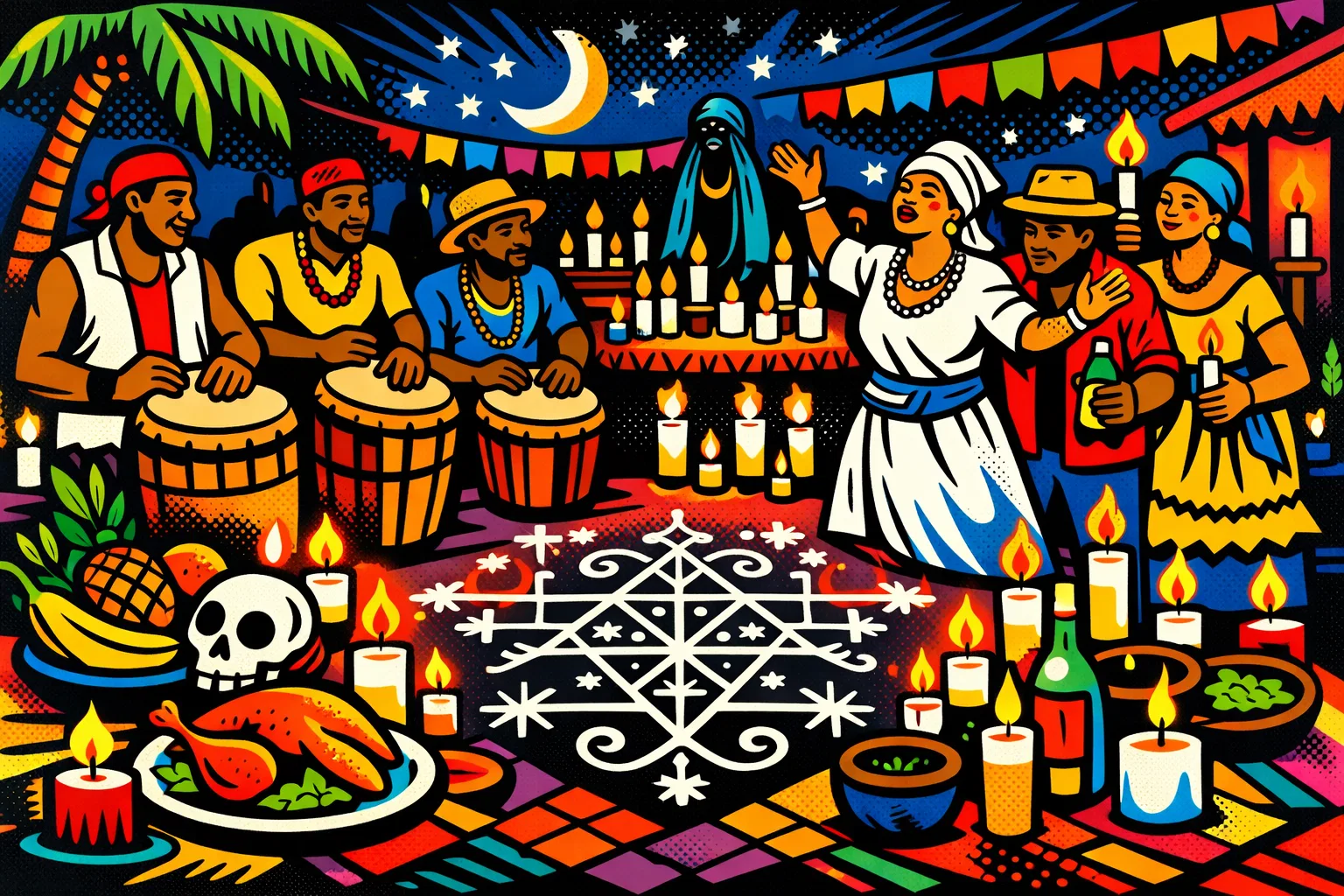
For folklore readers, the most important point is that Vodou is both religion and cultural memory. Its spirits are not merely “characters” in stories, but the centre of songs, offerings, ceremonies, family obligations, healing practices and local histories. The Library of Congress finding aid for recordings of Haitian Vodou religious expression, including interviews with the well-known Haitian religious leader Max Beauvoir, lists topics such as spirit possession, ritual signs, categories of spirits, animal sacrifice, oral transmission and the distinction between sensationalised “voodoo dolls” and actual ritual objects.[Library of Congress]hdl.loc.govOpen source on loc.gov.
This matters because many international retellings of Haitian folklore begin in the wrong place. They start with fear: curses, dolls, zombies, secret rites. Haitian sources and ethnographic material point instead to a religion organised around relationship: between people and spirits, the living and the dead, families and inherited practice, music and presence, suffering and protection. Smithsonian documentation of Vodou music describes drum orchestras as calling the spirits and notes that each branch of Vodou has associated rhythms, while also showing how particular spirits such as Papa Legba and Ogou are invoked through song and rhythm.[Folkways Media]folkways-media.si.eduFolkways Media
The zombie: Haiti’s most famous misunderstood figure
The Haitian zombie is one of the clearest examples of a local folk figure transformed by global entertainment. In much modern horror, a zombie is a contagious, flesh-eating corpse. In Haitian tradition and scholarship, the figure is more complicated. Accounts distinguish between bodily zombies and spirit zombies, and the core fear is often not being attacked by a monster but being made into a will-less worker.[anthropology.uci.edu]anthropology.uci.eduOpen source on uci.edu.
That difference changes the whole meaning of the figure. In Haitian folklore, the zombie is closely tied to fears of servitude, social death and the theft of a vital part of the person. One anthropological discussion summarises the belief that zombies may be created to work in fields or houses and links the condition to the loss of the part of the soul associated with personality, character and willpower. The same source stresses that zombification parallels enslavement: a person is stripped of individuality and reduced to labour.[anthropology.uci.edu]anthropology.uci.eduOpen source on uci.edu.
This is why the zombie belongs in Haitian folklore as a moral and historical figure, not just a monster. Haiti was born from the only successful large-scale revolt by enslaved people that created an independent Black republic, and stories of bodies forced to work after death carry an obvious emotional charge in that setting. Scholars have also examined reported “zombie” cases through grief, mental illness, family recognition and social suffering, which means the tradition sits uneasily between belief, diagnosis, social role and symbolic history.[anthropology.uci.edu]anthropology.uci.eduOpen source on uci.edu.
The popular zombie also shows how folklore can be exported and emptied of context. Once the figure entered foreign pulp writing, travel literature and cinema, it was often detached from Haitian ideas about soul, labour, ritual power and colonial memory. The result is a global monster whose Haitian roots are widely named but rarely understood. A useful Haiti-focused reading restores the original fear: not the end of the world by infection, but the loss of freedom, memory and personhood.

Spirits, signs and sacred personalities
Vodou spirits are among the most important supernatural presences in Haitian tradition. They are not all one kind of being, and they are not usually explained as gods in a simple pantheon. They are approached through ritual, song, rhythm, signs, offerings, possession and inherited relationships. Smithsonian material on Haitian ritual music, for example, describes Papa Legba as guardian of the crossroads and mediator between the world of spirits and humans, and Ogou as a warrior figure connected through a layered fusion of West African and Catholic references.[Folkways Media]folkways-media.si.eduFolkways Media
Visual signs also carry folk and religious meaning. The National Museum of African American History and Culture describes jewellery made in Haiti after 1949 that uses a Vodou ritual sign associated with the spirit Loko, noting that such designs presented Vodou as an essential part of Haitian culture rather than as something demonic or sensational.[National African American Museum]nmaahc.si.eduOpen source on si.edu.
Some spirits are especially visible in public-facing accounts of Haitian sacred geography. Erzulie, often associated with love, femininity, water, beauty, sorrow and protection in different forms, is central to the Saut-d’Eau pilgrimage, where Catholic devotion to the Virgin Mary of Mount Carmel and Vodou devotion are closely intertwined. In 2025, AP reported that several thousand people honoured Erzulie and the Virgin Mary at a substitute church in Port-au-Prince because gang control had prevented the usual pilgrimage to the Saut-d’Eau waterfall.[AP News]apnews.comOpen source on apnews.com.
The divine twins known as the Marasa are another example of how Haitian tradition complicates simple categories. A Penn State collection record for an artwork titled “Marasa Twa” describes them as sacred twins who are often depicted as three rather than two and links them with concern for children. That paradoxical “two who are three” quality is exactly the kind of symbolic texture that makes Haitian spirit traditions hard to flatten into a neat list of beings.[digital.libraries.psu.edu]digital.libraries.psu.eduCONTEN TdmCONTEN Tdm
Creatures of the night: more than the zombie
Haitian folk belief includes frightening nocturnal figures as well as revered spirits. The lougarou, often linked to French-Caribbean werewolf language and wider regional shape-shifter traditions, is commonly described in modern Haitian popular retellings as a dangerous night-roaming being. Evidence for such figures is often less formally archived than Vodou recordings or major pilgrimage traditions, so they should be presented as living and regional folklore rather than as a single fixed mythology.
The soucouyant-like figure belongs to a wider Caribbean pattern of skin-shedding, blood-taking night beings found in places including Haiti, Saint Lucia, Trinidad, Guyana, Suriname and Jamaica. A Humanities Kansas discussion of the soucouyant tradition notes that skin-shedding, bloodsucking creatures appear across many Caribbean cultures and raises the social question of why these stories so often focus suspicion on older women.[Humanities Kansas]humanitieskansas.orgOpen source on humanitieskansas.org.
These creatures matter because they show Haitian folklore as part of the wider Caribbean, especially the French- and African-influenced Atlantic world. Stories travel with enslaved people, sailors, migrants, plantation labour systems, Catholic calendars, African religious memory and later diaspora communities. In Haiti, the result is not a sealed national mythology but a living local version of regional Caribbean fear: night flight, blood loss, shape-changing, envy, hidden witchcraft and the danger that a familiar neighbour may not be what they seem.
Modern tourism and culture websites often present Haitian mermaids, lougarou and other beings as colourful folklore attractions. Those retellings can be useful entry points, but they should be read carefully. Some are contemporary summaries written for visitors, not primary records of old oral tradition. They are best used as evidence that these figures remain recognisable in public Haitian cultural storytelling, not as proof that every detail is ancient or uniform.
Sacred places: Saut-d’Eau and the landscape of belief
Haitian folklore is strongly tied to place. The most famous sacred landscape is Saut-d’Eau, a waterfall long associated with the Virgin Mary of Mount Carmel and Erzulie. Pilgrims traditionally travel there in July to bathe, pray, make offerings, seek healing and give thanks. Its power lies partly in the way it refuses a clean division between Catholic and Vodou practice: the same sacred season may include Mass, candles, rosaries, ritual bathing, Vodou devotion and family vows.[AP News]apnews.comOpen source on apnews.com.
The 2025 disruption of the Saut-d’Eau pilgrimage shows that folklore is not only about the past. AP reported that the waterfall, which had attracted thousands of Vodou and Christian followers for decades, became inaccessible after gang attacks and control of the town. Worshippers instead gathered at a church in Port-au-Prince, describing the loss of access to the waterfall as a national and spiritual wound.[AP News]apnews.comOpen source on apnews.com.
This is a reminder that sacred places are vulnerable. When a pilgrimage route is blocked, a tradition does not simply vanish, but its emotional geography changes. The waterfall is not interchangeable with any church or shrine: it is part of the story, part of the ritual and part of the remembered relationship between people, water, spirits, saints and national identity.
Bois Caïman: history, legend and misuse
No Haitian legendary site is more politically charged than Bois Caïman, the wooded meeting associated with the beginning of the Haitian Revolution in 1791. Many historians treat it as connected to a real clandestine assembly of enslaved Africans planning revolt against French slaveholders, while also noting that details of the ceremony have been retold, embellished and disputed over time.[The Washington Post]washingtonpost.comOpen source on washingtonpost.com.
For Haitian memory, Bois Caïman is a foundation story of liberation. For hostile outsiders, it has often been twisted into the false claim that Haiti made a “pact with the Devil”. That claim is both theologically misleading and politically loaded. The Washington Post, citing scholar Marlene Daut, notes that Haitian Vodou has no Satan in the sense required by that accusation, and frames the “devil pact” story as a malicious distortion that turns a revolt against slavery into a tale of curse and blame.[The Washington Post]washingtonpost.comOpen source on washingtonpost.com.
The folklore issue here is not whether every popular detail of Bois Caïman can be verified. It is how a national memory becomes a battleground. A ceremony remembered by Haitians as resistance can be retold by outsiders as superstition; a sacred-political gathering can be recast as evil; a revolution against enslavement can be explained away through racist legend rather than colonial violence and international pressure. Reading Bois Caïman responsibly means holding both truths: the historical record is complex, and the later demonising myth is harmful.
Oral storytelling: the call that opens the tale
Haiti’s folk tradition is also secular, comic and social. The call-and-response storytelling form often introduced by “Krik?” and answered by “Krak!” remains one of the most recognisable signs of Haitian oral culture. A 2024 essay on the tradition describes it as an art of riddles and tales that unites generations through oral speech, with the narrator’s call opening a shared performance rather than a private reading experience.[Buala]buala.orgKrik-krak, the art of short stories in Haiti | BUALAKrik-krak, the art of short stories in Haiti | BUALA
This kind of storytelling does several things at once. It entertains, teaches quick thinking, preserves communal memory and gives ordinary people a way to laugh at power, foolishness, greed and bad luck. The same account links the form to both colonial-era and African influences, while stressing that Haitians appropriated and transformed those influences into something distinctly their own.[Buala]buala.orgKrik-krak, the art of short stories in Haiti | BUALAKrik-krak, the art of short stories in Haiti | BUALA
For modern readers, the best-known literary echo is probably Edwidge Danticat’s short-story collection Krik? Krak!, which uses the phrase as a sign of Haitian narrative inheritance and diaspora memory. That does not make the tradition merely literary. The book’s title works because the call already carries cultural force: it tells listeners that a story is beginning and that they are part of its unfolding.
Rara: folklore on the move
Rara is one of Haiti’s most vivid seasonal traditions: a street festival of music, movement, ritual, satire and public presence. Smithsonian Music describes Rara as an old festival with roots reaching back to slavery-era Haiti and, before that, Western and Central Africa; its songs and melodies have been passed down for generations, and the festival is practised across Haiti with strong regional variation.[Smithsonian Music]music.si.eduSmithsonian Music Rara: Vodou, Power, and Performance | Smithsonian MusicSmithsonian Music Rara: Vodou, Power, and Performance | Smithsonian Music
Rara is especially associated with Lent and Easter season, but it is not only a religious procession. It can be devotional, political, comic, competitive and communal. Bands move through public space, and the performance can become a way of claiming territory, commenting on local affairs or carrying old songs into new crises. A New Yorker roundtable with scholars and writers described Rara as retaining a feeling of rebellion, with bands using music, movement and cryptic songs to address religious devotion, local corruption and political unease.[The New Yorker]newyorker.comOpen source on newyorker.com.
This makes Rara a useful corrective to the idea that folklore is quiet, rural and frozen in time. In Haiti, folklore can be loud, mobile and public. It can move through streets, attract sellers and children, honour the dead, call spirits, mock the powerful and carry a community’s mood in rhythm.
Archives, art and the problem of outsiders
Haitian folklore has been recorded by collectors, anthropologists, musicians, museums, journalists and Haitian culture-bearers, but the record is uneven. Some material is richly documented: the Library of Congress holds field recordings of Haitian music, spoken word, Vodou ceremonies, drumming, children’s songs and games, while Smithsonian Folkways material documents ritual and recreational music recorded in the twentieth century.[Research Guides]guides.loc.govResearch Guides
At the same time, Haitian traditions have often been filtered through outsiders’ expectations. During and after the US occupation of Haiti, foreign writers and film-makers helped popularise lurid ideas of “voodoo” as menace. Smithsonian discussion of Haitian-designed jewellery contrasts this with Haitian and diaspora uses of Vodou imagery that celebrated beauty, design and cultural identity rather than demonising the religion.[National African American Museum]nmaahc.si.eduOpen source on si.edu.
The safest way to read Haitian folklore is therefore to ask what kind of source is speaking. A ritual recording, an oral-history interview, a Haitian literary retelling, an academic study, a tourist article, a horror film and a missionary polemic may all mention the same figure, but they are not doing the same work. Some preserve tradition; some interpret it; some market it; some distort it.
How Haitian folklore is understood today
Today, Haitian folklore remains alive under difficult conditions. Vodou continues to provide ritual structure, protection, healing, identity and community for many Haitians, while also facing stigma from long histories of anti-Vodou campaigns, foreign sensationalism and religious competition. Recent journalism has shown both the pressure on sacred practice and its resilience, including the altered Saut-d’Eau pilgrimage under conditions of gang violence.[AP News]apnews.comOpen source on apnews.com.
The modern picture is not simply “ancient belief survives”. It is more dynamic than that. Haitian traditions are performed in rural ceremonies, urban churches, diaspora festivals, museum collections, contemporary art, literature, music, tourist writing, academic debate and online summaries. Some retellings are careful; others repeat clichés. Some old stories continue because they answer enduring fears: loss of freedom, dangerous envy, unquiet spirits, the need for protection, and the hope that ancestors and spirits remain near.
For a curious reader, the key is to treat Haitian folklore with the same seriousness one would give Greek myth, Irish fairy belief or Japanese ghost tradition: not as proof of the supernatural, but as a body of stories and practices through which people explain danger, honour memory, build community and argue over identity. Haiti’s folklore is famous because of zombies, but it is far richer than zombies: it is a living cultural language of spirits, songs, sacred places, night creatures, oral wit and historical survival.

eBay marketplace picks
Marketplace Samples
Live-tested eBay searches with available results related to this page.
Endnotes
1.
Source: anthropology.uci.edu
Link:https://www.anthropology.uci.edu/files/docs/2009_benedict_murtaugh.pdf
2.
Source: buala.org
Title: Krik-krak, the art of short stories in Haiti | BUALA
Link:https://www.buala.org/en/to-read/krik-krak-the-art-of-short-stories-in-haiti
3.
Source: folkways-media.si.edu
Title: Folkways Media
Link:https://folkways-media.si.edu/docs/folkways/artwork/HRT15020.pdf
4.
Source: digital.libraries.psu.edu
Title: CONTEN Tdm
Link:https://digital.libraries.psu.edu/digital/collection/arthist2/id/128551/
5.
Source: anthroencyclopedia.com
Link:https://www.anthroencyclopedia.com/entry/haitian-vodou
6.
Source: hdl.loc.gov
Link:https://hdl.loc.gov/loc.afc/eadafc.af022001.3
7.
Source: music.si.edu
Title: Smithsonian Music Rara: Vodou, Power, and Performance | Smithsonian Music
Link:https://music.si.edu/story/rara-vodou-power-and-performance
8.
Source: washingtonpost.com
Link:https://www.washingtonpost.com/history/2024/03/24/haiti-deal-devil-bois-caiman/
9.
Source: nmaahc.si.edu
Link:https://nmaahc.si.edu/explore/stories/harlem-haiti
10.
Source: apnews.com
Link:https://apnews.com/article/85c8a7ca12b0040c556f94928ec576cd
11.
Source: humanitieskansas.org
Link:https://www.humanitieskansas.org/doccenter/9aabc89965e14424a4fcefe11b99372e
12.
Source: newyorker.com
Link:https://www.newyorker.com/culture/sasha-frere-jones/roundtable-haitian-music-part-2-what-does-revolution-sound-like
13.
Source: guides.loc.gov
Title: Research Guides
Link:https://guides.loc.gov/haiti-folklife
14.
Source: apnews.com
Link:https://apnews.com/article/2ddd4922f6fdd071525e92879ede2f33
15.
Source: loc.gov
Link:https://www.loc.gov/item/hlas-bi2017001254
16.
Source: blogs.loc.gov
Link:https://blogs.loc.gov/folklife/category/haiti/
17.
Source: guides.loc.gov
Title: online resources
Link:https://guides.loc.gov/lomax-folklife/online-resources
18.
Source: guides.loc.gov
Title: primary resources
Link:https://guides.loc.gov/haiti-reimagined/primary-resources
19.
Source: blogs.loc.gov
Link:https://blogs.loc.gov/folklife/2025/page/2/?gca=68
20.
Source: guides.loc.gov
Title: digital collections
Link:https://guides.loc.gov/haiti-country-guide/digital-collections
21.
Source: guides.loc.gov
Link:https://guides.loc.gov/haiti-reimagined/haitian-creole/books
22.
Source: blogs.loc.gov
Link:https://blogs.loc.gov/folklife/2025/08/
23.
Source: si.edu
Link:https://www.si.edu/object/siris_sil_999057
24.
Source: nmaahc.si.edu
Link:https://nmaahc.si.edu/stories/collection/design
25.
Source: nmaahc.si.edu
Title: nmaahc 2018.4.3ab
Link:https://nmaahc.si.edu/object/nmaahc_2018.4.3ab
26.
Source: folkways-media.si.edu
Title: edufolk music of haiti
Link:https://folkways-media.si.edu/docs/folkways/artwork/FW04407.pdf
27.
Source: Wikipedia
Title: Haitian Vodou
Link:https://en.wikipedia.org/wiki/Haitian_Vodou
28.
Source: Wikipedia
Link:https://en.wikipedia.org/wiki/Haiti
29.
Source: Wikipedia
Link:https://en.wikipedia.org/wiki/Zombie
30.
Source: Wikipedia
Link:https://en.wikipedia.org/wiki/Soucouyant
31.
Source: Wikipedia
Title: Bois Caïman
Link:https://en.wikipedia.org/wiki/Bois_Ca%C3%AFman
32.
Source: Wikipedia
Title: Krik? Krak!
Link:https://en.wikipedia.org/wiki/Krik%3F_Krak%21
33.
Source: visithaiti.com
Link:https://visithaiti.com/art-culture/krik-krak/
34.
Source: newsroom.ap.org
Link:https://newsroom.ap.org/editorial-photos-videos/detail?itemid=66c7a3eadf6c4d1d47e406f6049ea33d&mediatype=video&source=youtube
35.
Source: folklore.usc.edu
Title: the soucouyant
Link:https://folklore.usc.edu/the-soucouyant/
36.
Source: websites.umich.edu
Link:https://websites.umich.edu/~uncanny/zombies.html
37.
Source: melodigging.com
Link:https://www.melodigging.com/genre/rara
Additional References
38.
Source: youtube.com
Title: Maman Brigitte: The Fierce Vodou Spirit Who Guards the Dead (Voodooism)
Link:https://www.youtube.com/watch?v=14Nk-cBm9dc
Source snippet
The complex origin of zombies | The Serpent and the Rainbow (feat. Kyle Leone of The Gory Days)...
39.
Source: youtube.com
Link:https://www.youtube.com/watch?v=WjEyKBNw33Y
Source snippet
The Misterious Sea God of Haitian Vodou - Agwé...
40.
Source: youtube.com
Title: Baron Samedi: The Mysterious Loa of the Dead in Haitian Vodou Explained
Link:https://www.youtube.com/watch?v=e3oO0ittSNs
Source snippet
Maman Brigitte: The Fierce Vodou Spirit Who Guards the Dead (Voodooism)...
41.
Source: youtube.com
Title: The Misterious Sea God of Haitian Vodou
Link:https://www.youtube.com/watch?v=rGj82cJGejg
Source snippet
Bois Caïman: How African Religion Became a Weapon against Slavery...
42.
Source: thinkinginenglish.blog
Link:https://thinkinginenglish.blog/2023/10/30/268-history-of-zombies-from-haiti-and-voodoo-to-the-night-of-the-living-dead-english-vocabulary-lesson/
43.
Source: researchgate.net
Link:https://www.researchgate.net/publication/346763916_The_Haitian_Carnival_Rara_Avenues_for_Political_Religious_Assertion_by_Haiti%27s_Poor
44.
Source: reddit.com
Link:https://www.reddit.com/r/haiti/comments/1j38qu9/q_does_anyone_know_the_history_between_haiti_and/
45.
Source: reddit.com
Link:https://www.reddit.com/r/haiti/comments/1nlbdt5/evangelicals_rewrote_the_bois_ca%C3%AFman_ceremony_and/
46.
Source: visithaiti.com
Link:https://visithaiti.com/festivals-events/experience-rara-easter/
47.
Source: instagram.com
Link:https://www.instagram.com/reel/DK-WbhETQ2P/?hl=en
Topic Tree
Follow this branch
Related pages 192
- Afghan Folklore
- Albanian Folklore
- Algerian Folklore
- Australian Folklore
- Azerbaijan Folklore
- +187 more in sidebar