Where Austria's Dark Season Meets Legend
Austria’s folklore is not a single national mythology so much as a living patchwork of Alpine winter processions, mountain legends, saints’ plays, haunted city stories, oral fairy-telling, folk songs, and local customs that still change from valley to valley.
Page outline Jump by section
Introduction
Austria’s own heritage institutions treat these practices not as museum relics alone, but as living forms of cultural expression. The Austrian Commission for UNESCO maintains a national inventory of intangible cultural heritage covering oral traditions, performing arts, social practices, nature knowledge, and craftsmanship, explicitly linking local practices to cultural diversity and continuity.[unesco.at]unesco.atNational InventoryNational Inventory
Austria’s folklore is local before it is national
A first-time reader may expect “Austrian mythology” to work like Greek mythology, with a fixed cast of gods and a stable national canon. Austrian tradition is different. Its strongest material is regional: Tyrol, Salzburg, Styria, Carinthia, Upper Austria, Vienna, Burgenland, and other areas preserve distinctive customs and stories shaped by dialect, landscape, religious life, and older Central European storytelling patterns.
That local quality matters because the same broad figure can change meaning from one place to another. A masked winter runner may be a frightening companion of Saint Nicholas in one village, a bearer of blessing in another, and part of a theatrical folk play somewhere else. A mountain may be described as a natural landmark, a tourist destination, a place of spiritual speculation, or the home of dwarfs, wild women, and a sleeping emperor. The tradition is not a tidy system; it is a collection of repeated motifs adapted to very specific communities.
This is also why archives and museums are so important in Austria. The Archive of the Austrian Folksong Institute, now part of the Austrian National Library, traces its origins to a 1904 state-backed project to record songs, dances, and melodies across Austria and the former Crown lands; it later became a documentation centre and was affiliated with the Austrian National Library in 1994.[| Österreichische Nationalbibliothek]onb.ac.atÖsterreichische Nationalbibliothek Archives of the Austrian Folksong InstituteÖsterreichische Nationalbibliothek Archives of the Austrian Folksong Institute The Volkskundemuseum Wien likewise presents folk art and everyday culture as both historical and contemporary, not just as nostalgic rural decoration.[Volkskundemuseum]volkskundemuseum.atOpen source on volkskundemuseum.at.
Winter is Austria’s great folklore season
The densest cluster of Austrian supernatural tradition sits in the dark half of the year, especially around Advent, Saint Nicholas, Christmas, New Year, and Epiphany. These are not merely “Christmas customs” in the modern commercial sense. They combine Christian calendar dates, older seasonal anxieties, household morality, noise-making, masking, visiting rituals, and local theatre.
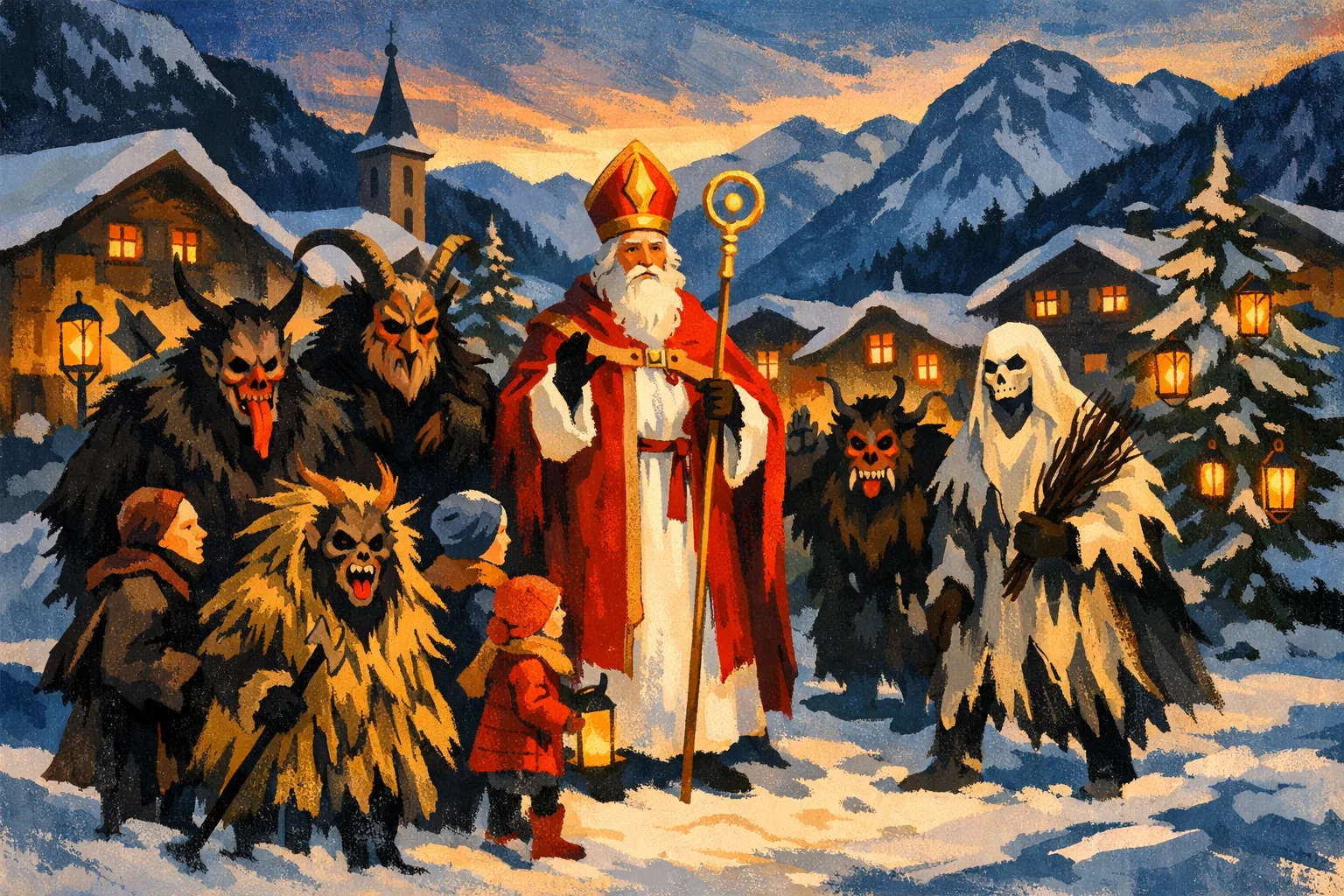
The best-known example is the world of Krampus and related masked figures. In many Austrian regions, Saint Nicholas rewards children, while frightening companions test, warn, punish, or dramatise disorder. Modern visitors often see this as a spectacular monster parade, but locally it can still be tied to specific houses, village groups, inherited costumes, memorised speeches, and rules about when and how the procession should happen.
A useful counterexample is the Niglo Procession in Windischgarsten. UNESCO’s Austrian inventory describes it as a local procession involving Saint Nicholas, recited poems, figures presented publicly, and gifts for children. It is practised only there in that form, passed down both orally and practically, and differs from many Krampus and Perchten runs because it emphasises Saint Nicholas and the good rather than the devilish element. Its first written evidence is around 150 years old; in 1958 it was reshaped from house-to-house visiting into a public procession, and since 2000 it has been held annually.[unesco.at]unesco.atThe Niglo Procession in WindischgarstenThe Niglo Procession in Windischgarsten
That example shows a key point: “old tradition” does not always mean unchanged tradition. Austrian winter customs often have deep roots, but their present form may reflect twentieth-century folklore associations, tourism, safety rules, youth culture, and public staging. A village procession can be both traditional and modern at the same time.
Krampus, Perchten, and the question of old belief
Krampus is now Austria’s most exportable folk monster, helped by postcards, horror films, Christmas markets, and internet imagery. Yet the broader Austrian context is more subtle than “Christmas demon punishes naughty children”. Krampus belongs especially to the Saint Nicholas cycle, while Perchten traditions tend to sit closer to the turn of the year, Epiphany, and the wider Alpine winter season.
Perchten are often presented in two broad visual types: beautiful or blessing-bringing figures and ugly, frightening figures that drive away evil, cold, or disorder. In practice, the local form is what matters. Gastein’s Perchten run, for instance, appears in Austria’s intangible heritage materials as a four-yearly event with roughly 140 different figures, where mythical figures with impressive headdresses offer blessings and good wishes to spectators.[unesco.at]unesco.atIntangible Cultural Heritage in AustriaIntangible Cultural Heritage in Austria
The relationship between these figures and ancient pagan religion is often overstated in popular writing. Some motifs probably preserve older seasonal concerns: the dangerous midwinter night, masked inversion, fertility, blessing, punishment, and the boundary between the living and the dead. But direct lines from a specific pre-Christian cult to a modern parade are hard to prove. A grounded reading is better: Austrian winter folklore is a layered tradition, shaped by Christian teaching, village discipline, theatre, local pride, antiquarian collection, and modern revival.
The Öblarn Krampus Play in Styria is a good illustration of that layered character. Austria’s UNESCO material describes it as one of the last surviving Styrian folk theatre traditions, with orally transmitted texts for individual characters, performed every year in early December in the town’s market square.[unesco.at]unesco.atIntangible Cultural Heritage in AustriaIntangible Cultural Heritage in Austria This is not simply a monster run. It is performance, memory, moral instruction, local identity, and seasonal entertainment at once.
Witches, wild women, and household fear
Austrian supernatural legend is not limited to public processions. It also lives in smaller stories of witches, night spirits, wild women, and unsettling household presences. These traditions overlap with wider Central European motifs, but Austrian versions often carry Alpine colouring.
Scholarship on Austrian demonological legends notes that Austrian witch legends resemble those of neighbouring European countries, yet motifs connected with Alpine figures such as Percht, Trud, Schrätel, and wild women are transferred into later witch legends. The same study also points to borderland mixtures, especially around Burgenland, where Alpine and Hungarian lowland traditions meet, and where historical witch-trial memory and legend can overlap.[ResearchGate]researchgate.netResearch Gate(PDF) Witches and Devil’s Magic in Austrian Demonological LegendsResearch Gate(PDF) Witches and Devil’s Magic in Austrian Demonological Legends
For readers, the important distinction is between the historical witch and the legendary witch. Historical witch trials involved real people, courts, accusations, and violence. Legendary witches belong to oral narrative: they steal milk, spoil butter, ride through the night, harm sleepers, or merge with older figures who punish laziness and disorder. Folklore often turns social fears into memorable characters. In Alpine Austria, that means the boundary between the witch, the winter visitor, the nightmare spirit, and the wild woman can be fluid.
The “wild women” of mountain legend are especially revealing. They can be dangerous, seductive, helpful, or morally testing, depending on the tale. They belong to a broader Alpine imagination in which cliffs, caves, forests, and high pastures are inhabited by beings just beyond human society. These figures make the landscape feel watched and morally charged.
Mountains that remember: Untersberg and the Wild Hunt
If Austrian folklore has a natural stage, it is the mountain. The Untersberg, near Salzburg and the German border, is one of the clearest examples of a landscape that has gathered many legends at once. Salzburg’s own tourism writing describes the darker months as the time when the mountain’s stories become especially vivid, including a Wild Hunt tradition associated with the second Thursday in Advent. In this account, named figures go from house to house to scare away evil spirits.[Salzburg]salzburg.infoUntersberg: Magazine: salzburg.infoUntersberg: Magazine: salzburg.info
The same source presents the Untersberg as a home of dwarfs, wild women, giants, and Emperor Charlemagne, who is said to sleep inside the mountain with loyal knights and dwarfs until a future crisis.[Salzburg]salzburg.infoUntersberg: Magazine: salzburg.infoUntersberg: Magazine: salzburg.info This is a classic “sleeping hero” pattern: a great ruler does not truly die, but waits hidden in a mountain until the world needs him again.
Such stories matter because they turn geography into memory. A mountain is not just scenery; it becomes a storehouse of hidden time. Caves suggest buried kingdoms. Echoes become invisible processions. Storms become the noise of hunters, spirits, or giants. The legend does not need to be believed literally to shape how people experience the place.
The Wild Hunt also shows how Austrian folklore belongs to a larger Central European world. Ghostly hunts, nocturnal processions, and storm-riding hosts appear across Germanic and neighbouring traditions. In Austria, however, they are often localised: attached to a particular mountain, Advent night, procession route, or named folk figure.
Dragons and city legends: Klagenfurt and Vienna
Austria’s folklore is not only rural and Alpine. Some of its most memorable legends are urban foundation stories or street legends. Two examples show how supernatural creatures can become part of civic identity.
Klagenfurt’s famous Lindwurm dragon is tied to the mythical founding of the city. According to the Austrian Embassy’s cultural account, local legend places the city in a marshy area plagued by a dragon; a duke builds a tower, knights bait the creature with a bull attached to a chain and hook, and once the dragon takes the bait, they kill it. The dragon and tower then become symbols of Klagenfurt.[Austria in USA]austria.orgin USAThe Lindwurm Dragon — Austria in USAin USAThe Lindwurm Dragon — Austria in USA
This is folklore doing civic work. The monster explains a dangerous landscape, gives the city a heroic origin, and creates a symbol that can be carved, displayed, and recognised. It also gives Klagenfurt a story that visitors can grasp instantly: the city begins where people overcome the creature of the marsh.
Vienna’s basilisk legend works differently. Instead of a city-founding dragon, it is a street-level monster story attached to a precise address. The tale places the basilisk at Schönlaterngasse 7, where a deadly creature in a well is defeated when a baker’s apprentice uses a mirror to turn its own gaze against it. The façade still preserves the memory of the story with an inscription and carving.[Secret Vienna Tours]secretvienna.orgSecret Vienna Tours The Basilisk of Vienna | Secret Vienna BlogSecret Vienna Tours The Basilisk of Vienna | Secret Vienna Blog
The basilisk story feels almost like a folk horror miniature: a domestic water source becomes a place of danger, ordinary workers become heroes, and cleverness defeats deadly supernatural force. It also shows how urban folklore survives through buildings. A carving, plaque, mural, or street name can keep a legend visible long after most residents stop treating it as belief.
Fairy tales and oral storytelling are still living heritage
Austria’s folklore is not only monsters and frightening processions. Fairy-telling is recognised in Austria’s intangible heritage inventory as an oral tradition across the country. The Austrian Commission for UNESCO describes fairy-telling as the art of entertaining people by conveying stories playfully and intellectually, with simple but subtle metaphors that connect listeners while allowing deeper reflection.[unesco.at]unesco.atTelling Fairy TalesTelling Fairy Tales
That description is useful because it explains why fairy tales survive. They are not just children’s stories, and they are not merely old texts printed in books. In oral performance, they create a shared room: teller, listeners, memory, humour, suspense, and moral imagination. The same tale can sound different depending on the teller’s age, dialect, pacing, and audience.
Austria’s fairy-tale culture also sits between oral tradition and literary collection. Nineteenth- and twentieth-century collectors, teachers, priests, scholars, and local enthusiasts recorded tales that had often circulated orally. Once written down, they became easier to preserve, teach, publish, and standardise, but also easier to detach from the specific voice or occasion that first gave them life.
For a public reader, the best way to approach Austrian fairy tales is to ask three questions: Where was this version collected? Who told or published it? And does the story now circulate mainly as oral performance, printed literature, school culture, tourism, or internet retelling? Those questions help separate living tradition from literary afterlife.
Folk religion, saints, and moral theatre
Austrian folklore is deeply entangled with Christianity, especially Catholic seasonal life. This does not mean that every custom began as church teaching. Rather, saints’ days, processions, passion plays, carolling, Epiphany visits, blessings, devils, and moral drama created a calendar in which supernatural stories could be performed publicly.
Saint Nicholas customs are the most obvious example, but they are not the only one. Austria’s intangible heritage inventory includes many practices that sit near the boundary between devotion, performance, and local identity: Saint Nicholas plays, Epiphany carolling, passion plays, nativity theatre, and regional festive customs. The inventory’s category system itself shows that Austrian living heritage is not restricted to “belief” in a narrow sense; it includes oral traditions, performing arts, rituals, social practices, and craft knowledge.[unesco.at]unesco.atNational InventoryNational Inventory
This blend explains why frightening figures can coexist with blessing figures. In many winter customs, the terrifying mask is not simply evil. It may scare away evil, test children, dramatise moral order, or represent chaos temporarily contained by a saintly figure. The village is allowed to meet disorder because the ritual gives it a time, costume, route, and ending.
What changed in modern Austria
Modern Austrian folklore is shaped by three overlapping forces: preservation, performance, and reinvention.
Preservation happens through archives, museums, local associations, and UNESCO-style heritage recognition. These institutions document songs, tales, masks, plays, costumes, and practices so that they are not lost when communities change. The Austrian Folksong Institute archive is a particularly clear example of systematic documentation, with regional archives in every Austrian state and a national role in networking, fieldwork, exhibitions, training, and publications.[| Österreichische Nationalbibliothek]onb.ac.atÖsterreichische Nationalbibliothek Archives of the Austrian Folksong InstituteÖsterreichische Nationalbibliothek Archives of the Austrian Folksong Institute
Performance changes the tradition because public events need schedules, audiences, safety measures, publicity, and sometimes tourism infrastructure. The Niglo Procession’s shift in 1958 from house-to-house groups to a public market-area procession shows how a custom can remain local while changing its social setting.[unesco.at]unesco.atThe Niglo Procession in WindischgarstenThe Niglo Procession in Windischgarsten
Reinvention is the most visible online. Krampus imagery has become a global gothic Christmas brand, often stripped of its Austrian village context. Internet lists may combine well-attested beings with loosely sourced fantasy creatures. Tourism writing may simplify legends into memorable visitor stories. None of this makes modern retellings worthless, but it does mean readers should treat them as adaptations, not as transparent windows into ancient belief.
The healthiest view is not to freeze Austrian folklore in the past. Living traditions survive because people keep finding reasons to perform, tell, argue over, and reshape them. The task is to notice the difference between a documented local practice, a nineteenth-century literary collection, a tourist-friendly summary, and a modern horror aesthetic.

Why Austrian folklore still matters
Austria’s folklore matters because it shows how communities give shape to fear, winter, landscape, memory, and belonging. A horned runner in December is not just a monster; he is part of a calendar. A dragon in Klagenfurt is not just a beast; it explains a city’s symbolic beginning. A basilisk in Vienna is not just a strange creature; it turns a street address into a story. The Untersberg’s sleeping emperor is not just a fantasy; he makes a mountain feel like a chamber of national and regional memory.
The strongest Austrian traditions are often both specific and layered. They belong to named villages, valleys, buildings, and performance groups, yet they also connect to wider European patterns: saints and devils, wild hunts, sleeping heroes, dragons, witches, fairy tales, and masked winter visitors. That combination is what gives Austrian folklore its distinctive texture. It is not a single mythology handed down unchanged, but a living conversation between place, season, story, and performance.
Amazon book picks
Further Reading
Books and field guides related to Where Austria's Dark Season Meets Legend. Use these as the next step if you want deeper reading beyond the article.
The Complete Grimm's Fairy Tales
Central European folk traditions strongly overlap with Austrian storytelling culture.
The Book of Symbols
Useful for interpreting recurring folk motifs and legendary figures.
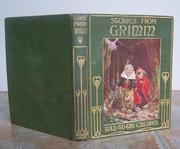
Fairy tales
First published 1800. Subjects: Allemagne, Tales, Fairy tales, Folklore, Contes.
eBay marketplace picks
Marketplace Samples
Live-tested eBay searches with available results related to this page.
Endnotes
1.
Source: unesco.at
Title: National Inventory
Link:https://www.unesco.at/en/culture/intangible-cultural-heritage/inventory
2.
Source: volkskundemuseum.at
Link:https://www.volkskundemuseum.at/en
3.
Source: unesco.at
Title: The Niglo Procession in Windischgarsten
Link:https://www.unesco.at/en/culture/intangible-cultural-heritage/inventory/element/the-niglo-procession-in-windischgarsten
4.
Source: unesco.at
Title: Intangible Cultural Heritage in Austria
Link:https://www.unesco.at/fileadmin/Redaktion/Publikationen/Publikations-Dokumente/2015_IKE-Verzeichnis_2014-2015.pdf
5.
Source: unesco.at
Title: Intangible Cultural Heritage in Austria
Link:https://www.unesco.at/fileadmin/Redaktion/Kultur/IKE/Verzeichnis/IKE_2019__Einzelseiten_online.pdf
6.
Source: researchgate.net
Title: Research Gate(PDF) Witches and Devil’s Magic in Austrian Demonological Legends
Link:https://www.researchgate.net/publication/320307611_Witches_and_Devil%27s_Magic_in_Austrian_Demonological_Legends
7.
Source: salzburg.info
Title: Untersberg: Magazine: salzburg.info
Link:https://www.salzburg.info/en/magazin/scenes/water-marble-and-magic-an-afternoon-on-the-untersberg_a_466674
8.
Source: austria.org
Title: in USAThe Lindwurm Dragon — Austria in USA
Link:https://www.austria.org/wahrzeichen/klagenfurt
9.
Source: unesco.at
Title: Telling Fairy Tales
Link:https://www.unesco.at/en/culture/intangible-cultural-heritage/inventory/element/telling-fairy-tales
10.
Source: unesco.at
Link:https://www.unesco.at/fileadmin/Redaktion/Kultur/IKE/Publikationen/Broschuere_IKE_2021Kern__einzelseiten.pdf
11.
Source: unesco.at
Title: Unesco IKE 2024 Kern 04022025
Link:https://www.unesco.at/fileadmin/Redaktion/Kultur/IKE/Verzeichnis/Unesco_IKE_2024_Kern_04022025.pdf
12.
Source: unesco.at
Title: 2017 IKE Verzeichnis 2016 2017
Link:https://www.unesco.at/fileadmin/Redaktion/Publikationen/Publikations-Dokumente/2017_IKE_Verzeichnis_2016_2017.pdf
13.
Source: unesco.at
Title: IKE Verzeichnis 2024 2025 Digital
Link:https://www.unesco.at/fileadmin/Redaktion/Kultur/IKE/Verzeichnis/IKE_Verzeichnis_2024-2025_Digital.pdf
14.
Source: unesco.at
Link:https://www.unesco.at/kultur/immaterielles-kulturerbe/verzeichnis
15.
Source: ich.unesco.org
Link:https://ich.unesco.org/en/lists
16.
Source: ich.unesco.org
Title: ITH 15 10.CO M Decisions EN.doc
Link:https://ich.unesco.org/doc/src/ITH-15-10.COM-Decisions_-EN.doc
17.
Source: ich.unesco.org
Title: LHE 23 18.CO M INF.7.c EN.docx
Link:https://ich.unesco.org/doc/src/LHE-23-18.COM-INF.7.c_EN.docx
18.
Source: volkskundemuseum.at
Link:https://www.volkskundemuseum.at/
19.
Source: researchgate.net
Link:https://www.researchgate.net/publication/315164291_The_registration_of_songs_in_the_infolk_database_a_virtual_network_of_folk_song_archives_in_Austria
20.
Source: wien.info
Title: Austrian Museum of Folk Life and Folk Art
Link:https://www.wien.info/en/art-culture/museums-exhibitions/austrian-museum-of-folk-life-and-folk-art-440194
21.
Source: austria.info
Link:https://www.austria.info/en-gb/inspiration/raucous-traditions/
22.
Source: onb.ac.at
Title: Österreichische Nationalbibliothek Archives of the Austrian Folksong Institute
Link:https://www.onb.ac.at/en/departments/archives-of-the-austrian-folksong-institute
23.
Source: secretvienna.org
Title: Secret Vienna Tours The Basilisk of Vienna | Secret Vienna Blog
Link:https://secretvienna.org/basilisk-of-vienna/
24.
Source: Wikipedia
Link:https://en.wikipedia.org/wiki/Austria
25.
Source: Wikipedia
Link:https://en.wikipedia.org/wiki/Krampus
26.
Source: Wikipedia
Title: Wild Hunt
Link:https://en.wikipedia.org/wiki/Wild_Hunt
27.
Source: Wikipedia
Link:https://en.wikipedia.org/wiki/Sch%C3%B6nlaterngasse
28.
Source: onb.ac.at
Link:https://www.onb.ac.at/en/departments/archives-of-the-austrian-folksong-institute/using-the-archive-of-the-austrian-folk-song-institute
29.
Source: mythologysource.com
Title: the wild hunt
Link:https://mythologysource.com/the-wild-hunt/
30.
Source: sites.pitt.edu
Link:https://sites.pitt.edu/~dash/sleep.html
31.
Source: sites.pitt.edu
Link:https://sites.pitt.edu/~dash/witch.html
32.
Source: tripadvisor.com
Title: Volkskunde Museum
Link:https://www.tripadvisor.com/Attraction_Review-g190441-d2098141-Reviews-Volkskunde_Museum-Salzburg_Austrian_Alps.html
33.
Source: visitingvienna.com
Link:https://www.visitingvienna.com/sights/museums/volkskundemuseum/
34.
Source: salzburgerland.com
Link:https://www.salzburgerland.com/en/krampus-and-perchten/
35.
Source: viennawurstelstand.com
Link:https://viennawurstelstand.com/location/basilisk-historical-spots-in-vienna/
36.
Source: hauntedvienna.blogspot.com
Link:https://hauntedvienna.blogspot.com/2020/10/untersberg-mystery-mountain.html
37.
Source: museumforall.eu
Link:https://museumforall.eu/museum/vienna-volkskundemuseum-wien/
Additional References
38.
Source: youtube.com
Title: Krampus: The Christmas Demon & Santa’s Shadow | Alpine Folklore History
Link:https://www.youtube.com/watch?v=ffkHiZJ23gY
Source snippet
Vienna: History, Folklore, Mythology & Horror...
39.
Source: youtube.com
Title: Krampus: The creepiest Christmas creature you’ll ever meet
Link:https://www.youtube.com/watch?v=eH3kVX6_CKk
Source snippet
We survived the KRAMPUSLAUF in Austria Rattenberger Advent...
40.
Source: youtube.com
Title: In the Alps, Saint Nick Doesn’t Travel Alone
Link:https://www.youtube.com/watch?v=mJVGpXe6fks
Source snippet
Krampus: The Christmas Demon & Santa's Shadow | Alpine Folklore History...
41.
Source: youtube.com
Title: Vienna: History, Folklore, Mythology & Horror
Link:https://www.youtube.com/watch?v=oh0BLwwKYIA
Source snippet
Krampus: The creepiest Christmas creature you'll ever meet...
42.
Source: youtube.com
Title: Klagenfurt Dragon: Austria’s Monster Beneath the City
Link:https://www.youtube.com/watch?v=1wxnCVftung
Source snippet
In the Alps, Saint Nick Doesn't Travel Alone...
43.
Source: reddit.com
Link:https://www.reddit.com/r/Austria/comments/19dgj87/creating_fantasy_from_the_mythology_of_austria/
44.
Source: encyclopedia.pub
Link:https://encyclopedia.pub/entry/32989
45.
Source: reddit.com
Link:https://www.reddit.com/r/Austria/comments/1kx9tzl/lieblings_sagenmythen_aus_%C3%B6sterreich/?tl=en
46.
Source: oeaw.ac.at
Link:https://www.oeaw.ac.at/vlach/collections/greek-varieties/dodecanese-greek/video-collection/folk-tales-and-myths
47.
Source: boroughsofthedead.com
Link:https://boroughsofthedead.com/frau-perchta/
Topic Tree
Follow this branch
Related pages 192
- Afghan Folklore
- Albanian Folklore
- Algerian Folklore
- Australian Folklore
- Azerbaijan Folklore
- +187 more in sidebar