Why Indonesia's Folklore Still Haunts the Map
Indonesia’s folklore is not one single mythology but a huge archipelago of local story-worlds. Its legends explain mountains, lakes, temples, beaches, royal lineages, moral duties, spirit-haunted landscapes and the relationship between people, ancestors and the unseen.
Page outline Jump by section
Why Indonesian folklore is so varied
Indonesia’s folklore reflects the country’s geography. Thousands of islands, hundreds of local languages and many ethnic traditions have produced different origin stories, spirit beliefs and ritual forms. A Javanese temple legend, a Batak lake myth, a Balinese performance of dangerous magic and a West Kalimantan ghost story may all be “Indonesian folklore”, but they come from very different landscapes and social worlds. That variety is why country-level summaries need care: Indonesia is not a single mythological system with one pantheon, but a shared national frame containing many regional traditions.[Utlib OJS]ojs.utlib.eeOpen source on utlib.ee.
The country’s stories also show long layers of religious and cultural change. Older ancestor and landscape beliefs continued to matter as Hindu-Buddhist, Islamic, local courtly and modern national forms developed. Wayang is a good example: UNESCO describes it as an ancient storytelling form from Java, but its repertoire and performance life have drawn on court culture, village ritual, local languages, moral teaching, Hindu epics, Javanese story cycles and later religious material.[unesco.org]ich.unesco.orgOpen source on unesco.org.
Modern institutions have also reshaped folklore. A 2022 study of Indonesian folk narratives notes that the Ministry of Education and Culture’s language agency collected and rewrote 165 folk narratives from all 34 provinces in 2016, making them available online for literacy and character education. That helps preserve and circulate stories, but it also changes them: oral tales become edited national texts, local variants are standardised, and stories are framed as lessons for school-age readers.[Utlib OJS]ojs.utlib.eeOpen source on utlib.ee.
The stories Indonesians keep retelling
Some Indonesian legends are famous because they attach moral drama to visible places. They are not just “once upon a time” stories; they give meaning to a beach, temple, lake or statue that people can still visit.
Malin Kundang, from West Sumatra, is one of the clearest examples. The story usually centres on a poor son who leaves home, becomes wealthy, then rejects his mother out of shame. In many retellings, the mother’s curse turns him into stone. Indonesia’s official tourism site links Air Manis Beach near Padang with the Malin Kundang rock, and describes the beach as a popular site for local and foreign visitors. The legend’s power lies in its simple moral structure: social ambition becomes monstrous when it is purchased by denying one’s parent and origin.[Visit Indonesia]indonesia.travelOpen source on indonesia.travel.
The Roro Jonggrang story, attached to the Prambanan temple complex in Central Java, works differently. The tale tells of Bandung Bondowoso, who tries to win or force marriage to Roro Jonggrang by building 1,000 temples in one night. She tricks him into thinking dawn has come before the task is complete; he then curses her into stone. Indonesia’s tourism ministry presents the legend as a story passed down through generations and associated with the Durga statue in the Shiva temple at Prambanan. The folklore does not replace the historical importance of Prambanan as a temple complex; instead, it gives visitors a narrative bridge between monument, sculpture and local imagination.[kemenpar.go.id]kemenpar.go.idOpen source on go.id.
Lake Toba in North Sumatra offers another kind of folklore: a landscape myth beside geological history. Modern science identifies Lake Toba as the site of a vast ancient volcanic eruption, while Batak-associated storytelling gives the lake a human and moral origin through a broken promise, a transformed woman and a flood. The contrast is not simply “science versus myth”; for readers of folklore, the interesting point is that a spectacular landscape invites both geological explanation and story-based belonging.[IUCN]iucn.orglake toba and batak legacy harmonising indigenous wisdom conservationlake toba and batak legacy harmonising indigenous wisdom conservation

Spirits, ghosts and the power of place
Indonesian supernatural tradition is especially strong where spirits are tied to territory: a sea, a forested river junction, a graveyard, a village boundary or a dangerous coast. These beings are best understood as figures in local belief and story, not as confirmed supernatural facts.
The Queen of the Southern Sea is one of Java’s most influential spirit figures. Scholarly work on the south coast of Java describes beliefs around Nyai Roro Kidul as active in fishing communities, where they help people think about danger, the sea, fear and protection. In the East Javanese fishing village of Puger, for example, R. Wessing’s study treats her not as a decorative myth but as part of a local spirit world connected to the hazards of maritime life and family concerns.[Persée]persee.frPersée Nyai Roro Kidul in Puger: Local Applications of a MythPersée Nyai Roro Kidul in Puger: Local Applications of a Myth
That same figure also travels through performance, tourism and popular culture. Studies of her representation note that she is known across much of Java’s southern coast, though local details vary. She may appear as a powerful sea queen, a courtly supernatural consort, a dangerous ruler of the ocean realm, or a symbol reused in film, television and other modern media. The result is a tradition that is both old in structure and constantly reinterpreted.[researchgate.net]researchgate.netOpen source on researchgate.net.
Kuntilanak shows a different kind of haunting. In Indonesian and wider Malay-region horror culture, she is often imagined as a female ghost or vampire-like figure, but the Pontianak tradition in West Kalimantan gives her a specific local role. Research on Kuntilanak narratives notes that people in Pontianak connect the city’s founding story with the eviction of a supernatural female being from the confluence of the Kapuas and Landak rivers. That makes her more than a generic horror monster: she becomes part of urban memory, settlement and the way a frontier city explains itself.[sciencedirect.com]sciencedirect.comOpen source on sciencedirect.com.
In Bali, frightening figures such as Rangda and the magical beings associated with the Calon Arang performance tradition occupy a more ritual and theatrical world. Recent scholarship on Rangda examines her as a powerful chthonic or underworld-linked figure whose identity intersects with the Hindu goddess Durga in specifically Balinese ways. She is often presented in opposition to Barong in performance, but reducing the tradition to a simple battle of “good versus evil” misses its deeper texture: fear, protection, destructive power and sacred performance are intertwined.[researchgate.net]researchgate.netResearch Gate(PDF) Balinese Calonarang in PerformanceResearch Gate(PDF) Balinese Calonarang in Performance
Wayang and the art of telling old stories anew
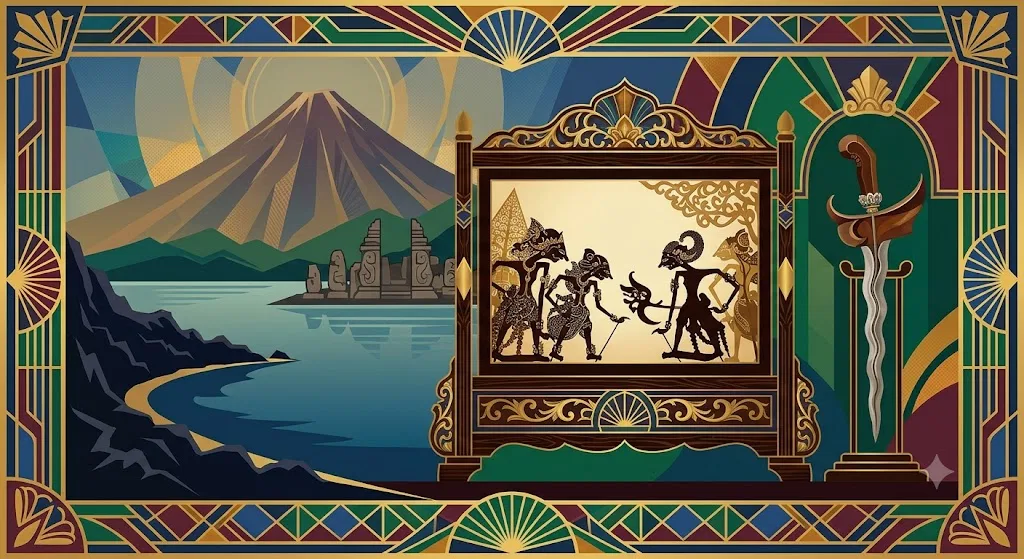
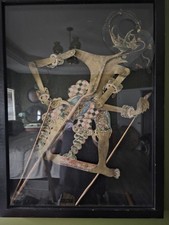
Wayang puppet theatre is one of Indonesia’s most important folklore-bearing arts. UNESCO describes it as a form of storytelling from Java, renowned for elaborate puppets and complex musical styles, which flourished for centuries in royal courts and rural areas and spread to places including Bali, Lombok, Madura, Sumatra and Borneo.[UNESCO Intangible Cultural Heritage]ich.unesco.orgOpen source on unesco.org.
Its importance is not only visual. A performance can combine story, music, moral reflection, comedy, local political commentary, ritual atmosphere and philosophical teaching. Even when the plot draws on the Ramayana or Mahabharata, the performance is not merely an imported epic in another language. Characters, humour, ethics, music and staging have been shaped by Indonesian courtly and local traditions.[unesco.org]ich.unesco.orgOpen source on unesco.org.
Wayang also shows how folklore survives by changing medium. UNESCO’s safeguarding material records wayang’s recognition as a Masterpiece of the Oral and Intangible Heritage of Humanity in 2003 and its inscription on the Representative List in 2008. That recognition does not freeze the tradition; rather, it supports transmission in a world where live performance competes with television, social media, tourism and formal education.[UNESCO Intangible Cultural Heritage]ich.unesco.org00550 EN.doc00550 EN.doc
The stories told through wayang are themselves varied. Alongside epic material, Indonesian performance traditions include local and regional cycles such as the Panji stories, tales of disguise, separation, searching and reunion centred on Prince Panji and Princess Candra Kirana. UNESCO describes the Panji tales as 13th-century stories that marked the development of a Javanese literature no longer overshadowed by the great Indian epics.[UNESCO]unesco.orgPanji Tales ManuscriptsPanji Tales Manuscripts

Sacred objects and magical craftsmanship
Indonesian folklore is not limited to spoken stories and ghosts. Objects can carry legend, spiritual value and social meaning. The kris, or asymmetrical dagger, is the most famous example. UNESCO describes the Indonesian kris as both a weapon and spiritual object, traditionally considered to possess magical powers, with the earliest known examples going back to around the tenth century and spreading from Java through Southeast Asia.[UNESCO Intangible Cultural Heritage]ich.unesco.orgIntangible Cultural Heritage Indonesian KrisIntangible Cultural Heritage Indonesian Kris
For a folklore reader, the kris matters because it sits between material culture and belief. It is an artefact that can be collected, worn, inherited, blessed, discussed as craftsmanship and interpreted as a vessel of power or status. Modern Indonesian commentary also shows how its meaning continues to shift: a 2026 report from Universitas Gadjah Mada described recent efforts to frame the kris as cultural heritage for a broad public, not only as a weapon or elite possession.[Universitas Gadjah Mada]ugm.ac.idUniversitas Gadjah Mada Keris: From Weapon of War to Cultural CollectibleUniversitas Gadjah Mada Keris: From Weapon of War to Cultural Collectible
Batik, though not a “monster” or “legend” topic, also belongs near Indonesian folklore when its motifs and rituals tell stories. UNESCO’s material on Indonesian batik emphasises handmade practice, symbolism, associated rituals and cultural values. In Javanese coastal reinterpretations, researchers have even connected batik storytelling with the mythic world of the Queen of the Southern Sea. This is a reminder that folklore can live in pattern, cloth, performance and object-use, not only in prose tales.[UNESCO Intangible Cultural Heritage]ich.unesco.org01579 EN.doc01579 EN.doc
Manuscripts, archives and the problem of “old tradition”
One of the most useful questions a reader can ask is: how do we know a story is old? In Indonesia, the answer varies. Some traditions are still transmitted orally; some survive through performance lineages; some were written in manuscripts; some were collected under colonial conditions; some are recent tourist or media retellings of older motifs.
The Panji manuscripts show the manuscript side of folklore especially well. UNESCO’s Memory of the World entry describes the Panji tales as 13th-century stories about Prince Panji’s adventures and search for Princess Candra Kirana. Leiden University Libraries notes that its Panji collection was inscribed on the UNESCO Memory of the World Register together with related collections in Indonesia, Malaysia and Cambodia.[UNESCO]unesco.orgPanji Tales ManuscriptsPanji Tales Manuscripts
Archives can preserve extraordinary evidence, but they also raise questions about power. Leiden’s digital collections include the Hazeu Papers, connected with the Dutch scholar and colonial official G. A. J. Hazeu, while KITLV has recently highlighted the need to examine the colonial histories of Asian library and manuscript formation. For Indonesian folklore, that means older written sources are valuable but not neutral: they often passed through collectors, administrators, missionaries, scholars and institutions far from the communities where stories lived.[universiteitleiden.nl]digitalcollections.universiteitleiden.nlOpen source on universiteitleiden.nl.
This is why modern folklore writing should distinguish between oral tradition, manuscript tradition, state-edited school texts, tourism copy and internet folklore. Malin Kundang at Air Manis Beach, for example, is both a moral legend and a tourist landscape; Roro Jonggrang is both a temple legend and a modern heritage narrative; Kuntilanak is both a local West Kalimantan being and a horror-film figure. None of these versions is simply “fake” because it is modern, but each version does different cultural work.[indonesia.travel]indonesia.travelOpen source on indonesia.travel.
Modern media, tourism and internet-era folklore
Indonesian folklore remains highly adaptable because its figures are memorable. Ghosts, cursed stones, sea queens, magical daggers and impossible temple-building tasks all translate easily into film, television, comics, tourist storytelling and social media. Kuntilanak, for instance, is now a major figure in Indonesian and regional horror culture, even though academic work shows that her local meanings are more complex than the standard film image of a terrifying woman in white.[researchgate.net]researchgate.netResearch Gate Kuntilanak-Ghost-Narratives-and-Malay-Modernity-inResearch Gate Kuntilanak-Ghost-Narratives-and-Malay-Modernity-in
Tourism can strengthen a legend by attaching it to an itinerary. Air Manis Beach is marketed through the Malin Kundang story; Prambanan is experienced by many visitors through the Roro Jonggrang legend as well as through archaeology and architecture. This can make folklore more visible, but it can also flatten local variants into a single visitor-friendly version.[indonesia.travel]indonesia.travelOpen source on indonesia.travel.
State heritage recognition has a similar double edge. UNESCO listing helps draw attention to traditions such as wayang and the kris, while national programmes can support teaching and preservation. But living folklore is not preserved simply by being labelled. It depends on performers, storytellers, ritual specialists, craftspeople, audiences, families and communities continuing to find meaning in the tradition.[UNESCO Intangible Cultural Heritage]ich.unesco.orgOpen source on unesco.org.
What to remember about Indonesian folklore
The most important thing to remember is that Indonesian folklore is plural. Java, Bali, Sumatra, Kalimantan, Sulawesi, Papua and many other regions hold different story traditions, and even famous figures vary from place to place. A good reading of Indonesian folklore therefore avoids treating one island’s traditions as the whole country’s mythology.[Utlib OJS]ojs.utlib.eeOpen source on utlib.ee.
The second point is that many Indonesian stories are attached to real cultural practices and landscapes. Wayang is not just a story archive but a performance art. The kris is not just a legendary weapon but a crafted and inherited object. Malin Kundang is not only a cautionary tale but a beach landmark and tourist story. The Queen of the Southern Sea is not only a mythic personage but part of coastal belief, performance and modern popular culture.[unesco.org]ich.unesco.orgOpen source on unesco.org.
The third point is that old and new are constantly mixed. Some traditions have medieval manuscript roots; some were shaped by courtly performance; some were collected and reframed in colonial archives; some circulate today through schoolbooks, horror films, tourism campaigns and online posts. Indonesian folklore is therefore best understood not as a museum shelf of ancient tales, but as a living field where local memory, sacred geography, moral teaching and popular entertainment keep meeting.[unesco.org]unesco.orgPanji Tales ManuscriptsPanji Tales Manuscripts

Amazon book picks
Further Reading
Books and field guides related to Why Indonesia's Folklore Still Haunts the Map. Use these as the next step if you want deeper reading beyond the article.
Javanese Shadow Plays, Javanese Selves
Explores wayang, one of Indonesia's most important storytelling traditions.
Island of Bali [by] Miguel Covarrubias
Explains living traditions, rituals and folklore in context.
eBay marketplace picks
Marketplace Samples
Live-tested eBay searches with available results related to this page.
Endnotes
1.
Source: ich.unesco.org
Link:https://ich.unesco.org/en/RL/wayang-puppet-theatre-00063
2.
Source: ich.unesco.org
Title: Intangible Cultural Heritage Indonesian Kris
Link:https://ich.unesco.org/en/RL/indonesian-kris-00112
3.
Source: unesco.org
Title: Panji Tales Manuscripts
Link:https://www.unesco.org/en/memory-world/panji-tales-manuscripts
4.
Source: ojs.utlib.ee
Link:https://ojs.utlib.ee/index.php/JEF/article/download/22754/17288/31497
5.
Source: ojs.utlib.ee
Link:https://ojs.utlib.ee/index.php/JEF/article/view/22754/17288
6.
Source: unesco.org
Title: document 3759
Link:https://www.unesco.org/archives/multimedia/document-3759
7.
Source: researchgate.net
Link:https://www.researchgate.net/publication/361700482_Indonesian_Folk_Narratives_On_the_Interstices_of_National_Identity_National_Values_and_Character_Education
8.
Source: indonesia.travel
Link:https://www.indonesia.travel/nl/en/destination/sumatra/west-sumatra/padang—air-manis-beach/
9.
Source: kemenpar.go.id
Link:https://kemenpar.go.id/en/articles/prambanan-temple-is-it-truly-from-the-story-of-roro-jonggrang-and-bandung-bondowoso-here-are-10-facts-about-it
10.
Source: indonesia.travel
Link:https://www.indonesia.travel/gb/en/travel-ideas/heritage/candi-prambanan/
11.
Source: iucn.org
Title: lake toba and batak legacy harmonising indigenous wisdom conservation
Link:https://iucn.org/story/202311/lake-toba-and-batak-legacy-harmonising-indigenous-wisdom-conservation
12.
Source: researchgate.net
Link:https://www.researchgate.net/publication/339742160_REPRESENTATION_OF_NYI_RORO_KIDUL_IN_MYTH_LEGEND_AND_POPULAR_CULTURE
13.
Source: academia.edu
Link:https://www.academia.edu/42727752/REPRESENTATION_OF_NYI_RORO_KIDUL_IN_MYTH_LEGEND_AND_POPULAR_CULTURE
14.
Source: sciencedirect.com
Link:https://www.sciencedirect.com/org/science/article/pii/S0006229420000143
15.
Source: daily.jstor.org
Title: the indonesian frontier town named for a jungle vampire
Link:https://daily.jstor.org/the-indonesian-frontier-town-named-for-a-jungle-vampire/
16.
Source: researchgate.net
Title: Research Gate(PDF) Balinese Calonarang in Performance
Link:https://www.researchgate.net/publication/361266592_Balinese_Calonarang_in_Performance
17.
Source: journal.equinoxpub.com
Link:https://journal.equinoxpub.com/searc/article/view/23962
18.
Source: indonesia.travel
Link:https://www.indonesia.travel/fr/fr/travel-ideas/heritage/kris/
19.
Source: ich.unesco.org
Title: 00550 EN.doc
Link:https://ich.unesco.org/doc/src/00550-EN.doc
20.
Source: ich.unesco.org
Link:https://ich.unesco.org/en/projects/implementation-of-the-national-action-plan-for-the-safeguarding-of-the-wayang-puppet-theatre-of-indonesia-00020
21.
Source: unesco.org
Title: document 628
Link:https://www.unesco.org/archives/multimedia/document-628
22.
Source: ich.unesco.org
Title: 01579 EN.doc
Link:https://ich.unesco.org/doc/src/01579-EN.doc
23.
Source: kitlv.nl
Link:https://www.kitlv.nl/unpacking-kitlv-special-collections/
24.
Source: researchgate.net
Title: Research Gate Kuntilanak-Ghost-Narratives-and-Malay-Modernity-in
Link:https://www.researchgate.net/publication/342149370_Kuntilanak_Ghost_Narratives_and_Malay_Modernity_in_Pontianak_Indonesia/fulltext/5ee4c5f1a6fdcc73be781809/Kuntilanak-Ghost-Narratives-and-Malay-Modernity-in-Pontianak-Indonesia.pdf
25.
Source: ich.unesco.org
Link:https://ich.unesco.org/en/state/indonesia-ID?info=periodic-reporting
26.
Source: ich.unesco.org
Link:https://ich.unesco.org/doc/src/Signed%20periodic%20report%20-%20Periodic%20report-67386.pdf
27.
Source: Wikipedia
Link:https://en.wikipedia.org/wiki/Wayang
28.
Source: Wikipedia
Title: Malin Kundang
Link:https://en.wikipedia.org/wiki/Malin_Kundang
29.
Source: Wikipedia
Title: Lake Toba
Link:https://en.wikipedia.org/wiki/Lake_Toba
30.
Source: persee.fr
Title: Persée Nyai Roro Kidul in Puger: Local Applications of a Myth
Link:https://www.persee.fr/doc/arch_0044-8613_1997_num
31.
Source: Wikipedia
Title: Nyai Roro Kidul
Link:https://en.wikipedia.org/wiki/Nyai_Roro_Kidul
32.
Source: jurnal.isbi.ac.id
Link:https://jurnal.isbi.ac.id/index.php/panggung/article/download/3683/2616
33.
Source: digitalcollections.universiteitleiden.nl
Link:https://digitalcollections.universiteitleiden.nl/panjitalesmanuscripts
34.
Source: ugm.ac.id
Title: Universitas Gadjah Mada Keris: From Weapon of War to Cultural Collectible
Link:https://ugm.ac.id/en/news/keris-from-weapon-of-war-to-cultural-collectible/
35.
Source: library.universiteitleiden.nl
Title: panji tales awarded the status of world heritage by unesco
Link:https://www.library.universiteitleiden.nl/news/2017/10/panji-tales-awarded-the-status-of-world-heritage-by-unesco
36.
Source: digitalcollections.universiteitleiden.nl
Link:https://digitalcollections.universiteitleiden.nl/hazeu
Additional References
37.
Source: youtube.com
Title: The Story of Malin Kundang | Stories for Kids | Indonesian Folklore
Link:https://www.youtube.com/watch?v=MCo_VNcVHHg
Source snippet
The Logic Behind Indonesian Superstition...
38.
Source: youtube.com
Title: Sangkuriang: Indonesian Legend | Myth Stories
Link:https://www.youtube.com/watch?v=WAGj-dp9z-M
Source snippet
The Story of Malin Kundang | Stories for Kids | Indonesian Folklore...
39.
Source: etnografia.kunstkamera.ru
Link:https://etnografia.kunstkamera.ru/en/archive/2019_1/frolova_luneva
40.
Source: iias.asia
Link:https://www.iias.asia/sites/iias/files/nwl_article/2024-06/IIAS_NL98_4748.pdf
41.
Source: youtube.com
Title: The Logic Behind Indonesian Superstition
Link:https://www.youtube.com/watch?v=RssmM227HnU
Source snippet
What Makes Indonesian Horror So Psychologically Terrifying?...
42.
Source: asianethnology.org
Title: 149479 homo narrans in east java regional myths and local concerns
Link:https://asianethnology.org/article/149479-homo-narrans-in-east-java-regional-myths-and-local-concerns.pdf
43.
Source: youtube.com
Title: The Wayang Puppet Theatre
Link:https://www.youtube.com/watch?v=pfydro4X2t0
Source snippet
Sangkuriang: Indonesian Legend | Myth Stories...
44.
Source: youtube.com
Title: What Makes Indonesian Horror So Psychologically Terrifying?
Link:https://www.youtube.com/watch?v=h-wUX3beWVE
45.
Source: scitepress.org
Link:https://www.scitepress.org/Papers/2019/99825/99825.pdf
46.
Source: supernaturalstudies.com
Link:https://www.supernaturalstudies.com/previous-journal-issues/vol-10-issue-1/duile
Topic Tree
Follow this branch
Related pages 192
- Afghan Folklore
- Albanian Folklore
- Algerian Folklore
- Australian Folklore
- Azerbaijan Folklore
- +187 more in sidebar