Where Chad's Stories Live Under the Stars
Chad’s folklore is not a single national mythology with one neat pantheon. It is a wide landscape of oral tales, sacred mountains, lake legends, clan memories, animal fables, Islamic-era foundation stories, and modern literary retellings shaped by one of Africa’s most culturally varied countries.
Page outline Jump by section
Introduction
For a folklore reader, the important point is that Chad’s tradition is layered. Some stories preserve old local religious ideas about earth, water, mountains and ancestral powers. Some are linked to historical kingdoms such as Kanem, Baguirmi and Wadai. Some come to us through written literature, especially Joseph Brahim Seid’s 1962 collection Au Tchad sous les étoiles, a landmark Chadian book of tales and poetic folklore.[Google Books]books.google.comBooks Au Tchad sous les étoilesBooks Au Tchad sous les étoiles And some survive today through family storytelling, illustrated retellings, cultural festivals, heritage projects and tourism around places such as the Ennedi Massif, Lake Chad and the Lakes of Ounianga.
Why Chad’s folklore is so regional
Chad’s geography helps explain why its folklore is so varied. The country stretches from the Sahara in the north, through the Sahel, to the savanna and river lands of the south. Minority Rights Group describes the northern BET area of Borkou, Ennedi and Tibesti as a vast Saharan zone dominated by Toubou peoples; the middle belt as a Sahelian region of nomadic, semi-nomadic and sedentary communities; and the south as a more densely populated area with many Sara and other southern communities.[Minority Rights Group]minorityrights.orgMinority Rights Group ChadMinority Rights Group Chad
That means Chadian folklore is not best read as a list of “Chadian monsters”. It is closer to a map of lived worlds. In the north, stories and sacred associations cluster around mountains, water holes, desert routes, rock shelters and nomadic memory. Around Lake Chad, folklore is tied to islands, fishing, reed settlements, older Sao civilisation memories and the historical reach of Kanem-Bornu. In Guéra, mountains are strongly associated with sacredness and ancestral spirituality. In the south, oral tales often sit within village life, night-time storytelling, initiation, social teaching and moral conduct.
Religion adds another layer. The Embassy of Chad in Washington describes Islam, Christianity and Indigenous religion as overlapping rather than entirely separate in everyday cultural life: Islam in Chad is said to draw on pre-Islamic Indigenous religion, while many Chadian Christians also integrate aspects of animism and other Indigenous beliefs.[My Site]chadembassy.usMy Site CULTURE | My SiteMy Site CULTURE | My Site For folklore, this matters because spirits, ancestors, saints, Quranic learning, local ritual specialists and moral tales can coexist in the same cultural field.
The oral tale: entertainment, memory and moral teaching
The heart of Chadian folklore is oral storytelling. These tales are not simply children’s entertainment, though children are often an important audience. They teach behaviour, explain danger, praise cleverness, remember old conflicts, dramatise marriage choices, make fun of greed and give listeners a shared store of images: the moon and sun, the hyena, the lion, the orphan, the hidden princess, the hunter, the old woman, the powerful ruler, the sacred mountain.
A clear modern statement of this comes from the Guéra storytelling project Folktales of Guera, which says that tales are told orally, often at night, and that they entertain while also teaching good morals and social conduct. The same project links Guéra tales to landscape, food, fauna and the mystery of ancestral spirituality.[artistetchadienne.org]artistetchadienne.orgFollktales of GueraFollktales of Guera This is a good general rule for reading Chadian folklore: the “marvellous” elements usually do social work. A magical helper, animal trickster or frightening spirit is rarely just decoration. It marks the boundary between proper and improper behaviour.
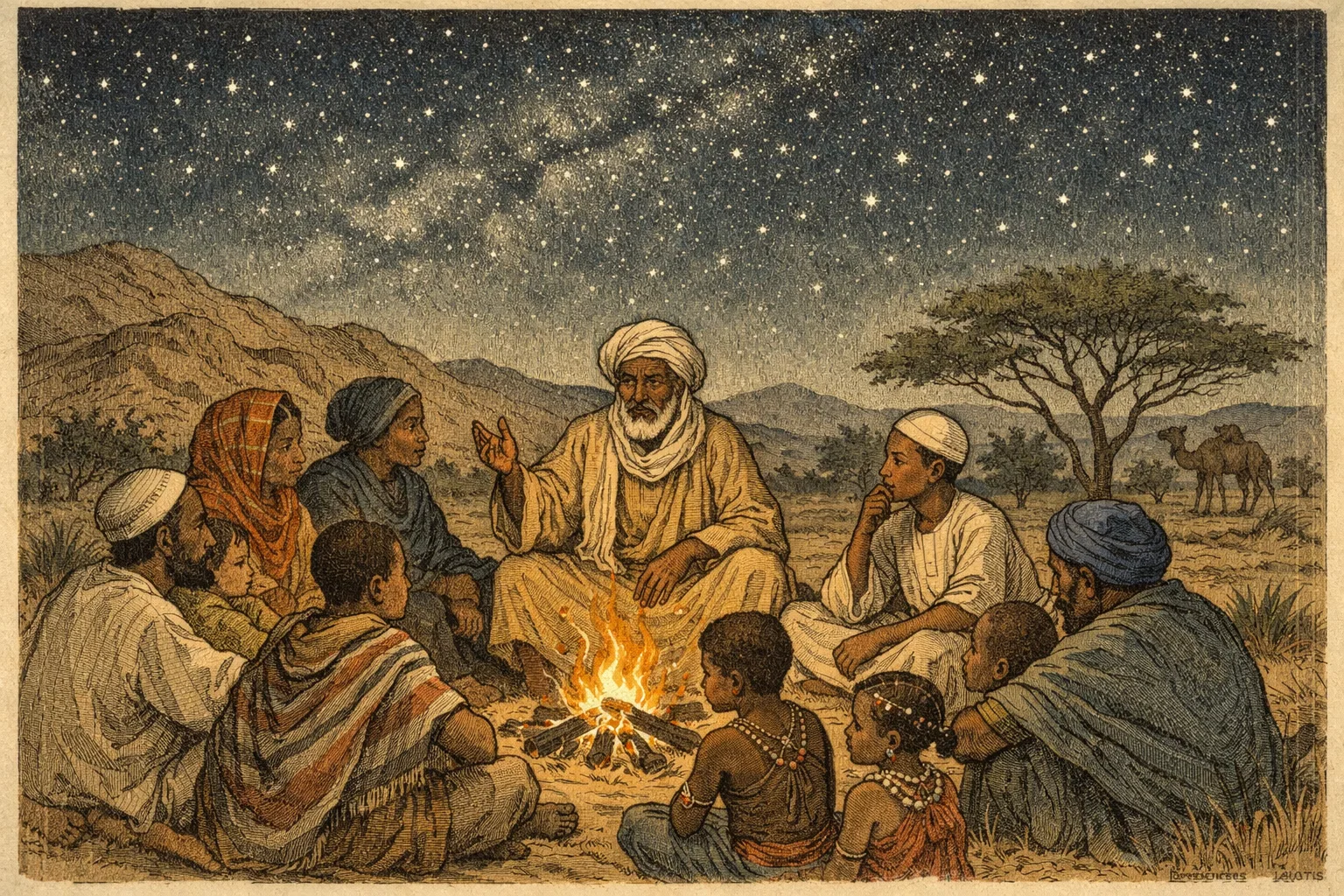
Joseph Brahim Seid’s Au Tchad sous les étoiles is especially important because it moved Chadian tale material into print. Google Books records the original Présence Africaine publication in 1962, while the publisher’s modern description presents the book as a work whose tales carry social and moral value beyond entertainment.[Google Books]books.google.comBooks Au Tchad sous les étoilesBooks Au Tchad sous les étoiles The title itself, meaning “In Chad under the stars”, captures a classic setting for oral storytelling: people gathered in the evening, under an open sky, listening to stories that move between everyday life and wonder.

Joseph Brahim Seid and the printed afterlife of Chadian tales
Joseph Brahim Seid is one of the key figures for anyone looking for Chadian folklore in written form. His Au Tchad sous les étoiles was published by Présence Africaine in 1962, and the publisher identifies Seid as a Chadian politician and writer who also wrote Un enfant du Tchad in 1967.[Google Books]books.google.comBooks Au Tchad sous les étoilesBooks Au Tchad sous les étoiles The book is not a neutral audio recording of village storytelling; it is a literary work that gathers, shapes and presents tales for readers. That distinction matters.
The stories associated with Seid’s collection include animal tales, royal legends, moral fables and marvellous narratives. A modern discussion of Kotoko folklore, drawing on the English translation Told by Starlight in Chad, highlights stories such as “The Eclipse of the Moon”, “The Kingdom of Wadai” and “The Most Beautiful Girl on Earth, Hidden Under an Ass’ Skin”.[mythologicalafricans.substack.com]mythologicalafricans.substack.comKotoko (Chad) FolkloreKotoko (Chad) Folklore These titles show the range of Chadian folklore in print: sky explanation, political-religious memory, romance, disguise, beauty, danger and transformation.
The printed version also changes the audience. Oral tales are flexible: a storyteller can shorten, expand, localise or adjust them for a particular night and group. A book fixes one version and makes it travel. That is why Seid’s work should be treated as both folklore evidence and literary retelling. It preserves Chadian story-worlds, but it also gives them the style, selection and moral emphasis of a modern author.
Lake Chad: Sao memory, island worlds and legendary ancestry
Lake Chad is one of the richest folklore zones in the country because it is both a real ecological world and a historical memory-bank. UNESCO’s Lake Chad cultural landscape material describes the lake’s islands, fishing shelters, dugouts, dikes and cultivated polders as part of a traditional lakeside way of life, and links the wider region to the Sao civilisation, known for terracotta culture.[UNESCO World Heritage Centre]whc.unesco.orgOpen source on unesco.org.
The Sao are especially important because they sit on the edge between archaeology, history and legend. Archaeological and heritage sources treat the Sao as an ancient civilisation of the Lake Chad basin, while oral traditions and later retellings often turn them into ancestral giants, mighty warriors or founders. Modern Kotoko identity is frequently linked to Sao descent, and Lake Chad traditions often remember older peoples through this heroic or enlarged form.[UNESCO World Heritage Centre]whc.unesco.orgOpen source on unesco.org.
For readers, the key is not to flatten the Sao into either “myth” or “fact”. There really was an ancient Lake Chad cultural world with terracotta and settlement traditions. There are also oral memories that have grown around that past, giving it the shape of giant ancestors and vanished powers. This is exactly how folklore often works: it does not replace history, but gives history a memorable human and moral form.
Lake Chad’s living landscape matters too. UNESCO has described the Lake Chad Basin as supporting about 45 million people across the wider transboundary region and as containing remarkable natural and cultural potential.[UNESCO]unesco.organd sustainable development lake chad basinand sustainable development lake chad basin Folklore here is therefore not only about the past. Stories of water, islands, reeds, fish, cattle, migration and danger speak to communities whose lives have long depended on fragile ecological balance.
Wadai, Kanem and stories of power
Some Chadian legends are tied to kingdoms and political memory rather than to spirits or animals. Wadai, Kanem and Baguirmi appear in Chadian historical consciousness not only as states but as sources of royal story, religious transformation and local identity. In the tale tradition associated with Seid, “The Kingdom of Wadai” is described as a folkloric-historical account of the arrival or spread of Islam in Wadai.[mythologicalafricans.substack.com]mythologicalafricans.substack.comKotoko (Chad) FolkloreKotoko (Chad) Folklore
Such stories should be read carefully. A kingdom legend may preserve memories of conquest, conversion, alliance or dynastic legitimacy, but it may also smooth over violence or simplify a complex political process. Folklore often turns history into a story with named heroes, villains, marriages, miracles and moral tests. That does not make it useless. It makes it revealing: the tale shows how later communities wanted to remember power.
Kanem and Kanem-Bornu also matter for folklore because they connect Chad to a wider Sahelian world of Islam, trade, scholarship, cavalry, royal courts and migration. The Kanembu/Bornu/Buduma cluster is one of Chad’s major population groupings, and Kanembu communities are historically associated with the Lake Chad and Kanem region.[Minority Rights Group]minorityrights.orgMinority Rights Group ChadMinority Rights Group Chad Around such histories, oral tradition can preserve genealogies, praise, origin stories and memories of movement across lake, desert and savanna.
Guéra and the sacred mountain world
One of the most distinctive Chadian folklore regions is Guéra, in south-central Chad. Modern Guéra cultural writing describes the mountains as sacred and as a haven of original spirituality known as Margay or Margaï, where visible and invisible worlds are understood as connected.[artistetchadienne.org]artistetchadienne.orgGuera, land of MargaïGuera, land of Margaï This is not a generic “mountain spirit” idea imported from elsewhere. It is a local way of speaking about place, ancestry, environment and spiritual power.
Guéra tales are often presented as landscape stories. The mountain is not just scenery; it is the source of mystery, danger and protection. The Folktales of Guera project says the mountain ranges are havens of sacredness and crossroads between the divine and human worlds, from which the magic of Guéra tales is born.[artistetchadienne.org]artistetchadienne.orgFollktales of GueraFollktales of Guera In such a setting, a hunter, traveller or wrongdoer entering the mountain is not merely entering rough terrain. They are crossing into a charged moral space.
This helps explain why Guéra folklore is so suitable for modern visual retelling. Mountains, animals, invisible forces and moral tests translate well into illustrated tales and animation. But the modern format should not obscure the older function: these stories teach conduct and respect for the environment by making the landscape spiritually alive.
Ennedi: rock art, memory and the deep past
The Ennedi Massif is not folklore in the narrow sense of a narrated fairy tale, but it is central to Chad’s mythic and sacred landscape. UNESCO describes the Ennedi as a sandstone massif in north-eastern Chad sculpted by water and wind into canyons, cliffs, natural arches and rock shelters, with permanent water in the largest canyons sustaining human, animal and plant life. It also records thousands of painted and carved images, one of the largest rock art ensembles in the Sahara.[UNESCO World Heritage Centre]whc.unesco.orgWorld Heritage Centre Ennedi Massif: Natural and Cultural LandscapeWorld Heritage Centre Ennedi Massif: Natural and Cultural Landscape
For a folklore page, the significance of Ennedi is twofold. First, rock art gives a visual record of older human imagination and environment: animals, people, movement, ritualised scenes and changing relationships with the Sahara. Second, rock shelters and water places often become sacred or storied places in local tradition. UNESCO material on Ennedi notes not only the scale of the rock art but also the close link between cultural and natural values in the landscape.[UNESCO World Heritage Centre]whc.unesco.orgWorld Heritage Centre Ennedi Massif: Natural and Cultural LandscapeWorld Heritage Centre Ennedi Massif: Natural and Cultural Landscape
The temptation is to call the paintings “myths on stone”, but that goes too far unless a specific story can be securely linked to a specific image. A safer reading is that Ennedi shows the deep antiquity of symbolic life in Chad. It reminds readers that storytelling did not begin with books, and that Chadian cultural memory includes images, places, routes and ritualised landscapes as well as spoken tales.
Ounianga and the folklore of impossible water
The Lakes of Ounianga, also in the Saharan north-east, are another place where landscape feels almost legendary even before any specific story is told. UNESCO describes eighteen interconnected lakes in the hyper-arid Ennedi region, supplied by groundwater, with saline, hyper-saline and freshwater lakes grouped around Ounianga Kebir and Ounianga Serir.[UNESCO World Heritage Centre]whc.unesco.orgWorld Heritage Centre Lakes of OuniangaWorld Heritage Centre Lakes of Ounianga The visual contrast is striking: blue, green and reddish waters, reeds, palms, dunes and sandstone landforms in the middle of desert.
Ounianga’s folklore value lies in what such places mean to human imagination. In a desert, permanent water is never neutral. It becomes a place of settlement, orientation, danger, blessing, memory and rule. UNESCO notes that local initiatives and traditional agricultural practices form part of the conservation setting for the lakes.[UNESCO World Heritage Centre]whc.unesco.orgWorld Heritage Centre Lakes of OuniangaWorld Heritage Centre Lakes of Ounianga Even where individual legends are not widely documented in English, the lakes belong to the same Chadian pattern: water sources and landscapes are cultural actors, not empty backdrops.
This matters for avoiding a common mistake. Folklore is not only “creatures” and “ghost stories”. In Chad, sacred or meaningful landscapes may be more important than named monsters. A lake, mountain, cave, reed island or water hole can carry tradition through repeated use, taboo, memory and story.
Animals, tricksters and moral intelligence
Many Chadian tales use animals to think about human behaviour. The Google Books index for Au Tchad sous les étoiles gives a sense of the animal world in Seid’s tale collection, with entries including hyena, lion, giraffe, rhinoceros, antelope-like animals, cattle, zebu and birds.[Google Books]books.google.comBooks Au Tchad sous les étoilesBooks Au Tchad sous les étoiles These animals are not simply “wildlife facts”. In folktales, they become social types: the greedy one, the proud one, the foolish one, the patient one, the dangerous one, the clever survivor.
The hyena is especially widespread across African tale traditions as a figure of appetite, stupidity, comic failure or dangerous greed. In a Chadian setting, animal tales also reflect the environments people know: savanna, river, lake, cattle camps, farming villages and desert margins. A story about cattle, for example, may speak to wealth, marriage, sacrifice, pastoral identity or survival. A tale about a lion may dramatise power. A tale about a small creature defeating a stronger one may praise intelligence over force.
This is one reason oral tales travel well between communities. A listener does not need to believe that animals literally spoke in the past. The animal mask makes human behaviour easier to laugh at, criticise and remember.
Spirits, ancestors and living religion
Chadian supernatural tradition is often local rather than systematised. There is no single Chadian equivalent of a national ghost catalogue. Instead, traditions cluster around ancestors, earth powers, mountain spirits, protective or dangerous places, divination, healing, ritual specialists and moral relationships between living people and the unseen.
The clearest documented example in the available public material is Guéra’s Margay or Margaï spirituality, where the visible and invisible are understood as interdependent and mountains symbolise sacred refuge.[artistetchadienne.org]artistetchadienne.orgGuera, land of MargaïGuera, land of Margaï The Embassy of Chad’s cultural page also notes that Indigenous religious elements continue to exist both independently and within Islamic and Christian practice.[My Site]chadembassy.usMy Site CULTURE | My SiteMy Site CULTURE | My Site
This blending is important. A person may participate in a world religion and still respect local prohibitions, family ancestors, place spirits or ritual specialists. Folklore survives not because it is frozen outside religion, but because it adapts. Old powers may be renamed, moralised, quietly practised, folded into family custom or retold as heritage rather than formal belief.
Initiation, performance and seasonal custom
Not all folklore is a story told in words. Dance, initiation, music, dress, hair, courtship and seasonal movement can also carry traditional knowledge. Chadian cultural life includes nomadic and sedentary communities whose rituals are tied to cattle, farming, age, gender, marriage, migration and religious calendars. Public travel and culture sources describe southern Sara initiation periods and Lake Chad nomadic ceremonies, though such accounts should be read as outsider-facing descriptions rather than full community explanations.[Kumakonda African Travel Experience]kumakonda.comOpen source on kumakonda.com.
The safer general point is that performance traditions often do what tales do: they teach identity. They mark who belongs, who is ready for adulthood, who may marry, who has spiritual responsibility, who remembers the ancestors, and how a community relates to land and season. In Chad’s rural regions, where French is not widely spoken and Chadian Arabic may serve as a trade language between groups, local languages and performance forms remain crucial vehicles of memory.[My Site]chadembassy.usMy Site CULTURE | My SiteMy Site CULTURE | My Site
Modern audiences sometimes separate “folklore” from “ceremony”, but that division can be misleading. A dance may enact an origin story. A song may preserve a migration route. A mask, hairstyle or initiation scar may tell a social history without needing a written explanation.
Modern retellings: from night tales to books, cartoons and heritage tourism
Chadian folklore is changing form. Oral tales still matter, but stories now move through books, school culture, cartoons, diaspora projects, tourist writing, museum objects and heritage websites. This shift can preserve tradition, but it can also simplify it.
Seid’s Au Tchad sous les étoiles is the classic literary example: oral-style tales become a national and international reading experience.[Google Books]books.google.comBooks Au Tchad sous les étoilesBooks Au Tchad sous les étoiles Guéra’s folktale projects show a newer visual route, turning local stories into illustrated and animated forms while presenting them as tools for cultural pride and moral education.[artistetchadienne.org]artistetchadienne.orgFollktales of GueraFollktales of Guera UNESCO and heritage bodies frame Ennedi, Ounianga and Lake Chad as landscapes of world significance, which brings global attention but also encourages a more curated view of local tradition.[UNESCO World Heritage Centre]whc.unesco.orgWorld Heritage Centre Ennedi Massif: Natural and Cultural LandscapeWorld Heritage Centre Ennedi Massif: Natural and Cultural Landscape
The reader should therefore ask three questions whenever encountering “Chadian folklore” online:
- Is this an old oral tradition, a modern literary retelling, or a tourism summary? Each can be valuable, but they are not the same kind of evidence.
- Which community or region is being discussed? A Sara, Kotoko, Kanembu, Toubou, Guéra or Wadai tradition should not be treated as interchangeable.
- Is the supernatural being presented as belief, story, metaphor or heritage? Good folklore writing keeps those categories clear.
What is most distinctive about Chadian folklore?
Chad’s folklore is distinctive because it is built around crossings. It crosses desert and savanna, Islam and Indigenous religion, oral tale and printed literature, ancient archaeology and living memory, local spirits and national heritage.
The most memorable examples are not always the most internet-famous. The Sao are important because they show how archaeology can become legendary ancestry. Guéra’s Margay spirituality is important because it shows how mountains can be treated as sacred presences rather than scenic background. Ennedi matters because it connects Chad’s story culture to one of the Sahara’s great rock art landscapes. Lake Chad matters because it is both a lived environment and a reservoir of stories about islands, older peoples, water, power and survival.
The strongest conclusion is also the most honest one: Chadian folklore is rich, but unevenly documented in accessible English. Some traditions are well represented through UNESCO heritage pages, Seid’s literary work and modern cultural projects; others remain mostly in local languages, family memory, performance, ritual and community knowledge. That is not a weakness of the folklore itself. It is a reminder that Chad’s legendary culture is still deeply oral, regional and place-based.
Amazon book picks
Further Reading
Books and field guides related to Where Chad's Stories Live Under the Stars. Use these as the next step if you want deeper reading beyond the article.
African Myths of Origin
Supports understanding of African origin stories and sacred narratives.
eBay marketplace picks
Marketplace Samples
Live-tested eBay searches with available results related to this page.

Endnotes
1.
Source: books.google.com
Title: Books Au Tchad sous les étoiles
Link:https://books.google.com/books/about/Au_Tchad_sous_les_%C3%A9toiles.html?id=7IvfAAAAMAAJ
2.
Source: artistetchadienne.org
Title: Follktales of Guera
Link:https://www.artistetchadienne.org/african-tales-in-cartoon-form
3.
Source: mythologicalafricans.substack.com
Title: Kotoko (Chad) Folklore
Link:https://mythologicalafricans.substack.com/p/kotoko-chad-folklore
4.
Source: whc.unesco.org
Link:https://whc.unesco.org/en/tentativelists/6360/
5.
Source: unesco.org
Title: and sustainable development lake chad basin
Link:https://www.unesco.org/en/articles/unesco-and-sustainable-development-lake-chad-basin
6.
Source: artistetchadienne.org
Title: Guera, land of Margaï
Link:https://www.artistetchadienne.org/guera-land-of-margai
7.
Source: whc.unesco.org
Title: World Heritage Centre Ennedi Massif: Natural and Cultural Landscape
Link:https://whc.unesco.org/en/list/1475/
8.
Source: whc.unesco.org
Title: World Heritage Centre Lakes of Ounianga
Link:https://whc.unesco.org/en/list/1400/
9.
Source: kumakonda.com
Link:https://kumakonda.com/trip/tribes-of-chad-sara-initiation/
10.
Source: minorityrights.org
Title: Minority Rights Group Chad
Link:https://minorityrights.org/country/chad/
11.
Source: chadembassy.us
Title: My Site CULTURE | My Site
Link:https://www.chadembassy.us/culture
Additional References
12.
Source: youtube.com
Link:https://www.youtube.com/watch?v=w26QvS8Ru6c
Source snippet
The Kanem-Bornu Empire: A Legacy of Power and Trade in Central Africa...
13.
Source: youtube.com
Title: Unveiling The Mysteries of the African Sao Civilization | Sao Culture
Link:https://www.youtube.com/watch?v=e3Xjr5ZlDxw
Source snippet
The Ennedi's nomads and the memory of a vanished green Sahara | SLICE | FULL DOCUMENTARY...
14.
Source: youtube.com
Title: Njabia Bâté: The True Story of the Horned Man from Chad
Link:https://www.youtube.com/watch?v=SHgp8tbgD5E
Source snippet
Unveiling The Mysteries of the African Sao Civilization | Sao Culture...
15.
Source: youtube.com
Title: The Kanem-Bornu Empire: A Legacy of Power and Trade in Central Africa
Link:https://www.youtube.com/watch?v=6SJWmBpaAlA
Source snippet
Music of Chad...
16.
Source: presenceafricaine.com
Title: Présence Africaine Editions Au Tchad sous les étoiles
Link:https://www.presenceafricaine.com/jeunesse-contes-afrique-caraibes/502-au-tchad-sous-les-etoiles-9782708709089.html
17.
Source: youtube.com
Title: Music of Chad
Link:https://www.youtube.com/watch?v=ffi61MowLTw
Topic Tree
Follow this branch
Related pages 192
- Afghan Folklore
- Albanian Folklore
- Algerian Folklore
- Australian Folklore
- Azerbaijan Folklore
- +187 more in sidebar