Within Greek Folklore
Are Greek Fairies Really Ancient Nymphs?
Greek fairy lore turns springs, caves, mountains and crossroads into places of beauty, danger and invisible power.
On this page
- Springs, caves, mountains and crossroads
- Beauty, danger and encounters with humans
- Ancient echoes and later village belief
Page outline Jump by section
Introduction
Are Greek fairies really ancient nymphs? The short answer is: partly, but not entirely. Across Greece, folk tradition describes beautiful female beings who appear at springs, caves, mountain paths, lonely shores and crossroads. They are often called fairies in English, yet many Greek stories use names that descend from the ancient word for the sea nymphs known as Nereids. Over centuries these figures absorbed elements from classical mythology, Christian belief, local legends and village storytelling, becoming something distinct from the nymphs of ancient religion.[Wikipedia]WikipediaAugust 28, 2001 — In modern Greek folklore, the term "nereid" (νεράιδα, neráida) has come to be used for all nymphs, fairies, or mermaid…
What makes these beings especially interesting is their connection to landscape. In Greek folklore, certain places are not merely scenic. A spring hidden among rocks, a cave high on a mountain, or a deserted crossroads may be imagined as a boundary between the human world and invisible powers. The stories turn natural beauty into something both attractive and dangerous, creating a folklore of enchanted wild places that has remained remarkably persistent in Greek culture.[Internet Sacred Text Archive]sacred-texts.comInternet Sacred Text ArchiveFairy Tales of Modern Greece: ForewordJuly 5, 1930 — The Greek's conception of fairies springs from his worsh…
Springs, Caves, Mountains and Crossroads
Ancient Greek nymphs were tied to particular features of the landscape. Some belonged to springs and rivers, others to mountains, forests, caves or the sea. Their presence helped explain why certain places felt sacred, mysterious or worthy of respect. Ancient shrines were often established at caves, groves and water sources associated with these beings.[Ελληνική Μυθολογία]mythoi.orgΕλληνική ΜυθολογίαNymphs in Greek MythologyJanuary 12, 2026 — 12 Jan 2026 — The Nymphs are female spirits of nature, associated with mountains, forests, springs, rivers, trees and…
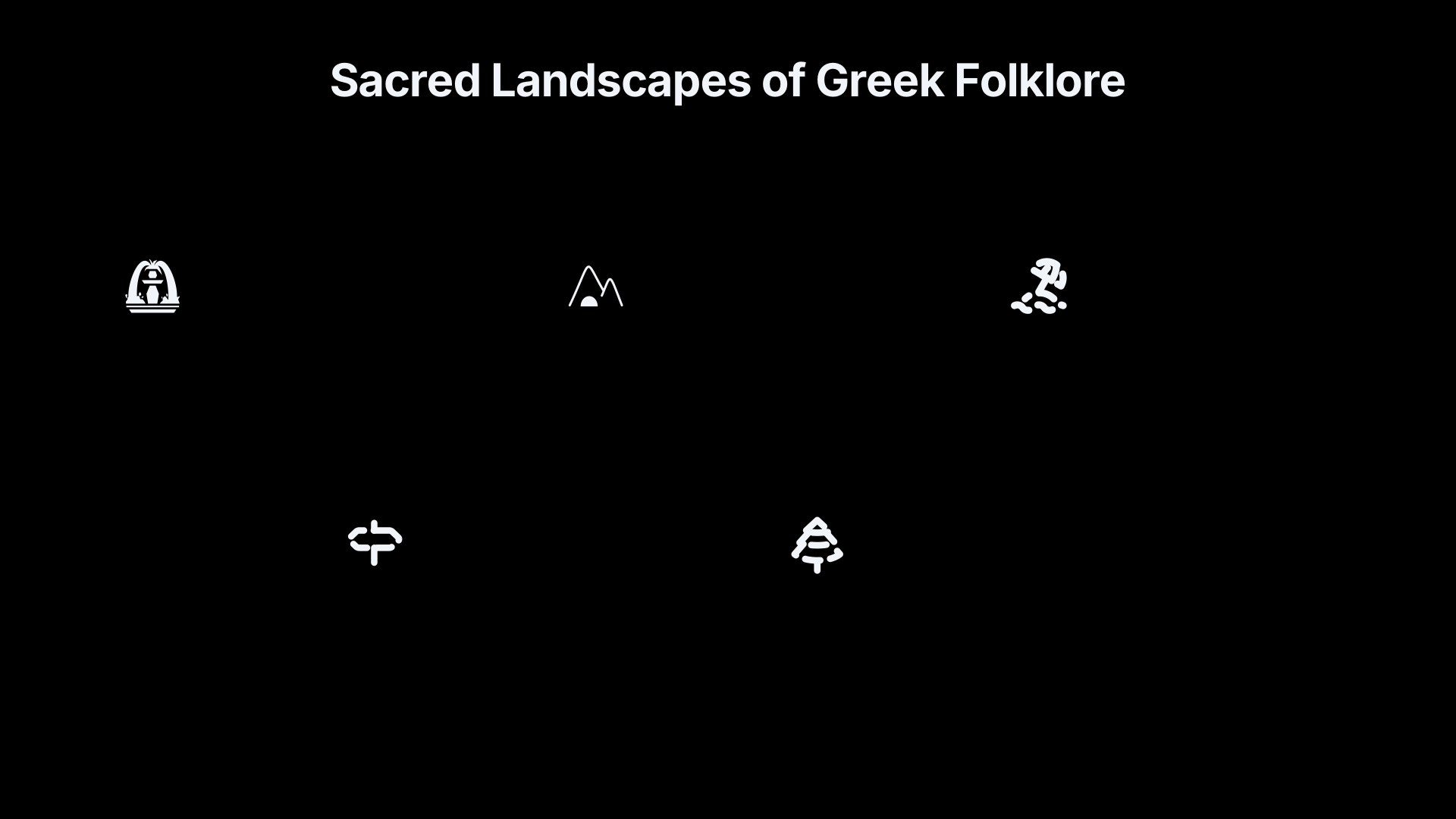
Later Greek folklore preserved the idea that specific locations possess unseen inhabitants. By the modern period, stories of fairy-like female beings were commonly attached to:
- Remote springs and wells.
- Mountain caves.
- Forest clearings.
- Isolated beaches and rocky shores.
- Crossroads and lonely paths.
- High mountain pastures.[wikipedia.org]WikipediaAugust 28, 2001 — In modern Greek folklore, the term "nereid" (νεράιδα, neráida) has come to be used for all nymphs, fairies, or mermaid…
The connection with water remained especially strong. Folk traditions frequently place these beings near fountains, rivers and springs, echoing the ancient association between nymphs and fresh water. Yet unlike the classical naiads of literature, the figures of village folklore are often less predictable and more dangerous.[Wikipedia]WikipediaAugust 28, 2001 — In modern Greek folklore, the term "nereid" (νεράιδα, neráida) has come to be used for all nymphs, fairies, or mermaid…
Caves occupy a particularly important place in Greek imagination. In ancient myth they could be homes of nymphs, while in later folklore they often became entrances to hidden realms where supernatural women danced, sang or guarded treasures. A cave might appear beautiful by day but become threatening after sunset, reinforcing the idea that certain landscapes demanded caution and respect.[Internet Sacred Text Archive]sacred-texts.comInternet Sacred Text ArchiveFairy Tales of Modern Greece: ForewordJuly 5, 1930 — The Greek's conception of fairies springs from his worsh…
Crossroads carried a different kind of symbolism. They were transitional spaces, neither one place nor another. In many European folk traditions such locations attracted supernatural stories, and Greece was no exception. A traveller who lingered too long at a deserted crossroads risked encountering forces that belonged outside ordinary village life.[Academia]academia.eduAcademia(PDF) Greece (and Italy): The Nereids, 'Those from Outside'Review on beliefs related to nymphs and Nereids in the post-Byzantine…
Beauty, Danger and Encounters with Humans
One reason these stories endured is that the fairies are rarely presented as simple monsters. They are usually described as extraordinarily beautiful young women. They sing, dance and appear in groups, especially during moonlit nights or around water. Their attractiveness is central to the folklore.[Internet Sacred Text Archive]sacred-texts.comInternet Sacred Text ArchiveFairy Tales of Modern Greece: ForewordJuly 5, 1930 — The Greek's conception of fairies springs from his worsh…
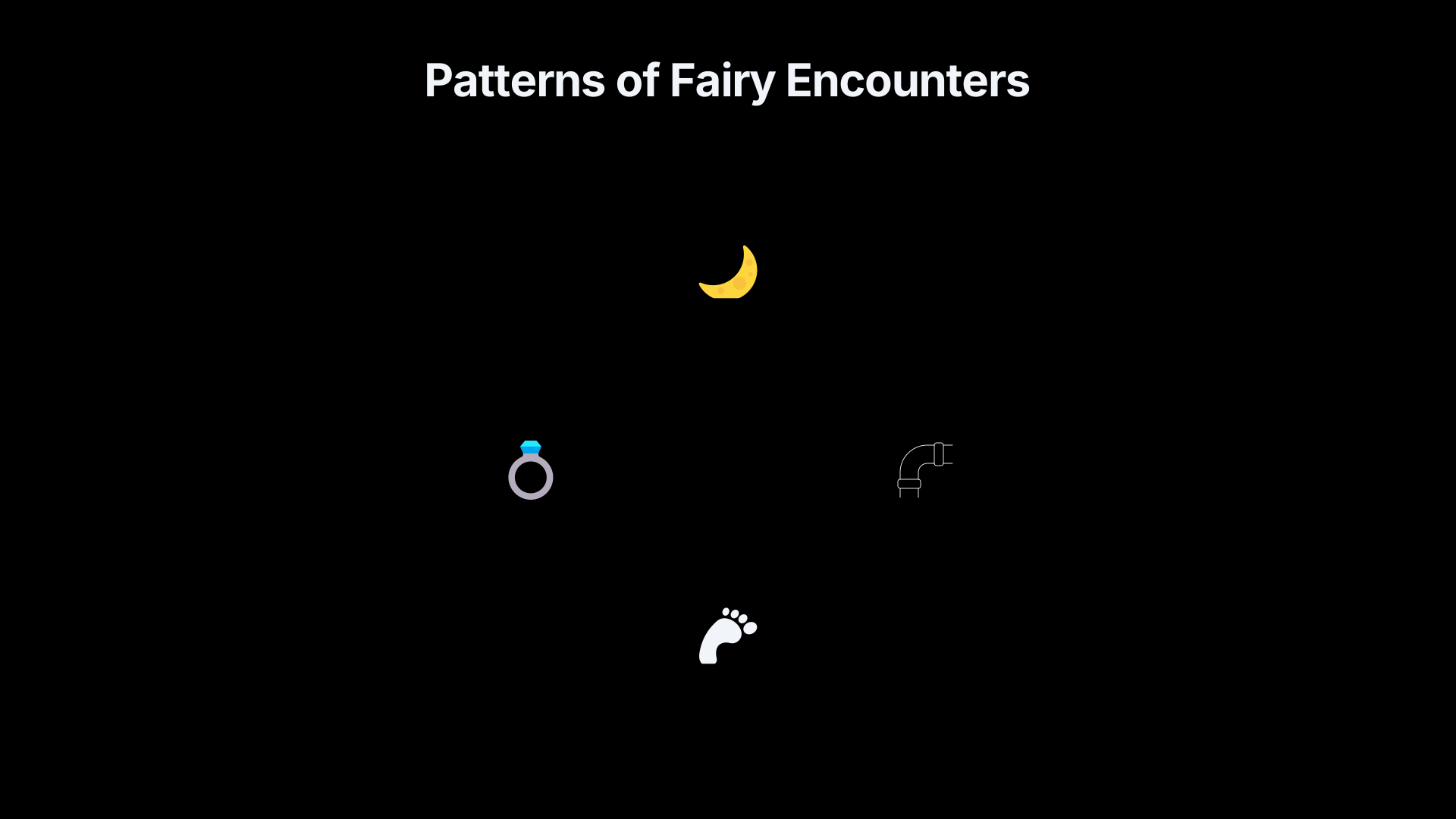
Yet beauty itself becomes a warning sign. Many stories follow a familiar pattern:
- A traveller encounters supernatural women in a lonely place.
- He is enchanted by their appearance or music.
- He follows them, approaches them, or watches them secretly.
- The encounter brings misfortune, illness, madness, disappearance or a lasting supernatural mark.
The exact details vary from region to region, but the underlying lesson is consistent. Wild places are alluring because they are beautiful, yet that beauty conceals danger.[CORE]core.ac.ukCOREMarrying a Fairy and a Nereid: South Slavic-Greek FolkGreek contexts. Both fairies and nereids are described as dangerous beings, which can be interpreted as a man's fear of beautiful women a…
In some tales a man marries a fairy woman under special conditions, creating a supernatural-wife story similar to traditions found elsewhere in the Balkans and Europe. Such marriages rarely end happily. A broken promise, a forbidden question or an act of curiosity usually causes the fairy bride to vanish back into the non-human world.[Wikipedia]WikipediaAugust 28, 2001 — In modern Greek folklore, the term "nereid" (νεράιδα, neráida) has come to be used for all nymphs, fairies, or mermaid…
Folklore scholars have often noted that these stories express anxieties about isolation, desire and the unpredictability of nature. A mountain spring may provide life-giving water, but it can also be a place where someone falls, becomes lost or disappears. The supernatural narrative gives emotional and cultural shape to those risks.[Academia]academia.eduAcademia(PDF) Greece (and Italy): The Nereids, 'Those from Outside'Review on beliefs related to nymphs and Nereids in the post-Byzantine…
Ancient Echoes and Later Village Belief
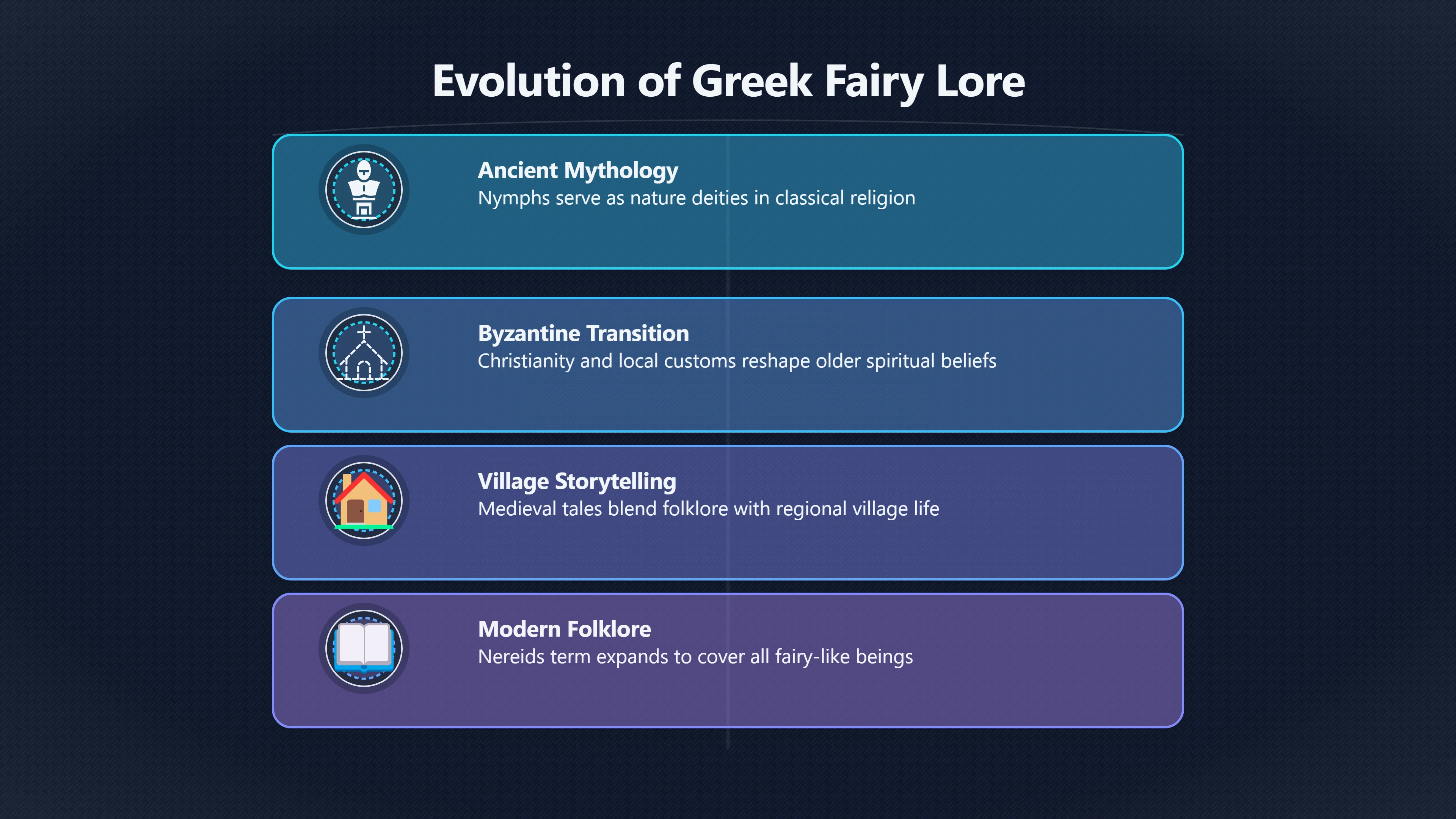
The strongest argument for continuity is linguistic. The modern Greek word commonly used for fairy-like beings derives from the ancient name of the Nereids, the sea nymphs. Over time the meaning expanded. What once referred to a specific class of mythological beings came to describe a much broader category of fairies, nymphs and even mermaid-like figures.[wikipedia.org]WikipediaAugust 28, 2001 — In modern Greek folklore, the term "nereid" (νεράιδα, neráida) has come to be used for all nymphs, fairies, or mermaid…
However, modern folklore figures are not simply ancient nymphs preserved unchanged. Between classical antiquity and modern village tradition lay centuries of social and religious transformation. Byzantine Christianity, local customs, medieval storytelling and regional beliefs all reshaped older traditions. As a result, Greek fairies inherited some characteristics of ancient nymphs while acquiring new roles and meanings.[Academia]academia.eduAcademia(PDF) Greece (and Italy): The Nereids, 'Those from Outside'Review on beliefs related to nymphs and Nereids in the post-Byzantine…
This distinction matters because nineteenth- and early twentieth-century scholars often searched for direct survivals of ancient religion in Greek folklore. Modern researchers tend to be more cautious. Similarities are real, but they do not necessarily prove an unbroken line of belief stretching back to classical times. Instead, Greek fairy lore is better understood as a long process of adaptation in which older images of landscape spirits merged with later folk traditions.[Academia]academia.eduAcademia(PDF) Greece (and Italy): The Nereids, 'Those from Outside'Review on beliefs related to nymphs and Nereids in the post-Byzantine…
The result is a uniquely Greek blend of continuity and change. A fairy dancing beside a mountain spring may remind modern readers of an ancient nymph, yet the story surrounding her often belongs to a much later village world.
Why Dangerous Wild Places Matter
Greek fairy lore is ultimately less about supernatural beings than about the relationship between people and landscape. Mountains, caves, springs and crossroads were essential parts of everyday life, but they also existed beyond the safety of the village. Folklore transformed these locations into places of invisible power.[Internet Sacred Text Archive]sacred-texts.comInternet Sacred Text ArchiveFairy Tales of Modern Greece: ForewordJuly 5, 1930 — The Greek's conception of fairies springs from his worsh…
The stories encouraged respect for natural spaces while explaining experiences that seemed strange or unsettling. A sudden illness after wandering alone, unusual sounds near a cave, the feeling of disorientation in the mountains or the hypnotic beauty of a remote spring could all be interpreted through the language of fairy encounters.[Academia]academia.eduAcademia(PDF) Greece (and Italy): The Nereids, 'Those from Outside'Review on beliefs related to nymphs and Nereids in the post-Byzantine…
That is why the question “Are Greek fairies really ancient nymphs?” has no simple answer. The fairies of Greek folklore carry unmistakable echoes of the nymphs who once inhabited classical myth, but they belong equally to later centuries of village storytelling. They stand at the meeting point of antiquity, folk belief and landscape, turning Greece’s most beautiful wild places into locations where wonder and danger exist side by side.[Wikipedia]WikipediaAugust 28, 2001 — In modern Greek folklore, the term "nereid" (νεράιδα, neráida) has come to be used for all nymphs, fairies, or mermaid…
Amazon book picks
Further Reading
Books and field guides related to Are Greek Fairies Really Ancient Nymphs?. Use these as the next step if you want deeper reading beyond the article.
eBay marketplace picks
Marketplace Samples
Live-tested eBay searches with available results related to this page.
Endnotes
1.
Source: Wikipedia
Link:https://en.wikipedia.org/wiki/Nereids
Source snippet
August 28, 2001 — In modern Greek folklore, the term "nereid" (νεράιδα, neráida) has come to be used for all nymphs, fairies, or mermaid...
Published: August 28, 2001
2.
Source: Wikipedia
Title: Modern Greek folklore
Link:https://en.wikipedia.org/wiki/Modern_Greek_folklore
3.
Source: academia.edu
Link:https://www.academia.edu/122597150/Greece_and_Italy_The_Nereids_Those_from_Outside_
Source snippet
Academia(PDF) Greece (and Italy): The Nereids, 'Those from Outside'Review on beliefs related to nymphs and Nereids in the post-Byzantine...
4.
Source: core.ac.uk
Title: COREMarrying a Fairy and a Nereid: South Slavic-Greek Folk
Link:https://core.ac.uk/works/78828602/
Source snippet
Greek contexts. Both fairies and nereids are described as dangerous beings, which can be interpreted as a man's fear of beautiful women a...
5.
Source: Wikipedia
Link:https://en.wikipedia.org/wiki/Nymph
Source snippet
NymphA nymph is a minor female nature deity in ancient Greek folklore. Distinct from other Greek goddesses, nymphs are generally regar...
6.
Source: sacred-texts.com
Link:https://sacred-texts.com/neu/ftmg/ftmg03.htm
Source snippet
Internet Sacred Text ArchiveFairy Tales of Modern Greece: ForewordJuly 5, 1930 — The Greek's conception of fairies springs from his worsh...
Published: July 5, 1930
7.
Source: mythoi.org
Title: Ελληνική ΜυθολογίαNymphs in Greek Mythology
Link:https://mythoi.org/en/nymphes-elliniki-mythologia/
Source snippet
January 12, 2026 — 12 Jan 2026 — The Nymphs are female spirits of nature, associated with mountains, forests, springs, rivers, trees and...
Published: January 12, 2026
8.
Source: mythus.fandom.com
Title: Myth and Folklore Nereid
Link:https://mythus.fandom.com/wiki/Nereid
Source snippet
Myth and Folklore Wiki - FandomIn modern Greek folklore, the term "nereid" (νεράιδα, neráida) has come to be used for all nymphs, fairies...
9.
Source: essentialhistoryandmythology.wordpress.com
Link:https://essentialhistoryandmythology.wordpress.com/2025/05/02/nereids/
Source snippet
Sea Nymphs of Greek Mythology2 May 2025 — Naiads (Freshwater Nymphs): Naiads are nymphs of rivers, springs, lakes and fountains. Whereas...
Published: May 2025
Additional References
10.
Source: greekmythologytours.com
Link:https://greekmythologytours.com/blog/greek-mythology/nymphs
Source snippet
The stories behind the NymphsIn Greek folklore, Nymphs and Nereids are known as 'Neraides', including in this term the fairies and the me...
11.
Source: chemeurope.com
Link:https://www.chemeurope.com/en/encyclopedia/Nymph.html
Source snippet
NymphNymphs live in mountains and groves, by springs and rivers, and in valleys and cool grottoes. They are frequently associated with th...
12.
Source: theoi.com
Link:https://www.theoi.com/greek-mythology/nymphs.html
Source snippet
NymphsA comprehensive guide to the Nymphs of Greek mythology including Naiads, Dryads, Nereids, Oceanids, Hesperides, Aurae, Nephelae, an...
13.
Source: facebook.com
Link:https://www.facebook.com/groups/345699203421480/posts/368010057857061/
Source snippet
Nymphs in ancient Greek folklore as nature deitiesDifferent from Greek goddesses, nymphs are generally regarded as personifications of na...
14.
Source: ronelthemythmaker.com
Link:https://www.ronelthemythmaker.com/nymphs-of-all-kinds-folklore-atozchallenge/
Source snippet
Nymphs of All Kinds #Folklore #AtoZChallengeIn ancient Greek lore, the nymphs were lesser deities or nature spirits, whose dominion or re...
15.
Source: facebook.com
Link:https://www.facebook.com/janineralbrecht/posts/im-a-greek-fairy-in-my-costume-according-to-various-legends-nymphs-were-very-bea/191903896681575/
Source snippet
are supernatural beings. Nereids (sea nymphs), "mountain") were nymphs of mountains and...
16.
Source: reddit.com
Link:https://www.reddit.com/r/GreekMythology/comments/1q4lekj/my_current_understanding_of_nymphs_and_a_few/
Source snippet
s are specifically followers/worshippers of Dionysus and who hangs...
17.
Source: ronelthemythmaker.com
Title: surreal sea nymphs folklore
Link:https://www.ronelthemythmaker.com/surreal-sea-nymphs-folklore/
Source snippet
Surreal Sea Nymphs27 May 2020 — The Nereids of Greek mythology are deeply associated with water, especially sea water. They are the perso...
Published: May 2020
18.
Source: youtube.com
Link:https://www.youtube.com/watch?v=Ruks7UGPl6w
Source snippet
mischievous however in some parts of greece they were often feared...
19.
Source: youtube.com
Title: Stories to Learn Greek #2 “The Fairy Fountain”| Greek Language Story Narration
Link:https://www.youtube.com/watch?v=FbwWjF_vuc0
Source snippet
Greek Nymphs Were More Dangerous Than Gods...
Topic Tree