Where Iraq's Oldest Stories Still Live
Iraq’s folklore is unusually deep because it sits on several layers at once: ancient Mesopotamian myth from the land between the Tigris and Euphrates, Islamic and Arabic storytelling, minority religious traditions, Kurdish and northern Iraqi oral culture, shrine-city ritual, marshland legend, and modern retellings shaped by exile, war, archaeology,...
Page outline Jump by section
Introduction
The strongest centre of gravity is place. Iraq’s legendary imagination is tied to rivers, ruins, deserts, shrines, marshes and cities: Baghdad as a city of storytellers, southern Iraq as the landscape of Sumer and the marshes, Karbala and Najaf as sacred pilgrimage centres, northern Iraq as home to Yazidi and Neo-Aramaic traditions, and the Tigris and Euphrates as both practical waterways and mythic lifelines.[unesco.org]whc.unesco.orgOpen source on unesco.org.
Why Iraqi folklore feels older than most national traditions
For many countries, “ancient myth” and “folk tale” are separated by a long documentary gap. Iraq is different because the region of ancient Mesopotamia left one of the world’s richest early written records. The Electronic Text Corpus of Sumerian Literature, based at the University of Oxford, makes accessible more than 400 Sumerian literary works composed in ancient Mesopotamia during the late third and early second millennia BCE. These texts are not modern village folktales, but they show how early Iraq’s story culture was already using gods, heroes, monsters, omens, journeys, laments and cosmic explanations.[ETCSL]etcsl.orinst.ox.ac.ukOpen source on ox.ac.uk.
The best-known example is the Gilgamesh tradition. Gilgamesh was associated with Uruk, in southern Iraq, and the surviving Sumerian and Akkadian stories made him into a heroic king who travels, fights, grieves, seeks immortality and confronts human limits. The Sumerian poem sometimes called “Gilgamesh and Huwawa” sends the hero towards the cedar mountains, while the later Akkadian epic includes the famous flood narrative. These stories matter for Iraqi folklore because they show several patterns that later oral tradition also loves: the restless hero, the dangerous journey, the supernatural opponent, and the wisdom gained too late.[ETCSL]etcsl.orinst.ox.ac.ukOpen source on ox.ac.uk.
That does not mean every Iraqi folktale is a direct survival from Sumer. Folklore does not pass through 4,000 years like a sealed jar. Stories are retold, borrowed, Islamised, localised, forgotten and reinvented. Still, scholars have taken modern Iraqi folktales seriously as evidence for long-lived narrative habits in the region. The 2007 edition of Lady E. S. Drower’s collected Iraqi tales, based on material gathered in the early twentieth century, was described by its publisher as preserving monsters, heroes, maidens and fairies from an oral tradition that had already largely disappeared in its older form.[gorgiaspress.com]gorgiaspress.comdrowers folk tales of iraqdrowers folk tales of iraq
This is why Iraq is such a powerful folklore case: it is both a country of written antiquity and a country of oral storytelling. The ancient tablets do not simply “prove” the modern tales, and the modern tales do not simply repeat the tablets. They sit in conversation with one another across time, giving Iraq a rare double archive: clay, manuscript, shrine, song, tale and living practice.[ETCSL]etcsl.orinst.ox.ac.ukOpen source on ox.ac.uk.
Baghdad, the Nights and the art of the told story
For many readers outside Iraq, Baghdad enters folklore through the world of The Thousand and One Nights. The Nights are not “Iraqi folklore” in a narrow national sense: they are a layered Arabic collection with Indian, Persian, Arabic, Egyptian and other elements. But Baghdad is central to the collection’s imaginative geography, and medieval Baghdad was an important setting for tales of caliphs, merchants, thieves, clever women, jinn, hidden treasure and sudden reversals of fortune. The Library of Congress notes that the tales accrued over centuries and drew on cultural traditions from the Middle East and regions connected through trade, travel, invasion and war.[The Library of Congress]blogs.loc.gova thousand and one nights arabian story telling in world literaturea thousand and one nights arabian story telling in world literature
One reason the Nights belong on an Iraq folklore page is that they preserve a style of storytelling as much as a set of plots. Frame stories, nested tales, cliff-hangers, riddling tests, disguises, moral reversals and magical intrusions all belong to a performance tradition as well as a literary one. A Muslim Journeys timeline notes that Ibn al-Nadim, writing in tenth-century Baghdad, mentioned a Persian book of stories in which a Scheherazade-like figure tells stories over many nights to save her life.[Bridging Cultures]bridgingcultures-muslimjourneys.orgOpen source on bridgingcultures-muslimjourneys.org.
Baghdad also had more everyday storytelling settings. A study of oral roots in the Nights describes popular coffee houses in Baghdad hiring storytellers in the early twentieth century to read or perform tales, including humorous ones. That detail matters because folklore is not only the “content” of a tale; it is also the room, the voice, the audience, the interruption, the joke, the social memory and the pleasure of hearing an old story made new.[Core]core.ac.ukCore Roots of Oral Tradition in The Arabian NightsCore Roots of Oral Tradition in The Arabian Nights
Modern readers should therefore avoid two mistakes. The first is to treat the Nights as a simple national epic of Iraq. The second is to exclude them entirely because they are cross-cultural. Their better role is as a bridge: Baghdad helped give the wider Arabic and Islamic story-world one of its most famous literary stages, while Iraqi oral culture continued to produce its own local tales outside the grand printed canon.[The Library of Congress]blogs.loc.gova thousand and one nights arabian story telling in world literaturea thousand and one nights arabian story telling in world literature

Monsters, spirits and protective fear
Iraqi supernatural tradition includes several beings familiar across the Arabic-speaking world, but local collections and landscapes give them Iraqi texture. Jinn appear as invisible or shape-shifting beings; ghouls haunt desolate places and graves; ogres and devouring figures enter folktales as threats to children, travellers and heroines; and female demons or spirit-wives appear in older tale collections. In Drower’s Iraqi material, for example, the female demon sometimes called the qarina is described as attaching herself to a man and drawing his affection away from his human wife or bride.[PagePlace]api.pageplace.deOpen source on pageplace.de.
The ghoul is a good example of a creature that is both local and regional. It belongs to Arabic folklore more broadly, but writers on the creature often connect it to older Mesopotamian underworld beings and to the fear of wilderness, graves and social danger. In Iraqi folktales, such figures often do the work that wolves, witches or trolls perform in European tales: they mark the edge of safe society, test the cleverness of the hero, and make the ordinary road feel morally dangerous.[Medievalists.net]medievalists.netThe Mythical Ghoul in Arabic CultureThe Mythical Ghoul in Arabic Culture
The jinn are more complicated because they are not just “monsters”. In Islamic cultures, jinn can be frightening, neutral, seductive, pious, mischievous or dangerous, depending on the story. In folk narrative they may marry humans, guard treasure, possess places, grant help, punish disrespect or reveal the hidden world beside the visible one. This makes them especially useful in Iraqi storytelling, where ruined cities, riversides, graveyards, deserts and empty houses can all become thresholds between worlds.[Wikipedia]WikipediaOpen source on wikipedia.org.
Ancient Mesopotamian protective magic adds another layer. Museum collections show that Iraq’s ancient inhabitants did not imagine the supernatural only as something to fear; they also made images and amulets to manage fear. The Metropolitan Museum of Art describes Pazuzu as the king of evil wind demons, associated with cold winds from the Zagros region that could bring illness, yet also used to protect against the dangerous demon Lamashtu. The British Museum similarly describes a Pazuzu head probably suspended near a woman in labour for protection.[The Metropolitan Museum of Art]metmuseum.orgThe Metropolitan Museum of Art Pendant with the head of PazuzuThe Metropolitan Museum of Art Pendant with the head of Pazuzu
That protective logic is one of Iraq’s most enduring folkloric patterns: a dangerous power can sometimes be turned against a worse danger. Pazuzu is not a cosy household guardian, but his image could be used defensively. Later amulets, prayers, shrine visits and protective customs work in different religious languages, yet often answer the same human questions: how do you protect a baby, a mother, a traveller, a house, a harvest or a soul when ordinary control feels too weak?[The Metropolitan Museum of Art]metmuseum.orgOpen source on metmuseum.org.
The marshes: water, reeds and shape-shifting stories
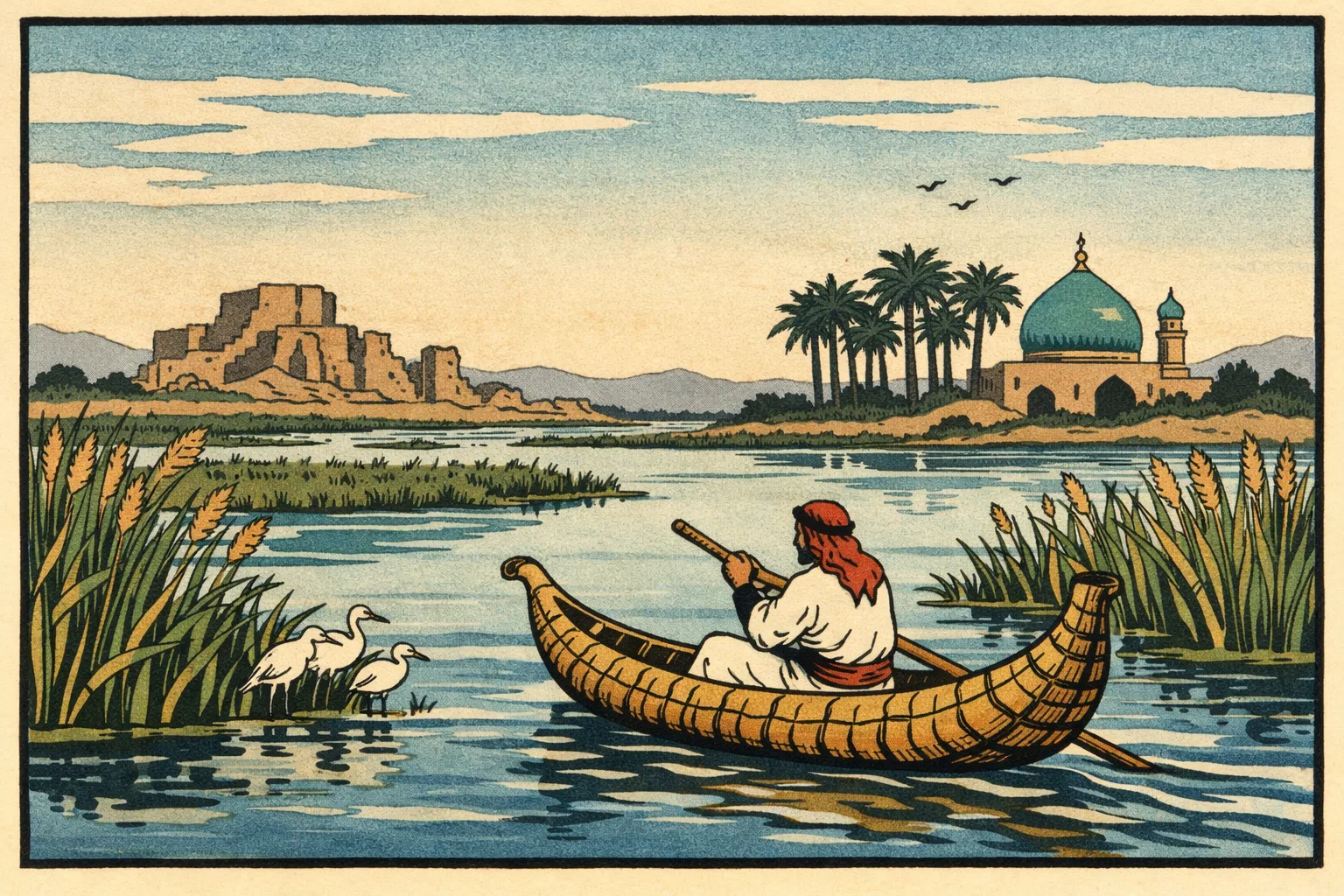
Southern Iraq’s marshes are among the country’s most vivid folklore landscapes. UNESCO’s World Heritage listing for the Ahwar of Southern Iraq describes a mixed site made up of three archaeological cities and four wetland marsh areas, linking Uruk, Ur and Eridu with one of the world’s largest inland delta systems in an extremely hot and arid environment. That combination of ancient city, water maze, reed architecture, wildlife and threatened livelihood gives the marshes a strong mythic charge.[UNESCO World Heritage Centre]whc.unesco.orgOpen source on unesco.org.
The marshes are often popularly connected with the Garden of Eden, though that identification is a later interpretive tradition rather than a simple archaeological fact. More securely, they are a living cultural landscape where Marsh Arab communities developed distinctive houses, boats, buffalo economies, hospitality customs and oral stories shaped by water. UNESCO’s 2023 listing of the traditional craft skills and arts of building the reed guesthouse emphasises informal transmission through hands-on practice and participation, which is exactly how much folklore survives: by doing, watching and remembering, not by reading a manual.[UNESCO Intangible Cultural Heritage]ich.unesco.orgOpen source on unesco.org.
One modern example of marsh folklore is the shape-shifting Tantal. Al Jazeera’s 2023 feature on Iraqi spirit tales describes the Tantal as a marshland being that can take the form of a man, animal or object, and as a trickster associated with mischief. The article is journalistic rather than a full scholarly collection, but it usefully captures how regional beings continue to be narrated in public culture today.[Al Jazeera]aljazeera.comAl Jazeera Spooky Arab tales for Halloween: Iraq's shape-shiftingAl Jazeera Spooky Arab tales for Halloween: Iraq's shape-shifting
The marshes also show how folklore can be endangered by environmental change. Drought, drainage, pollution, oil extraction and upstream water pressures do not merely damage “nature”; they threaten the settings in which stories, crafts, routes, livelihoods and ritual memories make sense. Reuters reported in May 2026 that water had returned to parts of the marshes after years of severe drought, allowing buffalo herders and fishermen to come back, while also noting the longer history of marsh drainage in the 1990s and partial reflooding after 2003.[Reuters]reuters.comIraq's historic marshes revive as water returns after years of droughtThis revitalization is crucial for the Marsh Arabs, whose livelihoods are deeply connected to the marsh ecosystem. Biodiversity is beginn…
This makes the marshes one of Iraq’s clearest examples of folklore as lived ecology. A reed house, a buffalo, a boat route, a tale of a shape-shifter and a memory of ancient cities are not separate heritage items. They belong to one watery world, and when the water disappears, the stories lose part of their stage.[The United Nations in Iraq]iraq.un.org308406 mesopotamian marshes world heritage brink308406 mesopotamian marshes world heritage brink
Sacred rivers and minority traditions
Iraq’s rivers are not only backdrops for myth. For the Mandaeans, an ancient religious minority historically rooted in southern Iraq and Iran, flowing water is central to ritual life. Encyclopaedia Iranica describes frequent ritual use of running water for baptisms and purifications as a major characteristic of Mandaean religion, along with a rich literature in the Mandaic language and script.[Iranica Online]iranicaonline.orgOpen source on iranicaonline.org.
This belongs in a folklore guide because folk religion is one of the places where story, ritual and identity meet. Mandaean tradition is not simply a set of “legends”; it is a living religious system in which water, purity, priesthood, scripture, cosmology and community memory are linked. Modern reporting has stressed that water scarcity and pollution now threaten these practices. SOAS noted in 2025 that Mandaean ceremonies take place along riverbanks and involve baptisms not only of people but also of ritual objects and scriptures; The Guardian reported in 2025 that major life events for Mandaeans require ritual purification in flowing river water.[SOAS]soas.ac.ukfaith crisis water ritual and resilience among iraqs mandaeansfaith crisis water ritual and resilience among iraqs mandaeans
Northern Iraq adds another major sacred tradition: Yazidism. Yazidi belief is not reducible to folklore, but its myths, symbols and pilgrimage geography are crucial to Iraq’s legendary culture. Lalish, in northern Iraq, is the holiest Yazidi sanctuary, and Yazidi tradition gives the Peacock Angel a central place in cosmic and devotional imagination. Yazda, a Yazidi cultural organisation, describes the sacred peacock standard and the tour of Yazidi villages as a tradition combining religious and social aspects.[yazda.org]yazda.orgOpen source on yazda.org.
Iraq’s folklore is therefore not only Arabic and Islamic, even though those are central. It also includes Mandaean, Yazidi, Kurdish, Neo-Aramaic, Jewish and other minority memories. Some are well documented; others are fragile because of displacement, violence and language loss. The more precise view is not “one Iraqi folklore”, but a national landscape of overlapping traditions, each with its own sacred places, ritual specialists, oral genres and historical wounds.[British Museum]britishmuseum.orgOpen source on britishmuseum.org.
Shrines, pilgrimage and public ritual
Karbala and Najaf are central to Iraq’s sacred geography. Their importance is religious before it is folkloric, but pilgrimage always generates story: miracle accounts, family vows, mourning poetry, hospitality customs, route memories, devotional objects and tales of endurance. UNESCO’s listing for the provision of services and hospitality during the Arba’in visitation describes a social practice across central and southern Iraq in which processions of visitors and pilgrims converge on Karbala.[UNESCO Intangible Cultural Heritage]ich.unesco.orgOpen source on unesco.org.
Arba’in commemorates the fortieth day after the martyrdom of Husayn ibn Ali, the Prophet Muhammad’s grandson, at Karbala in 680 CE. For many pilgrims, the walk is not only a journey to a shrine but a re-enactment of loyalty, grief, sacrifice and moral witness. Reuters described pilgrims in 2025 walking hundreds of kilometres through Iraq’s desert heat to reach Karbala, relying on hospitality along the route and interpreting hardship as part of devotion.[Reuters]reuters.comFor Shi'ite pilgrims in Iraq's deserts, suffering strengthens faithThe pilgrimage, considered the world’s largest annual religious gathering, underscores the historical Shi’ite-Sunni divide: Shi’ites beli…
The hospitality itself is a major cultural tradition. Food, drink, shelter, medical help and rest are offered freely by volunteers and families along the roads. UNESCO’s recognition is important because it focuses not only on the shrine destination but on the social practice of service: the ordinary people who feed, wash, guide and host strangers.[UNESCO Intangible Cultural Heritage]ich.unesco.orgOpen source on unesco.org.
For a folklore reader, the key point is that shrine culture keeps oral memory public. Laments, sermons, family stories, banners, processions and repeated routes turn history into performed remembrance. These rituals are not “myths” in the sense of fictional tales; they are sacred narratives lived through the body and the crowd.[UNESCO Intangible Cultural Heritage]ich.unesco.orgOpen source on unesco.org.
Music, craft and seasonal customs as living folklore
Not all folklore is a monster or a legend. Iraq’s living heritage also survives in music, craft, games, clothing, hospitality and seasonal practice. UNESCO identifies the Iraqi Maqam as Iraq’s predominant classical music tradition, with a large repertory of songs and traditional instruments, and notes that it carries information on the musical history of the region and wider Arab influences.[UNESCO Intangible Cultural Heritage]ich.unesco.orgOpen source on unesco.org.
The Maqam matters because it shows how oral and performed heritage can be highly refined. It is not a casual folk song in the narrow sense, but it belongs to the same larger world of memory, voice and transmission. A performance can carry poetry, urban identity, religious feeling, humour, dialect and historical style all at once. For readers interested in Iraqi folklore, Maqam is a reminder that “tradition” includes sound as well as story.[UNESCO Intangible Cultural Heritage]ich.unesco.orgOpen source on unesco.org.
UNESCO’s Iraq page also lists other intangible heritage elements, including oud-related practices, palm-fibre crafts, henna rituals, Al-Naoor waterwheel craft, and Al-Mudhif reed-house building. These practices are not all supernatural, but they form the cultural ground from which supernatural stories grow: weddings, river work, seasonal gatherings, guest houses, craft workshops and family rituals are where tales are repeated and adapted.[UNESCO Intangible Cultural Heritage]ich.unesco.orgOpen source on unesco.org.
Recent additions reported by Xinhua in 2025 included traditions such as the Ramadan guessing game Muhaibis, the ceremonial bridal procession Zaffa, the men’s outer garment Bisht and Arabic Kohl as a social practice. Such traditions help correct a common misconception: folklore is not only ancient survivals. It is also the patterned play, dress, adornment and public celebration by which communities recognise themselves.[Xinhua News]english.news.cnOpen source on news.cn.
How old are Iraq’s folk tales, really?
The honest answer is: some Iraqi story motifs are ancient, some are medieval, some are early modern, some were collected in the twentieth century, and some are modern retellings of older-looking material. A folktale may contain a very old motif while the version we know was recorded recently. That is why good folklore reading asks two separate questions: how old is the motif, and how old is the evidence for this version?[Utlib OJS]ojs.utlib.eeOpen source on utlib.ee.
Drower’s Folk-Tales of Iraq is one of the key English-language collections for older Iraqi oral material. The original book appeared in 1931, and the Gorgias Press edition published in 2007 included previously unpublished material from her archive. Drower was resident in Baghdad between 1928 and 1935 and was also a major scholar of Mandaean and Yazidi traditions, though modern readers should still remember that colonial-era collectors worked through their own assumptions, translations and social access.[google.com]books.google.comOpen source on google.com.
Inea Bushnaq’s Arab Folktales also includes Iraqi tales alongside stories from other Arab regions. Archive listings include Iraqi examples such as “The Good Neighbours”, “The Jewel in the Sand”, “The Girl Who Spoke Jasmines and Lilies”, “A Tale within a Tale”, “The Maiden of the Tree of Raranj and Taranj” and “What God Wrote Cannot Be Unwritten”. These titles show Iraqi tales participating in wider Arab and international tale types while still carrying local names, settings and idioms.[Internet Archive]archive.orgOpen source on archive.org.
The practical lesson is to avoid both romantic extremes. It is too simple to say that an Iraqi folktale is “really Sumerian” just because it has a monster, a magical bride or a journey to the underworld. It is also too cautious to ignore Iraq’s unusually long continuity of place, story forms and supernatural imagination. The best reading holds both truths together: continuity is real, but it is rarely straight.[Academia]academia.eduOpen source on academia.edu.
Modern Iraq: archaeology, exile and internet-era retelling
Modern Iraqi folklore is shaped by disruption as well as inheritance. Wars, displacement, language loss, environmental crisis and the destruction of archives have scattered communities that once passed stories face to face. Mandaeans, for example, now maintain traditions in diaspora communities in the United States, Australia, Sweden and elsewhere; The Guardian reported in 2024 on Iraqi Mandaeans in Michigan preserving baptism, language learning and communal holidays after being uprooted from the Middle East.[The Guardian]theguardian.comOpen source on theguardian.com.
At the same time, digital archives have made ancient and modern materials more accessible than ever. ETCSL, the Cuneiform Digital Library Initiative and museum databases allow general readers to see translations, object records and images connected with ancient Mesopotamian myth and magic. This changes how folklore circulates: a demon like Pazuzu can move from Assyrian amulet to museum label to horror film reference to online meme, often losing and gaining meanings along the way.[ox.ac.uk]etcsl.orinst.ox.ac.ukOpen source on ox.ac.uk.
Tourism and heritage writing also reshape folklore. The marshes may be marketed through Edenic language; Baghdad through the Nights; Babylon through imperial ruins; Karbala through pilgrimage; Lalish through sacred minority heritage. These framings can help outsiders care, but they can also flatten living communities into picturesque symbols. A grounded Iraq folklore page should therefore ask who tells the story, who benefits from the telling, and what has been left out.[unesco.org]whc.unesco.orgOpen source on unesco.org.
Internet-era folklore adds another complication. Modern articles about Iraqi spirits, haunted ruins or marsh creatures may preserve genuine oral memories, but they may also simplify, dramatise or detach stories from their communities. The safest approach is not to reject modern retellings, but to label them honestly: a reported contemporary spirit tale is different from a collected folktale, which is different from an ancient cuneiform myth, which is different again from a living religious rite.[aljazeera.com]aljazeera.comAl Jazeera Spooky Arab tales for Halloween: Iraq's shape-shiftingAl Jazeera Spooky Arab tales for Halloween: Iraq's shape-shifting
What to remember about Iraqi folklore
Iraqi folklore is best understood as a layered cultural landscape rather than a single canon. Its deepest written layer includes Sumerian and Akkadian myth, Gilgamesh, flood stories, demons, protective magic and the sacred geography of southern Mesopotamia. Its oral and literary layers include Baghdad storytelling, the wider world of the Nights, Drower’s collected Iraqi tales, Arab folktale types, jinn, ghouls, ogres, spirit brides and tricksters. Its living ritual layers include Mandaean river rites, Yazidi sacred tradition, Arba’in hospitality, Maqam performance, reed-house building, henna, games and pilgrimage.[ox.ac.uk]etcsl.orinst.ox.ac.ukOpen source on ox.ac.uk.
The most distinctive thing about Iraq is how often folklore is tied to a real place: the marsh, the shrine, the riverbank, the ruined city, the coffee house, the desert road, the reed guesthouse, the museum tablet. That place-based quality keeps the stories from floating away into generic “Middle Eastern mythology”. Iraqi folklore is ancient, but not frozen; religious, but not only religious; local, but deeply connected to neighbouring regions; wounded by modern history, yet still being sung, walked, told, built and remembered.
Amazon book picks
Further Reading
Books and field guides related to Where Iraq's Oldest Stories Still Live. Use these as the next step if you want deeper reading beyond the article.
Myths from Mesopotamia
Covers major ancient narratives originating in the lands of modern Iraq.
The Arabian Nights
Baghdad-centered storytelling traditions are central to Iraqi folklore and literary imagination.
The Epic of Gilgamesh
Introduces the foundational story-world behind much of Iraq’s oldest legendary heritage.
A History of the Arab Peoples
Provides cultural context for the Arabic and Islamic storytelling traditions that shaped Iraqi folklore.
eBay marketplace picks
Marketplace Samples
Example marketplace items related to this page. Use the search link to explore similar finds on eBay.
Endnotes
1.
Source: gorgiaspress.com
Title: drowers folk tales of iraq
Link:https://www.gorgiaspress.com/drowers-folk-tales-of-iraq
2.
Source: ich.unesco.org
Link:https://ich.unesco.org/en/state/iraq-IQ
3.
Source: whc.unesco.org
Link:https://whc.unesco.org/en/list/1481/
4.
Source: ich.unesco.org
Link:https://ich.unesco.org/en/RL/provision-of-services-and-hospitality-during-the-arba-in-visitation-01474
5.
Source: ojs.utlib.ee
Link:https://ojs.utlib.ee/index.php/sht/article/download/23716/18037/34023
6.
Source: academia.edu
Link:https://www.academia.edu/12672791/The_Folk_Tales_of_Iraq_and_the_Literary_Traditions_of_Ancient_Mesopotamia
7.
Source: archive.org
Link:https://archive.org/details/arabfolktales00inea
8.
Source: api.pageplace.de
Link:https://api.pageplace.de/preview/DT0400.9781463211011_A38590537/preview-9781463211011_A38590537.pdf
9.
Source: medievalists.net
Title: The Mythical Ghoul in Arabic Culture
Link:https://www.medievalists.net/2015/10/the-mythical-ghoul-in-arabic-culture/
10.
Source: books.google.com
Link:https://books.google.com/books/about/Folk_tales_of_Iraq.html?id=DIwiAAAAMAAJ
11.
Source: Wikipedia
Link:https://en.wikipedia.org/wiki/Jinn
12.
Source: ich.unesco.org
Link:https://ich.unesco.org/en/RL/traditional-craft-skills-and-arts-of-al-mudhif-building-01950
13.
Source: reuters.com
Title: Iraq’s historic marshes revive as water returns after years of drought
Link:https://www.reuters.com/sustainability/climate-energy/iraqs-historic-marshes-revive-water-returns-after-years-drought-2026-05-07/
Source snippet
This revitalization is crucial for the Marsh Arabs, whose livelihoods are deeply connected to the marsh ecosystem. Biodiversity is beginn...
14.
Source: soas.ac.uk
Title: faith crisis water ritual and resilience among iraqs mandaeans
Link:https://www.soas.ac.uk/about/blogs/faith-crisis-water-ritual-and-resilience-among-iraqs-mandaeans
15.
Source: yazda.org
Link:https://www.yazda.org/culture
16.
Source: reuters.com
Title: For Shi’ite pilgrims in Iraq’s deserts, suffering strengthens faith
Link:https://www.reuters.com/world/middle-east/shiite-pilgrims-iraqs-deserts-suffering-strengthens-faith-2025-08-15/
Source snippet
The pilgrimage, considered the world’s largest annual religious gathering, underscores the historical Shi’ite-Sunni divide: Shi’ites beli...
17.
Source: ich.unesco.org
Link:https://ich.unesco.org/en/RL/iraqi-maqam-00076
18.
Source: unesco.org
Title: document 3744
Link:https://www.unesco.org/archives/multimedia/document-3744
19.
Source: ich.unesco.org
Link:https://ich.unesco.org/en/RL/traditional-craft-skills-and-arts-of-al-naoor-01694
20.
Source: cdli.earth
Link:https://cdli.earth/external-resources/5
21.
Source: Wikipedia
Title: One Thousand and One Nights
Link:https://en.wikipedia.org/wiki/One_Thousand_and_One_Nights
22.
Source: Wikipedia
Title: Mesopotamian mythology
Link:https://en.wikipedia.org/wiki/Mesopotamian_mythology
23.
Source: Wikipedia
Title: List of Intangible Cultural Heritage elements in Iraq
Link:https://en.wikipedia.org/wiki/List_of_Intangible_Cultural_Heritage_elements_in_Iraq
24.
Source: Wikipedia
Title: Ahwar of Southern Iraq
Link:https://en.wikipedia.org/wiki/Ahwar_of_Southern_Iraq
25.
Source: Wikipedia
Title: Gilgamesh flood myth
Link:https://en.wikipedia.org/wiki/Gilgamesh_flood_myth
26.
Source: Wikipedia
Link:https://en.wikipedia.org/wiki/Mandaeism
27.
Source: Wikipedia
Title: Tawûsî Melek
Link:https://en.wikipedia.org/wiki/Taw%C3%BBs%C3%AE_Melek
28.
Source: Wikipedia
Link:https://en.wikipedia.org/wiki/Mandaeans
29.
Source: Wikipedia
Title: Arba’in pilgrimage
Link:https://en.wikipedia.org/wiki/Arba%27in_pilgrimage
30.
Source: ich.unesco.org
Link:https://ich.unesco.org/doc/src/47647.pdf
31.
Source: ich.unesco.org
Link:https://ich.unesco.org/en/video/66631
32.
Source: ich.unesco.org
Link:https://ich.unesco.org/en/video/48617
33.
Source: academia.edu
Link:https://www.academia.edu/11682972/The_Arabian_Nights_in_Comparative_Folk_Narrative_Research
34.
Source: academia.edu
Link:https://www.academia.edu/79534699/The_Electronic_Text_Corpus_of_Sumerian_Literature
35.
Source: academia.edu
Link:https://www.academia.edu/33792116/MATERIALIZING_MEMORY_The_Role_of_Yezidi_Peacock_Sanjak
36.
Source: archive.org
Link:https://archive.org/details/mandaeansofiraqi0000drow
37.
Source: etcsl.orinst.ox.ac.uk
Link:https://etcsl.orinst.ox.ac.uk/index1.htm
38.
Source: iranicaonline.org
Link:https://www.iranicaonline.org/articles/mandaeans/mandaeans-ii-the-mandaean-religion/
39.
Source: etcsl.orinst.ox.ac.uk
Link:https://etcsl.orinst.ox.ac.uk/cgi-bin/etcsl.cgi?text=t.1.8.1.5.1
40.
Source: blogs.loc.gov
Title: a thousand and one nights arabian story telling in world literature
Link:https://blogs.loc.gov/international-collections/2017/10/a-thousand-and-one-nights-arabian-story-telling-in-world-literature/
41.
Source: bridgingcultures-muslimjourneys.org
Link:https://bridgingcultures-muslimjourneys.org/items/show/157
42.
Source: core.ac.uk
Title: Core Roots of Oral Tradition in The Arabian Nights
Link:https://core.ac.uk/download/pdf/62761850.pdf
43.
Source: metmuseum.org
Title: The Metropolitan Museum of Art Pendant with the head of Pazuzu
Link:https://www.metmuseum.org/art/collection/search/327485
44.
Source: britishmuseum.org
Link:https://www.britishmuseum.org/collection/object/W
45.
Source: metmuseum.org
Link:https://www.metmuseum.org/art/collection/search/326961
46.
Source: metmuseum.org
Link:https://www.metmuseum.org/exhibitions/listings/2014/assyria-to-iberia/blog/posts/pazuzu
47.
Source: aljazeera.com
Title: Al Jazeera Spooky Arab tales for Halloween: Iraq’s shape-shifting
Link:https://www.aljazeera.com/features/2023/10/31/spirit-tales-iraqs-shape-shifting-tantals
48.
Source: iraq.un.org
Title: 308406 mesopotamian marshes world heritage brink
Link:https://iraq.un.org/en/308406-mesopotamian-marshes-world-heritage-brink
49.
Source: theguardian.com
Link:https://www.theguardian.com/environment/2025/dec/16/no-water-no-life-iraqs-tigris-river-in-danger-of-disappearing
Source snippet
Water flow has also dropped significantly, with upstream dams in Turkey and Iran diverting water, decreasing levels by 33% in recent deca...
50.
Source: britishmuseum.org
Link:https://www.britishmuseum.org/collection/term/BIOG62134
51.
Source: english.news.cn
Link:https://english.news.cn/20251212/d678ae678f60428398f1f9efc1474486/c.html
52.
Source: theguardian.com
Link:https://www.theguardian.com/us-news/article/2024/jun/09/iraq-mandaean-religion-michigan
53.
Source: loc.gov
Link:https://www.loc.gov/resource/gdcwdl.wdl_16199_009/?sp=13
54.
Source: loc.gov
Title: Folklife Today
Link:https://www.loc.gov/static/managed-content/uploads/sites/22/2024/06/FolklifeToday-Podcast_Episode7_transcription.pdf
55.
Source: tile.loc.gov
Link:https://tile.loc.gov/storage-services/master/gdc/gdcebookspublic/20/22/01/37/97/2022013797/2022013797.pdf
56.
Source: hdl.loc.gov
Link:https://hdl.loc.gov/loc.mss/eadmss.ms011077.3
57.
Source: tile.loc.gov
Link:https://tile.loc.gov/storage-services/master/gdc/gdcebookspublic/20/19/05/93/52/2019059352/2019059352.pdf
58.
Source: tile.loc.gov
Link:https://tile.loc.gov/storage-services/master/gdc/gdcebookspublic/20/20/03/75/94/2020037594/2020037594.pdf
59.
Source: tile.loc.gov
Link:https://tile.loc.gov/storage-services/master/gdc/gdcebookspublic/20/19/46/78/88/2019467888/2019467888.pdf
60.
Source: loc.gov
Link:https://www.loc.gov/nls/wp-content/uploads/2016/12/6novdec.pdf
61.
Source: loc.gov
Link:https://www.loc.gov/static/portals/about/reports-and-budgets/documents/annual-reports/fy2004.pdf
62.
Source: tile.loc.gov
Link:https://tile.loc.gov/storage-services/master/gdc/gdcebookspublic/20/19/66/77/50/2019667750/2019667750.pdf
63.
Source: reutersconnect.com
Title: d GFn On Jld XRlcn Mu Y29t LDIw Mj Y6bm V3c21s X01UMUFOQURMMDAw V1ZGWU1U
Link:https://www.reutersconnect.com/item/iraqi-mandaeans-a-religious-minority-in-baghdad-perform-unique-religious-rituals-in-river/dGFnOnJldXRlcnMuY29tLDIwMjY6bmV3c21sX01UMUFOQURMMDAwV1ZGWU1U
64.
Source: aljazeera.com
Title: muslims arrive at karbala for arbaeein
Link:https://www.aljazeera.com/news/2022/9/16/muslims-arrive-at-karbala-for-arbaeein
65.
Source: searchworks.stanford.edu
Link:https://searchworks.stanford.edu/view/3356896
Additional References
66.
Source: youtube.com
Title: Ancient Mesopotamian Myths & Legends
Link:https://www.youtube.com/watch?v=O8DiVh0523c
Source snippet
This Mesopotamian Mythology Documentary provides an in-depth exploration of the ancient foundational myths and religious traditions that...
67.
Source: youtube.com
Title: The Entire Story of Mesopotamian Mythology
Link:https://www.youtube.com/watch?v=fjvjr_HX_GM
Source snippet
Ancient Mesopotamia (Iraq and Kuwait) a.k.a. the Cradle of Civilization...
68.
Source: researchgate.net
Link:https://www.researchgate.net/publication/341206260_Digital_Technology_and_Pilgrimage_Shii_Rituals_of_Arbain_in_Iraq
69.
Source: researchgate.net
Link:https://www.researchgate.net/publication/249569501_Review_Article_The_Folk-Tales_of_Iraq_and_the_Literary_Traditions_of_Ancient_Mesopotamia
70.
Source: apnews.com
Link:https://apnews.com/article/2c1f5a219f61e245cb9718c1609d19f9
71.
Source: facebook.com
Link:https://www.facebook.com/ToledoMuseum/posts/across-the-ancient-world-people-created-objects-that-told-powerful-stories-about/1389926626496913/
72.
Source: brill.com
Link:https://brill.com/edcollchap/book/9789004676572/B9789004676572_s011.pdf?srsltid=AfmBOoqjTgnVI2589AZbLWvttmC0umQPVWYJYa_9c4BH-LLTzTRCISwQ
73.
Source: amazon.de
Link:https://www.amazon.de/-/en/Arab-Folktales-INEA-Y-BUSHNAQ/dp/0394501047?tag=searcht-20
74.
Source: amazon.de
Link:https://www.amazon.de/-/en/Arab-Folktales-Inea-Bushnaq/dp/0394751795?tag=searcht-20
75.
Source: facebook.com
Link:https://www.facebook.com/BahraniHistory/posts/common-creatures-and-themes-in-arabic-mythsarabic-myths-are-rich-with-recurring-/1251192103861959/
Topic Tree
Follow this branch
Related pages 192
- Afghan Folklore
- Albanian Folklore
- Algerian Folklore
- Australian Folklore
- Azerbaijan Folklore
- +187 more in sidebar